How To Play The Bitcoin 4-Year Cycle For The Most Gains In The Bull Market

bitcoinistPubblicato 2026-05-25Pubblicato ultima volta 2026-05-25

Introduzione

A crypto analyst argues that Bitcoin's four-year cycle is still active, despite recent market debates suggesting it may be over. By examining past cycles from 2011-2014, 2015-2018, and 2019-2022, the analyst identifies a consistent pattern: a "Buy" year with declining prices, a "Hold" year of rising prices, a "Sell" year near the peak, and a final "Bear" year of market crash. The analyst applies this model to the current cycle, positioning 2023 as the Buy phase, 2024 as Hold, 2025 as Sell, and 2026 as the ongoing Bear phase, explaining Bitcoin's recent sideways and declining price action. Looking ahead, the analyst predicts the 2027-2030 cycle will follow the same pattern, with the next major accumulation opportunity potentially arriving in 2027. The conclusion is that the four-year cycle structure remains intact and is playing out as expected.

A crypto analyst is raising questions over whether the famous four-year cycle theory that has governed Bitcoin’s (BTC) market trajectory in the past is now dead. The expert has shared BTC’s price movements and investor trends to prove that the cycle theory is still very much alive and playing out in the current market cycle.

Analyst Says Bitcoin’s 4-Year Cycle Is Still Active

In an X post on May 23, Mags, a crypto analyst, has raised concerns about whether “the 4-year cycle is over” for Bitcoin. This debate has been spreading across the market for months now, with some experts, such as Strategy CEO Michael Saylor, stating that the four-year cycle has ended, while others believe it is still active.

Many crypto community members, in response to Mags’ post, also compared this cycle to past ones. They noted that the current BTC market is markedly different from previous cycles, due to the emergence of Spot ETFs, increased institutional flows, and broader adoption.

However, after examining and comparing these cycles himself, Mags noted that each one corresponds almost perfectly to the next. The analyst pointed to the 2011-2014 four-year cycle on his accompanying chart, highlighting how the market moved through distinct stages of investor activity and price movement during that period.
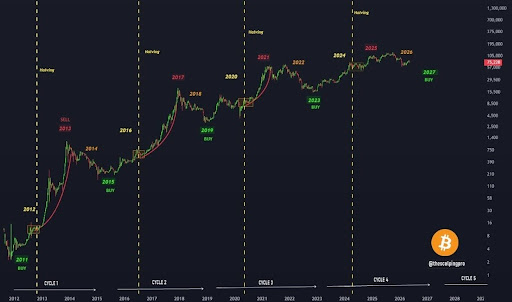
Source: Chart from Mags on X

In 2011, Bitcoin prices were declining, presenting a buying opportunity for investors. In the second year, Bitcoin began to rise, and investors simply held onto their tokens to allow them to grow. By 2013, prices had climbed to near peak levels, which the analyst noted was when most investors began selling their BTC. The fourth and final year of that cycle saw the market crash, and prices fall sharply. Mags described this as the bear market stage, marking the final stage before a fresh bull cycle began.

Notably, the same four-stage yearly trend was observed during the 2015-2018 and 2019-2022 cycles. Mags also stated that the cyclical theory is actively running in the current cycle, noting that Bitcoin has already moved through its Buy stage in 2023, Hold in 2024, and Sell phase in 2025. Based on this, Mags said that BTC is now in its bear market phase, coinciding with the cryptocurrency’s recent sideways movements and ongoing price declines.

What The Theory Says About The 2027-2030 Cycle

In his analysis, Mags went further to predict what the next cycle could look like after the current one ends. He suggested that the 2027-2030 cycle could follow a similar pattern, with Bitcoin potentially experiencing the same Buy, Hold, Sell, Bear market phases across each year.

He noted that if this structure holds, the next major accumulation window for investors and traders would arrive in 2027, a year ahead of the next anticipated bull run. Mags has pushed back against the speculation that the four-year cycle is dead, declaring that the structure “is still on track and everything is playing out perfectly.”


BTC trading at $77,435 on the 1D chart | Source: BTCUSDT on Tradingview.com

Domande pertinenti

QIs Bitcoin's 4-year cycle theory still active according to the crypto analyst Mags?

AYes, Mags states that the 4-year cycle theory is still active and is playing out perfectly in the current market cycle.

QWhat are the four distinct yearly stages described in the analyst's interpretation of the Bitcoin cycle?

AThe four distinct yearly stages are: Buy (Year 1 - price decline/buying opportunity), Hold (Year 2 - price rise/accumulation), Sell (Year 3 - near peak levels/most investors sell), and Bear Market (Year 4 - market crash/price decline).

QAccording to Mags' analysis, what phase is Bitcoin currently in within the 2023-2026 cycle?

AAccording to Mags, Bitcoin is currently in its Bear Market phase for the 2023-2026 cycle, coinciding with recent sideways movements and price declines.

QWhen does Mags predict the next major accumulation window for Bitcoin investors will occur?

AMags predicts the next major accumulation window for investors and traders will arrive in 2027.

QWhy are some in the crypto community debating if the 4-year cycle is over for Bitcoin?

ASome believe the current Bitcoin market is markedly different from past cycles due to factors like the emergence of Spot ETFs, increased institutional flows, and broader adoption, leading to the debate about the cycle's validity.

Letture associate

Who Will Take the Flag? How Ethereum Will Navigate the Post-Foundation Era After Losing Its 'Big Brother'

**Summary:** Ethereum Foundation (EF) is transitioning to a less central role, prompting debates about its future influence and Ethereum's path forward. Vitalik Buterin has clarified that EF, holding only 0.16% of ETH supply, will focus on core protocol research and public goods, not on supporting ETH's price. He outlined a strategy of organizational streamlining and emphasized technology development around the "CROPS" principles (Censorship-Resistance, Robustness, Openness, Privacy, Security), rather than engaging in direct performance wars with chains like Solana. The article contrasts EF's "long-termist," non-profit model with the more aggressive, fund-driven approaches of newer foundations (e.g., Solana, Aptos) or corporate-backed models like Coinbase's Base. It notes challenges for Ethereum, including talent drain to better-funded competitors and community frustration over ETH's market performance. Despite EF stepping back, Ethereum's mainstream adoption is advancing, highlighted by the potential inclusion of Ethereum DAT companies in major Russell indexes. The piece suggests Ethereum's next phase will rely more on ecosystem self-drive and large external stakeholders (like BitMine, a major ETH holder) for growth, moving into a "post-foundation era." Ultimately, the core question remains how Ethereum can reignite positive momentum through its unique value proposition while navigating this new, less centrally guided landscape.

marsbit11 min fa

Who Will Take the Flag? How Ethereum Will Navigate the Post-Foundation Era After Losing Its 'Big Brother'

marsbit11 min fa

Research on Commercialization Infrastructure for Crypto Agents: In-depth Analysis of Stablecoin as the Core "Native Currency Layer" and Settlement Network

This article explores the commercialization of AI Agents and the critical "payment gap" they face within traditional financial systems. It argues that stablecoins (like USDC, USDT) provide a superior, native "monetary layer" for AI, enabling programmable, permissionless, 24/7, and transparent value transfer essential for autonomous agents. The piece details infrastructure initiatives from key players: Coinbase's AgentKit and Agentic Wallets for on-chain payments; Circle's CCTP for cross-chain USDC transfers and AgentStack for micro-payments; and Stripe's stablecoin APIs bridging traditional commerce. Collaborations like AWS-Stripe-Coinbase and Google-Coinbase are also highlighted. Key application scenarios are analyzed: 1) DeFi yield optimization, where agents autonomously manage capital across protocols; 2) Ultra-micro-payments (e.g., per API call) enabled by low-fee stablecoin protocols like x402 and Gateway; 3) Automated yield generation through yield-bearing stablecoins, transforming agents into self-sustaining economic units. Major challenges to scaling are identified: private key security and risks like prompt injection; regulatory grey areas regarding agent identity (KYA) and liability; and technical risks including smart contract vulnerabilities and ensuring AI intent alignment during financial operations. In conclusion, the fusion of AI Agents and stablecoins is fundamentally reshaping digital commerce settlement. While security and regulation are immediate hurdles, the infrastructure being built paves the way for a self-operating, agent-driven on-chain economy, shifting humans from transaction approvers to system designers.

marsbit31 min fa

Research on Commercialization Infrastructure for Crypto Agents: In-depth Analysis of Stablecoin as the Core "Native Currency Layer" and Settlement Network

marsbit31 min fa

Season One of The Beacon Chain Game Goes Live, A Comprehensive Guide to the 7.7 Million BCN Prize Pool and Chest Mechanics

"The Beacon" Season 1 is now live with a 7.7 million BCN prize pool. This guide provides a tutorial and gameplay strategies. To start, players must sign in via a Web3 wallet at the official app, download the game via the Epic Store for optimal experience, and control their character using WASD keys. An optional $19.99 "Starter Pack" provides 2000 Glint and premium chests. Gameplay currently offers two main paths. First, the "Dungeon" (up from spawn) costs 20 Stamina per run to earn Shadow Shards, which exchange for Umbra Chests. Second, "Kraken Klash" (right from spawn) is a betting mini-game using Goblin Tokens to guess correct tiles for rewards. Rewards consist of Cosmetics and BCN tokens. Free players receive account-bound cosmetics, while Starter Pack purchasers ("Premium" players) receive tradable NFT cosmetics. The season features three chest types: 1. **Umbra Chests** (from Shadow Shards): Contain cosmetics and small BCN amounts (Premium only). 2. **Kraken Chests** (from Goblin Tokens): Contain exclusive cosmetics and larger BCN amounts (Premium only). 3. **Glint Chests** (from Glint, premium currency): Contain exclusive cosmetics and the largest BCN amounts (Premium only). Each chest type (Umbra, Kraken, Glint) has detailed rarity probabilities (Common, Rare, Epic, Legendary) and BCN reward distributions listed for free and premium versions. The four in-game currencies are: Shadow Shards, Goblin Tokens, Glint, and BCN. A stable earning method is farming dungeons for Shadow Shards to exchange for Umbra Chests. Kraken Klash is a higher-risk, higher-reward option using Goblin Tokens.

Odaily星球日报31 min fa

Season One of The Beacon Chain Game Goes Live, A Comprehensive Guide to the 7.7 Million BCN Prize Pool and Chest Mechanics

Odaily星球日报31 min fa

Trading

Spot
Futures

Articoli Popolari

Come comprare 4

Benvenuto in HTX.com! Abbiamo reso l'acquisto di 4 (4) semplice e conveniente. Segui la nostra guida passo passo per intraprendere il tuo viaggio nel mondo delle criptovalute.Step 1: Crea il tuo Account HTXUsa la tua email o numero di telefono per registrarti il tuo account gratuito su HTX. Vivi un'esperienza facile e sblocca tutte le funzionalità,Crea il mio accountStep 2: Vai in Acquista crypto e seleziona il tuo metodo di pagamentoCarta di credito/debito: utilizza la tua Visa o Mastercard per acquistare immediatamente 44.Bilancio: Usa i fondi dal bilancio del tuo account HTX per fare trading senza problemi.Terze parti: abbiamo aggiunto metodi di pagamento molto utilizzati come Google Pay e Apple Pay per maggiore comodità.P2P: Fai trading direttamente con altri utenti HTX.Over-the-Counter (OTC): Offriamo servizi su misura e tassi di cambio competitivi per i trader.Step 3: Conserva 4 (4)Dopo aver acquistato 4 (4), conserva nel tuo account HTX. In alternativa, puoi inviare tramite trasferimento blockchain o scambiare per altre criptovalute.Step 4: Scambia 4 (4)Scambia facilmente 4 (4) nel mercato spot di HTX. Accedi al tuo account, seleziona la tua coppia di trading, esegui le tue operazioni e monitora in tempo reale. Offriamo un'esperienza user-friendly sia per chi ha appena iniziato che per i trader più esperti.

340 Totale visualizzazioniPubblicato il 2025.10.20Aggiornato il 2025.10.20

Come comprare 4

Discussioni

Benvenuto nella Community HTX. Qui puoi rimanere informato sugli ultimi sviluppi della piattaforma e accedere ad approfondimenti esperti sul mercato. Le opinioni degli utenti sul prezzo di 4 4 sono presentate come di seguito.

活动图片