How the $900 Billion Anthropic Was Built?

链捕手Pubblicato 2026-05-13Pubblicato ultima volta 2026-05-13

Introduzione

Anthropic, the AI startup behind Claude, is reportedly in early talks to raise at least $30 billion in new funding, targeting a valuation exceeding $900 billion. This would propel it past OpenAI's recent $852 billion valuation. The funding round is expected to close by late May 2026. The company's valuation surge is driven by extraordinary revenue growth, reportedly reaching an annualized $30 billion by March 2026 from $1 billion in December 2024. However, OpenAI questions this figure, suggesting a net revenue closer to $22 billion after cloud platform fees. Despite high revenue, Anthropic's gross margin is reportedly around 40%, and it is not yet profitable, with breakeven projected for 2028. A significant portion of the new capital would fund massive, pre-committed computing infrastructure with partners like Amazon, Google, and Microsoft. This highlights a new AI financing model where high valuations fuel compute spending, which in turn requires even higher future valuations to sustain. Notably, many early-stage investors are reportedly sitting out this round. Bankers privately estimate a potential IPO valuation between $400-500 billion, creating a rare scenario where the final private funding round valuation ($900B+) could far exceed the expected public market debut. Anthropic is targeting an IPO between October 2026 and the first half of 2027. Its public listing is poised to be a critical test for the entire AI sector's valuation logic, potentially validating or chall...

By Su Yang

Edited by Xu Qingyang

Bloomberg, citing informed sources, revealed that AI startup Anthropic is in early-stage talks with investors, aiming to raise at least $30 billion in new funding at a valuation exceeding $900 billion.

Informed sources disclosed that this round of financing is expected to be completed as early as the end of May 2026, although the deal is not yet finalized, and no term sheet has been signed.

If the financing succeeds, Anthropic will not only surpass OpenAI (valued at $852 billion in March) but also challenge the market capitalizations of tech giants like Apple and Microsoft. It is noteworthy that early investors who backed the company have largely chosen to sit on the sidelines for this round.

Anthropic CEO Dario Amodei. This image was generated by AI.

01 $30 Billion in Annual Revenue and 40% Gross Margin

Why can a company's valuation skyrocket 15-fold in 14 months? The answer seems obvious: growth rate.

According to publicly reported data, Anthropic's annualized revenue surged from $1 billion in December 2024 to $30 billion by the end of March 2026. This means that over consecutive years, it has maintained a growth rate exceeding 10x.

This growth curve may be unprecedented in enterprise software history.

Eight of the top ten companies on the Fortune Global 500 list are already Anthropic's clients. Over 1,000 enterprise accounts spend more than $1 million annually on Claude. In particular, its developer-facing coding product, Claude Code, launched in May 2025, reached an annualized revenue of $2.5 billion by February 2026, with enterprise subscriptions quadrupling within the first six weeks of the year.

Calculated with a $900 billion valuation and $30 billion in annualized revenue, the price-to-sales ratio is approximately 30x. This multiple sounds extreme, but supporters' calculations bet on the future. They believe a company growing 10x annually cannot be valued conventionally. Its pricing logic assumes it can maintain a similar compound growth rate until 2028, making the current valuation reasonable in hindsight.

Regarding Anthropic's revenue, competitor OpenAI has raised its own doubts, suggesting that the $30 billion annualized revenue reported by Anthropic uses gross revenue accounting. That is, when customers use its models through platforms like Amazon Web Services or Google Cloud, it records the total end consumption as revenue and then lists the fees paid to the cloud platforms as expenses.

OpenAI estimates that after deducting these intermediary fees, Anthropic's true annual revenue is closer to $22 billion. This $8 billion gap is purely a methodological choice, but it will become a focal point for market and regulatory scrutiny during an IPO.

More noteworthy than revenue accounting are the costs.

Documents show that Anthropic plans to spend approximately $19 billion in 2026 on training and inference computing, a figure almost equivalent to its annual revenue. More critically, due to inference costs exceeding expectations by 23%, its business gross margin has been compressed to about 40%, a level far below that of most mature enterprise software companies.

Anthropic is not yet profitable and is expected to break even only by 2028. For a company nearing a trillion-dollar valuation, this combination of financial metrics is indeed unusual.

02 Valuation-Driven Computing Arms Race

Why does Anthropic need to raise so much money?

Nominally, it's for development and expansion, but in essence, this $30 billion financing is primarily to pay for the computing infrastructure it has already committed to but has not yet built. This appears to be a model completely different from traditional tech finance.

In the past, startups raised funds to refine products, expand markets, and then gradually match valuations with growth. But in the AI era, startups need to first raise funds at an extremely high valuation, use that money to lock in massive future computing power, and then hope this computing power drives a leap in model capabilities, leading to revenue growth that ultimately justifies the high valuation.

It's like the chicken-and-egg debate.

Now, valuations drive computing commitments, and these commitments require the next, even higher valuation to fund them. This cycle is constantly accelerating. Anthropic is the ultimate embodiment of this model.

Once this cycle starts, it's hard to stop. It can propel a company to the clouds or plunge it into an abyss in an instant.
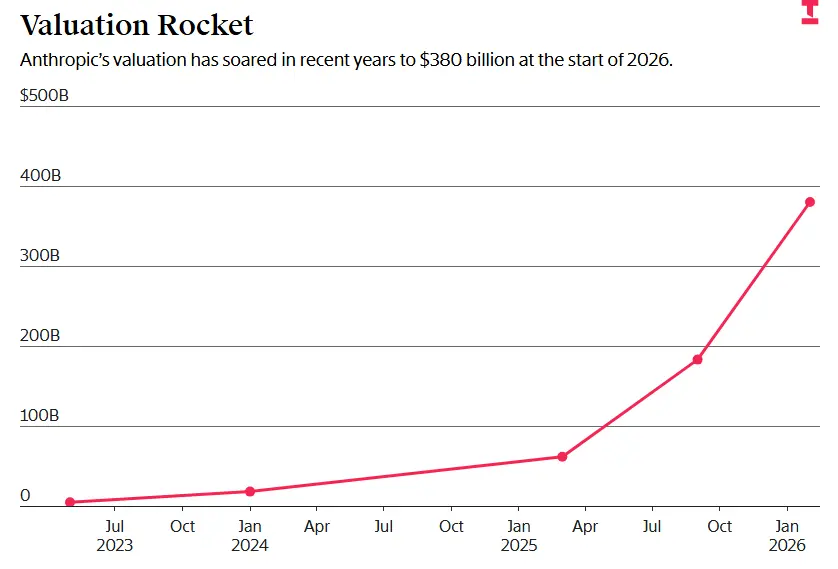
Anthropic's valuation surged to $380 billion in early 2026.

Shortly after the company completed its last $30 billion funding round, Anthropic CEO Dario Amodei told Fortune magazine that if AI progress were delayed by 12 months, Anthropic would go bankrupt.

For a company valued at $900 billion, the distance between "extraordinary success" and "operational bankruptcy" might be just a few bad quarters.

This precarious balance may be why sensitive early investors have largely refrained from participating in this round.

03 Early Investors Collectively Wait-and-See

According to Forbes, some of Anthropic's early backers—those who invested at a $4.1 billion valuation in 2023 or a $61.5 billion valuation in March 2025—have almost no willingness to participate in this round.

The reason is simple. Bankers privately estimate that if Anthropic goes public as early as October 2026, its public market valuation might land between $400 billion and $500 billion. This means that if someone invests at a $900 billion valuation in the final private round, theoretically, before the shares even unlock and become tradable, that investment would already be underwater on paper.

Such an inversion, where late-stage private valuations are significantly higher than expected IPO valuations, is extremely rare in the history of tech financing.

It's a signal, indicating either that this company is severely overvalued in the private market, or that the public market will offer a completely different pricing. Either possibility is fraught with uncertainty.

And that decisive event on the horizon is the IPO itself.

We previously mentioned the key figure behind Anthropic's IPO and financing—the company's financial helmsman, Krishna Rao.

The Information reported that at the time, Anthropic's computing lifeline was essentially tied to Google alone. Rao felt this was untenable—you can't put all your eggs in one basket. He championed a new strategy internally and among investors: computing suppliers must be diversified.

According to The Information citing informed sources, Rao discussed this strategy in depth with investor Byron Deeter of Bessemer Venture Partners. Deeter later commented that it was Rao who made the company realize that having multiple partners would allow for faster development.

Looking back now, Anthropic moved faster than OpenAI. They have already signed deep agreements with all three cloud computing giants: Amazon, Google, and Microsoft. At the chip level, they have also incorporated NVIDIA GPUs, Google's self-developed TPUs, and Amazon's chips, forming a diversified supply network.

But signing agreements is not enough; the core is ensuring suppliers actually deliver the computing resources. In late 2025, Rao spearheaded two major deals: one committing $30 billion to use Microsoft's cloud servers running NVIDIA chips, and another securing up to 1 million Google TPUs.

By early April 2026, Anthropic went further, signing new agreements with Broadcom and Google, locking in several gigawatts of data center power supply capacity. These moves are no longer simply "buying" computing power but are large-scale "reservations" of future infrastructure.

Since joining, Rao has helped the company complete multiple funding rounds totaling $60 billion. By January of this year, the company's valuation had risen to $380 billion.

It can be said that under Rao's forceful drive, Anthropic's computing infrastructure and financial firepower have reached unprecedented scale.

04 Is There a Bubble? The Answer in Six Months

Following the current pace, if this round of financing proceeds as intended, Anthropic is expected to seek an IPO between October 2026 and the first half of 2027. Goldman Sachs, JPMorgan Chase, and Morgan Stanley are reportedly in discussions about the matter.

At that time, the market's core focus will no longer be "Can Anthropic sustain growth?" but will turn into a public referendum on the entire AI industry's valuation logic over the past three years: Was the private market's pricing of AI correct?

Ultra-large-scale corporate capital expenditure commitments, multi-year computing reservation contracts, 40% gross margins, the debate between gross and net revenue accounting, and that accelerating "valuation-computing-revaluation" cycle—all these complex issues that could be ambiguously handled in the private market will, at the IPO, be placed under the public market's microscope.

If the public market is willing to give Anthropic a valuation of $1 trillion or even higher, then the entry price at a $900 billion valuation might look like a generous early bet. But if the market only offers $500 billion, the situation for the last batch of private investors would be very awkward.

A third possibility, perhaps with more profound implications, is that Anthropic's IPO will serve as a key data point to validate or disprove the entire AI finance structural hypothesis.

Remember Michael Burry, the inspiration behind *The Big Short*, who recently warned about "tech stocks" and "chip stocks" bubbles in his paid newsletter again. Once the AI finance hypothesis is disproven during Anthropic's listing, it could be the moment the bubble bursts.

So, whether for Anthropic itself or for the entire AI industry accustomed to soaring valuations over the past three years, the stress test has just begun, and will soon be given the most real, most ruthless pricing by a stock trend curve.

Special contributor Jin Lu also contributed to this article.

Domande pertinenti

QAccording to the article, what is Anthropic's current annualized revenue and how does it compare to OpenAI's reported revenue?

AAccording to the article, Anthropic's annualized revenue has surged to $30 billion as of March 2026. OpenAI estimates that Anthropic's real net revenue, after deducting payments to cloud platforms, is closer to $22 billion, questioning the $30 billion figure which uses gross revenue accounting.

QWhat is the primary purpose of Anthropic's new $30 billion funding round as described in the text?

AThe primary purpose of the $30 billion funding round is to pay for the massive computing infrastructure that Anthropic has already committed to but has not yet built. This is part of a 'valuation-computing-valuation' cycle where high valuations fund future compute resources.

QWhy are many of Anthropic's early-stage investors reportedly not participating in the new $30 billion funding round?

AEarly-stage investors are hesitant because bankers privately estimate that Anthropic's public market valuation upon an IPO could be between $400 and $500 billion. Investing at a $900 billion valuation in the final private round could mean immediate paper losses once the company goes public at a lower valuation.

QWhat key financial challenge regarding costs does Anthropic face, according to the article?

AAnthropic plans to spend about $19 billion on training and inference compute in 2026, which is almost equivalent to its full-year revenue. Due to inference costs exceeding expectations by 23%, its gross margin is compressed to around 40%, which is lower than most mature enterprise software companies. The company is not yet profitable.

QWho is identified as a key figure behind Anthropic's financing and compute strategy, and what was his major contribution?

AKrishna Rao, Anthropic's financial leader, is identified as the key figure. He advocated for and executed a strategy of diversifying compute suppliers beyond just Google, securing deals with Amazon, Google, and Microsoft, and locking in large-scale, long-term compute and power infrastructure commitments.

Letture associate

A Nation Blocks Chips, a Giant Buys a Nuclear Power Plant: Why It's Time to Seriously Consider DeAI

**Title: Great Powers Blockade Chips, Giants Buy Nuclear Plants: Why It's Time to Seriously Consider DeAI** In May 2026, the US closed loopholes for Chinese firms to acquire advanced NVIDIA chips via overseas subsidiaries. That same month, Kenya halted a $1B geothermal data center project involving Microsoft, fearing its immense energy consumption. Meanwhile, Huawei announced mass production of its Ascend AI chip. These disparate events underscore a new reality: the competition for computing power ("compute") has escalated beyond the tech industry, becoming a geopolitical and infrastructural battleground. A new era of oligopoly is forming, with control over the AI stack—from GPU chips (NVIDIA) and cloud platforms (AWS, Azure, Google Cloud) to foundational models (OpenAI, Anthropic)—concentrating in a few Western "AI Octopus" corporations. This centralization creates systemic risks: pricing power and platform lock-in for users, infrastructure fragility, and a widening "compute divide" that threatens to marginalize nations without independent AI capacity. An "AI Iron Curtain" is deepening through export controls. In response, some nations like Saudi Arabia and the UAE are investing heavily to buy compute power, aiming to transition from oil to AI economies. The EU seeks to triple its compute capacity by 2030 to reduce dependency. However, the spending gap is vast, with four US tech giants alone planning ~$750B in AI capex for 2026. The race is increasingly constrained by energy, with AI tasks consuming up to 1000x more power than web searches, pushing firms to even acquire nuclear plants. This landscape is fueling interest in Decentralized AI (DeAI). It proposes a third way: using open protocols to coordinate a global network of idle GPUs, independent developers, and data centers, creating an AI infrastructure without a single controlling entity. Leveraging blockchain and cryptographic verification, DeAI aims to break market concentration, disperse energy demands, reduce geopolitical dependencies, and enhance transparency. While still nascent in performance and stability, DeAI's core promise is not immediate superiority but providing a crucial alternative architecture to resist monopoly, censorship, and centralized power. As specialized AI hardware costs fall and open-source models flourish, the window to build this foundation is open. The very existence of such competition serves as a vital check against the inevitable abuse of concentrated power.

marsbit22 min fa

A Nation Blocks Chips, a Giant Buys a Nuclear Power Plant: Why It's Time to Seriously Consider DeAI

marsbit22 min fa

Outpoll Review: A Prediction Market Platform Built for Active Traders

Outpoll Review: A Prediction Market Platform Built for Active Traders In recent years, prediction markets have grown from a niche sector to a mainstream arena, attracting billions in trading volume and institutional capital. However, the user experience and tools for traders have not kept pace. Outpoll, a new global prediction market platform, aims to fill this gap by providing enhanced trading infrastructure for active and professional traders. Built on standard prediction market principles, Outpoll allows users to trade on the outcome of specific events. It uses fully collateralized contracts with USDC settlement, charges a competitive 0.1% fee per trade, and provides clear settlement rules upfront to minimize disputes. A key focus for Outpoll is its professional-grade trading tools. The platform supports limit and market orders, as well as take-profit and stop-loss orders for open positions—features uncommon in prediction markets. For automated trading, Outpoll offers comprehensive REST and WebSocket APIs, enabling portfolio management, price arbitrage, and integration with existing tools. The platform also features a creator-led market model, where approved experts and community leaders can create and manage markets for niche topics under platform supervision. Its integrated interface combines news feeds directly with trading functions, allowing users to monitor events and manage positions seamlessly. Outpoll launched with a native Android app (available on Google Play) and plans an iOS version later this year. In summary, Outpoll distinguishes itself with trader-focused tools, practical APIs, transparent and collateralized markets, integrated news, and an expanding creator program. For active traders, its advanced order types and API access alone make it a platform worth watching. Outpoll is now globally accessible via outpoll.com and Google Play.

marsbit30 min fa

Outpoll Review: A Prediction Market Platform Built for Active Traders

marsbit30 min fa

Bitwise: Crypto Becomes a Contrarian Investment, Three Logics to Understand the Current Market

**Summary** Matt Hougan, Bitwise's CIO, analyzes the current crypto market through three key lenses, arguing it has shifted from a momentum-driven to a contrarian investment. **1) Crypto Becomes a Contrarian Play:** The market is weak, with major assets like Bitcoin and Ethereum down significantly. Capital has moved to hot sectors like AI, leaving crypto as an "unloved" asset class. This transforms crypto investing from trend-following to a test of patience and fundamental analysis. Investors now favor projects with solid fundamentals (e.g., Hyperliquid) over speculative ones. **2) Regulatory Overhang:** The uncertain fate of the U.S. CLARITY Act, a major crypto regulatory framework, is a key headwind. With its passage in 2024 seen as far from guaranteed (estimates range from 30-55%), institutional capital remains on the sidelines, choosing less risky alternatives like AI stocks. The market needs clarity—whether the bill passes or fails—more than any specific outcome to move decisively. **3) Capital Rotates to New Fundamentals:** This cycle differs from past bear markets where money fled to Bitcoin. Now, capital seeks smaller assets with strong use cases. While major cryptos fell in May 2024, tokens like Hyperliquid (+72%), Zcash (+50%), and XLM (+44%) rallied on their specific fundamentals. This rotation confirms the new contrarian, fundamentals-driven logic and signals the bear market may be in its later stages. **Conclusion:** Short-term pressure persists due to regulatory uncertainty and competition from AI narratives. Investing in crypto now requires a contrarian mindset—acting against the crowd and focusing on fundamental value. Patience and targeting high-quality projects based on their merits are essential for capturing long-term gains.

marsbit1 h fa

Bitwise: Crypto Becomes a Contrarian Investment, Three Logics to Understand the Current Market

marsbit1 h fa

ChatGPT Might Be Disappearing Soon

OpenAI announced at its "Intelligence at Work" event that its coding assistant, Codex, will be fully integrated into the ChatGPT app within weeks. This move marks a strategic shift from a conversational AI (Chat) towards a unified "agentic" platform capable of execution. Codex, originally launched to compete with Anthropic's Claude Code, has grown rapidly to 5 million weekly active users, with 20% being non-developers like analysts and designers. Its enterprise revenue now constitutes 40% of OpenAI's total. The integration is the first step in creating a super-app combining ChatGPT (interface), Codex (execution engine), and the Atlas browser (web access). OpenAI also unveiled new Codex features: specialized Agent plugins for six professional roles, an "Annotations" tool for direct document editing, and a "Sites" function to turn work into shareable web apps. Internally, this reflects a power shift; the Codex team now leads core product strategy. While the ChatGPT brand remains for its vast user base, the platform's future is focused on autonomous agents that perform tasks, not just chat. The article notes that competition with Claude Code pushed OpenAI's development, with Codex competing on cost-effectiveness and accessibility rather than raw coding quality. It concludes that the essence of "ChatGPT" is evolving from a chatbot into an AI agent platform, with the name potentially becoming a legacy symbol of its original function.

marsbit1 h fa

ChatGPT Might Be Disappearing Soon

marsbit1 h fa

Trading

Spot
Futures
活动图片

