How Should Crypto VCs Survive? When Top Projects No Longer Need Institutional Funding

marsbitPubblicato 2026-04-13Pubblicato ultima volta 2026-04-13

Introduzione

Cryptocurrency venture capital is at a watershed moment. Token exits, once the primary driver of outsized returns, are undergoing a major reset. The definition of token value is being rewritten in real-time, yet no standard valuation framework has emerged. Key market shifts include the rise of tokens with real, on-chain revenue (like HYPE), which exposed the weakness of governance tokens with no fundamentals; a supply shock from meme coins (e.g., PUMP) fragmenting liquidity; and competition from prediction markets, stock perps, and leveraged ETFs diverting retail speculative capital. This has compressed token lifecycles and cratered holding periods. VCs now face critical questions: Are they underwriting equity, tokens, or a hybrid? What is the best practice for on-chain value accrual beyond potentially toxic buybacks? Will the "crypto premium" vanish entirely, forcing valuations to align with public equities and crashing many Layer 1 tokens? The result is a divergence: early-stage investors are becoming more price-sensitive on token projects, while appetite for equity deals is growing. Later-stage crypto VCs are increasingly competing with traditional funds in "Web2.5" deals. To survive, crypto VCs must find their product-market fit with founders. Capital alone is no longer sufficient. Winning the best deals—from projects that may not even need institutional funding—requires providing unmatched brand value and non-capital advantages.

Author: Catrina,Partner at Portal Ventures

Compiled by: Jiahuan, ChainCatcher

Crypto venture capital is at a watershed moment. Over the past three cycles, token exits have been the primary driver of outsized returns, but they are now undergoing a major reset. The definition of token value is being rewritten in real-time, yet an industry-standard valuation framework has yet to emerge.

What Exactly Is Happening?

This time, the crypto market structure is being simultaneously impacted by multiple unprecedented forces, completely upending it:

1. The emergence of HYPE awakened the token market, proving that token prices can have real revenue backing, with over 97% of its eight to nine-figure revenue generated on-chain.

This has thoroughly disillusioned the market regarding governance tokens propped up by narratives but hollow in fundamentals—think of the L1s and "governance tokens" that primarily existed to navigate the ambiguities of securities laws (which made direct revenue distribution unfeasible). HYPE reset market expectations almost overnight: revenue is now scrutinized more strictly and has become the basic ante to play.

2. Chain Reaction and Backlash on Other Token Projects

Before 2025, if you had on-chain revenue, you were considered a security; after HYPE, if you ask most hedge funds, they'll tell you that if you don't have on-chain revenue, you'll go to zero. This has left most projects, especially non-DeFi ones, in a dilemma, scrambling to adapt.

3. PUMP Brought a Stunning Supply Shock to the System.

The explosion of supply from meme coin mania, by diverting attention and liquidity, has fundamentally disrupted the market structure. On Solana alone, the number of newly generated tokens surged from about 2-4 thousand per year to a peak of 40-50 thousand. This effectively split the not-much-grown liquidity cake into about one-twentieth. Chasing alpha, the same buyer demographic has shifted its attention and capital to speculating on meme coins rather than holding altcoins.

4. Accelerated Diversion of Retail Speculative Capital.

Prediction markets, stock perpetuals (perps), and leveraged ETF trading are now directly competing for the same pool of capital that would have flowed into altcoins. Meanwhile, the maturation of tokenization technology has made leveraged trading of blue-chip stocks possible—these stocks don't carry the risk of going to zero like most altcoins, are subject to much stricter regulation, and are more transparent with lower information asymmetry risks.

The result is a severe compression of the token lifecycle: the time from peak to trough has shortened dramatically, retail willingness to "hold" tokens has plummeted, replaced by faster capital rotation.

Some Big Questions Every VC Is Asking Themselves and Their Peers

1. Are we underwriting equity, tokens, or a combination of both?

The biggest challenge here is that we have no new playbook for value accrual in token projects—even the most successful projects like Aave still face controversy between the DAO and equity.

2. What is the best practice for on-chain value accrual?

The most common is token buybacks, but that doesn't mean it's right. We have long been against the prevailing trend of token buybacks: it is toxic and puts founders with real revenue in a bind.

The incentive is completely wrong: stock buybacks happen after a company has finished investing in growth, whereas crypto buybacks are increasingly demanded immediately, driven by retail/public perception (a completely fickle and irrational thing).

You might burn $10 million that could have been reinvested for nothing, and the very next day that value could vanish due to some random market maker getting liquidated.

Public companies buy back stock when it's undervalued. Token buybacks get front-run at every turn, so they are often executed at local highs.

Especially if you are a B2B business generating off-chain revenue, this is a futile exercise. In my opinion, when your revenue is less than $20 million, there is absolutely no reason to do buybacks just to please retail instead of reinvesting the capital into growth.

I really like this report from fourpillars, which shows that buybacks in the high nine-figures did almost nothing to help projects set a long-term price floor.
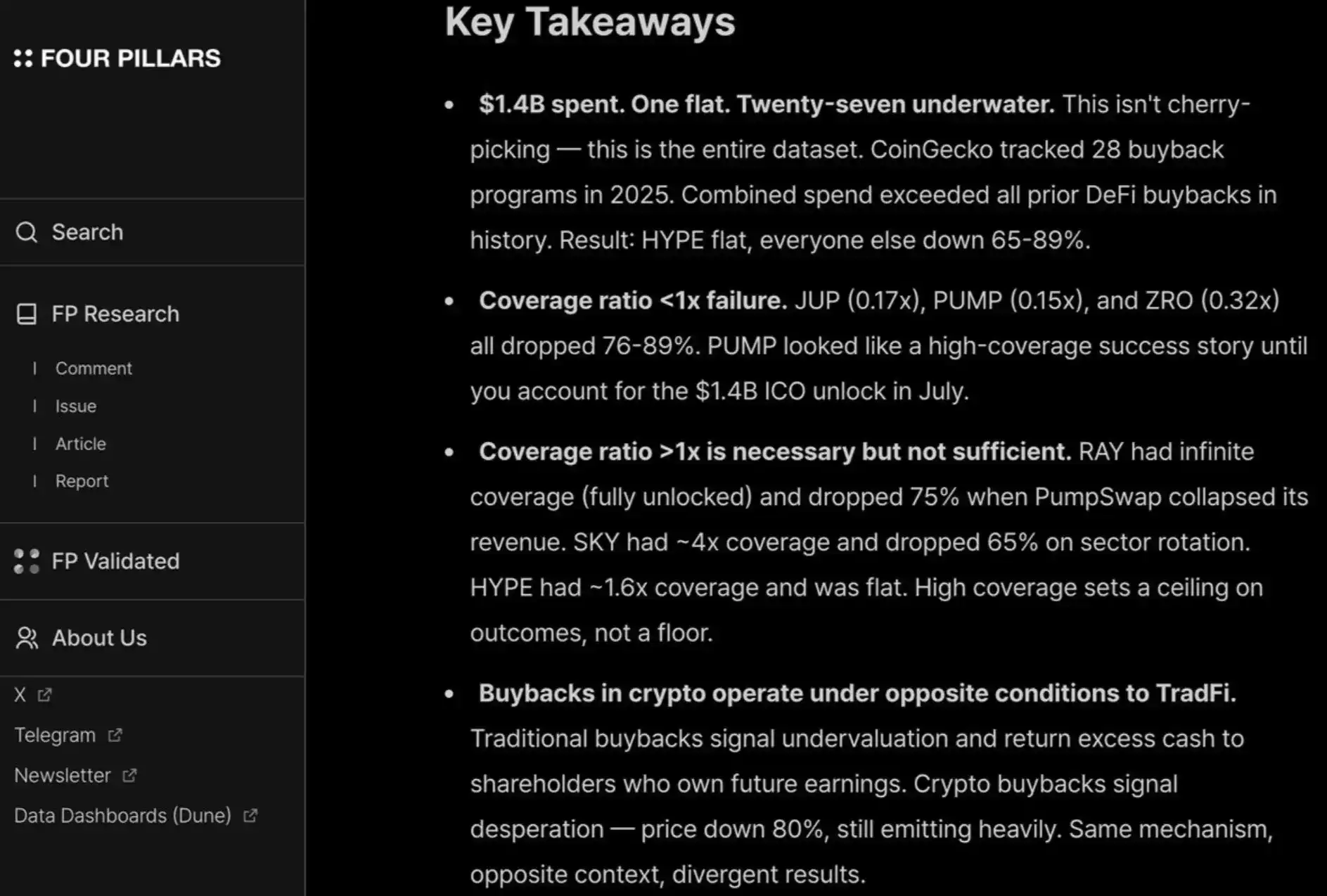
Beyond that, to keep retail and hedge funds happy, you must also conduct buybacks consistently and transparently, like HYPE does. Any failure to do so is punished, as seen with PUMP's P/E ratio (based on fully diluted valuation) being only 6x because the public "doesn't trust" them—despite the fact that they have verifiably burned $1.4 billion in revenue that could have gone to the treasury.

Here is some further reading on "on-chain value accrual mechanisms that work without burning money"

3. Will the "crypto premium" disappear entirely?

This would mean that in the future, all projects will be valued based on multiples similar to public stocks (roughly 2 to 30x revenue). Take a moment to think about what this implies—if true, we would see most L1 public chains fall more than 95% from current prices, with exceptions like TRON, HYPE, and other revenue-generating DeFi projects. And this is even without considering token vesting.
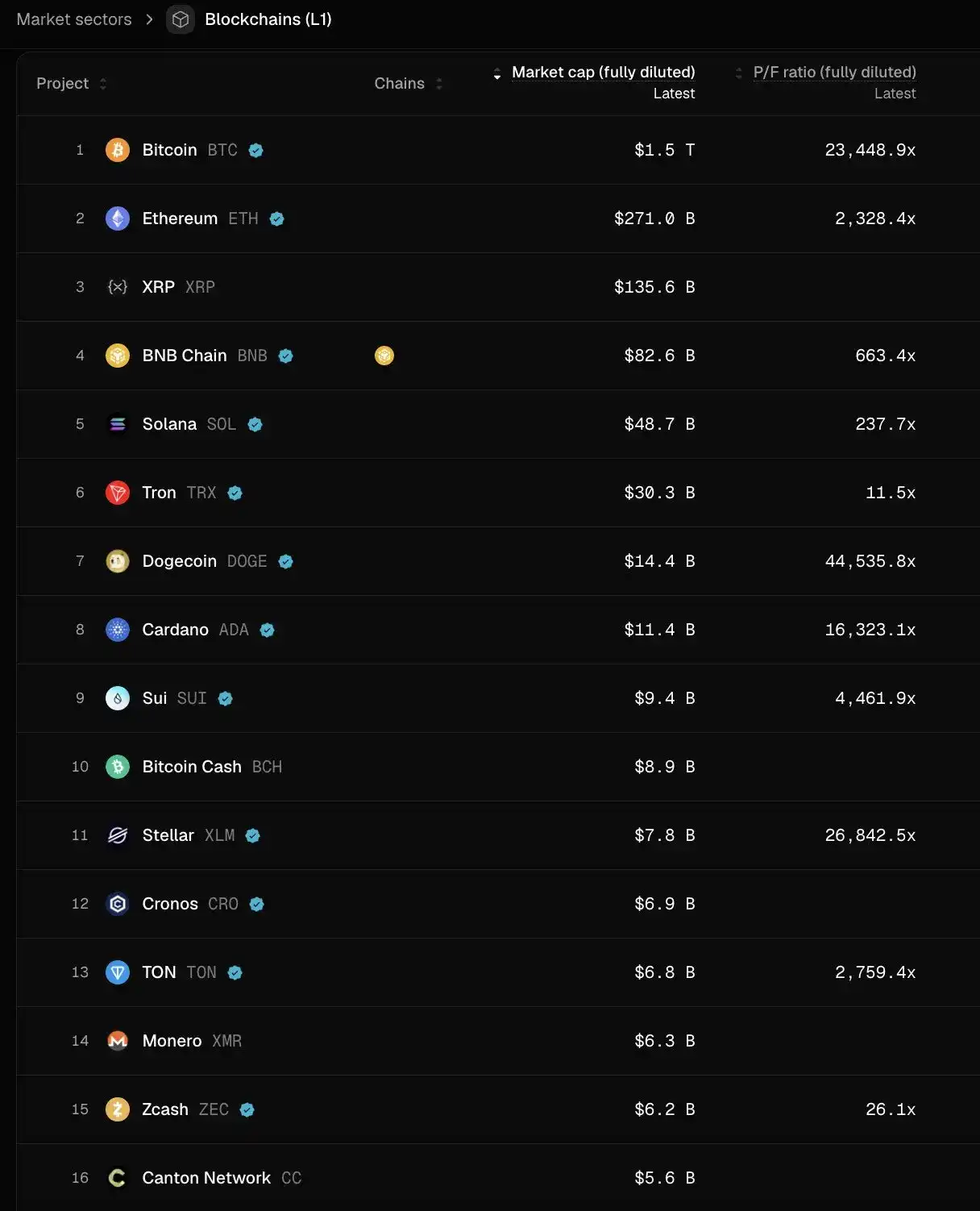
Personally, I don't think it will be like this—HYPE set an extremely exceptional expectation, making many investors impatient for "day one revenue/user traction" from early-stage startups. For sustaining innovations like payments and DeFi companies, yes, this is a reasonable expectation.

But disruptive innovation takes time to build, launch, grow, and then see revenue grow exponentially.

In the past two cycles, we had excessive patience and blind optimism for so-called "disruptive technologies"—new L1s, esoteric concepts like Flashbots/MEV raising up to Series 8-9, and now the pendulum has swung too far the other way, only willing to back DeFi projects.

The pendulum will swing back. While evaluating DeFi projects based on "quantitative" fundamentals is indeed a net positive for the industry maturity, for non-DeFi categories, "qualitative" fundamentals also need to be considered: culture, technological innovation, disruptive concepts, security, decentralization, brand equity, and industry connectivity. And these traits are not simply reflected in TVL and on-chain buybacks.

What to Do Now?

Return expectations for token projects have been significantly compressed, while equity businesses have not seen a comparable decline. This divergence is particularly evident in early-stage versus growth-stage projects.

Early-stage investors have become much more price-sensitive when underwriting projects that might exit via tokens. At the same time, appetite for equity businesses has increased, especially given the favorable M&A environment. This is completely different from the situation in 2022-2024, when token exits were the preferred liquidity path, underpinned by the assumption that the token valuation premium would persist.

Later-stage investors, those with the strongest brand equity and value-add in the crypto-native context, are increasingly moving away from purely "crypto-native" deals. Instead, they are pivoting to support more "Web2.5" companies, whose underwriting is anchored by revenue traction.

This pushes them into unfamiliar territory, competing head-on with firms like Ribbit, Founders Fund—institutions that have deeper backgrounds in traditional fintech, stronger portfolio synergies, and better visibility into early-stage deal flow outside of crypto.

The crypto VC space is entering a period of value validation. The right to survive depends on VCs finding their own PMF (Product-Market Fit) with founders, where the "product" is a combination of capital, brand alignment, and value-add.

For the highest-quality deals, VCs need to sell themselves to founders to win the right to be on the cap table, especially as some of the most successful projects in recent years have needed almost no institutional capital (e.g., Axiom) or none at all (e.g., HYPE). If capital is the only thing a VC provides, it will almost certainly be eliminated.

Those VCs qualified to remain in the game need to be very clear about what they can offer in terms of brand alignment (which is what prompts the best founders to engage in the first place) and value-add (which ultimately determines their right to win the deal).

Domande pertinenti

QWhat are the main forces that have disrupted the crypto market structure according to the article?

AThe crypto market structure is being disrupted by multiple unprecedented forces: 1) The emergence of HYPE, which demonstrated that token prices can be supported by real on-chain revenue, resetting market expectations. 2) A chain reaction that penalizes other token projects without on-chain revenue. 3) The massive supply shock from the memecoin frenzy (e.g., PUMP), which fragments liquidity and attention. 4) The accelerated diversion of retail speculative capital into prediction markets, stock perps, and leveraged ETFs, compressing the token lifecycle.

QHow has the HYPE project changed the market's expectations for tokens?

AHYPE proved that a token's price can be backed by substantial, real on-chain revenue, with over 97% of its nine-to-ten-figure revenue generated on-chain. This has led to a 'de-memeing' of governance tokens that relied on narrative over fundamentals. It reset market expectations, making on-chain revenue a fundamental requirement for entry, and subjecting revenue to much stricter scrutiny.

QWhy does the author argue against the prevalent trend of token buybacks?

AThe author argues that token buybacks are often 'toxic' and put founders with real revenue in a difficult position. The motivation is wrong: stock buybacks occur after a company has invested in growth, whereas crypto buybacks are increasingly demanded by fickle and irrational retail/public perception for immediate action. They are often executed at local price highs due to front-running and can be rendered worthless by a random market maker's liquidation. For a B2B business with sub-$20M in revenue, it's counterproductive to buy back tokens to please retail instead of reinvesting in growth.

QWhat does the article suggest about the future of the 'crypto premium'?

AThe article suggests there is a question of whether the 'crypto premium' will disappear entirely, meaning all projects would be valued based on multiples similar to public stocks (around 2x to 30x revenue). If this happens, it would imply a further drop of over 95% for most L1 blockchains. However, the author personally believes the pendulum will swing back. While quantitative fundamentals are a net positive for DeFi, qualitative fundamentals (culture, tech innovation, disruptive concepts, security, decentralization, brand equity) must also be considered for non-DeFi categories, and these are not reflected in TVL or buybacks alone.

QHow must crypto VCs adapt to survive in the current market environment according to the article?

ATo survive, crypto VCs must find their Product-Market Fit (PMF) with founders, where their 'product' is a combination of capital, brand credibility, and value-add. For the highest-quality deals, VCs must sell themselves to founders to earn a place on the cap table, especially as top projects may no longer need institutional capital (e.g., Axiom, HYPE). If capital is the only thing a VC provides, it will likely be eliminated. Surviving VCs need to be very clear about what brand credibility they offer to attract top founders and what value-add they provide to win deals.

Letture associate

Why Do You Always Lose Money on Polymarket? Because You're Betting on News, While the Pros Read the Rules

Why do you always lose money on Polymarket? Because you bet on news, while the pros study the rules. This article explains how top traders ("che tou") profit by meticulously analyzing market rules, not just predicting events. Polymarket, a prediction market platform, often sees disputes over event outcomes due to ambiguous rule wording. For instance, a market asking "Who will be the leader of Venezuela by the end of 2026?" was misinterpreted by many who bet on Delcy Rodríguez, assuming she held power. However, the rules specified "officially holds" as the formally appointed, sworn-in individual. Since Nicolás Maduro was still recognized as president officially, he won the market—even being in prison. To resolve such disputes, Polymarket uses a decentralized arbitration system via UMA protocol. The process involves: 1. Proposal: Anyone can propose a market outcome by staking 750 USDC, earning 5 USDC if unchallenged. 2. Dispute: A 2-hour window allows challenges with a 750 USDC stake; successful challengers earn 250 USDC. 3. Discussion: A 48-hour period on UMA Discord for evidence and debate. 4. Voting: UMA token holders vote in two 24-hour phases (blind then public). Outcomes require >65% consensus and 5M tokens voted; otherwise, four re-votes occur before Polymarket intervention. 5. Settlement: Results are final and automatic. Unlike traditional courts, Polymarket’s system lacks separation between arbitrators and stakeholders—voters often hold market positions, creating conflicts of interest. This leads to herd mentality in discussions and non-transparent outcomes without explanatory rulings, preventing precedent formation. Thus, success on Polymarket hinges on deep rule interpretation, not just event prediction, exploiting gaps between reality and contractual wording.

marsbit1 h fa

Why Do You Always Lose Money on Polymarket? Because You're Betting on News, While the Pros Read the Rules

marsbit1 h fa

DeepSeek Funding: Liang Wenfeng's 'Realist' Pivot

DeepSeek, a leading Chinese AI company, has initiated its first external funding round, aiming to raise at least $300 million at a valuation of no less than $10 billion. This move marks a significant shift from its founder Liang Wenfeng’s previous idealistic stance of rejecting external capital to maintain independence. Despite strong financial backing from its parent company, quantitative trading firm幻方量化 (Huanfang Quant), which provided an estimated $700 million in revenue in 2025 alone, DeepSeek faces mounting challenges. Key issues include a 15-month gap in major model updates, delays in its flagship V4 release, and the loss of several core researchers to competitors offering significantly higher compensation. The company is also undergoing a strategic pivot by migrating its infrastructure from NVIDIA’s CUDA to Huawei’s Ascend platform, a move aligned with China’s push for technological self-reliance amid U.S. export controls. However, DeepSeek lags behind rivals like智谱AI and MiniMax—both now publicly listed—in areas such as product ecosystem, multimodal capabilities, and commercialization. The funding round, though relatively small in scale, is seen as a way to establish a market-validated valuation anchor, making employee stock options more competitive and facilitating talent retention. It also signals DeepSeek’s transition from a pure research-oriented organization to a commercially-driven player in the global AI ecosystem.

marsbit2 h fa

DeepSeek Funding: Liang Wenfeng's 'Realist' Pivot

marsbit2 h fa

Trading

Spot
Futures
活动图片