In the mid-year "examination" of major economic provinces, the change in ranking between Anhui and Hunan has become the biggest highlight. In the first half of the year, Anhui's GDP grew by 5.6%, surpassing Hunan in total output to enter the national top ten; meanwhile, Hunan's growth rate was only 2.7%, putting its ranking under pressure to decline.
The key to the shift lies in the "K-shaped divergence" in the industrial momentum of the two provinces.
Anhui leverages technological innovation to drive high-tech manufacturing, with industry and foreign trade mutually reinforcing and propelling growth. In contrast, Hunan is dragged down by the adjustment of traditional industries, while the contribution from emerging industries remains limited, exacerbating the pain of transformation as "the new cannot sufficiently compensate for the old."
Facing the dual pressure of slowing growth and a slipping ranking, Hunan clearly cannot sit still. Just a few days ago, top leaders of the Hunan Provincial Party Committee and Provincial Government conducted intensive research focusing on industrial upgrading—
One route involved three consecutive days of visits to three leading construction machinery enterprises in Changsha, emphasizing the need to accelerate the transformation and upgrading of traditional industries and fully leverage cluster advantages. The other route focused on future industries like embodied intelligence and quantum technology, planning to foster and strengthen future industrial clusters based on local conditions.
The two rounds of research point to a highly consistent goal: boosting industry through technological innovation to break through the transformation dilemma. The question is, with neighboring provinces like Anhui and Hubei already racing ahead in technological innovation, where should Hunan seek its breakthrough?
01
Divergence
Viewed over a longer period, the "Anhui-Hunan swap" was not without precedent.
In 2016, Hunan's GDP first exceeded 3 trillion yuan, ranking 8th nationally, closely following Hubei.
However, hidden worries about industrial "imbalance" were already sown. In 2017, Hunan was overtaken by Fujian and Shanghai, slipping to 10th place nationally, a position it has hovered around for many years since.
Looking back at economic development in 2017, the official Hunan level once stated, "shortcomings in industrial development persist," with prominent contradictions between emerging and traditional industries where "the small cannot sufficiently compensate for the large, the new cannot sufficiently compensate for the old, and the increase cannot sufficiently compensate for the decrease."
Meanwhile, Anhui, driven by innovation, spurred industrial revenue growth, emerging as a new industrial and manufacturing powerhouse. Its economic ranking climbed from 13th nationally in 2016 to 11th in 2025. The economic gap between Anhui and Hunan also narrowed year by year, shrinking from 442.38 billion yuan in 2016 to 231.92 billion yuan in 2025.
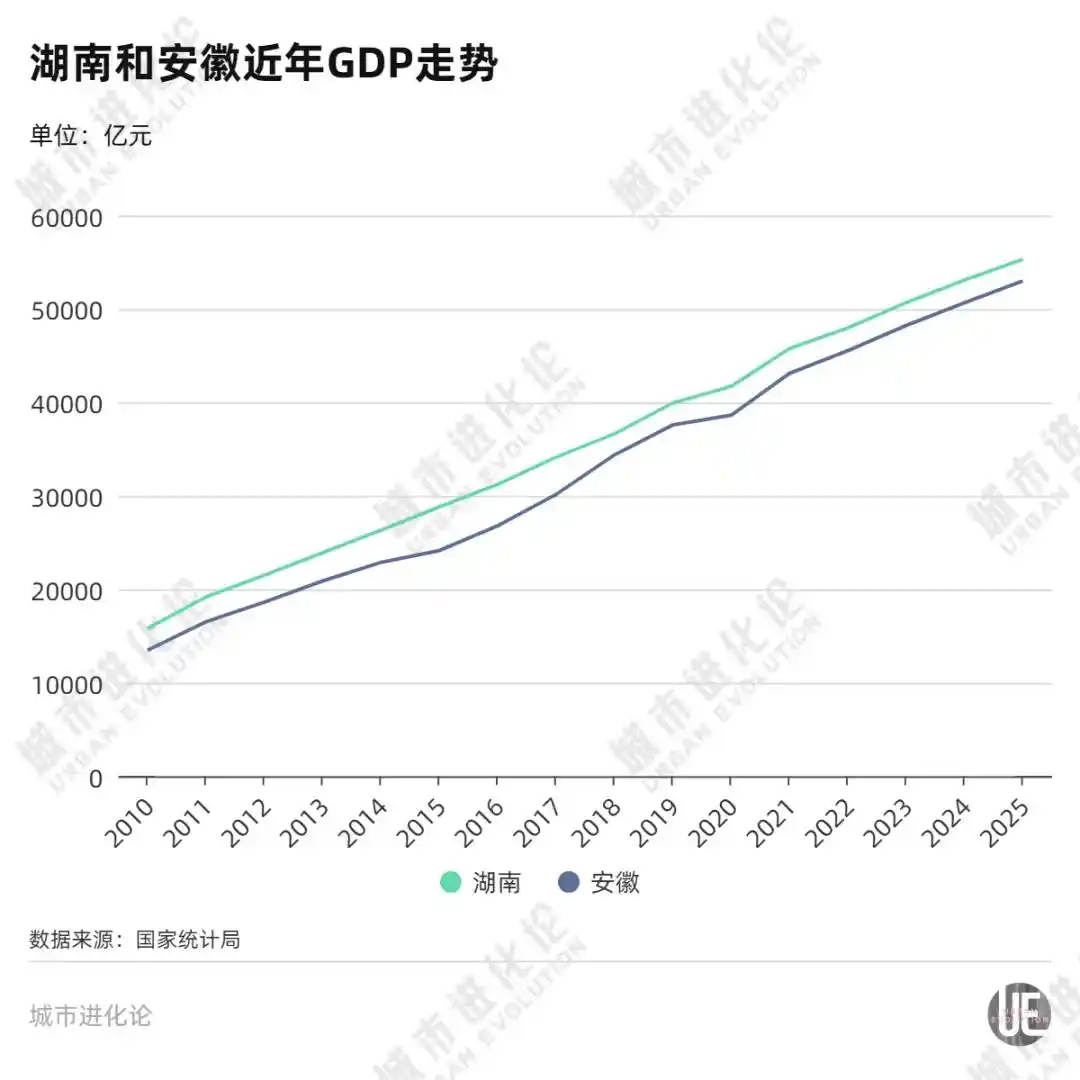
In the first half of this year, Anhui overtook Hunan with an advantage of 36.7 billion yuan, securing a spot among the top ten GDP provinces.
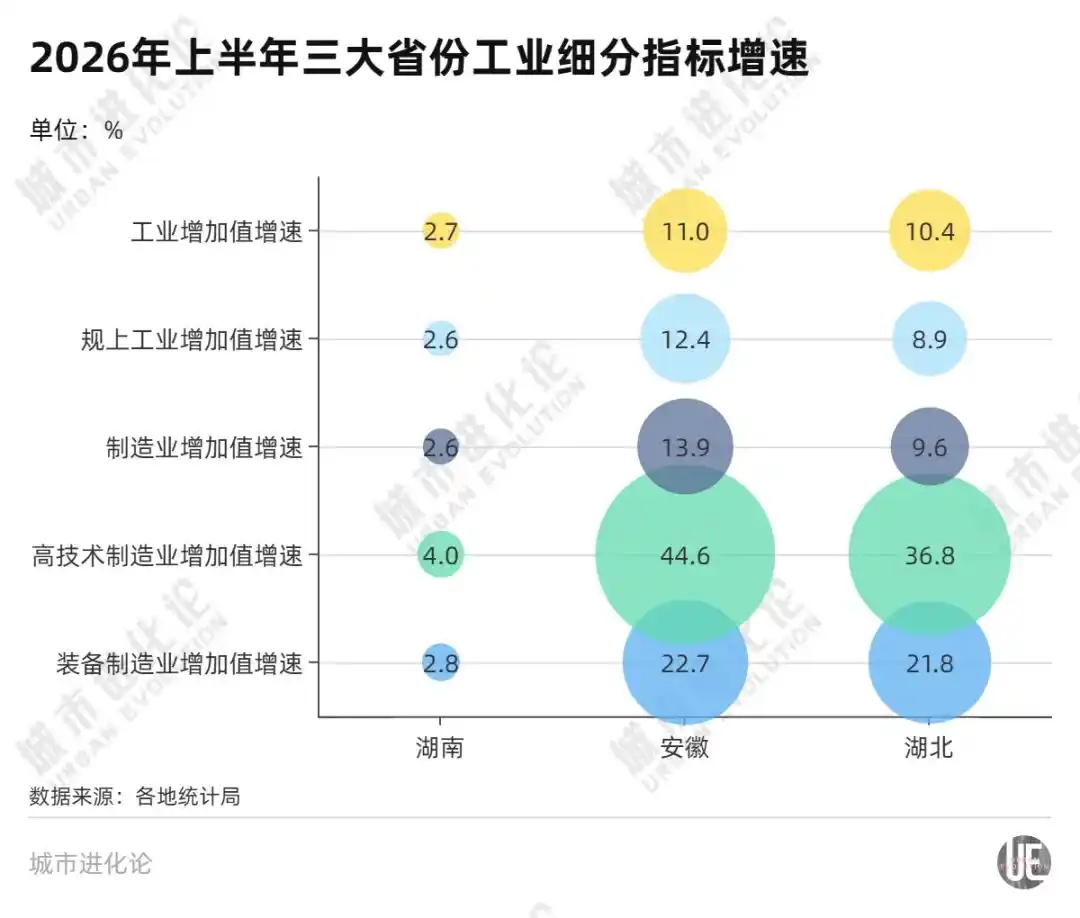
The key factor was industry—Anhui's industrial value-added grew by a high 12.4% in the first half, maintaining rapid growth, while Hunan's above-scale industrial value-added grew by only 2.6%, creating a significant gap between the two.
The gap between old and new drivers is even more striking. Looking at segmented data, Hunan's industrial growth was mainly driven by traditional industries, with value-added in high-tech manufacturing and equipment manufacturing growing by only 4.0% and 2.8% respectively. In contrast, Anhui saw these two indicators grow by 44.6% and 22.7%, respectively, making high-tech manufacturing the absolute engine.
Looking across the central region, Qin Zunwen, Vice President of the Chinese Society of Urban Economy and Secretary-General of the Yangtze River High-End Think Tank Alliance, told City Evolution Theory that the divergent trends among several provinces are related to their industrial structures.
Anhui has a lighter historical burden in industry. It bet early on sectors like new energy vehicles and integrated circuits, and with the "Hefei Model" providing patient capital empowerment, industrial clusters have shown significant results.
Hubei was once constrained by the transition of the fuel vehicle industry, but emerging sectors like optoelectronics and information technology promptly took over, filling in new growth drivers.
In contrast, Hunan's traditional advantageous industries like construction machinery are currently in a cyclical downturn, while emerging industries suffer from a lack of concentration. This poor alternation between old and new leads to weak growth on both ends.
Qin Zunwen believes that Hunan must now emphasize innovation-driven development but cannot take the "break first, then establish" approach. Construction machinery remains Hunan's industrial "bread and butter"; it must be consolidated, stabilized, and upgraded. Simultaneously, high-tech industries must quickly scale up to achieve balanced development between traditional and emerging industries.
This aligns closely with recent high-level deployments in Hunan: from August 4th to 6th, the top leader of the Hunan Provincial Party Committee led a team on three consecutive days of intensive visits to three leading construction machinery enterprises in Changsha. Around the same time, the top leader of the Hunan Provincial Government focused on research into future industries like embodied intelligence and quantum technology in Changsha.
Subsequently, on August 7th, the Standing Committee meeting of the Hunan Provincial Party Committee explicitly called for unswervingly focusing on industry, projects, and enterprises.
For Hunan, it has reached a critical stage of "dual-track uphill climbing"—both upgrading traditional industries and cultivating emerging ones.
02
Rebuilding
As Hunan's most competitive industrial calling card, construction machinery remains the "anchor" for stabilizing its industrial growth.
Hunan's construction machinery industry scale has ranked first nationally for 15 consecutive years, nurturing 5 companies among the "Global Top 50 Construction Machinery Enterprises," led by Sany Heavy Industry. However, since 2021, with the fading of traditional infrastructure dividends and the industry entering stock competition, the old path of merely competing on scale is unsustainable. Hunan urgently needs to chart a second growth curve for the industry.
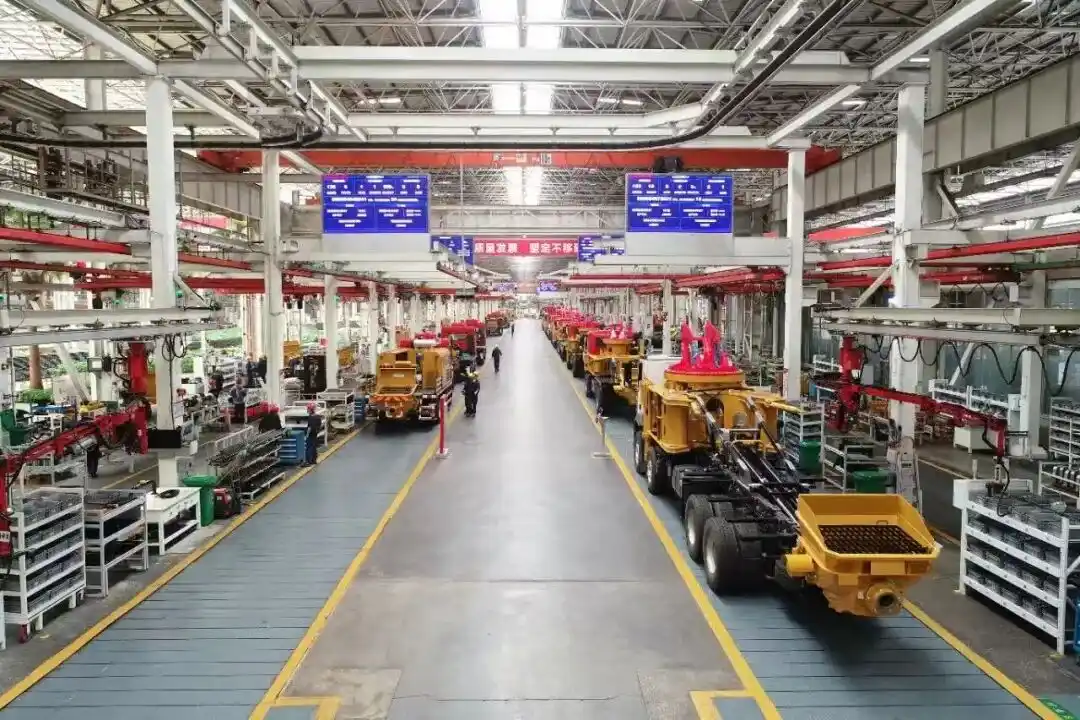
Image Source: Hunan Daily
In Qin Zunwen's view, as the AI wave sweeps the globe and embodied intelligence accelerates development, Hunan's construction machinery should deeply integrate with artificial intelligence. Specifically, the intelligent capabilities of the three leading enterprises should be diffused across the upstream and downstream industrial chains. At the same time, product boundaries should be expanded, extending from traditional machinery equipment to new areas like intelligent robots, mining equipment, and energy storage equipment.
This direction was also conveyed during the recent research visits.
In visits to the three construction machinery giants—Sany Group, Zoomlion, and Sanyou Intelligent—a frequently mentioned keyword was "artificial intelligence."
In the Changsha Sany Heavy Truck workshop, industrial robots and automated guided vehicles work in coordination, producing one vehicle every 5 minutes on average. In June this year, 883 Sany electric heavy trucks were shipped overseas from here, setting a record for the single largest export batch of Chinese new energy heavy trucks.
Hunan's leadership emphasized the need to accelerate the transformation and upgrading of the construction machinery industry, seize the opportunities presented by AI development, and rejuvenate traditional industries through technological innovation.
Changsha, the "Capital of Construction Machinery," took the lead in intensifying efforts. On August 10th, the Changsha Municipal Government Executive Meeting emphasized making physical AI a core track, focusing on areas like embodied intelligence, and accelerating the building of a benchmark city for integrated development of "AI + Manufacturing."
However, transformation during an industry downturn cannot rely on individual enterprises fighting alone. Hunan's strategy is to encourage enterprises to form synergistic clusters, strengthen cooperation within the construction machinery industry chain, fully leverage cluster advantages, and promote collaborative development.
Qin Zunwen noted that there was a degree of vicious competition among construction machinery enterprises in the past. "Huddling together" through joint R&D, sharing common technologies, and forming entities can reduce redundant investment and create synergy.
Beyond transformation breakthroughs at the enterprise level, Hunan also sees an opportunity for cross-regional collaborative innovation. Recently, the National Manufacturing Innovation Center for High-End Construction Machinery was approved, to be co-built by Changsha and Xuzhou.
"Looking at the development history of Wuhan's optoelectronics industry, it is inseparable from the establishment of China Information and Communication Technology Group and the subsequent convergence of national industrial resources—these are projections of national strategic layout," Qin Zunwen stated. National-level support is crucial for local industrial development. Changsha should seize the opportunity and collaborate with Xuzhou on technological breakthroughs, striving for significant achievements.
03
Sourcing
The economic disparity among central provinces, on the surface, is a short-term numerical gap in industrial growth rates, but its essence lies in the "generation gap" in the cultivation rhythm of new quality productive forces.
The rapid development of Anhui and Hubei is largely due to being born anew. In the first half of this year, emerging industries led by electronics, information technology, and automobiles contributed over 70% to Anhui's above-scale industrial growth. Hubei's high-tech manufacturing value-added grew by 36.8%, with its share of above-scale industry rising from 17.4% last year to 24.8%.
"Our traditional advantageous sectors are undergoing deep adjustment, while the 'fish' others have meticulously nurtured have already grown." As stated by *Hunan Daily*, when Anhui's integrated circuits and Hubei's optoelectronics become national strategic strengths, Hunan's new growth drivers have not yet fully formed.
It should be said that Hunan's innovation resources are not poor—it has 3 "985" universities, ranking first in central China. In 2024, Hunan's R&D expenditure intensity increased to 2.57%, ranking 9th nationally and second only to Anhui in central China.
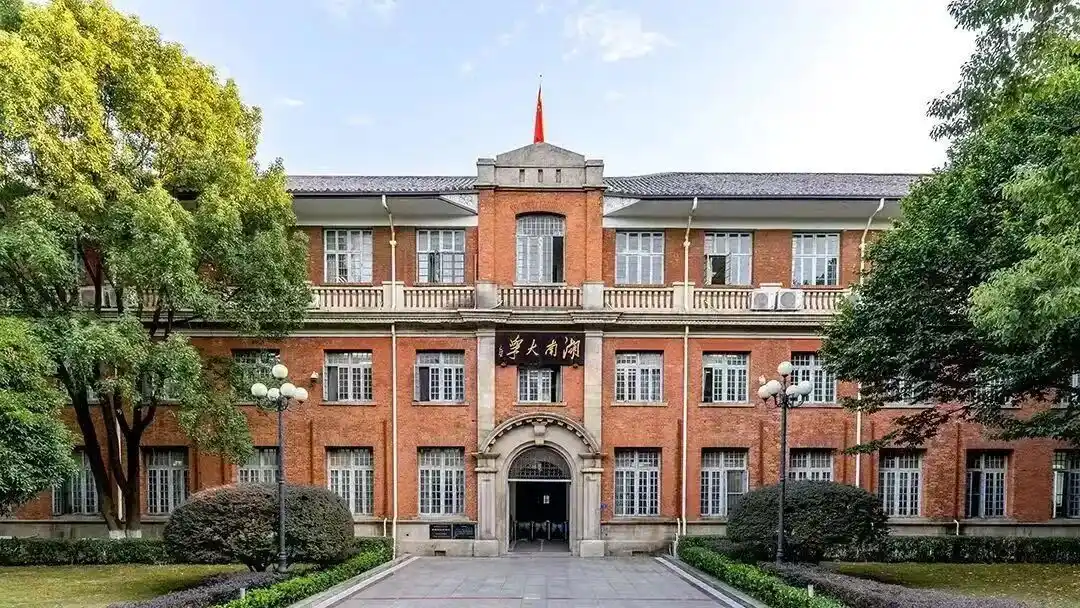
Image Source: Hunan University
However, this solid foundation in science and education has not been sufficiently translated into industrial competitiveness. The mismatch of "strong in research, weak in industry" has become the most prominent contradiction on Hunan's transformation path.
From July 28th to 31st this year, the Hunan Provincial Political Consultative Conference initiated a science and innovation research trip to Hubei. Bei Bing, President of the Hunan Academy of Future Economic Development, who participated in the trip, frankly stated that in comparison, although Hunan is rich in scientific and educational resources, there are structural shortcomings in the "intermediate link" from the laboratory to the production line, with many achievements "blooming inside the wall but fragrant outside."
Local media reports serve as evidence: Hunan is a hometown of non-ferrous metals, but large quantities of copper and aluminum ingots are shipped out, while the high-value-added deep processing stages remain in other provinces. The gap is not in the mines but in the chain.
As the core carrier of provincial scientific innovation, Changsha's performance is even more representative. In emerging fields, Changsha has never nurtured industry giants like Hefei's ChangXin Memory or Wuhan's Yangtze Memory. This leads the market to question: "Others have 'Six Dragons'; does Changsha only have 'Six Crayfish'?"
Hunan is not unaware of the problem. According to the latest deployment, Hunan will foster and strengthen future industrial clusters based on local conditions, focusing on four key directions: "artificial intelligence, quantum technology, life engineering, and frontier materials."
In fact, these tracks were already identified in Hunan's 15th Five-Year Plan outline: AI should be "independently controllable," life engineering should be "industrialized," quantum technology should be "engineered," and frontier materials should be "commercialized."
Just on August 7th, in the Hunan Xiangjiang New Area, Zhongke Huisi Embodied Intelligence (Hunan) Co., Ltd., incubated by the Institute of Automation, Chinese Academy of Sciences, launched three dexterous hand products, seen as an important move for Hunan in racing on the embodied intelligence track.
Qin Zunwen believes that Hunan, in R&D and innovation, similar to industrial development, also has a path dependence favoring traditional industries. Taking Changsha as an example, it should learn from the determination of Hefei and Wuhan to "persistently tackle a few industries," enhancing the visibility of its layout in new industrial tracks.
Furthermore, drawing lessons from the regional sci-tech innovation patterns of Anhui and Hubei where multiple areas coordinate efforts, Hunan should further convert Changsha's innovation resources into empowerment effects for the province's manufacturing industry, strengthen the radiating and driving effect on manufacturing hubs like Yueyang, Zhuzhou, and Xiangtan, and form a growth synergy through province-wide sci-tech innovation collaboration.
This article is from the WeChat public account "City Evolution Theory," author: Liu Xuqiang