How Does Backpack's Staking Token-to-Equity Conversion Work?

marsbitPubblicato 2026-02-25Pubblicato ultima volta 2026-02-25

Introduzione

Backpack, a Solana-based wallet and exchange platform founded by ex-FTX members, has announced a novel staking-to-equity conversion plan. Users who stake its native token for at least one year can convert those tokens into real company equity at a fixed ratio, with 20% of equity reserved for this purpose. The platform emerged after FTX’s collapse, having lost 80% of its operational funds, and gradually built its user base through its Mad Lads NFT community and a compliant exchange. It recently acquired FTX Europe and secured regulatory licenses. Backpack’s tokenomics include a 1 billion total supply, with 62.5% pre-IPO allocation. The TGE will release 25% of tokens, entirely to users. The model ties token distribution to IPO milestones—a rare hybrid approach in crypto. This move aims to transform users from token holders into legal company owners. However, it faces significant regulatory challenges, particularly from the SEC, which may view the token as a security. The dual-structure of token and equity could also complicate IPO investor relations. While innovative, the plan operates in a regulatory grey area—attempting to bridge decentralized tokenomics with traditional equity financing.

Original | Odaily Planet Daily (@OdailyChina)

Author | DingDang (@XiaMiPP)
On February 24, Backpack CEO Armani Ferrante announced a staking-to-equity conversion plan, allowing users who stake Backpack's native token for at least one year to exchange these tokens for real company equity at a fixed ratio. The company has reserved 20% of its equity for this plan.

This brief statement conveys far more information than a conventional TGE narrative.

In traditional TGE narratives, users are seen as traffic and community token holders; in this design, Backpack attempts to elevate users from product users to legal company owners.

The question is: Can it really work? Is this a financial innovation or a high-risk experiment dancing on the edge of regulation? Does it change the power structure, or is it just a more advanced form of chip management? To understand this, we must look back at Backpack's own history.

Backpack: A Company Rising from the Ruins

Backpack is a "wallet + exchange" integrated platform centered on the Solana ecosystem, founded by Armani Ferrante, a former member of FTX and Alameda Research. It was established after the collapse of FTX, emphasizing compliance and user custody.

However, unlike the "trading first, ecosystem later" development path of centralized exchanges like Binance, Backpack's path is the reverse. It started with a wallet and NFTs, gradually accumulating users, community, and technical foundations, and eventually launched an exchange.

Looking back at Backpack's history. In 2022, the collapse of FTX not only tore apart the credit structure of the entire crypto industry but also directly impacted projects associated with it. Backpack had just completed a $20 million funding round led by FTX Ventures and Jump Crypto before FTX's collapse. But as the empire crumbled, about 80% of Backpack's operating funds evaporated. At that time, Backpack was positioned as a "wallet + xNFT operating system," aiming to provide Solana users with a safer, integrated entry point, avoiding reliance on centralized platforms.

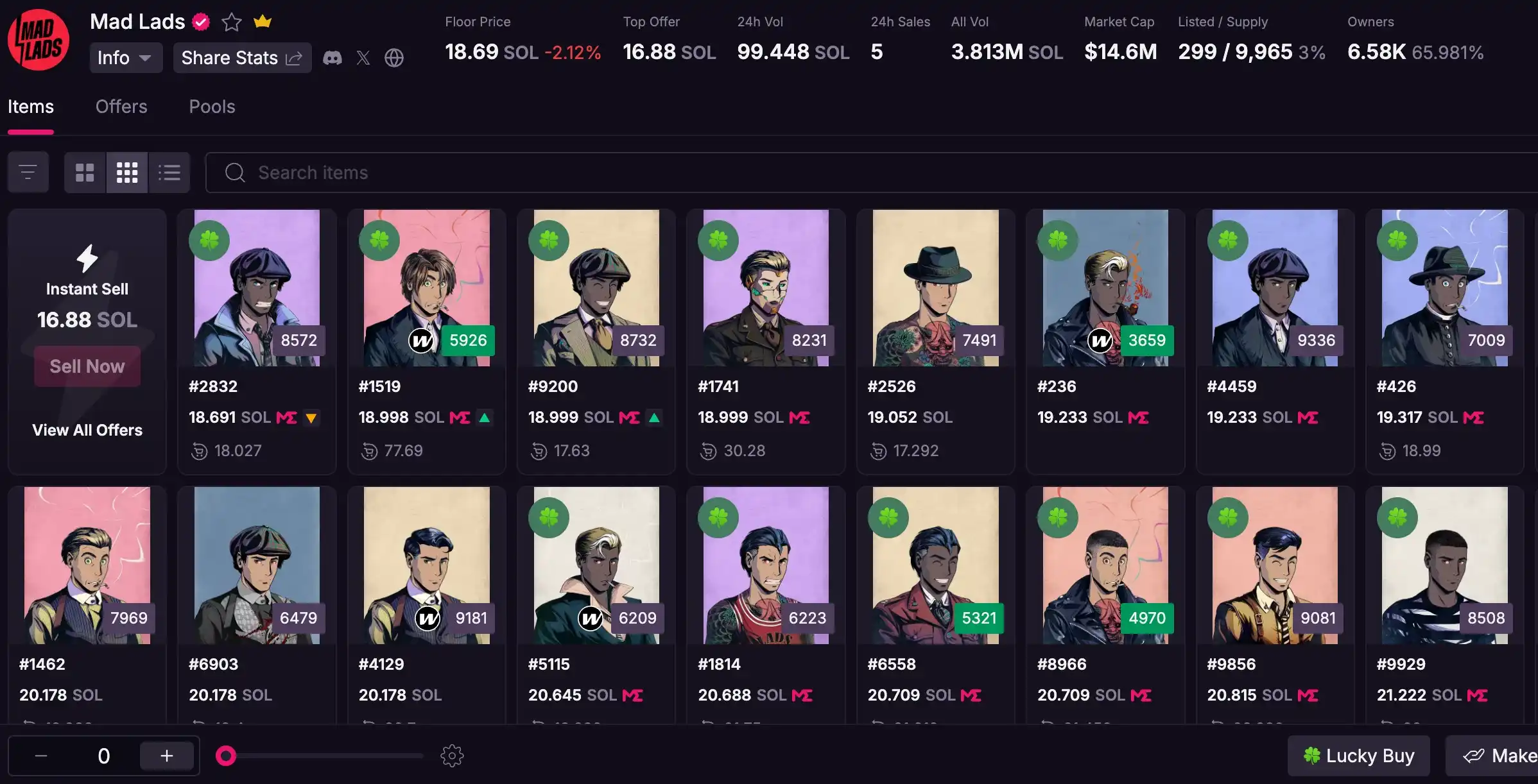
In April 2023, during the bear market trough, Backpack quietly launched the Mad Lads NFT series, with a minting price of 6.9 SOL. It quickly became one of the top NFT communities on Solana, with the floor price once reaching 229.4 SOL. Today, despite the overall decline of NFTs, the Mad Lads floor price remains at 18.8 SOL, more than double the original minting price.
In November of the same year, Backpack obtained a Dubai VARA license and launched Backpack Exchange, though it was only in a limited testing phase at the time. By then, it had accumulated user trust through its wallet and NFTs, leveraging the exchange to monetize traffic. In February 2024, Backpack completed a $17 million Series A funding round, valuing the company at $120 million. In January 2025, it acquired FTX Europe's assets for $32.7 million, obtaining a European MiFID II license, further strengthening its compliance foundation and committing to handle FTX EU customer claims.

Backpack was born with a silver spoon but rebuilt from the ruins. After nearly three years, Backpack has accumulated a trading volume of over $400 billion and user assets exceeding $350 million.

Now, it is poised for a greater leap.

Token Issuance Plan and Equity Linkage

On February 17, Backpack announced the start of identity verification before TGE, the first step for users to claim tokens.

According to Backpack's token economic model, the total token supply is 1 billion. The pre-IPO total supply is 625 million tokens (62.5%), released in three phases:

  • Phase 1 (TGE): Releases 25% of the total supply, or 250 million tokens. Of these, 240 million (24%) are allocated to points holders, and 10 million (1%) to Mad Lads holders. This phase is 100% allocated to users, with no internal team share.
  • Phase 2 (Pre-IPO): Accounts for 37.5%, or 375 million tokens, as "growth-triggered unlocks," released gradually based on key milestones (such as regulatory approvals, new product launches, and geographic expansion).
  • Phase 3 (Post-IPO): Also accounts for 37.5%, or 375 million tokens, deposited into company treasury, locked for one year after IPO, for the team and investors.

From its token distribution plan, we can already see that token issuance is closely tied to an IPO. Backpack is currently negotiating terms for a new $50 million funding round at a valuation of $1 billion. At this valuation, the 20% equity reserved is worth $200 million.

In the short history of the cryptocurrency industry, token issuance has quietly evolved from an optional financing tool to an almost "instinctive choice" and default path for nearly all projects. As users, we are familiar with this method, but Backpack's approach goes beyond what we know.

From an industry perspective, this model fills a gap. Coinbase successfully IPOed in 2021 but never issued a native token; DeFi projects like Uniswap issued governance tokens but did not pursue an equity listing. Backpack is attempting a "dual-track" system: tokens for community incentives and equity for long-term ownership, which is unprecedented in the crypto industry.

Is Token Issuance + IPO Feasible?

Although this plan is bold and innovative, it faces regulatory challenges.

Under U.S. regulatory context, most tokens could be considered securities by the SEC. If so, companies must comply with registration, disclosure, and anti-fraud rules. If an IPO is pursued in the future, the SEC will review the history of token issuance, structural design, and potential compliance violations.

More complex is the potential "ownership conflict" between equity and tokens: IPO investors worry about dilution of rights (such as voting rights and dividends), while token holders expect value capture, which could be seen as "dual financing" or misleading behavior. Especially during the Gensler era (2022-2024), enforcement tightened, and many projects abandoned IPOs altogether.

In short, token issuance takes the "decentralized/on-chain financing" fast lane, while an IPO takes the "centralized/compliant/equity financing" slow lane. Backpack is trying to drive both vehicles simultaneously, which requires极强的 structural design and regulatory communication skills. Otherwise, it could face delays in listing or regulatory fines.

While there is no complete precedent in the crypto industry, there are partial ones. Coinbase, also a centralized exchange, completed its IPO in 2021, but it had considered issuing a token. Backpack co-founder Can Sun revealed in a podcast two years ago that he participated in Coinbase's上市 work, helping design its token economic model. Although Coinbase ultimately chose a pure equity listing, this experience provided valuable reference for Backpack. At that time, he already planned to realize this unfulfilled ambition at Backpack.

Can It Change the Industry?

Today, the reality of the crypto industry is that many tokens lose over 80% of their value within a year of listing. "Peak at issuance" has almost become a curse. Backpack seems to be寻找 another path: giving tokens the possibility of converting to equity,推动 incentive methods to change.

In the past, the familiar model was "earn tokens with product," where projects first build a good product, and users earn token rewards through usage, such as fee sharing, liquidity mining, airdrops, etc. Token value comes from the product's actual performance. Backpack's approach更像 using token expectations to feed company valuation, i.e., equity binding, IPO narrative, using the expected value of tokens to quickly gather funds, community, and attention, thereby raising the company's valuation and accelerating financing and product iteration. Tokens are no longer just reward tools but valuation engines.

Of course, this transformation is full of uncertainty. How will regulators define it? How to balance rights between equity and tokens? Will the market really buy into the narrative of future shareholders? These questions have no ready answers. But in a pessimistic moment for the crypto industry, Backpack is at least trying to provide a new tension.

Backpack once rebuilt from the ruins; this time, it is building a bridge in the cracks of the system.


Domande pertinenti

QWhat is the core mechanism of Backpack's staking-to-equity conversion plan?

AUsers who stake Backpack's native token for at least one year have the opportunity to convert these tokens into real company equity at a fixed ratio, with 20% of the company's equity reserved for this plan.

QHow did Backpack's development path differ from traditional centralized exchanges like Binance?

ABackpack started with a wallet and NFT ecosystem (e.g., Mad Lads NFT) to build user trust and community, then launched its exchange, whereas traditional exchanges like Binance typically prioritize trading services first before expanding into ecosystems.

QWhat are the three phases of Backpack's token economic model?

APhase 1 (TGE): 25% of total supply allocated to users; Phase 2 (Pre-IPO): 37.5% unlocked based on milestones like regulatory approvals; Phase 3 (Post-IPO): 37.5% reserved for team and investors, locked for one year after IPO.

QWhat regulatory challenges does Backpack face with its dual-token and equity model?

AThe SEC may classify the token as a security, requiring compliance with registration and disclosure rules. The dual structure could also create ownership conflicts between equity investors and token holders, potentially leading to regulatory scrutiny or delays in IPO.

QHow does Backpack's approach aim to change the typical 'peak at launch' token trend?

ABy linking token staking to real equity ownership and an IPO narrative, Backpack uses token expectations to boost company valuation, attract funding, and shift incentives from short-term rewards to long-term ownership, potentially breaking the cycle of post-launch token depreciation.

Letture associate

Stuck Polymarket: The Real Test After Riding the Traffic Boom Has Arrived

Polymarket, a leading prediction market platform, is facing significant technical challenges as its growth outpaces its current infrastructure on Polygon. Users are experiencing laggy transactions, unresponsive orders, and delayed confirmations, severely impacting the trading experience. In response, DeFi Engineering VP Josh Stevens outlined a comprehensive engineering overhaul. The plan includes reducing on-chain data delays, fixing order cancellation issues, rebuilding the central limit order book (CLOB), improving website performance, and developing a unified SDK and API. A major revelation was the ongoing "chain migration," indicating a potential move away from Polygon. The core issue is that Polymarket has evolved from a simple prediction market into a high-frequency trading platform, making Polygon's limitations—such as block space, gas fees, and block time—a ceiling for further growth. The migration is not just a simple chain switch but a fundamental rebuild of its trading system to support more complex products like perpetual contracts (Perps). This announcement has sparked competition among chains like Solana, Sui, and Algorand, all vying to host Polymarket. For Polygon, losing this key application, which contributes significantly to its gas fee revenue, would be a major setback. The real test for Polymarket is no longer attracting users but proving it can provide a stable, reliable trading environment that retains them.

Odaily星球日报8 min fa

Stuck Polymarket: The Real Test After Riding the Traffic Boom Has Arrived

Odaily星球日报8 min fa

Lowering Expectations for BTC's Next Bull Market

The author, Alex Xu, explains his decision to significantly reduce his Bitcoin holdings (from full to ~30% of his portfolio) during the current bull cycle, citing a lowered long-term outlook for BTC's price appreciation in the next cycle. He outlines six key reasons for this reduced expectation: 1. **Diminished Growth Drivers:** The narrative of exponential user adoption has largely played out with institutional ETF adoption. The next major growth phase—adoption by sovereign national reserves or central banks—seems unlikely in the near future. 2. **Personal Opportunity Cost:** More attractive investment opportunities have emerged in other assets, such as undervalued companies. 3. **Industry-Wide Contraction:** The broader crypto industry is struggling, with most Web3 business models (SocialFi, GameFi, DePIN) failing. This overall萧条 (depression) reduces the fundamental demand and consensus for Bitcoin. 4. **Strain on Major Buyer:** MicroStrategy, a major corporate buyer of BTC, faces rising financing expenses for its debt, which could slow its purchasing rate and create significant marginal pressure on the market. 5. **Increased Competition from Gold:** The emergence of "tokenized gold" has closed the functional gap (portability, divisibility) between physical gold and Bitcoin, offering a strong competitor in the non-sovereign store-of-value space. 6. **Security Budget Concerns:** The block reward halving continues to exacerbate the long-standing issue of funding Bitcoin's network security, with new fee source explorations like Ordinals and L2s largely failing. The author's decision to hold a significant (though reduced) position reflects a cautious, not bearish, outlook. He remains open to increasing his exposure if the fundamental reasons for his skepticism change or if new positive catalysts emerge.

marsbit46 min fa

Lowering Expectations for BTC's Next Bull Market

marsbit46 min fa

Can Iran 'Control' the Strait of Hormuz?

Iran has announced a comprehensive plan to assert control over the strategic Strait of Hormuz, a critical global oil shipping chokepoint. The proposed measures include requiring all vessels to obtain Iranian permission for passage, imposing fees for security, environmental protection, and navigation management—preferably paid in Iranian rials—and absolutely banning Israeli ships. Vessels from countries deemed hostile by Iran’s top security bodies may also be barred. Analysts suggest Iran’s motives are multifaceted: increasing pressure on the U.S. and Israel by leveraging control over oil transit to influence global prices and inflation; creating a new revenue stream, potentially exceeding $7.7 billion annually, to counter Western sanctions and support postwar reconstruction; and using transit permissions as bargaining chips in future negotiations, notably with the U.S. However, the plan faces significant practical and diplomatic challenges. Enforcing comprehensive interception and fee collection in the busy waterway, patrolled by international military forces, would be difficult. The U.S. has already countering with a blockade of Iranian ports and threats to intercept any ship paying fees, potentially strangling Iran’s oil exports and fee revenue. Broad international opposition, led by European and Gulf states, and legal controversies further complicate implementation. The proposal may ultimately serve more as a negotiating tactic than a feasible policy, with its execution remaining highly uncertain.

marsbit1 h fa

Can Iran 'Control' the Strait of Hormuz?

marsbit1 h fa

Trading

Spot
Futures

Articoli Popolari

Come comprare F

Benvenuto in HTX.com! Abbiamo reso l'acquisto di Synfutures (F) semplice e conveniente. Segui la nostra guida passo passo per intraprendere il tuo viaggio nel mondo delle criptovalute.Step 1: Crea il tuo Account HTXUsa la tua email o numero di telefono per registrarti il tuo account gratuito su HTX. Vivi un'esperienza facile e sblocca tutte le funzionalità,Crea il mio accountStep 2: Vai in Acquista crypto e seleziona il tuo metodo di pagamentoCarta di credito/debito: utilizza la tua Visa o Mastercard per acquistare immediatamente SynfuturesF.Bilancio: Usa i fondi dal bilancio del tuo account HTX per fare trading senza problemi.Terze parti: abbiamo aggiunto metodi di pagamento molto utilizzati come Google Pay e Apple Pay per maggiore comodità.P2P: Fai trading direttamente con altri utenti HTX.Over-the-Counter (OTC): Offriamo servizi su misura e tassi di cambio competitivi per i trader.Step 3: Conserva Synfutures (F)Dopo aver acquistato Synfutures (F), conserva nel tuo account HTX. In alternativa, puoi inviare tramite trasferimento blockchain o scambiare per altre criptovalute.Step 4: Scambia Synfutures (F)Scambia facilmente Synfutures (F) nel mercato spot di HTX. Accedi al tuo account, seleziona la tua coppia di trading, esegui le tue operazioni e monitora in tempo reale. Offriamo un'esperienza user-friendly sia per chi ha appena iniziato che per i trader più esperti.

265 Totale visualizzazioniPubblicato il 2024.12.21Aggiornato il 2025.03.21

Come comprare F

Discussioni

Benvenuto nella Community HTX. Qui puoi rimanere informato sugli ultimi sviluppi della piattaforma e accedere ad approfondimenti esperti sul mercato. Le opinioni degli utenti sul prezzo di F F sono presentate come di seguito.

活动图片