How Bitcoin ETFs Are Taking A Key Role In Price Discovery And Liquidity – Analyst

bitcoinistPubblicato 2026-04-04Pubblicato ultima volta 2026-04-04

Introduzione

U.S. Bitcoin Spot ETFs, launched in January 2024, have become a major bullish driver and a structural component of the Bitcoin market, extending beyond mere investment vehicles. With cumulative net inflows of $55.96 billion and net assets of $86.22 billion—representing 6.44% of Bitcoin's market cap—these ETFs are significantly influencing liquidity and price discovery. Their daily trading volume often rivals major exchanges like Coinbase, shifting traditional price discovery mechanisms. Additionally, the ETFs' holdings of 1.3 million BTC create a structural supply lock, reducing circulating liquidity. The approval of in-kind creation/redemption and arbitrage activities by authorized sponsors help maintain price alignment with the spot market. Japanese investors, with over $12.53 trillion in household assets, could further amplify market impact if local Bitcoin ETFs are approved. Currently, Bitcoin trades around $66,889, with weekly gains of 1.14%, though trading volume has declined by 41.68%, indicating cautious sentiment. Prices remain 47% below the cycle’s all-time high of $126,100.

The US Bitcoin Spot ETFs are credited as a major bullish driver in the concluding market cycle, for heralding a heavy wave of institutional investment in the premier cryptocurrency. Interestingly, on-chain data shows these funds are transforming into key structural components of the Bitcoin market, moving beyond just investment vehicles.

Bitcoin ETF Adoption Redefines Market Dynamics

The US Bitcoin Spot ETFs were launched in January 2024, marking a historic moment for institutional participation in the digital asset market. These funds have turned out to be a monumental success, attracting a present cumulative total net inflow of $55.96 billion and net assets of $86.22 billion, accounting for 6.44% of the current BTC market cap. In a QuickTake post on April 3, market analysis page XWIN Research Japan explains that the growth of the Bitcoin ETFs market is allowing these investment products to influence key market aspects such as liquidity and price discovery.
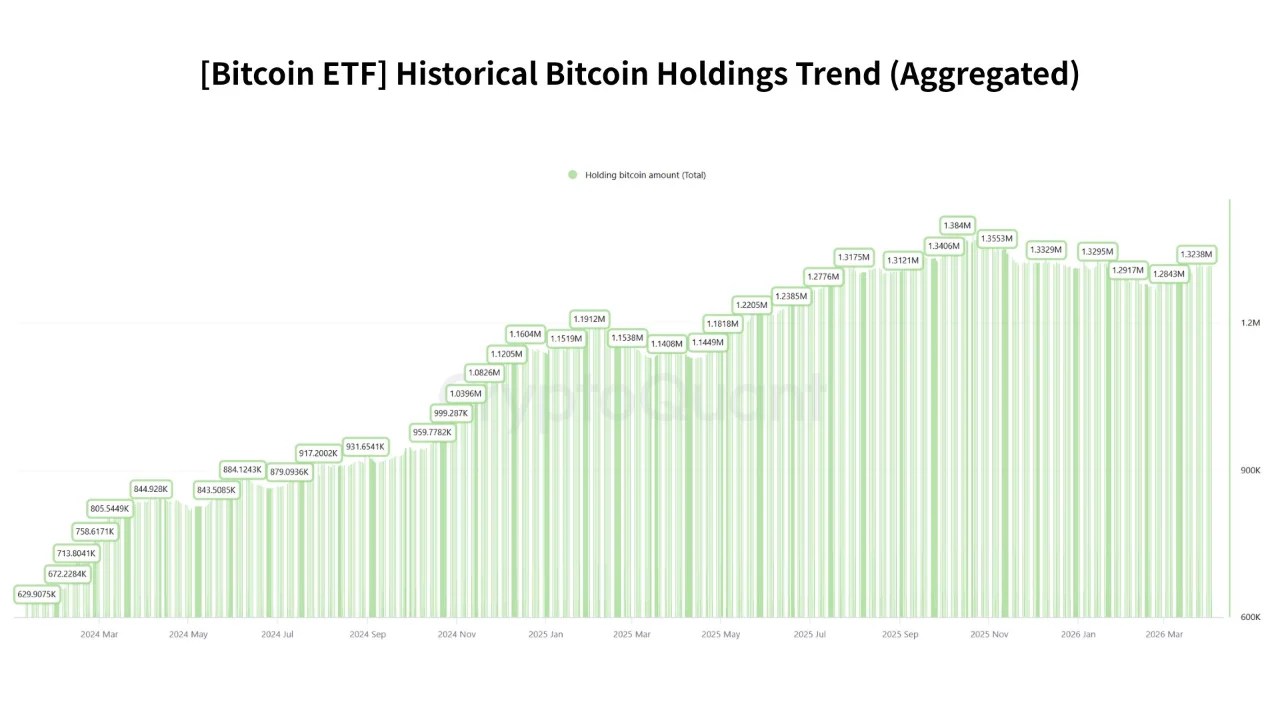
Source: CryptoQuant

For context, the average daily trading volume of the Bitcoin Spot ETFs is estimated to be in the multi-billion dollar range, with BlackRock’s IBIT intermittently experiencing levels similar to the Coinbase exchange. This observation suggests that these investment funds now play a major role in price discovery, which has been historically tied to trading volume observed on the centralized exchanges. Meanwhile, the net assets of 1.3 million BTC represent more than just inflows. XWIN Research Japan describes this development as a structural supply lock, reducing BTC liquidity in active circulation.

In particular, these changing dynamics have been attributed to the constant efforts by authorized sponsors to arbitrage price gaps as well as the approval of in-kind creation/redemption, thus ensuring that ETFs reflect spot market price and showcase a capital efficiency that encourages continued institutional adoption.

Bitcoin ETFs In Japan?

Meanwhile, XWIN Research Japan also highlighted the potential role of Japanese investors in expanding the Bitcoin ETFs market influence. With over ¥2,000 trillion ($12.53 billion) in household assets, even small allocations to a potential Bitcoin spot ETF market would result in significant inflows capable of altering the demand-supply market.

At press time, Bitcoin trades at $66,889 following a minor 1.14% gain over the last week. Meanwhile, daily trading volume is down by 41.68%, suggesting that market participants remain largely apprehensive despite recent gains. Over the last week, the premier cryptocurrency maintained a price range of $66,000-$69,000, amid multiple retest attempts of the lower boundary zone. The bear market remains active with present spot prices still about 47% away from the cycle’s all-time high at $126,100.

BTC trading at $67,030 on the daily chart | Source: BTCUSDT chart on Tradingview.com

Domande pertinenti

QWhat role do US Bitcoin Spot ETFs play in the Bitcoin market beyond being investment vehicles?

AUS Bitcoin Spot ETFs are transforming into key structural components of the Bitcoin market, influencing liquidity and price discovery. They act as a structural supply lock by holding a significant amount of BTC (1.3 million BTC), reducing the active circulating supply.

QHow much cumulative net inflow and net assets have US Bitcoin Spot ETFs attracted since their launch?

AUS Bitcoin Spot ETFs have attracted a cumulative total net inflow of $55.96 billion and net assets of $86.22 billion, accounting for 6.44% of the current BTC market cap.

QWhy are Bitcoin Spot ETFs considered important for price discovery in the Bitcoin market?

ABitcoin Spot ETFs are important for price discovery because their average daily trading volume is in the multi-billion dollar range, with some like BlackRock's IBIT intermittently experiencing levels similar to major exchanges like Coinbase. This high volume allows them to play a major role in determining Bitcoin's price.

QWhat potential impact could Japanese investors have on the Bitcoin ETF market?

AJapanese investors, with over ¥2,000 trillion ($12.53 billion) in household assets, could significantly expand the Bitcoin ETF market's influence. Even small allocations to a potential Bitcoin spot ETF in Japan would result in substantial inflows capable of altering the demand-supply dynamics.

QWhat was Bitcoin's price and trading volume situation at the time of the article's publication?

AAt the time of publication, Bitcoin was trading at $66,889 with a minor 1.14% gain over the last week. However, daily trading volume was down by 41.68%, indicating that market participants remained largely apprehensive despite recent gains.

Letture associate

a16z: AI's 'Amnesia', Can Continuous Learning Cure It?

The article "a16z: AI's 'Amnesia' – Can Continual Learning Cure It?" explores the limitations of current large language models (LLMs), which, like the protagonist in the film *Memento*, are trapped in a perpetual present—unable to form new memories after training. While methods like in-context learning (ICL), retrieval-augmented generation (RAG), and external scaffolding (e.g., chat history, prompts) provide temporary solutions, they fail to enable true internalization of new knowledge. The authors argue that compression—the core of learning during training—is halted at deployment, preventing models from generalizing, discovering novel solutions (e.g., mathematical proofs), or handling adversarial scenarios. The piece introduces *continual learning* as a critical research direction to address this, categorizing approaches into three paths: 1. **Context**: Scaling external memory via longer context windows, multi-agent systems, and smarter retrieval. 2. **Modules**: Using pluggable adapters or external memory layers for specialization without full retraining. 3. **Weights**: Enabling parameter updates through sparse training, test-time training, meta-learning, distillation, and reinforcement learning from feedback. Challenges include catastrophic forgetting, safety risks, and auditability, but overcoming these could unlock models that learn iteratively from experience. The conclusion emphasizes that while context-based methods are effective, true breakthroughs require models to compress new information into weights post-deployment, moving from mere retrieval to genuine learning.

marsbit2 h fa

a16z: AI's 'Amnesia', Can Continuous Learning Cure It?

marsbit2 h fa

Can a Hair Dryer Earn $34,000? Deciphering the Reflexivity Paradox in Prediction Markets

An individual manipulated a weather sensor at Paris Charles de Gaulle Airport with a portable heat source, causing a Polymarket weather market to settle at 22°C and earning $34,000. This incident highlights a fundamental issue in prediction markets: when a market aims to reflect reality, it also incentivizes participants to influence that reality. Prediction markets operate on two layers: platform rules (what outcome counts as a win) and data sources (what actually happened). While most focus on rules, the real vulnerability lies in the data source. If reality is recorded through a specific source, influencing that source directly affects market settlement. The article categorizes markets by their vulnerability: 1. **Single-point physical data sources** (e.g., weather stations): Easily manipulated through physical interference. 2. **Insider information markets** (e.g., MrBeast video details): Insiders like team members use non-public information to trade. Kalshi fined a剪辑师 $20,000 for insider trading. 3. **Actor-manipulated markets** (e.g., Andrew Tate’s tweet counts): The subject of the market can control the outcome. Evidence suggests Tate’sociated accounts coordinated to profit. 4. **Individual-action markets** (e.g., WNBA disruptions): A single person can execute an event to profit from their pre-placed bets. Kalshi and Polymarket handle these issues differently. Kalshi enforces strict KYC, publicly penalizes insider trading, and reports to regulators. Polymarket, with its anonymous wallet-based system, has historically been more permissive, arguing that insider information improves market accuracy. However, it cooperated with authorities in the "Van Dyke case," where a user traded on classified government information. The core paradox is reflexivity: prediction markets are designed to discover truth, but their financial incentives can distort reality. The more valuable a prediction becomes, the more likely participants are to influence the event itself. The market ceases to be a mirror of reality and instead shapes it.

marsbit3 h fa

Can a Hair Dryer Earn $34,000? Deciphering the Reflexivity Paradox in Prediction Markets

marsbit3 h fa

Trading

Spot
Futures
活动图片