How Bitcoin and Ethereum absorbed $500 mln last week – Without a rally

ambcryptoPubblicato 2025-12-15Pubblicato ultima volta 2025-12-15

Introduzione

Bitcoin and Ethereum spot ETFs recorded over $500 million in net inflows between December 8th and 12th, yet both cryptocurrencies showed almost no price movement during that period. Bitcoin ETFs attracted $287 million, largely driven by BlackRock’s IBIT, while Ethereum ETFs saw $209 million in inflows, led by products from BlackRock and Fidelity. Despite this steady institutional demand, Bitcoin traded around $89,600, down 2.16% for the week, and Ethereum hovered near $3,127, dipping just 0.23%. The market’s muted reaction is attributed to several factors: traders had priced in a Federal Reserve rate cut in advance, Bitcoin faced strong resistance near the $92K–$94K range, and overall risk sentiment remained cautious. ETF-driven demand appears to be more focused on strategic, long-term allocation rather than short-term speculation. Bitcoin ETFs now hold approximately $118.3 billion in net assets, and Ethereum ETFs manage around $19.4 billion, indicating significant capital commitment. The disconnect between steady inflows and flat prices suggests that price is no longer an immediate indicator of demand. If inflows continue with low volatility, the next significant price move could be sudden and unexpected as ownership shifts quietly.

Bitcoin and Ethereum just had a strong week on paper, but you wouldn’t know it by looking at prices.

Between the 8th and 12th of December, Bitcoin and Ethereum spot ETFs combined pulled in a little more than $500 million in net inflows! And yet, both assets barely budged.

It’s strange. Steady money is coming in, yet prices are going nowhere.

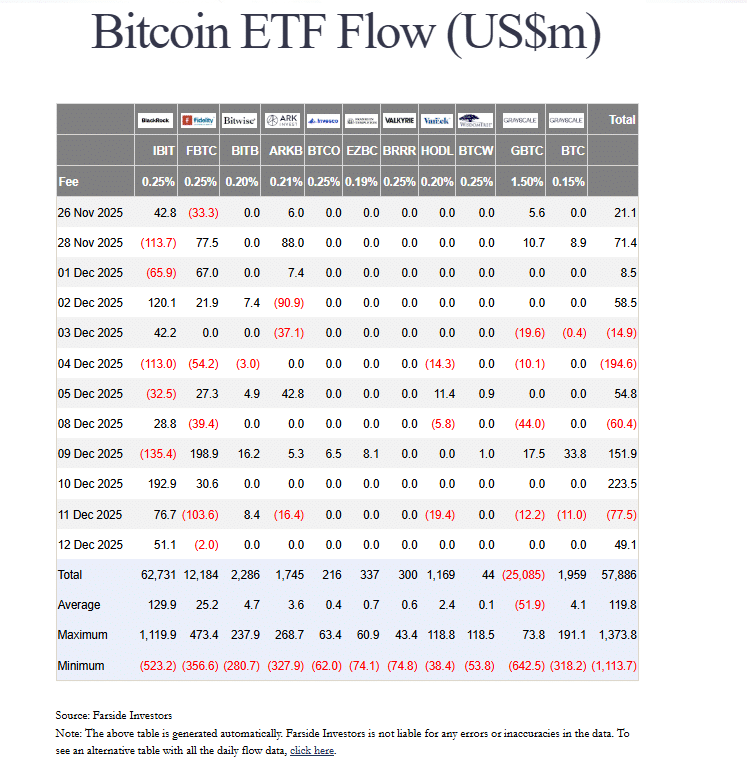
ETF money kept coming, prices didn’t

Source: Farside Investors

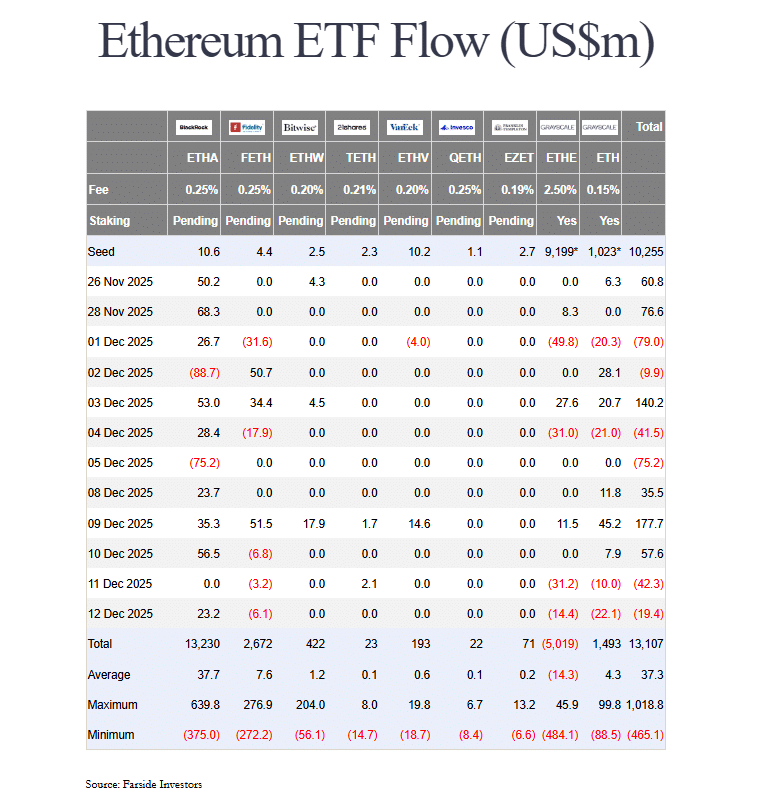
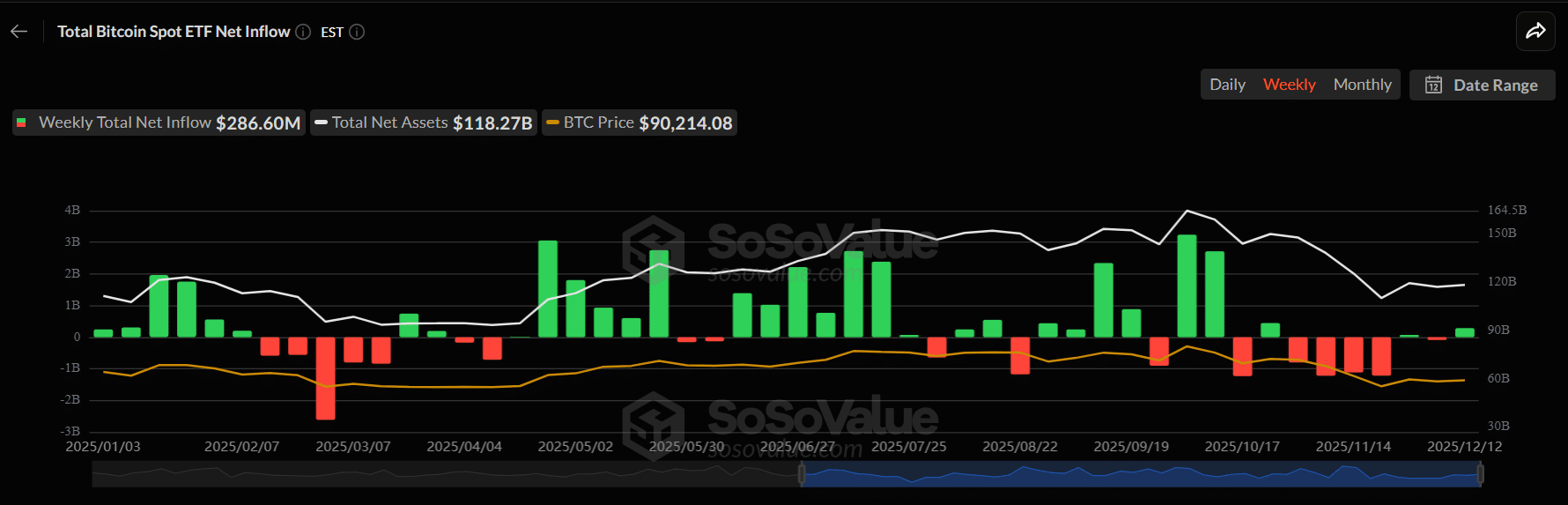
Between the 8th and 12th of December, Bitcoin ETFs recorded $287 million in net inflows, led largely by BlackRock’s IBIT, which saw consistent daily additions despite a few mixed sessions.

Source: Farside Investors

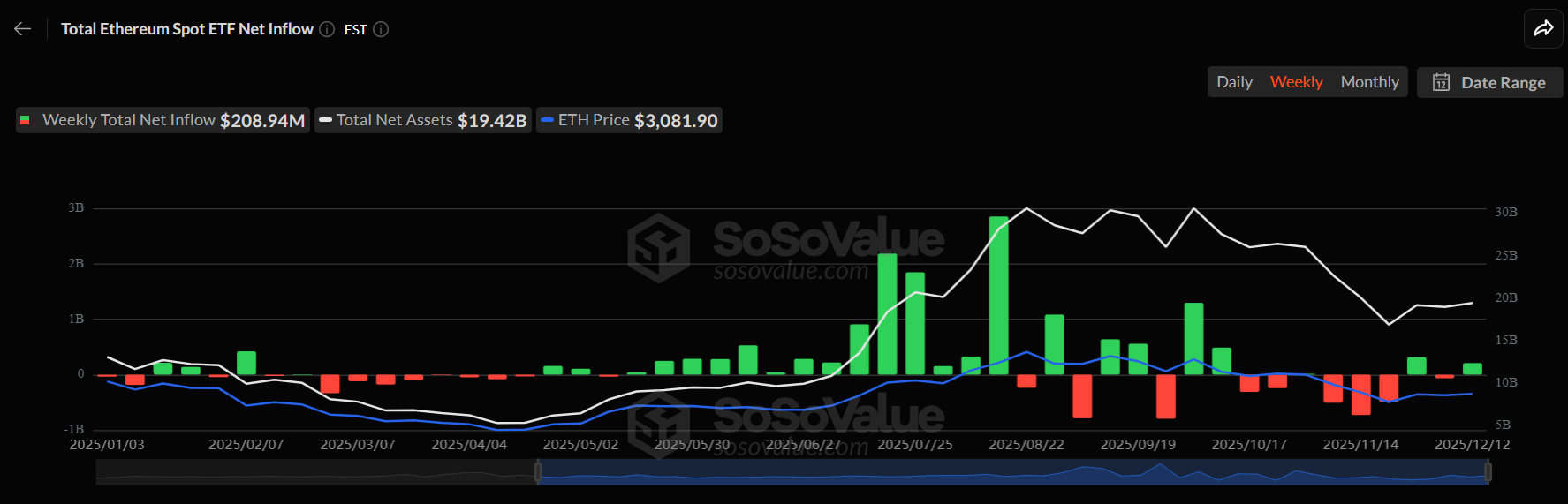
Ethereum ETFs followed a similar pattern, posting $209 million in weekly inflows, with BlackRock’s ETHA and Fidelity’s FETH leading the demand.

Source: CoinMarketCap

However, Bitcoin [BTC] traded near $89.6K, down 2.16% on the week, with a market cap of roughly $1.78 trillion.

Ethereum [ETH] traded around $3,127, slipping just 0.23% over the week, with a market value close to $377 billion.

The market is absorbing capital with steady ETF buying, calmer price moves, and no rush from traders on either side.

Why did prices stay flat?

Market forces kept Bitcoin and Ethereum prices largely range-bound. Traders were still digesting a Federal Reserve rate cut that failed to spark a rally, as the move had already been fully priced in.

Bitcoin also struggled to break resistance around the $92K-$94K range, keeping prices capped. Risk sentiment remained cautious into early December.

As a result, Bitcoin traded at nearly $90,000 throughout the week and Ethereum traded between $3.1K to 3.2K. ETF demand is increasingly centered around longer-term allocation than impulse.

2025 in ETFs

Bitcoin and Ethereum ETFs have continued to grow steadily despite long stretches of flat or declining prices.

Source: SoSoValue

Bitcoin spot ETFs now hold about $118.3 billion in total net assets, while Ethereum ETFs sit near $19.4 billion, so there’s strong capital commitment.

Source: SoSoValue

Even in weeks like the latest one, price barely reacted. That disconnect means that price is no longer the immediate feedback loop for demand.

If inflows remain steady with subdued volatility, the next move may surprise you. Ownership will have shifted hands while the market looked elsewhere.


Final Thoughts

  • $500M+ in Bitcoin and Ethereum ETF inflows met flat prices this last week.
  • When ownership shifts without chaos, the next Bitcoin and Ethereum move often comes fast and unexpected.
Next: Is Bitcoin done dumping? What BTC accumulation trends say
Share
  • Share
  • Tweet

Letture associate

How Many Tokens Away Is Yang Zhilin from the 'Moon Chasing the Light'?

The article explores the intense competition between two leading Chinese AI companies, DeepSeek and Kimi (Moon Dark Side), and the mounting pressure on Yang Zhilin, the founder of Kimi. While DeepSeek re-emerged after 15 months of silence with its powerful V4 model—boasting 1.6 trillion parameters and low-cost, long-context capabilities—Kimi has been focusing on long-context processing and multi-agent systems with its K2.6 model. Yang faces a threefold challenge: technological rivalry, commercialization pressure, and investor expectations. Despite Kimi’s high valuation (reaching $18 billion), its revenue heavily relies on a single product with low paid conversion rates, while DeepSeek’s strategic silence and open-source influence have strengthened its market position and valuation prospects, now targeting over $20 billion. Both companies reflect broader trends in China’s AI ecosystem: Kimi aims for global influence through open-source contributions and agent-based advancements, while DeepSeek prioritizes foundational innovation and hardware independence, notably shifting to Huawei’s chips. Their competition is seen as vital for China’s AI progress, with the gap between top Chinese and U.S. models narrowing to just 2.7% on the Elo rating scale. Ultimately, the article argues that this rivalry, though anxiety-inducing for leaders like Zhilin, is essential for driving innovation and solidifying China’s role in the global AI landscape.

marsbit3 h fa

How Many Tokens Away Is Yang Zhilin from the 'Moon Chasing the Light'?

marsbit3 h fa

TechFlow Intelligence Bureau: ChatGPT Helps Amateur Mathematician Crack 60-Year-Old Problem, CFTC Sues New York Regulator Over Coinbase and Gemini

An amateur mathematician, with the assistance of ChatGPT, has solved a combinatorial mathematics puzzle originally proposed by Hungarian mathematician Paul Erdős in the 1960s. This marks another milestone in AI-aided mathematical research, demonstrating the evolving capabilities of large language models in formal reasoning. In other AI developments, OpenAI introduced a new privacy filter tool for enterprise API usage, automatically screening sensitive data. Meanwhile, the Qwen3.6-27B model achieved 100 tokens per second on a single RTX 5090 GPU using quantization, significantly lowering the cost barrier for local AI deployment. In crypto and Web3, the U.S. CFTC sued New York’s financial regulator, challenging its oversight of Coinbase and Gemini—a first-of-its-kind federal-state regulatory clash. Following a vulnerability, KelpDAO and major DeFi protocols established a recovery fund. Tether froze $344 million in assets linked to Iran’s central bank upon U.S. Treasury request, highlighting the centralized control risks in stablecoins. Separately, Litecoin underwent a 3-hour chain reorganization to undo a privacy-layer exploit. In the U.S., former President Trump invoked the Defense Production Act to address power grid bottlenecks affecting AI data centers and dismissed the entire National Science Board, raising concerns over research independence. A retail trader gained 250% on a $600k Intel options bet amid AI-related speculation. Xiaomi announced its first performance electric vehicle, targeting rivals like Tesla. Meanwhile, iPhone users reported devices automatically reinstalling a hidden app daily, suspected to be MDM-related. A Chinese securities report noted that A-share institutional crowding has reached its second-longest streak since 2007, signaling high valuations and potential style rotation. The day’s developments reflect a dual narrative: AI is enabling unprecedented individual breakthroughs, while centralized power structures—whether governmental or corporate—are becoming more assertive, underscoring that decentralization is as much a political-economic challenge as a technical one.

marsbit3 h fa

TechFlow Intelligence Bureau: ChatGPT Helps Amateur Mathematician Crack 60-Year-Old Problem, CFTC Sues New York Regulator Over Coinbase and Gemini

marsbit3 h fa

Trading

Spot
Futures

Articoli Popolari

Cosa è WL

I. Introduzione al ProgettoWorldLand è una L2 o side chain di Ethereum, progettata come una soluzione dal basso verso l'alto per migliorare l'ecosistema di Ethereum.II. Informazioni sul Token1) Informazioni di BaseNome del token: WL (WorldLand)III. Link CorrelatiSito web:https://worldland.foundation/Esploratori:https://bscscan.com/address/0x8aaB31fbc69C92fa53f600910Cf0f215531F8239Social:https://x.com/WorldLand_space Nota: L'introduzione al progetto proviene dai materiali pubblicati o forniti dal team ufficiale del progetto, che sono solo a scopo di riferimento e non costituiscono consulenza per gli investimenti. HTX non si assume alcuna responsabilità per eventuali perdite dirette o indirette risultanti.

294 Totale visualizzazioniPubblicato il 2026.03.28Aggiornato il 2026.03.28

Cosa è WL

Come comprare WL

Benvenuto in HTX.com! Abbiamo reso l'acquisto di WorldLand (WL) semplice e conveniente. Segui la nostra guida passo passo per intraprendere il tuo viaggio nel mondo delle criptovalute.Step 1: Crea il tuo Account HTXUsa la tua email o numero di telefono per registrarti il tuo account gratuito su HTX. Vivi un'esperienza facile e sblocca tutte le funzionalità,Crea il mio accountStep 2: Vai in Acquista crypto e seleziona il tuo metodo di pagamentoCarta di credito/debito: utilizza la tua Visa o Mastercard per acquistare immediatamente WorldLandWL.Bilancio: Usa i fondi dal bilancio del tuo account HTX per fare trading senza problemi.Terze parti: abbiamo aggiunto metodi di pagamento molto utilizzati come Google Pay e Apple Pay per maggiore comodità.P2P: Fai trading direttamente con altri utenti HTX.Over-the-Counter (OTC): Offriamo servizi su misura e tassi di cambio competitivi per i trader.Step 3: Conserva WorldLand (WL)Dopo aver acquistato WorldLand (WL), conserva nel tuo account HTX. In alternativa, puoi inviare tramite trasferimento blockchain o scambiare per altre criptovalute.Step 4: Scambia WorldLand (WL)Scambia facilmente WorldLand (WL) nel mercato spot di HTX. Accedi al tuo account, seleziona la tua coppia di trading, esegui le tue operazioni e monitora in tempo reale. Offriamo un'esperienza user-friendly sia per chi ha appena iniziato che per i trader più esperti.

219 Totale visualizzazioniPubblicato il 2026.03.28Aggiornato il 2026.03.28

Come comprare WL

Come comprare BASED

Benvenuto in HTX.com! Abbiamo reso l'acquisto di Based (BASED) semplice e conveniente. Segui la nostra guida passo passo per intraprendere il tuo viaggio nel mondo delle criptovalute.Step 1: Crea il tuo Account HTXUsa la tua email o numero di telefono per registrarti il tuo account gratuito su HTX. Vivi un'esperienza facile e sblocca tutte le funzionalità,Crea il mio accountStep 2: Vai in Acquista crypto e seleziona il tuo metodo di pagamentoCarta di credito/debito: utilizza la tua Visa o Mastercard per acquistare immediatamente BasedBASED.Bilancio: Usa i fondi dal bilancio del tuo account HTX per fare trading senza problemi.Terze parti: abbiamo aggiunto metodi di pagamento molto utilizzati come Google Pay e Apple Pay per maggiore comodità.P2P: Fai trading direttamente con altri utenti HTX.Over-the-Counter (OTC): Offriamo servizi su misura e tassi di cambio competitivi per i trader.Step 3: Conserva Based (BASED)Dopo aver acquistato Based (BASED), conserva nel tuo account HTX. In alternativa, puoi inviare tramite trasferimento blockchain o scambiare per altre criptovalute.Step 4: Scambia Based (BASED)Scambia facilmente Based (BASED) nel mercato spot di HTX. Accedi al tuo account, seleziona la tua coppia di trading, esegui le tue operazioni e monitora in tempo reale. Offriamo un'esperienza user-friendly sia per chi ha appena iniziato che per i trader più esperti.

457 Totale visualizzazioniPubblicato il 2026.03.30Aggiornato il 2026.03.30

Come comprare BASED

Discussioni

Benvenuto nella Community HTX. Qui puoi rimanere informato sugli ultimi sviluppi della piattaforma e accedere ad approfondimenti esperti sul mercato. Le opinioni degli utenti sul prezzo di A A sono presentate come di seguito.

活动图片