Hot Perp DEX Recent Updates: Find the Best Way to Participate

Odaily星球日报Pubblicato 2025-12-18Pubblicato ultima volta 2025-12-18

Introduzione

Despite a generally cool market, Perp DEX platforms remain highly active due to airdrop incentives and stable trading volumes. Here are key updates from three popular Perp DEXs: **StandX** launched its mainnet trading points program, with daily volume exceeding $100 million. Users earn points by depositing DUSD, providing liquidity, trading, or inviting friends. A trading competition is planned, along with more trading pairs. **Aster**, currently leading in daily trading volume among Perp DEXs, continues its monthly airdrop campaigns. Phase 4 is ongoing until Dec 22, and Phase 5 will run from Dec 22 to Feb 1, 2026, distributing 1.2% of total supply. Aster has also increased its daily buyback and burn rate to ~$4 million and launched a human vs. AI trading competition. **Lighter** has been added to Coinbase's listing roadmap, but its TGE may be delayed until late December or early January. Its points system for traders remains opaque ("a blind box"), considering factors like volume and PnL. The team emphasizes a long-term approach to token value rather than a pump at launch.

Original | Odaily Planet Daily (@OdailyChina)

Author | Asher (@Asher_ 0210)
Although the overall market has been relatively cold recently, driven by incentives such as token airdrops, the community discussion around the Perp DEX sector remains highly active, and daily trading volume has remained stable without significant decline. Next, Odaily Planet Daily will summarize the recent key updates from 3 highly discussed Perp DEX platforms to see what offers the best value at this stage.

StandX: Trading Points Activity Now Live on Mainnet, Trading Competition Coming Soon

On December 10, StandX announced on platform X that the trading points activity is now live on the mainnet, with the first day's trading volume exceeding $81 million, and reaching over $100 million on December 16. Users can earn points by depositing DUSD into the Perps Wallet, Vaults, or actively participating in trading (Interaction link: https://standx.com/).

This event is in cooperation with Binance Wallet. Users using Binance Wallet's keyless extension wallet will receive a 10% points bonus, which lasts for 4 weeks until January 7, 2026. Points will be retroactively awarded for all past transactions since the mainnet launch.

Furthermore, core team member Justin participated in a Chinese AMA in early December. Odaily Planet Daily summarizes the key points below:

Q1: Is there a depegging risk for the built-in stablecoin (DUSD)? How secure is it?

A1: The DUSD mechanism is secure and fully collateralized, with underlying assets like BTC and ETH; it uses a "spot long + perpetual short" basis trading strategy to maintain "market neutrality." This means the total asset value remains stable in U terms regardless of price fluctuations, only earning funding rates without bearing the risk of price volatility.

Q2: What's the difference between the Mainnet and the previous Alpha testnet?

A2: The Alpha phase used test coins, primarily for testing product features and distributing "testnet points"; the Mainnet phase uses real funds, requiring users to deposit actual USDT for trading. The current points are "mainnet points," whose value and weight differ from the testnet.

Q3: What are the project's future plans?

A3: StandX is about to launch a trading competition and plans to list more altcoin perpetual pairs. Simultaneously, the team will continue optimizing the product experience, aiming for a CEX-like (centralized Exchange) experience on the DEX.

Q4: What is the proportion of trading points vs. deposit points for the airdrop?

A4: This hasn't been finalized yet because we are currently separating points from each phase and each type, meaning rewards are earned separately. We will comprehensively evaluate the contribution of each user type and point type to the overall StandX product and ecosystem before the airdrop to decide the reward proportions.

Complete Guide to Earning StandX Points

Method 1: Deposit DUSD to get tDUSD (1.2x points), specific steps:

  • Mint DUSD with USDT/USDC;
  • Deposit DUSD into the Perps wallet to convert it to tDUSD;
  • Every 1000 tDUSD / day = 1200 points;
  • Lossless participation, suitable for newcomers and users who don't trade.

Method 2: Provide LP, points rules:

  • DUSD: Each DUSD earns 1 point per day;
  • USDT/USDC: Each USDT/USDC earns 1.2 points per day.

For example, 1000 DUSD + 1000 USDT → 2200 points/day.

Method 3: SWAP trading to earn points (specified trading pairs), every 100 DUSD trading volume = 5 points.

This method has significant slippage; "point farmers" should participate cautiously.

Method 4: Invite friends, both parties get an additional 5% points bonus.

Method 5: Trade on the StandX mainnet to earn points.

  • If profitable: More profit means more tDUSD, leading to higher points;
  • If loss: If the loss exceeds 50% of the initial capital, points are still given based on 50% of the initial capital.

Additionally, the daily trading check-in event is worth participating in. Complete two trades over $100 daily to earn 10 points.

The StandX trade-to-earn points for token airdrop is still in its early stages. Judging by the daily trading volume, it's not "very competitive" currently, making it relatively easy to earn points. It's worth participating in; even if you don't farm trading volume for points, you can deposit stablecoins to "freeload" points daily.

Aster: Monthly Airdrops + Regular Buyback & Burn; Launches Human vs. AI Trading Duel

According to the latest data from DeFiLlama, Aster's daily trading volume has recently surpassed that of Lighter (which has the highest token launch expectations), ranking first among Perp DEX projects.

Perp DEX Data

Although Aster has completed its TGE, its airdrop activities continue to progress, operating on a monthly cycle with short interaction periods and clear rewards.

Phase 4 Token Airdrop Ongoing

Currently, Phase 4 Aster Harvest officially started at 8:00 AM UTC on November 10 and will last until 7:59 AM UTC on December 22, 2025. This phase will distribute 1.5% of the total ASTER token supply, allocated equally across six epoch cycles, with 0.25% allocated per epoch.

Phase 5 Token Airdrop Starts December 22, Lasts 6 Weeks

Phase 5 Aster Crystal will begin after Phase 4 Aster Harvest concludes. Specific details are as follows:

  • Duration: 6 weeks (December 22, 2025, to February 1, 2026);
  • Allocation: 1.2% of the total supply (approx. 96 million ASTER) for Phase 5, with 0.6% claimable immediately after the event ends and the other 0.6% subject to a 3-month lock-up.

Additionally, Aster will launch the Aster chain testnet by the end of this year, the mainnet in Q1 next year, and token staking and governance functions in Q2.

Accelerates Phase 4 Buyback Execution, Daily Buyback Scale Increased to ~$4 Million

According to the latest announcement from the ASTER team, the buyback speed for Phase 4 will be increased under the existing mechanism. The accelerated buyback scale increased from approximately $3 million/day to about $4 million/day starting December 8.

The official statement said this move allows faster on-chain deployment of the fees accumulated since November 10 for Phase 4 buybacks and strengthens support during market volatility. Based on current fee levels, it's estimated that stable execution of the buyback will be reached within 8 to 10 days, after which the daily buyback scale will continue to be maintained between 60% and 90% of the previous day's revenue as per Phase 4 rules.

The team emphasized that all operations remain transparently executed on-chain, with no changes to the relevant execution wallet address (Address link: https://bscscan.com/address/0x573ca9ff6b7f164dff513077850d5cd796006ff4).

Additionally, Aster burned 77.86 million ASTER repurchased in Season 3 on December 5, worth nearly $80 million.
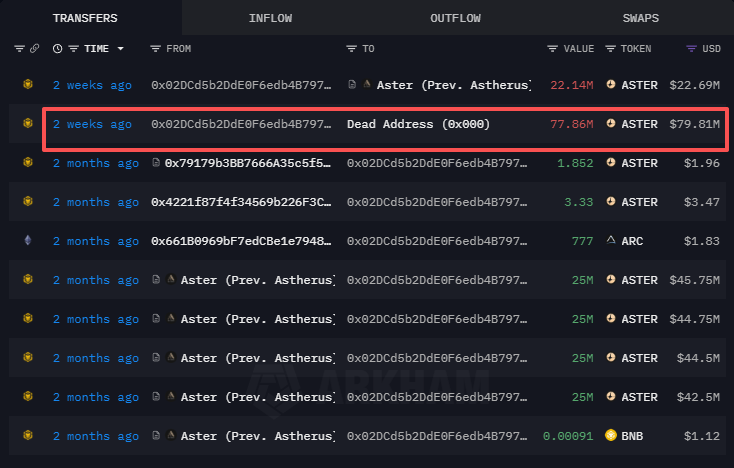
Aster Buyback Address

Launches Human vs. AI Trading Duel

On December 9, Aster announced on platform X that the Human vs. AI trading duel is live. 70 funded human traders are competing against 30 AI agents run by @nofA_ai (initial capital $10,000 each). The trading duel runs from December 9 to December 23.

As of now, only 29 out of the 100 traders (human and AI) are profitable. Among them, only 9 have profits exceeding $5,000—8 are human traders, and 1 is AI. The top performer is human trader Tippy, with profits as high as $47,000, far ahead.
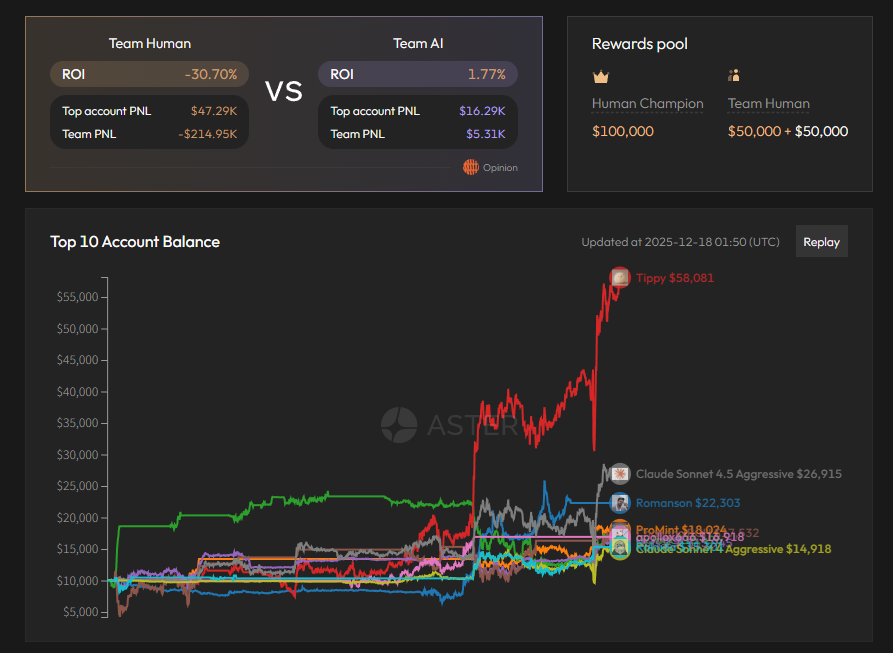
Human vs. AI Trading Profit Chart

Lighter: To List on Coinbase, but TGE Might Be Delayed

Since Lighter announced the completion of a $68 million funding round on November 11, valuing the company at $1.5 billion post-funding, its daily trading volume has consistently remained at the forefront of Perp DEXs, often ranking first. Regarding Q2 points, the official distribution is scheduled for every Friday. Market makers are allocated 50,000 points weekly (only advanced accounts are eligible to earn points through market making). Regular trading users are allocated 200,000 points weekly. Factors influencing points include: trading volume, open interest, account equity, leverage, profit/loss amount, and trading categories, but the specific weights have not been disclosed, making it a "blind box."

On December 13, Coinbase Markets announced on platform X that Lighter had been added to its listing roadmap, leading community members to believe Lighter's TGE is imminent.
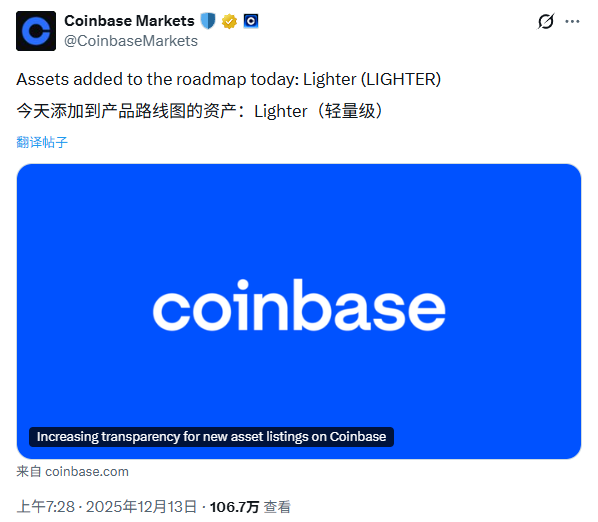
Coinbase Adds Lighter to Listing Roadmap

However, based on feedback from participants in Lighter's Japanese AMA, the TGE might be delayed to between December 24 and January 1 next year. Influenced by this news, the probability of "No" in the Polymarket event "Will Lighter airdrop tokens this year?" increased from just 8% on December 16 to 33%.
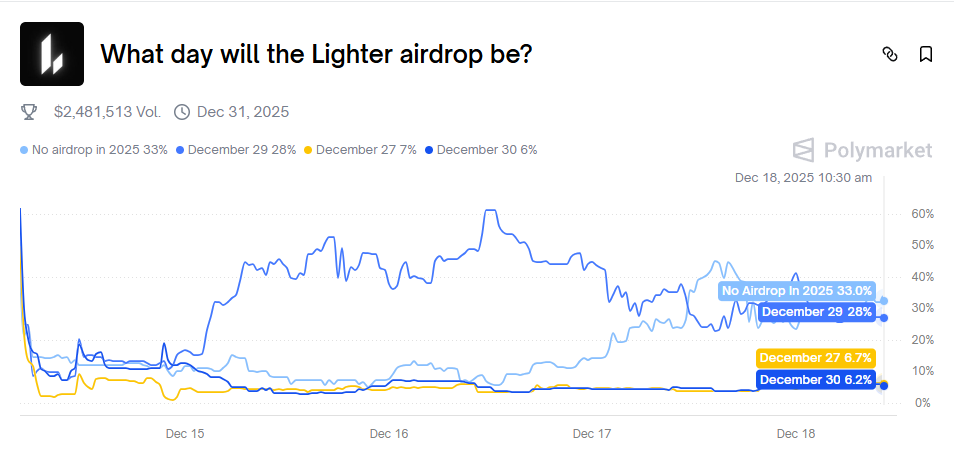
Polymarket Event: "Will Lighter Airdrop Tokens This Year?"

Furthermore, in a recent podcast interview on The Chopping Block, Lighter founder and CEO Vladimir Novakovski, when asked about the token, stated: "From an expectation management perspective, this is a marathon, not a sprint. The team and early community don't really anticipate a 'day one moonshot.' A more realistic expectation is starting from a relatively healthy position, with the overall trend gradually improving as we continue building the product. Our goal is clearly not to maximize value on day one, but to have it in a healthy state in the current market environment, and then iterate from there. We've seen too many tokens pump hard on day one and then trend downwards."

Related Content

2025 Airdrop Farming Survival Rules: Past Gold Rushes, Now Relying on These Two Trump Cards

Crypto di tendenza

Domande pertinenti

QWhat are the main ways to earn points on StandX and which method is recommended for new users?

AThe main ways to earn points on StandX are: 1) Depositing DUSD to get tDUSD (1.2x points), 2) Providing liquidity (LP), 3) SWAP trading on specified pairs, 4) Inviting friends for a 5% bonus, and 5) Trading on the mainnet. The method recommended for new users or those who don't want to trade is depositing stablecoins to 'farm' points with minimal risk.

QWhat is the current status of Aster's token airdrop and what are the key details of its upcoming Phase 5?

AAster's Phase 4 airdrop (Aster Harvest) is currently ongoing until December 22, 2025, distributing 1.5% of the total ASTER supply. Phase 5 (Aster Crystal) will begin on December 22, 2025, and last for 6 weeks until February 1, 2026. It will distribute 1.2% of the total supply (approx. 96 million ASTER), with half (0.6%) claimable immediately and the other half (0.6%) subject to a 3-month lockup.

QHow has Aster modified its token buyback mechanism in Stage 4 and what was the recent major burn event?

AAster has accelerated its Stage 4 buyback, increasing the daily buyback volume from approximately $3 million to about $4 million starting December 8th. This is executed transparently on-chain. Additionally, Aster recently burned 77.86 million ASTER tokens from the S3 season回购, valued at nearly $80 million.

QWhat was the outcome of the 'Human vs. AI Trading Duel' event hosted on Aster, and who was the top performer?

AIn the Human vs. AI Trading Duel on Aster, 70 human traders competed against 30 AI agents. As of the report, only 29 of the 100 participants were profitable. The top performer was a human trader named 'Tippy', who achieved a profit of $47,000. Only 9 traders had profits exceeding $5,000, 8 of whom were human and 1 was an AI.

QWhat is the current expectation for Lighter's TGE (Token Generation Event) according to community speculation, and what evidence suggests a potential delay?

ACommunity speculation, based on a Japanese AMA, suggests Lighter's TGE might be delayed to between December 24th and January 1st. This is further supported by the probability of 'No' on the Polymarket prediction market for 'Will Lighter airdrop its token this year?' rising from 8% to 33%.

Letture associate

Ethereum Q1 2026 Report: Fees Decline, Users and Transaction Volume Hit New Highs

Ethereum Q1 2026 Report: Fees Down, Users & Transactions Hit New Highs Token Terminal's Q1 2026 report on Ethereum presents a pivotal development: the network achieved record highs in monthly active users (13.2M, +85.9% YoY), total transactions (200.4M, +81.5% YoY), and throughput (25.78 TPS), while transaction fees on the mainnet plummeted by 47.9% quarter-over-quarter. This shift is attributed to the network's strategic move into a "low fees for scale" phase, exemplified by the Fusaka upgrade which increased data capacity and lowered block space costs, releasing pent-up demand (a manifestation of Jevons's Paradox). The report highlights a core narrative shift for Ethereum: from a DeFi-centric blockchain to a global financial settlement layer. It maintains a dominant position in tokenized assets, holding majority market shares among top chains in stablecoins (61.8%), tokenized funds (73.0%), and tokenized commodities (84.0%). Growth in tokenized funds (+73.1% YoY) and commodities (+325.9% YoY) was particularly strong, driven by institutions like BlackRock and JPMorgan entering the space. Contrasting these usage gains, several USD-denominated value metrics declined in Q1: fully diluted market cap fell 30.3% QoQ, total value locked (TVL) dropped 11.0%, and ecosystem transaction volume decreased 24.0%. The report interprets this as Ethereum prioritizing long-term network expansion and cementing its role as the default settlement layer for finance over short-term fee capture. The commentary from Etherealize argues that, much like the early internet, Ethereum's open, permissionless model is poised to win over closed alternatives as institutional tokenization accelerates.

marsbit1 h fa

Ethereum Q1 2026 Report: Fees Decline, Users and Transaction Volume Hit New Highs

marsbit1 h fa

He Just Raised 2.7 Billion, and Li Fei-Fei Also Invested

Pete Florence, a former senior research scientist at Google DeepMind and a key contributor to the Vision-Language-Action (VLA) model architecture, is deliberately distancing his startup, Generalist AI, from the trendy "world model" label. He argues that the industry should prioritize concrete goals over buzzwords. His goal is to create robots that can perform a vast range of unseen tasks with high speed and success rates, without needing task-specific training data. Recently, his company raised $400 million (¥2.7 billion) at a $2 billion valuation. Notable investors include NVIDIA's NVentures, Bezos Expeditions, NFDG, as well as Xiaomi co-founder Lin Bin, Zoom founder Eric Yuan, and renowned AI scientist Fei-Fei Li. Florence's approach stems from his academic background at MIT under Professor Russ Tedrake, focusing on understanding the physical world. After joining DeepMind, he developed models like Transporter Network and co-created the VLA framework. He left in 2025 to found Generalist AI. The company has launched two models: GEN-0, which demonstrated that scaling laws apply to physical motion, and GEN-1. GEN-1 was trained on over 500,000 hours of physical interaction data collected via a specialized wearable device. It achieves a 99% success rate on precise mechanical tasks like folding boxes and maintains performance three times faster than its predecessor. Florence believes GEN-1 is reaching a commercial utility threshold similar to the GPT-3 inflection point. The substantial funding round, following GEN-1's release, signifies strong investor confidence in Generalist AI's practical, goal-driven path to creating versatile, useful robots, regardless of the "world model" terminology.

marsbit1 h fa

He Just Raised 2.7 Billion, and Li Fei-Fei Also Invested

marsbit1 h fa

Two Legends Lost in Three Days: Is Google's AI Talent Dam Cracking?

In three days, Google lost two AI legends. On June 18, Noam Shazeer, co-author of the seminal "Attention is All You Need" paper and Gemini co-lead, left for OpenAI. Just 48 hours later, John Jumper, 2024 Nobel laureate and AlphaFold lead, departed DeepMind for Anthropic. This follows Andrej Karpathy joining Anthropic in May. These moves highlight a structural trend: top AI talent is concentrating at mission-driven, pre-IPO firms like OpenAI and Anthropic, while Google becomes a primary source. The exodus stems from a core mission mismatch. Google's ad-centric model often subordinates AI research to product and revenue goals, creating friction for pioneers like Shazeer, who returned in 2024 only to leave again. In contrast, OpenAI and Anthropic offer singular focus on pushing AI boundaries, whether towards AGI or safety-aligned models, which deeply appeals to top researchers like Jumper. Financial incentives amplify the pull. With both OpenAI and Anthropic nearing IPO, employees stand to gain immensely from equity, an upside Google's mature stock cannot match. Furthermore, the 2023 merger of Google Brain and DeepMind, intended to consolidate strength, has instead created cultural tension and slowed the path from research to product, as evidenced by Gemini's pace. This talent redistribution is reshaping the AI landscape. While Google retains vast data and compute resources, its true crisis is the quiet, continuous loss of the people who define the field's future. The real moat in AI is not infrastructure, but the concentration of brilliant minds—a battle Google is currently losing.

marsbit3 h fa

Two Legends Lost in Three Days: Is Google's AI Talent Dam Cracking?

marsbit3 h fa

Behind the AI Report Card, Lies a Chinese 'Exam Setter'

Beyond the familiar performance charts like MMLU-Pro and MMMU, which major AI models strive to ace, stands a key "examiner": Chinese-Canadian researcher Wenhu Chen. An assistant professor at the University of Waterloo and founder of TIGERLab, Chen addresses the crucial need for more rigorous AI evaluation. As models like GPT-4 began scoring near-perfect results on older benchmarks like MMLU, it became difficult to distinguish their true capabilities. In response, Chen introduced MMLU-Pro in 2024, featuring harder, more reasoning-focused questions with more answer choices, successfully reintroducing meaningful performance gaps. His work extends to multi-modal evaluation with MMMU and its enhanced version, MMMU-Pro. These benchmarks test a model's ability to understand and reason with complex information from images, charts, and text across diverse academic subjects, exposing the significant challenges even top models face in genuine comprehension. Chen's background in complex QA, table reasoning, and his experience at Google DeepMind on projects like Gemini inform his approach. He understands that effective benchmarks must anticipate how models might "cheat" by memorizing data or avoiding visual analysis. His lab also actively researches video understanding and generation models (e.g., UniVideo, Vamba), ensuring his evaluation work is grounded in practical model-building challenges. Now at Meta's Super Intelligence Lab, Chen continues his focus on multi-modal data and evaluation, representing the deep yet often unseen contributions of Chinese talent in shaping the fundamental tools of the AI industry.

marsbit3 h fa

Behind the AI Report Card, Lies a Chinese 'Exam Setter'

marsbit3 h fa

Trading

Spot
Futures

Articoli Popolari

Come comprare HOT

Benvenuto in HTX.com! Abbiamo reso l'acquisto di Holo (HOT) semplice e conveniente. Segui la nostra guida passo passo per intraprendere il tuo viaggio nel mondo delle criptovalute.Step 1: Crea il tuo Account HTXUsa la tua email o numero di telefono per registrarti il tuo account gratuito su HTX. Vivi un'esperienza facile e sblocca tutte le funzionalità,Crea il mio accountStep 2: Vai in Acquista crypto e seleziona il tuo metodo di pagamentoCarta di credito/debito: utilizza la tua Visa o Mastercard per acquistare immediatamente HoloHOT.Bilancio: Usa i fondi dal bilancio del tuo account HTX per fare trading senza problemi.Terze parti: abbiamo aggiunto metodi di pagamento molto utilizzati come Google Pay e Apple Pay per maggiore comodità.P2P: Fai trading direttamente con altri utenti HTX.Over-the-Counter (OTC): Offriamo servizi su misura e tassi di cambio competitivi per i trader.Step 3: Conserva Holo (HOT)Dopo aver acquistato Holo (HOT), conserva nel tuo account HTX. In alternativa, puoi inviare tramite trasferimento blockchain o scambiare per altre criptovalute.Step 4: Scambia Holo (HOT)Scambia facilmente Holo (HOT) nel mercato spot di HTX. Accedi al tuo account, seleziona la tua coppia di trading, esegui le tue operazioni e monitora in tempo reale. Offriamo un'esperienza user-friendly sia per chi ha appena iniziato che per i trader più esperti.

98 Totale visualizzazioniPubblicato il 2024.12.11Aggiornato il 2026.06.02

Come comprare HOT

Cosa è HOLO

Comprendere HOLO: Il Futuro delle Applicazioni Decentralizzate Introduzione a HOLO, $holo Nel panorama in rapida evoluzione delle criptovalute e delle tecnologie decentralizzate, HOLO, noto anche come Holo, è emerso come un attore notevole. Questo progetto innovativo facilita lo sviluppo di applicazioni decentralizzate (DApps) attraverso la sua architettura sottostante conosciuta come Holochain. Con una visione di creare un ponte tra l'internet centralizzato che conosciamo oggi e l'ecosistema decentralizzato del futuro, HOLO mira a rendere le DApps accessibili all'utente comune senza gli ostacoli di installazioni complesse e competenze tecniche. Cos'è HOLO, $holo? Alla sua base, HOLO è una piattaforma distribuita progettata per ospitare DApps costruite su Holochain. A differenza delle tradizionali piattaforme blockchain, Holochain adotta un approccio unico consentendo a ciascuna applicazione di funzionare secondo un proprio insieme di regole. Il mandato di HOLO è connettere queste applicazioni Holochain (hApps) con gli utenti tramite tecnologie web familiari. L'obiettivo principale di HOLO è democratizzare l'accesso e l'uso delle DApps consentendo agli utenti di accedere a queste applicazioni direttamente attraverso i normali browser web. Questa accessibilità è fondamentale per ridurre le frizioni per gli utenti medi di internet, permettendo loro di utilizzare applicazioni di nuova generazione senza dover affrontare le complessità spesso associate alle criptovalute e all'uso delle DApp. Creatore di HOLO, $holo HOLO nasce dalla visione dei suoi creatori, Arthur Brock ed Eric Harris-Braun. Entrambi sviluppatori esperti e programmatori di contratti, hanno avviato il progetto nel dicembre 2016 come parte del MetaCurrency Project. Questa iniziativa era inizialmente focalizzata sullo sviluppo di strumenti e tecnologie mirati a promuovere un'economia peer-to-peer. I loro background nella programmazione e nelle iniziative imprenditoriali li hanno posizionati in modo unico per affrontare le sfide dello sviluppo e dell'hosting di applicazioni decentralizzate. Investitori di HOLO, $holo Sebbene i dettagli specifici riguardanti investitori individuali in HOLO non siano facilmente disponibili, è evidente che il progetto ha ricevuto un sostegno significativo e attenzione dalla comunità più ampia delle criptovalute. Il suo approccio innovativo all'hosting di applicazioni decentralizzate, insieme a una comunità di supporto, ha alimentato l'interesse e l'investimento nel progetto. Come funziona HOLO, $holo? HOLO opera creando un ampio ecosistema in cui gli host contribuiscono con spazio di archiviazione e potenza di elaborazione per le DApps basate su Holochain. Trasformando i loro dispositivi o anche hardware dedicato come HoloPorts in nodi di hosting, gli individui possono monetizzare efficacemente le risorse inutilizzate dei loro computer. I principali componenti funzionali di HOLO includono: Fornitore di Applicazioni: Queste entità acquistano crediti di hosting da HOLO, che vengono mantenuti in un conto di riserva. Questo meccanismo consente agli sviluppatori di DApp di garantire le risorse necessarie per eseguire le loro applicazioni. Host: Individui o organizzazioni che scelgono di ospitare DApps generano log di servizio firmati mentre rispondono alle richieste degli utenti. Questo processo garantisce che tutte le interazioni sulla rete siano tracciate e autenticate. Prova di Servizio: Un elemento cruciale dell'integrità operativa di HOLO, gli host presentano fatture ai fornitori di applicazioni, che poi convalidano il servizio fornito. Una volta convalidato, gli host ricevono compenso sotto forma di crediti di hosting. HoloFuel: Servendo come token nativo della rete Holo, HoloFuel è progettato per microtransazioni. Questo token facilita l'ampio throughput di transazioni necessario affinché la piattaforma supporti miliardi di transazioni simultanee senza problemi. La sinergia combinata di questi componenti garantisce un ambiente di hosting robusto e decentralizzato, spingendo l'utilità e la portata delle applicazioni Holochain. Cronologia di HOLO, $holo Il percorso di HOLO è stato segnato da diversi traguardi sin dalla sua nascita: Dicembre 2016: L'inizio di HOLO da parte di Arthur Brock ed Eric Harris-Braun come parte del MetaCurrency Project. 2018: L'emissione di un token ERC20, noto come HoloToken (HOT), ha servito come un “IOU” che è riscattabile per HoloFuel al lancio del progetto. Sviluppo Continuo: Avanzamenti, test e ottimizzazione continui della rete Holo e di HoloFuel, assicurando che il progetto rimanga all'avanguardia della tecnologia di hosting di applicazioni decentralizzate. Caratteristiche Uniche di HOLO, $holo HOLO si distingue nel campo affollato delle criptovalute e delle piattaforme decentralizzate grazie alle sue caratteristiche distintive e al framework innovativo su cui opera: Hosting Peer-to-Peer: HOLO apre la porta a chiunque per diventare un host per DApps semplicemente utilizzando i propri computer. Questa democratizzazione dell'hosting è simile a come piattaforme come Airbnb hanno interrotto l'industria alberghiera tradizionale dando potere agli individui di partecipare all'economia. Framework Holochain: Centrale alle innovazioni di HOLO è il framework Holochain stesso. Posizionato come una tecnologia di nuova generazione, Holochain vanta scalabilità senza pari, velocità di transazione rapide, eccezionale efficienza energetica e convenienza rispetto alle tecnologie blockchain convenzionali. HoloFuel per Microtransazioni: HoloFuel è meticolosamente progettato per accogliere microtransazioni, consentendo alla rete Holo di gestire efficientemente miliardi di transazioni contemporaneamente. Questa capacità è fondamentale per l'adozione mainstream, consentendo agli sviluppatori di creare applicazioni che siano economicamente sostenibili su larga scala. Conclusione HOLO rappresenta un significativo avanzamento nel panorama delle applicazioni decentralizzate e della tecnologia blockchain. Con la sua infrastruttura robusta, un approccio user-friendly e il framework innovativo Holochain, HOLO è pronto a svolgere un ruolo cruciale nel futuro del web. Se migliorerà le esperienze quotidiane su internet o ridefinirà il modo in cui sviluppatori e utenti interagiscono con le applicazioni digitali rimane da vedere, ma i suoi progressi finora meritano di essere seguiti mentre il mondo continua a muoversi verso un'economia digitale decentralizzata. Man mano che il progetto evolve, i suoi sviluppi in corso e il coinvolgimento della comunità saranno componenti cruciali del suo successo, potenzialmente stabilendo HOLO come una piattaforma mainstream per applicazioni decentralizzate. Con il crescente interesse attorno alle tecnologie decentralizzate, l'importanza e l'impatto di progetti come HOLO aumenteranno solo negli anni a venire.

101 Totale visualizzazioniPubblicato il 2024.12.26Aggiornato il 2024.12.26

Cosa è HOLO

Discussioni

Benvenuto nella Community HTX. Qui puoi rimanere informato sugli ultimi sviluppi della piattaforma e accedere ad approfondimenti esperti sul mercato. Le opinioni degli utenti sul prezzo di HOT HOT sono presentate come di seguito.

活动图片