Hot Interactions Collection | xStocks Points Event Now Live; Tempo Mainnet Launches (March 25)

Odaily星球日报Pubblicato 2026-03-25Pubblicato ultima volta 2026-03-25

Introduzione

This article highlights three major interactive opportunities in the crypto space: 1. **xStocks**: A tokenized stock platform backed by Kraken, allowing users to trade tokenized versions of real-world assets. It recently launched an xPoints rewards program where users can earn points by holding tokenized stocks, borrowing/lending, and providing liquidity. Users can connect their wallet, complete daily check-ins, and join the Telegram for bonus points. 2. **Tempo**: A payment-focused Layer 1 blockchain incubated by Stripe and Paradigm. Unlike typical blockchains, it uses stablecoins like USDC/USDT for gas fees. After raising $500M in funding, it has now launched its mainnet. Users can create a wallet using a passkey and bridge USDC to the Tempo network via Stargate. 3. **Forte Protocol**: A blockchain infrastructure project focused on compliance and economic tools, which raised $910M in 2021. It has launched two Galxe quests: one for social media tasks (X account required) and another for Galxe subscribers or users with a high Human Passport score.

Original | Odaily Planet Daily (@OdailyChina)

Author | Asher (@Asher_ 0210)

xStocks: U.S. Stock Tokenization Platform

Project Introduction

Backed Finance is an infrastructure provider responsible for issuing on-chain representations of traditional financial assets, including stocks, ETFs, and bonds. The company was acquired by Kraken in December 2025 and launched xStocks in June of the same year, offering tokenized stock products backed by real stocks held by Swiss custody partners. Currently, xStocks is integrated into multiple centralized platforms, including Kraken, Gate, Bybit, and Bitget, and supports Ethereum, Solana, and Tron.

On March 11, xStocks announced on platform X the launch of the xPoints rewards program. On March 18, it announced that points (xPoints) are now viewable. Users automatically accumulate points by holding tokenized stocks in their wallets, establishing positions in lending markets, and providing liquidity on DEXs.

Interaction Tutorial

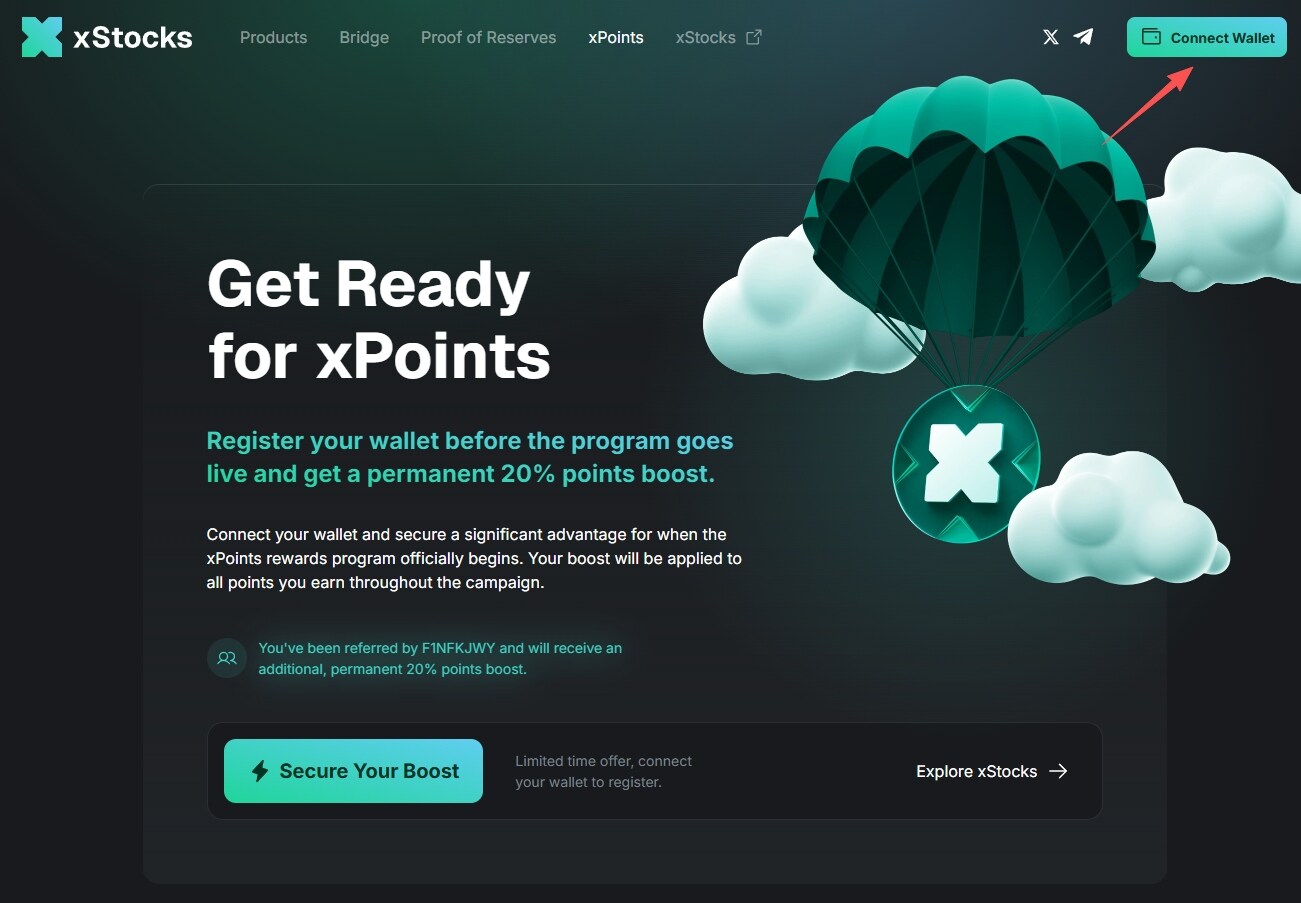
STEP 1. Go to the official website (Link: https://defi.xstocks.fi/points), click "Connect Wallet" to log in.
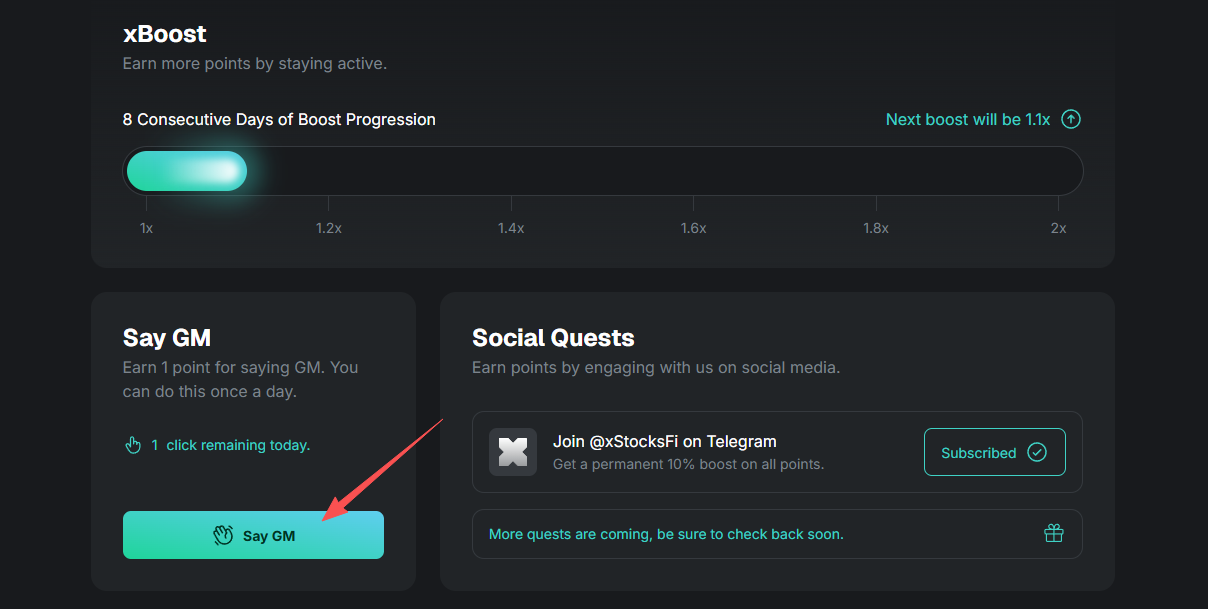
STEP 2. Click GM (daily check-in type task) to earn points. Additionally, joining the official TG and verifying will grant a 10% points bonus.
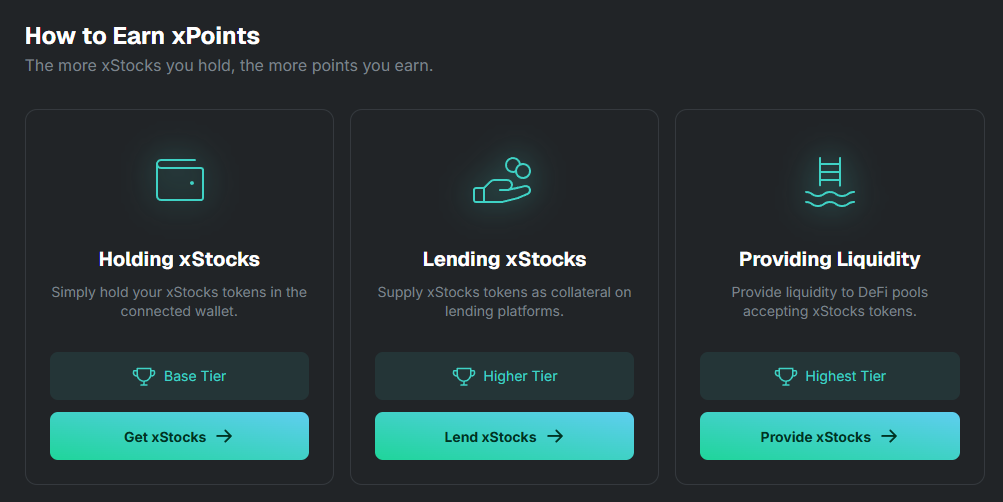
STEP 3. Earn points through three main methods: holding xStocks tokens, borrowing xStocks tokens, and providing liquidity for xStocks tokens, with increasing weight for each method.
Tempo: L1 Project Focused on the Payments Track

Project Introduction

Tempo is an L1 project focused on payments, jointly incubated by Stripe and Paradigm. Its biggest difference from traditional public chains is that it does not issue its own native token but directly accepts mainstream stablecoins like USDC and USDT as Gas.

According to ROOTDATA data, Tempo completed a $500 million Series A funding round on October 8, 2025, led by venture capital giants Greenoaks and Joshua Kushner's Thrive Capital. This round valued Tempo at $5 billion, with participation from Sequoia Capital, Ribbit Capital, and Ron Conway's SV Angel.

On March 18, Tempo announced the launch of its mainnet, marking the official transition of its stablecoin payment system from the testing phase to practical application.

Interaction Tutorial

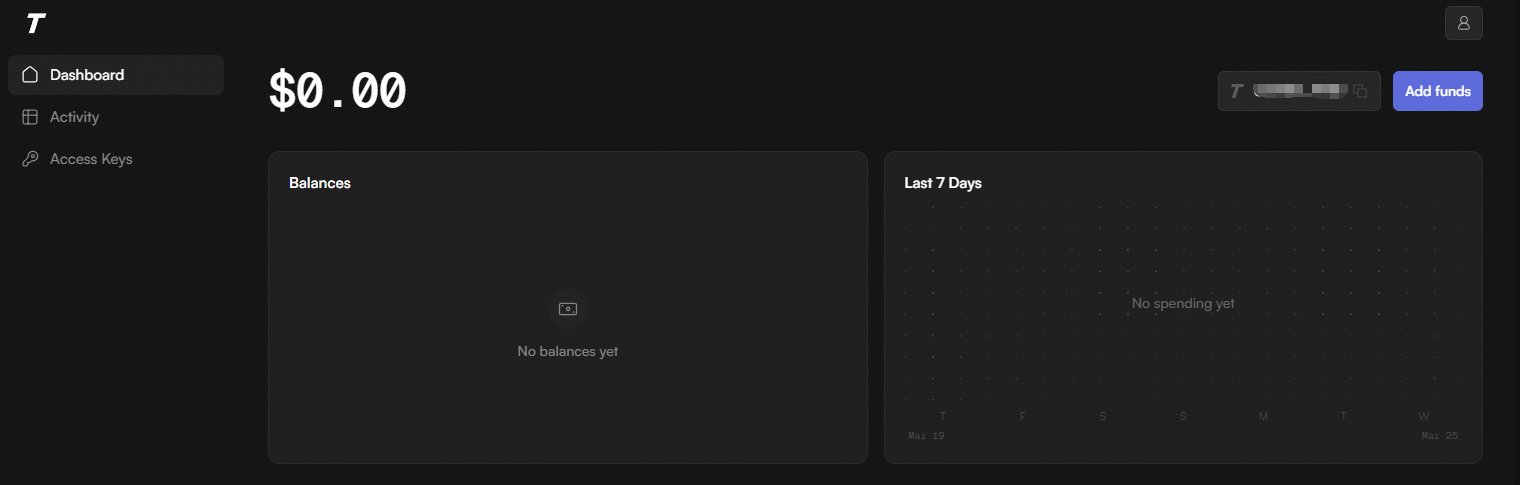
STEP 1. Create a Tempo wallet (Link: https://wallet.tempo.xyz/welcome) by logging in using your computer/phone's Passkey.
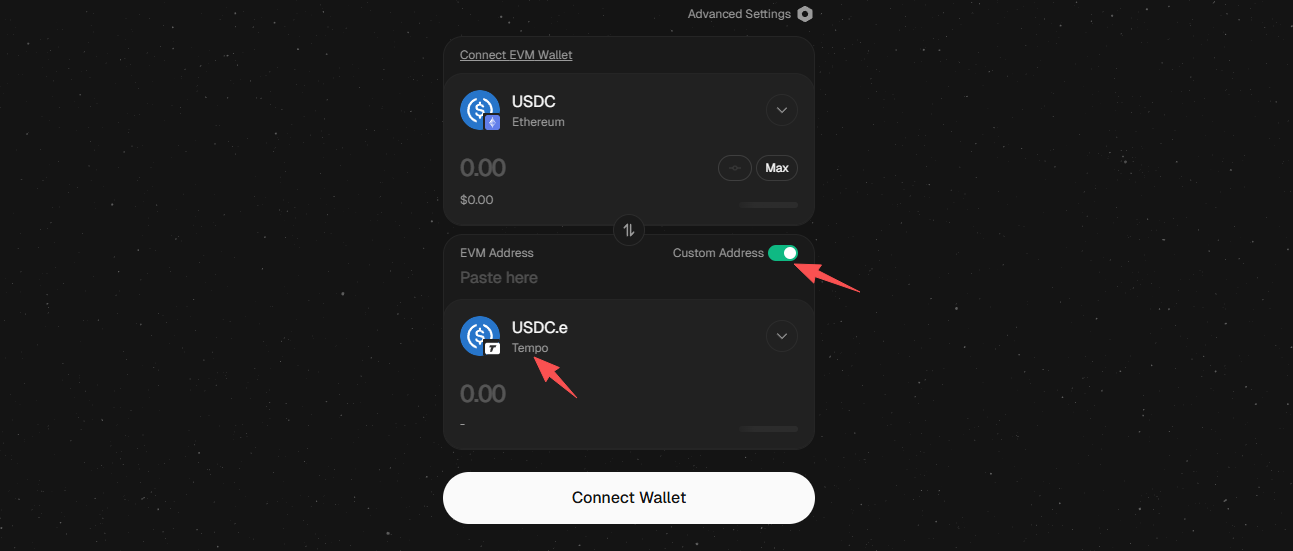
STEP 2. Bridge USDC (Link: https://stargate.finance/). Select USDC, choose the Tempo network as the destination chain, select "Custom address" for the recipient address, paste the newly created Tempo wallet address, and confirm the bridge.
Forte Protocol: Blockchain Infrastructure Focused On-Chain Compliance and Economic Tools

Project Introduction

The Forte Protocol project was established in 2018. It is a set of open-source on-chain compliance and economic rule engines, providing open-source on-chain solutions aimed at creating a secure environment to support healthy and stable digital asset economies. Its trust and privacy protection solutions enable developers to manage compliance risks, promote economic stability, and leverage instant liquidity.

According to ROOTDATA data, Forte Protocol completed two funding rounds as early as 2021, raising a total of $910 million.

Recently, Forte Protocol launched Season 0 tasks on Galxe. Currently, there are 2 tasks available to participate in.

Interaction Tutorial

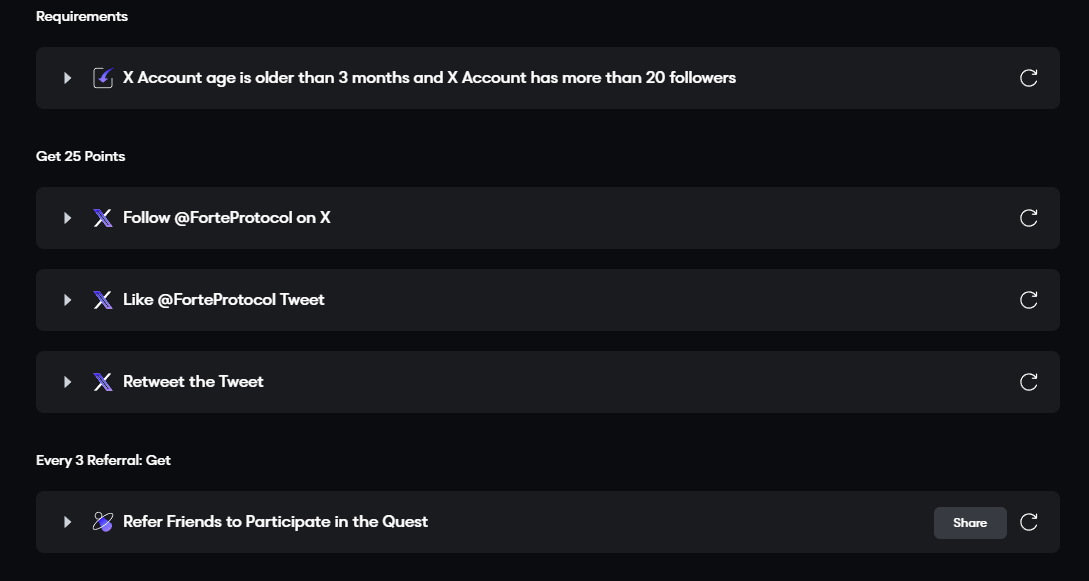
Galxe Task One: Spread the Word (Link: https://app.galxe.com/quest/ForteProtocol/GCHxctYayA?referral_code=GRFr2JLgLym0F_CjZtICIKop6-k3a5AWWjkhuI2Kg5uvmw): X account must be older than 3 months with more than 20 followers, and complete social tasks.
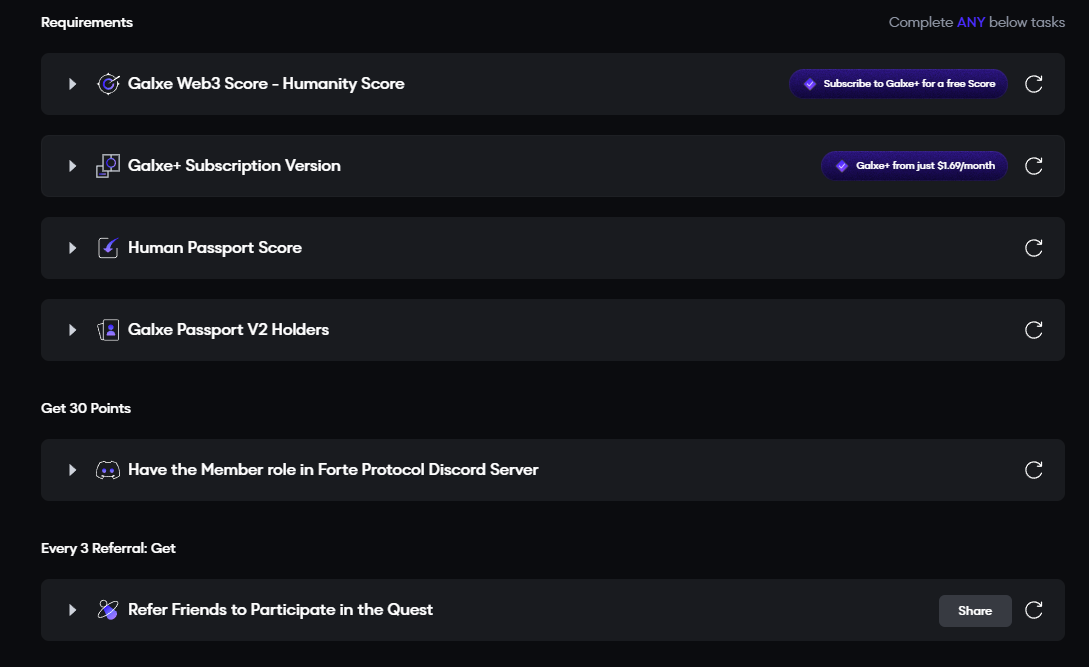
Galxe Task Two: (Link: https://app.galxe.com/quest/ForteProtocol/GCLHFtYfPg?referral_code=GRFr2JPsJmm0Fjrq5tICIKopwKZDR_ow6bG-TQ5tpNQM1dw): Requires a Galxe subscription membership or a Human Passport score that meets the requirements.
Domande pertinenti

QWhat is xStocks and what recent activity did they launch?

AxStocks is a tokenized stock platform that provides on-chain representations of traditional financial assets like stocks, ETFs, and bonds, backed by real stocks held by Swiss custodians. They recently launched an xPoints points program where users can earn points by holding tokenized stocks, establishing positions in lending markets, and providing liquidity on DEXs.

QWhich major exchange acquired Backed Finance, the company behind xStocks?

AKraken acquired Backed Finance in December 2025.

QWhat is Tempo and what makes it different from traditional blockchains?

ATempo is a payment-focused Layer 1 blockchain project incubated by Stripe and Paradigm. Unlike traditional blockchains, it does not have a native token and instead uses mainstream stablecoins like USDC and USDT for gas fees.

QHow much funding did Tempo raise in its Series A round and what was it valued at?

ATempo raised $500 million in its Series A funding round, which valued the company at $5 billion.

QWhat is Forte Protocol and what type of tasks did they recently launch on Galxe?

AForte Protocol is a blockchain infrastructure project focused on on-chain compliance and economic tools. They recently launched 'Season 0' tasks on Galxe, including a 'Spread the Word' social media task and another task requiring a Galxe subscription or a specific Human Passport score.

Letture associate

Dialogue with Jia Hang | Looking Back at Two Decades of Chinese Payment Going Global

**Summary: A Conversation with Jia Hang on Two Decades of China's Payment Globalization** Jia Hang, a veteran with over twenty years in payments, reflects on China's attempts to build a global payment network through three key phases: UnionPay (card networks), Alipay+ (digital wallets), and now, stablecoins. His journey began at UnionPay International, aiming to establish China's card network abroad. While successful in following Chinese tourists ("where Chinese go, UnionPay goes"), it struggled to achieve true global scale. The core lesson: card networks like Visa/Mastercard's unassailable advantage isn't just technical standards, but their deeply entrenched **governance and profit-sharing models** that create powerful network effects. Competing as the "same species" is nearly impossible. At Ant Group, he led Alipay+, a strategy to bypass card networks by interconnecting local e-wallets worldwide. While innovative, it faced a similar ceiling. Mobile QR payments and card swipes were essentially **the same species competing for the same pie**, lacking a disruptive value proposition for users or a sustainable new incentive model to replace the card networks' established flywheel. Today, at Singapore's DCS, Jia focuses on stablecoin-based payments. He argues stablecoins represent a fundamental shift. They are not competing with Visa for consumer payments but challenging the **traditional banking and account system for value movement**. Products like "U Cards" (stablecoin-linked payment cards) are transitional, leveraging existing card networks for acceptance while building new rails. The real potential lies in stablecoins enabling seamless, low-cost global value transfer, potentially reorganizing the financial infrastructure around **accounts rather than cards**. Jia believes stablecoin adoption for local retail payments, cross-border transactions, and as high-yield savings vehicles is becoming irreversible. This could gradually reduce reliance on traditional fiat channels, especially in regions with weak currencies or capital controls. The quest for the "next global payment network" continues, now centered on whether stablecoins can successfully bridge Web2 and Web3, establish new governance, and create compelling user value beyond mere cost reduction.

marsbit21 min fa

Dialogue with Jia Hang | Looking Back at Two Decades of Chinese Payment Going Global

marsbit21 min fa

Circle's Stock Price Plunges 76%, Hong Kong Dollar Stablecoin Set to Launch Within Two Weeks

Circle's stock price has plunged approximately 76% from its 2023 peak, reflecting a major market revaluation. Despite this, Circle President Heath Tarbert emphasized the company's focus on long-term execution and its dominant position with USDC's $73 billion circulation across 34 blockchains. The competitive landscape is intensifying. A new consortium-backed stablecoin, Open USD, is attempting to challenge incumbents by sharing reserve yields with partners. More significantly, Visa's new stablecoin platform, initially supporting Open USD while also being compatible with USDC, could erode Circle's network effects. In response, Circle is expanding into real-world payments through partnerships like the one with Japan's JCB. Separately, Tether (USDT) faces a two-year compliance window under new U.S. regulations, requiring it to adjust its reserve composition away from assets like Bitcoin and loans towards cash and U.S. Treasuries. Meanwhile, in Hong Kong, Standard Chartered-backed fintech firm Dian Dian is poised to launch a licensed HKD-pegged stablecoin (HKDAP), moving the industry into a phase where the real test is integrating licensed stablecoins into actual payment flows and corporate treasury systems. The sharp decline in Circle's stock underscores a broader shift: the stablecoin market is moving from a winner-takes-all dynamic to a multi-player competitive arena where execution, compliance, and real-world utility are becoming paramount.

marsbit21 min fa

Circle's Stock Price Plunges 76%, Hong Kong Dollar Stablecoin Set to Launch Within Two Weeks

marsbit21 min fa

Amidst Capital's Encirclement, Decentralization is the Sole Defense for Public Blockchains

In a landscape dominated by power and profit motives, the author argues that decentralization is not merely one desirable feature among many in blockchain design—it is the singular, non-negotiable defense against corporate and capital capture. The article adopts a Machiavellian, realist perspective on human institutions, positing that businesses will inevitably attempt to co-opt any valuable network to protect their profits and dominance. While external attacks like 51% forks are often discussed, the greater existential risk is internal capture—the gradual erosion of a protocol’s neutrality by vested interests, as seen historically with platforms like Visa and Google. The piece critiques permissioned chains, highly centralized “permissionless” layer-1s, and layer-2s without sufficient decentralization (e.g., single sequencers) as inherently vulnerable. These compromised systems, promoted by established financial players, are framed as delaying tactics to stifle truly open networks that threaten existing high-fee, inefficient business models. Real-world examples, such as closed enterprise consortiums that exclude competitors, illustrate how such systems cement oligopolies rather than foster innovation. The author concludes that while decentralized protocols like Ethereum are imperfect and costly to operate, they represent the only viable long-term equilibrium. In a market where value naturally flows to the most secure and neutral settlement layer, only maximally decentralized public blockchains can resist being subsumed by capital and powerful incumbents.

Foresight News31 min fa

Amidst Capital's Encirclement, Decentralization is the Sole Defense for Public Blockchains

Foresight News31 min fa

Trading

Spot
活动图片