Hoskinson Warns Of Cardano ‘Wave of Failures’ After TapTools Shutdown

bitcoinistPubblicato 2026-06-03Pubblicato ultima volta 2026-06-03

Introduzione

Cardano founder Charles Hoskinson warns the ecosystem could face a "wave of failures" following the shutdown announcement of data and analytics platform TapTools. Citing leadership departures and unsustainable platform economics, TapTools is winding down operations despite serving over a million users. Hoskinson framed this not as an isolated incident but as a symptom of broader funding, coordination, and incentive problems within Cardano. He predicts more project failures in the second half of the year due to difficult market conditions. Hoskinson expressed frustration that proposed solutions, like a sovereign wealth fund or strategic acquisitions, have failed to gain sufficient support or faced criticism for centralization. He emphasized his lack of unilateral control over Cardano's governance, treasury, or direction, shifting responsibility to DReps and delegators to choose a clear growth strategy. The livestream concluded with a critique of Cardano's political culture and a discussion of potential extreme measures, including governance reform or even a new chain, if the current structure cannot support builders.

Charles Hoskinson warned that Cardano could face a broader “wave of failures” across its ecosystem after TapTools said it is preparing to wind down operations over the next two weeks, citing leadership departures and difficult platform economics.

The June 2 livestream marked one of Hoskinson’s sharpest public interventions on Cardano’s current governance and commercialization debate. Responding to TapTools’ shutdown statement, the Cardano founder framed the episode not as an isolated project failure, but as a symptom of deeper funding, coordination and incentive problems inside the ecosystem.

TapTools, a widely used Cardano data, analytics and discovery platform, said it had become difficult to responsibly keep operating after the departure of multiple senior team members. According to the statement read by Hoskinson, two co-founders, including the CTO and COO, had left earlier this year. A back-end developer had stepped into the CTO role, but that person has now also decided to move on.

“The technical knowledge required to responsibly operate and maintain TapTools cannot be replaced overnight,” the team said. “At the same time, the economics of running a platform like this remain challenging. Infrastructure costs are real. Development costs are real. Support costs are real.”

TapTools said it had served more than one million users, supported hundreds of projects through its API, published hundreds of articles, generated hundreds of millions of social impressions and helped bring visibility to builders across Cardano. The team said it would remain open to acquisition talks or other resources that could allow the platform to continue sustainably.

Hoskinson Says More Cardano Projects Could Follow

Hoskinson said TapTools had been part of his “daily ritual” and argued that its exit reflected a problem he had warned about earlier in the year: ecosystem projects running out of runway in poor market conditions.

“This is where we’re at as an ecosystem,” Hoskinson said. “I said at the beginning of the year, we’re going to see a lot of people collapse because the markets are really bad and we need some way to bail out our ecosystem and get them the lifeblood that they need to get to the next level.”

He pointed to JPEG Store and TapTools as examples of projects already affected, adding that he expects more failures in the second half of the year. “I would suspect others are coming very soon,” he said. “There’s going to be a wave of failures in the ecosystem.”

Hoskinson said he had previously proposed several mechanisms to address the issue, including a Cardano sovereign wealth fund, an ecosystem index and strategic acquisitions. He argued that these ideas either failed to gain sufficient support or were criticized as attempts to centralize the ecosystem. He cited his acquisitions of Nami and Blockfrost as examples of infrastructure he had tried to preserve and commercialize, while saying similar interventions often drew backlash.

The broader frustration, according to Hoskinson, is that Cardano governance has not yet produced an effective mechanism for deploying treasury resources into commercial infrastructure. He said Draper had received a large amount of ADA, but suggested that venture capital funding would likely flow mostly into new ventures rather than distressed existing platforms that may not be in an investable state.

Governance, Treasury And Commercialization

Hoskinson repeatedly rejected the idea that he has unilateral control over Cardano’s direction. He said he does not have governance keys, cannot initiate a hard fork or protocol parameter change, does not control the treasury and does not own the Cardano trademark.

“I’d really like to understand what my agency is here,” he said. “I don’t have any special powers with Cardano. I don’t have any governance keys. I don’t have any ability to even initiate a hard fork, much less a protocol parameter change.”

The livestream then turned into a wider critique of Cardano’s political culture. Hoskinson accused parts of the ecosystem of opposing commercialization while also blaming leadership when commercial infrastructure fails. He directed much of his message at DReps and delegators, arguing they need to evaluate whether their representatives are enabling growth or blocking it.

“You need to pick a leader. You need to pick a vision. You need to pick a strategy and fix it,” Hoskinson said. “You need to or you cannot and let it die. That’s your choice.”

He also floated more extreme options, including constitutional changes, treasury reform, changes to executive function and, at the outer edge, a new Cardano launched through a proof-of-burn mechanism. Hoskinson described that as the “nuclear option,” while presenting it as one of several possible responses if the current governance structure cannot support builders.

At press time, ADA traded at $0.2177.
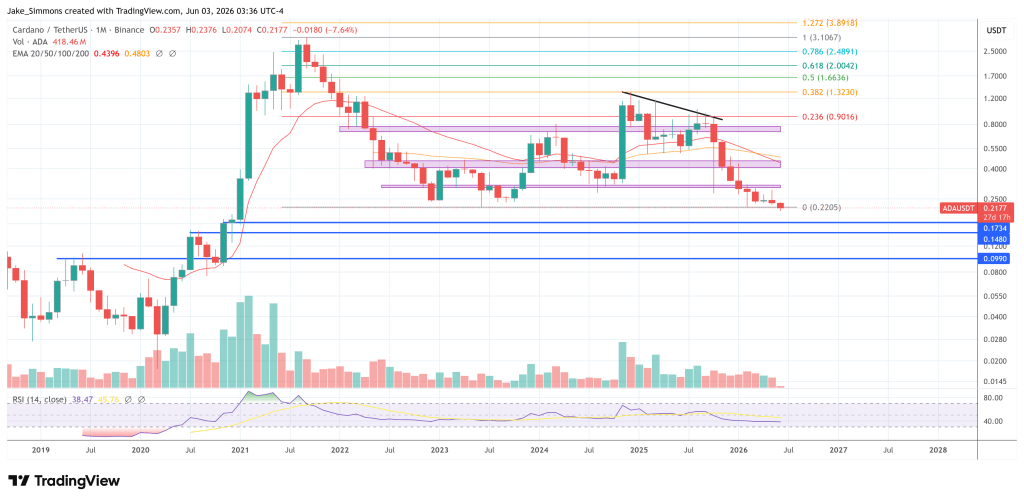
ADA drops below key support, 1-day chart | Source: ADAUSDT on TradingView.com

Domande pertinenti

QWhat is the main reason TapTools gave for shutting down operations according to the article?

ATapTools cited the departure of multiple senior team members, including two co-founders (the CTO and COO) and a back-end developer who had stepped into the CTO role, as well as difficult platform economics involving high infrastructure, development, and support costs.

QHow does Charles Hoskinson frame the shutdown of TapTools in relation to the Cardano ecosystem?

AHoskinson frames it not as an isolated project failure, but as a symptom of deeper funding, coordination, and incentive problems within the ecosystem. He warns it could signal the start of a broader 'wave of failures' for projects running out of financial runway in poor market conditions.

QWhat mechanisms has Hoskinson previously proposed to address ecosystem funding issues, and what was the outcome?

AHe proposed mechanisms like a Cardano sovereign wealth fund, an ecosystem index, and strategic acquisitions. He stated these ideas either failed to gain sufficient support or were criticized as attempts to centralize control over the ecosystem.

QAccording to Hoskinson, what is a key frustration regarding Cardano's governance and treasury?

AHis key frustration is that Cardano's governance has not yet produced an effective mechanism for deploying treasury resources to support commercial infrastructure projects within the ecosystem.

QWhat extreme 'nuclear option' did Hoskinson mention as a possible response if current governance cannot support builders?

AHe mentioned the possibility of launching a new version of Cardano through a proof-of-burn mechanism as the most extreme 'nuclear option' among several potential responses to governance failure.

Letture associate

Anthropic's IPO Launch: Commercial Miracle or Valuation Bubble?

Anthropic has confidentially filed for an IPO, led by Morgan Stanley and Goldman Sachs, potentially going public by October. Following its latest $650 billion funding round, its pre-IPO valuation stands at $965 billion, with projections reaching up to $2 trillion at listing, which would make it the highest-valued private company ever. The article, written by Fu Sheng, addresses skepticism that this represents an AI bubble akin to the 2000 dot-com crash. It argues the current situation differs fundamentally. Unlike the internet bubble era, which relied on speculative narratives with little revenue, Anthropic's valuation is backed by unprecedented, measurable financial performance. Key data points include: * **Revenue Growth:** ARR skyrocketed from $10 billion in early 2025 to $470 billion by May 2026, targeting $100 billion by year-end—a growth curve unmatched in business history. * **Profitability:** It achieved operating profitability in Q2 2026 with an estimated $5.6 billion profit. * **Efficiency:** With ~3,000 employees and ~$470 billion ARR, its revenue per employee exceeds $10 million. Products like Claude Code, launched less than a year ago, already generate $25 billion in annualized revenue. * **Enterprise Adoption:** It boasts a strong enterprise client base, with 8 of the Fortune 10 and over 1,000 large firms spending over $1 million annually on Claude. The valuation is framed using a traditional SaaS model (e.g., a 10x Price-to-Sales multiple on $100 billion revenue). The author contends the core question for analysts has shifted from "How big could this be?" to "How much is it earning and will earn next quarter?" The discussion extends beyond Anthropic to a broader paradigm shift: the transition from a "carbon-based" to a "silicon-based" economy. Companies are increasingly prioritizing investment in compute and AI capabilities over human resources, as these directly scale productivity and competitive advantage. Anthropic's IPO is thus positioned not just as a corporate milestone, but as a price anchor for this new economic era.

链捕手25 min fa

Anthropic's IPO Launch: Commercial Miracle or Valuation Bubble?

链捕手25 min fa

Near Returns to the AI Stage: Transformation into a Public Chain Due to 'Payroll Difficulties,' Agent and Privacy Emerge as New Growth Narratives

NEAR Returns to AI Origins: From Payroll Struggles to Blockchain, Now Focusing on AI Agents and Privacy NEAR Protocol's journey began not with grand blockchain ambitions, but from a practical hurdle: its AI startup founders, including Transformer paper co-author Illia Polosukhin, couldn't efficiently pay international developers in 2017. This led them to pivot and build a high-performance, scalable blockchain. After years navigating various crypto narratives like sharding and cross-chain interoperability, NEAR is now leveraging its AI roots to re-enter the AI arena. A key driver is its "NEAR Intents" layer, which abstracts complex cross-chain transactions. Users simply state their goal (e.g., swap BTC for ETH), and a solver network finds the optimal route. This system has processed over $20B in cross-chain volume, generating significant fee revenue. A major growth area is private transactions via "Confidential Intents/Swaps," which hide trade details until settlement to protect against MEV and front-running. Remarkably, private swaps recently accounted for over 40% of NEAR's transaction volume, highlighting strong demand but also potential regulatory scrutiny. With its AI-founder pedigree, NEAR is positioning itself at the intersection of blockchain, AI agents, and privacy, aiming to become infrastructure for the emerging agent economy while navigating the challenges of its rapid adoption.

marsbit3 h fa

Near Returns to the AI Stage: Transformation into a Public Chain Due to 'Payroll Difficulties,' Agent and Privacy Emerge as New Growth Narratives

marsbit3 h fa

From Ethereum to AI's 'CROPS': What Exactly is This Set of 'Slow Variables' That Vitalik Repeatedly Emphasizes?

In recent discussions, Vitalik Buterin has frequently emphasized the concept of "CROPS," a framework defining core values for Ethereum's development. CROPS stands for Censorship Resistance, Capture Resistance, Open Source, Privacy, and Security. Initially outlined in the Ethereum Foundation's "EF Mandate," it represents a commitment to user sovereignty, ensuring that the network resists external control, remains open, protects privacy, and prioritizes security. The relevance of CROPS extends beyond Ethereum's foundational principles, becoming crucial in the context of AI integration. As AI agents begin handling wallet operations and automated transactions, the risk increases that users may cede control over their digital assets, privacy, and intentions to centralized AI service providers. A "CROPS AI" would therefore emphasize local execution where possible, privacy-preserving remote model calls (e.g., using zero-knowledge proofs), and transparent, verifiable processes to maintain user agency. Vitalik highlights a significant convergence between "CROPS Ethereum access layer" and "CROPS AI." Both address the same fundamental challenge: how users can access powerful services—be it blockchain data via RPCs or AI models—without exposing sensitive information or relinquishing ultimate control. This intersection points toward a future digital entry point that is more private, secure, and user-controlled. Ultimately, CROPS is not merely an abstract ideal but a practical guidepost. It steers development—from protocol resilience and wallet design to AI agent safety—towards a future where users retain self-sovereignty even as digital systems grow more complex and powerful. In an era of accelerating AI adoption, these "slow variables" of censorship resistance, openness, privacy, and security may define Ethereum's enduring value.

marsbit3 h fa

From Ethereum to AI's 'CROPS': What Exactly is This Set of 'Slow Variables' That Vitalik Repeatedly Emphasizes?

marsbit3 h fa

Trading

Spot
Futures

Articoli Popolari

Come comprare ADA

Benvenuto in HTX.com! Abbiamo reso l'acquisto di Cardano (ADA) semplice e conveniente. Segui la nostra guida passo passo per intraprendere il tuo viaggio nel mondo delle criptovalute.Step 1: Crea il tuo Account HTXUsa la tua email o numero di telefono per registrarti il tuo account gratuito su HTX. Vivi un'esperienza facile e sblocca tutte le funzionalità,Crea il mio accountStep 2: Vai in Acquista crypto e seleziona il tuo metodo di pagamentoCarta di credito/debito: utilizza la tua Visa o Mastercard per acquistare immediatamente CardanoADA.Bilancio: Usa i fondi dal bilancio del tuo account HTX per fare trading senza problemi.Terze parti: abbiamo aggiunto metodi di pagamento molto utilizzati come Google Pay e Apple Pay per maggiore comodità.P2P: Fai trading direttamente con altri utenti HTX.Over-the-Counter (OTC): Offriamo servizi su misura e tassi di cambio competitivi per i trader.Step 3: Conserva Cardano (ADA)Dopo aver acquistato Cardano (ADA), conserva nel tuo account HTX. In alternativa, puoi inviare tramite trasferimento blockchain o scambiare per altre criptovalute.Step 4: Scambia Cardano (ADA)Scambia facilmente Cardano (ADA) nel mercato spot di HTX. Accedi al tuo account, seleziona la tua coppia di trading, esegui le tue operazioni e monitora in tempo reale. Offriamo un'esperienza user-friendly sia per chi ha appena iniziato che per i trader più esperti.

1.3k Totale visualizzazioniPubblicato il 2024.12.10Aggiornato il 2026.06.02

Come comprare ADA

Discussioni

Benvenuto nella Community HTX. Qui puoi rimanere informato sugli ultimi sviluppi della piattaforma e accedere ad approfondimenti esperti sul mercato. Le opinioni degli utenti sul prezzo di ADA ADA sono presentate come di seguito.

活动图片