Hoskinson Blasts Ripple CEO Garlinghouse In Fresh Public Rant

bitcoinistPubblicato 2026-01-19Pubblicato ultima volta 2026-01-19

Introduzione

Cardano founder Charles Hoskinson criticized Ripple CEO Brad Garlinghouse in a video on January 18, 2026, for supporting the US Clarity Act, which Hoskinson argues would expand the SEC's authority and harm the crypto industry. He claimed the bill, with 137 amendments, would treat all new projects as securities by default, forcing them to seek regulatory relief. Hoskinson called this worse than the current regulatory uncertainty, accusing Garlinghouse and others of compromising too easily. He warned that passing a flawed bill would make meaningful change nearly impossible, citing the long-standing Securities Exchange Act of 1933. Hoskinson also expressed concerns about the industry moving toward custodial wallets, KYC, and reversible transactions, which he believes betray crypto's original revolutionary ethos. At the time of reporting, XRP was trading at $1.95.

Cardano founder Charles Hoskinson took aim at Ripple CEO Brad Garlinghouse in a January 18, 2026 video, criticizing what he framed as an industry push to accept the US Clarity Act on terms that would expand the Securities and Exchange Commission’s authority over new projects.

Speaking on Jan 18, Hoskinson used a wide-ranging monologue on market fatigue, industry morale, and the mission behind Cardano and Midnight to zero in on a regulatory flashpoint: a bill he described as swollen by “137 amendments” and tilted toward the SEC. In his telling, the proposal would force crypto projects to “go beg and plead” for relief, with “all new projects” treated as securities by default.

Why Hoskinson Blasted Ripple CEO Garlinghouse

Hoskinson argued that the outcome would be a strategic own-goal, worse, in his view, than the policy uncertainty the industry has been trying to escape. “How is that any better than what Scary Gary [Gensler] gave us under Biden?” he said, referring to the SEC’s enforcement action against the crypto industry under former US President Joe Biden, before extending the critique to lobbying and political dealmaking more broadly.

Hoskinson’s sharpest remarks came when he cited unnamed industry figures he suggested are urging compromise, then called out Garlinghouse directly. “Still got people like Brad [Garlinghouse] saying well it’s not perfect but we just got to get something,” he said. “You know, it’s better than no clarity. Hand it to the same people who sued us. Hand it to the same people who put us out of business, who subpoenaed us, who put us in jail. That’s better. That’s what we fought for.”

He then framed the decision as effectively irreversible once legislated, invoking the long life of US securities law to argue that a flawed framework would calcify. “And tell me, how do we change it? Like we changed the Securities Exchange Act of 1933,” Hoskinson said. “93 years later, have we been able to change it? No. You pass it, you own it forever. Sorry, Brad. It’s not better than chaos. Take the chaos and fight for what’s right. Fight for integrity.”

While the Garlinghouse jab was the most explicit, Hoskinson placed it inside a larger narrative: that crypto’s purpose is being reduced to a lobbying-driven contest for acceptable market access rather than an attempt to redesign how value and identity are handled online.

He argued that the industry is at risk of normalizing a world of “custodial wallet” defaults, pervasive KYC, and reversible transactions, outcomes he associated with legacy power structures rather than the original “revolution” ethos.

“I didn’t sign up to hand the revolution to 15 banks,” he said, describing a future where transactions can be “frozen at a whim.” Hoskinson linked those concerns to a broader critique of technological surveillance and what he called the loss of individual “agency,” suggesting the industry’s incentive structure is pulling leaders toward comfort and access rather than confrontation.

The remarks landed amid a separate thread in his talk: a rebuke of what he called “toxic learned hopelessness” in crypto discourse. Hoskinson said he had stopped using X/Twitter, still broadcasting, but not reading or engaging—arguing that constant outrage and demands for instant announcements distort how long negotiations and product development actually work.

At press time, XRP traded at $1.95.
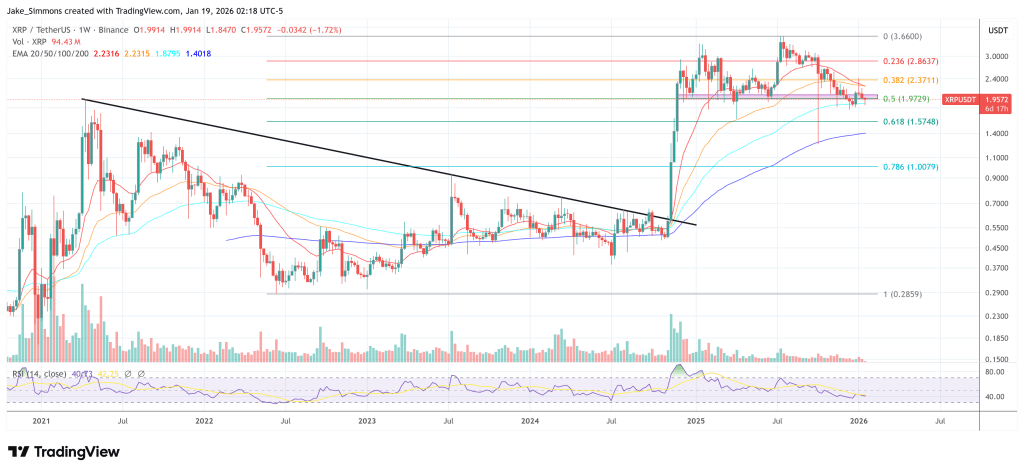
XRP falls into the red support zone again, 1-week chart | Source: XRPUSDT on TradingView.com

Domande pertinenti

QWhat was the main criticism Charles Hoskinson directed at Brad Garlinghouse in his January 18, 2026 video?

AHoskinson criticized Garlinghouse for advocating to accept the US Clarity Act despite its flaws, arguing that compromising with a bill that expands SEC authority and treats all new projects as securities by default is worse than regulatory chaos.

QAccording to Hoskinson, what negative outcomes would the proposed regulatory framework lead to for the crypto industry?

AHoskinson argued it would force crypto projects to beg for relief, treat all new projects as securities by default, normalize custodial wallets, pervasive KYC, and reversible transactions, ultimately handing control to traditional banks and allowing transactions to be frozen at a whim.

QWhy does Hoskinson believe that passing a flawed regulatory framework would be effectively irreversible?

AHe invoked the long life of US securities law, specifically referencing the Securities Exchange Act of 1933 which hasn't been changed in over 93 years, arguing that once such a framework is passed, the industry would be stuck with it forever.

QBeyond criticizing Garlinghouse, what broader concern did Hoskinson express about the crypto industry's direction?

AHe expressed concern that the industry's purpose is being reduced to a lobbying-driven contest for acceptable market access rather than a revolution to redesign how value and identity are handled online, and that leaders are being pulled toward comfort and access rather than confrontation.

QWhat did Hoskinson say about his own engagement with social media platform X/Twitter?

AHoskinson stated that he had stopped using X/Twitter in terms of reading or engaging with content, though he still broadcasts, due to what he called 'toxic learned hopelessness' and the distortion that constant outrage and demands for instant announcements create.

Letture associate

Will the Next Crypto Bull Run Start with On-Chain Trading of SpaceX?

This article presents a scenario-based forecast for the crypto industry from 2026 to 2029, arguing that the next major cycle will be driven not by technological narratives but by legal access to real-world assets. The author predicts that by mid-2026, pre-IPO perpetual contracts for top private companies like SpaceX, OpenAI, and Anthropic on platforms like Hyperliquid will become the primary gateway for accessing quality assets, as most crypto-native tokens fail to capture real value. The much-hyped AI x Crypto intersection largely fails except for prediction markets, which thrive on betting on AI model supremacy. By 2027, public blockchain foundations are forced to choose between catering to retail speculation or building compliant infrastructure for institutions, with many opting for the latter. Growth in stablecoins and tokenized private credit/equity hits a "triple ceiling" due to regulatory and political uncertainty rather than market demand. The pivotal shift is forecast for 2028. A major liquidation event in pre-IPO perpetuals exposes the structural flaw of synthetic markets lacking a real underlying asset anchor. In response, regulatory changes finally allow the public solicitation of private securities resales to verified accredited investors. This creates a legitimate secondary market for real company equity, which then becomes the core asset class of the new bull market, relegating synthetic perps to a niche role. By 2029, the industry becomes "boring" but foundational. Tokens without claims on real cash flows or assets cease trading. Stablecoin growth is steady but politically capped. Crypto infrastructure fades from view as it gets absorbed into traditional finance backends. The article's central thesis is that the key bottleneck for crypto's next phase is legal and regulatory channels for real asset ownership, not technology.

marsbit1 h fa

Will the Next Crypto Bull Run Start with On-Chain Trading of SpaceX?

marsbit1 h fa

The Value Distribution of Stablecoins

**Summary: The Value Distribution of Stablecoins** The article argues that stablecoins are evolving from mere trading tools into broader channels for dollar access. It divides the stablecoin ecosystem into four layers to analyze how value is distributed: 1. **Issuance Layer:** Mints stablecoins, holds reserve assets, and captures the spread between reserve yield and user costs (e.g., Tether, Circle). This layer currently earns the largest profit margin. 2. **Infrastructure Layer:** Connects stablecoins to the traditional financial system, handling fiat on/off-ramps, banking integration, compliance (KYC/AML), and asset management (e.g., Bridge, BVNK). This is the "unglamorous" but critical work, building the essential bridges between crypto and real-world finance. 3. **Acquiring/Distribution Layer:** Integrates stablecoins into merchant systems, manages payment flows, and provides enterprise financial software (e.g., Stripe, Coinbase). They act as the access point for businesses. 4. **Application Layer:** The end-users and businesses that ultimately use stablecoins for payments, settlements, or as a store of value. They benefit from convenience but have little pricing power. The core thesis is that while the issuance layer currently dominates profits, the often-overlooked **infrastructure layer holds significant long-term potential**. The real challenge and barrier to mass adoption is not the on-chain transfer of stablecoins (which is simple), but the complex "last mile" integration into existing business workflows, banking systems, and regulatory frameworks across different countries. Companies in this layer are currently in a "land grab" phase, investing heavily to build networks, secure bank partnerships, and establish compliance pathways. While their position is currently pressured by the profitable issuers above and distribution platforms below, the article suggests that if stablecoins become a default financial rail for businesses, the infrastructure providers who have done the hard work of integration will ultimately gain strong pricing power and become entrenched, essential players.

marsbit8 h fa

The Value Distribution of Stablecoins

marsbit8 h fa

The Value Distribution of Stablecoins

The Value Distribution of Stablecoins The article argues that stablecoins are evolving from a mere trading tool into a broad "dollar channel." It analyzes the industry's value chain through four layers: 1. **Issuance Layer (e.g., Tether, Circle):** The top layer that mints stablecoins, holds reserve assets, and captures the thickest interest rate spread. 2. **Infrastructure Layer (e.g., Bridge, BVNK):** Connects stablecoins to the traditional financial system, handling critical but complex "dirty work" like fiat on/off-ramps, banking integration, compliance (KYC/AML), and cross-border settlement. 3. **Acquiring/Distribution Layer (e.g., Stripe, Coinbase):** Embeds stablecoins into merchant systems, manages payment flows, and integrates with enterprise software. 4. **Application Layer:** End-users and businesses that ultimately use stablecoins for payments, settlement, or storing value. The author posits that while the issuance layer currently captures the most profit, the most overlooked and potentially critical layer is infrastructure. The core challenge for stablecoin adoption isn't the on-chain transfer (which is simple), but bridging the gap between blockchain and the real-world financial system. This involves solving practical problems for businesses: fiat conversion, reconciliation, tax handling, and user onboarding. Infrastructure companies are currently in a difficult "land-grab" phase—building networks, securing banking relationships, and achieving compliance country-by-country. They face pressure from both the profitable issuance layer above and distribution platforms below. However, the author suggests this layer is building a crucial moat. Once stablecoins become a default business rail, the infrastructure players who have done the hard work of integration may gain significant, durable value and pricing power.

链捕手8 h fa

The Value Distribution of Stablecoins

链捕手8 h fa

Trading

Spot
Futures
活动图片