Hormuz Blockade, Oil Prices Surpass $100, Why Aren't U.S. Stocks Falling?

marsbitPubblicato 2026-04-14Pubblicato ultima volta 2026-04-14

Introduzione

Amidst the U.S.-Iran negotiation breakdown and the subsequent blockade of the Strait of Hormuz, which pushed oil prices above $100 per barrel, the S&P 500 surprisingly rose by 1% on April 13, erasing all losses since the outbreak of the Iran conflict and reaching 6,886 points. Major financial institutions like J.P. Morgan, Morgan Stanley, and BlackRock concurrently expressed bullish outlooks, emphasizing that corporate earnings resilience far outweighs geopolitical shocks. Data from LSEG I/B/E/S showed Q1 2026 earnings growth expectations for the S&P 500 increased to 13.9%, up from 12.7% pre-conflict. The "Magnificent Seven" tech giants saw their valuation premium narrow, making equities more attractive. Historical analysis from UBS and LPL Research indicates that geopolitical shocks typically see markets recover within six weeks. Meanwhile, retail investors on Reddit expressed confusion, questioning why negative news didn’t trigger declines, highlighting a disconnect between headline risks and market pricing. The consensus among institutions is that strong earnings and limited conflict impact justify buying the dip.

Author: Claude, Deep Tide TechFlow

Deep Tide Guide: U.S.-Iran negotiations break down, the Hormuz Strait blockade is initiated, oil prices return above $100, yet the S&P 500 closed up 1% on Monday, completely erasing all losses since the Iran war to reach 6886 points. J.P. Morgan, Morgan Stanley, and BlackRock all expressed bullish views on the same day, with a consistent core logic: corporate profit resilience far outweighs the impact of geopolitical shocks. The investment section of Reddit exploded with activity, with retail investors exclaiming, 'The market simply ignores the news.'

On the first trading day after the breakdown of U.S.-Iran negotiations, U.S. stocks charted a curve that left everyone puzzled.

On April 13 (Monday), the S&P 500 closed up 69 points, a gain of 1%, at 6886 points; the Dow Jones Industrial Average rose 302 points, up 0.6%; the Nasdaq Composite Index increased by 1.2%. On the same day, Trump announced on a social platform that the U.S. Navy would immediately initiate a blockade operation in the Hormuz Strait. Brent crude oil broke through $100 per barrel during the session before pulling back to close around $98.16, while WTI crude closed at $97.82.
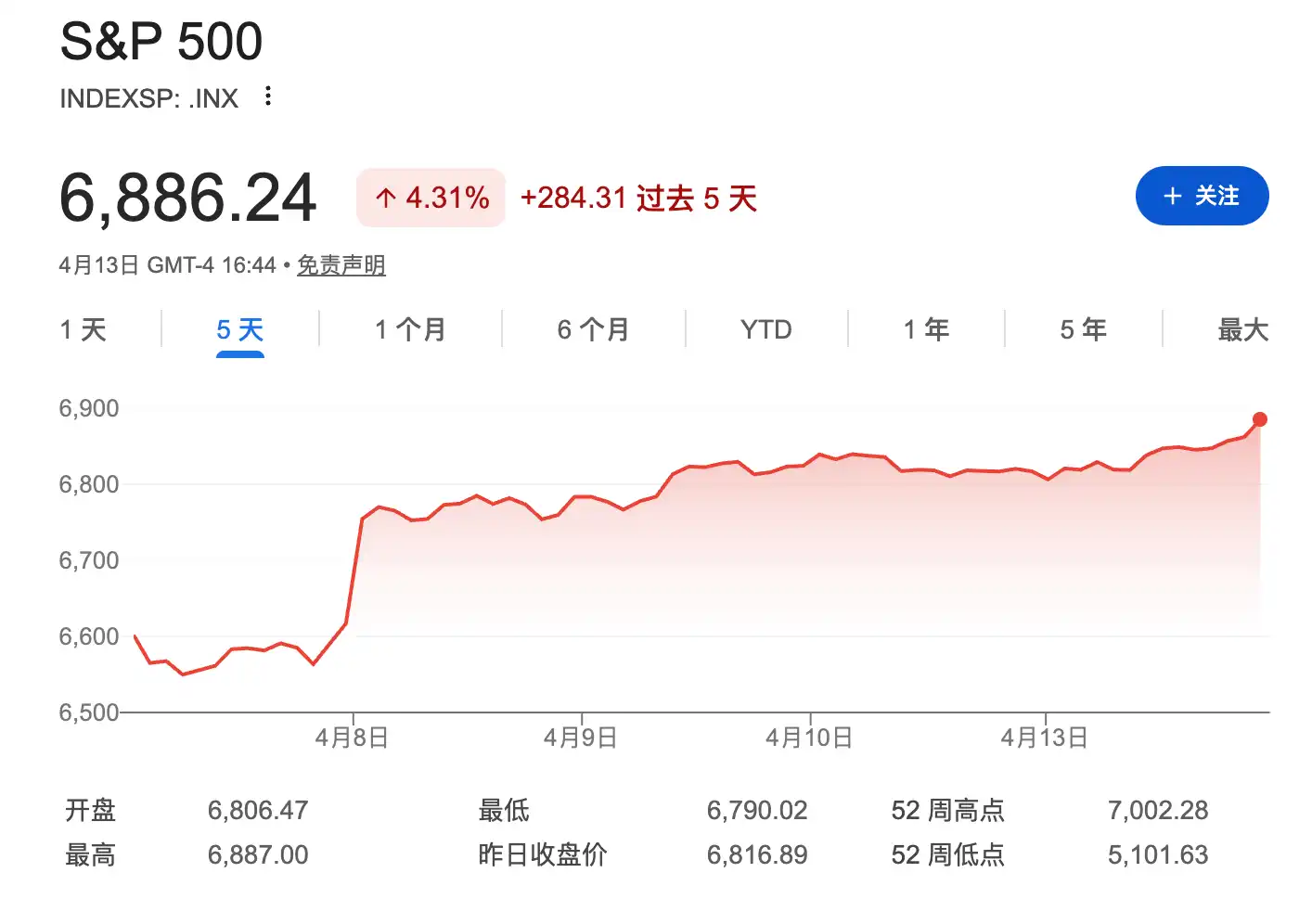
The S&P 500 rose to its highest level since the end of February that day, fully recovering all the losses incurred since the outbreak of the Iran war. The simultaneous occurrence of surging oil prices and rising stock markets seems logically contradictory. However, the largest institutions on Wall Street provided a highly consistent explanation: corporate profits remain strong, the persistence of geopolitical shocks is limited, and the current moment presents a window for buying on the dip.

Three Major Institutions Bullish on the Same Day, Core Logic Points to Profit Resilience

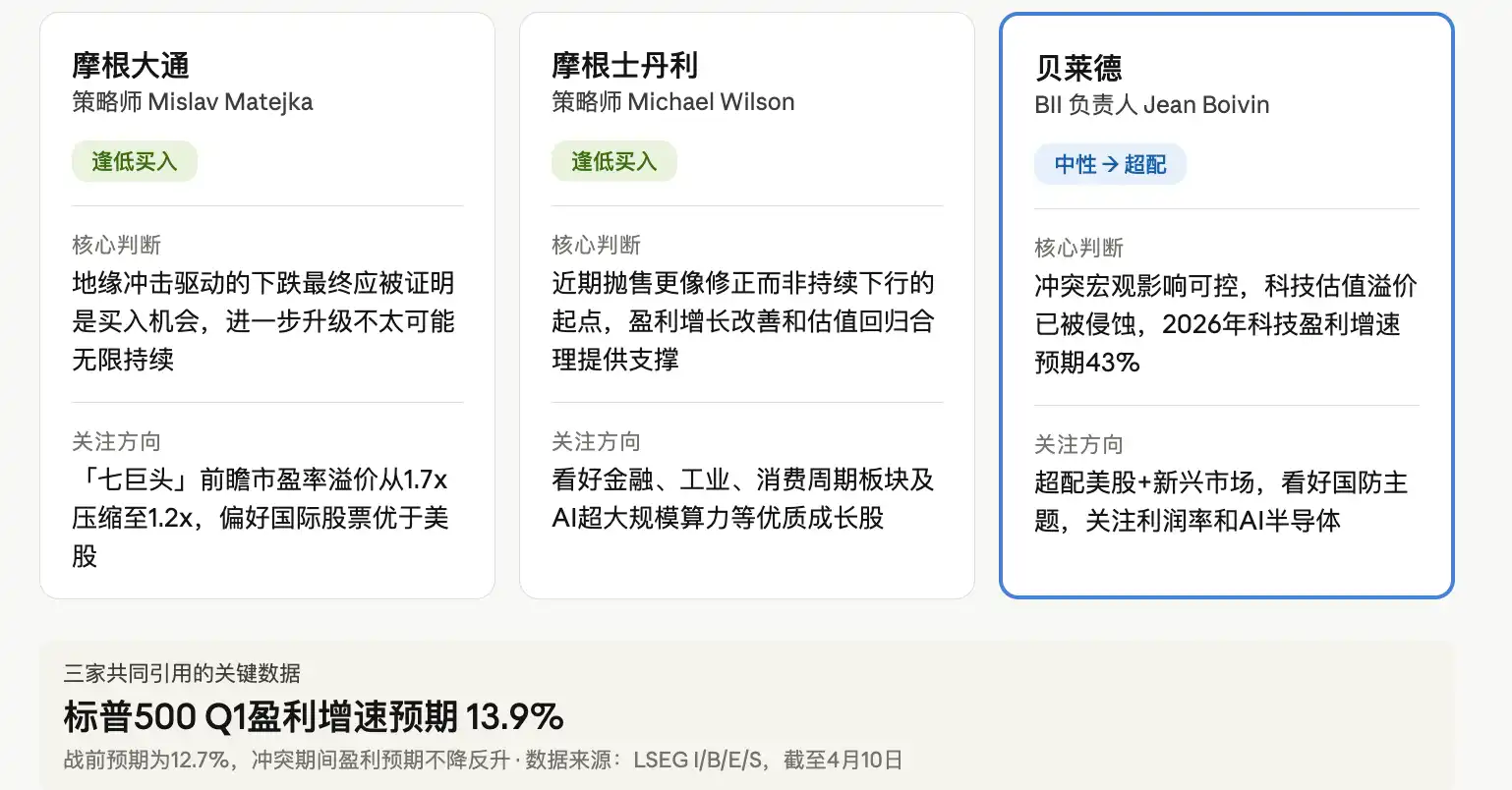
J.P. Morgan, in a research report authored by strategist Mislav Matejka, stated that declines driven by geopolitical shocks should ultimately prove to be buying opportunities.

Morgan Stanley strategist Michael Wilson's team judged that the recent sell-off in the S&P 500 resembled a correction rather than the start of a sustained downturn, with supporting factors coming from improved profit growth and a return to reasonable valuations. Morgan Stanley continues to be bullish on cyclical sectors such as financials, industrials, and consumer discretionary, as well as high-quality growth targets like AI hyperscale computing.

On the same day, the BlackRock Investment Institute upgraded its rating on U.S. stocks from 'neutral' to 'overweight,' making it the most active mover among the three. Jean Boivin, head of the BlackRock Investment Institute, stated that the valuation premium of the technology sector has been eroded, while the sector's expected profit growth rate for 2026 has risen to 43%, higher than last year's 26%.

BlackRock pointed out in its weekly market report that the two signposts triggering its decision to increase exposure have appeared: first, there is tangible evidence showing that navigation through the Hormuz Strait is resuming, and second, the sustained damage of the conflict to the macroeconomy has proven to be manageable.

The three institutions cited the same set of data: according to LSEG I/B/E/S data, as of April 10, the expected Q1 profit growth rate for the S&P 500 is 13.9%, higher than the pre-war 12.7%. In other words, nearly seven weeks after the conflict erupted, analysts have not only failed to lower profit expectations but have instead raised them.
Valuation Contraction of the 'Magnificent Seven' Becomes a Reason to Buy

J.P. Morgan specifically mentioned in its report that the forward P/E premium of the 'Magnificent Seven' (Nvidia, Apple, Microsoft, Meta, Google, Amazon, and Tesla) has narrowed significantly from the previous level of 1.7 times the S&P 500 to 1.2 times.

This data constitutes a key argument for Wall Street bulls: the problem of top-heavy concentration that has suppressed market breadth over the past two years is being alleviated on its own due to valuation regression.

BlackRock pointed out that the valuation premium of the technology sector relative to the other ten sectors has fallen to its lowest level since mid-2020. The company stated that against the backdrop of firm corporate profit expectations and limited damage to global growth, it has decided to increase exposure to U.S. stocks and emerging markets.

Historical Data Backs It Up: Geopolitical Shocks Are Usually Digested Within Six Weeks

The optimism of Wall Street institutions is not without basis. Research from UBS shows that when the S&P 500 falls 5% to 10% within three to four weeks, it historically usually returns to pre-conflict levels within six months.

A review of geopolitical shock events since World War II by LPL Research shows that the average first-day reaction is approximately a 1% decline, the average peak-to-trough decline is about 5%, the average time to bottom is about 19 days, and the average recovery cycle is about 42 days.

UBS stated in a mid-March research report that from the outbreak of the conflict on February 28 to March 13, global stocks fell only about 5%, while crude oil prices rose about 40% during the same period. The stock market's 'insensitivity' to the oil price shock itself validates the above historical pattern.

On April 6, UBS lowered its year-end target price for the S&P 500 from 7700 to 7500 and its mid-term target from 7300 to 7000, but maintained its overall judgment that U.S. stocks are 'attractive,' with the 2026 EPS forecast unchanged at $310.

Reddit Investors' Soul-Searching Question: 'The Market Simply Ignores the News'

While the consensus among institutions can be explained by data, the reaction in retail communities more directly reflects current market sentiment.

In the r/stocks subreddit, a post titled roughly 'Do you believe it now? The market doesn't move because of the news' received 923 upvotes and 159 comments. The poster's core point was: the market moves first, then finds reasons later. This Hormuz blockade is the most typical case he has experienced. A large number of comments expressed confusion about the disconnect between geopolitical risks and market pricing.
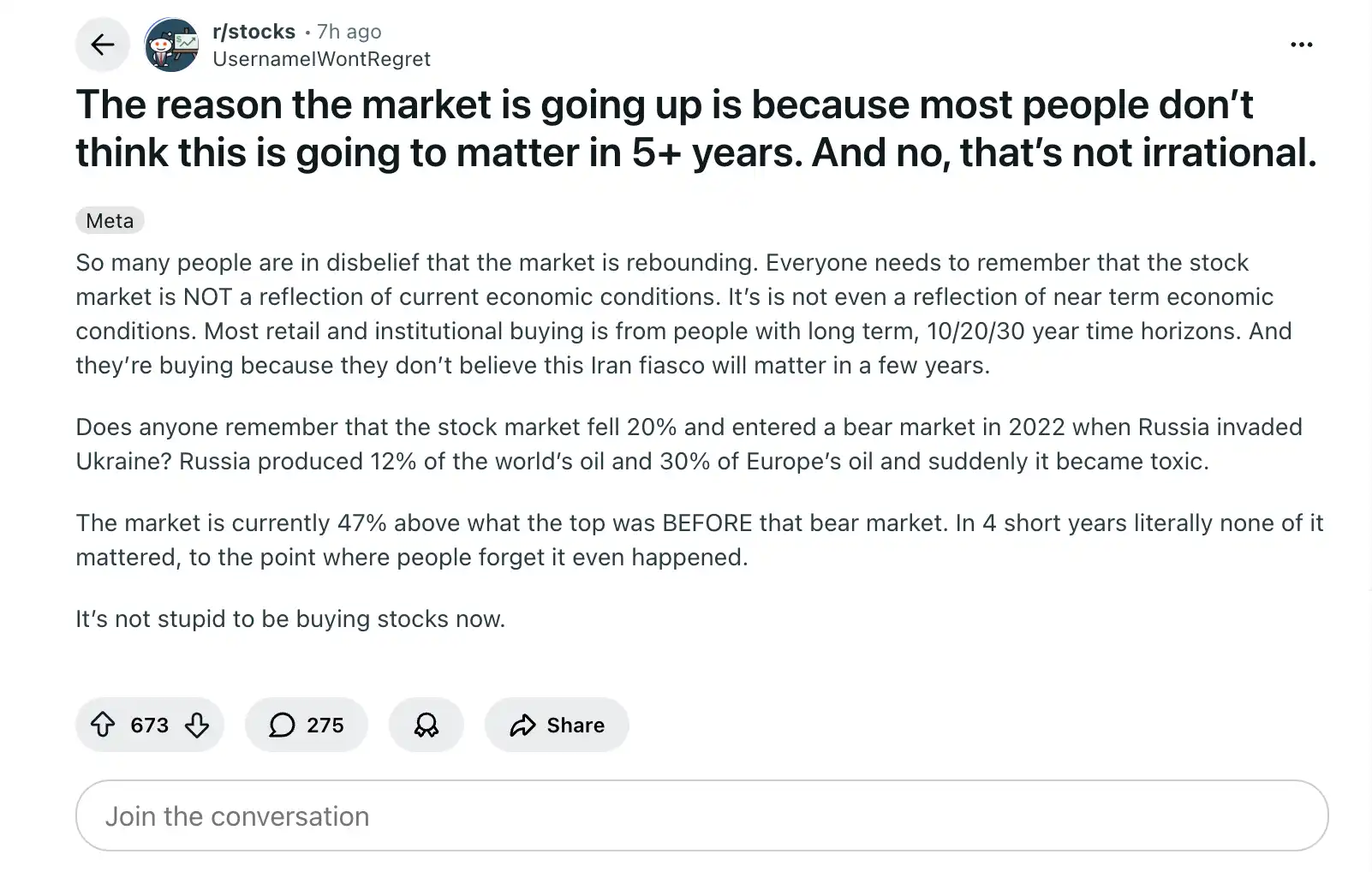
'The market is rising because most people think this won't matter in 5 years; this is not irrational.' This post received 344 upvotes and 199 comments, representing the typical stance of long-term investors.

In the r/wallstreetbets subreddit, a post with 504 upvotes pointed out that the physical oil market is 'screaming supply shock,' but the stock market remains calm, leaving traders不知所措 (at a loss) due to the contradictory signals between the two markets.

The confusion of retail investors and the confidence of institutions form a sharp contrast, but the underlying logic is actually two sides of the same coin: institutions are betting on profit resilience and the limited nature of the conflict, while retail investors are confused about why bad news hasn't translated into declines.

The answer might be simple: the market already completed a round of pricing in March and is currently in a rebound phase where 'bad news is exhausted.'


Domande pertinenti

QWhy did the US stock market rise despite the blockade of the Strait of Hormuz and oil prices above $100?

AMajor financial institutions like JPMorgan, Morgan Stanley, and BlackRock believe that strong corporate earnings resilience far outweighs the impact of geopolitical shocks, making the market a buying opportunity.

QWhat was the core logic provided by Wall Street institutions for being bullish on US stocks?

AThe core logic is that corporate profit growth remains robust, geopolitical shocks are limited in duration, and valuations have become more attractive, particularly in sectors like technology.

QHow did the valuation of the 'Magnificent Seven' tech stocks change, and why was it significant?

AThe forward P/E premium of the 'Magnificent Seven' narrowed from 1.7 times the S&P 500 to 1.2 times, reducing market concentration issues and making valuations more appealing for investors.

QWhat historical data supports the idea that geopolitical shocks are short-lived for the stock market?

AHistorical data from UBS and LPL Research shows that markets typically recover from geopolitical shocks within about six weeks, with an average peak-to-trough decline of around 5% and a recovery period of about 42 days.

QHow did retail investors on platforms like Reddit react to the market's performance amid the geopolitical tension?

ARetail investors expressed confusion and disbelief, with many noting that the market seemed to ignore negative news, highlighting a disconnect between geopolitical risks and market pricing.

Letture associate

The AI Investment Landscape Is Being Reshaped: Beyond the 'Magnificent Seven', What Opportunities Lie in the Semiconductor Supply Chain?

AI Investment Map is Reshaping: Opportunities Beyond the 'Magnificent Seven' Since ChatGPT ignited the AI wave, investment initially focused on the "Magnificent Seven" tech giants dominating cloud infrastructure. However, the rise of DeepSeek and debates on AI capital expenditure effectiveness are shifting this dynamic. Investors now recognize opportunities deeper in the supply chain—the companies providing the essential "picks and shovels." Early concerns about an AI investment "arms race" and potential low returns were partly alleviated by strong Q1 earnings from cloud providers, validating robust compute demand. This has highlighted a more certain investment thesis: regardless of which AI applications ultimately win, massive capital expenditure will first fuel demand for semiconductors and related components. This "pick-and-shovel" logic has driven semiconductor ETFs to record highs. Key beneficiaries include: * **Memory Chipmakers (e.g., SK Hynix, Samsung, Micron)**: High Bandwidth Memory (HBM) is a critical bottleneck for AI training. * **Photonics Companies**: Crucial for high-speed data transfer within AI data centers. * **The Broader "AI-11" Semiconductor Ecosystem**: This encompasses foundries & lithography (TSMC, ASML), logic & custom chips (AMD, Broadcom, Intel, Marvell), and enterprise storage (SanDisk, Western Digital). Every dollar of AI infrastructure spending flows through this chain. While the "Magnificent Seven" remain dominant in market size, their earnings growth premium over the rest of the S&P 500 ("S&P 493") is narrowing. Market attention and marginal investment are shifting towards the expanding semiconductor supply chain. The investment narrative is evolving from "betting on the ultimate AI winner" to "investing in the certainty of the infrastructure build-out." Understanding this shift from the demand side to the supply side is key to identifying future AI investment opportunities.

marsbit22 min fa

The AI Investment Landscape Is Being Reshaped: Beyond the 'Magnificent Seven', What Opportunities Lie in the Semiconductor Supply Chain?

marsbit22 min fa

600 People, $66 Billion: The First Major Cash-Out in the Era of Large Models

The first systematic "big cash-out" of the AI era occurred in October 2025, when over 600 current and former OpenAI employees sold a total of $6.6 billion in shares via a secondary market. Approximately 75 individuals maxed out a $30 million per-person sale limit, while around 525 others cashed out an average of $8.3 million each. This event, exceeding the scale of any 2024 US IPO, functioned as a "shadow IPO." It marked a radical departure from the traditional Silicon Valley path of waiting for a public listing, instead allowing employees to convert equity to cash after just two years of tenure—a direct retention tool in a fiercely competitive talent market where rivals like Meta have offered packages worth hundreds of millions. This massive liquidity event presents a dual-edged sword for OpenAI. While it helps retain talent, it also risks triggering a brain drain as newly wealthy employees may depart. Furthermore, it creates a dilemma for those who sold: they forfeited potential future gains as the company's valuation soared from $400 billion to $852 billion within months. In stark contrast, employees at rival Anthropic demonstrated greater reluctance to sell during their own secondary offering. The financial narratives of the two labs also diverge sharply. OpenAI, while achieving over $20 billion in annualized revenue by 2025, faces massive projected losses (up to $14 billion in 2026), a long path to cash flow positivity, and significant revenue-sharing payments to Microsoft. Anthropic reports rapid revenue growth, improving gross margins, and a faster path to profitability. OpenAI's trajectory is thus balanced precariously between skyrocketing valuation based on funding narratives and the pressures of sustained financial losses post-cash-out. The event underscores that the AI race has evolved into a capital and human experiment, where immense wealth crystallizes the complex calculations of greed, fear, and ambition within the industry.

marsbit42 min fa

600 People, $66 Billion: The First Major Cash-Out in the Era of Large Models

marsbit42 min fa

NVIDIA Begins Adding Soap to the Bubble

NVIDIA is taking on a dual role: not just as a leading chip supplier, but as a massive capital allocator across the entire AI supply chain. In 2026, the company has committed over $40 billion in investments within five months, targeting everything from optical fiber manufacturing and data center operations to foundational AI model development. This investment spree, described as a systematic "sprinkler" approach, primarily funds companies that are major buyers of NVIDIA's own GPUs. Critics, including analysts from Goldman Sachs, label this a "circular revenue" loop—comparable to a supplier financing a customer to buy more of its products. A prominent example is NVIDIA's investment in OpenAI, which is expected to generate around $13 billion in revenue for NVIDIA, much of which may be reinvested back into OpenAI. While CEO Jensen Huang dismisses the "circular financing" critique as "absurd," arguing the investments are confidence votes in long-term generational shifts, some analysts express discomfort. They note that while investments in critical supply chain components like optics are strategically sound, funding new cloud providers like CoreWeave feels like "pre-paying for your own GPUs." The strategy carries significant risks. If the AI investment cycle turns, the market may question how much demand is genuine versus artificially sustained by NVIDIA's own balance sheet. Despite posting record-breaking earnings—$215.9 billion in annual revenue and $120 billion in net profit for FY2026—NVIDIA's stock fell after its report, signaling that "beating expectations" may no longer be enough to assure investors about the duration of the AI spending boom. The article concludes that while a bubble isn't necessarily a fraud, NVIDIA's actions resemble adding soap to a bubble—making it appear more robust and durable. This creates a complex scenario requiring extreme冷静 from investors to distinguish between real structural growth and financial engineering.

marsbit59 min fa

NVIDIA Begins Adding Soap to the Bubble

marsbit59 min fa

Short Positions Have Been Squeezed Out: Will the Next Leg of the U.S. Stock AI Rally Continue in Seoul?

"Short Squeeze Exhausted: Will the Next Leg of the AI Rally Continue in Seoul?" A Nomura report suggests the US AI stock rally, which saw the S&P 500 rise ~16.6% in 28 days largely driven by 10 key stocks, may be pausing. The fuel from short covering, CTA fund positioning, and volatility-control strategies is nearing its limit. For the rally to continue, new momentum from retail and sentiment-driven FOMO (Fear Of Missing Out) is needed. South Korea's market provided a potential answer on the very day the report was published. The KOSPI index surged 4.32%, triggering a buy-side circuit breaker, led by massive gains in chip giants SK Hynix (+11.98%) and Samsung. This surge is characterized by retail "hynix FOMO" and overseas funds precisely buying into AI themes via chip-focused ETFs, shifting from broad Korean market ETFs. The Korean rally is a high-beta extension of the US AI capital expenditure story, as major cloud providers plan massive infrastructure spending, directly benefiting memory chip leaders. However, this linkage also implies vulnerability. The sustainability of this next leg depends on whether US tech stocks correct, the trajectory of US inflation (with upcoming CPI data key), and geopolitical tensions around the Strait of Hormuz. Seoul has emerged as the new epicenter of the AI trade, but its fate remains tied to these broader macro and market dynamics.

marsbit1 h fa

Short Positions Have Been Squeezed Out: Will the Next Leg of the U.S. Stock AI Rally Continue in Seoul?

marsbit1 h fa

Trading

Spot
Futures
活动图片




