Hong Kong Professionals Association Urges Regulators To Ease Crypto Reporting Rules

bitcoinistPubblicato 2026-01-20Pubblicato ultima volta 2026-01-20

Introduzione

Hong Kong Securities & Futures Professionals Association (HKSFPA) has urged regulators to ease certain aspects of the OECD’s Crypto Asset Reporting Framework (CARF) and related amendments to Hong Kong’s Common Reporting Standard (CRS). While generally supportive, the association raised concerns about record-keeping obligations for dissolved entities and uncapped penalties for minor technical errors. It proposed appointing third-party custodians for dissolved firms and introducing penalty caps for unintentional errors. The group also recommended a simplified registration process for crypto service providers with no annual filings. Hong Kong is among 76 jurisdictions committed to implementing CARF by 2028 as part of its broader strategy to become a global crypto hub.

A Hong Kong industry group has urged the city’s regulators to ease aspects of the Organisation for Economic Co-operation and Development’s (OECD) crypto reporting rules ahead of its implementation.

Association Pushes To Soften CARF Requirements

On Monday, the Hong Kong Securities & Futures Professionals Association (HKSFPA) released a response to the implementation of the OECD’s Crypto Asset Reporting Framework (CARF) and the related amendments made to Hong Kong’s Common Reporting Standard (CRS).

In their official response, the association shared its concerns about certain elements of the CARF and CRS amendments, warning that they could create operational and liability risks for market participants.

Notably, the HKSFPA affirmed that it mostly supports the proposals, but urged regulators to ease the record-keeping requirements for dissolved entities. “We generally agree with the six-year retention period to align with existing inland revenue and CRS standards,” they explained, “but we have concerns regarding the obligations placed on individuals post-dissolution.”

The industry group argued that holding directors or principal officers personally liable for record-keeping after dissolution poses significant practical challenges, noting that former officers of dissolved companies may lack the resources, infrastructure, and legal standing to maintain sensitive personal data of former clients.

As a result, they suggested the government “allow for the appointment of a designated third-party custodian (such as a liquidator or a licensed corporate service provider) to fulfill this obligation, rather than placing indefinite personal liability and logistical burden on former individual officers.”

Moreover, the association also cautioned that the proposed uncapped per-account penalties for minor technical errors. They asserted that this could lead to “disproportionately astronomical fines for systemic software errors affecting thousands of accounts where there was no intent to defraud.”

To solve this, they proposed a “reasonable cap” on total penalties for unintentional administrative errors or first-time offenses to ensure that the per-account calculation “is reserved for cases of willful negligence or intentional evasion.”

Additionally, the group suggested a “lite” registration or a simplified annual declaration process for Reporting Crypto-Asset Service Providers (RCASPs) that anticipate filing Nil Returns, to reduce administrative costs while still satisfying the Inland Revenue Department’s oversight requirements.

Hong Kong’s Crypto Hub Efforts

Notably, Hong Kong is among the 76 markets committed to implementing the upcoming crypto reporting framework, which is the OECD’s new global standard for exchanging tax information on crypto assets.

The CARF is designed to prevent tax evasion by bringing crypto users across borders under global tax transparency rules, similar to the OECD’s existing CRS for traditional finance. Hong Kong will be among the 27 jurisdictions that will begin their first cross-border exchanges of crypto reporting data in 2028.

Over the past few years, Hong Kong financial authorities have been actively working to develop a comprehensive framework that supports the expansion of the digital assets industry, part of its strategy to become a leading crypto hub in the world.

As reported by Bitcoinist, the city is exploring rules to allow insurance companies to invest in cryptocurrencies and the infrastructure sector. The Hong Kong Insurance Authority recently proposed a framework that could channel insurance capital into cryptocurrencies and stablecoins.

Moreover, the Hong Kong Monetary Authority (HKMA) is expected to grant the first batch of stablecoin issuer licenses in the first few months of the year. The HKMA enacted the Stablecoins Ordinance in August, which directs any individual or entity seeking to issue a stablecoin in Hong Kong, or any Hong Kong Dollar-pegged token, to obtain a license from the regulator.

Multiple companies have applied for the license, with over 30 applications filed in 2025, including logistics technology firm Reitar Logtech and the overseas arm of Chinese mainland financial technology giant Ant Group.
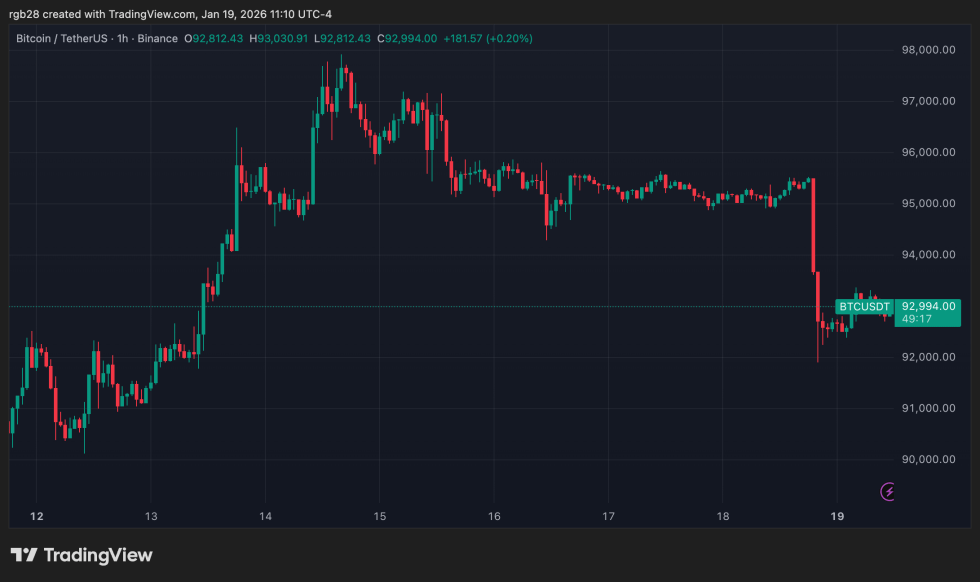
Bitcoin (BTC) trades at $92,994 in the one-week chart. Source: BTCUSDT on TradingView


Domande pertinenti

QWhat is the main concern raised by the Hong Kong Securities & Futures Professionals Association (HKSFPA) regarding the OECD's Crypto Asset Reporting Framework (CARF)?

AThe HKSFPA is concerned that certain elements of CARF and related CRS amendments could create operational and liability risks for market participants, particularly regarding record-keeping requirements for dissolved entities and uncapped penalties for minor technical errors.

QWhat specific suggestion did the HKSFPA make to address the record-keeping burden on dissolved entities?

AThe association suggested allowing the appointment of a designated third-party custodian (such as a liquidator or licensed corporate service provider) to fulfill record-keeping obligations instead of placing indefinite personal liability on former individual officers.

QHow did the HKSFPA propose to handle penalties for unintentional administrative errors in crypto reporting?

AThey proposed implementing a reasonable cap on total penalties for unintentional administrative errors or first-time offenses, reserving per-account penalty calculations for cases of willful negligence or intentional evasion.

QWhen will Hong Kong begin its first cross-border exchanges of crypto reporting data under CARF?

AHong Kong will begin its first cross-border exchanges of crypto reporting data in 2028, as one of the 27 jurisdictions committed to implementing the framework.

QWhat recent regulatory development in Hong Kong involves stablecoin issuance?

AThe Hong Kong Monetary Authority (HKMA) enacted the Stablecoins Ordinance in August, requiring any individual or entity seeking to issue a stablecoin in Hong Kong to obtain a license, with the first batch of licenses expected to be granted in early 2025.

Letture associate

Computing Power Constrained, Why Did DeepSeek-V4 Open Source?

DeepSeek-V4 has been released as a preview open-source model, featuring 1 million tokens of context length as a baseline capability—previously a premium feature locked behind enterprise paywalls by major overseas AI firms. The official announcement, however, openly acknowledges computational constraints, particularly limited service throughput for the high-end DeepSeek-V4-Pro version due to restricted high-end computing power. Rather than competing on pure scale, DeepSeek adopts a pragmatic approach that balances algorithmic innovation with hardware realities in China’s AI ecosystem. The V4-Pro model uses a highly sparse architecture with 1.6T total parameters but only activates 49B during inference. It performs strongly in agentic coding, knowledge-intensive tasks, and STEM reasoning, competing closely with top-tier closed models like Gemini Pro 3.1 and Claude Opus 4.6 in certain scenarios. A key strategic product is the Flash edition, with 284B total parameters but only 13B activated—making it cost-effective and accessible for mid- and low-tier hardware, including domestic AI chips from Huawei (Ascend), Cambricon, and Hygon. This design supports broader adoption across developers and SMEs while stimulating China's domestic semiconductor ecosystem. Despite facing talent outflow and intense competition in user traffic—with rivals like Doubao and Qianwen leading in monthly active users—DeepSeek has maintained technical momentum. The release also comes amid reports of a new funding round targeting a valuation exceeding $10 billion, potentially setting a new record in China’s LLM sector. Ultimately, DeepSeek-V4 represents a shift toward open yet realistic infrastructure development in the constrained compute landscape of Chinese AI, emphasizing engineering efficiency and domestic hardware compatibility over pure model scale.

marsbit26 min fa

Computing Power Constrained, Why Did DeepSeek-V4 Open Source?

marsbit26 min fa

Trading

Spot
Futures
活动图片