Hong Kong proceeds with licensing regimes for virtual asset dealers and custodians

cointelegraphPubblicato 2025-12-24Pubblicato ultima volta 2025-12-24

Introduzione

Hong Kong regulators are moving forward with new licensing requirements for cryptocurrency dealers and custodians following the conclusion of consultations. The Financial Services and the Treasury Bureau (FSTB) and the Securities and Futures Commission (SFC) announced the decision, which is part of a broader effort to strengthen oversight of the digital asset sector. This builds on the city’s existing regulatory framework, which already mandates licensing for crypto trading platforms and recently enacted a stablecoin licensing regime. Hong Kong aims to position itself as a trusted crypto hub with comprehensive regulations covering stablecoins, tokenization, and now dealer and custody services. Separately, the SFC also launched a consultation for licensing crypto advisory and management service providers, linking the proposals to anti-money laundering and counter-terrorist financing rules.

Hong Kong regulators will proceed with legislating licensing regimes for crypto dealers and custodians after wrapping up consultations, as part of a broader push to tighten oversight.

In a Wednesday announcement, the city’s Financial Services and the Treasury Bureau (FSTB) and the Securities and Futures Commission (SFC) said that they had concluded consultations on proposed licensing regimes, which would require firms providing crypto dealings or custody services in Hong Kong to obtain licenses once the framework takes effect.

The move adds to the city’s expanding crypto licensing framework. Earlier in 2025, Hong Kong brought its Stablecoin Ordinance into force, opening a new licensing regime for stablecoin issuers.

Hong Kong already requires crypto trading platforms to be licensed. The current mandatory regime builds on earlier opt-in framework introduced in 2020, with 11 companies having received approval from the SFC to date.
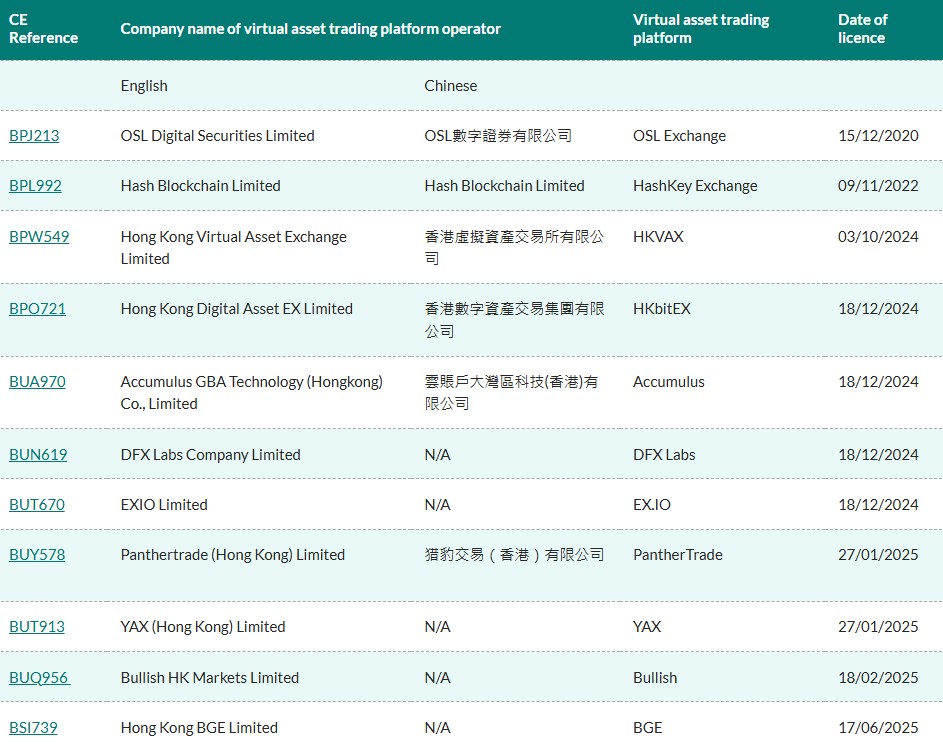
Hong Kong has rejected more applicants for its crypto exchange license than it approved. Source: SFC

Related: Crypto may enter insurers’ portfolios as Hong Kong reviews capital rules

Hong Kong’s broader crypto initiatives

Hong Kong has long expressed its ambitions to develop into a crypto hub. The city already functions as a financial hub with its business-friendly tax regimes and its reputation as a finance gateway between mainland China and global capital markets.

Beyond crypto licensing rules, Hong Kong has also tested tokenization initiatives. In Thursday’s announcement, regulators added that the pending introduction of licensing regimes for crypto dealers and custodians is part of the city’s effort to establish a comprehensive regulatory framework for digital assets alongside stablecoins and tokenization.

​Julia Leung, CEO of the SFC, said that the further development of Hong Kong’s crypto regulatory framework would help the city maintain its position in global digital asset market developments by “fostering a trusted, competitive and sustainable ecosystem.”

Related: Hong Kong launches CARF crypto tax consultation to combat evasion

New advisory and management consultation

The SFC also published a consultation paper on the same day, seeking public feedback on proposals to introduce licensing regimes for crypto advisory service providers and management service providers.

The consultation links the proposed regimes to Hong Kong’s existing Anti‐Mone‐Laundering (AML) framework and Counter‐Terrorist Financing Ordinance, and sets out how advisory and management activities involving digital assets will be brought within the regulatory framework.

It also invites comments on matters such as licensing scope, regulatory powers, sanctions and appeal arrangements, which will be taken into account in finalizing the proposals.


Domande pertinenti

QWhat are the key licensing regimes that Hong Kong is proceeding with for virtual assets?

AHong Kong is proceeding with licensing regimes for virtual asset dealers and custodians, as well as for advisory service providers and management service providers.

QWhich regulatory bodies announced the conclusion of consultations on the proposed licensing frameworks?

AThe Financial Services and the Treasury Bureau (FSTB) and the Securities and Futures Commission (SFC) announced the conclusion of consultations on the proposed licensing regimes.

QWhat earlier crypto-related licensing regime did Hong Kong bring into force in 2025?

AIn early 2025, Hong Kong brought its Stablecoin Ordinance into force, which opened a new licensing regime for stablecoin issuers.

QAccording to the SFC CEO, what is the goal of further developing Hong Kong's crypto regulatory framework?

AAccording to SFC CEO Julia Leung, the goal is to help Hong Kong maintain its position in global digital asset market developments by 'fostering a trusted, competitive and sustainable ecosystem'.

QWhat existing frameworks are the proposed licensing regimes for advisory and management services linked to?

AThe proposed regimes are linked to Hong Kong's existing Anti-Money Laundering (AML) framework and Counter-Terrorist Financing Ordinance.

Letture associate

Who Funds the Agents?

**Summary: Who Funds AI Agents?** OpenAI recently shut down a feature allowing AI agents to shop for users, highlighting the challenge of creating a secure and regulated environment for agent-driven transactions. While payment infrastructure exists, a crucial governance layer—defining spending limits, fraud detection, tax handling, and return policies—is largely missing. The potential is enormous: AI agents already processed $73M across 176M transactions last year, with McKinsey forecasting this could grow to $3-5T in global consumer commerce by 2030. The core competition isn't just about processing payments, which can be very cheap (especially with crypto-based settlement), but about controlling the rules that govern agent spending. Key players like Stripe and Coinbase are racing to dominate this governance layer. Stripe's acquisition of wallet provider Privy allows it to set spending policies, identity checks, and human-in-the-loop approvals directly at the wallet level. Similarly, Coinbase's stack, including its x402 protocol and AgentKit, embeds governance rules. This vertical integration across settlement, wallet, and governance layers is becoming the dominant strategy. Control over the governance layer is where significant future value lies. If agents handle trillions in transactions, even a small fee for managing compliance, fraud prevention, and policy enforcement could generate billions in annual revenue. The companies that successfully integrate across the payment stack will capture value from idle agent balances, transaction fees, and governance services, positioning themselves as the foundational banks of the AI agent economy.

marsbitAdesso

Who Funds the Agents?

marsbitAdesso

A Nation Blocks Chips, a Giant Buys a Nuclear Power Plant: Why It's Time to Seriously Consider DeAI

**Title: Great Powers Blockade Chips, Giants Buy Nuclear Plants: Why It's Time to Seriously Consider DeAI** In May 2026, the US closed loopholes for Chinese firms to acquire advanced NVIDIA chips via overseas subsidiaries. That same month, Kenya halted a $1B geothermal data center project involving Microsoft, fearing its immense energy consumption. Meanwhile, Huawei announced mass production of its Ascend AI chip. These disparate events underscore a new reality: the competition for computing power ("compute") has escalated beyond the tech industry, becoming a geopolitical and infrastructural battleground. A new era of oligopoly is forming, with control over the AI stack—from GPU chips (NVIDIA) and cloud platforms (AWS, Azure, Google Cloud) to foundational models (OpenAI, Anthropic)—concentrating in a few Western "AI Octopus" corporations. This centralization creates systemic risks: pricing power and platform lock-in for users, infrastructure fragility, and a widening "compute divide" that threatens to marginalize nations without independent AI capacity. An "AI Iron Curtain" is deepening through export controls. In response, some nations like Saudi Arabia and the UAE are investing heavily to buy compute power, aiming to transition from oil to AI economies. The EU seeks to triple its compute capacity by 2030 to reduce dependency. However, the spending gap is vast, with four US tech giants alone planning ~$750B in AI capex for 2026. The race is increasingly constrained by energy, with AI tasks consuming up to 1000x more power than web searches, pushing firms to even acquire nuclear plants. This landscape is fueling interest in Decentralized AI (DeAI). It proposes a third way: using open protocols to coordinate a global network of idle GPUs, independent developers, and data centers, creating an AI infrastructure without a single controlling entity. Leveraging blockchain and cryptographic verification, DeAI aims to break market concentration, disperse energy demands, reduce geopolitical dependencies, and enhance transparency. While still nascent in performance and stability, DeAI's core promise is not immediate superiority but providing a crucial alternative architecture to resist monopoly, censorship, and centralized power. As specialized AI hardware costs fall and open-source models flourish, the window to build this foundation is open. The very existence of such competition serves as a vital check against the inevitable abuse of concentrated power.

marsbit55 min fa

A Nation Blocks Chips, a Giant Buys a Nuclear Power Plant: Why It's Time to Seriously Consider DeAI

marsbit55 min fa

Outpoll Review: A Prediction Market Platform Built for Active Traders

Outpoll Review: A Prediction Market Platform Built for Active Traders In recent years, prediction markets have grown from a niche sector to a mainstream arena, attracting billions in trading volume and institutional capital. However, the user experience and tools for traders have not kept pace. Outpoll, a new global prediction market platform, aims to fill this gap by providing enhanced trading infrastructure for active and professional traders. Built on standard prediction market principles, Outpoll allows users to trade on the outcome of specific events. It uses fully collateralized contracts with USDC settlement, charges a competitive 0.1% fee per trade, and provides clear settlement rules upfront to minimize disputes. A key focus for Outpoll is its professional-grade trading tools. The platform supports limit and market orders, as well as take-profit and stop-loss orders for open positions—features uncommon in prediction markets. For automated trading, Outpoll offers comprehensive REST and WebSocket APIs, enabling portfolio management, price arbitrage, and integration with existing tools. The platform also features a creator-led market model, where approved experts and community leaders can create and manage markets for niche topics under platform supervision. Its integrated interface combines news feeds directly with trading functions, allowing users to monitor events and manage positions seamlessly. Outpoll launched with a native Android app (available on Google Play) and plans an iOS version later this year. In summary, Outpoll distinguishes itself with trader-focused tools, practical APIs, transparent and collateralized markets, integrated news, and an expanding creator program. For active traders, its advanced order types and API access alone make it a platform worth watching. Outpoll is now globally accessible via outpoll.com and Google Play.

marsbit1 h fa

Outpoll Review: A Prediction Market Platform Built for Active Traders

marsbit1 h fa

Trading

Spot
Futures

Articoli Popolari

Come comprare VIRTUAL

Benvenuto in HTX.com! Abbiamo reso l'acquisto di Virtuals Protocol (VIRTUAL) semplice e conveniente. Segui la nostra guida passo passo per intraprendere il tuo viaggio nel mondo delle criptovalute.Step 1: Crea il tuo Account HTXUsa la tua email o numero di telefono per registrarti il tuo account gratuito su HTX. Vivi un'esperienza facile e sblocca tutte le funzionalità,Crea il mio accountStep 2: Vai in Acquista crypto e seleziona il tuo metodo di pagamentoCarta di credito/debito: utilizza la tua Visa o Mastercard per acquistare immediatamente Virtuals ProtocolVIRTUAL.Bilancio: Usa i fondi dal bilancio del tuo account HTX per fare trading senza problemi.Terze parti: abbiamo aggiunto metodi di pagamento molto utilizzati come Google Pay e Apple Pay per maggiore comodità.P2P: Fai trading direttamente con altri utenti HTX.Over-the-Counter (OTC): Offriamo servizi su misura e tassi di cambio competitivi per i trader.Step 3: Conserva Virtuals Protocol (VIRTUAL)Dopo aver acquistato Virtuals Protocol (VIRTUAL), conserva nel tuo account HTX. In alternativa, puoi inviare tramite trasferimento blockchain o scambiare per altre criptovalute.Step 4: Scambia Virtuals Protocol (VIRTUAL)Scambia facilmente Virtuals Protocol (VIRTUAL) nel mercato spot di HTX. Accedi al tuo account, seleziona la tua coppia di trading, esegui le tue operazioni e monitora in tempo reale. Offriamo un'esperienza user-friendly sia per chi ha appena iniziato che per i trader più esperti.

371 Totale visualizzazioniPubblicato il 2024.12.23Aggiornato il 2026.06.02

Come comprare VIRTUAL

Discussioni

Benvenuto nella Community HTX. Qui puoi rimanere informato sugli ultimi sviluppi della piattaforma e accedere ad approfondimenti esperti sul mercato. Le opinioni degli utenti sul prezzo di VIRTUAL VIRTUAL sono presentate come di seguito.

活动图片












