HIVE tests investor appetite for AI-Bitcoin infrastructure in Andean markets

cointelegraphPubblicato 2025-12-11Pubblicato ultima volta 2025-12-11

Introduzione

HIVE Digital Technologies has become the first Bitcoin and AI infrastructure company to list on a Latin American exchange, debuting on the Colombian Stock Exchange under the ticker HIVECO. This listing provides access to investors across the Andean market system, which includes Colombia, Peru, and Chile. The move reflects the sector’s expansion as Bitcoin mining and high-performance computing (HPC) companies seek broader capital market opportunities. HIVE, which already trades in North America and Europe, has existing operations in Latin America, including hydroelectric-powered data centers in Paraguay. The company, like other major Bitcoin miners, has been diversifying into AI and HPC due to compressed mining margins following the 2024 Bitcoin halving, rising costs, and falling revenues. This strategic shift highlights the growing importance of diversification in the current challenging mining economy.

HIVE Digital Technologies has debuted on the Colombian Stock Exchange under the ticker HIVECO, becoming the first Bitcoin and AI infrastructure company to trade publicly on a Latin American exchange. The move marks another sign of the sector’s expansion as Bitcoin miners and high-performance computing (HPC) companies push deeper into global capital markets.

Announced on Thursday, the listing makes HIVE available to investors across the Andean market system, which links the exchanges of Colombia, Peru and Chile.

For a region traditionally dominated by energy and natural-resources issuers, the addition of a digital infrastructure company offers exposure to a growing sector that sits at the intersection of high-performance computing, renewable power and Bitcoin (BTC).

Colombia’s exchange is one of the Andean marketplace’s most institutionally connected platforms, giving HIVE access to a broader, more integrated investor base than is typical elsewhere in Latin America.

Source: HIVE Digital Technologies

HIVE shares are already traded in North America and Europe, including on the TSX Venture Exchange, the Nasdaq and the Frankfurt Stock Exchange.

On the Nasdaq, HIVE shares slipped more than 1% on Thursday, though they remain up for the year.

Related: Bitcoin miners gambled on AI last year, and it paid off

HIVE’s Latin American footprint grows as Bitcoin mining economics tighten

HIVE already has an operational footprint in Latin America, having developed Tier I data centers in Paraguay powered entirely by hydroelectricity. The company began expanding its presence there in late 2024 and completed the acquisition of its Yguazú site in March of this year, as previously reported by Cointelegraph.

HIVE was among the early Bitcoin miners to pivot toward AI and high-performance computing as mining economics tightened and demand for GPU infrastructure surged.

Other major public miners, including Core Scientific, Hut 8, Riot Platforms, TeraWulf and Marathon Holdings have also expanded into AI and HPC workloads in varying degrees.
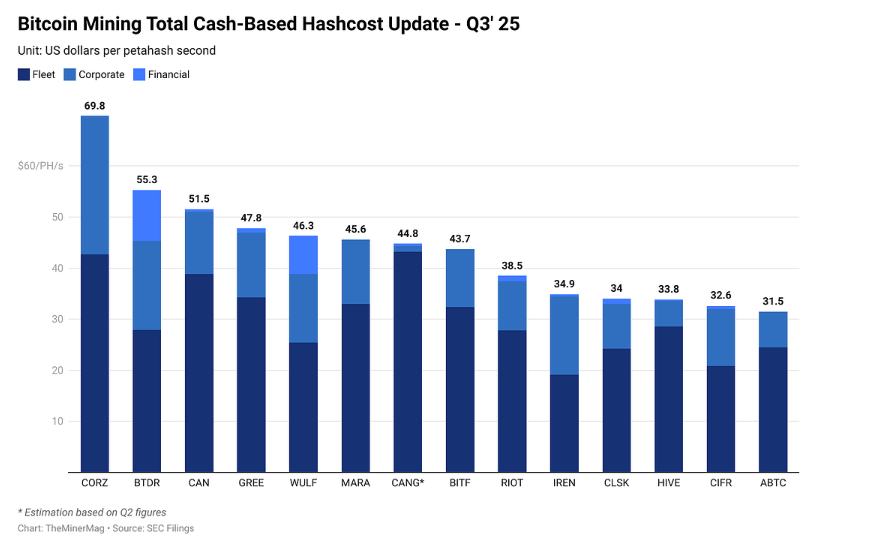
Current mining costs for public Bitcoin miners. Source: TheMinerMag

While these companies remain active in Bitcoin mining, the sector is operating in one of its toughest environments to date. Industry research describes current miner margins as historically compressed, with revenue at “structural lows” amid falling hash price and rising operating costs.

Much of the pressure stems from the 2024 Bitcoin halving, which reduced block rewards to 3.125 BTC and effectively halved mining revenue. Higher electricity costs and ongoing equipment expenses have added further strain, making diversification into AI and HPC increasingly important for many miners.

Related: Thirteen years after the first halving, Bitcoin mining looks very different in 2025

Letture associate

Oracle Plunges 40%, Will Excessive AI Infrastructure Overbuild Drag Down Giants?

Oracle's stock has plummeted 40% from its September peak, despite securing over $500 billion in AI infrastructure orders, signaling that massive backlogs alone no longer assure investor confidence. Similarly, Broadcom, with a $73 billion AI order backlog, and CoreWeave, which recently landed $36 billion in deals with OpenAI and Meta, have also faced stock declines. The market is growing skeptical of the AI infrastructure boom, concerned not only about suppliers' ability to fund and deliver these projects but also about the financial health and commitment of their major clients—primarily tech giants like Meta, Alphabet, Microsoft, Amazon, Apple, and Nvidia, alongside AI startups like OpenAI and Anthropic. While giants have robust finances, they are increasingly relying on debt to fuel AI capex, with soaring expenditures on data centers straining cash reserves and free cash flow. For instance, Microsoft, Alphabet, and Amazon are projected to collectively invest $1 trillion over four years. However, AI still contributes minimally to their overall revenue, raising questions about the sustainability of using profits from core businesses to fund speculative AI expansions. Execution challenges—such as power grid limitations, cooling issues, and community opposition—further complicate timely deployment. The critical uncertainty remains: if exponential AI demand fails to materialize and monetize quickly enough, these vast investments could lead to underutilized infrastructure, massive losses, and a fundamental weakening of these tech titans. The race between AI infrastructure build-out and actual market payoff will determine whether this bet becomes a triumph or a disastrous overreach.

marsbit5 min fa

Oracle Plunges 40%, Will Excessive AI Infrastructure Overbuild Drag Down Giants?

marsbit5 min fa

a16z Bets on Energy Tokenization Experiment: How Will DayFi Use DeFi to Restructure the Power Grid? Jae 2025/12/13 12:00

a16z Backs Energy Tokenization Experiment: How DayFi Aims to Restructure the Grid with DeFi As global tech giants compete for computing power, electricity has become a critical resource. DayFi, a decentralized energy capital markets protocol under the Daylight ecosystem, is launching a $50 million pre-deposit event on December 16. Backed by a16z Crypto and Framework Ventures, DayFi tokenizes future electricity revenue into tradable crypto assets. The protocol allows users to deposit stablecoins to mint GRID—a fully collateralized stablecoin—and then stake it to receive sGRID, a yield-bearing token representing a share in energy asset revenue. This creates a flywheel effect: liquidity funds distributed energy projects, which generate tokenized returns for holders. However, DayFi faces significant regulatory challenges. sGRID may be classified as a security by the SEC, requiring strict disclosures. Additionally, FERC’s restrictions on disclosing critical energy infrastructure data conflict with DeFi’s transparency requirements. Technical solutions like zero-knowledge proofs may be needed to verify收益 without exposing sensitive data. Valuation of the underlying energy assets—solar panels, batteries—also remains uncertain, with risks of depreciation and potential manipulation. Despite these hurdles, DayFi represents an ambitious attempt to bridge DeFi with physical energy grids, transforming electricity into a dynamic, tradable asset amid growing AI-driven power demand.

marsbit27 min fa

a16z Bets on Energy Tokenization Experiment: How Will DayFi Use DeFi to Restructure the Power Grid? Jae 2025/12/13 12:00

marsbit27 min fa

Trading

Spot
Futures
活动图片