Hiring Plummets by 80%, Is the Crypto Talent Market Saturated?

比推Pubblicato 2026-01-19Pubblicato ultima volta 2026-01-19

Introduzione

The cryptocurrency job market in early 2026 has seen a significant slowdown, with an 80% year-on-year decline in new job postings during the first two weeks of January compared to the same period in 2025. Only 85–90 new roles were detected across major crypto-focused job platforms, excluding direct corporate pages. Despite this sharp drop, the market isn't entirely saturated. Most openings (60%) are technical or engineering roles, with a strong preference for experienced professionals—65% of positions target mid-to-senior level candidates, often requiring 5+ years of experience (7+ for management roles). Key hiring is concentrated in infrastructure, stablecoins, and fintech/payment startups, with growth-stage companies (Series A and beyond) leading recruitment efforts. A notable shift is the rising competition for talent between ecosystems, particularly Solana’s growing challenge to Ethereum’s long-standing dominance. In 2024, Solana attracted a larger share of new developers (22%) than Ethereum (16%) for the first time since 2016, fueled by increased funding and ecosystem growth. The author suggests that 2026 will favor projects with strong fundamentals, real users, and sustainable revenue models, as the industry moves away from speculative token launches and focuses on tangible value creation.

Written by: willthetrill

Compiled by: Chopper, Foresight News


Is the hiring market in the cryptocurrency industry saturated now? Both yes and no. Although there were layoffs sporadically in December, overall, hiring momentum remained strong in the fourth quarter.

To uncover the truth, I specifically extracted data from major vertical recruitment websites in the crypto industry for the first two weeks of January 2026 (this data does not include official company recruitment pages). The results showed that only 85-90 new unique positions were added during this period.

This year's start has been quite quiet. In contrast, the data for January 2025 was quite impressive, with a total of 1,192 positions posted in that single month, making it the highest month for recruitment in all of 2025.
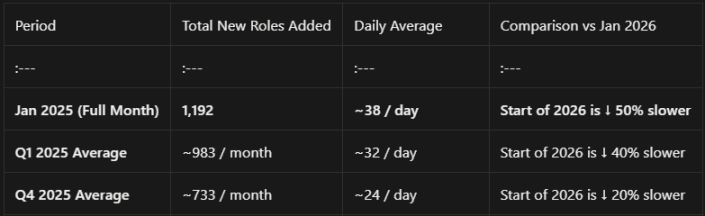
Data as of January 12, 2026

In the first two weeks of January 2025, the average number of daily job postings was about 38; in the same period of 2026, the average number of daily job postings was only about 6.5.

Recruitment activity in early January decreased by approximately 80% compared to the same period last year. This data confirms the widespread speculation: the industry's start this year is far less heated than last year.

Analyzing the details of the above job data, the main characteristics of the current recruitment market are as follows:

  • Job Type Distribution: Technical / Engineering positions account for 60%, Non-Technical / Business Development positions account for 40%.

  • Job Grade Distribution: Specialist / Senior Specialist / Manager / Department Head and other mid-to-senior level positions account for about 65%. This signal indicates that companies are prioritizing the recruitment of experienced talent to lead key projects related to core product development and business growth.

  • Experience Requirements: Most positions require candidates to have more than 5 years of relevant experience; management positions require more than 7 years of experience.

When conducting screening interviews with candidates, I often ask them: What currently attracts you to the crypto industry? The answers are invariably two: prediction markets and stablecoins. Therefore, it's not surprising that the data shows about 60% of recruitment demand is concentrated in infrastructure teams, stablecoin projects, and payment / fintech infrastructure startups. Furthermore, the talent war between the Kalshi and Polymarket platforms continues, and this competition is expected to persist.

Currently, the most aggressive recruiters are those growth-stage companies (i.e., companies that have completed Series A funding or later rounds). A quick glance at the recruitment pages of several companies and information on the Ashby platform also confirms this conclusion.

  • Series A Companies: Lifi Protocol has 13 open positions, Privy IO (acquired) has 10 open positions, Crossmint has 10 open positions, Coinflow Labs has 14 open positions;

  • Series B Companies: TurnkeyHQ has 12 open positions;

  • Series C Companies: Raincards has 49 open positions;

  • Series D Companies: Anchorage has 66 open positions.

However, perhaps more interesting is the change in talent flow.

Having worked full-time in crypto recruitment for 5 years, I can't help but recall: "Has there ever been a public chain ecosystem, like Solana, that challenged Ethereum's dominance in the recruitment and developer growth arena?" The answer is: No, at least never on this scale.

Looking back, other public chains like Polkadot and Cosmos have all experienced phases of rapid developer growth, but they never managed to pose a challenge to Ethereum of the same magnitude in terms of market share and sustained recruitment scale.

Solana is the first ecosystem with the real strength to compete with Ethereum. In 2024, it set a historic record, achieving, for the first time since 2016, a higher percentage of new contributing developers than Ethereum. Solana attracted over 22% of the crypto industry's new developers, while Ethereum's share was about 16%. This phenomenon is quite rare, considering that in the past, Ethereum almost monopolized the vast majority of new talent.
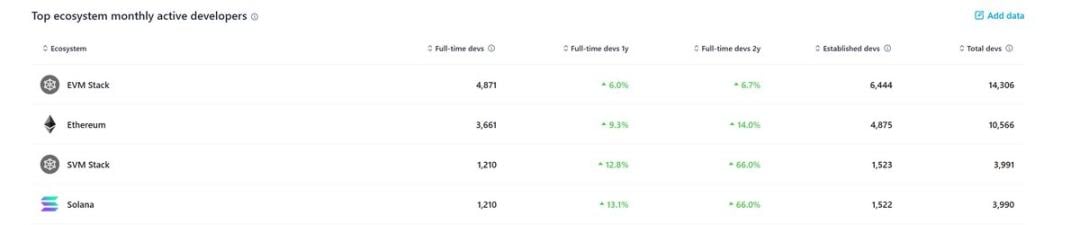
Data source: Electric Capital "Developer Report", as of January 14, 2026

In the third quarter of 2025 alone, 23 Solana ecosystem projects completed financing, raising $211 million, a 70% year-on-year increase in ecosystem financing scale.

For example: When a project completes a $13.5 million financing round (like Raikucom did in Q3 2025), its first priority is to recruit 5-10 senior engineers to build the core engineering team and business development team. These types of positions often do not appear on public recruitment websites but are filled through investor / angel investor networks, hackathon events, and targeted headhunting.

The crypto industry is constantly evolving, and the landscape of the recruitment market will change accordingly. Through token issuance, crypto technology can push internet capital markets to maximize development, but the reality is that the vast majority of tokens issued in the past two years have seen their prices fall.

I believe that in 2026, the ripple effects of this phenomenon will gradually become apparent, affecting how companies raise risk capital, their market expansion strategies, and, of course, their talent recruitment strategies.

The projects that will stand out this year will undoubtedly be those with solid business fundamentals, a real user base, solving actual needs, and most importantly, generating revenue.


Twitter:https://twitter.com/BitpushNewsCN

Bitpush TG Discussion Group:https://t.me/BitPushCommunity

Bitpush TG Subscription: https://t.me/bitpush

Original link:https://www.bitpush.news/articles/7604019

Domande pertinenti

QAccording to the data, by what percentage did the daily job posting rate in the crypto industry drop in the first two weeks of January 2026 compared to the same period in 2025?

AThe daily job posting rate dropped by approximately 80% in the first two weeks of January 2026 compared to the same period in 2025.

QWhat are the two main areas that candidates cite as their reason for joining the crypto industry, which also account for 60% of the hiring demand?

AThe two main areas are prediction markets and stablecoins.

QWhich blockchain ecosystem is highlighted as the first to seriously challenge Ethereum's dominance in developer recruitment and growth?

AThe Solana ecosystem is highlighted as the first to seriously challenge Ethereum's dominance.

QWhat type of companies are currently the most aggressive in their hiring, according to the article?

AGrowth-stage companies (those that have completed Series A funding or later) are currently the most aggressive in their hiring.

QWhat key characteristic is mentioned for projects that are predicted to stand out in 2026?

AProjects that are predicted to stand out in 2026 are those with solid business fundamentals, a real user base, that solve actual needs, and, most importantly, are able to generate revenue.

Letture associate

Interview with Robinhood Executive: Meme + Tokenized US Stocks as "Barbell" Customer Acquisition Strategy, All Business Lines Achieve Hundreds of Millions in Revenue

Interview with Robinhood executive Johann Kerbrat reveals the company's "barbell" customer acquisition strategy for its new Robinhood Chain, combining meme tokens with tokenized stocks. Three weeks after mainnet launch, the chain has seen over $3B in weekly DEX volume and 105M transactions. Kerbrat explains the logic behind the permissionless chain: meme tokens attract DeFi users, while tokenized real-world assets (RWA), currently over 90 US stocks and ETFs accessible in 120+ countries, serve global users. The goal is to bring Robinhood's 27 million funded accounts on-chain by simplifying DeFi with a user-friendly interface, exemplified by features like Robinhood Earn which offers yield without requiring wallet management. Built on Arbitrum's technology stack for its speed, low cost, and Ethereum's security, the chain focuses on financial products like Earn, spot trading, and perpetuals. Kerbrat downplays direct competition with platforms like Base, emphasizing the goal of expanding the overall market for on-chain assets. He details selective partnerships (e.g., Morpho, Lighter) based on compliance, unique UX, and differentiation. While regulatory clarity is pending for US perpetuals, the expansion continues via Bitstamp in Europe. Finally, Kerbrat positions Robinhood as a "super app" integrating stocks, options, crypto, banking, and AI trading, with all major business lines generating hundreds of millions in revenue. For the chain, current priority is driving adoption over maximizing gas fee revenue.

marsbit1 h fa

Interview with Robinhood Executive: Meme + Tokenized US Stocks as "Barbell" Customer Acquisition Strategy, All Business Lines Achieve Hundreds of Millions in Revenue

marsbit1 h fa

Fidelity Q3 Report: BTC, ETH, and SOL Continue to Build Bottoms; How Much Further Will This Crypto Bear Market Go?

Fidelity's Q3 Crypto Signal Report analyzes the current bear market, noting Bitcoin (BTC), Ethereum (ETH), and Solana (SOL) are in a prolonged bottoming phase. Key indicators like the weighted Net Unrealized Profit/Loss (NUPL) have turned negative (-0.01), signaling the market is slightly below its aggregate cost basis, with BTC acting as the primary stabilizing asset. BTC's dominance has risen to 68%, indicating a lack of capital rotation to other digital assets. Performance has been weak across the board, with BTC, ETH, and SOL down significantly year-to-date. Market sentiment is depressed, exacerbated by substantial outflows from spot ETPs and a challenging macro environment. The report compares the current ~203-day downtrend to historical ~300-day bottoming cycles, suggesting the process may be two-thirds complete, with late 2026 as a potential timeframe to monitor. For Bitcoin, NUPL at 0.09 indicates cautious sentiment, while momentum signals remain negative. The Yardstick metric points to potential undervaluation relative to network security (hashrate). Ethereum's NUPL is deep in the "capitulation" zone at -0.43, a historically positive signal for future returns, though its momentum and network fee revenue are negative. Solana shows the deepest NUPL at -0.72 but demonstrates relative resilience in on-chain activity and stablecoin transfer volume. The report concludes that while several metrics are near historical capitulation levels, a definitive market bottom has not yet been established. The path forward likely involves continued consolidation, with BTC's relative strength and fundamental on-chain usage for ETH and SOL providing key areas for investor observation.

marsbit1 h fa

Fidelity Q3 Report: BTC, ETH, and SOL Continue to Build Bottoms; How Much Further Will This Crypto Bear Market Go?

marsbit1 h fa

Trading

Spot
活动图片