Author: Santiago Roel Santos
Compiled by: Luffy, Foresight News
Original Title: Can Cryptocurrencies Without Compound Interest Outperform Stocks?
As I write this article, the cryptocurrency market is experiencing a sharp decline. Bitcoin has touched the $60,000 mark, SOL has fallen back to its price level during the FTX bankruptcy asset liquidation, and Ethereum has also dropped to $1,800. I won't elaborate on the long-term bearish arguments here.
This article aims to explore a more fundamental question: why can't tokens achieve compound growth?
For the past few months, I have maintained a viewpoint: from a fundamental perspective, crypto assets are severely overvalued. Metcalfe's Law cannot support the current valuations, and the divergence between industry application and asset prices may persist for years.
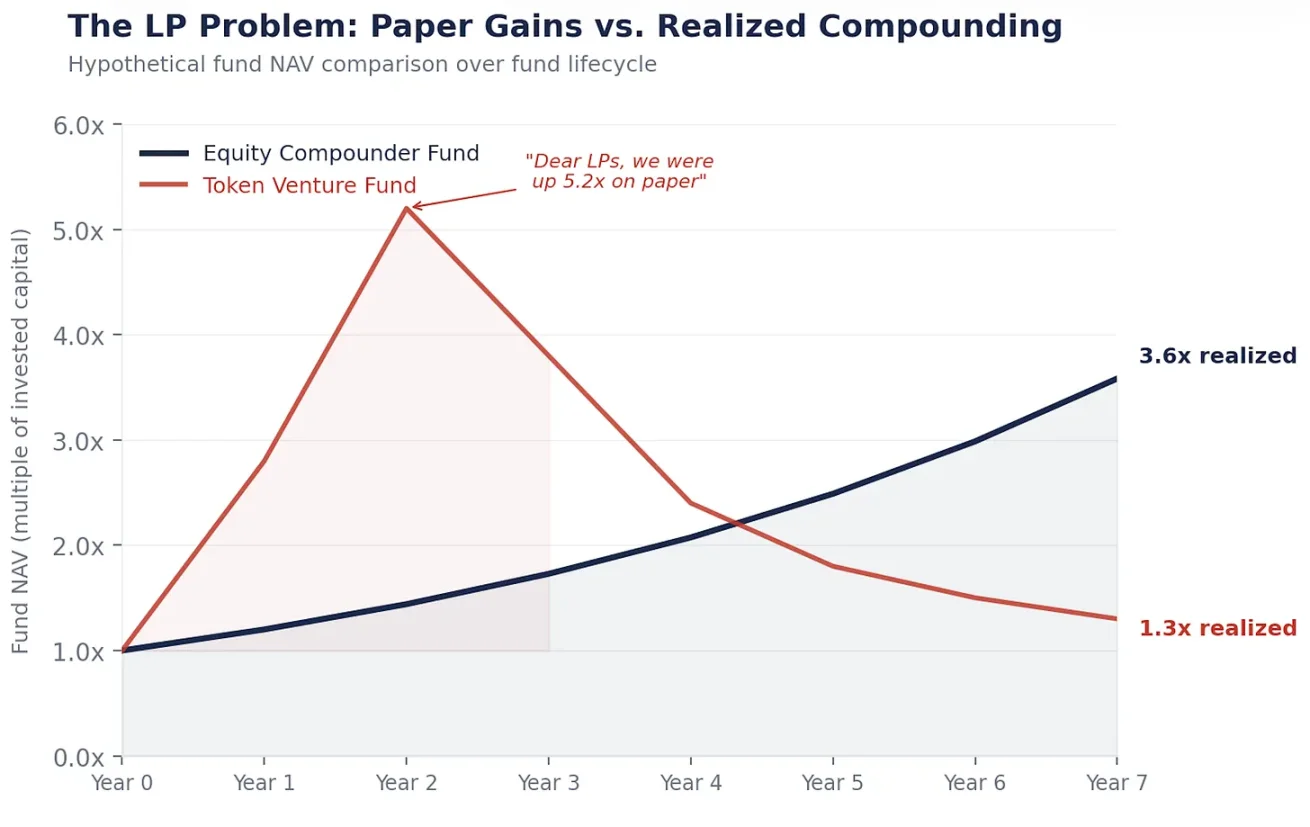
Imagine this scenario: "Dear liquidity providers, stablecoin trading volume has grown 100-fold, but the returns we bring you are only 1.3x. Thank you for your trust and patience."
What is the strongest objection to all this? "You're too pessimistic and simply don't understand the value proposition of tokens; this is a new paradigm."
I understand the value proposition of tokens all too well, and that is precisely the crux of the problem.
The Compound Interest Engine
Berkshire Hathaway now has a market capitalization of about $1.1 trillion. This isn't because of Buffett's precise market timing, but because this company has the ability to grow through compound interest.
Every year, Berkshire reinvests its profits into new businesses, expands profit margins, acquires competitors, thereby increasing the intrinsic value per share, and the stock price follows suit. This is an inevitable result because the underlying economic engine is continuously growing stronger.
This is the core value of a stock. It represents ownership of an engine that reinvests profits. Management earns profits, then allocates capital, plans for growth, cuts costs, buys back shares. Every correct decision becomes a stepping stone for the next phase of growth, creating compound interest.
$1 growing at a 15% compound annual rate for 20 years becomes $16.37; $1 stored at a 0% interest rate for 20 years remains just $1.
Stocks can turn $1 of profit into $16 of value; tokens, however, can only turn $1 of fee revenue into $1 of fee revenue, with no appreciation.
Show Me Your Growth Engine
Let's see what happens when a private equity fund acquires a business with an annual free cash flow of $5 million:
Year 1: Achieves $5 million free cash flow. Management reinvests it into R&D, building a stablecoin custody channel, repaying debt—these are three key capital allocation decisions.
Year 2: Each decision yields returns, free cash flow increases to $5.75 million.
Year 3: The gains from earlier stages continue, supporting the implementation of new decisions, free cash flow reaches $6.6 million.
This is a business compounding at 15%. The increase from $5 million to $6.6 million isn't due to high market sentiment, but because every capital allocation decision made by people empowers and builds upon the last. Persist like this for 20 years, and $5 million will eventually become $82 million.
Now, consider a crypto protocol with annual fee revenue of $5 million:
Year 1: Earns $5 million in fees, distributes it all to token stakers, capital completely exits the system.
Year 2: Might earn $5 million in fees again, provided users are willing to return, then distributes it all again, capital exits once more.
Year 3: Earnings depend entirely on how many users are still participating in this "casino."
There is no compound interest whatsoever, because there was no reinvestment in Year 1, hence no growth flywheel by Year 3. Subsidy programs alone are far from sufficient.
Token Design is Inherently Like This
This is not accidental; it's a legal strategy.
Looking back to 2017-2019, the U.S. Securities and Exchange Commission (SEC) cracked down on all assets that resembled securities. At that time, all lawyers advising crypto protocol teams gave the same advice: never make tokens look like stocks. Do not grant token holders rights to cash flow, do not give tokens governance rights over the core development entity, do not retain earnings. Define them as utility assets, not investment products.
Thus, the entire crypto industry designed tokens deliberately to distinguish them from stocks. No cash flow rights, to avoid appearing like dividends; no governance rights over the core dev entity, to avoid seeming like shareholder rights; no retained earnings, to avoid looking like a corporate treasury; staking rewards are defined as network participation rewards, not investment returns.
This strategy worked. The vast majority of tokens successfully avoided being classified as securities, but simultaneously, they lost all possibility of achieving compound growth.
This asset class was deliberately designed from its inception to be incapable of performing the core action for creating long-term wealth—compound interest.
Developers Hold Equity, You Hold 'Coupons'
Every major crypto protocol corresponds to a for-profit core development entity. These entities develop software, control the front-end interface, own the brand, manage enterprise partnership resources. And the token holders? They only get governance voting rights and a variable claim on fee revenue.
This model is ubiquitous in the industry. The core R&D entity holds the talent, intellectual property, brand, enterprise contracts, and strategic choices; token holders only get variable "coupons" tied to network usage and the "privilege" to vote on proposals that the R&D entity increasingly ignores.
This also explains why, when a company like Circle acquires a protocol like Axelar, the acquirer buys the equity of the core development entity, not the tokens. Because equity compounds, tokens do not.
Lack of clear regulatory intent has led to this distorted industry outcome.
What Are You Actually Holding?
Set aside all market narratives, ignore price fluctuations, and look at what token holders actually receive.
Staking Ethereum, you about 3%-4% yield. This yield is determined by the network's inflation mechanism and adjusts dynamically based on the staking rate: more stakers, lower yield; fewer stakers, higher yield.
This is essentially a variable-rate interest coupon tied to the protocol's predetermined mechanism. It's not a stock; it's a bond.
Admittedly, Ethereum's price might rise from $3,000 to $10,000, but the price of a junk bond can also double if the spread narrows—that doesn't turn it into a stock.
The key question is: by what mechanism does your cash flow grow?
Stock cash flow growth: Management reinvests profits, achieving compound growth. Growth rate = Return on Capital × Reinvestment Rate. As a holder, you participate in an expanding economic engine.
Token cash flow: Depends entirely on network usage × fee rate × staking participation rate. You receive a coupon that fluctuates with block space demand. The entire system lacks any reinvestment mechanism or compound growth engine.
Significant price volatility makes people think they hold stocks, but economically, they are holding fixed-income products,附带 60%-80% annualized volatility. This is the worst of both worlds.
For the vast majority of tokens, the real yield, after deducting inflationary dilution, is only 1%-3%. No fixed-income investor in the world would accept such a risk-reward ratio, but the high volatility of these assets always attracts wave after wave of buyers. This is the true embodiment of the "greater fool theory."
The Power Law of Timing, Not the Power Law of Compounding
This is why tokens cannot achieve value accumulation and compound growth. The market is gradually realizing this. It is not stupid; it is starting to shift towards crypto-related stocks. First, digital asset treasuries, and then increasingly, capital is flowing into enterprises that use crypto technology to reduce costs, increase revenue, and achieve compound growth.
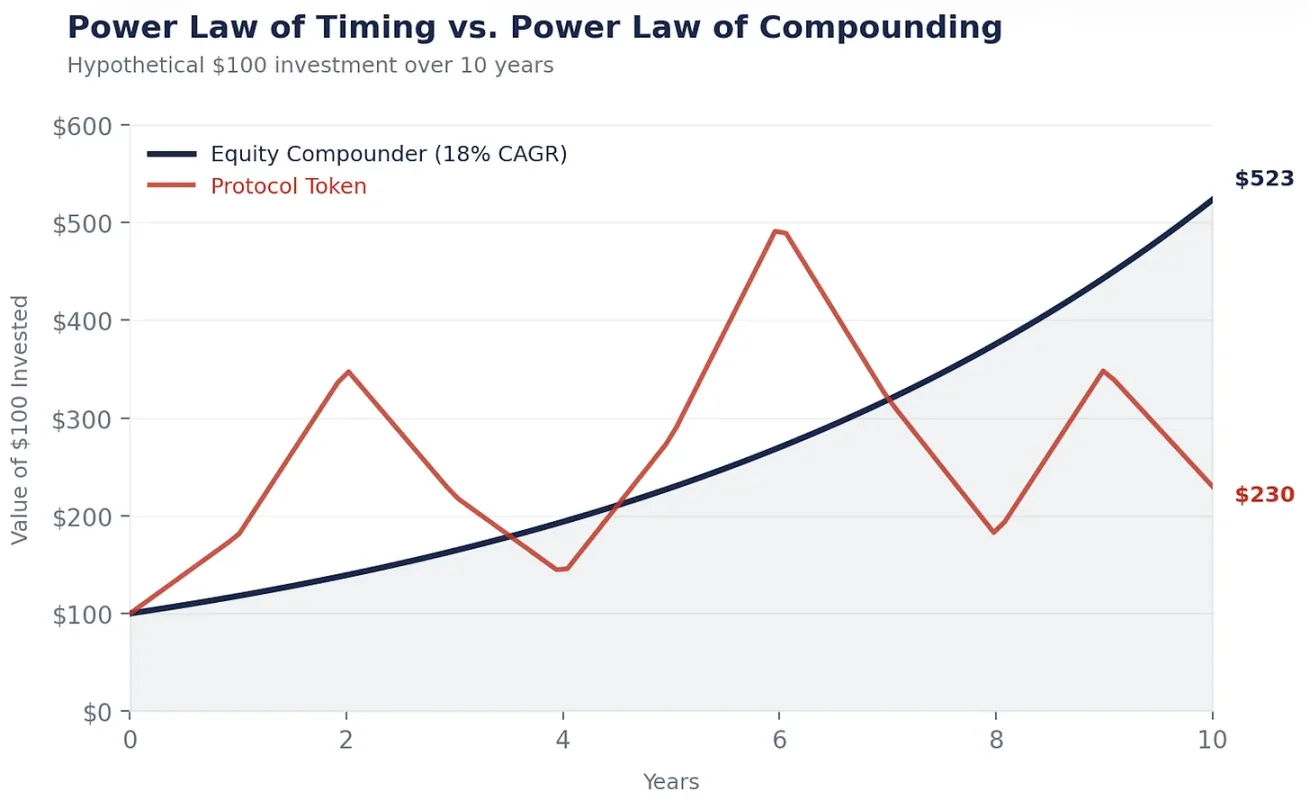
Wealth creation in crypto follows the power law of timing: those who make huge profits bought early and sold at the right time. My own portfolio follows this pattern. Crypto assets are called "liquid venture capital" for a reason.
Wealth creation in stocks follows the power law of compounding: Buffett didn't make money on Coca-Cola by timing the purchase, but by buying and holding for 35 years, letting compound interest work.
In crypto, time is your enemy: hold too long, and profits evaporate. High inflation mechanisms, low float, high fully diluted valuation (FDV) design, coupled with a market现状 of insufficient demand and excess block space, are key reasons. Super-liquid assets are among the few exceptions.
In stocks, time is your ally: the longer you hold a compounding asset, the more impressive the returns from mathematical规律.
The crypto market rewards traders; the stock market rewards holders. And in reality, far more people get rich by holding stocks than by trading.
I have to repeatedly check these numbers because every liquidity provider asks: "Why not just buy Ethereum?"
Pull up the chart of a compounding stock—Danaher, Constellation Software, Berkshire—and compare it to Ethereum's chart: the compounding stock's curve climbs steadily up and to the right because the underlying economic engine grows stronger every year; Ethereum's price surges and crashes, cycles repeatedly, and the ultimate cumulative return depends entirely on your entry and exit timing.
Perhaps the final returns might be similar, but holding stocks lets you sleep soundly at night, holding tokens requires you to be a prophet who can predict the market. "Time in the market beats timing the market"—everyone knows this, but the hard part is actually holding long-term. Stocks make long-term holding easier: cash flow supports the stock price, dividends give you patience to wait, buybacks compound while you hold. The crypto market makes long-term holding extremely difficult: fee revenue dries up, market narratives change, you have nothing to rely on, no price floor, no stable coupon, only faith.
I'd rather be a holder than a prophet.
Investment Strategy
If tokens cannot compound, and compounding is the core method of wealth creation, then the conclusion is self-evident.
The internet created trillions of dollars in value. Where did this value ultimately flow? Not to protocols like TCP/IP, HTTP, SMTP. They are public goods, immensely valuable, but bring no return to investors at the protocol level.
The value ultimately flowed to companies like Amazon, Google, Meta, Apple. They built businesses on top of the protocols and achieved compound growth.
The crypto industry is repeating this history.
Stablecoins are gradually becoming the TCP/IP of money—highly practical, high adoption rate, but whether the protocol itself can capture value commensurate with this is still unknown. USDT is backed by a company with equity, not just a protocol—an important hint lies here.
Enterprises that integrate stablecoin infrastructure into their operations, reduce payment friction, optimize working capital, cut foreign exchange costs—these are the true compounding entities. A CFO who saves $3 million annually by switching cross-border payments to stablecoin channels can reinvest that $3 million into sales, product development, or debt repayment, and that $3 million will continue to compound. The protocol that facilitated the transaction only earned a fee, with no compounding.
The "Fat Protocol" thesis argued that crypto protocols would capture more value than the application layer. But seven years on, public chains occupy about 90% of the total crypto market cap, yet their share of fee revenue has plummeted from 60% to 12%; the application layer contributes about 73% of fees, yet its valuation share is less than 10%. Markets are always efficient; this data says it all.
The market still clings to the "Fat Protocol" narrative, but the next chapter of crypto will undoubtedly be written by crypto-enabled stocks: companies that have users, generate cash flow, and whose management can use crypto technology to optimize the business and achieve higher compound growth rates will outperform tokens.
Portfolios of companies like Robinhood, Klarna, NuBank, Stripe, Revolut, Western Union, Visa, Blackrock will certainly outperform a basket of tokens.
These companies have a real price support: cash flow, assets, customers. Tokens do not. When token valuations are driven to outrageous multiples based on future revenue, the severity of their decline is可想而知.
Be long-term bullish on crypto technology, be selective with tokens, and heavily invest in the stocks of companies that can leverage crypto infrastructure to amplify advantages and achieve compound growth.
The Frustrating Reality
All attempts to solve the token compounding problem inadvertently confirm my point.
Those Decentralized Autonomous Organizations (DAOs) trying to perform actual capital allocation—like MakerDAO buying treasury bonds, establishing sub-DAOs, appointing specialized teams—are slowly重塑 corporate governance models. The more a protocol wants to achieve compound growth, the more it不得不 resemble a corporation.
Digital asset treasuries and tokenized stock wrapper tools also don't solve this. They just create a second claim on the same cash flow, competing with the underlying token. Such tools don't make the protocol better at compounding; they merely redistribute收益 from token holders who don't hold the tool to those who do.
Token burns are not stock buybacks. Ethereum's burn mechanism is like a thermostat set to a fixed temperature, unchanging; Apple's stock buybacks are flexible decisions made by management based on market conditions. Smart capital allocation, the ability to adjust strategy according to the market, is the core of compounding. Rigid rules cannot generate compound interest; flexible decisions can.
And regulation? This is actually the most值得探讨 part. The root cause why tokens cannot compound today is that protocols cannot operate as businesses: they cannot incorporate, cannot retain earnings, cannot make legally binding promises to token holders. The GENIUS Act proves that the U.S. Congress can integrate tokens into the financial system without stifling development. When we have a framework that allows protocols to operate using corporate capital allocation tools, that will be the biggest catalyst in crypto history, far exceeding the impact of the Bitcoin spot ETF.
Until then, smart capital will continue to flow to stocks, and the compounding gap between tokens and stocks will widen every year.
This is Not Bearish on Blockchain
Let me be clear: Blockchain is an economic system with infinite potential and will undoubtedly become the underlying infrastructure for digital payments and agentic commerce. My company, Inversion, is developing a blockchain precisely because we deeply believe this.
The problem is not the technology itself, but the economic model of tokens. Current blockchain networks merely transfer value; they do not accumulate and reinvest it for compound growth. But this will eventually change: regulation will improve, governance will mature, some protocol will find a way to retain and reinvest value like a good corporation. When that day comes, tokens will be stocks in everything but name, and the compound interest engine will officially start.
I am not bearish on that future; I just have my own estimate of its arrival time.
Someday, blockchain networks will achieve compound value growth. Until then, I will choose to buy companies that use crypto technology to achieve faster compound growth.
I might be wrong on the timing. The crypto industry is an adaptive system, and that is one of its most precious traits. But I don't need to be perfectly precise; I just need to be right on the big direction: the long-term performance of compounding assets will ultimately surpass other assets.
And that is the charm of compound interest. As Charlie Munger said: "It is remarkable how much long-term advantage people like us have gotten by trying to be consistently not stupid, instead of trying to be very intelligent."
Crypto technology drastically reduces the cost of infrastructure, and wealth will ultimately flow to those who use this low-cost infrastructure to achieve compound growth.
Twitter:https://twitter.com/BitpushNewsCN
Bitpush TG Discussion Group:https://t.me/BitPushCommunity
Bitpush TG Subscription: https://t.me/bitpush