Hidden Ads No More: Under X's New Disclosure Rules, KOLs' Easy Money Model Faces Account Suspension Risks

比推Pubblicato 2026-02-24Pubblicato ultima volta 2026-02-24

Introduzione

X, formerly known as Twitter, is set to enforce stricter advertising disclosure rules, as announced by product lead Nikita Bier. The new policy will require users to clearly label paid promotions with tags like #ad or #sponsored. This follows a public intervention by Bier, who warned an influential account promoting Kalshi without proper disclosure of its financial ties. The article highlights several high-engagement “stealth ads”—posts disguised as organic content that are actually paid promotions—from accounts like @jota_snchez and @FluentInFinance, which garnered millions of views without disclosure. These posts often promoted prediction markets like Polymarket and Kalshi by leveraging FOMO and misleading narratives. The new rules aim to increase transparency, impacting Web3 projects and influencers who rely on undisclosed soft promotions for user acquisition. KOLs may face higher risks, including post removal and account suspension, while projects could see rising marketing costs. Alternatively, advertisers may shift budgets to X’s official promoted post system, potentially increasing the platform’s ad revenue. The move is expected to reduce deceptive marketing practices and improve user awareness in the long term.

Author: Sanqing, Foresight News

Original Title: X's New Advertising Disclosure Rules to Launch, Potentially Ending the Crypto KOLs' 'Easy Money' Model


On February 21, X platform product lead Nikita Bier (@nikitabier) publicly intervened in a post suspected of undisclosed paid promotion, directly requesting the original poster to add a disclosure statement or face account suspension. User @infodexx posted a list of the "Most Valuable Startups of 2025," with prediction market Kalshi ranking second with a $11 billion valuation, accompanied by Kalshi's green brand image and founder's photo.

The post garnered over 420,000 views, nearly 2000 likes, and hundreds of reposts. While it appeared to be an objective ranking, it was flagged in the reader community notes as "this is a paid post." Furthermore, @infodexx's bio explicitly states "@Kalshi partner," yet the original post lacked any clear disclosure labels like #ad or #sponsored.
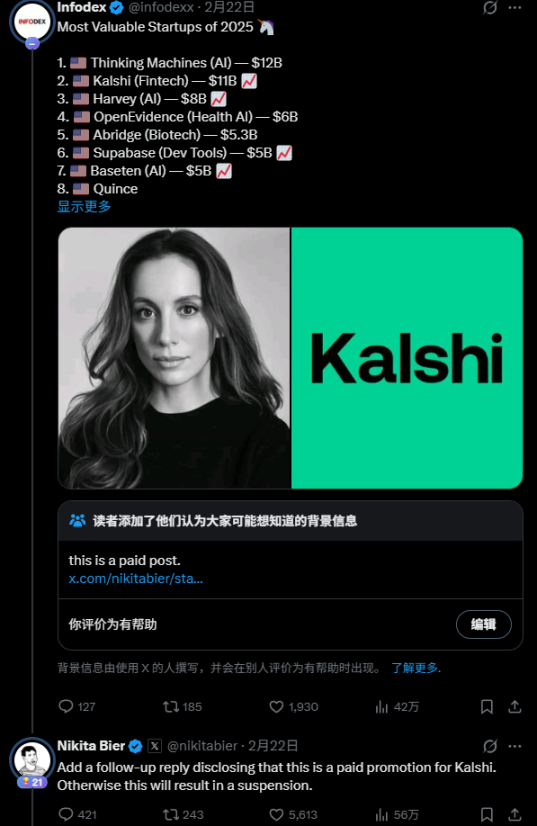
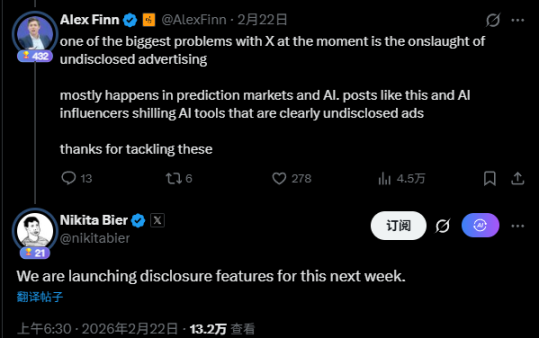
Nikita Bier replied to the post on the same day: "Please add a follow-up reply disclosing this is a paid promotion for Kalshi. Otherwise, this will result in account suspension." Later, when user @AlexFinn complained about the X platform being flooded with undisclosed ads (especially posts related to prediction markets and AI), Nikita Bier further stated: "We are launching a disclosure feature for this type of issue next week."
High-Viewership Hidden Ads Will Be Brought into the Light

Below are several examples of high-viewership "hidden ads" selected by the author. These tweets appear to be natural shares but are suspected promotions lacking any disclosure labels. They attract high views, lure degens to follow the trend, yet evade responsibility.

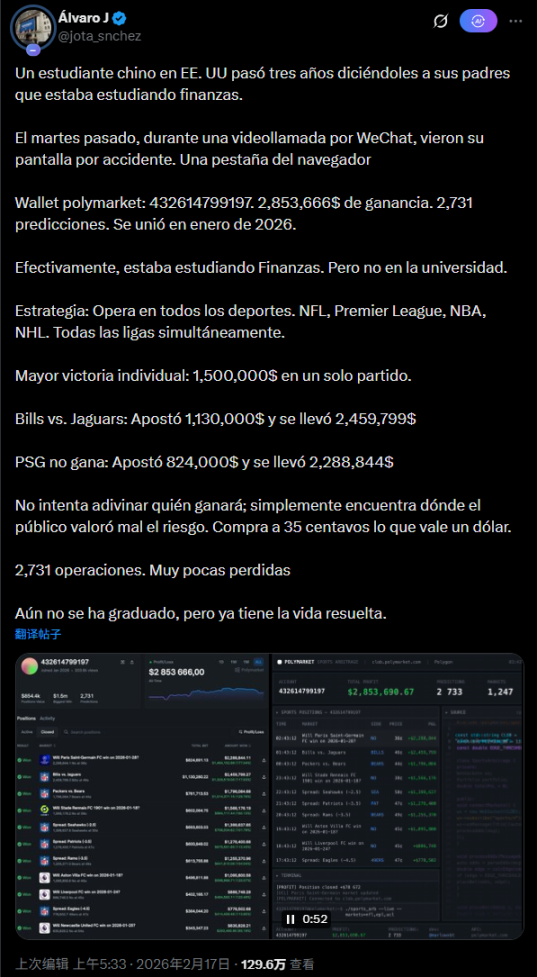
A Spanish-language account @jota_snchez shared a story about a "Chinese student making a fortune on Polymarket," with over 1.29 million views, 7313 likes, and 312 reposts. The content detailed strategies with images and videos, seeming like an inspirational post but actually softly promoting Polymarket's money-making potential. No #ad label, yet indirectly hyping the platform—a classic disguise of experience sharing.
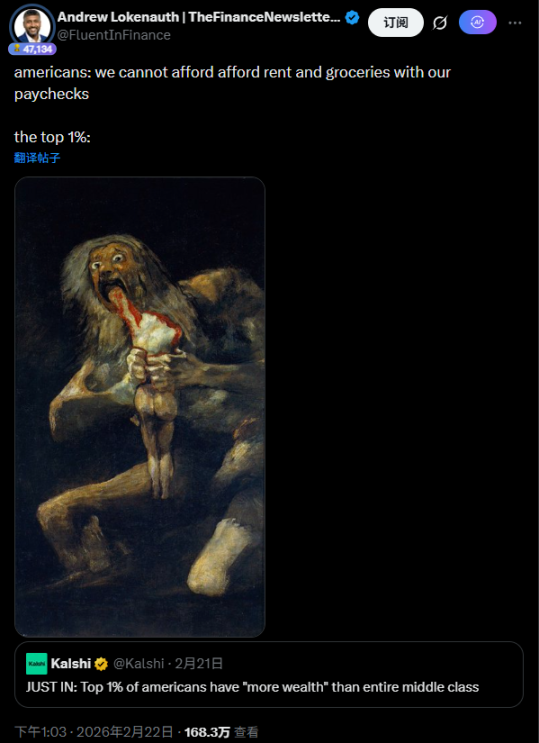
User @FluentInFinance quoted a Kalshi tweet, complaining "US 1% wealthier than middle class," with 1.68 million views, 150k+ likes, and 20k+ reposts. Superficially social commentary, it actually quoted Kalshi's "JUST IN" news, guiding users to bet on related events on the platform. Not labeled #sponsored, yet amplified exposure through high engagement. This is where Web3 degens often get tricked.
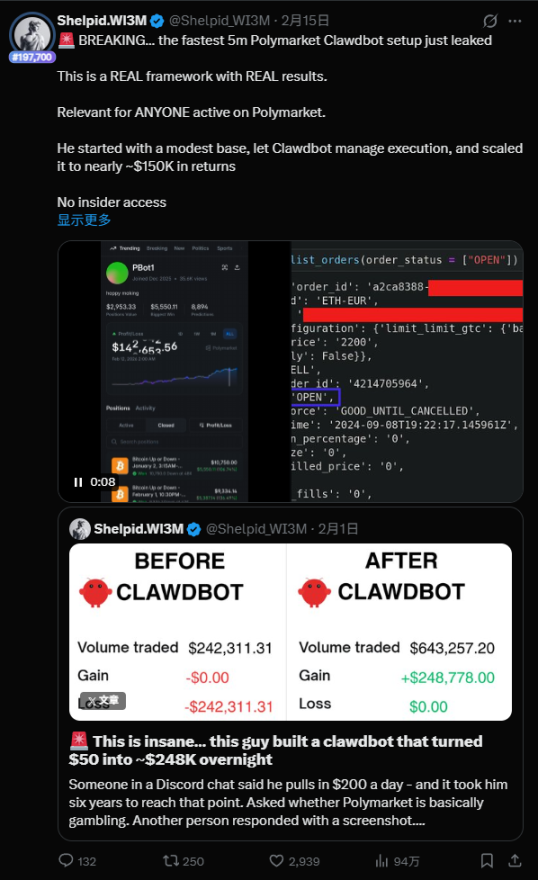
@Shelpid_WI3M "exposed" a 5-minute setup framework for Polymarket Clawdbot, with 940k views, 2940 likes, 6091 bookmarks. Detailed steps + link, seeming like a "free share" but actually promoting a copytrade tool, indirectly pulling new users to Polymarket. No disclosure of any partnership—this type of "developer perspective" hidden ad is the most deceptive for technical degens.
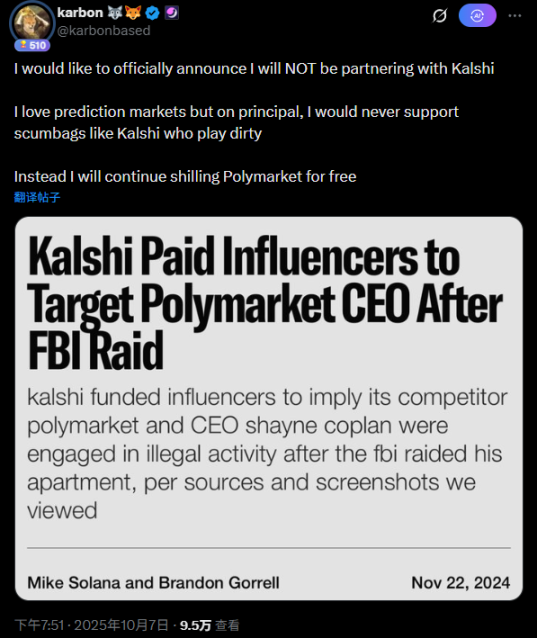
@karbonbased publicly "refused Kalshi collaboration but continues to shill Polymarket for free," with 95k views, 764 likes. Superficially a "principled" refusal, it actually promotes Polymarket indirectly. The word "free" is most suspicious—what's truly free in Web3? No #ad, yet using moral high ground to induce followers.
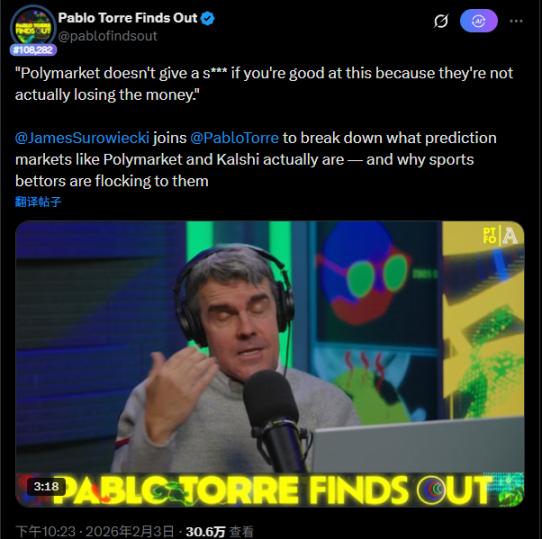
@pablofindsout uploaded a video discussing the nature of Polymarket and Kalshi, with 300k views, 1657 likes. Citing expert opinions, seemingly neutral but actually amplifying platform exposure—an unlabeled sponsored隐形广告片 (stealth ad video).
These examples show that high viewership does not equal sincerity. They rely on FOMO for viral spread but avoid disclosure, costing wallets dearly. After the new rules, similar tweets will be restricted.

Impact of X's New Rules on Web3 Marketing

For Web3 project teams, this means a significant increase in marketing costs. Many prediction market projects (like Polymarket and Kalshi) rely on KOLs' soft ads to drive user FOMO entry at low cost.

Now, the new rules require any content involving payment, gifts, affiliate links, or material incentives to be prominently labeled with "#ad," "sponsored," or "paid partnership," etc. Otherwise, the tweet will be directly removed, and the account faces suspension or even permanent ban.

In the short term, growth for these platforms will slow down. KOLs will hesitate to share freely, collaboration thresholds will be raised, and budgets will be forced towards more expensive channels.

For KOLs, the most direct impact is the end of the "low-effort easy money" model. In the past, many projects heavily relied on KOLs' "soft ad" strategy: disguising promotions as neutral experience sharing, data-driven complaints, or viral memes to create FOMO and drive user participation at low cost.

Now, forced explicit disclosure means KOLs can no longer hide commercial relationships and dare not casually "share naturally." Once detected by AI or reported, the risk of tweet deletion and account suspension is extremely high.

This will also raise the collaboration threshold between projects and KOLs. As risks increase, KOLs' rates may rise. But in the long run, this is positive for the Web3 ecosystem. Increased transparency will restore user trust in promoted content, reducing rug pulls and short-term speculation.

A common alternative is shifting to X's official Promoted Post system: these ads automatically carry "Promoted" or "Ads" labels, handled uniformly by the platform for disclosure, avoiding manual labeling risks. However, this also means project teams pay directly to X, concentrating more ad revenue into the platform's hands rather than dispersing it to KOLs.

X's move also likely aims to enhance its own advertising monetization capability. By enforcing explicit disclosure and promoting official ad tools, the platform can attract more budgets into its own system, capturing the share of "hidden ads" that originally flowed to KOLs, further strengthening its position as an ad revenue source, especially in competitive fields like prediction markets and AI content.


Twitter:https://twitter.com/BitpushNewsCN

Bitpush TG Discussion Group:https://t.me/BitPushCommunity

Bitpush TG Subscription: https://t.me/bitpush

Original article link:https://www.bitpush.news/articles/7614106

Domande pertinenti

QWhat new policy is X platform introducing regarding paid promotions?

AX platform is introducing a new policy that requires any content involving paid promotions, giveaways, affiliate links, or material incentives to be clearly labeled with disclosures such as '#ad', 'sponsored', or 'paid partnership'. Failure to comply will result in post removal and potential account suspension or permanent ban.

QWho is Nikita Bier and what action did he take on February 21st?

ANikita Bier is the Product Lead at X platform. On February 21st, he publicly intervened on a post by user @infodexx that was suspected of being an undisclosed paid promotion. He instructed the user to add a disclosure statement or face account suspension.

QWhat are some examples of high-engagement 'stealth ads' mentioned in the article?

AExamples include a Spanish account @jota_snchez sharing a story about a Chinese student making money on Polymarket (1.29M views), @FluentInFinance criticizing wealth inequality while referencing Kalshi (1.68M views), and @Shelpid_WI3M sharing a 'setup framework' for a Polymarket tool (940k views). All lacked proper disclosure tags.

QHow will the new disclosure rules impact Web3 projects and KOLs according to the article?

AFor Web3 projects, marketing costs will rise as they can no longer rely on low-cost, undisclosed KOL soft promotions. For KOLs, their 'easy money' model of sharing undisclosed ads will end, forcing them to properly label content. This raises the cooperation threshold and may increase KOL pricing due to higher risks.

QWhat is a potential alternative for advertisers under the new rules, and what is X platform's possible motive?

AA common alternative is to use X's official Promoted Post system, which automatically labels ads as 'Promoted' or 'Ads'. The article suggests X's motive may be to increase its own advertising revenue by redirecting budgets from KOL 'stealth ads' to its official ad platform, especially in competitive areas like prediction markets and AI content.

Letture associate

He Just Raised 2.7 Billion, and Li Fei-Fei Also Invested

Pete Florence, a former senior research scientist at Google DeepMind and a key contributor to the Vision-Language-Action (VLA) model architecture, is deliberately distancing his startup, Generalist AI, from the trendy "world model" label. He argues that the industry should prioritize concrete goals over buzzwords. His goal is to create robots that can perform a vast range of unseen tasks with high speed and success rates, without needing task-specific training data. Recently, his company raised $400 million (¥2.7 billion) at a $2 billion valuation. Notable investors include NVIDIA's NVentures, Bezos Expeditions, NFDG, as well as Xiaomi co-founder Lin Bin, Zoom founder Eric Yuan, and renowned AI scientist Fei-Fei Li. Florence's approach stems from his academic background at MIT under Professor Russ Tedrake, focusing on understanding the physical world. After joining DeepMind, he developed models like Transporter Network and co-created the VLA framework. He left in 2025 to found Generalist AI. The company has launched two models: GEN-0, which demonstrated that scaling laws apply to physical motion, and GEN-1. GEN-1 was trained on over 500,000 hours of physical interaction data collected via a specialized wearable device. It achieves a 99% success rate on precise mechanical tasks like folding boxes and maintains performance three times faster than its predecessor. Florence believes GEN-1 is reaching a commercial utility threshold similar to the GPT-3 inflection point. The substantial funding round, following GEN-1's release, signifies strong investor confidence in Generalist AI's practical, goal-driven path to creating versatile, useful robots, regardless of the "world model" terminology.

marsbit3 min fa

He Just Raised 2.7 Billion, and Li Fei-Fei Also Invested

marsbit3 min fa

Two Legends Lost in Three Days: Is Google's AI Talent Dam Cracking?

In three days, Google lost two AI legends. On June 18, Noam Shazeer, co-author of the seminal "Attention is All You Need" paper and Gemini co-lead, left for OpenAI. Just 48 hours later, John Jumper, 2024 Nobel laureate and AlphaFold lead, departed DeepMind for Anthropic. This follows Andrej Karpathy joining Anthropic in May. These moves highlight a structural trend: top AI talent is concentrating at mission-driven, pre-IPO firms like OpenAI and Anthropic, while Google becomes a primary source. The exodus stems from a core mission mismatch. Google's ad-centric model often subordinates AI research to product and revenue goals, creating friction for pioneers like Shazeer, who returned in 2024 only to leave again. In contrast, OpenAI and Anthropic offer singular focus on pushing AI boundaries, whether towards AGI or safety-aligned models, which deeply appeals to top researchers like Jumper. Financial incentives amplify the pull. With both OpenAI and Anthropic nearing IPO, employees stand to gain immensely from equity, an upside Google's mature stock cannot match. Furthermore, the 2023 merger of Google Brain and DeepMind, intended to consolidate strength, has instead created cultural tension and slowed the path from research to product, as evidenced by Gemini's pace. This talent redistribution is reshaping the AI landscape. While Google retains vast data and compute resources, its true crisis is the quiet, continuous loss of the people who define the field's future. The real moat in AI is not infrastructure, but the concentration of brilliant minds—a battle Google is currently losing.

marsbit2 h fa

Two Legends Lost in Three Days: Is Google's AI Talent Dam Cracking?

marsbit2 h fa

Behind the AI Report Card, Lies a Chinese 'Exam Setter'

Beyond the familiar performance charts like MMLU-Pro and MMMU, which major AI models strive to ace, stands a key "examiner": Chinese-Canadian researcher Wenhu Chen. An assistant professor at the University of Waterloo and founder of TIGERLab, Chen addresses the crucial need for more rigorous AI evaluation. As models like GPT-4 began scoring near-perfect results on older benchmarks like MMLU, it became difficult to distinguish their true capabilities. In response, Chen introduced MMLU-Pro in 2024, featuring harder, more reasoning-focused questions with more answer choices, successfully reintroducing meaningful performance gaps. His work extends to multi-modal evaluation with MMMU and its enhanced version, MMMU-Pro. These benchmarks test a model's ability to understand and reason with complex information from images, charts, and text across diverse academic subjects, exposing the significant challenges even top models face in genuine comprehension. Chen's background in complex QA, table reasoning, and his experience at Google DeepMind on projects like Gemini inform his approach. He understands that effective benchmarks must anticipate how models might "cheat" by memorizing data or avoiding visual analysis. His lab also actively researches video understanding and generation models (e.g., UniVideo, Vamba), ensuring his evaluation work is grounded in practical model-building challenges. Now at Meta's Super Intelligence Lab, Chen continues his focus on multi-modal data and evaluation, representing the deep yet often unseen contributions of Chinese talent in shaping the fundamental tools of the AI industry.

marsbit2 h fa

Behind the AI Report Card, Lies a Chinese 'Exam Setter'

marsbit2 h fa

Alliance Co-founder's Letter to Entrepreneurs: Written at the Moment Cursor Sold for $600 Billion

Alliance Co-founder's Letter to Entrepreneurs: On Cursor's $60 Billion Sale Many aspiring founders see massive exits like Cursor's $60B sale and wonder why they can't achieve the same, often concluding opportunities are exhausted. But great companies aren't built in obvious, crowded spaces. Cursor, like Stripe, Figma, and Shopify before it, started with a non-consensus belief about the future. Before ChatGPT, they believed AI would transform knowledge work. They focused on a genuinely exciting domain, became their own customer, and obsessed over power users. Their journey involved years of "glass-chewing" effort before the market was ready. The pattern is consistent: identify a long-term technological shift, find a missed entry point, and execute for years before the trend becomes obvious. First-generation products (PayPal, Adobe, Amazon) prove a market exists. Second-generation winners (Stripe, Figma, Shopify) rebuild that market around new insights, technology, or changing customer behaviors. Founders must identify their phase in the cycle. Early entrants like Coinbase or Cursor focus on making new technology usable for power users. Later entrants find the "yin" to the established "yang"—the blind spots incumbents miss as they grow distant from individual users. The key is deep market immersion. Use every product in your space. Talk to users. Build an audience. Stop looking for ideas and start *seeing* them everywhere. Then, choose one. The idea must offer a 10x improvement or solve a "hair-on-fire" pain point—something severe enough that users are already crafting workarounds. When building, avoid feature bloat. Ask: why would someone switch? Great startups rarely force new behaviors; they improve familiar workflows with drastically lower friction (e.g., Cursor forked VS Code instead of creating a new editor). Distribution is the underestimated moat. Before product-market fit, achieve distribution-market fit. How do customers discover new tools? Founders like those at Airbnb, Stripe, and Cursor did unscalable, manual work to recruit early users. The final, unteachable ingredient is resilience. Cursor built for years pre-market, faced rejection, and persisted. So did Airbnb, Nvidia, and Rain (which launched post-FTX collapse). The lesson isn't that these founders were smarter, but that they stayed in the game long enough for their insights to compound. Framework: Spot technological cycles. Cultivate unique insight. Obsess over your market. Talk to customers. Find a hair-on-fire problem. Build the simplest wedge. Win your distribution channel. Above all, don't quit when it gets hard. Most people won't do these things consistently. The few who do build the next generation of great companies. Go build.

marsbit2 h fa

Alliance Co-founder's Letter to Entrepreneurs: Written at the Moment Cursor Sold for $600 Billion

marsbit2 h fa

Trading

Spot
Futures
活动图片