Here’s what happened in crypto today: 1 sell-off, 4 major shocks

ambcryptoPubblicato 2026-02-02Pubblicato ultima volta 2026-02-02

Introduzione

The cryptocurrency market experienced a significant sell-off, with Bitcoin dropping to around $76K. Despite the decline, historical patterns suggest such downturns—like those following Mt. Gox, the ICO bubble burst, COVID-19, and the FTX collapse—are often temporary, with Bitcoin historically recovering from losses as high as 80%. In other major developments: - World Liberty Financial (WLFI), linked to former President Trump, sold a 49% stake to UAE-based Aryam Investment in a $500 million deal. The transaction occurred just before Trump’s second inauguration, though WLFI had no live products at the time. - Igor Runets, CEO of Russian Bitcoin mining firm BitRiver, was detained in Moscow on tax evasion charges. The company, once worth hundreds of millions, has faced challenges since U.S. sanctions in 2022. - CrossCurve’s cross-chain bridge was exploited due to a smart contract flaw, resulting in an estimated $3 million loss. The team has offered a 10% reward for the return of funds and warned of potential legal action. Despite short-term concerns, Bitcoin’s long-term resilience remains a key theme.

Crypto had one of those days. The market was hit by a big sell-off that saw Bitcoin [BTC] lose key levels, alongside many other unsettling headlines piling up.

Here’s a quick rundown.

BTC falls, history repeats

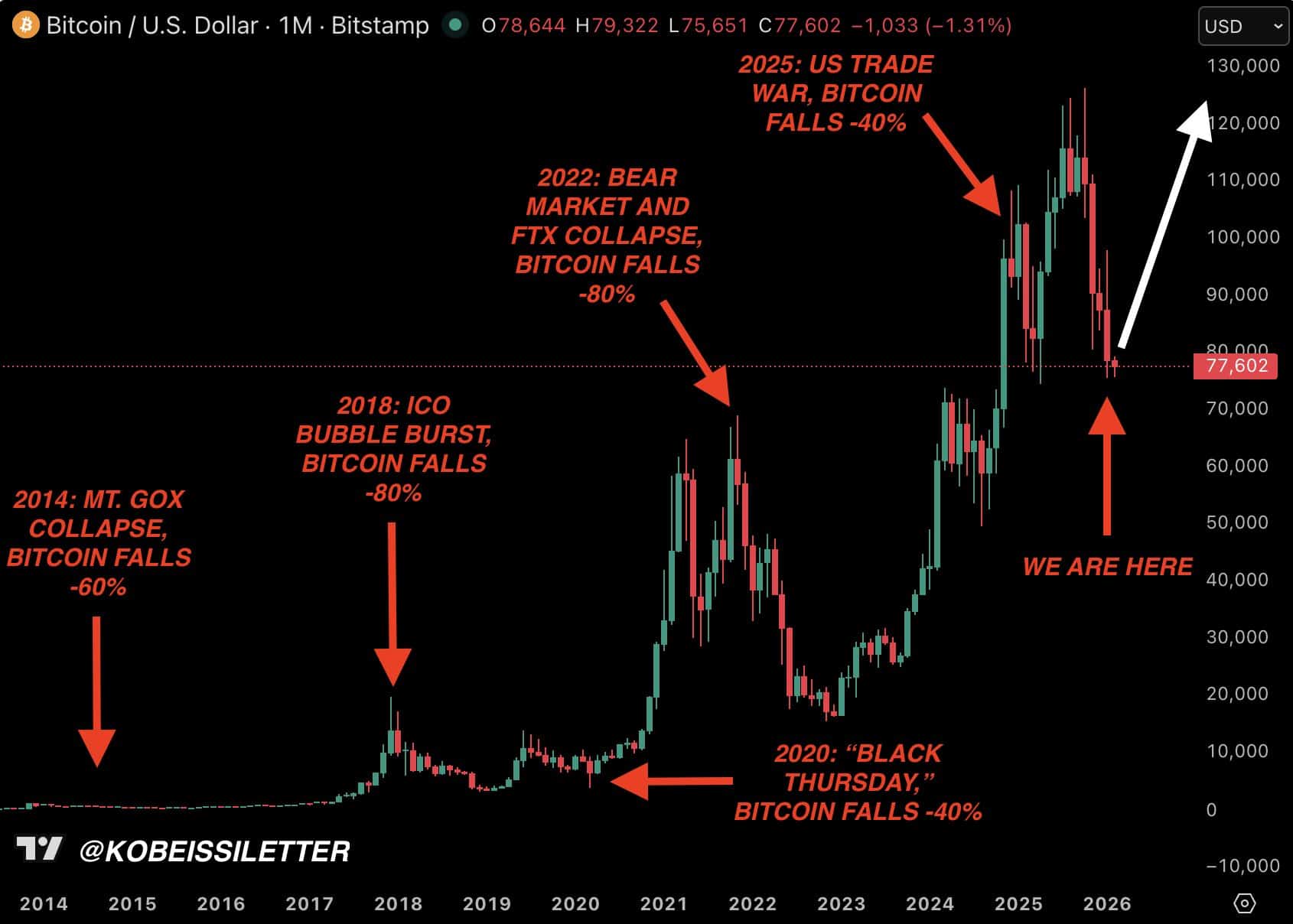
Bitcoin slid to around $76K at press time, with a market sell-off dragging major tokens lower in a matter of hours. While this seems like a reason to panic, zooming out will give you the real picture.

Source: X

The Kobeissi Letter’s recent X post puts this drop in familiar company.

Bitcoin has lived through far deeper falls: the Mt. Gox collapse in 2014, the ICO bubble burst in 2018, the Covid-era crash in 2020, and the 2022 bear market caused by FTX.

Each time, losses ranged from 40% to as much as 80%. Each time, Bitcoin eventually recovered. Every major crypto crash feels terminal in the moment but becomes a rounding error over time.

49% of Trump-linked WLFI bought out

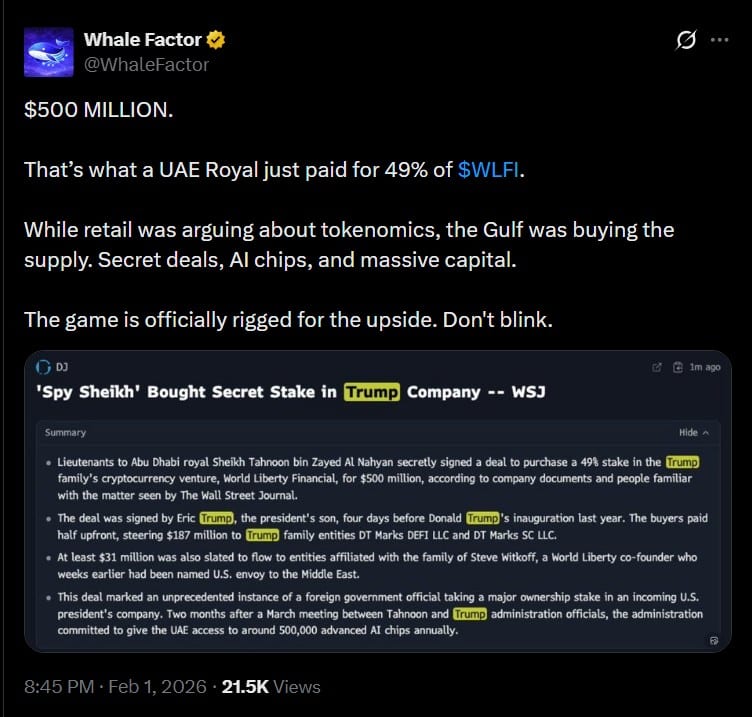
The Wall Street Journal has reported that World Liberty Financial sold a 49% stake to UAE-based Aryam Investment. The deal is said to be worth $500 million.

The agreement was allegedly signed just days before President Trump’s second inauguration, despite the company having no live products at the time. Notably, Aryam does not receive any rights tied to the WLFI token.

Source: X

Aryam is backed by Sheikh Tahnoon bin Zayed Al Nahyan, the UAE’s national security advisor and brother of the country’s president. Sheikh Tahnoon also chairs AI-focused firms MGX and G42.

Earlier this year, MGX invested $2 billion into Binance, settling the transaction using WLF’s newly launched stablecoin, USD1.

This was without disclosing its indirect ownership in WLF.

Russian Bitcoin mining firm CEO detained

Igor Runets, founder and CEO of Russian Bitcoin mining firm BitRiver, has reportedly been detained by authorities in Moscow on allegations of tax evasion.

Local media reports say Runets was taken into custody on Friday and formally charged the following day with three counts related to hiding assets to avoid paying taxes.

A Moscow court has ordered him to remain under house arrest, a decision his legal team can still appeal before it takes full effect later this week.

Runets built BitRiver into one of Russia’s largest Bitcoin mining operators after founding the company in 2017. At its peak, his crypto mining business was reported to be worth hundreds of millions of dollars.

Since being sanctioned by the U.S. in 2022, the firm has lost key clients, faced lawsuits, and struggled with delayed employee payments.

Cross-chain bridge breach causes emergency stop

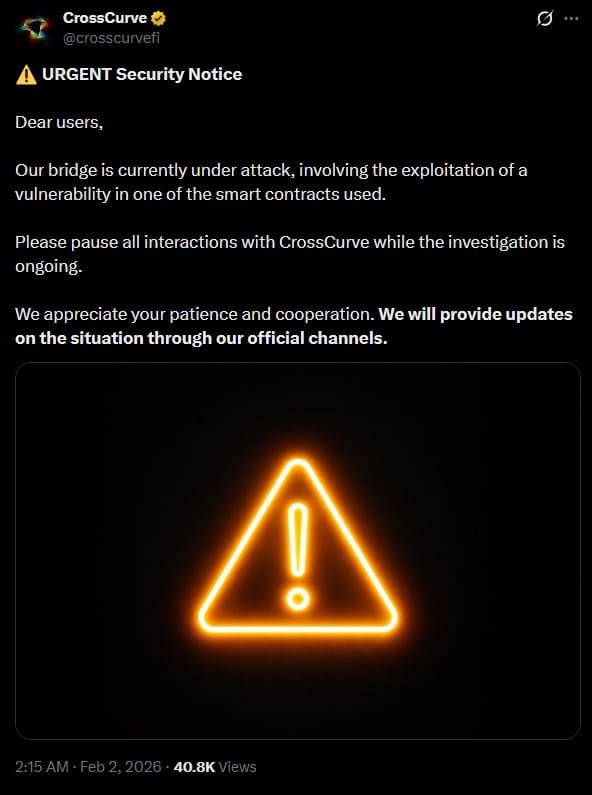
Crypto protocol CrossCurve has asked users to stop interacting with its platform after confirming that its cross-chain bridge was compromised in a smart contract attack.

An estimated $3 million was reportedly drained across multiple blockchain networks.

The team said the issue stemmed from a flaw in one of the contracts used by the bridge. This allowed unauthorized transactions to slip through normal checks.

Blockchain security trackers flagged the exploit shortly after it happened. They warned that the vulnerability could be used to unlock tokens without proper validation.

Source: X

The incident prompted partner protocol Curve Finance to caution users who had exposure to CrossCurve-related pools. They’ve asked users to reassess their positions and consider withdrawing support.

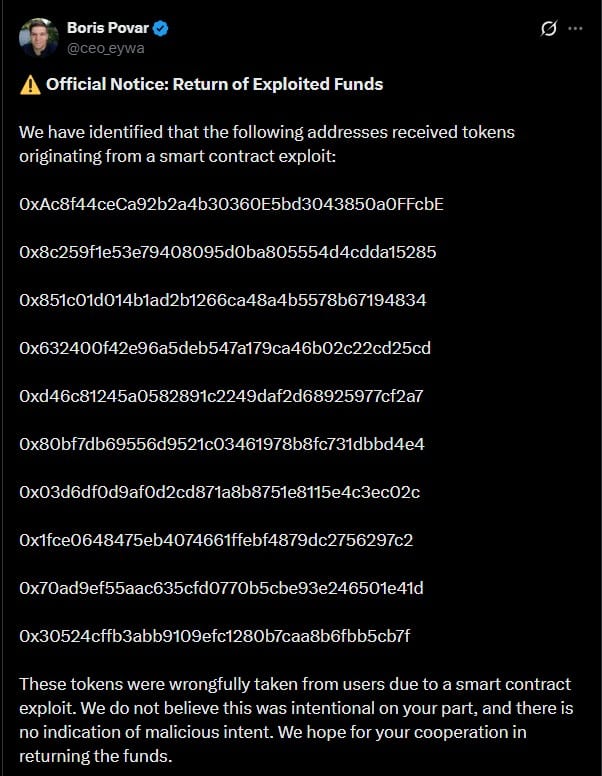
In response, CrossCurve CEO Boris Povar publicly addressed the wallets believed to have received the stolen funds. If the assets are returned in 72 hours, he’s offered a reward of up to 10%.

Source: X

The team has stated that it is prepared to involve law enforcement and pursue legal action if needed.


Final Thoughts

  • Bitcoin slipped to $76K, but patterns say the worries won’t last long.
  • In other news, WLFI has sold a major chunk of equity while the CEO of BitRiver got detained.
Next: Uniswap breaks multi-year support: Will UNI see a larger crash?
Share
  • Share
  • Tweet

Crypto di tendenza

Domande pertinenti

QWhat was the main event that caused Bitcoin to drop to around $76K?

AA market sell-off dragged major tokens lower, causing Bitcoin to slide to around $76K.

QWhich company sold a 49% stake to UAE-based Aryam Investment, and what was the deal's value?

AWorld Liberty Financial sold a 49% stake to Aryam Investment in a deal worth $500 million.

QWhy was Igor Runets, CEO of BitRiver, detained by authorities in Moscow?

AIgor Runets was detained on allegations of tax evasion, specifically for hiding assets to avoid paying taxes.

QWhat was the cause of the CrossCurve cross-chain bridge breach, and how much was estimated to be drained?

AThe breach was caused by a flaw in one of the smart contracts used by the bridge, allowing unauthorized transactions, and an estimated $3 million was drained.

QWhat did CrossCurve CEO Boris Povar offer to the wallets that received the stolen funds if they returned the assets within 72 hours?

ABoris Povar offered a reward of up to 10% if the stolen assets were returned within 72 hours.

Letture associate

7 Months After the Collapse of Huiwang, Southeast Asia's Escrow Platforms Undergo a Major Reshuffle

Following the collapse of Huione Pay—dubbed the "Alipay of Southeast Asia"—seven months ago, the region's underground financial guarantee platform sector is undergoing a significant reshuffle. This power vacuum has been swiftly filled by emerging platforms such as XinBi, Tiger/Navigator, JinBei (renamed JinBo), Dali/Tiancheng, and FullyLight. These platforms, operating largely via Telegram and offering services like escrow for illicit transactions, have absorbed the vast user base and markets left behind by Huione. While positioning themselves as "trust intermediaries," their primary clientele consists of networks involved in online scams, money laundering, illegal gambling, and even human trafficking. For instance, the Tiger/Navigator platform explicitly provides "escrow" services for kidnapping-for-ransom operations ("强押车交易"). Data underscores the immense scale: Huione alone processed over $103 billion in cryptocurrency payments and facilitated over $31 billion through its escrow market before its downfall, linking it to Cambodia's notorious Prince Group. Since its collapse, competitors have seen explosive growth. For example, the XinBi platform has accumulated over $1.6 billion in total USDT revenue, while platforms like NewPay, OkPay (under Dali), and FullyLight Wallet collectively processed over $4.8 billion in USDT in a single year. This ecosystem thrives in regions like Cambodia and Myanmar, where regulatory gaps allow these platforms to act as critical financial infrastructure for sprawling cybercrime industries, from scam compounds to online casinos. The article concludes that the moniker "Southeast Asian Alipay" is a misnomer, obscuring the platforms' fundamental role in enabling serious criminal enterprises rather than representing legitimate financial innovation.

Odaily星球日报46 min fa

7 Months After the Collapse of Huiwang, Southeast Asia's Escrow Platforms Undergo a Major Reshuffle

Odaily星球日报46 min fa

The Changing Landscape: What Are Crypto VCs Experiencing?

Title: The Shifting Landscape of Crypto Venture Capital The era of dedicated crypto venture capital funds is undergoing a significant transformation. Once essential for navigating the sector's complexity and high risk, these specialized funds are now facing an identity crisis as the market matures. This shift mirrors historical patterns in other specialized investment classes like cleantech and SPACs, where initial information advantages dissipate as technologies become mainstream and integrated into existing industry frameworks. The article argues that crypto is reaching a critical inflection point, transitioning from a "building phase" to an "integration phase." Major players like Stripe, BlackRock, and Visa now engage with crypto not for its novel mechanics but as a foundational financial infrastructure. Their needs—regulatory compliance, banking partnerships, distribution channels—align with traditional fintech, a domain easily understood by large, generalist funds like Sequoia and Founders Fund. This evolution creates a "barbell effect" within the VC landscape. On one end are massive, diversified platforms that can incorporate crypto as one vertical among many. On the other are small, nimble funds focused on niche, experimental projects. The middle ground—medium-sized dedicated crypto funds—is being squeezed out. Their typical fund size makes it impossible to generate sufficient returns solely from early-stage crypto bets, yet they cannot compete with giants for later-stage deals. Consequently, leading crypto-native firms like Paradigm and Framework Ventures are expanding into AI, robotics, and other sectors, driven partly by LP pressure for better returns amid a broader VC DPI crisis. Others, like Dragonfly and a16z, have narrowed their crypto focus predominantly to financial infrastructure like stablecoins, reframing the sector's core narrative. For crypto entrepreneurs, this consolidation presents challenges. While generalist funds offer larger checks and broader resources, crypto projects now compete fiercely with AI for attention and capital within these firms. Furthermore, the long-term, non-commercial foundational work that built the ecosystem—funded by dedicated crypto VCs—is less likely to attract generalist capital focused on direct returns. The conclusion is that "crypto investor" as a standalone category is becoming obsolete, akin to "internet investor." Crypto is becoming a baseline infrastructure layer. The future will see a barbell structure: large-scale growth financing handled by generalist funds, while pioneering, speculative projects are funded by small, specialized vehicles. The dedicated crypto funds of the 2017-2021 boom, which incubated core infrastructure, are giving way to this new, bifurcated reality.

Foresight News1 h fa

The Changing Landscape: What Are Crypto VCs Experiencing?

Foresight News1 h fa

As Consensus Accelerates, What Are Young Investors Betting On?

Title: As Consensus Forms Faster, What Are Young Investors Betting On? In the rapid evolution of tech investment, a new generation of young investors is navigating a landscape where AI, robotics, commercial aerospace, and quantum computing are advancing simultaneously. Traditional investment logic based on financial models is giving way to a need for deep technical understanding and the ability to act before industry consensus forms. An analysis of trends from the "WAIC FUTURE TECH" list of young investment leaders reveals key shifts in focus. The first major trend is the movement of AI from the digital screen into the physical world. Investment is shifting from large language models and chatbots towards embodied AI, robotics, AI hardware, and edge computing. While demonstrations generate excitement, the real challenge lies in achieving scalable, reliable, and cost-effective delivery in complex real-world environments like factories and logistics. Success depends not just on algorithms but on the integration of sensors, actuators, and control systems. Second, the competitive focus for large models is moving beyond raw capability toward building an "intelligence flywheel." The goal is to create self-reinforcing systems where user interaction generates data, improving the model, which in turn enhances the user experience and attracts more engagement. Companies that successfully embed AI into workflows to create these closed-loop systems can build lasting value that isn't easily erased by the next model upgrade. Third, facing a potential bottleneck in high-quality human-generated data, investors are looking at new underlying technologies. Reinforcement learning and self-play, as demonstrated by AlphaGo Zero, offer paths for AI to generate its own experience. Scientific foundation models, which aim to build general AI capabilities for fields like life sciences and materials discovery, represent a non-consensus direction that could unlock new frontiers of knowledge and data. Finally, in deep-tech areas like quantum computing, commercial aerospace, and space-based infrastructure, patient capital is essential. These fields have long, uncertain development and validation cycles involving complex engineering, supply chains, and regulations. Investment here requires a long-term view, focusing on foundational team capabilities and the eventual emergence of market demand, even if commercial returns are distant. Collectively, these trends illustrate how young investors are adapting to a new era. They are learning to make earlier, technically-informed judgments, balance hype with real-world viability, and provide the patient capital needed to build the deep-tech foundations of the future.

marsbit1 h fa

As Consensus Accelerates, What Are Young Investors Betting On?

marsbit1 h fa

Trading

Spot

Articoli Popolari

Come comprare 4

Benvenuto in HTX.com! Abbiamo reso l'acquisto di 4 (4) semplice e conveniente. Segui la nostra guida passo passo per intraprendere il tuo viaggio nel mondo delle criptovalute.Step 1: Crea il tuo Account HTXUsa la tua email o numero di telefono per registrarti il tuo account gratuito su HTX. Vivi un'esperienza facile e sblocca tutte le funzionalità,Crea il mio accountStep 2: Vai in Acquista crypto e seleziona il tuo metodo di pagamentoCarta di credito/debito: utilizza la tua Visa o Mastercard per acquistare immediatamente 44.Bilancio: Usa i fondi dal bilancio del tuo account HTX per fare trading senza problemi.Terze parti: abbiamo aggiunto metodi di pagamento molto utilizzati come Google Pay e Apple Pay per maggiore comodità.P2P: Fai trading direttamente con altri utenti HTX.Over-the-Counter (OTC): Offriamo servizi su misura e tassi di cambio competitivi per i trader.Step 3: Conserva 4 (4)Dopo aver acquistato 4 (4), conserva nel tuo account HTX. In alternativa, puoi inviare tramite trasferimento blockchain o scambiare per altre criptovalute.Step 4: Scambia 4 (4)Scambia facilmente 4 (4) nel mercato spot di HTX. Accedi al tuo account, seleziona la tua coppia di trading, esegui le tue operazioni e monitora in tempo reale. Offriamo un'esperienza user-friendly sia per chi ha appena iniziato che per i trader più esperti.

390 Totale visualizzazioniPubblicato il 2025.10.20Aggiornato il 2026.06.02

Come comprare 4

Discussioni

Benvenuto nella Community HTX. Qui puoi rimanere informato sugli ultimi sviluppi della piattaforma e accedere ad approfondimenti esperti sul mercato. Le opinioni degli utenti sul prezzo di 4 4 sono presentate come di seguito.

活动图片