Helium jumps 20%, but is this a real trend shift for HNT?

ambcryptoPubblicato 2026-02-16Pubblicato ultima volta 2026-02-16

Introduzione

Helium (HNT) surged over 20% to $1.36, rebounding sharply from a long-term descending regression channel low near $0.75. The price now tests the upper boundary of this channel around $1.50, a level where previous rallies have stalled. While technical indicators like MACD show strengthening bullish momentum and spot trading volume has expanded, underlying sell pressure remains. The 90-day Spot Taker CVD still reflects persistent selling dominance, creating a divergence with the rising price. Open Interest increased 22.83%, indicating new positions are being opened. The rally faces key resistance between $1.40–$1.80. A sustained break above could signal a trend reversal, but rejection at this level would reinforce the ongoing downtrend. The token is at a critical structural decision point.

Helium [HNT] has surged over 20% to $1.36, rebounding sharply from regression channel lows near $0.75 as buyers return aggressively.

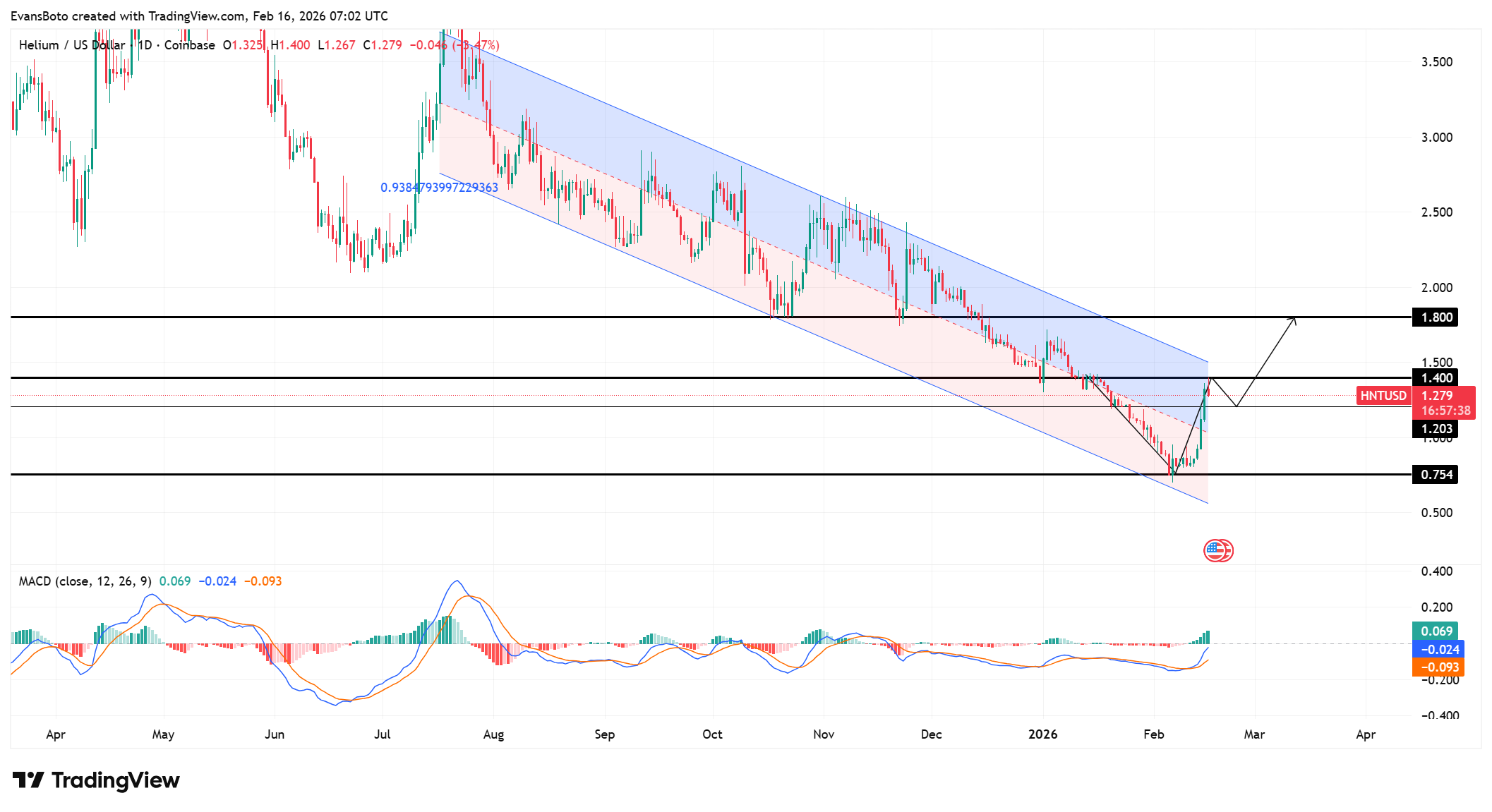
Price now trades around $1.27 after reaching $1.40 intraday, marking its strongest upward reaction in months.

This rebound emerged precisely from the lower boundary of a descending regression trend channel that has guided the broader decline since mid-2025.

However, HNT now approaches the channel’s upper boundary, where previous rallies stalled.

At the same time, structural sell pressure still lingers beneath the surface, creating tension between price recovery and underlying flow.

Helium tests upper regression channel

HNT has reclaimed the $1.20 level and pushed into the $1.40 supply zone, marking a decisive short-term shift in structure.

Price now sits near the upper boundary of a descending regression trend channel that has guided the broader decline for months.

This boundary aligns closely with the $1.50 region, while stronger horizontal resistance rests at $1.80. Therefore, price faces layered overhead pressure at a technically sensitive zone.

A sustained hold above $1.40 could open room toward $1.80. However, rejection near the channel ceiling would reinforce the prevailing downtrend.

At the same time, MACD prints 0.069, with the signal line at -0.024 and the histogram turning positive. Green bars are now expanding after prolonged compression, showing strengthening bullish energy.

However, the indicator still hovers near neutral territory. Buyers must maintain follow-through to validate this breakout attempt.
Sell pressure lingers beneath the rally

Despite the sharp rebound from $0.75, the 90-day Spot Taker CVD still reflects taker sell dominance.

This reading shows aggressive market sells continue to outweigh buys on a cumulative basis. This creates a divergence between rising price and persistent sell-side flow.

In other words, price climbs even while broader spot aggression favors sellers. Such divergence can weaken rallies if demand fails to absorb supply fully.

However, rapid technical rebounds sometimes unfold under similar conditions when short-term buyers overwhelm liquidity temporarily.

If spot buyers increase conviction, the CVD trend could stabilize and gradually shift. Until that shift appears clearly, the rally remains technically impressive yet structurally fragile.

Open Interest expansion reflects new positions

Open Interest has increased 22.83% to $4.40 million during this surge. That expansion signals traders are opening fresh positions rather than merely closing shorts.

If short covering drove this rally alone, Open Interest would likely decline. Instead, derivatives traders now position aggressively around current levels.

Rising Open Interest alongside advancing price can support continuation if buyers maintain control.

However, leverage also increases downside risk near resistance zones. Should price reject near $1.50 or $1.80, liquidation pressure could amplify volatility quickly.

Therefore, positioning has become sensitive to price behavior at the regression channel ceiling, where leverage could either fuel extension or accelerate reversal.

Rising participation, confirmed

The Spot Volume Bubble Map now shows heating clusters, reflecting expanding spot participation.

Larger bubbles correspond with heightened trading activity during this rebound phase. Increased engagement supports the move from $0.75 toward the $1.40 region.

Rising participation often strengthens breakout attempts because it reflects genuine liquidity rotation.

However, continuation requires sustained activity above reclaimed resistance. If volume contracts sharply near the $1.50 boundary, buying enthusiasm could fade rapidly.

On the other hand, persistent bubble expansion beyond the regression ceiling would validate structural repair more convincingly.

Therefore, liquidity flow now plays a decisive role in determining whether Helium builds on this surge or stalls beneath overhead supply.

Relief bounce or structural shift?

Helium has delivered a powerful rebound from channel lows and now challenges the upper boundary of its regression trend structure.

Technical indicators show rebuilding strength, and participation has expanded. However, structural sell pressure and overhead resistance still dominate the broader picture.

If price sustains strength above $1.40 and pushes toward $1.80 with expanding participation, recovery could gain traction.

Yet rejection at the channel ceiling would reaffirm the prevailing downtrend. Helium now stands at a clear structural decision point.


Final Summary

  • Helium rebounded over 20% from $0.75 channel lows to test the $1.40–$1.50 resistance zone, signaling a strong short-term structural recovery.
  • However, persistent sell-side flow, rising Open Interest, and overhead channel resistance suggest the rally remains fragile.


Domande pertinenti

QWhat was the percentage surge in Helium (HNT) and what price level did it rebound from?

AHelium (HNT) surged over 20%, rebounding sharply from regression channel lows near $0.75.

QWhat key technical indicator is showing strengthening bullish energy, and what is its current value?

AThe MACD indicator is showing strengthening bullish energy. It currently prints a value of 0.069, with the signal line at -0.024 and the histogram turning positive with expanding green bars.

QDespite the price increase, what does the 90-day Spot Taker CVD reading indicate about market activity?

AThe 90-day Spot Taker CVD reading indicates that aggressive market sells continue to outweigh buys on a cumulative basis, reflecting persistent taker sell dominance beneath the surface.

QHow did Open Interest change during the price surge, and what does this signal about trader behavior?

AOpen Interest increased by 22.83% to $4.40 million. This expansion signals that traders are opening fresh new positions rather than merely closing out short positions.

QWhat are the two critical price levels that will determine if this is a relief bounce or a structural shift for HNT?

AThe two critical levels are $1.40 and $1.80. A sustained hold above $1.40 could open room toward $1.80, validating a recovery. However, rejection at the channel ceiling near $1.50 would reaffirm the prevailing downtrend.

Letture associate

$292 Million KelpDAO Cross-Chain Bridge Hack: Who Should Foot the Bill?

On April 18, 2026, an attacker stole 116,500 rsETH (worth ~$292M) from KelpDAO’s cross-chain bridge in 46 minutes—the largest DeFi exploit of 2026. The stolen assets were deposited into Aave V3 as collateral, causing $177–200M in bad debt and triggering a cascade of losses across nine DeFi protocols. Aave’s TVL dropped by ~$6B overnight. This legal analysis argues that KelpDAO and LayerZero Labs share concurrent liability, with fault apportioned 60%/40%. KelpDAO negligently configured its bridge with a 1-of-1 decentralized verifier network (DVN)—a single point of failure—despite LayerZero’s explicit recommendation of a 2-of-3 setup. LayerZero, which operated the compromised DVN, failed to secure its RPC infrastructure against a known poisoning attack vector. Both protocols’ terms of service cap liability at $200 (KelpDAO) or $50 (LayerZero), but these limits are likely unenforceable due to unconscionability, gross negligence exceptions, and potential securities law invalidation (if rsETH is deemed a security under the Howey test). Aave’s governance also faces fiduciary duty claims for raising rsETH’s loan-to-value ratio to 93%—far above competitors’ 72–75%—without adequately assessing bridge risks, amplifying the systemic fallout. Practical recovery targets include LayerZero Labs (a registered Canadian entity), KelpDAO’s founders, auditors, and identifiable Aave governance delegates. The incident underscores escalating legal risks for DeFi protocols, infrastructure providers, and governance participants.

marsbit5 min fa

$292 Million KelpDAO Cross-Chain Bridge Hack: Who Should Foot the Bill?

marsbit5 min fa

Insider Trading in War: 5 People Involved, the Highest Earner Was Arrested

On April 24, the U.S. Department of Justice arrested U.S. Army Special Forces Staff Sergeant Gannon Ken Van Dyke for insider trading related to the capture of Venezuelan President Nicolás Maduro on January 3. Van Dyke allegedly profited over $400,000 by placing bets on a prediction market, Polymarket, using insider knowledge of the covert operation. According to the indictment, Van Dyke registered an account (0x31a5) on December 26 and made a series of bets predicting Maduro’s capture and U.S. military involvement in Venezuela. He withdrew most of his funds on the day of the operation and attempted to obscure his tracks by transferring assets through crypto and brokerage accounts. This case marks the first time the DOJ has prosecuted insider trading on Polymarket. PolyBeats had previously identified five suspicious accounts, including Van Dyke’s—the highest earner—in January. The other accounts, with profits ranging from $34,000 to $145,000, remain under unofficial scrutiny but have not been charged. Their lower profits, indirect access to information, and unclear legal boundaries may complicate prosecution. Polymarket has since strengthened its market integrity rules, explicitly prohibiting trading based on confidential or insider information. Van Dyke’s arrest, nearly four months after his trades, signals increased regulatory attention and the persistent traceability of blockchain-based transactions.

marsbit7 min fa

Insider Trading in War: 5 People Involved, the Highest Earner Was Arrested

marsbit7 min fa

Bitwise: Bullish on Bitcoin's Performance in the Second Half of the Year, AI and Regulation Will Spark a New Altcoin Season

Bitwise CIO Matt Hougan and Research Lead Ryan Rasmussen express strong bullish sentiment on Bitcoin's long-term prospects, suggesting that its $1 million price target may be too conservative. They argue Bitcoin serves a dual role: as digital gold and a potential global settlement asset, especially amid declining trust in traditional monetary systems. Despite a weak Q1 2026 where nearly all crypto assets and prices saw double-digit declines, the analysts remain optimistic due to strong forward-looking catalysts, including institutional adoption via Bitcoin ETFs from major firms like Morgan Stanley and Goldman Sachs. Geopolitical instability, such as Iran’s mention of using Bitcoin for international payments, increases the value of Bitcoin’s “out-of-the-money call option” as a non-political, global settlement currency. This enhances its appeal beyond a mere store of value. . Additionally, Hougan highlights that a clearer regulatory token framework under current SEC leadership, combined with AI efficiency gains and high-performance blockchains, could fuel a new “altseason” by late 2026. This may lead to a wave of legitimate, value-capturing token projects, unlike the earlier ICO boom. . Bitwise also announced an Avalanche ETF, citing its unique architecture and rapid growth in real-world asset (RWA) tokenization, which has surged 10x to nearly $30 billion in two years. The firm believes Layer 1 blockchains are still early in their growth cycle, with significant potential ahead.

marsbit53 min fa

Bitwise: Bullish on Bitcoin's Performance in the Second Half of the Year, AI and Regulation Will Spark a New Altcoin Season

marsbit53 min fa

Trading

Spot
Futures
活动图片




