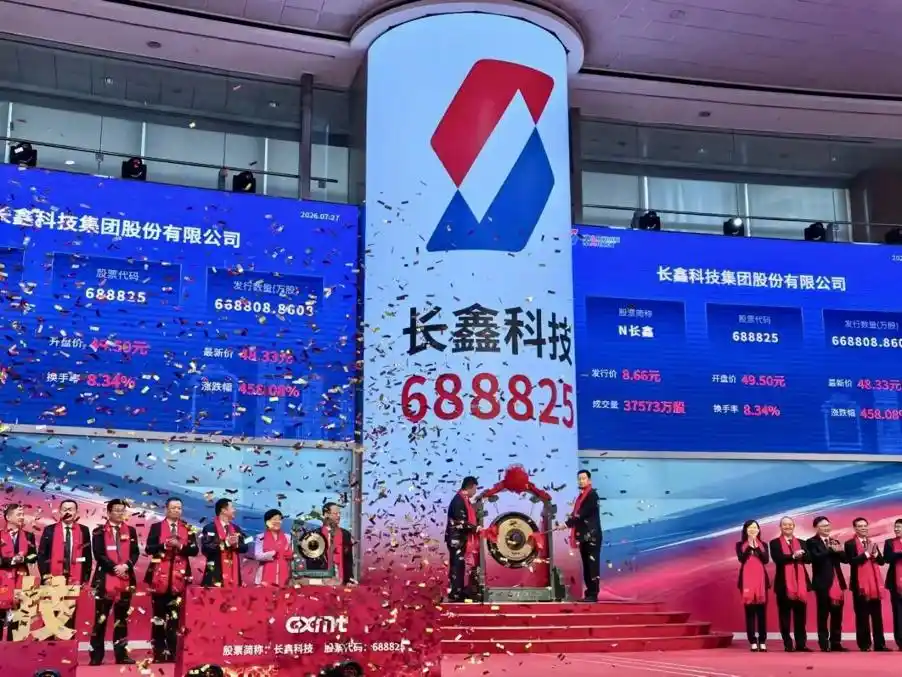
On the morning of July 27, 2026, before the opening bell of the Shanghai STAR Market had sounded, the stock code of ChangXin Technology Group Co., Ltd. had already appeared at the very top of countless trading terminal watchlists. At 9:30, the bell rang, and ChangXin Memory began trading at an issue price of 8.66 yuan.
For the first few minutes, the market was relatively restrained, but the accumulation of buy orders visibly thickened. Around 9:40, the stock price began to trace a nearly vertical curve. On the trading software of major brokerages, the red number indicating the stock's gain jumped a line higher with each refresh.
At the close, the gain settled at over 465%, and the company's market capitalization settled at approximately 3.3 trillion yuan—overnight, it knocked Industrial and Commercial Bank of China (ICBC), which had long held the top spot in A-share market value, down to second place.
The next day, the rally continued, with the company's total market value once touching 3.66 trillion yuan, a figure that scrolled across headlines in nearly all Chinese financial media that day.
But the ones whose emotions were truly swayed by this K-line chart were a group of people far away in Hefei.
According to the final shareholding ratio, the book floating profit in Hefei's state-owned capital system jumped to over 1 trillion yuan in that single day. Its starting point, just ten years ago, was an investment of less than 30 billion yuan.
To understand where this 1 trillion came from, one needs to rewind time to 2016.
A "Military Order" and a Decade-Long Partnership
That year, Zhu Yiming, carrying a DRAM chip industrialization proposal, ran almost across half of China.
He was no unknown figure. Eleven years prior, he had given up a stable job in Silicon Valley, and with startup funds of $920,000 pooled together by a few Tsinghua University alumni, founded GigaDevice in a bare, two-story space at the Tsinghua Science Park. By focusing on the NOR Flash niche abandoned strategically by giants, he managed to take the startup public on the Shanghai Stock Exchange.
But what he wanted to do in 2016 was on an entirely different scale: China spent over $200 billion annually on chip imports, with a self-sufficiency rate close to zero. Three foreign companies—Samsung, SK Hynix, and Micron—carved up this market almost impenetrably, leaving almost no gaps for newcomers.
Zhu Yiming wanted to build China's own DRAM fab on this giant-dominated track, with just the first phase requiring an investment of 18 billion yuan.
He approached many places, and was almost always politely declined with "too risky."
When it was Hefei's turn, frankly, not many expected this provincial capital, often mocked by outsiders as the "biggest county town" at the time, to take on this hot potato—it lacked both a prominent industrial foundation and robust fiscal resources. But Hefei took it on.
In July 2018, Zhu Yiming made a decision that surprised the capital markets: he resigned as General Manager of GigaDevice, retaining only the Chairman title, and took on the full-time roles of Chairman and CEO of ChangXin Technology. He also issued a "military order"—he would not draw a salary until the company became profitable.
This was not a publicity stunt, but an accurate preview of the reality for nearly the next decade. Subsequently, ChangXin Memory posted losses for nearly ten consecutive years, accumulating over 36 billion yuan in losses.
Someone later commented on this journey quite bluntly: "Over the decade, ChangXin accumulated losses exceeding 30 billion. Any purely market-driven capital would have pulled out long ago." But Hefei's state-owned capital did not pull out, nor did the National Integrated Circuit Industry Investment Fund—they were not calculating a three-to-five-year return on investment, but an account that required the patience of an entire generation.
It wasn't until the first quarter of 2026 that ChangXin finally, riding a super-cycle in memory chips driven by AI demand, achieved revenue of 50.8 billion yuan and a net profit of 33 billion yuan. Its quarterly profit alone wiped out the accumulated losses from previous years in one go.
During this ten-year process, Hefei not only raised funds everywhere for ChangXin but also provided "nanny-style" services like talent recruitment.
It simultaneously invested hundreds of billions to build a memory industry cluster integrating a wafer manufacturing base, supporting industrial parks, and an international community.
This all-in approach is known as the "Hefei Model."
Hefei was once a typical example of "the collapse of the central region," being neither a coastal open city nor a traditional industrial hub, with its only prominent endowment being its educational and scientific resources.
Jiedian Finance learned that as early as around 2005, Hefei resolved to "establish itself through industry," but lacked funds, projects, and supporting facilities. Under this forcing mechanism, the government began actively playing the role of a "venture capitalist," using limited fiscal funds as "seed money" to leverage key industries with prospects but lacking capital. The core was "exchanging capital for industry," profiting not from financial returns, but from the taxes, employment, and technology spillover generated by industries staying locally.
The true logic of the "Hefei Model" was never betting on a single blockbuster project, but using one anchor enterprise to leverage an entire industrial chain.
The final report card from this ten-year marathon looked like this: The total investment for ChangXin's Phase I project in 2016 was 18 billion yuan, with the Hefei side taking the lion's share, contributing 14.4 billion yuan; over the subsequent nearly ten years, Hefei's state-owned capital added more investment, cumulatively investing approximately 26 to 30 billion yuan.
On the IPO day, Hefei's state-owned capital, through platforms like Qinghui Jidian, ChangXin Jicheng, and Hefei Jixin, held a combined stake of approximately 36.79%, corresponding to about 22.138 billion shares, with a market value exceeding 1 trillion yuan.
Sharing in this feast was also the National Integrated Circuit Industry Investment Fund Phase II—with a total scale of 200 billion yuan, its shareholding value in ChangXin alone now exceeds 250 billion yuan, almost recouping its entire principal from this one investment.
A chip project that grew from a factory building in Hefei allowed everyone who accompanied it through its darkest hours to reap immense profits.
That Year, Hefei Even Paused Its Subway First
Rewinding another twelve years reveals the true starting point of this entire approach.
In 2008, with the shadow of the global financial crisis looming over the entire manufacturing sector, BOE, frequently viewed unfavorably by the capital markets and struggling in its operations, came knocking, hoping a city would take on the construction of the country's first 6th-generation LCD panel production line.
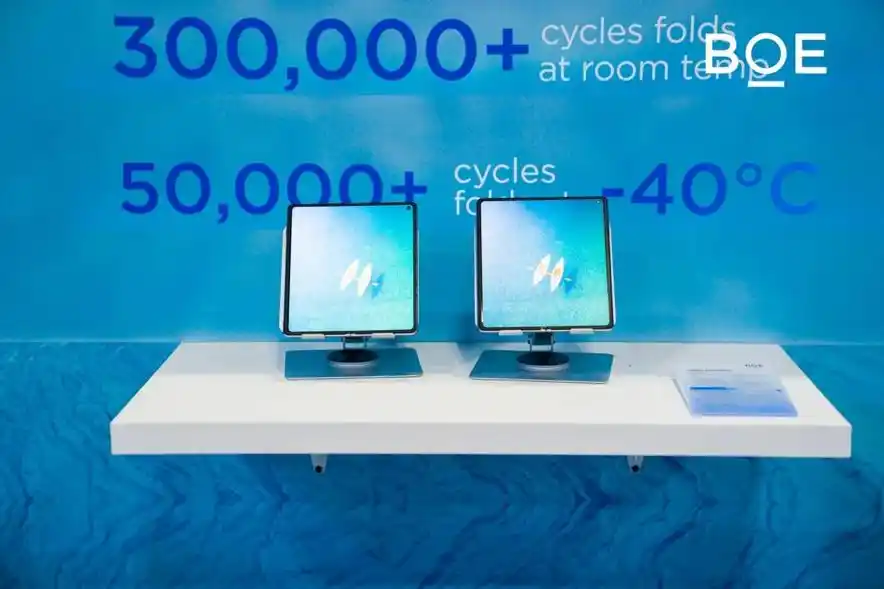
While more economically developed cities like Shenzhen hesitated and delayed approval, Hefei made a decision almost incomprehensible at the time: to concentrate its limited financial resources on this project, it paused the already planned and advancing subway construction, diverting the saved funds to this display panel company that had been posting annual losses. External evaluations of this decision were almost unanimously negative: "a gambler's bet." How could a provincial capital that hadn't even built a subway yet bet on an LCD panel production line requiring tens of billions in investment?
As it turned out, this widely doubted gamble paid off.
Today, approximately one-tenth of the world's notebook computer panels and one-fifth of LCD displays are produced in Anhui. BOE's establishment catalyzed the aggregation of an entire upstream and downstream industrial chain—including glass substrates and polarizers—around Hefei; Nexchip, which set up in Hefei in 2015, has now also grown into one of the world's top ten wafer foundries.
It is worth noting that Hefei did eventually build its subway later, but every penny saved in those years became the foundation for the city's future signature industries.
"Equity Finance": A Story Being Retold
In the view of Jiedian Finance, the stories of BOE and ChangXin, spanning many years and involving varying degrees of risk, piece together what outsiders now refer to as the "Hefei Model": using the credit and patience of state-owned capital to provide a backstop and enter at the moment when an enterprise is most difficult and no one else is willing to take it on, accompanying it through successive industry cycles, then leveraging the capital market as an amplifier to realize the floating profits of long-held equity, ultimately feeding back into the city's finances and industries.
A frequently quoted statement by Hefei Party Secretary Yu Aihua somewhat reveals the self-expectation behind this approach: not venture capital, but industry investment; not gambling, but striving.
The reason this approach is repeatedly mentioned in 2026 and eagerly studied by local governments across the country lies in a larger backdrop of the times: the overall narrative of China's local public finance is undergoing a shift.
The land conveyance revenue that supported local government operations over the past two decades is no longer flowing as abundantly as before, hence the high hopes placed on "equity finance."
In the view of Jiedian Finance, local governments are no longer solely reliant on selling land plots for cash. Instead, they hold equity in high-quality industrial projects, leveraging the guiding and amplifying functions of state-owned capital to attract more social capital into industrial investment. The ultimate goal is both to cultivate industrial clusters rooted locally and to secure long-term fiscal revenue through the appreciation of the equity itself.
This shift is particularly concrete and vivid in Hefei's case: from 2015 to 2021, the total land conveyance fees for the entire city of Hefei amounted to about 551.6 billion yuan, while the book floating profit from the ChangXin project alone exceeds 1 trillion yuan.
During the "14th Five-Year Plan" period, the Hefei State-owned Assets Supervision and Administration Commission system cumulatively invested over 220 billion yuan in state capital, driving project investment scale exceeding 840 billion yuan. This is equivalent to nearly four yuan of social investment following for every one yuan of state capital invested.
Another long-term dividend from industrial agglomeration is population: over the past decade, Hefei's permanent resident population has increased by an average of about 200,000 net annually, making it one of the cities with the highest net population growth in the country.
The More Interesting Question: Why Specifically Hefei?
If one only stays at the level of "Hefei hit the jackpot," it appears rather simplistic and does a disservice to the truly valuable aspects worth excavating from these eighteen years.
The truly interesting question is: this approach has clear logic and impressive financial results, and cities willing to study and imitate it have never been lacking over the years. Yet, eighteen years on, almost no second "Hefei" has fully emerged.
In the view of Jiedian Finance, the reasons are worth examining layer by layer.
The first layer is an exceedingly rare patience. Pausing a planned subway line to bet on a perennially loss-making display panel company—decisions of this scale and nature require the city's top leaders to withstand years of accountability pressure, endure doubts spanning several five-year assessment cycles, and also persuade successive leadership teams not to easily change course.
Hefei's successive leadership teams have maintained a remarkably rare continuity on the path of industrial investment. This kind of resolve, capable of spanning over a decade and persisting despite repeatedly seeing book losses, is itself an extremely scarce political resource, one that most localities find hard to sustain within their election cycles.
The second layer is a professional operational team. Behind the "Hefei Model" is never a vague decision by a general investment promotion office. Instead, it involves the coordinated operation of several state-owned capital platforms with distinct positioning—such as Hefei Construction Investment, Hefei Industry Investment, and Hefei Xing Tai—which have honed a complete set of market-oriented "raise-invest-manage-exit" tactics through repeated practical experience. The level of professionalism in investment decisions is significantly higher than the常规 operations of typical local governments.
In the view of Jiedian Finance, the industrial judgment and risk control experience accumulated by this team through repeated trial, error, and复盘 on projects like BOE and ChangXin constitute a truly organizationally沉淀 capability. It cannot be copied and pasted by simply handing an operations manual to another city's investment promotion team.
The third layer is that there is also an element of luck belonging to this era; it cannot all be attributed to human judgment.
The leap in ChangXin's valuation was largely facilitated by catching the tailwind of AI demand driving the global memory chip sector into a super-cycle—from a valuation of about 158.4 billion yuan in the last private financing round in June 2025 to an issuance market value of about 579.2 billion yuan at IPO, the valuation multiplied approximately 3.6 times in just over a year.
In the view of Jiedian Finance, Hefei correctly judged the industrial direction back then and also恰好 caught the window when capital market sentiment was most亢奋. This sense of timing,精确 to the year, is itself something serendipitous and难以 written into any replicable operations guide.
The fourth layer,也是最容易被外界忽视的一层, is that during the same period, many other cities were also desperately trying to bet on the semiconductor track with real money, but the stories unfolded quite differently.
In the view of Jiedian Finance, being willing to spend money is merely an entry ticket. What真正 determines whether a project最终 goes to IPO or experiences a资金链断裂 is that comprehensive ability to "understand the industrial direction, withstand long loss cycles, and resist both external temptations and internal impulses for quick success."—And this is precisely the asset that Hefei has truly accumulated bit by bit over these eighteen years, and the core of why this story is最难 to simply复制.
What Can Be Learned and What Cannot
Piecing these clues together, the "Hefei Model" can actually be split into two distinct layers. What can be systematically studied and is already being效仿 by various regions is the concept of "equity finance" itself, along with the整套 toolbox built around it: the government no longer relies solely on land sales for cash flow, but uses state-owned capital to acquire equity in industrial projects, employing a market-oriented entry and exit mechanism to actively manage risk, rather than simply and crudely throwing money at problems.
In the view of Jiedian Finance, this layer is essentially about institutional design. It can be written into documents and replicated in short-term specialized training sessions, allowing investment promotion officials from other cities to follow the general idea.
What is truly difficult to replicate is the team's practical experience accumulated bit by bit over these eighteen years; the patience maintained across several successive leadership teams that never wavered; the specific industrial and capital cycles that Hefei恰好踩中; and, among these, the most easily overlooked yet crucial point: the resolve to choose to run alongside despite prolonged亏损 periods with no return in sight. It's like the "military order" Zhu Yiming issued—no salary until profitable—and also like the subway line Hefei temporarily paused for that LCD panel production line years ago.
These things cannot be written into any investment promotion manual, nor can they be直接搬走 through a single跨省 inspection tour.
In the two days of ChangXin's listing, what Hefei's state-owned capital truly earned was not just the book floating profit figure exceeding 1 trillion yuan. The more tangible and less easily swayed by capital market sentiment收获 was the aggregation of over 450 upstream and downstream enterprises around ChangXin as the anchor; the industrial foundation of Hefei's integrated circuit industry output value soaring from less than 18 billion yuan in 2016 to 151.4 billion yuan in 2025—a more than sevenfold increase.
These things rooted in the land are the parts that investment promotion teams across the country truly want to learn but find hardest to打包带走. For Chinese local governments四处寻找 a new fiscal narrative, Hefei's "assignment" indeed reads爽快, but真要 starting to抄, it likely requires more time and longer patience than most imagine.
This article is from the WeChat public account "Jiedian Finance" (ID: jiedian2018), author: Jiedian Finance