He Kaiming's Team's New Work: After Deleting VAE and Private Data, Text-to-Image Generation Becomes Even Stronger

marsbitPubblicato 2026-06-22Pubblicato ultima volta 2026-06-22

Introduzione

KaiMing He's team introduces **MiniT2I**, a minimalist text-to-image (T2I) model that challenges the complexity of mainstream approaches. It eliminates components commonly considered essential: the VAE encoder-decoder, AdaLN conditioning mechanisms, auxiliary losses, private training data, and post-training alignment stages like RL/DPO. Instead, it uses a pure flow-matching objective trained directly on RGB pixels. The model employs a simplified **MM-JiT** Transformer architecture. It removes AdaLN blocks for conditioning and instead prepends two lightweight text adapter blocks to a standard pre-norm Transformer, allowing frozen T5 text features to adapt to the denoiser. Training follows a two-stage, LLM-like paradigm using only public datasets: pre-training on LLaVA-recaptioned CC12M for coverage, followed by fine-tuning on ~120k high-quality image-text pairs. With just 258M parameters (B/16), MiniT2I achieves competitive scores (0.87 on GenEval, 84.2 on DPG-Bench), outperforming larger pixel-space models. Scaling to 912M parameters (L/16) yields results comparable to SD3-Medium (~2B parameters) in style, composition, and imagination, though it lags in text rendering and named entities due to public data limitations. Key advantages include lower computational cost (~570 GFLOPs vs. ~1379 for latent models) and architectural simplicity. Acknowledged limitations include patch boundary artifacts in pixel space, side effects of high CFG scales, resolution ceilings for sequence...

The field of text-to-image generation has long been a fiercely competitive red ocean, seemingly with no room left to innovate.

What do you need to train a powerful text-to-image model today?

Following the current mainstream approach, you would need: a pre-trained VAE encoder-decoder, concatenated text encoders, meticulously designed conditional injection mechanisms, massive datasets, RL or DPO alignment phases...

Overall, there seems to be a consensus: text-to-image generation must be this complex.

He Kaiming's team, however, takes a contrarian approach, offering a new perspective in the field of text-to-image models. They have released MiniT2I — a minimalist, pixel-space text-to-image model that deliberately pursues simplicity.

No VAE encoder-decoder, no AdaLN conditional injection, no auxiliary loss functions, no private data, no RL/DPO alignment, just pure flow matching trained directly on pixels. The 258M-parameter B/16 version achieves 0.87 on GenEval and 84.2 on DPG-Bench, surpassing pixel-space models several times its size.
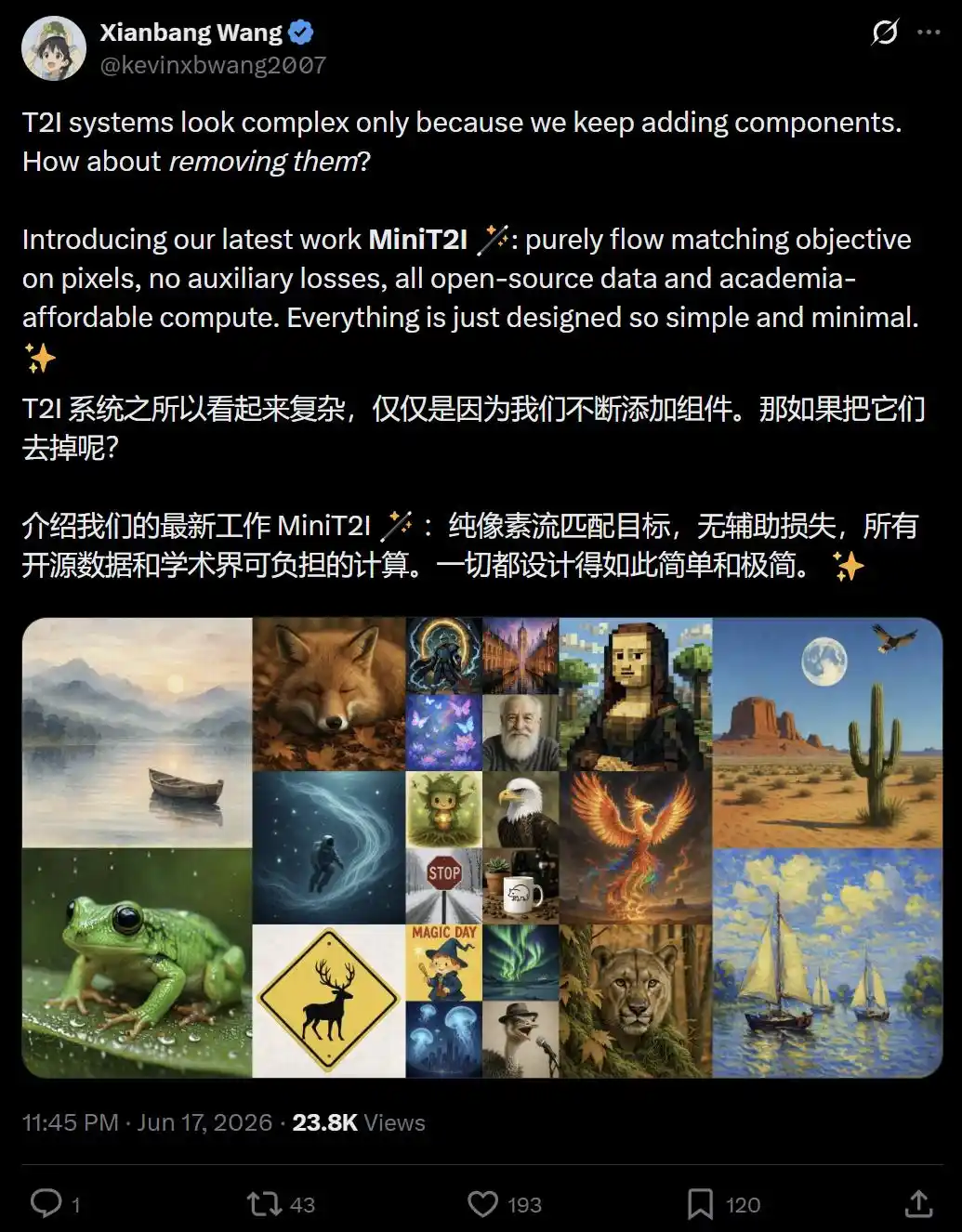
The core proposition of MiniT2I is: If text conditioning is treated as 'context tokens with semantic information' and injected into the model, text-to-image generation and class-conditional ImageNet generation are not fundamentally that different — the architecture can be similar, computational requirements comparable, and even the scale of data can be aligned.
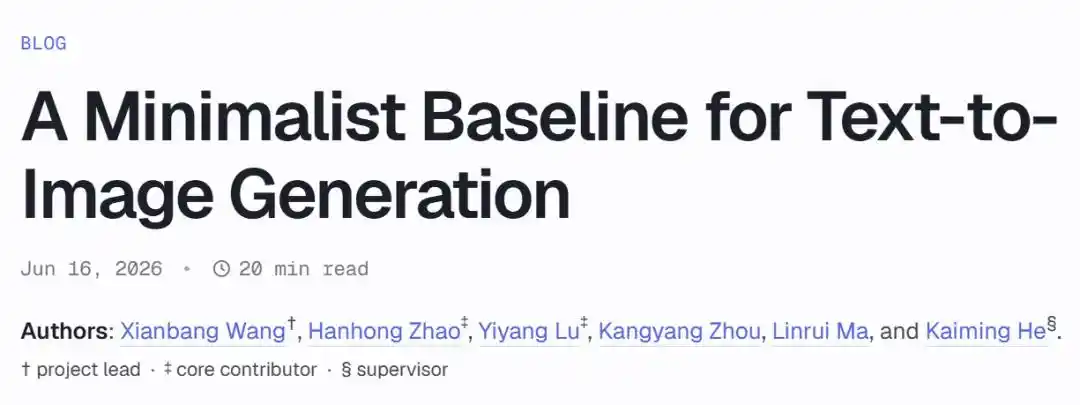
  • Paper Title: A Minimalist Baseline for Text-to-Image Generation
  • Technical Blog: https://peppaking8.github.io/#/post/minit2i
  • Open Source Repo: https://github.com/PeppaKing8/minit2i-jax

Technical Approach: Subtraction at Every Step

Direct Pixel-Space Output, No VAE

MiniT2I's first design choice is radical: discard the VAE, perform denoising directly on RGB pixels.

Latent Diffusion Models are the current mainstream paradigm, first compressing images into a low-dimensional latent space using an autoencoder before diffusion. This makes high-resolution generation feasible, but at the cost of introducing reconstruction error, an extra training phase, and misalignment between the encoder and denoiser objectives.

MiniT2I's choice of pixel space is pragmatic: For 512×512 resolution, using 16×16 patches to divide the image into 1024 tokens keeps the sequence length well within the Transformer's comfort zone. Removing the VAE reduces single-step forward computation from ~1379 GFLOPs to ~570 GFLOPs (B/16 setting), and eliminates the ceiling on reconstruction accuracy — the output quality is only limited by the denoiser's capability.

Experiments confirm this: Under the same parameter budget, pixel models achieve FID on par with latent space models (18.7 vs 19.0), but with a 5x lower per-step cost.

MM-JiT Architecture: Returning to a Simple Transformer

SD3's MM-DiT uses AdaLN (Adaptive Layer Normalization) within each block to inject timestep and pooled text embeddings into the network — each sub-block needs to compute scale, shift, and gate parameters generated by an extra MLP from the conditioning vectors. This is an elaborate modulation mechanism, but MiniT2I finds it non-essential.
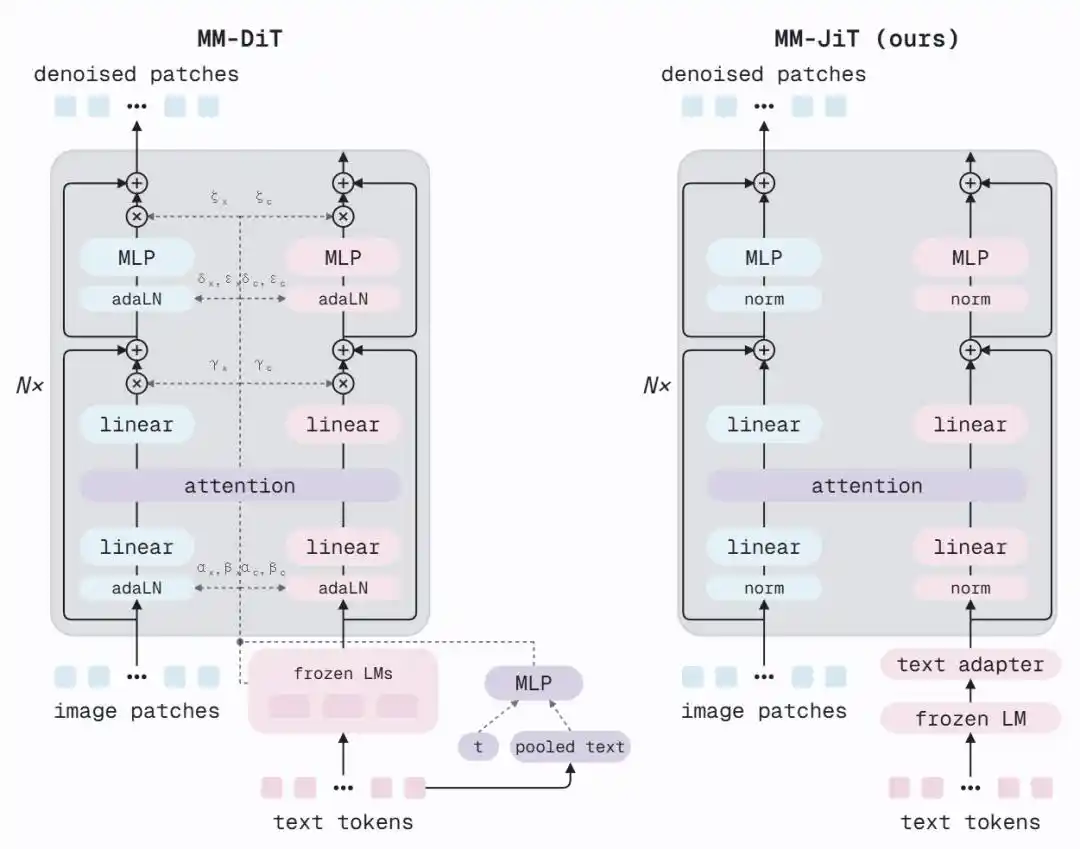
The proposed MM-JiT architecture does two things:

1. Add Two Text Adapter Layers: Insert two lightweight Transformer blocks before joint attention, allowing the frozen T5 features to first 'adapt' to the denoiser's needs.

2. Remove the AdaLN Branch: No longer inject timestep and global text information through an additional path. The model can still perceive noise levels — because the noise-corrupted image itself carries timestep information.

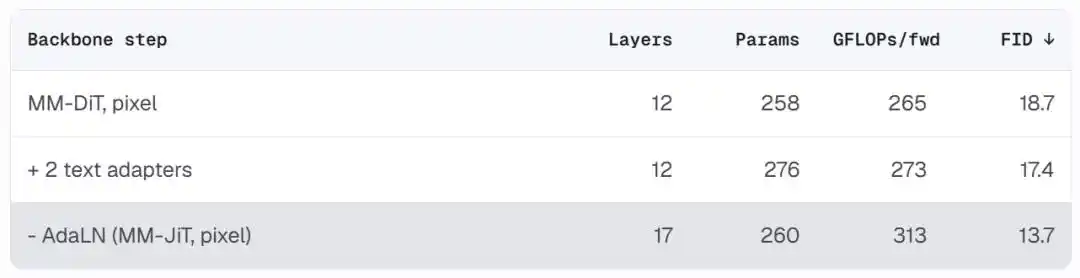
The result is a clean architecture nearly identical to a standard pre-normalization Transformer. Removing AdaLN reduces parameters, allowing for more layers within the same compute budget (12 layers → 17 layers). FID drops from 18.7 to 13.7, and the architecture itself is easier to understand and modify.
Training Data: Fully Public, Two-Phase

MiniT2I's training data also pursues minimalism:

  • Pre-training: LLaVA-recaptioned CC12M (publicly available VLM re-captioned dataset), 250K steps
  • Fine-tuning: ~120K high-quality image-text pairs (BLIP3o-60K + LAION DALL・E 3 Discord set + ShareGPT-4o-Image), 40K steps

This 'pre-train then fine-tune' two-stage pattern directly mirrors LLM training paradigms: pre-training buys coverage, fine-tuning teaches the model what a good answer is. Ablations show both are indispensable — pre-training alone yields acceptable image quality but poor prompt following; fine-tuning alone makes the model's world too narrow, causing generative diversity to collapse.

Results: Small Model, Big Performance

In comparisons among pixel-space text-to-image models, MiniT2I offers exceptional value:
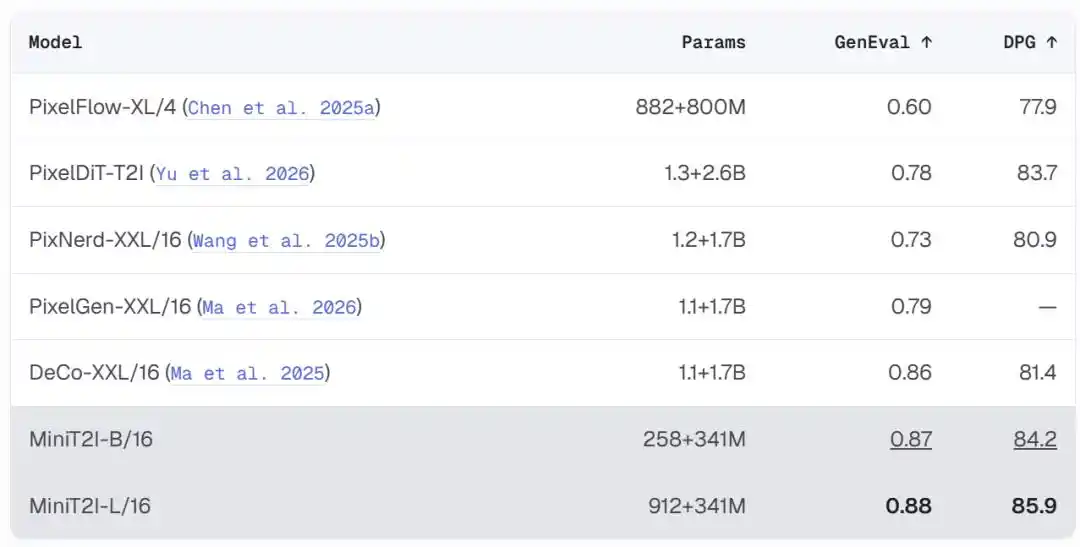
MiniT2I-B/16, with only ~600M total parameters (including text encoder), surpasses models 3-4 times its size on GenEval and DPG-Bench. Moreover, training cost is extremely low: the B/32 ablation model required only about 3 days on 8 H100s, with total training FLOPs comparable to a standard 200-epoch ImageNet experiment.
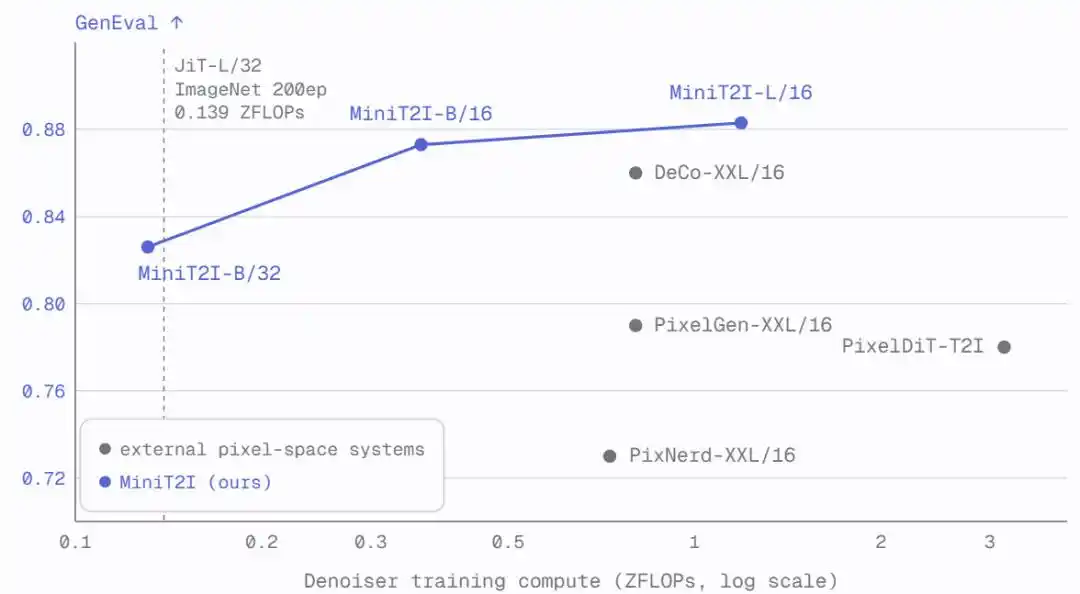
Scaling to L/16 (912M parameters) yields noticeable improvements in style diversity, spatial relationships, and text rendering, achieving quality on imaginative scenes comparable to or even better than SD3-Medium (~2B parameters).

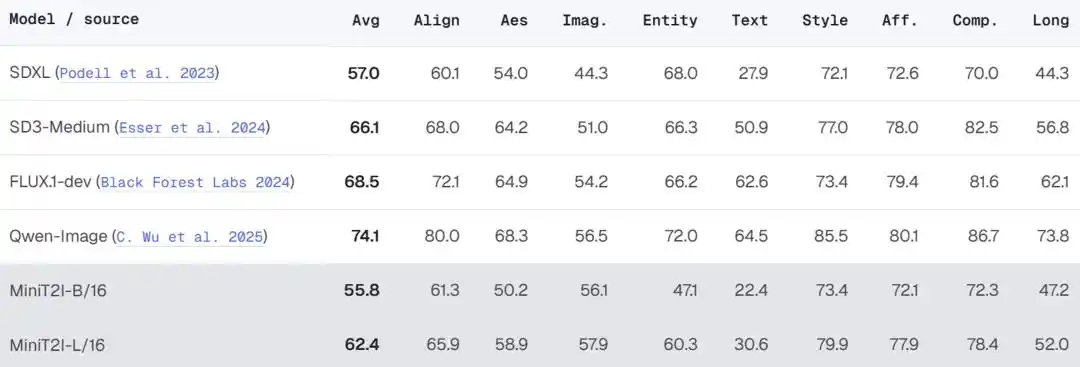
In the more comprehensive PRISM-Bench evaluation, MiniT2I-L/16 performs well in style, composition, and imagination dimensions (79.9, 78.4, 57.9), approaching SD3-Medium levels. However, gaps remain in text rendering (30.6 vs SD3's 50.9) and named entities (60.3 vs 66.3) — the team acknowledges these are inherent limitations of the public data recipe, requiring targeted data to bridge.
Limitations and Outlook

MiniT2I is a proof of concept for a technical path, not a final product. The team honestly points out several unresolved issues:

  • Patch artifacts in pixel space: Measurable discontinuities exist at patch boundaries (gradients 17-22% higher at boundaries than elsewhere), a problem latent-space models do not have.
  • Side effects of CFG in pixel space: High guidance scales (~6) push local tokens away from the data manifold, directly exposing visual artifacts without a decoder's 'smoothing' effect.
  • Resolution ceiling: Works well at 512×512 currently; pushing to 4K+ requires longer sequences or more efficient attention mechanisms.
  • Data bottleneck: Text rendering and named entities remain weaker than industrial systems, requiring specialized data augmentation.

MiniT2I demonstrates that state-of-the-art text-to-image generation is no longer a game only for top industrial labs.

When a 258M-parameter model, trained on purely public data with academic-level compute for just 3 days, can defeat opponents orders of magnitude larger, perhaps text-to-image is undergoing a paradigm shift from 'brute force' to 'distillation'.

"T2I is no longer an insurmountable wall. Welcome to use and improve it, to build a simpler baseline."

This article is from the WeChat public account "机器之心" (Almost Human)

Crypto di tendenza

Domande pertinenti

QWhat is the main contribution or innovation of the MiniT2I model proposed by He Kaiming's team?

AThe main contribution is proposing MiniT2I, a minimalist text-to-image baseline model. It removes numerous complex components standard in current models—such as the VAE encoder-decoder, the AdaLN conditional injection mechanism, auxiliary loss functions, and private training data—and relies solely on flow matching objectives trained directly on pixel space. It demonstrates that with a simpler architecture and public data, it can achieve competitive performance against much larger models.

QHow does the architectural design of MiniT2I's MM-JiT differ from the commonly used MM-DiT in models like SD3?

AThe MM-JiT architecture in MiniT2I differs from MM-DiT by performing simplification in two key ways. First, it adds two lightweight text adapter Transformer blocks before joint attention to help frozen T5 features adapt to the denoiser. Second, and more importantly, it deletes the complex AdaLN (Adaptive Layer Normalization) branches used to inject timestep and text conditioning. This results in a cleaner, near-standard pre-norm Transformer architecture, reducing parameters and allowing for more layers within the same compute budget.

QWhat is the core argument for MiniT2I's choice to operate directly in pixel space instead of a latent space like most models?

AThe core argument is simplicity and alignment. Removing the VAE eliminates several issues: reconstruction error, extra training stages, and misalignment between encoder and denoiser objectives. For 512x512 images, patchifying into 1024 16x16 tokens keeps the sequence length manageable for Transformers. This direct approach reduces computational cost per forward pass significantly (~570 vs ~1379 GFLOPs for the B/16 configuration) and removes the upper bound of reconstruction accuracy, meaning the output quality depends directly on the denoiser's capability.

QWhat were the two stages of data used to train MiniT2I, and why was this two-stage approach necessary?

AMiniT2I was trained in two stages using only public data: 1) Pre-training on LLaVA-recaptioned CC12M (a VLM-recaptioned dataset) for 250K steps. 2) Fine-tuning on a combined set of ~120K high-quality image-text pairs from sources like BLIP3o-60K, LAION DALL・E 3 Discord set, and ShareGPT-4o-Image for 40K steps. This 'pre-train then fine-tune' paradigm mirrors LLM training. Ablation studies showed both stages are essential: pre-training alone gives good image quality but poor prompt following, while fine-tuning alone causes a collapse in generation diversity due to a limited worldview.

QAccording to the article, what are some of the key limitations or unsolved problems with the MiniT2I approach?

AThe key limitations highlighted include: 1) Patch boundary artifacts in pixel space, leading to measurable discontinuities not present in latent models. 2) Negative side effects of high CFG (Classifier-Free Guidance) scales in pixel space, which push local tokens off the data manifold and manifest as visual flaws. 3) A resolution ceiling, as scaling to 4K+ would require longer sequences or more efficient attention. 4) Data bottlenecks, particularly in text rendering and named entity accuracy, which lag behind industrial systems and would require specialized data to improve.

Letture associate

Farewell to Speculation: The Graham Moment of the Crypto Industry

"Farewell to Speculation: The Graham Moment for the Crypto Industry" The article draws a parallel between today's cryptocurrency market and the speculative, unregulated US stock market of the 1920s. That era lacked mandatory corporate disclosure, enabling rampant manipulation and turning stocks into gambling tools. The 1929 crash led to foundational reforms: the Securities Acts of 1933/34 mandated transparent, audited financial reporting, and Benjamin Graham's "Security Analysis" provided a framework for fundamental valuation. Together, they created modern investing, requiring both reliable data and a methodology to value assets. Similarly, the crypto market is currently driven by narratives and speculation. However, it possesses a key advantage: unlike 1920s corporations, blockchain protocols have inherently transparent, on-chain data for revenue, treasury, and activity. The core obstacle is not transparency, but the lack of legal claim to that value. Due to regulatory uncertainty (primarily the Howey Test), most tokens are deliberately stripped of economic rights like profit-sharing to avoid being classified as securities. This creates a paradox where protocols generate revenue, but token holders have no right to it. The turning point, argues the author, is imminent US legislation. The already-passed GENIUS Act provides a framework for stablecoins. The crucial CLARITY Act, currently in advanced legislative stages, aims to clearly categorize digital assets and define their regulatory treatment (SEC vs. CFTC). This would allow developers to legally design tokens with enforceable economic rights, such as profit distribution. If passed, this would enable a shift from speculation to fundamental investment. Analysis would focus on protocol revenue sustainability, network effects, valuation multiples, and the specific rights encoded in a token's contract—mirroring traditional equity analysis. The article notes significant legislative hurdles and timelines (1-3 years for rulemaking post-passage), but emphasizes the direction is set. A deeper challenge remains: building decentralized, legally enforceable governance and ownership structures to protect token holder rights, akin to corporate law. This will be a core development focus. The transformation applies mainly to revenue-generating protocol tokens, not to assets like Bitcoin (digital gold). The article concludes that the industry's question has evolved from "can tokens create value?" to "who gets to allocate that value?". Solving the latter, as in the 1920s, will mark crypto's transition to a legitimate asset class for fundamental investment.

Foresight News9 min fa

Farewell to Speculation: The Graham Moment of the Crypto Industry

Foresight News9 min fa

Quantum Computing "Manhattan Project" Unveiled: Is the Encryption Industry at a Critical Turning Point?

"Quantum Computing 'Manhattan Project' Launched: Is the Crypto Industry at a Critical Juncture?" On June 22, former U.S. President Donald Trump signed two executive orders. The first mandates all federal agencies upgrade their cryptographic systems to new, quantum-resistant standards by 2030. The second orders the Department of Energy to lead the development of a national quantum computer, signaling a shift from laboratory research to a state-enforced national agenda. This creates a hard deadline. A powerful quantum computer could break current encryption. The threat is compounded by "harvest now, decrypt later" attacks, where encrypted data is stored today for future decryption. Federal agencies must appoint migration officers and complete post-quantum cryptography (PQC) upgrades for key establishment by 2030 and digital signatures by 2031. Procurement rules will also be changed, forcing government contractors to comply. The crypto industry faces a direct threat. Bitcoin's ECDSA signatures are theoretically vulnerable. Research indicates millions of Bitcoin with exposed public keys are at risk if quantum computers advance. While projects like Bitcoin Quantum testnets and efforts by Ethereum, Solana, NEAR, and Zcash are exploring quantum-resistant solutions, achieving consensus in decentralized networks remains a major challenge. The centralized U.S. government has started a 5-year countdown. For decentralized crypto networks, the real test is whether they can complete this anti-quantum upgrade before the theoretical threat becomes a practical reality.

Foresight News30 min fa

Quantum Computing "Manhattan Project" Unveiled: Is the Encryption Industry at a Critical Turning Point?

Foresight News30 min fa

Coin Stock Barometer丨BitMine's Total Assets and Investment Reach $10.7 Billion, Exceeding ~$9.3 Billion Floating Loss; Strategy Buys Only 520 BTC, Strive Adds Positions Against the Trend (June 23)

This article provides a weekly market update on "coin-equity" trends, focusing on listed companies holding major cryptocurrencies. Key highlights include: **General Market Trends:** Global equities, particularly in the US, Japan, and South Korea, faced significant sell-offs, led by large tech and AI-related stocks. Analysts cite profit-taking and a shift from hype-driven to performance-driven valuation for AI companies. Market focus is on upcoming Micron Technology's earnings. **Cryptocurrency Treasury Updates:** * **Bitcoin (BTC):** Net weekly BTC purchases by listed companies (excluding miners) totaled approximately $86 million, down 13.97% from the prior week. Strategy (formerly MicroStrategy) purchased only 520 BTC for ~$34.9 million, while Strive Asset Management increased its holdings by 759 BTC for ~$50 million. Other notable actions include Mara Holdings adding 1,000 BTC and Capital B shareholders approving a massive financing plan (up to ~$1.2 trillion) to potentially expand its Bitcoin reserves. * **Ethereum (ETH):** BitMine emerged as the largest corporate ETH treasury, holding 5.67 million ETH (4.7% of supply). It purchased an additional 52,203 ETH ($92 million) in the past week. Sharplink completed a $75 million private placement to fund further ETH accumulation and stock buybacks. * **Solana (SOL):** The top five listed companies hold over 15.7 million SOL combined. However, Solmate Infrastructure, a SOL treasury firm, faces a lawsuit from its largest external shareholder alleging board misconduct and self-dealing. * **Other:** Updates include Canton Strategic's $50 million stock buyback plan and Lite Strategy's $1 million strategic investment in LitVM, a Layer-2 network for Litecoin. The article notes that while crypto treasury firms continue fundraising and accumulation, their stocks may struggle to rise against the broader market downturn until Q4.

marsbit45 min fa

Coin Stock Barometer丨BitMine's Total Assets and Investment Reach $10.7 Billion, Exceeding ~$9.3 Billion Floating Loss; Strategy Buys Only 520 BTC, Strive Adds Positions Against the Trend (June 23)

marsbit45 min fa

Trading

Spot
Futures

Articoli Popolari

Cosa è ₿O₿

Bitcoin Bob ($₿o₿): Pionieristico DeFi Centrato su Bitcoin Attraverso Innovazione Ibrida Layer-2 In un'era in cui l'economia digitale sta evolvendo rapidamente, Bitcoin Bob ($₿o₿) emerge come un progetto rivoluzionario volto a migliorare l'utilità di Bitcoin nel settore della finanza decentralizzata (DeFi). Lanciato ufficialmente a maggio 2024, Bitcoin Bob, noto anche come Build on Bitcoin (BOB), rappresenta una soluzione blockchain ibrida Layer-2 che fonde la rinomata sicurezza e immutabilità di Bitcoin con la programmabilità di Ethereum. Questa iniziativa cerca di colmare un'importante lacuna nell'ecosistema di Bitcoin facilitando l'integrazione di smart contract e applicazioni decentralizzate, mantenendo al contempo i principi fondamentali di fiducia e sicurezza insiti in Bitcoin. Con un sostegno significativo da parte di importanti investitori di venture capital, Bitcoin Bob è posizionato per ridefinire il ruolo di Bitcoin nel panorama DeFi, rendendolo una pietra miliare delle operazioni finanziarie decentralizzate a livello globale. Cos'è Bitcoin Bob, $₿o₿? Alla sua base, Bitcoin Bob è una soluzione blockchain ibrida progettata per migliorare la funzionalità di Bitcoin. L'obiettivo principale del progetto è abilitare la finanza decentralizzata su Bitcoin, facilitando transazioni rapide e senza soluzione di continuità, garantendo al contempo elevati livelli di sicurezza. Bitcoin Bob utilizza tecnologie avanzate, in particolare un'architettura ibrida layer-2 che combina le caratteristiche di sicurezza di Bitcoin con la programmabilità e la flessibilità della Ethereum Virtual Machine (EVM). Questo approccio pragmatico consente al progetto di operare efficacemente senza compromettere i valori fondamentali di Bitcoin, rappresentando un passo monumentale nel colmare il divario tra i tradizionali detentori di Bitcoin e l'emergente ecosistema DeFi. Una delle caratteristiche distintive di Bitcoin Bob è il suo ruolo nel fornire un ambiente a fiducia minimizzata attraverso meccanismi innovativi, come gli optimistic rollups inizialmente basati su Ethereum, che si evolveranno infine verso un'integrazione completa con Bitcoin. Questo sistema ibrido è progettato per garantire che la vasta liquidità presente in Bitcoin non solo venga preservata, ma anche utilizzata efficacemente in vari protocolli DeFi. Chi è il Creatore di Bitcoin Bob, $₿o₿? La forza creativa dietro Bitcoin Bob è il co-fondatore e CEO Alexei Zamyatin, che porta con sé una vasta esperienza e conoscenza dal suo ampio background nel settore delle criptovalute. Zamyatin ha conseguito un dottorato in Informatica ed è stato attivamente coinvolto nello sviluppo di Bitcoin dal 2015. La sua profonda comprensione degli ecosistemi di Bitcoin ed Ethereum gioca un ruolo cruciale nel plasmare la visione e le basi tecnologiche di Bitcoin Bob. Insieme a Zamyatin c'è il co-fondatore Dominik Harz, che ricopre il ruolo di Chief Technology Officer (CTO). Insieme, i due hanno coltivato un team di talenti con una passione condivisa per spingere i confini della tecnologia blockchain, assicurando la posizione innovativa di Bitcoin Bob nel mercato. Chi Sono gli Investitori di Bitcoin Bob, $₿o₿? Bitcoin Bob ha ottenuto con successo il supporto di una serie di importanti investitori e società di venture capital che riconoscono il suo potenziale di trasformare il panorama di Bitcoin. A marzo 2024, il progetto ha completato un robusto round di finanziamento seed da 10 milioni di dollari, guidato da Castle Island Ventures, con una partecipazione notevole da parte di aziende come Coinbase Ventures e Bankless Ventures. Poco dopo, a luglio 2024, Bitcoin Bob ha ottenuto un ulteriore finanziamento strategico di 1,6 milioni di dollari. Questo round è stato co-guidato da Ledger Ventures e ha visto la partecipazione di angel investor provenienti da varie aziende di spicco come BlackRock, Aave e Curve. Il forte sostegno finanziario riflette un riconoscimento a livello di settore dell'approccio innovativo di Bitcoin Bob per sbloccare il potenziale di Bitcoin nello spazio DeFi. Questo finanziamento è cruciale non solo per lo sviluppo continuo del progetto, ma anche per stabilire un incubatore per promuovere applicazioni decentralizzate (dApps) native di Bitcoin, mirate specificamente a soddisfare le esigenze di una base utenti in crescita. Come Funziona Bitcoin Bob, $₿o₿? Le meccaniche operative di Bitcoin Bob sono radicate nella sua architettura ibrida rollup, progettata per combinare i benefici della sicurezza di Bitcoin con la versatilità dell'EVM di Ethereum. Il progetto utilizza un modello di sicurezza a fasi che delinea la sua interazione con utenti e sviluppatori nel seguente modo: Fase 1 – La fase iniziale opera come un optimistic rollup su Ethereum, in cui le transazioni vengono elaborate con una promettente aspettativa di validità, aprendo la strada a futuri sviluppi su Bitcoin. Fase 2 – Man mano che il progetto si evolve, integrerà la finalità di Bitcoin attraverso il Bitcoin Staking, sfruttando il Babylon Network per migliorare la sicurezza. Questo meccanismo richiede ai validatori di bloccare Bitcoin, verificando così le transazioni BOB, il che non solo migliora la sicurezza ma crea anche opportunità di rendimento per i partecipanti. Fase 3 – La visione prospettica per Bitcoin Bob è quella di integrarsi completamente con Bitcoin, utilizzando tecnologie innovative come BitVM e prove a conoscenza zero per facilitare il calcolo off-chain mantenendo l'integrità della sicurezza di Bitcoin. Innovazioni chiave come BitVM2, un protocollo di bridge a fiducia minimizzata co-autore di Zamyatin, sono fondamentali per la funzionalità del progetto, consentendo depositi e prelievi di Bitcoin senza la necessità di una dipendenza estesa dalla rete. Questo consente all'ecosistema di connettersi in modo efficiente con Ethereum e altre catene compatibili, creando un modello di interazione snello ed efficace per utenti e sviluppatori. Cronologia di Bitcoin Bob, $₿o₿ Comprendere l'evoluzione di Bitcoin Bob implica seguire le sue tappe importanti: 2019: Alexei Zamyatin e Dominik Harz fondano una società di ricerca focalizzata su soluzioni blockchain, ponendo le basi per progetti futuri. Marzo 2024: Bitcoin Bob raccoglie con successo 10 milioni di dollari in un round di finanziamento seed, segnando il suo ingresso nel competitivo panorama blockchain. 1 Maggio 2024: Si svolge il lancio ufficiale della mainnet, mostrando le capacità del progetto con una significativa adozione da parte degli utenti e un valore totale bloccato (TVL). Luglio 2024: Il progetto attira un ulteriore 1,6 milioni di dollari in finanziamento strategico per stabilire il suo incubatore, mirato a promuovere innovazioni guidate da Bitcoin. Ottobre 2024: Bitcoin Bob rilascia un “Vision Paper”, dettagliando il suo design ibrido layer-2 e le strategie prospettiche. 2025: Si prevede il lancio delle funzionalità della Fase 2, focalizzandosi sulla finalità di Bitcoin e sui bridge BitVM mirati a migliorare la funzionalità complessiva. Conclusione: Ridefinire il Ruolo di Bitcoin nella Finanza Decentralizzata Bitcoin Bob ($₿o₿) non è solo un altro progetto blockchain; rappresenta un cambiamento di paradigma nel modo in cui Bitcoin può interagire con applicazioni finanziarie più ampie. Combinando meticolosamente la sicurezza di Bitcoin con la flessibilità di Ethereum, Bitcoin Bob mira a rimodellare il panorama DeFi, colmando il divario tra valuta digitale e applicazioni decentralizzate. Con un robusto framework tecnologico, una forte leadership e finanziamenti strategici, Bitcoin Bob è ben posizionato per affermarsi come un attore fondamentale nell'ecosistema delle criptovalute, sbloccando nuove dimensioni di liquidità e utilità per Bitcoin. Man mano che il progetto continua a evolversi ed espandersi, promette di inaugurare una nuova era di innovazione, dimostrando che il potenziale di Bitcoin si estende ben oltre essere un semplice deposito di valore, ma piuttosto come una pietra angolare del futuro panorama finanziario. Mentre il progetto avanza attraverso le sue fasi anticipate, tutti gli occhi saranno puntati su Bitcoin Bob, in particolare riguardo al suo impegno per incorporare principi decentralizzati e garantire che gli utenti possano godere dei pieni benefici di DeFi ancorati a Bitcoin.

14 Totale visualizzazioniPubblicato il 2025.06.30Aggiornato il 2025.06.30

Cosa è ₿O₿

Come comprare O

Benvenuto in HTX.com! Abbiamo reso l'acquisto di O1 exchange (O) semplice e conveniente. Segui la nostra guida passo passo per intraprendere il tuo viaggio nel mondo delle criptovalute.Step 1: Crea il tuo Account HTXUsa la tua email o numero di telefono per registrarti il tuo account gratuito su HTX. Vivi un'esperienza facile e sblocca tutte le funzionalità,Crea il mio accountStep 2: Vai in Acquista crypto e seleziona il tuo metodo di pagamentoCarta di credito/debito: utilizza la tua Visa o Mastercard per acquistare immediatamente O1 exchangeO.Bilancio: Usa i fondi dal bilancio del tuo account HTX per fare trading senza problemi.Terze parti: abbiamo aggiunto metodi di pagamento molto utilizzati come Google Pay e Apple Pay per maggiore comodità.P2P: Fai trading direttamente con altri utenti HTX.Over-the-Counter (OTC): Offriamo servizi su misura e tassi di cambio competitivi per i trader.Step 3: Conserva O1 exchange (O)Dopo aver acquistato O1 exchange (O), conserva nel tuo account HTX. In alternativa, puoi inviare tramite trasferimento blockchain o scambiare per altre criptovalute.Step 4: Scambia O1 exchange (O)Scambia facilmente O1 exchange (O) nel mercato spot di HTX. Accedi al tuo account, seleziona la tua coppia di trading, esegui le tue operazioni e monitora in tempo reale. Offriamo un'esperienza user-friendly sia per chi ha appena iniziato che per i trader più esperti.

15 Totale visualizzazioniPubblicato il 2026.06.19Aggiornato il 2026.06.19

Come comprare O

Discussioni

Benvenuto nella Community HTX. Qui puoi rimanere informato sugli ultimi sviluppi della piattaforma e accedere ad approfondimenti esperti sul mercato. Le opinioni degli utenti sul prezzo di O O sono presentate come di seguito.

活动图片