HBAR Consolidates Near Lows While Analysts Map Potential Short-Term Bounce Scenarios

bitcoinistPubblicato 2025-12-17Pubblicato ultima volta 2025-12-17

Introduzione

Hedera's HBAR token is trading near its lowest levels in over a year, reflecting both broader crypto market weakness and project-specific challenges. After a steady decline, HBAR has entered a tight consolidation range, with traders debating whether this pause signals a potential short-term rebound or a continuation of the downtrend. The token recently fell to the $0.11–$0.12 range after failing to hold above the $0.125 support level. Market structure is bearish, with HBAR trading below key moving averages and momentum indicators like RSI and MACD pointing lower. Volume patterns show active trading around key levels, with resistance near $0.119–$0.122 and immediate support at $0.112–$0.113. A break above resistance could signal a move toward $0.13, while a breakdown might lead to a retest of the psychological $0.10 level. Analysts are divided: some see oversold conditions and potential for a bounce to the mid-$0.12 to $0.14 range, while others remain cautious due to slowing ecosystem growth and weak demand for Hedera-linked investment products.

Hedera’s HBAR token is trading near its lowest levels in more than a year, reflecting both broader crypto market weakness and project-specific headwinds.

After a steady decline through November and December, HBAR has slipped into a tight consolidation range, with traders debating whether the current pause marks a base for a short-term rebound or a continuation of the downtrend.

Recent price action indicates growing activity around key technical levels, despite mixed fundamental indicators.
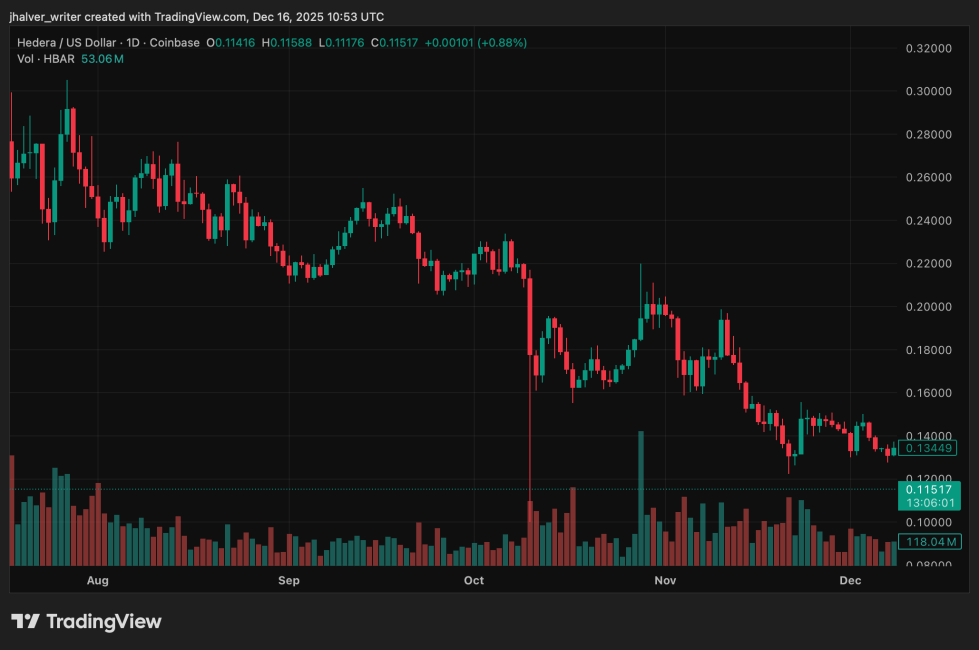
HBAR's price trends to the downside on the daily chart. Source: HBARUSD chart on Tradingview

HBAR Slides to Multi-Month Lows as Selling Pressure Builds

HBAR fell to around $0.11–$0.12 this week after failing to hold above the $0.125 support zone, a level that had acted as a floor several times earlier in the year. The drop coincided with a wider market pullback, as Bitcoin and major altcoins weakened ahead of global macro events, including Senate decisions in the U.S.

Trading data shows that volume surged sharply during attempts to reclaim resistance near $0.119–$0.120, suggesting active distribution rather than sustained accumulation.

Market structure has turned decisively bearish over recent sessions. HBAR is now trading below key moving averages, and momentum indicators such as RSI and MACD continue to point lower.

On-chain and ecosystem data have also weighed on sentiment, with Hedera’s total value locked declining significantly from earlier highs and stablecoin supply on the network shrinking over recent months.

Volume Spikes Show Key Support and Resistance Zones

Despite the broader downtrend, recent volume patterns have drawn attention from short-term traders. During one session, HBAR volume jumped more than 80% above its daily average as the price tested resistance near $0.119.

The rejection triggered another wave of selling, but late-session activity showed renewed buying interest as the price approached the $0.112–$0.113 area. This zone is now viewed as immediate support, with a deeper psychological level around $0.10 acting as the next downside reference if selling resumes.

On the upside, analysts are watching $0.119–$0.122 as a critical resistance band. A clean break above this range would be needed to shift short-term structure and open the door for a move toward prior highs near $0.13.

Analysts Split Between Oversold Bounce and Further Downside Risk

Some technical analysts argue that HBAR is approaching oversold conditions, noting weakening bearish momentum and signs of trendline breaks on lower timeframes. These signals have fueled short-term bounce scenarios targeting the mid-$0.12 to $0.14 range, provided support continues to hold.

Others remain cautious, pointing to stalled demand for recent Hedera-linked investment products and slowing ecosystem growth. From this view, failure to defend current levels could expose HBAR to a retest of $0.10, a level last seen during earlier liquidation events.

Cover image from ChatGPT, HBARUSD chart from Tradingview

Crypto di tendenza

Letture associate

Misjudged A-Shares: Resilience, Expectations, and Confidence

China's A-share market recently faced selling pressure, especially in tech sectors, initially triggered by a global tech sell-off that began in South Korea. However, the article argues this is a case of "mistaken injury" and highlights the market's underlying resilience. This resilience stems from three main pillars: **1) Tech Sector Fundamentals:** Unlike Korea's market dominated by a few memory chip stocks, China's tech sector is diversified across computing, communications, electronics, and semiconductors, supported by dual narratives of global AI supply chains and domestic substitution. Core areas like optical modules and fiber optics continue to show strong earnings growth. **2) "National Team" Support:** State-backed institutions and large corporations have made significant market purchases and announced buybacks, providing liquidity and signaling confidence. This is seen as a stabilizing policy signal, often associated with market bottoms. **3) Broader Market Pillars:** Other major sectors are showing endogenous recovery momentum. Consumer stocks benefit from stabilizing CPI and signs of sector recovery (e.g., liquor price hikes). Cyclical sectors like aluminum have high earnings, potential price increases due to tight supply, and low valuations. The financial sector offers stable dividends and low valuations. The conclusion is that the sell-off was driven by external contagion, not a collapse in fundamentals. With strong policy support and recovering momentum across key sectors, the A-share market possesses the toughness to regain stability.

marsbit24 min fa

Misjudged A-Shares: Resilience, Expectations, and Confidence

marsbit24 min fa

The Clarity Act's Journey Through Congress: The Thorny Path of Bipartisan Compromise in the U.S.

The U.S. Congress is struggling to advance the crypto market structure bill known as the Clarity Act, with bipartisan compromise proving difficult. Key hurdles include unresolved disputes over "yield" products and, more critically, the inclusion of strong ethics provisions for elected officials—a non-negotiable demand for many Democrats. While a compromise on yield was reached in May, securing only limited Democratic support in committee, the separate Senate Agriculture Committee version later passed with no Democratic votes due to the ethics impasse. As Republicans push for a full Senate vote in July, demands for ethics rules have expanded, and other contentious issues like developer protections and concerns from law enforcement and large banks further complicate negotiations. Despite consensus on the need for legislation, the path forward is unclear. Recent discussions between senators and White House officials aim to find acceptable ethics language. Some lawmakers question whether a compromise text can garner enough bipartisan support, with one Democrat stating the current proposal lacks the strong ethics provisions required for their vote. Potential short-term goals for the crypto community include symbolic Senate action before the August recess, a longer-term aim for passage by 2026, or establishing a detailed framework that addresses ethics and other compromises. The process remains arduous, relying on the traditional, vote-by-vote effort to build bipartisan support.

marsbit43 min fa

The Clarity Act's Journey Through Congress: The Thorny Path of Bipartisan Compromise in the U.S.

marsbit43 min fa

Are Kalshi and Polymarket Founders at Odds? This Business Rivalry Is More Brutal Than You Think

"The Rivalry Between Kalshi and Polymarket Founders Turns Bitter and Litigious" The intense feud between Tarek Mansour, CEO of Kalshi, and Shayne Coplan, founder of Polymarket, has escalated far beyond typical business competition into personal animosity and regulatory battles. Both lead billion-dollar prediction market platforms, but their approaches differ sharply. Kalshi positions itself as the compliant operator, securing U.S. regulatory approval before launching. In contrast, Polymarket initially operated offshore, allowing U.S. users to access its platform via VPN, which drew regulatory scrutiny. The conflict reached a peak in November 2024 when FBI agents raided Coplan's New York apartment. While Coplan publicly blamed political motives, his team privately suspected Kalshi was involved. According to sources, Kalshi's lawyers had previously reported Polymarket's operations to federal prosecutors, highlighting its accessibility to U.S. users despite a ban. This incident fueled mutual accusations and underhanded tactics, including social media smear campaigns and attempts to sabotage each other's major business deals. Their rivalry also played out in Washington, influencing regulatory debates. Kalshi actively lobbied against Polymarket's practices, framing them as illegal and unethical. Polymarket, after facing a CFTC fine and investigation, later acquired a licensed U.S. firm to launch a domestic app, regaining a foothold. Despite the hostility, both companies have seen massive growth, with combined trading volumes soaring. However, increased regulatory scrutiny, particularly around insider trading on Polymarket's platform, continues to pose challenges. The founders' deep-seated mutual disdain ensures their battle for market dominance remains as much a personal vendetta as a commercial one.

marsbit52 min fa

Are Kalshi and Polymarket Founders at Odds? This Business Rivalry Is More Brutal Than You Think

marsbit52 min fa

Trading

Spot

Articoli Popolari

Come comprare HBAR

Benvenuto in HTX.com! Abbiamo reso l'acquisto di Hedera Hashgraph (HBAR) semplice e conveniente. Segui la nostra guida passo passo per intraprendere il tuo viaggio nel mondo delle criptovalute.Step 1: Crea il tuo Account HTXUsa la tua email o numero di telefono per registrarti il tuo account gratuito su HTX. Vivi un'esperienza facile e sblocca tutte le funzionalità,Crea il mio accountStep 2: Vai in Acquista crypto e seleziona il tuo metodo di pagamentoCarta di credito/debito: utilizza la tua Visa o Mastercard per acquistare immediatamente Hedera HashgraphHBAR.Bilancio: Usa i fondi dal bilancio del tuo account HTX per fare trading senza problemi.Terze parti: abbiamo aggiunto metodi di pagamento molto utilizzati come Google Pay e Apple Pay per maggiore comodità.P2P: Fai trading direttamente con altri utenti HTX.Over-the-Counter (OTC): Offriamo servizi su misura e tassi di cambio competitivi per i trader.Step 3: Conserva Hedera Hashgraph (HBAR)Dopo aver acquistato Hedera Hashgraph (HBAR), conserva nel tuo account HTX. In alternativa, puoi inviare tramite trasferimento blockchain o scambiare per altre criptovalute.Step 4: Scambia Hedera Hashgraph (HBAR)Scambia facilmente Hedera Hashgraph (HBAR) nel mercato spot di HTX. Accedi al tuo account, seleziona la tua coppia di trading, esegui le tue operazioni e monitora in tempo reale. Offriamo un'esperienza user-friendly sia per chi ha appena iniziato che per i trader più esperti.

346 Totale visualizzazioniPubblicato il 2024.12.11Aggiornato il 2026.06.02

Come comprare HBAR

Discussioni

Benvenuto nella Community HTX. Qui puoi rimanere informato sugli ultimi sviluppi della piattaforma e accedere ad approfondimenti esperti sul mercato. Le opinioni degli utenti sul prezzo di HBAR HBAR sono presentate come di seguito.

活动图片













