Hassabis Predicts: AI's 'Move 37' in Mathematics is Only a Matter of Time

marsbitPubblicato 2026-08-10Pubblicato ultima volta 2026-08-10

Introduzione

Demis Hassabis, the co-founder of DeepMind, predicts that AI achieving a "Move 37" level breakthrough in mathematics—solving a major unsolved problem like a Millennium Prize problem—is only a matter of time. He draws a parallel to the pivotal "Move 37" in the 2016 AlphaGo vs. Lee Sedol match, where AI's unconventional play challenged human understanding. Conversely, Lee Sedol's "Move 78" victory highlighted human resilience and the potential for human-AI collaboration. The article details AI's rapid progress in mathematics. Starting from basic arithmetic errors in 2023, AI systems like AlphaProof and Gemini Deep Think reached gold-medal levels in the International Mathematical Olympiad by 2025. The shift from problem-solving to genuine research began in 2025, with AI (e.g., GPT-5, Claude Fable 5) contributing key ideas to solve or refute long-standing conjectures like the Erdős problem 848 and the Jacobian conjecture. In 2026, AI achieved breakthroughs such as OpenAI's solution to the plane unit-distance problem and DeepMind's Aletheia agent autonomously tackling multiple open problems. Hassabis envisions a "centaur" era of science, where human intuition guides AI in complex, less-verifiable fields like biology and drug discovery. While AI can enhance human creativity and efficiency, as seen in post-AlphaGo围棋, there is a risk of over-reliance diminishing human judgment. The core challenge is for humanity to find its own "Move 78"—leveraging AI while maintaining critical ins...

AI in Mathematics, Ushering in a 'Slap-in-the-Face Moment' Similar to What the Go World Experienced a Decade Ago.

Holding a similar view is none other than Demis Hassabis, co-founder of DeepMind, who spearheaded the AlphaGo project ten years ago.

Although Hassabis recently underwent a series of role changes—transitioning from CEO of DeepMind to Google's Chief Scientist and Chairman of DeepMind.

When it comes to how AI is changing human cognition, he remains one of the most authoritative voices.
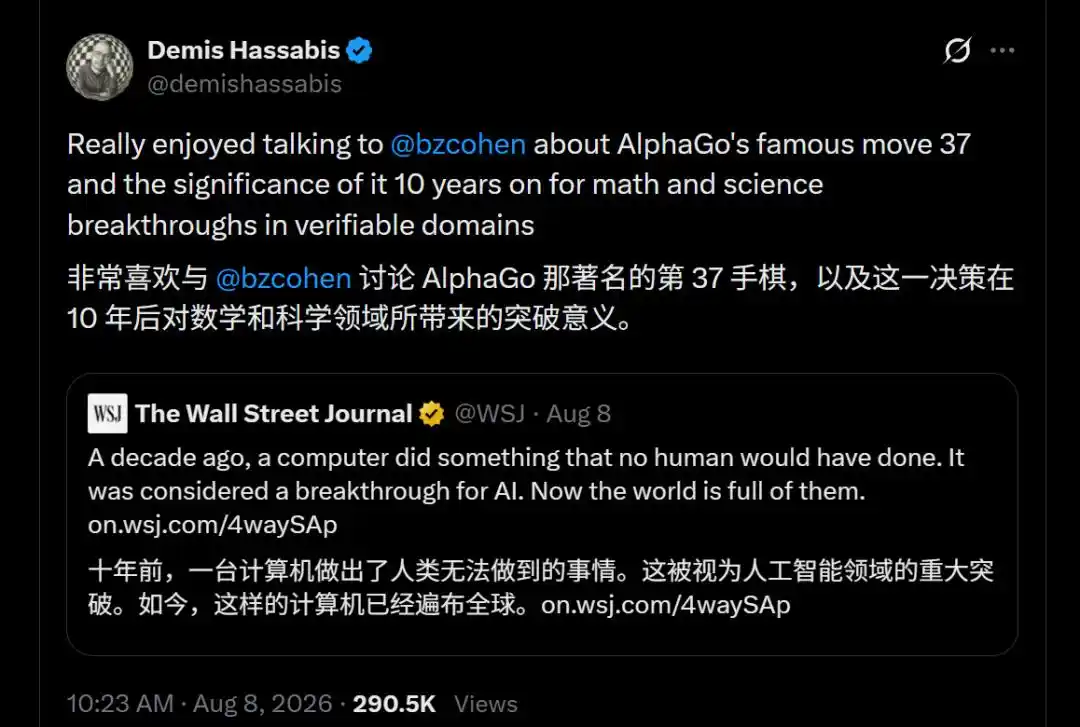
A decade ago, he witnessed AlphaGo's earth-shattering Move 37 defeat legendary Go player Lee Sedol.

A decade later, now at the forefront of AI's push into mathematics and scientific frontiers, he offers another new assessment:

If AI can solve one of the Millennium Prize Problems in mathematics, that would be a 'Move 37-level' breakthrough. At present, it seems to be only a matter of time before AI reaches that level, I see no reason why it wouldn't happen.

Move 37, a moment representing the first time humanity was collectively humbled by AI, is thus remembered by the world.

But few remember that Move 37 was not the only answer left by that man-machine battle.

Two matches later, after losing three games in a row, Lee Sedol played Move 78.

This move also had a probability of only one in ten thousand of being played by a human, yet it successfully disrupted AlphaGo, helping Lee Sedol secure the only human victory in the five-match series.

Looking back at this man-machine battle ten years later, one can't help but marvel:

The relationship between humans and AI is precisely like these two numbers.

One made humanity recognize AI anew, the other made humanity recognize itself anew.

The Face-Slapping Move 37

Turning back the clock to March 2016, the five-match series between AlphaGo and Lee Sedol was taking place in Seoul, South Korea.

In the first game, Lee Sedol lost to AlphaGo, an inauspicious start.

Arriving at the second game, the whole world awaited a counterattack from this legendary player.

Midway through the game, Lee Sedol temporarily left the board, had a cigarette to calm his nerves. But when he returned to the board, a black stone had already been placed.

Move 37.

Lee Sedol did not sit down immediately. He stood there staring at the board, hardly able to believe his eyes.

The reason was simple: this move was too inhuman.

AlphaGo placed the stone on the fifth line, deviating from centuries of positional intuition held by professional players. In conventional human Go understanding, stones should occupy higher positions to control the board, but AlphaGo placed it in an area with no immediate fighting.

The live commentators initially even suspected AlphaGo had made a mistake.

Professional 9-dan Michael Redmond, serving as commentator, stared at the black stone for a long time, unable to judge, could only say:

I don't know if this is good or bad, it's very strange.

His co-commentator was more direct:

I thought it was a mistake.

The DeepMind team later calculated the probability of a human player choosing this move at one in ten thousand.

But as the game progressed, people gradually realized this was not a bad move; it was a brilliant move that changed the course of the battle on a larger scale.

About 100 moves later, this seemingly misplaced black stone became the key to AlphaGo's victory in the second game.

Later, this moment of collective human misjudgment was gradually dubbed the 'Slap-in-the-Face Moment'

Originally thinking AI was wrong, but in the end, it was humans themselves who were wrong.

Beyond the slap, this move also made the world realize for the first time that AI could not only mimic human play, but also make moves humans had never considered.

And just ten years later, 'Move 37' indeed re-emerged, and this time it's linked to an ancient discipline:

Mathematics.

For AI, Go and mathematics share a major commonality: verifiability.

Because the logic and rules of these fields are sufficiently clear, AI can repeatedly run a simple process:

Try an idea, test it, learn from the results, then try again until it succeeds (the reinforcement learning approach).

This mechanism also explains why mathematics is the first discipline to be 'bombarded' by AI's 'Move 37'.

In fields like drug discovery, biology, etc., whether an idea works often requires lengthy experiments to verify.

Mathematics is different; a proof can be checked step by step, right or wrong, so AI can tirelessly search.

And so, as AI capabilities grow stronger, change began accelerating on a yearly basis.

Starting with ChatGPT's birth in 2023, large models still stumbled on basic arithmetic problems; flubs like "Which is larger, 9.11 or 9.9?" once caused amusement.

But by 2024, DeepMind's AlphaProof and AlphaGeometry 2 had already stormed into the International Mathematical Olympiad (IMO).

The two systems solved 4 out of 6 problems, scoring 28 points, reaching silver medal level (just 1 point short of that year's gold medal threshold).

And merely a year later, Gemini Deep Think solved 5 problems within the official contest's 4.5-hour limit, scoring 35 points, reaching IMO gold medal level.

In two years, AI advanced from novice to IMO gold medalist—astonishing speed.

But this was just the exam hall.

What really made the mathematical community feel the tide rushing in was AI starting to move from 'problem-solving' to 'research'.

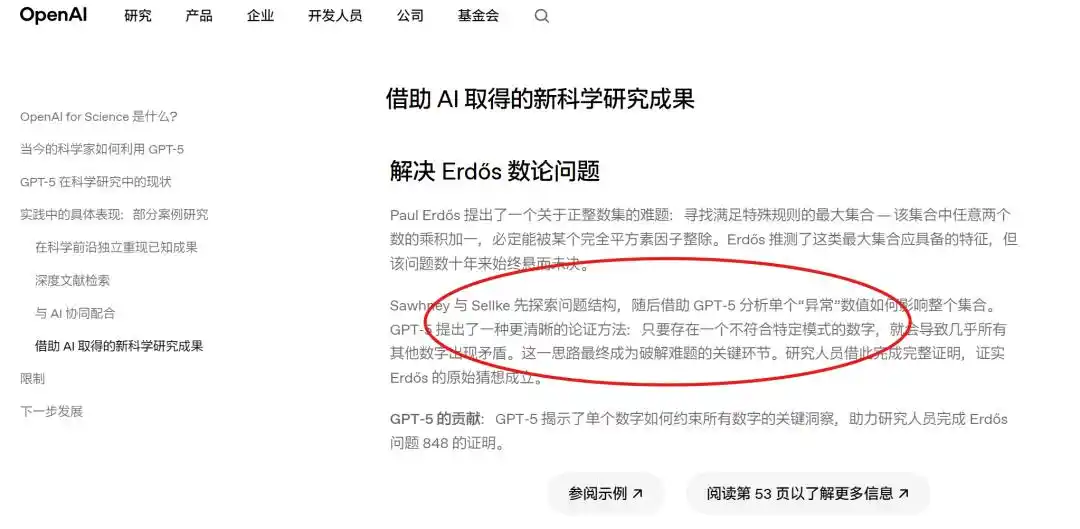
In 2025, GPT-5 participated in solving Erdős Problem 848, proposing a key estimate required for the proof.

Mathematicians refined and tightened it, ultimately completing the full proof.
The same year, UCLA mathematician Ernest Ryu used GPT-5 to find a breakthrough for an open problem that had puzzled optimization theory for 40 years.
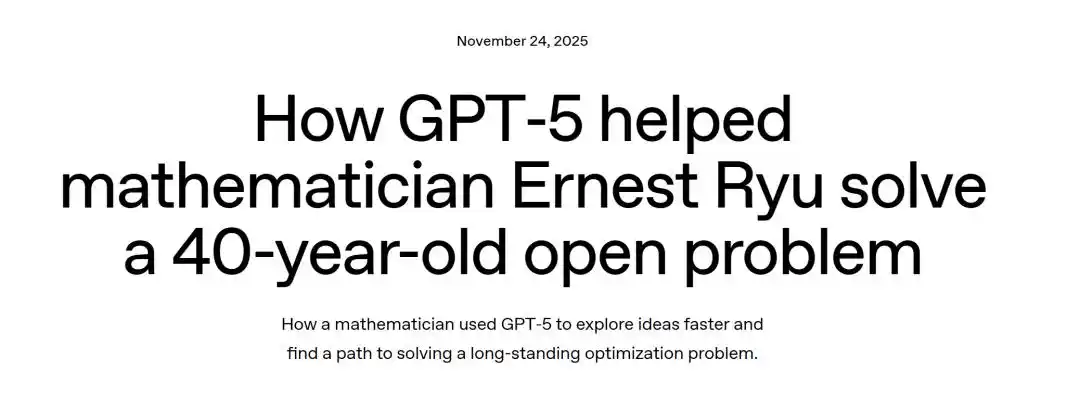
At this stage, AI was no longer just calculating answers; it began contributing key ideas.

Then, as time came to 2026, a series of major mathematical problems began to see breakthroughs.

Leading the charge with a bombshell was again OpenAI.

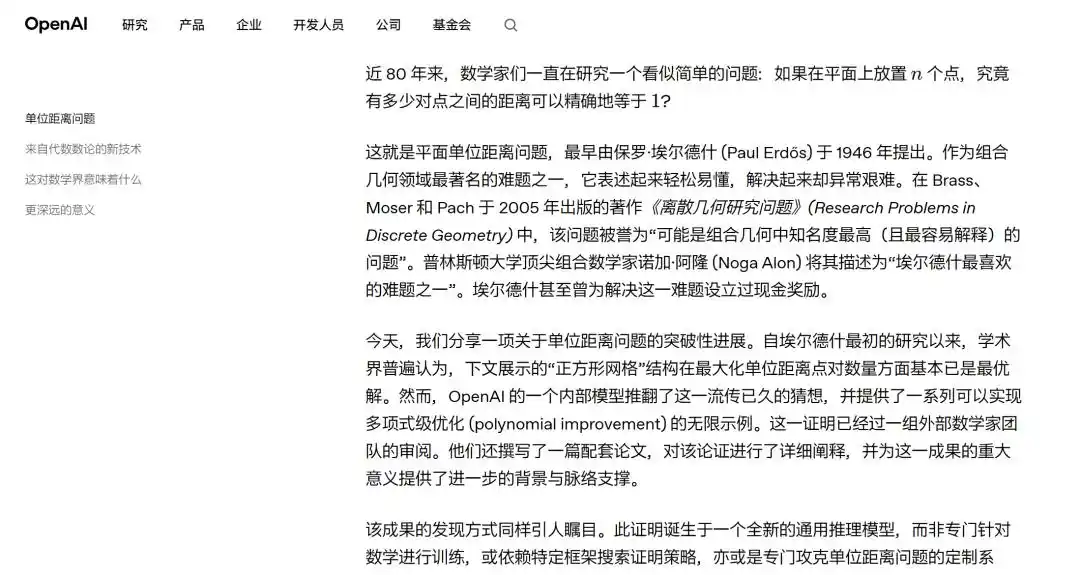
An internal general-purpose reasoning model set its sights on the Unit Distance Problem in the plane. Posed by mathematician Paul Erdős in 1946, it asks: given n points placed on a plane, what is the maximum number of pairs of points exactly distance 1 apart.

For nearly 80 years, the mathematical consensus was that constructions like square grids were near-optimal.

But the AI directly borrowed a set of tools from seemingly unrelated algebraic number theory, constructing an entirely new set of points, overturning this long-held conjecture.

The entire proof was subsequently verified by external mathematicians.

OpenAI stated that this was the first time a general-purpose AI autonomously solved an open problem of significant standing in a mathematical subfield.
Following closely, Anthropic also made its move.

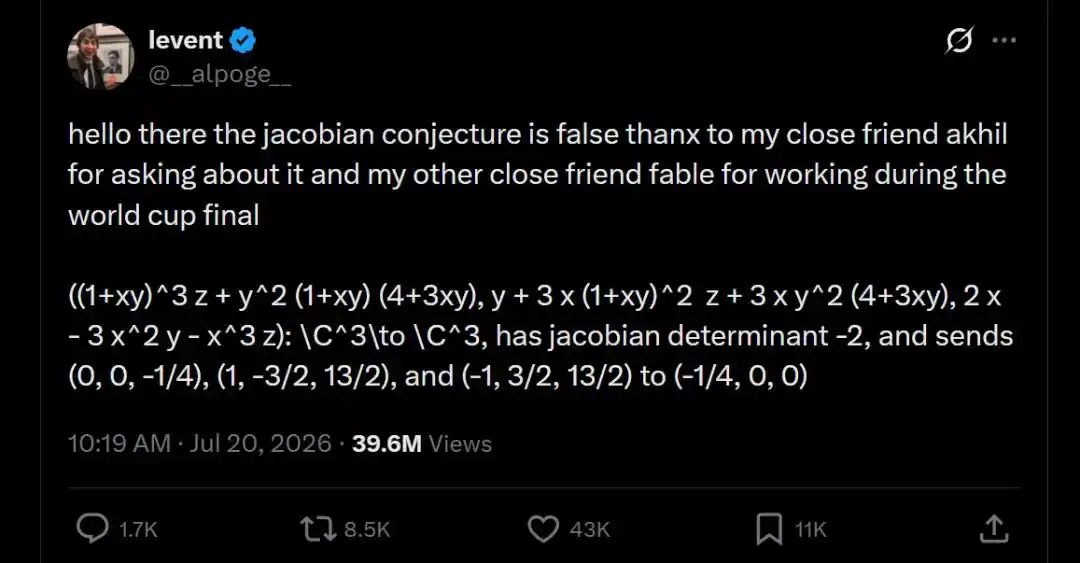
In July 2026, Anthropic mathematician Levent Alpöge, using Claude Fable 5, found an explicit counterexample to the Jacobian Conjecture.

A conjecture that had puzzled mathematicians for 87 years was thus disproven by AI overnight.
There were even instances of OpenAI and Anthropic joining forces.

Just a couple of days ago, GPT-5.6 and Fable 5 teamed up to solve a mathematical puzzle that had been open for 25 years.

(There are plenty of similar stories...)

But perhaps the most astonishing is Google, as DeepMind is turning such breakthroughs into an assembly line.

Its mathematical agent, Aletheia, no longer just generates one answer; it repeatedly proposes proofs, checks for flaws, refutes itself, and then searches for new paths.

DeepMind used it to scan 700 open problems in the Erdős conjecture database.

Among them, AI autonomously solved 4 unsolved problems and contributed to multiple mathematical results of publishable quality.

This attempt demonstrates that AI has begun systematically exploring the blank spaces in the mathematical world.

So it's not hard to imagine:

AI solving more major mathematical problems is truly just a matter of time.

From problem-solving to research, from reiterating known knowledge to proposing unknown answers, Move 37 in mathematics is being played one after another.

Searching for Humanity's Move 78

And facing this moment that is most likely approaching, humanity will undoubtedly confront a soul-searching question:

If AI will keep making novel moves humans have never considered, what should humanity do?

Move 78 from that decade-ago match might be the answer.

In the fourth match of the five-game series, Lee Sedol, having already lost three in a row, wedged a white stone into the center of AlphaGo's formation.

This move was also unconventional; AlphaGo estimated the probability of a human playing it at one in ten thousand.

Subsequently, the machine lost its composure.

Lee Sedol ultimately secured the only human victory, and Move 78 was thus dubbed the 'Hand of God' move.

This victory did not mean humans had overcome AI again.

But it at least showed that humans, after understanding the machine, could find a next step the machine did not anticipate.

This is precisely the lesson Move 78 leaves for today.

As AI becomes increasingly adept at providing answers, human value will shift more towards asking questions, judging direction, and deciding which answers are truly worth seeking.

Borrowing the concept of 'centaur chess' from chess, where human players cooperate with computer engines.

p.s. After IBM's 'Deep Blue' defeated human world champion Garry Kasparov in 1997, Kasparov advocated and organized the first 'Advanced Chess' (Centaur) tournament in 1998 to explore the potential of human-AI collaboration.

Hassabis believes science is entering a similar 'Centaur Era':

We are entering an era of collaboration between humans and computers. I don't know how long this cycle will last. But for very complex fields, it might be quite long. For instance, in drug discovery, biology, chemistry, etc., these fields are highly complex, dynamic, and not everything can be verified. That's where human intuition and insight are needed to decide the direction forward.

Subsequent developments in Go have proven this point.

After AlphaGo emerged, AI quickly became a review tool for professional players. Players could use AI to re-examine past joseki, discover which experiences were actually unreliable, and study new moves once deemed unreasonable.

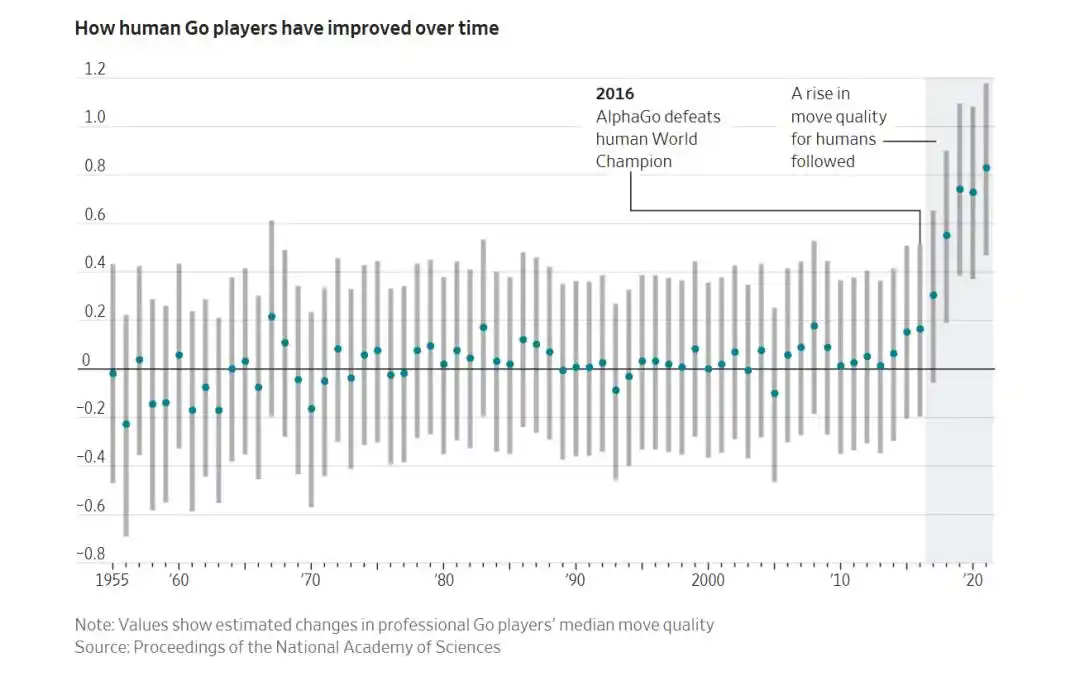
An analysis of over 5.8 million professional move decisions found:

After the advent of superhuman AI, the quality of human players' moves significantly improved, and novel moves also became more frequent.
However, there's another side to the story, namely:

People began relying on AI for answers, gradually losing the ability to judge the answers themselves.

As Lee Sedol said upon retiring, facing an undefeatable opponent made it hard for him to continue enjoying the Go he once loved.

This might be the most cautionary issue in the AI era.

As more fields beyond mathematics are impacted by AI, will more powerful systems make us more creative, efficient, and more human?

Or will they cause people to give up striving?

In the future, AI will keep playing Move 37.

The remaining question is, can humanity find its own Move 78.

Reference links:

[1]https://www.wsj.com/tech/ai/move-37-ai-demis-hassabis-google-deepmind-alphago-ec832a41?st=9XMAjn&reflink=desktopwebshare_permalink

[2]https://x.com/demishassabis/status/2085914742414061886

This article is from the WeChat public account "QbitAI", author: Focus on Frontier Technology

Crypto di tendenza

Domande pertinenti

QWhat is the significance of 'Move 37' in the context of AI development according to Demis Hassabis?

A'Move 37' refers to a groundbreaking move made by AlphaGo during its 2016 match against Lee Sedol, which defied centuries of established human intuition in Go. According to Demis Hassabis, it represents the moment AI demonstrated it could find novel solutions beyond human thinking, and he believes a similar level of breakthrough is imminent in mathematics, where AI could solve a Millennium Prize Problem.

QWhat major shift in AI's role in mathematics does the article describe between 2024 and 2026?

AThe article describes a shift from AI 'solving problems' (like achieving IMO gold-level performance) to AI 'conducting research' and contributing key novel ideas to solve long-standing open conjectures. Examples include AI disproving the Jacobian Conjecture in 2026 and autonomously tackling significant problems like the planar unit distance problem.

QWhat does the 'Move 78' from the AlphaGo-Lee Sedol match symbolize in the human-AI relationship?

A'Move 78', the unexpected move by Lee Sedol that led to his sole victory in the match, symbolizes the human ability to find novel paths even after understanding AI's capabilities. It represents the hope that humans, by collaborating with and learning from AI, can maintain their creative and strategic value by asking the right questions and finding unexpected solutions.

QWhat concept does Demis Hassabis use to describe the future of scientific discovery with AI?

ADemis Hassabis describes the future as entering a 'centaur era' for science, drawing a parallel to chess. This concept refers to an era of human-computer collaboration, where human intuition and insight are crucial for guiding direction in complex, less verifiable fields like drug discovery and biology, while AI handles vast computation and pattern recognition.

QAccording to the article, what is a potential risk of increasing reliance on powerful AI systems?

AA potential risk is that humans might become overly reliant on AI for answers, leading to a loss of independent judgment and the ability to critically evaluate solutions. The article cites Lee Sedol's retirement sentiment, where the dominance of an unbeatable AI opponent diminished his enjoyment of Go, illustrating how reliance could potentially stifle human motivation and creativity.

Letture associate

Stock Price Doubles Within the Year, Plummets 20% After Resumption, Baolai Medical's 'Chip Backdoor Listing' Script Ends

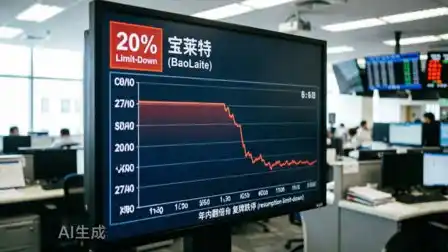
On August 10, 2026, BPL (300246.SZ) resumed trading after a nearly week-long suspension and immediately fell by a 20% limit-down. This plunge was triggered by the termination of a planned controlling stake transfer, dashing earlier market speculation. In January 2026, Zhejiang Quwei Zhihe Partnership entered as a significant shareholder, sparking hopes. Investors speculated that its backer, Weigu Information—a specialized "little giant" company in high-reliability solid-state storage chips—might be seeking a backdoor listing through BPL. This "cross-industry restructuring" expectation fueled a strong rally, with BPL's stock price more than doubling in 2026 prior to the halt. However, the deal was called off on August 7, directly causing the sharp sell-off. Underlying BPL's vulnerability is its fundamentally weak business. The company, a medical device firm, is mired in losses, having reported three consecutive years of net losses totaling over 200 million yuan. Its core hemodialysis business is squeezed by government procurement price cuts, while growth in its patient monitor segment has stalled. Furthermore, BPL faces imminent debt pressure with convertible bonds worth approximately 218 million yuan due in September 2026, and its current stock price is far below the conversion price. The failed control transfer may represent a delayed release of negative news, but BPL's core challenges remain: reversing operational losses and addressing its urgent liquidity crisis.

marsbit35 min fa

Stock Price Doubles Within the Year, Plummets 20% After Resumption, Baolai Medical's 'Chip Backdoor Listing' Script Ends

marsbit35 min fa

Moore Threads, Having Just Raised 8 Billion, Is Already Planning a Hong Kong IPO

On August 9th, Moore Threads announced plans for a Hong Kong IPO alongside a strong first-half 2026 earnings report. Listed on the Shanghai STAR Market in December 2025 as the "first domestic GPU stock," the company raised 8 billion yuan. Its stock price initially surged but has since fallen 40% from its peak. This decline followed market concerns over its use of substantial idle raised funds for low-risk financial products instead of promised projects. The company's H1 2026 revenue reached 1.74 billion yuan, a 147.4% year-over-year increase, already surpassing its full-year 2025 revenue. This growth is attributed to strong demand for AI and full-feature GPUs, particularly its Kuae AI computing clusters. Despite the revenue surge, Moore Threads remains unprofitable on a non-GAAP basis, with a net loss of 115 million yuan after adjustments. R&D and sales expenses grew significantly. The proposed Hong Kong listing aims to support its global strategy, attract international talent, and improve corporate governance, following the path of other Chinese tech firms pursuing dual listings. However, its港股 IPO valuation may face challenges as international investors could benchmark it against peers like Biren Technology, potentially demanding a discount. In summary, while Moore Threads is expanding rapidly and strategically seeking a港股 listing for global growth, it continues to face profitability challenges amid high costs and market skepticism about its capital allocation and valuation.

marsbit58 min fa

Moore Threads, Having Just Raised 8 Billion, Is Already Planning a Hong Kong IPO

marsbit58 min fa

Trading

Spot

Articoli Popolari

Cosa è $S$

Comprendere SPERO: Una Panoramica Completa Introduzione a SPERO Mentre il panorama dell'innovazione continua a evolversi, l'emergere delle tecnologie web3 e dei progetti di criptovaluta gioca un ruolo fondamentale nel plasmare il futuro digitale. Un progetto che ha attirato l'attenzione in questo campo dinamico è SPERO, denotato come SPERO,$$s$. Questo articolo mira a raccogliere e presentare informazioni dettagliate su SPERO, per aiutare gli appassionati e gli investitori a comprendere le sue basi, obiettivi e innovazioni nei domini web3 e crypto. Che cos'è SPERO,$$s$? SPERO,$$s$ è un progetto unico all'interno dello spazio crypto che cerca di sfruttare i principi della decentralizzazione e della tecnologia blockchain per creare un ecosistema che promuove l'impegno, l'utilità e l'inclusione finanziaria. Il progetto è progettato per facilitare interazioni peer-to-peer in modi nuovi, fornendo agli utenti soluzioni e servizi finanziari innovativi. Al suo interno, SPERO,$$s$ mira a responsabilizzare gli individui fornendo strumenti e piattaforme che migliorano l'esperienza dell'utente nello spazio delle criptovalute. Questo include la possibilità di metodi di transazione più flessibili, la promozione di iniziative guidate dalla comunità e la creazione di percorsi per opportunità finanziarie attraverso applicazioni decentralizzate (dApps). La visione sottostante di SPERO,$$s$ ruota attorno all'inclusività, cercando di colmare le lacune all'interno della finanza tradizionale mentre sfrutta i vantaggi della tecnologia blockchain. Chi è il Creatore di SPERO,$$s$? L'identità del creatore di SPERO,$$s$ rimane piuttosto oscura, poiché ci sono risorse pubblicamente disponibili limitate che forniscono informazioni dettagliate sul suo fondatore o fondatori. Questa mancanza di trasparenza può derivare dall'impegno del progetto per la decentralizzazione—un ethos che molti progetti web3 condividono, dando priorità ai contributi collettivi rispetto al riconoscimento individuale. Centrando le discussioni attorno alla comunità e ai suoi obiettivi collettivi, SPERO,$$s$ incarna l'essenza dell'empowerment senza mettere in evidenza individui specifici. Pertanto, comprendere l'etica e la missione di SPERO rimane più importante che identificare un creatore singolo. Chi sono gli Investitori di SPERO,$$s$? SPERO,$$s$ è supportato da una varietà di investitori che vanno dai capitalisti di rischio agli investitori angelici dedicati a promuovere l'innovazione nel settore crypto. Il focus di questi investitori generalmente si allinea con la missione di SPERO—dando priorità a progetti che promettono avanzamenti tecnologici sociali, inclusività finanziaria e governance decentralizzata. Queste fondazioni di investitori sono tipicamente interessate a progetti che non solo offrono prodotti innovativi, ma contribuiscono anche positivamente alla comunità blockchain e ai suoi ecosistemi. Il supporto di questi investitori rafforza SPERO,$$s$ come un concorrente degno di nota nel dominio in rapida evoluzione dei progetti crypto. Come Funziona SPERO,$$s$? SPERO,$$s$ impiega un framework multifunzionale che lo distingue dai progetti di criptovaluta convenzionali. Ecco alcune delle caratteristiche chiave che sottolineano la sua unicità e innovazione: Governance Decentralizzata: SPERO,$$s$ integra modelli di governance decentralizzati, responsabilizzando gli utenti a partecipare attivamente ai processi decisionali riguardanti il futuro del progetto. Questo approccio favorisce un senso di proprietà e responsabilità tra i membri della comunità. Utilità del Token: SPERO,$$s$ utilizza il proprio token di criptovaluta, progettato per servire varie funzioni all'interno dell'ecosistema. Questi token abilitano transazioni, premi e la facilitazione dei servizi offerti sulla piattaforma, migliorando l'impegno e l'utilità complessivi. Architettura Stratificata: L'architettura tecnica di SPERO,$$s$ supporta la modularità e la scalabilità, consentendo un'integrazione fluida di funzionalità e applicazioni aggiuntive man mano che il progetto evolve. Questa adattabilità è fondamentale per mantenere la rilevanza nel panorama crypto in continua evoluzione. Coinvolgimento della Comunità: Il progetto enfatizza iniziative guidate dalla comunità, impiegando meccanismi che incentivano la collaborazione e il feedback. Nutrendo una comunità forte, SPERO,$$s$ può affrontare meglio le esigenze degli utenti e adattarsi alle tendenze di mercato. Focus sull'Inclusione: Offrendo basse commissioni di transazione e interfacce user-friendly, SPERO,$$s$ mira ad attrarre una base utenti diversificata, inclusi individui che potrebbero non aver precedentemente interagito nello spazio crypto. Questo impegno per l'inclusione si allinea con la sua missione generale di empowerment attraverso l'accessibilità. Cronologia di SPERO,$$s$ Comprendere la storia di un progetto fornisce preziose intuizioni sulla sua traiettoria di sviluppo e sui traguardi. Di seguito è riportata una cronologia suggerita che mappa eventi significativi nell'evoluzione di SPERO,$$s$: Fase di Concettualizzazione e Ideazione: Le idee iniziali che formano la base di SPERO,$$s$ sono state concepite, allineandosi strettamente con i principi di decentralizzazione e focus sulla comunità all'interno dell'industria blockchain. Lancio del Whitepaper del Progetto: Dopo la fase concettuale, è stato rilasciato un whitepaper completo che dettaglia la visione, gli obiettivi e l'infrastruttura tecnologica di SPERO,$$s$ per suscitare interesse e feedback dalla comunità. Costruzione della Comunità e Prime Interazioni: Sono stati effettuati sforzi attivi di outreach per costruire una comunità di early adopters e potenziali investitori, facilitando discussioni attorno agli obiettivi del progetto e ottenendo supporto. Evento di Generazione del Token: SPERO,$$s$ ha condotto un evento di generazione del token (TGE) per distribuire i propri token nativi ai primi sostenitori e stabilire una liquidità iniziale all'interno dell'ecosistema. Lancio della Prima dApp: La prima applicazione decentralizzata (dApp) associata a SPERO,$$s$ è stata attivata, consentendo agli utenti di interagire con le funzionalità principali della piattaforma. Sviluppo Continuo e Partnership: Aggiornamenti e miglioramenti continui alle offerte del progetto, inclusi partnership strategiche con altri attori nello spazio blockchain, hanno plasmato SPERO,$$s$ in un concorrente competitivo e in evoluzione nel mercato crypto. Conclusione SPERO,$$s$ rappresenta una testimonianza del potenziale del web3 e delle criptovalute di rivoluzionare i sistemi finanziari e responsabilizzare gli individui. Con un impegno per la governance decentralizzata, il coinvolgimento della comunità e funzionalità progettate in modo innovativo, apre la strada verso un panorama finanziario più inclusivo. Come per qualsiasi investimento nello spazio crypto in rapida evoluzione, si incoraggiano potenziali investitori e utenti a ricercare approfonditamente e a impegnarsi in modo riflessivo con gli sviluppi in corso all'interno di SPERO,$$s$. Il progetto mostra lo spirito innovativo dell'industria crypto, invitando a ulteriori esplorazioni delle sue innumerevoli possibilità. Mentre il percorso di SPERO,$$s$ è ancora in fase di sviluppo, i suoi principi fondamentali potrebbero effettivamente influenzare il futuro di come interagiamo con la tecnologia, la finanza e tra di noi in ecosistemi digitali interconnessi.

298 Totale visualizzazioniPubblicato il 2024.12.17Aggiornato il 2024.12.17

Cosa è $S$

Cosa è AGENT S

Agent S: Il Futuro dell'Interazione Autonoma in Web3 Introduzione Nel panorama in continua evoluzione di Web3 e criptovalute, le innovazioni stanno costantemente ridefinendo il modo in cui gli individui interagiscono con le piattaforme digitali. Uno di questi progetti pionieristici, Agent S, promette di rivoluzionare l'interazione uomo-computer attraverso il suo framework agentico aperto. Aprendo la strada a interazioni autonome, Agent S mira a semplificare compiti complessi, offrendo applicazioni trasformative nell'intelligenza artificiale (AI). Questa esplorazione dettagliata approfondirà le complessità del progetto, le sue caratteristiche uniche e le implicazioni per il dominio delle criptovalute. Cos'è Agent S? Agent S si presenta come un innovativo framework agentico aperto, progettato specificamente per affrontare tre sfide fondamentali nell'automazione dei compiti informatici: Acquisizione di Conoscenze Specifiche del Dominio: Il framework apprende in modo intelligente da varie fonti di conoscenza esterne ed esperienze interne. Questo approccio duale gli consente di costruire un ricco repository di conoscenze specifiche del dominio, migliorando le sue prestazioni nell'esecuzione dei compiti. Pianificazione su Lungo Orizzonte di Compiti: Agent S impiega una pianificazione gerarchica potenziata dall'esperienza, un approccio strategico che facilita la suddivisione e l'esecuzione efficiente di compiti complessi. Questa caratteristica migliora significativamente la sua capacità di gestire più sottocompiti in modo efficiente ed efficace. Gestione di Interfacce Dinamiche e Non Uniformi: Il progetto introduce l'Interfaccia Agente-Computer (ACI), una soluzione innovativa che migliora l'interazione tra agenti e utenti. Utilizzando Modelli Linguistici Multimodali di Grandi Dimensioni (MLLM), Agent S può navigare e manipolare senza sforzo diverse interfacce grafiche utente. Attraverso queste caratteristiche pionieristiche, Agent S fornisce un framework robusto che affronta le complessità coinvolte nell'automazione dell'interazione umana con le macchine, preparando il terreno per innumerevoli applicazioni nell'AI e oltre. Chi è il Creatore di Agent S? Sebbene il concetto di Agent S sia fondamentalmente innovativo, informazioni specifiche sul suo creatore rimangono elusive. Il creatore è attualmente sconosciuto, il che evidenzia sia la fase embrionale del progetto sia la scelta strategica di mantenere i membri fondatori sotto anonimato. Indipendentemente dall'anonimato, l'attenzione rimane sulle capacità e sul potenziale del framework. Chi sono gli Investitori di Agent S? Poiché Agent S è relativamente nuovo nell'ecosistema crittografico, informazioni dettagliate riguardanti i suoi investitori e sostenitori finanziari non sono documentate esplicitamente. La mancanza di approfondimenti pubblicamente disponibili sulle fondazioni di investimento o sulle organizzazioni che supportano il progetto solleva interrogativi sulla sua struttura di finanziamento e sulla roadmap di sviluppo. Comprendere il supporto è cruciale per valutare la sostenibilità del progetto e il suo potenziale impatto sul mercato. Come Funziona Agent S? Al centro di Agent S si trova una tecnologia all'avanguardia che gli consente di funzionare efficacemente in contesti diversi. Il suo modello operativo è costruito attorno a diverse caratteristiche chiave: Interazione Uomo-Computer Simile a Quella Umana: Il framework offre una pianificazione AI avanzata, cercando di rendere le interazioni con i computer più intuitive. Mimando il comportamento umano nell'esecuzione dei compiti, promette di elevare le esperienze degli utenti. Memoria Narrativa: Utilizzata per sfruttare esperienze di alto livello, Agent S utilizza la memoria narrativa per tenere traccia delle storie dei compiti, migliorando così i suoi processi decisionali. Memoria Episodica: Questa caratteristica fornisce agli utenti una guida passo-passo, consentendo al framework di offrire supporto contestuale mentre i compiti si sviluppano. Supporto per OpenACI: Con la capacità di funzionare localmente, Agent S consente agli utenti di mantenere il controllo sulle proprie interazioni e flussi di lavoro, allineandosi con l'etica decentralizzata di Web3. Facile Integrazione con API Esterne: La sua versatilità e compatibilità con varie piattaforme AI garantiscono che Agent S possa adattarsi senza problemi agli ecosistemi tecnologici esistenti, rendendolo una scelta attraente per sviluppatori e organizzazioni. Queste funzionalità contribuiscono collettivamente alla posizione unica di Agent S all'interno dello spazio crittografico, poiché automatizza compiti complessi e multi-fase con un intervento umano minimo. Man mano che il progetto evolve, le sue potenziali applicazioni in Web3 potrebbero ridefinire il modo in cui si svolgono le interazioni digitali. Cronologia di Agent S Lo sviluppo e le tappe di Agent S possono essere riassunti in una cronologia che evidenzia i suoi eventi significativi: 27 Settembre 2024: Il concetto di Agent S è stato lanciato in un documento di ricerca completo intitolato “Un Framework Agentico Aperto che Usa i Computer Come un Umano”, mostrando le basi per il progetto. 10 Ottobre 2024: Il documento di ricerca è stato reso pubblicamente disponibile su arXiv, offrendo un'esplorazione approfondita del framework e della sua valutazione delle prestazioni basata sul benchmark OSWorld. 12 Ottobre 2024: È stata rilasciata una presentazione video, fornendo un'idea visiva delle capacità e delle caratteristiche di Agent S, coinvolgendo ulteriormente potenziali utenti e investitori. Questi indicatori nella cronologia non solo illustrano i progressi di Agent S, ma indicano anche il suo impegno per la trasparenza e il coinvolgimento della comunità. Punti Chiave su Agent S Man mano che il framework Agent S continua a evolversi, diversi attributi chiave si distinguono, sottolineando la sua natura innovativa e il potenziale: Framework Innovativo: Progettato per fornire un uso intuitivo dei computer simile all'interazione umana, Agent S porta un approccio nuovo all'automazione dei compiti. Interazione Autonoma: La capacità di interagire autonomamente con i computer attraverso GUI segna un passo avanti verso soluzioni informatiche più intelligenti ed efficienti. Automazione di Compiti Complessi: Con la sua metodologia robusta, può automatizzare compiti complessi e multi-fase, rendendo i processi più veloci e meno soggetti a errori. Miglioramento Continuo: I meccanismi di apprendimento consentono ad Agent S di migliorare dalle esperienze passate, migliorando continuamente le sue prestazioni e la sua efficacia. Versatilità: La sua adattabilità attraverso diversi ambienti operativi come OSWorld e WindowsAgentArena garantisce che possa servire un'ampia gamma di applicazioni. Man mano che Agent S si posiziona nel panorama di Web3 e delle criptovalute, il suo potenziale per migliorare le capacità di interazione e automatizzare i processi segna un significativo avanzamento nelle tecnologie AI. Attraverso il suo framework innovativo, Agent S esemplifica il futuro delle interazioni digitali, promettendo un'esperienza più fluida ed efficiente per gli utenti in vari settori. Conclusione Agent S rappresenta un audace passo avanti nell'unione tra AI e Web3, con la capacità di ridefinire il modo in cui interagiamo con la tecnologia. Sebbene sia ancora nelle sue fasi iniziali, le possibilità per la sua applicazione sono vaste e coinvolgenti. Attraverso il suo framework completo che affronta sfide critiche, Agent S mira a portare le interazioni autonome al centro dell'esperienza digitale. Man mano che ci addentriamo nei regni delle criptovalute e della decentralizzazione, progetti come Agent S giocheranno senza dubbio un ruolo cruciale nel plasmare il futuro della tecnologia e della collaborazione uomo-computer.

735 Totale visualizzazioniPubblicato il 2025.01.14Aggiornato il 2025.01.14

Cosa è AGENT S

Come comprare S

Benvenuto in HTX.com! Abbiamo reso l'acquisto di Sonic (S) semplice e conveniente. Segui la nostra guida passo passo per intraprendere il tuo viaggio nel mondo delle criptovalute.Step 1: Crea il tuo Account HTXUsa la tua email o numero di telefono per registrarti il tuo account gratuito su HTX. Vivi un'esperienza facile e sblocca tutte le funzionalità,Crea il mio accountStep 2: Vai in Acquista crypto e seleziona il tuo metodo di pagamentoCarta di credito/debito: utilizza la tua Visa o Mastercard per acquistare immediatamente SonicS.Bilancio: Usa i fondi dal bilancio del tuo account HTX per fare trading senza problemi.Terze parti: abbiamo aggiunto metodi di pagamento molto utilizzati come Google Pay e Apple Pay per maggiore comodità.P2P: Fai trading direttamente con altri utenti HTX.Over-the-Counter (OTC): Offriamo servizi su misura e tassi di cambio competitivi per i trader.Step 3: Conserva Sonic (S)Dopo aver acquistato Sonic (S), conserva nel tuo account HTX. In alternativa, puoi inviare tramite trasferimento blockchain o scambiare per altre criptovalute.Step 4: Scambia Sonic (S)Scambia facilmente Sonic (S) nel mercato spot di HTX. Accedi al tuo account, seleziona la tua coppia di trading, esegui le tue operazioni e monitora in tempo reale. Offriamo un'esperienza user-friendly sia per chi ha appena iniziato che per i trader più esperti.

1.5k Totale visualizzazioniPubblicato il 2025.01.15Aggiornato il 2026.06.02

Come comprare S

Discussioni

Benvenuto nella Community HTX. Qui puoi rimanere informato sugli ultimi sviluppi della piattaforma e accedere ad approfondimenti esperti sul mercato. Le opinioni degli utenti sul prezzo di S S sono presentate come di seguito.

活动图片