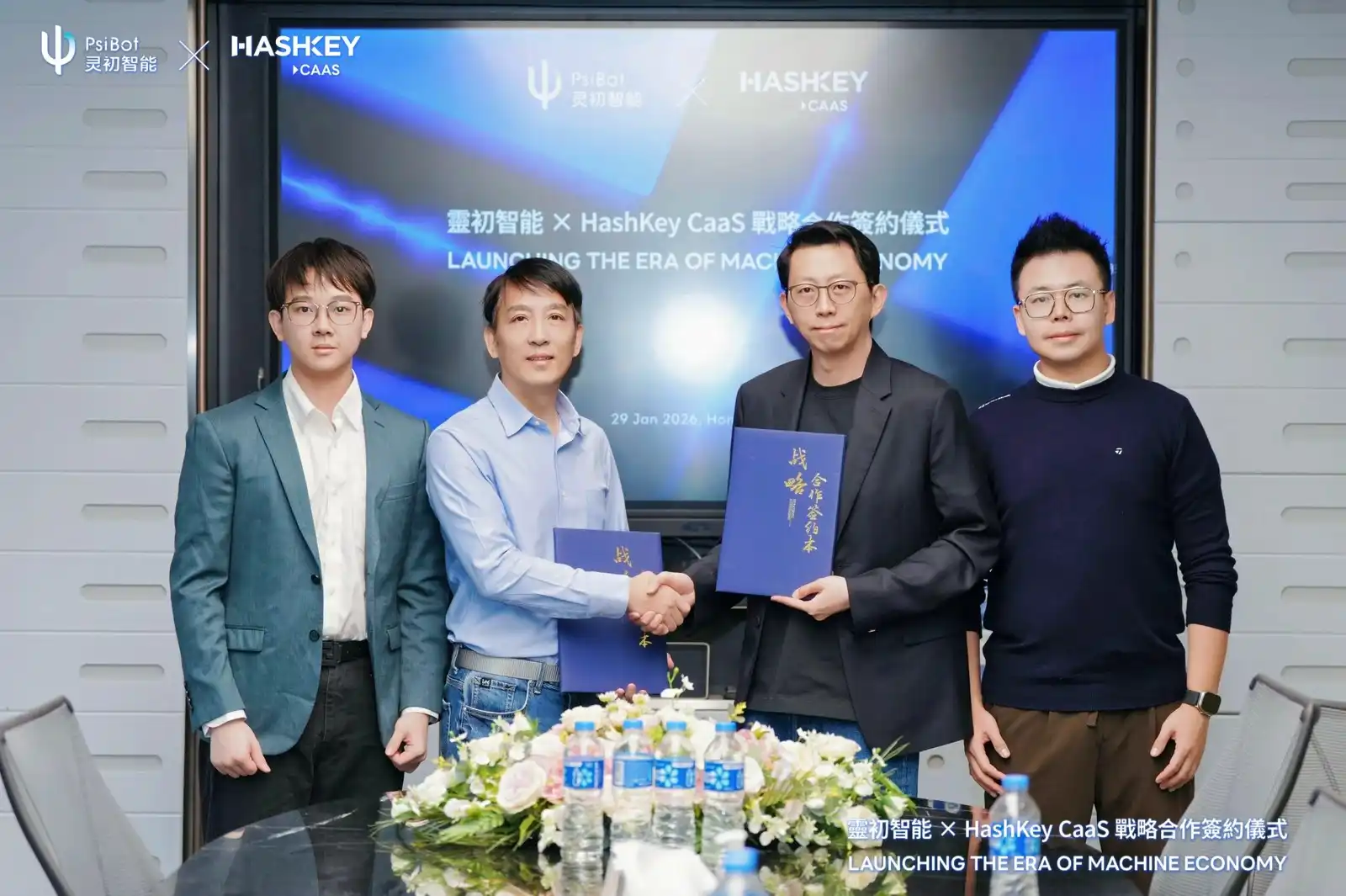
HashKey CaaS and Lingchu Intelligence Form Strategic Partnership to Jointly Build AI Autonomous Payment Infrastructure

marsbitPubblicato 2026-01-29Pubblicato ultima volta 2026-01-29

Introduzione

HashKey CaaS and Lingchu Intelligence have entered into a strategic partnership to jointly develop AI autonomous payment infrastructure. The collaboration will focus on data tokenization for robots and the implementation of the HP2 (HashKey Payment Protocol) autonomous payment network, aiming to integrate AI with the digital financial system and build key infrastructure for the embodied intelligence economy. As part of the agreement, Lingchu will deploy 10 dual-arm robots integrated with HashKey CaaS’s HP2 payment protocol, designed for Web3 and AI agents. These robots will gain controlled payment permissions, enabling them to act as autonomous agents to conduct on-chain transactions—such as purchasing services, accessing data interfaces, and earning on-chain income through task execution. Each autonomous transaction will be recorded as an auditable on-chain financial record, transforming the robots from mere smart devices into independent participants in the digital economy. Additionally, HashKey CaaS will tokenize the operational data generated by Lingchu’s robots, turning them into tradable digital assets with monetary value. HashKey’s CEO of On-Chain Business Group, Li Chen, stated that this partnership marks the first application of the HP2 protocol in embodied AI, supporting the integration of robots into the digital financial ecosystem. Wang Qibin, CEO of Lingchu Intelligence, emphasized that the collaboration will help accelerate the transition from R&D to an ecosy...

HashKey CaaS has announced a strategic partnership with Lingchu Intelligence, a robotics company focused on the field of embodied AI. The two parties will engage in in-depth collaboration around robot data tokenization and the HP2 (HashKey Payment Protocol) autonomous payment network, promoting the integration of AI and the digital financial system, and jointly building the key infrastructure for the embodied intelligent economy.

As part of this collaboration, Lingchu Intelligence will deploy 10 dual-arm robots and integrate them with HashKey CaaS's HP2 payment protocol, which is specifically designed for Web3 and AI Agents. Through HP2, the robots will gain controlled payment permissions, enabling them to perform on-chain interactions as "autonomous agents," including autonomously purchasing services, calling data interfaces, and earning on-chain revenue by executing tasks. Throughout this process, every autonomous transaction generated by the robots will be fully recorded as auditable on-chain financial credentials, transforming the robots from traditional "intelligent devices" into genuine "digital economic entities" capable of independently participating in economic activities.

Simultaneously, HashKey CaaS will convert the operational data generated by Lingchu Intelligence's robots during actual operation into tradable tokenized digital assets, endowing "robot data" with asset attributes and transactional value.

Li Chen, CEO of HashKey On-Chain Business Group, stated: "This collaboration marks the first application of the HP2 protocol in the field of embodied AI. HashKey CaaS's on-chain new financial infrastructure will support robots and AI in truly integrating into the digital financial system, achieving autonomous on-chain data transactions and value circulation, and laying the foundation for embodied intelligence to participate in the real economy."

Wang Qibin, CEO of Lingchu Intelligence, stated: "The widespread application of embodied intelligence relies on the confirmation of data value and an automated value exchange system. Through the partnership with HashKey, Lingchu Intelligence will accelerate its transition from technological research and development to ecosystem development oriented towards the machine economy."

In the future, the two parties will continue to explore more applications of embodied intelligence in scenarios such as payment and autonomous services, accelerate the implementation of related technologies and models, and promote the shift of the AI economy from conceptual validation to large-scale practice.


Domande pertinenti

QWhat is the strategic partnership between HashKey CaaS and Lingchu AI about?

AThe strategic partnership between HashKey CaaS and Lingchu AI focuses on robot data tokenization and the HP2 (HashKey Payment Protocol) autonomous payment network. They aim to integrate AI with the digital financial system and build key infrastructure for the embodied intelligent economy.

QHow many robots will Lingchu AI deploy as part of this collaboration?

ALingchu AI will deploy 10 dual-arm robots as part of this collaboration.

QWhat is the HP2 payment protocol designed for?

AThe HP2 payment protocol is designed for Web3 and AI Agents, enabling robots to have controlled payment permissions, act as autonomous agents for on-chain interactions, purchase services, call data interfaces, and earn on-chain income through task execution.

QHow will HashKey CaaS utilize the operational data from Lingchu AI's robots?

AHashKey CaaS will convert the operational data generated by Lingchu AI's robots into tokenized digital assets, giving the data asset attributes and transactional value.

QWhat did HashKey's On-Chain Business Group CEO, Li Chen, say about this partnership?

ALi Chen stated that this partnership is the first application of the HP2 protocol in the embodied intelligence field. HashKey CaaS's on-chain financial infrastructure will support robots and AI in integrating into the digital financial system, enabling autonomous on-chain data settlement and value transfer, laying the foundation for embodied intelligence to participate in the real economy.

Letture associate

The Verdict in Choi Tae-won's Divorce Case: Revealing the Inheritance Undercurrent Behind SK Hynix's Trillion-Won Empire

SK Group Chairman Chey Tae-won's high-profile divorce case, involving a record 1.38 trillion won settlement, has drawn attention to the succession plans for Korea's second-largest conglomerate, especially its crown jewel, SK hynix. Unlike traditional chaebol scripts centered on the eldest son, Chey's three children from his marriage to former President Roh Tae-woo's daughter, Roh Soh-yeong, are carving distinct, non-traditional paths. Eldest daughter Chey Yun-jung (b. 1989) is seen as the most evident successor. With a scientific and consulting background, she holds executive roles at SK bioscience and SK Inc.'s growth support department, focusing on future strategy and biopharma. Her marriage is to an AI infrastructure entrepreneur, not a traditional business alliance. Second daughter Chey Min-jung (b. 1991) took a unique route, voluntarily serving as a South Korean naval officer, including an anti-piracy deployment. She later worked on policy and strategy for SK hynix in Washington D.C. before co-founding an AI-driven healthcare startup. She married a former U.S. Marine Corps officer, connecting her to U.S. defense and policy circles—networks crucial for a global semiconductor giant. The only son, Chey In-geun (b. 1995), who studied physics like his father, worked briefly at SK E&S before joining McKinsey. Despite fitting the traditional "heir" profile as the eldest son, he remains silent and holds no public position or shares in SK, suggesting the old succession playbook is obsolete. As SK hynix's valuation soars, becoming a geopolitical asset in the AI era, the heirs' legitimacy is no longer automatic. They must prove themselves in fields like AI biotech, global policy, and strategic consulting. Their marriages also reflect new elite networks in tech and defense, not old political alliances. Their inheritance is the complex challenge of navigating a globalized, tech-driven world, not just a corporate throne.

marsbit10 h fa

The Verdict in Choi Tae-won's Divorce Case: Revealing the Inheritance Undercurrent Behind SK Hynix's Trillion-Won Empire

marsbit10 h fa

From OpenSea to OpenRouter: Is Alex Atallah Repeating His 'Exit at the Peak' Playbook?

From OpenSea to OpenRouter: Is Alex Atallah Repeating His "Exit at the Peak" Playbook? According to the Wall Street Journal, payments giant Stripe is in talks to acquire the AI model aggregation platform OpenRouter in a potential deal valuing the company near $100 billion. This would mark founder Alex Atallah's second creation of a company reaching a $100 billion valuation, following his co-founding of NFT marketplace OpenSea. OpenRouter, founded just over three years ago, has grown rapidly by acting as a unified gateway for developers to access over 400 AI models. It currently has about 10 million users and processes over 200 trillion tokens monthly. While the platform's annualized revenue is around $50 million, its valuation has skyrocketed from $1.3 billion in March 2026. The potential acquisition by Stripe, a company OpenRouter's founder once likened it to, represents a major expansion into AI infrastructure for the payments leader. This move echoes Atallah's previous timing with OpenSea, where he departed before the NFT market's significant downturn. For OpenRouter, selling now may be strategic. Despite its scale, its business model—charging a 5-5.5% fee on AI inference calls—faces pressure from competition, open-source models, and potential price wars among model providers, limiting its profitability narrative for an IPO. A key asset for potential acquirers like Stripe is OpenRouter's vast repository of real-world AI usage data, which offers unique insights into model performance and developer preferences that are difficult to replicate. Whether this potential deal signifies a new valuation benchmark for AI infrastructure or another market peak signal remains to be seen.

链捕手11 h fa

From OpenSea to OpenRouter: Is Alex Atallah Repeating His 'Exit at the Peak' Playbook?

链捕手11 h fa

Trading

Spot
活动图片




