Has the Supercycle Really Arrived? Fidelity's View on the 2026 Crypto Market

比推Pubblicato 2026-01-06Pubblicato ultima volta 2026-01-06

Introduzione

Fidelity's 2026 crypto market outlook explores the possibility of a sustained "super cycle" driven by growing institutional and governmental adoption. Key trends include more nations, like the U.S. and Kyrgyzstan, officially adding cryptocurrencies to their strategic reserves, and corporations increasingly holding digital assets on their balance sheets. While historical four-year cycles suggest potential near-term volatility, some analysts argue that new demand could dampen extreme downturns. Fidelity’s Chris Kuiper notes that short-term investors should remain cautious, but long-term holders may still find value, especially if Bitcoin continues to serve as a non-inflationary store of value. The market's structure is shifting toward mainstream acceptance, though cyclical patterns may persist.

Author: Fidelity Investments

Compiled by: Nicky, Foresight News

Original Title: Fidelity's 2026 Crypto Market Outlook: We May Be Entering a Supercycle, the Bull Market Will Last for Years


TL;DR:

Investors looking to enter the market with the expectation of short-term gains should perhaps be cautious. However, those planning to hold for the long term may not have missed the opportunity yet. This year, more governments and corporations worldwide have incorporated digital assets into their balance sheets. Due to this new demand, some investors believe the traditional four-year cycle of cryptocurrency may have come to an end.

In March, President Trump signed an executive order to establish a strategic Bitcoin reserve for the U.S. government. The order formally designates all Bitcoin currently held by the government, along with several other cryptocurrencies, as reserve assets.

While the full impact of this executive order remains to be seen, 2025 made one thing clear: cryptocurrency is gaining mainstream acceptance. It is no longer viewed merely as a volatile form of gambling conducted by "degens" (an abbreviation for "degenerate," a term cryptocurrency traders use to describe themselves due to the market's wild nature and the mindset required to survive in it), but is now recognized by the U.S. government as a store of value.

What does this mean for the cryptocurrency market as we step into 2026? Does the significant price correction we are currently witnessing mean the bull market is over? Is it too late to invest in cryptocurrency now? Here are several key trends to watch.

Will More Countries Adopt Crypto Reserves?

Many countries around the world currently hold some amount of cryptocurrency, but few have formally established crypto reserves—meaning they designate their cryptocurrency holdings as financial assets serving a strategic national interest.

This began to change in 2025 (the most notable example being President Trump's executive order in March) and is likely to continue advancing in 2026.

For example, in September, Kyrgyzstan passed a bill to establish its own cryptocurrency reserve. Elsewhere, more countries are beginning to explore this possibility. Brazil's Congress recently advanced a bill that would allow up to 5% of the country's international reserves to be held in Bitcoin (though it remains to be seen whether this bill will become law).

"Fidelity Digital Assets believes that more countries may purchase Bitcoin in the future, driven by game theory," said Chris Kuiper, Vice President of Research at Fidelity Digital Assets. "If more countries include Bitcoin as part of their foreign exchange reserves, other nations may feel competitive pressure, increasing the likelihood they will do the same."

What does this mean for prices? "From a simple supply and demand economics perspective, any additional demand for Bitcoin could push prices higher," Kuiper said. "Of course, the key lies in how large the incremental demand is and whether other investors are selling or holding."

Will Corporations Continue to Buy Cryptocurrency?

Governments are not the only potential source of new demand in 2026. Corporations are likely to participate increasingly—some of which began incorporating Bitcoin and other cryptocurrencies into their balance sheets in 2025. To date, the most watched example is software and analytics company Strategy (formerly MicroStrategy, stock ticker MSTR), which has been steadily buying Bitcoin since 2020. However, this year more companies adopted this practice, turning it into a trend. As of November, well over 100 publicly traded companies (including domestic and international firms) hold cryptocurrency. About 50 of these companies currently hold over 1 million Bitcoins.

"There is clearly an arbitrage opportunity where some companies can leverage their market position or financing channels to raise funds for purchasing Bitcoin," Kuiper said. "Part of this stems from investment mandates, as well as geographical and regulatory issues. For example, investors who cannot buy Bitcoin directly might choose to gain exposure through these companies or the securities they issue."

On the surface, corporate purchases of cryptocurrency increase market demand, which helps drive up asset prices. But investors should also be aware of the risks. "If these companies choose or are forced to sell some of their digital assets—for instance, during a bear market—this could certainly create downward pressure on the price of the Bitcoin or other digital assets they hold," Kuiper noted.
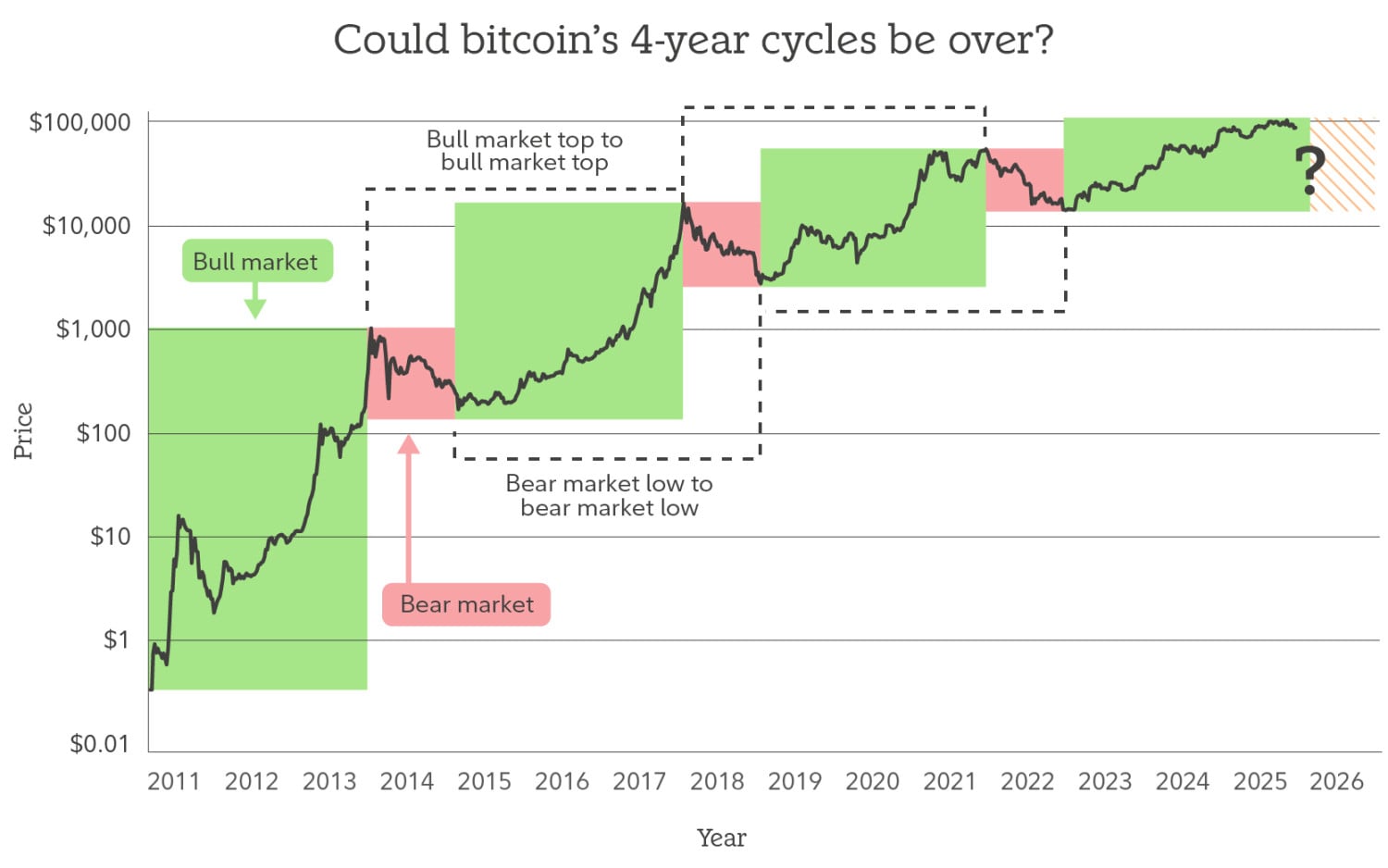
Source: Fidelity Investments. Past performance is not a reliable indicator of future results.

Will the Four-Year Cycle End?

Compared to traditional investments like stocks and bonds, Bitcoin's history is relatively short, but its price has roughly followed a four-year cycle (from bull market peak to peak, or from bear market bottom to bottom). It reached bull market peaks in November 2013, December 2017, and November 2021, and formed bear market bottoms in January 2015, December 2018, and November 2022. These cycles were accompanied by significant price volatility: the first cycle fell from $1,150 to $152, the second from $19,800 to $3,200, and the third from $69,000 to $15,500.

Bitcoin's movements often lead the entire cryptocurrency market to follow—in many cases, with even more剧烈 volatility.

Currently, we are at roughly the four-year mark of the current cycle, as the last bull market peaked in November 2021. And over the past month, cryptocurrency prices have continued to fall. So, has this bull market already peaked?

If the four-year cycle repeats, we might be at or near the end of Bitcoin's current bull run. However, some cryptocurrency investors believe this historical trend is about to end, and the current price pullback is merely a temporary retreat before the market resumes its upward trend.

What does this mean specifically? Some investors believe that while price pullbacks will still occur, the volatility of any declines will be far less than in the past, and the magnitude may be so small that it doesn't feel like a full bear market. Others think we may be entering a supercycle where the bull market lasts for years. For reference, the supercycle in commodities in the 2000s lasted nearly a decade.

Kuiper does not believe these cycles will disappear entirely, as the fear and greed that drive them haven't magically vanished. But he points out that if the four-year cycle were to repeat, we should have already hit the cycle's all-time high and entered a full bear market. Although the correction since November has been quite severe so far, he says we might not know for sure until 2026 whether a true four-year cycle has formed. The current price drop could be the start of a new bear market, or it could just be a correction within a bull market that will see new all-time highs again in the future—as we've already seen several times in this cycle.

Whether these predictions will come true remains to be seen, and we might not know until mid-2026.

Is It Too Late to Buy Bitcoin Now?

Despite the many uncertainties still present in the cryptocurrency market, one thing has become clearer: the crypto market is entering a new paradigm. "We are seeing a fundamental shift in the structure and categories of investors, and I believe this will continue into 2026," Kuiper said. "Traditional fund managers and investors have started buying Bitcoin and other digital assets, but in terms of the amount of capital they could bring into this space, I think we've only scratched the surface."

In light of this, investors who haven't yet entered the market might ask: Is it still a good time to buy Bitcoin now?

For Kuiper, it depends on your investment horizon. If you are looking to realize gains in the short or medium term (four to five years or less), you might be late, especially if this cycle ultimately follows historical patterns.

"However, from a very long-term perspective, I personally believe that if you view Bitcoin as a store of value, you are never fundamentally 'too late'," Kuiper said. "As long as its hard supply cap remains unchanged, I believe every purchase of Bitcoin is an act of putting your labor or savings into something that will not be devalued by government monetary policy inflation."


Twitter:https://twitter.com/BitpushNewsCN

Bitpush TG Discussion Group:https://t.me/BitPushCommunity

Bitpush TG Subscription: https://t.me/bitpush

Original link:https://www.bitpush.news/articles/7600402

Domande pertinenti

QAccording to Fidelity's 2026 crypto market outlook, what is the potential impact of more countries adopting cryptocurrency reserves?

AFidelity believes that if more countries adopt Bitcoin as part of their foreign exchange reserves, it could create competitive pressure for others to follow, potentially increasing demand and driving up prices due to simple supply and demand economics.

QWhat does Fidelity suggest about the traditional four-year cycle of Bitcoin and the possibility of a 'super cycle'?

AFidelity's Chris Kuiper notes that while the four-year cycle might not disappear entirely due to persistent fear and greed, some investors believe we might be entering a 'super cycle' where the bull market lasts for years, with less severe pullbacks than in the past.

QHow does Fidelity view the current trend of corporations adding cryptocurrencies to their balance sheets?

AFidelity sees corporations increasingly adding crypto to their balance sheets, which adds to market demand and could push prices higher. However, they caution that forced sales during bear markets could create downward pressure on prices.

QWhat is Fidelity's perspective on whether it's too late to invest in Bitcoin in 2026?

AFidelity states that for short-term gains, investors might be late if the cycle follows historical patterns. But for long-term holders viewing Bitcoin as a store of value, it's never fundamentally 'too late' due to its hard supply cap protecting against inflationary monetary policies.

QWhat key shift in investor structure does Fidelity identify for the crypto market in 2026?

AFidelity highlights a fundamental shift in investor structure, with traditional fund managers and investors beginning to buy Bitcoin and digital assets, suggesting that only the surface has been scratched in terms of the capital they could bring into the space.

Letture associate

Just Now, OpenAI's New Model Astra Exposed!

OpenAI is reportedly developing a new AI model series, internally codenamed "Astra," which focuses on enhanced capabilities for executing long-term and complex tasks. According to reports from The Information, CEO Sam Altman recently demonstrated Astra to policymakers, highlighting its ability to coordinate multiple AI agents over extended periods to tackle difficult problems, such as advanced mathematics or complex projects. Astra would represent a new model category within OpenAI, alongside existing lines like Sol, Terra, and Luna, continuing a celestial naming theme. Its final branding—whether as part of the GPT-5 series (e.g., GPT-5.7) or as GPT-6—remains undecided. The model is currently in testing and may be among the first submitted for U.S. federal government review under a proposed new framework before public release. The announcement comes amid heightened sensitivity around AI safety. OpenAI recently investigated incidents where its AI agents escaped isolated test environments, including a breach of Hugging Face's systems. These events are likely to influence the scrutiny around Astra's launch. Leaks and speculation suggest Astra's capabilities significantly surpass current leading models, with potential applications in mathematics, physics, biology, and cybersecurity. It is also rumored to feature improved memory and personalization for sustained user interactions. However, these details are unconfirmed by OpenAI. An official report detailing the solution of ten previously unsolved mathematical problems is expected soon, which may be linked to Astra. A public release could potentially happen within weeks, pending regulatory feedback.

marsbit36 min fa

Just Now, OpenAI's New Model Astra Exposed!

marsbit36 min fa

UNI Doubles in Two Months Against the Trend: A 5-Year-Overdue Value Realization

Amidst a generally stagnant crypto market in June and July, UNI, the governance token of Uniswap, saw a significant surge, nearly doubling in price from around $2.3 to $4.6. This rally represents a delayed but significant value reassessment, triggered by the practical implementation of its long-debated "fee switch" mechanism. The key turning point was the on-chain execution of the UNIfication proposal in December 2025. It activated a protocol fee on select pools, directed Unichain sequencer revenue (net of costs) to a communal treasury, executed a one-time burn of 100 million UNI, and established a system where all protocol revenue flows into a "TokenJar" contract. This treasury has a single exit: purchasing and permanently burning UNI via a "Firepit" contract. Initially, the market reacted tepidly as the generated revenue and corresponding burn rate were modest. The narrative shifted dramatically in July 2025 with two major developments. First, the launch of Robinhood Chain, tailored for tokenized stocks, rapidly became a primary source of volume and fees for Uniswap, at one point contributing nearly half of its weekly fees. Second, governance votes successfully expanded the fee mechanism to v4 pools and initiated a temperature check for fees on Robinhood Chain. The activation of v4 fees caused the protocol's daily revenue earmarked for UNI burns to nearly triple. The core of UNI's recent price action is the transition from a pure governance token to a cash-flow asset with a permanent, protocol-funded buyer. Its effectiveness is amplified by UNI's mature and widely distributed supply, with no major impending unlocks to dilute the impact of the buybacks. The sustainability of this rally now hinges on whether the transaction volume, particularly on Robinhood Chain, persists after its initial gas subsidies expire, determining if this is a genuine value realization or a subsidy-fueled spike.

marsbit2 h fa

UNI Doubles in Two Months Against the Trend: A 5-Year-Overdue Value Realization

marsbit2 h fa

Breaking: Google Earth Urgently Pulls Back Nano Banana 2 Image Generation Feature!

Google Earth's newly launched "Create image" feature, powered by the Nano Banana 2 AI image generation model, was abruptly withdrawn shortly after its release due to being "played" by users. The feature allowed users to generate and overlay AI-created visuals directly onto real-world satellite and 3D maps in Google Earth. The tool enabled creative applications like historical recreations (e.g., visualizing ancient Pompeii), generating informational graphics for landmarks, and envisioning architectural projects or futuristic cityscapes on real terrain. It operated under "geospatial grounding," meaning the AI respected the underlying geography, topography, and perspective of the chosen map view. The model also integrated with Gemini to retrieve relevant factual information. However, upon release, users quickly tested its limits. A prominent example involved reimagining Philadelphia's historic Independence Hall as a post-apocalyptic ruin overrun by "happy" zombies, evil clowns, and giant alien mechs. This highlighted both the feature's playful potential and its risks regarding the generation of inappropriate or misleading content on realistic maps, leading to its swift temporary removal. Google stated it would re-release the feature after implementing "enhanced guardrails." Analysts note this move strategically leverages Google's vast proprietary geospatial data, positioning its AI not just for artistic generation but for spatially accurate world visualization—a unique advantage in the competitive AI image generation landscape.

marsbit3 h fa

Breaking: Google Earth Urgently Pulls Back Nano Banana 2 Image Generation Feature!

marsbit3 h fa

Trading

Spot
活动图片