Has the Era of Project Buyback Bonuses Really Come to an End?

marsbitPubblicato 2026-01-09Pubblicato ultima volta 2026-01-09

Introduzione

"Project Buybacks: The End of an Era?" In traditional finance, stock buybacks are often seen as a confidence booster. However, this strategy has largely failed to produce positive results in the Web3 space. Recently, Jupiter co-founder SIONG proposed halting $JUP's buyback program after the project spent over $70 million on repurchases with little positive impact on the token price. Similarly, Helium's founder Amir Haleem announced an end to their buyback, calling it "throwing money into a black hole." Data from 2025 shows a collective downturn for major projects that executed buybacks. Despite Hyperliquid spending $716 million and others like Pump.fun, LayerZero, Raydium, and Sky also making significant investments, most tokens continued to decline in value, raising questions about the efficacy of buybacks. The debate highlights a split in perspectives: some founders advocate reallocating funds towards user acquisition and product development to strengthen fundamentals. Others, like DeFi OG CM, argue that buybacks are inherently beneficial by reducing circulating supply, though they don't guarantee short-term price increases. Critics, including Helius CEO Mert Mumtaz, view buybacks as a pessimistic mechanism, signaling a lack of better growth opportunities. Former Aave executive Ajit Tripathi called the buyback narrative "the most value-destructive play after memecoins." Alternative strategies are emerging. Selini Capital's Jordi Alexander emphasizes the importance of ex...

Author: Chloe, ChainCatcher

In the world of traditional finance, stock buybacks are often seen as a "shot in the arm" for market confidence. When a company announces a share repurchase, it usually signifies that management believes the stock is undervalued or that the company has ample cash flow. However, applying a similar strategy to Web3 projects fails to yield positive results.

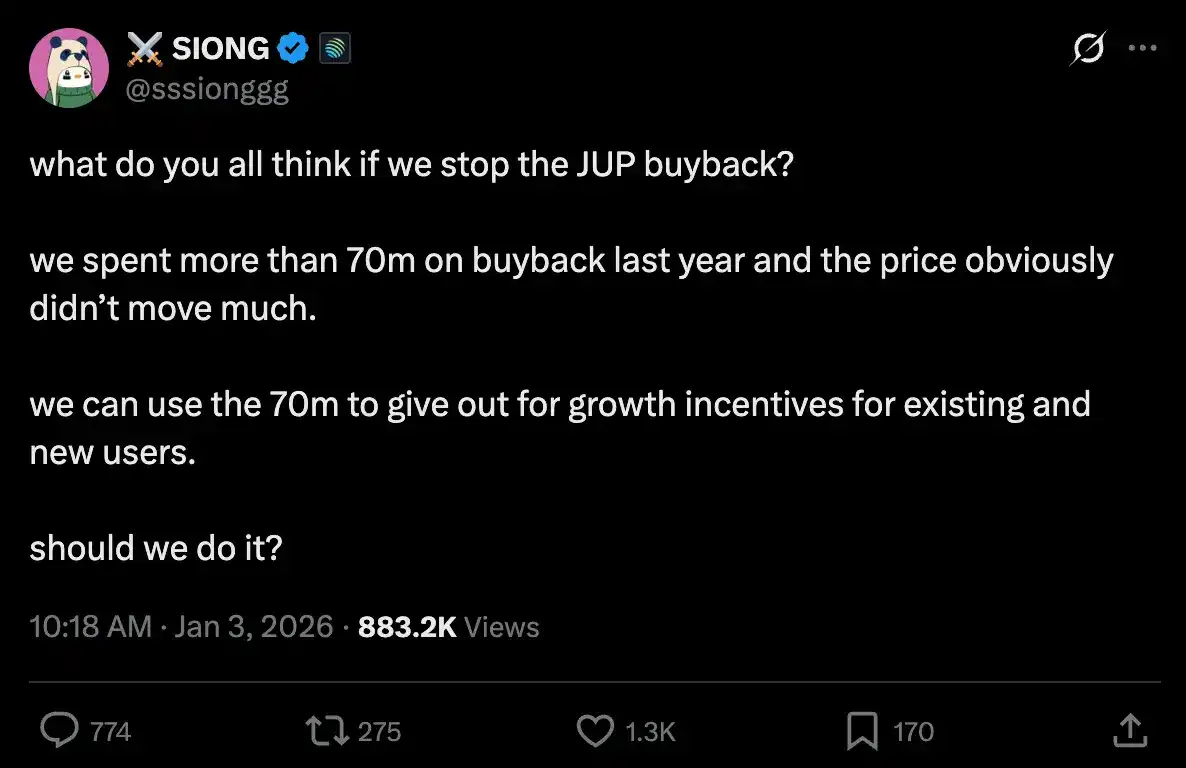
Recently, Jupiter co-founder SIONG initiated a discussion on X, proposing to halt the $JUP token buyback plan. He stated that Jupiter had invested over $70 million in token buybacks over the past year, but the token's performance has been lackluster. Meanwhile, Helium founder Amir Haleem directly announced the cessation of token buybacks, describing it as "throwing money into a black hole."

Why can tens of millions of dollars in real money not create even a ripple in the crypto market? Is the problem with the underlying design of the buyback strategy? Below is a summary of the performance data of project buybacks last year and market perspectives on project buybacks.
Data Performance: The Collective Waterloo of 2025's Buyback Projects

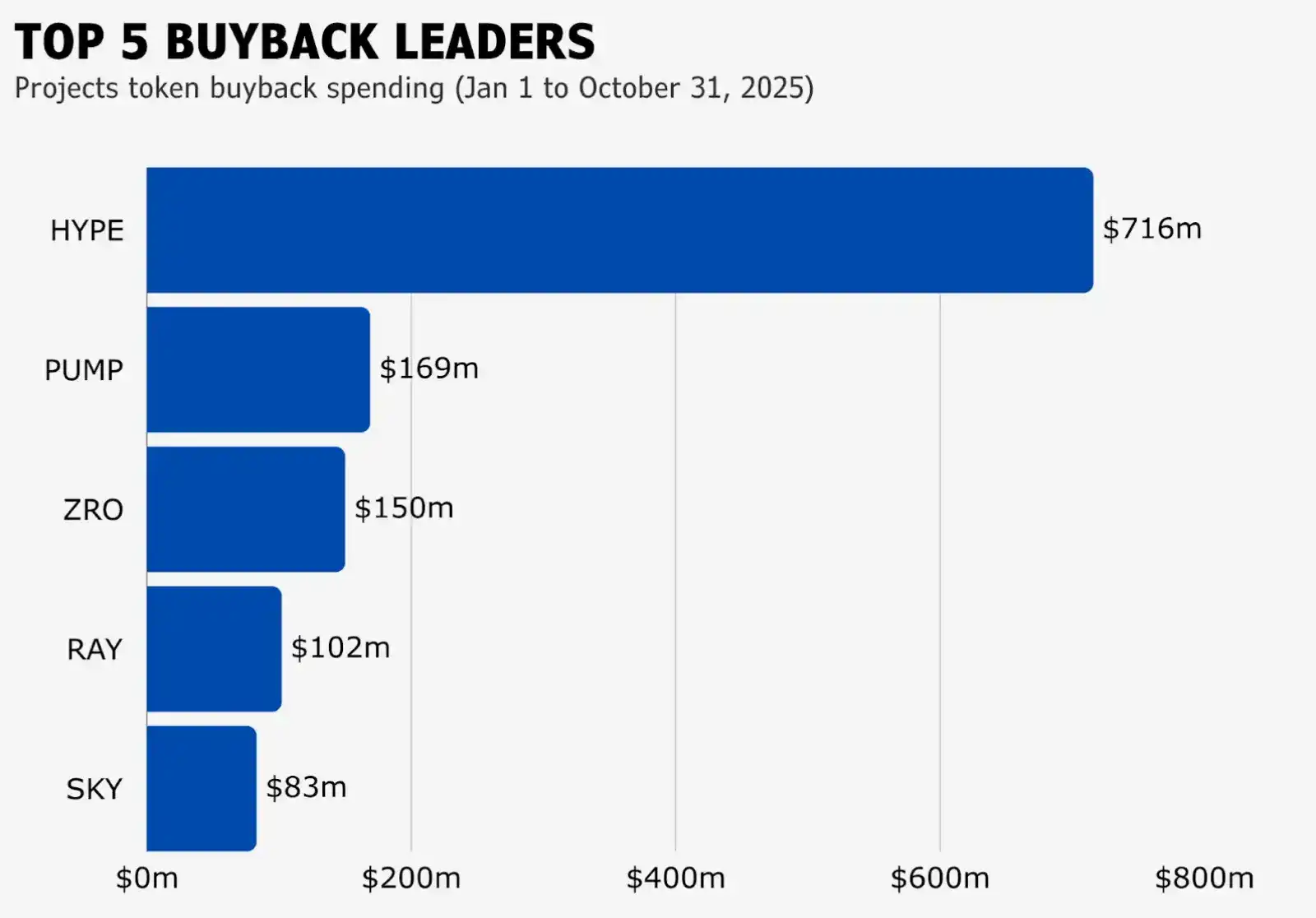
According to market research agency blockmates' tracking of buyback projects from January to October 2025, the top five projects were Hyperliquid, Pump.fun, LayerZero, Raydium, and Sky. Among them, Hyperliquid's buyback amount reached as high as $716 million, while Sky, at the bottom of the list, also invested $83 million.

However, the capital input did not yield proportional returns. Except for Hyperliquid's token price, which remained strong in the first three quarters (it has since fallen from $45.5 at the end of October to $25.94 at the time of writing), almost all other projects experienced continuous declines. This phenomenon has led the market to question: if buybacks cannot enhance token value, is this money essentially wasted?
Viewpoint Debate: The Trade-off Between Buybacks, Staking, and Growth Incentives

Regarding whether projects should stop buybacks, there are starkly different voices in the market:

The founders of Jupiter and Helium lean towards stopping token buybacks and instead using the funds to "acquire users," potentially through subsidizing transaction fees, rewarding new users, or enhancing product features to strengthen fundamentals. However, this shift still faces challenges: tokens will continue to unlock, and users might choose to sell due to a lack of long-term confidence, creating sustained selling pressure and risking a further significant drop in token price.

DeFi OG CM stated that the core meaning of buybacks lies in reducing the circulating supply and establishing a "regular deflation" model. Token price ultimately depends on market supply and demand and project fundamentals, not the buyback action itself. Buybacks are necessarily beneficial for token holders but are not equivalent to a short-term "guaranteed rise." Project teams should not easily halt execution due to low token prices or high buyback costs.

Helius CEO Mert Mumtaz expressed that buybacks are inherently a pessimistic mechanism, implicitly signaling that the project team cannot find a better use for the funds than short-term price boosting, attempting to initiate a growth cycle through price reflexivity rather than product growth. Buybacks are not the optimal strategy in a highly competitive market; the only effective edge case is opportunistic buybacks during market crashes (when equity is irrationally undervalued), combined with aggressive reinvestment during normal times. This is a judgment from a founder's perspective, not an investor's.

Ajit Tripathi, former Head of Institutional Business at Aave and FinTech Partner at ConsenSys, stated that the buyback narrative is the most value-destructive play after meme coins. This logic was initially a marketing tactic by Solana to boast its superiority over Ethereum, but it ended up harming all tokens, even those with revenue, forcing everyone to play pure financial games in the end.

Many other viewpoints have proposed alternative solutions. For example, Selini Capital founder Jordi Alexander observed that the failure of many projects lies not in the mechanism but in the "execution timing" of token buybacks. Some star projects of this cycle (e.g., HYPE, ENA, $JUP) executed large-scale buybacks during the market's most frenzied period when token valuations were most unreasonable. When the price-to-earnings ratio of tokens inflated due to excessive hype, project teams continued buybacks, essentially buying at the peak for sellers, which was a wrong decision. Therefore, Jordi suggests that project teams need more complex "financial engineering," and an ideal model should be dynamic buybacks based on the price-to-earnings ratio.

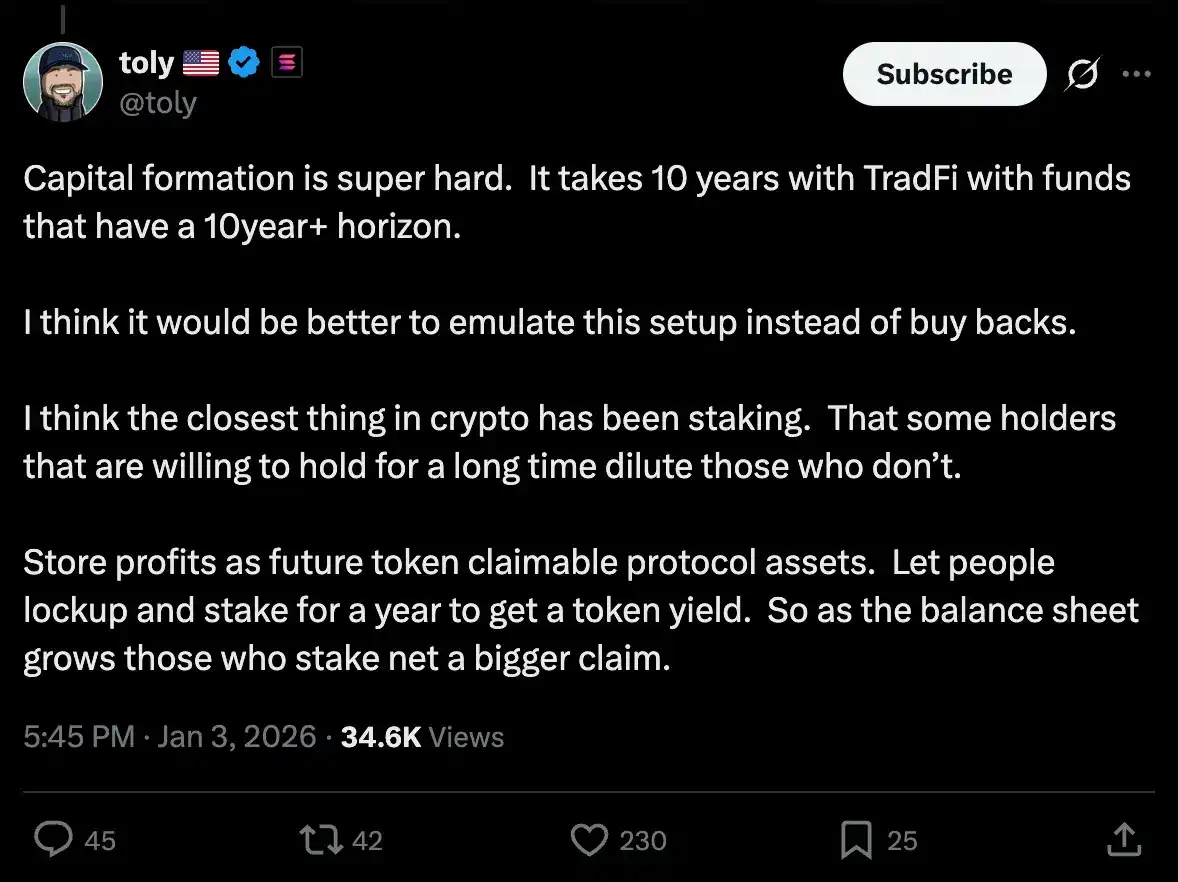
Solana founder Anatoly believes that projects should not pursue short-term price stimulation (buybacks) but should learn from traditional finance and establish a capital accumulation process spanning 10 years. He favors staking mechanisms more, allowing long-term lockers to obtain more shares, thereby diluting short-term speculators. He believes profits should be stored as "future token claims" rather than consumed in market fluctuations.
Represented by Selini Capital founder Jordi Alexander, some believe the buyback itself is not wrong, but the "amateur execution" is. Projects should hire professional financial advisors to adjust buyback strategies based on the token's price-to-earnings ratio and market cycles, rather than blindly repurchasing, leading to the dilemma of depleting the treasury at the bull market peak and having no funds to protect the price when entering a trough.

Evolution from "Blind Buybacks" to "Strategic Value Management"

Token buybacks are essentially a "deflation tool," not a guarantee of price increase. Amid various market fluctuations, buybacks more often play a role of "passive defense." They can reduce supply and establish a bottom support for the token price, but they cannot single-handedly reverse complex trends formed by macro conditions, unlocking pressure, or market sentiment.

The path to token value growth should evolve from单一的 buyback actions to strategic value management. First, projects need to establish execution strategies with better financial judgment, such as following the logic of "buying low valuation, reserving high valuation": firmly executing buybacks when the token price is far below intrinsic value to maximize capital return; and halting buybacks when market heat is excessive and valuation is unreasonable, instead depositing profits into the treasury as reserve funds or using them to fuel product growth.

Furthermore, buybacks can only address the "supply" issue but cannot create "demand." A project must give users a reason to hold tokens continuously. These reasons may come from the expectation of protocol revenue distribution, the power of ecosystem governance, or the irreplaceable competitiveness of the product itself. Without solid fundamental support, any form of buyback will ultimately become an exit channel for arbitrageurs.


Domande pertinenti

QWhy are some Web3 project founders, like those from Jupiter and Helium, proposing to stop token buybacks?

AThey believe that spending millions on buybacks has not effectively supported the token price and view it as inefficient capital allocation, with one founder even comparing it to 'throwing money into a black hole'. They suggest reallocating these funds towards user acquisition and product growth instead.

QAccording to the data from blockmates, what was the performance of major buyback projects in 2025?

AThe data showed a collective downturn. Despite significant investments, with Hyperliquid leading at $716 million in buybacks, most projects experienced continuous price declines. Only Hyperliquid maintained a strong performance initially, but its price also fell significantly later, dropping from $45.5 to $25.94 by the time of writing.

QWhat is the core argument in favor of continuing token buybacks, as presented by DeFi OG CM?

ACM argues that the core value of a buyback is to reduce circulating supply and establish a 'regular deflation' model. While buybacks are beneficial for token holders by creating a supply shock, they do not guarantee short-term price increases. The ultimate token price depends on market supply-demand dynamics and project basics, not the buyback action itself.

QWhat alternative to buybacks does Solana founder Anatoly Yakovenko propose for long-term value creation?

AAnatoly Yakovenko advocates for a long-term capital accumulation process over 10 years, similar to traditional finance, rather than short-term price stimulation via buybacks. He favors a staking mechanism that rewards long-term holders with more tokens, thereby diluting short-term speculators, and suggests storing profits as 'future token claims' instead of spending them on market volatility.

QWhat key flaw in the execution of buyback strategies does Jordi Alexander, founder of Selini Capital, identify?

AJordi Alexander identifies the flaw as 'amateur execution', not the mechanism itself. He observes that many projects conducted large-scale buybacks at the peak of market frenzy when token valuations were most inflated, essentially buying at the top for sellers. He recommends a more sophisticated 'financial engineering' approach with a dynamic buyback model based on the token's price-to-earnings ratio and market cycles.

Letture associate

ETFs Are Just the Ticket: The True Institutionalization of Bitcoin Is Happening Where You Can't See It

Beyond the Bitcoin ETF spotlight, a deeper institutionalization is underway, leveraging Bitcoin as a foundational financial primitive. Institutions are using Bitcoin for purposes long reserved for assets like U.S. Treasuries and gold: as collateral for loans, insurance reserves, and the backbone of rated bonds. Examples include a Barbados-based insurer capitalizing with $40M in Bitcoin reserves and Ledn's $188M securitization of Bitcoin-backed loans, which received the first-ever investment-grade rating (BBB-) from S&P for a digital asset-backed security. This structure was stress-tested during a 27% price drop in early 2026, triggering automatic liquidations that functioned as designed but revealed the systemic risk of synchronized selling across leveraged positions. Infrastructure is evolving to support this, with platforms like Anchorage Digital's Atlas network enabling secure, institutional-grade settlement and collateral management. Strategies like basis trades and corporate treasuries (exemplified by companies like MicroStrategy issuing billions in equity and debt to fund Bitcoin acquisitions) further integrate Bitcoin into financial mechanics. While ETFs solved "how to own" Bitcoin, these developments answer "what to do with it," embedding the asset into the working machinery of finance—as collateral upon which loans, derivatives, and structured products are built. The real, enduring institutional shift is happening in these largely invisible plumbing and financing systems.

marsbit6 min fa

ETFs Are Just the Ticket: The True Institutionalization of Bitcoin Is Happening Where You Can't See It

marsbit6 min fa

ZEC Co-Founder Responds to Orchard Vulnerability: No Signs of Theft, Orchard Pool to Be Sealed

ZEC Co-Founder Addresses Orchard Vulnerability: No Signs of Theft, Plans to Sunset Orchard Pool A security vulnerability was recently discovered in Zcash's Orchard shielded pool, raising key concerns. The primary questions are whether the flaw was exploited, if user funds are safe, whether users can verify the total ZEC supply, and if other similar vulnerabilities exist. Analysis suggests the vulnerability was likely not exploited prior to its discovery. It was found proactively by a researcher using specialized tools, not due to an active breach. The development team and mining pools acted quickly to contain the issue. Typical financially-motivated attacks would likely have left visible on-chain evidence, which has not been observed. User funds in Orchard are considered safe and should be recoverable, assuming no prior exploitation. If the flaw was never used, all legitimate funds can be withdrawn. The article outlines risks associated with moving funds to transparent addresses or other pools, but concludes that leaving assets in place is a reasonable option. Currently, users cannot independently verify that the total ZEC supply hasn't been inflated due to this bug. However, the planned Ironwood network upgrade is designed to resolve this. It will permanently close the Orchard pool to new deposits and internal transfers, allowing only withdrawals. This mechanism will cap total withdrawals at the amount of legitimately deposited funds, enabling anyone to cryptographically verify the supply post-upgrade. Multiple teams, including Shielded Labs, have conducted extensive audits focused on counterfeiting vulnerabilities, assisted by advanced AI tools. No additional flaws of this type have been found so far, increasing confidence that no other similar undisclosed vulnerabilities exist. In summary, evidence indicates the Orchard bug was probably not used, user funds are secure, and no other counterfeiting flaws are currently known. The upcoming Ironwood upgrade will restore users' ability to independently verify the total ZEC supply, closing this chapter.

Foresight News11 min fa

ZEC Co-Founder Responds to Orchard Vulnerability: No Signs of Theft, Orchard Pool to Be Sealed

Foresight News11 min fa

Microsoft Announces Commercial-Grade Quantum Computer to be Completed in Three Years: Will the Boots Land?

Microsoft announces plans to build a commercially viable quantum computer by 2029, a significant acceleration from the previous industry consensus of a decade. The breakthrough is fueled by their new Majorana 2 quantum chip, which boasts a record-breaking average qubit lifetime of 20 seconds—a 1,000-fold reliability improvement over its predecessor. This leap was achieved by leveraging topological qubits, a theoretically more stable technology using Majorana zero modes, and switching the core superconducting material from aluminum to lead. Crucially, Microsoft's "Discovery" agentic AI platform accelerated the R&D process. AI agents autonomously analyzed vast experimental data, optimized manufacturing parameters (like the lead alloy composition), and solved issues like "ghost noise," dramatically speeding up experimentation. While the 20-second coherence time is a landmark, challenges remain: scaling from 12 qubits to the millions needed for practical applications, managing compilation costs, and verifying quantum results. Skeptics call for peer-reviewed data, and questions persist about whether even 20 seconds is sufficient for complex algorithms like breaking RSA encryption. The race is on with other approaches (superconducting, trapped ions), but Microsoft's confidence in its topological roadmap signals a potential shortcut to a scalable quantum future.

marsbit29 min fa

Microsoft Announces Commercial-Grade Quantum Computer to be Completed in Three Years: Will the Boots Land?

marsbit29 min fa

Trading

Spot
Futures

Articoli Popolari

Come comprare ERA

Benvenuto in HTX.com! Abbiamo reso l'acquisto di Caldera (ERA) semplice e conveniente. Segui la nostra guida passo passo per intraprendere il tuo viaggio nel mondo delle criptovalute.Step 1: Crea il tuo Account HTXUsa la tua email o numero di telefono per registrarti il tuo account gratuito su HTX. Vivi un'esperienza facile e sblocca tutte le funzionalità,Crea il mio accountStep 2: Vai in Acquista crypto e seleziona il tuo metodo di pagamentoCarta di credito/debito: utilizza la tua Visa o Mastercard per acquistare immediatamente CalderaERA.Bilancio: Usa i fondi dal bilancio del tuo account HTX per fare trading senza problemi.Terze parti: abbiamo aggiunto metodi di pagamento molto utilizzati come Google Pay e Apple Pay per maggiore comodità.P2P: Fai trading direttamente con altri utenti HTX.Over-the-Counter (OTC): Offriamo servizi su misura e tassi di cambio competitivi per i trader.Step 3: Conserva Caldera (ERA)Dopo aver acquistato Caldera (ERA), conserva nel tuo account HTX. In alternativa, puoi inviare tramite trasferimento blockchain o scambiare per altre criptovalute.Step 4: Scambia Caldera (ERA)Scambia facilmente Caldera (ERA) nel mercato spot di HTX. Accedi al tuo account, seleziona la tua coppia di trading, esegui le tue operazioni e monitora in tempo reale. Offriamo un'esperienza user-friendly sia per chi ha appena iniziato che per i trader più esperti.

350 Totale visualizzazioniPubblicato il 2025.07.17Aggiornato il 2026.06.02

Come comprare ERA

Discussioni

Benvenuto nella Community HTX. Qui puoi rimanere informato sugli ultimi sviluppi della piattaforma e accedere ad approfondimenti esperti sul mercato. Le opinioni degli utenti sul prezzo di ERA ERA sono presentate come di seguito.

活动图片












