Grayscale Just Made Another XRP Move As ETFs Cross $2 Billion Milestone

bitcoinistPubblicato 2026-01-29Pubblicato ultima volta 2026-01-29

Introduzione

Grayscale has filed a new amendment to its Spot XRP ETF, updating the list of trading platforms used to calculate the index price. The amendment adds Binance, Gate, and Hashkey while removing Bitfinex, which failed to meet eligibility criteria. This move aims to improve pricing accuracy and reflects a focus on higher-liquidity exchanges. Concurrently, US Spot XRP ETFs have surpassed $2 billion in cumulative trading volume, demonstrating steady institutional demand and growing confidence in XRP as an investment vehicle. The consistent capital inflow, including recent positive inflows of $9.16 million, suggests strengthening institutional participation that could support a bullish trend for XRP.

Grayscale, one of the world’s largest digital asset-focused managers, has filed a new amendment to its Spot XRP ETF, updating specific details in the original document. Meanwhile, XRP ETFs have achieved a remarkable milestone, surpassing $2 billion in total volume, reflecting growing institutional demand and interest.

Grayscale Files New Amendment For Its XRP ETF

On Tuesday, January 20, Grayscale updated its Form 8-K filing for the Spot XRP ETF, highlighting new details it has included in the index calculation. The amendment, which was submitted to the US Securities and Exchange Commission (SEC), revealed changes to the digital asset trading platforms previously used to determine the Index Price for the Grayscale XRP Trust ETF, GXRP.

The CoinDesk Indices, Inc., which provides the index, initially included Bitstamp by Robinhood, Crypto.com, Gemini, Kraken, LMAX Digital, OKX, and Bitfinex for XRP-USD trading pairs in the original XRP Spot ETF filing. For XRP-USDC trading pairs, the index previously featured Bitstamp, Bullish, Bybit, Kraken, and OKX.

Notably, the January 20 amendment has now added Binance, Gate, and Hashkey as new platforms for XRP trading pairs. These additions follow a routine monthly review where the platforms met the conditions and eligibility criteria for inclusion. At the same time, Bitfinex was removed from the index. Grayscale disclosed that the reason for the exclusion was due to Bitfinex’s failure to meet the Index Provider’s conditions for inclusion.

The asset manager’s move reflects its ongoing efforts to maintain a more accurate and reliable pricing for its XRP ETFs. Market analyst Xaif Crypto has stated that the new amendment improves NAV accuracy on NYSE Arca. He also noted that the removal of Bitfinex underscores Grayscale’s growing focus on higher-liquidity exchanges amid XRP’s growing institutional demand and adoption post SEC clarity.

XRP ETFs Exceed $2 Billion In Trading Volume

As investors become more familiar with the newly added trading platforms in Grayscale’s XRP ETF pricing index, new reports have revealed a major increase in volume for these investment products. According to an X post by crypto enthusiast XRP Update, the total US Spot XRP ETFs have surpassed $2 billion in cumulative trading volume, marking a significant growth milestone.

XRP Update revealed that since October 2025, XRP Spot ETFs have seen steady demand and increasing institutional participation, reflecting growing confidence in the cryptocurrency as an investment vehicle. The chart, which shows cumulative volume, illustrates slow but sustained growth, with XRP ETFs rising above $500 million, then exceeding $1 billion, and now sitting above $2 billion.
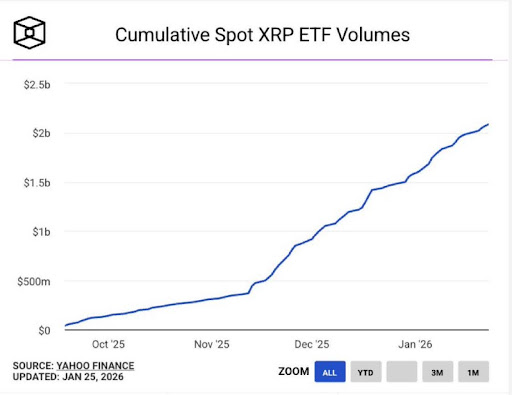
Source: Chart from XRP Update on X

XRP Update notes that capital is quietly and consistently rotating into XRP ETFs. Due to strong volume growth, the crypto enthusiast believes that continued institutional demand could ignite a bullish trend in XRP’s price. In addition to its rising trading volume, XRP ETFs have also recorded another day of positive inflows, adding approximately $9.16 million to total net assets.

XRP trading at $1.90 on the 1D chart | Source: XRPUSDT on Tradingview.com

Domande pertinenti

QWhat is the significance of Grayscale's recent amendment to its Spot XRP ETF filing?

AThe amendment updates the index calculation by adding new digital asset trading platforms (Binance, Gate, Hashkey) and removing Bitfinex to maintain a more accurate and reliable pricing for its XRP ETFs, reflecting a focus on higher-liquidity exchanges.

QWhich trading platforms were added and removed in Grayscale XRP Trust ETF's index calculation according to the January 20 amendment?

ABinance, Gate, and Hashkey were added as new platforms for XRP trading pairs, while Bitfinex was removed due to its failure to meet the Index Provider's conditions for inclusion.

QWhat milestone have US Spot XRP ETFs recently surpassed in terms of trading volume?

AUS Spot XRP ETFs have surpassed $2 billion in cumulative trading volume, indicating significant growth and increasing institutional demand.

QHow has the trading volume of XRP ETFs evolved since October 2025 according to the report?

ASince October 2025, XRP Spot ETFs have seen steady demand and increasing institutional participation, with cumulative volume growing from over $500 million to exceeding $1 billion and now sitting above $2 billion.

QWhat does the analyst XRP Update believe could result from continued institutional demand for XRP ETFs?

AXRP Update believes that continued institutional demand could ignite a bullish trend in XRP's price, supported by strong volume growth and positive inflows into the ETFs.

Letture associate

Has the 'Digital Gold' Narrative for BTC Failed?

**Title: Has the "Digital Gold" Narrative for Bitcoin Failed?** The article argues that Bitcoin's "digital gold" narrative remains valid despite a recent sharp price decline (from a peak near $126k in Oct 2025 to briefly under $61k in Feb 2026). It presents a long-term investment framework based on three core points: **1. Viewing Bitcoin as an Asset:** Bitcoin is presented as a superior potential store of value compared to gold. Key arguments are its absolute scarcity (21 million cap), superior portability, and transparent auditability via its public ledger. While acknowledging its current use in early, volatile stages (~3-4% global adoption), the author draws parallels to the early, disruptive phases of the internet and e-commerce. **2. Understanding the Recent Downturn:** The current ~50% correction is framed as a predictable, consensus-driven cycle following its post-halving peak (the 2024 halving preceded the Oct 2025 high). A crucial factor is a historic "changing of hands": the influx of new institutional buyers via ETFs allowed early, low-cost holders (miners, OG believers) to take profits. The author notes that while severe, Bitcoin's historical drawdowns (e.g., 93% in 2011, 77% in 2021-22) have been progressively smaller, suggesting maturing holder structure and decreasing volatility over time. **3. The Long-Term Perspective:** The long-term thesis hinges on Bitcoin capturing a portion of gold's market value. With Bitcoin's market cap at ~$1.4 trillion (at $70k) versus gold's ~$20 trillion, significant upside potential exists if the "digital gold" narrative is partially realized. However, the author strongly cautions that short-term risks remain, the bottom is unpredictable, and high volatility is inherent. The real risk is not Bitcoin failing but poor personal position management (over-leverage, wrong capital) and a lack of deep understanding, which can force investors out during severe downturns. The conclusion uses Amazon's 95% crash post-2000 dot-com bubble and subsequent 42x recovery as an analogy. The ultimate question is not if Bitcoin's price will rise, but if an investor's strategy and conviction can withstand the volatility to see the long-term play out. The recent divergence (gold up, Bitcoin down) is posed not as a narrative failure, but as potential evidence of this ongoing, painful transition from a speculative asset to a mainstream allocation.

marsbit1 h fa

Has the 'Digital Gold' Narrative for BTC Failed?

marsbit1 h fa

Has BTC's 'Digital Gold' Narrative Failed?

The article discusses Bitcoin's "digital gold" narrative, its recent price drop, and long-term outlook through the perspective of "Jason". It argues the narrative is not a failure but that Bitcoin represents a superior, new asset class due to its fixed supply (21 million), portability, and auditability. The piece compares its current ~3-4% global adoption rate to early internet/e-commerce, suggesting significant growth potential. Regarding the 2025-2026 price decline (from ~$126k to briefly under $61k), the author views it as a predictable, consensus-driven sell-off within Bitcoin's ~4-year cycle post-halving, exacerbated by a major "handover" from early, low-cost holders to new institutional buyers via ETFs. A key observation is that historical peak-to-trough drawdowns have lessened over time (e.g., 93% in 2011 to ~50% in 2026), indicating maturing volatility as holder structure changes. For the long term, the author uses a simple framework: Bitcoin's total market cap (~$1.4T at $70k) is only about 7% of gold's (~$20T). Even capturing 30-50% of gold's value would imply substantial upside. However, the article strongly cautions against viewing this as investment advice, emphasizing extreme volatility and the critical importance of risk management, position sizing, and deep fundamental understanding to survive severe drawdowns. It concludes by drawing a parallel to Amazon's 95% crash in 2000 and subsequent 42x recovery, stressing that the key is surviving market cycles to realize long-term potential.

链捕手1 h fa

Has BTC's 'Digital Gold' Narrative Failed?

链捕手1 h fa

From Code to Cognition: A Ten-Thousand-Word Guide to the Evolution of the Robot Brain

"From Code to Cognition: The Evolution of Robot Brains" The journey of robotic intelligence has shifted dramatically from manually coded systems to AI-driven brains. For decades, robots relied on layered software stacks—perception, state estimation, planning, control—each handcrafted. While predictable, they lacked adaptability. The 2010s saw deep learning revolutionize perception (e.g., object detection) and control (via reinforcement learning), but learned skills remained narrow. The arrival of Large Language Models (LLMs) marked a turning point. LLMs acted as high-level planners, interpreting natural language instructions and generating sequences of actions for traditional robotic systems to execute. However, true integration came with Visual-Language-Action (VLA) models, which fused vision, language, and motion prediction into a single network. Pioneered by models like RT-2 and open-source projects like OpenVLA, VLAs enable robots to reason and act directly from visual input and commands. The most advanced humanoid robots now employ a "dual-brain" architecture: a slow-thinking, large VLA (System 2) for reasoning and planning, and a fast-reacting, small network (System 1) for high-frequency motion control, sometimes with an even lower-level System 0 for balance. This split balances cognition with the physics of real-time movement. Computation is split between onboard hardware (e.g., NVIDIA Jetson) for safety-critical control loops and cloud/edge servers for non-critical tasks like learning and interfaces. A crucial driver is the open-source ecosystem—models like GR00T and OpenVLA allow startups to build upon pre-trained brains and fine-tune them with their own data, accelerating development. Despite progress, current systems struggle with recovery from errors, sample inefficiency, and long-horizon tasks. This has spurred the rise of **World Models**—neural networks that predict the consequences of actions. By simulating possible futures before acting (like NVIDIA Cosmos or Meta V-JEPA), robots can plan, recover, and generalize better. This represents the next frontier: shifting intelligence from learned reactions to an internal model of physics and cause-and-effect. The field is rapidly evolving. While not yet at its "ChatGPT moment," the convergence of cheaper hardware, scalable simulation, and world models points toward robots that are increasingly capable, adaptive, and useful. The question is shifting from "what can robots do?" to "what *should* they do?"

marsbit2 h fa

From Code to Cognition: A Ten-Thousand-Word Guide to the Evolution of the Robot Brain

marsbit2 h fa

AI Bubble Is Bursting

The AI Bubble is Bursting: A Necessary Purge on the Path to Ubiquitous Intelligence Market volatility has reignited debates about an AI bubble, with figures like Ray Dalio pointing to high valuations. However, this parallels the dot-com bubble, which, despite its crash, laid the physical infrastructure for today's internet era. The current AI investment frenzy, with tech giants planning trillions in infrastructure spending far outstripping current AI application revenues, appears similarly imbalanced. This 'bubble' is seen as an inevitable phase for a disruptive technology, paying the "innovation tax." Critically, AI inference costs have plummeted over 99.7% since 2023, making intelligence nearly free at the margin. This hasn't reduced spending but has instead unlocked massive new demand, as seen in enterprise AI cloud expenditure tripling. This follows the Jevons Paradox: efficiency gains lead to greater total consumption. The market is now entering a cleansing phase, weeding out speculative ventures lacking real moats. The deeper shift is a move from capital expenditure (CapEx) on hardware to value creation in operational expenditure (OpEx) through AI applications that solve real industry problems. While infrastructure valuations are high, rapid earnings growth from widespread AI adoption across sectors—from manufacturing and finance to law and healthcare—may digest these valuations over time. Ultimately, this creative destruction will leave behind robust infrastructure and optimized models, cheaply powering an AI-augmented future for all industries, much as the internet became indispensable after its own bubble burst. The core productive potential remains undiminished.

链捕手2 h fa

AI Bubble Is Bursting

链捕手2 h fa

Trading

Spot
Futures

Articoli Popolari

Come comprare MOVE

Benvenuto in HTX.com! Abbiamo reso l'acquisto di Movement (MOVE) semplice e conveniente. Segui la nostra guida passo passo per intraprendere il tuo viaggio nel mondo delle criptovalute.Step 1: Crea il tuo Account HTXUsa la tua email o numero di telefono per registrarti il tuo account gratuito su HTX. Vivi un'esperienza facile e sblocca tutte le funzionalità,Crea il mio accountStep 2: Vai in Acquista crypto e seleziona il tuo metodo di pagamentoCarta di credito/debito: utilizza la tua Visa o Mastercard per acquistare immediatamente MovementMOVE.Bilancio: Usa i fondi dal bilancio del tuo account HTX per fare trading senza problemi.Terze parti: abbiamo aggiunto metodi di pagamento molto utilizzati come Google Pay e Apple Pay per maggiore comodità.P2P: Fai trading direttamente con altri utenti HTX.Over-the-Counter (OTC): Offriamo servizi su misura e tassi di cambio competitivi per i trader.Step 3: Conserva Movement (MOVE)Dopo aver acquistato Movement (MOVE), conserva nel tuo account HTX. In alternativa, puoi inviare tramite trasferimento blockchain o scambiare per altre criptovalute.Step 4: Scambia Movement (MOVE)Scambia facilmente Movement (MOVE) nel mercato spot di HTX. Accedi al tuo account, seleziona la tua coppia di trading, esegui le tue operazioni e monitora in tempo reale. Offriamo un'esperienza user-friendly sia per chi ha appena iniziato che per i trader più esperti.

269 Totale visualizzazioniPubblicato il 2024.12.13Aggiornato il 2026.06.02

Come comprare MOVE

Discussioni

Benvenuto nella Community HTX. Qui puoi rimanere informato sugli ultimi sviluppi della piattaforma e accedere ad approfondimenti esperti sul mercato. Le opinioni degli utenti sul prezzo di MOVE MOVE sono presentate come di seguito.

活动图片