GOP hardliners vexed as defense bill advances without CBDC ban

cointelegraphPubblicato 2025-12-11Pubblicato ultima volta 2025-12-11

Introduzione

A group of Republican hardliners are angered after the U.S. House passed a $900 billion defense spending bill without including a promised ban on central bank digital currencies (CBDCs). GOP Representative Keith Self stated that conservatives were explicitly assured that strong anti-CBDC language would be part of the National Defense Authorization Act (NDAA), but the promise was broken. An amendment to reinstate the ban failed to advance. The provision would have prohibited the Federal Reserve from testing, developing, or issuing a digital currency and from offering financial services directly to individuals. Some Republicans, including Marjorie Taylor Greene, criticized House leadership for not upholding the commitment, citing concerns over government control of money. The House had previously passed a separate CBDC ban in July, but it has stalled in the Senate. Self vowed to continue fighting against CBDCs in future must-pass legislation.

A group of Republicans has called foul after the US House passed a massive defense spending bill on Wednesday, which omitted a ban on central bank digital currencies (CBDC) despite promises it would be included.

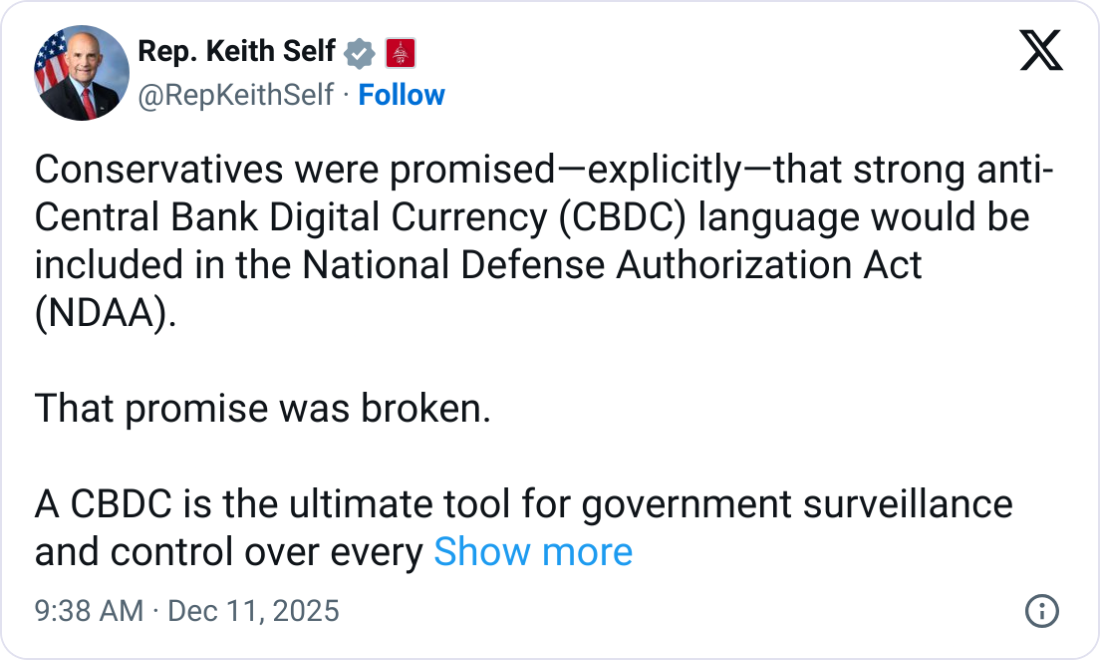
“Conservatives were promised — explicitly — that strong anti-Central Bank Digital Currency (CBDC) language would be included in the National Defense Authorization Act (NDAA). That promise was broken,” GOP Representative Keith Self wrote to X on Wednesday.

The House voted 312-112 to pass the NDAA on Wednesday, sending the $900 billion annual military funding bill to the Senate in a bid to have it passed before the end of the year.

Self had filed an amendment on Tuesday to include a CBDC ban, which had been removed from the bill, but it failed to advance and did not see a vote on the House floor.

Self said a group of Republicans was “assured that anti-CBDC language would be included. Instead, we have been forced into a take-it-or-leave-it bill that breaks that promise. Without that language, I’m inclined to leave it.”
Source: Keith Self

The more than 3,000-page bill is considered must-pass legislation and typically sees non-defense-related amendments that could otherwise be stalled or heavily revised if passed as standalone bills.

In July, House Republican leaders cut a deal with a group of party hardliners to put a CBDC ban in the defense spending bill after the group refused to move forward with three crypto bills unless a CBDC ban was guaranteed.

The bills had been held up in a record-long nine-hour procedural vote and included the stablecoin-regulating GENIUS Act, which President Donald Trump had pressured the GOP to quickly pass.

Related: Does GENIUS turn stablecoin issuers into stealth buyers of US debt?

GOP Representative Marjorie Taylor Greene slammed Speaker Mike Johnson on Monday for not keeping his promise of a CBDC ban, adding she supports crypto but “will never support giving the government the ability to turn off your ability to have full control of your money and to buy and sell.”

An early House version of the bill shared in August had included a CBDC ban, before it was subjected to amendments via multiple markups and committees.

The language of the provision banned the Federal Reserve from testing, studying, developing or issuing any digital currency or asset. It would have also stopped the central bank from offering financial products or services directly to individuals.

In July, the House passed a bill banning CBDCs, the Anti-CBDC Surveillance State Act, with a slim vote of 219-210, which has stalled in the Senate.

Self said he would “fight on in the next must-pass bill to ensure a CBDC never sees the light of day. Financial freedom isn’t negotiable.”

Legal Panel: Crypto wanted to overthrow banks, now it’s becoming them in stablecoin fight

Crypto di tendenza

Letture associate

After Aave's Exit and TVL's Sharp Fluctuation, Where Does MegaETH's Valuation Anchor Lie?

Following the withdrawal of Aave and a sharp drop in its Total Value Locked (TVL), the valuation of the high-performance DeFi blockchain MegaETH faces scrutiny. Once a highly anticipated project with a fully diluted valuation (FDV) reaching around $2 billion, MegaETH saw its TVL plummet from a May peak of $245 million to just over $30 million in July, a roughly 70% decline. Its native token, MEGA, currently trades around $0.048 with a market cap of approximately $54 million and an FDV of about $480 million. The report identifies a core vulnerability: MegaETH's TVL was heavily dependent on a single protocol, Aave V3, which at its peak contributed around 90% of the chain's TVL. A significant portion of this capital is attributed to leveraged yield-farming strategies involving stablecoins like USDe. When the profitability of these strategies diminished, capital rapidly exited, exposing the lack of diversified, sustainable activity. Three key mismatches between MegaETH's valuation and its fundamentals are highlighted: 1. **Valuation vs. Real Usage:** With an FDV of ~$4.8B but only ~$1M in annualized protocol revenue and ~2,600 daily active addresses, the valuation appears disconnected from current economic activity. 2. **Token Narrative vs. Ecosystem Reality:** Despite its DeFi narrative, nearly 80% of the chain's recent protocol revenue comes from a trading card game, Monster, not from core DeFi applications like Aave. The chain's native stablecoin, USDM, also shows low trading volume and a declining market cap. 3. **Short-Term Hype vs. Long-Term Delivery:** Initial hype from token generation, blue-chip integrations, and influencer support has faded. Major protocols like Uniswap now hold minimal TVL on the chain, indicating that early capital was largely transient and driven by incentives rather than organic demand. The situation reflects a broader market trend where investors are becoming less tolerant of valuations based on inflated TVL and narrative, demanding clearer evidence of sustainable transactions, revenue, and ecosystem development. While MEGA's price may experience short-term rebounds from market sentiment, a fundamental re-rating likely depends on the team's ability to convert its remaining resources into tangible, user-retaining applications and genuine ecosystem growth.

链捕手57 min fa

After Aave's Exit and TVL's Sharp Fluctuation, Where Does MegaETH's Valuation Anchor Lie?

链捕手57 min fa

Goldman Sachs In-Depth Report: Who Will Be the Long-Term Winners in China's AI Large Model Industry?

Goldman Sachs Report: China's AI Models at an Inflection Point China's open-source/open-weight large language models (LLMs) have reached performance parity with top global proprietary models, according to a Goldman Sachs report. This is driven by architectural innovations and higher parameter efficiency, allowing Chinese models to achieve comparable capabilities at 2%-10% the parameter size and significantly lower cost. The market is evolving into a two-tiered structure: a high-end segment (e.g., GLM5.2, Qwen3.7 Max) with premium pricing and a low-end, price-sensitive segment for global SMEs and individual users. Key points: * **Cost & Performance:** Innovations like Mixture of Experts (MoE) enable high performance with smaller models. Projects like Meituan's LongCat 2.0, trained on domestic hardware, highlight progress in tech self-sufficiency. * **Open-Source Strategy:** Most Chinese players use open-source/open-weight models for flexibility and ecosystem growth. However, Goldman notes this may underreport actual deployment and revenue. A shift toward "open-weight + community license" models with revenue sharing (e.g., MiniMax) could improve monetization. * **Market Shift & Global Expansion:** Enterprise AI adoption is shifting from "token maximization" to "ROI-first." International expansion, especially in non-US markets, is a major growth driver. Chinese models are increasingly available on global platforms like AWS Bedrock and Microsoft Copilot. * **Competitive Landscape:** Using a framework based on pricing power, cost advantage, and financial strength, Goldman identifies **Zhipu AI and DeepSeek** as the strongest in foundational text models, and **ByteDance** as the leader in multimodal/video generation. The report maintains Buy ratings on MiniMax and Kuaishou. * **Market Growth:** China's AI model API and subscription revenue is projected to grow from an estimated ¥35 billion in 2026 to ¥879 billion by 2030.

marsbit1 h fa

Goldman Sachs In-Depth Report: Who Will Be the Long-Term Winners in China's AI Large Model Industry?

marsbit1 h fa

Goldman Sachs Deep Dive Report: Who Will Become the Long-Term Winners in China's AI Large Model Industry?

Goldman Sachs Report: Who Will Be the Long-Term Winners in China's AI Large Model Industry? China's AI large model sector is at a historic inflection point. Goldman Sachs argues that the intelligence of Chinese open-source/open-weight models is approaching top global proprietary models. Rapid adoption by domestic enterprises and global SMEs is creating a data flywheel effect that will further drive model iteration. The evolution is summarized as moving from "DeepSeek's cost-efficiency moment last year to GLM's model-intelligence moment this year." Chinese models achieve near-state-of-the-art performance at significantly lower cost, primarily due to architectural innovations like Mixture of Experts (MoE) and higher parameter efficiency. Models like DeepSeek V4 Pro (1.6T params), GLM5.2 (0.7T), and MiniMax M3 (0.4T) are much smaller than global leaders. Recent advancements in coding capability are attributed to better data curation and RLHF. Landmarks like Meituan's LongCat 2.0, trained fully on domestic AI chips, demonstrate progress in hardware stack independence. The market is forming a "two-tiered structure." The high-end tier (e.g., GLM5.2, Alibaba's Qwen3.7 Max) prices around $1 per million tokens, about 10-25% of US top models, with estimated inference gross margins of 10-20%. The low-end tier (priced as low as $0.06-$0.2 per million tokens) targets price-sensitive global SMEs and individuals. MiniMax derives 60-70% of revenue overseas. Goldman forecasts China's AI model API/subscription revenue to grow from an estimated RMB 35bn in 2026 to RMB 879bn by 2030. Most Chinese players adopt open-source/open-weight strategies for deployment flexibility and community feedback, though this limits monetization as deployments on third-party platforms (e.g., Alibaba Cloud) may not generate direct revenue. A shift towards "open-weight + community license" models with revenue-sharing agreements (like MiniMax's approach) could improve unit economics. International expansion, particularly in non-US markets, is the key growth driver. The global enterprise AI paradigm is shifting from "token maximization" to "ROI prioritization." Chinese models are already hosted on major global platforms like AWS Bedrock and are under consideration for integration into Microsoft Copilot. Using a competitive framework based on pricing power, cost advantage, and financial strength, Goldman identifies the strongest players: In foundational text models, Zhipu AI (initiated coverage) and DeepSeek lead. In multimodal/video generation, ByteDance's Seed is the frontrunner, with Kuaishou's Kling and MiniMax's Hailuo also well-positioned. Goldman maintains a Buy rating on MiniMax, citing its attractive valuation.

链捕手1 h fa

Goldman Sachs Deep Dive Report: Who Will Become the Long-Term Winners in China's AI Large Model Industry?

链捕手1 h fa

Trading

Spot

Articoli Popolari

Come comprare BAN

Benvenuto in HTX.com! Abbiamo reso l'acquisto di Comedian (BAN) semplice e conveniente. Segui la nostra guida passo passo per intraprendere il tuo viaggio nel mondo delle criptovalute.Step 1: Crea il tuo Account HTXUsa la tua email o numero di telefono per registrarti il tuo account gratuito su HTX. Vivi un'esperienza facile e sblocca tutte le funzionalità,Crea il mio accountStep 2: Vai in Acquista crypto e seleziona il tuo metodo di pagamentoCarta di credito/debito: utilizza la tua Visa o Mastercard per acquistare immediatamente ComedianBAN.Bilancio: Usa i fondi dal bilancio del tuo account HTX per fare trading senza problemi.Terze parti: abbiamo aggiunto metodi di pagamento molto utilizzati come Google Pay e Apple Pay per maggiore comodità.P2P: Fai trading direttamente con altri utenti HTX.Over-the-Counter (OTC): Offriamo servizi su misura e tassi di cambio competitivi per i trader.Step 3: Conserva Comedian (BAN)Dopo aver acquistato Comedian (BAN), conserva nel tuo account HTX. In alternativa, puoi inviare tramite trasferimento blockchain o scambiare per altre criptovalute.Step 4: Scambia Comedian (BAN)Scambia facilmente Comedian (BAN) nel mercato spot di HTX. Accedi al tuo account, seleziona la tua coppia di trading, esegui le tue operazioni e monitora in tempo reale. Offriamo un'esperienza user-friendly sia per chi ha appena iniziato che per i trader più esperti.

522 Totale visualizzazioniPubblicato il 2024.12.11Aggiornato il 2026.06.02

Come comprare BAN

Discussioni

Benvenuto nella Community HTX. Qui puoi rimanere informato sugli ultimi sviluppi della piattaforma e accedere ad approfondimenti esperti sul mercato. Le opinioni degli utenti sul prezzo di BAN BAN sono presentate come di seguito.

活动图片