Google's AI Chief is Actually the Secret Backer of Anthropic, Hassabis Quietly Controls the Global AI Ecosystem

marsbitPubblicato 2026-05-21Pubblicato ultima volta 2026-05-21

Introduzione

A bombshell report reveals that Demis Hassabis, the head of Google AI and DeepMind founder, was an early, secret investor in Anthropic, Google's arch-rival in the AI race. This discovery unveils a vast, interconnected empire—dubbed the "DeepMind Mafia"—where Hassabis's capital and influence extend through numerous top AI startups like Inflection AI and Ineffable Intelligence, which have collectively raised over $14 billion. Despite the public rivalry between Google's Gemini and Anthropic's Claude, Hassabis personally funded Anthropic at its inception, a stake now astronomically valuable given the company's reported $900 billion valuation. Furthermore, a close, mentor-like relationship exists between Hassabis and Anthropic CEO Dario Amodei. Concurrently, Hassabis has consolidated power within Google. Following the 2023 merger of Google Brain and DeepMind into Google DeepMind, his loyalists have assumed key leadership roles across Google's AI and cloud divisions. However, Hassabis continues to operate his power base from London, not Silicon Valley. The report paints a picture of Hassabis as a master strategist, quietly orchestrating the global AI ecosystem through a web of personal investments, former protégés, and internal corporate control, ensuring his influence prevails regardless of which public-facing company wins in the market.

Just now, a massive bombshell exploded in the global tech world—

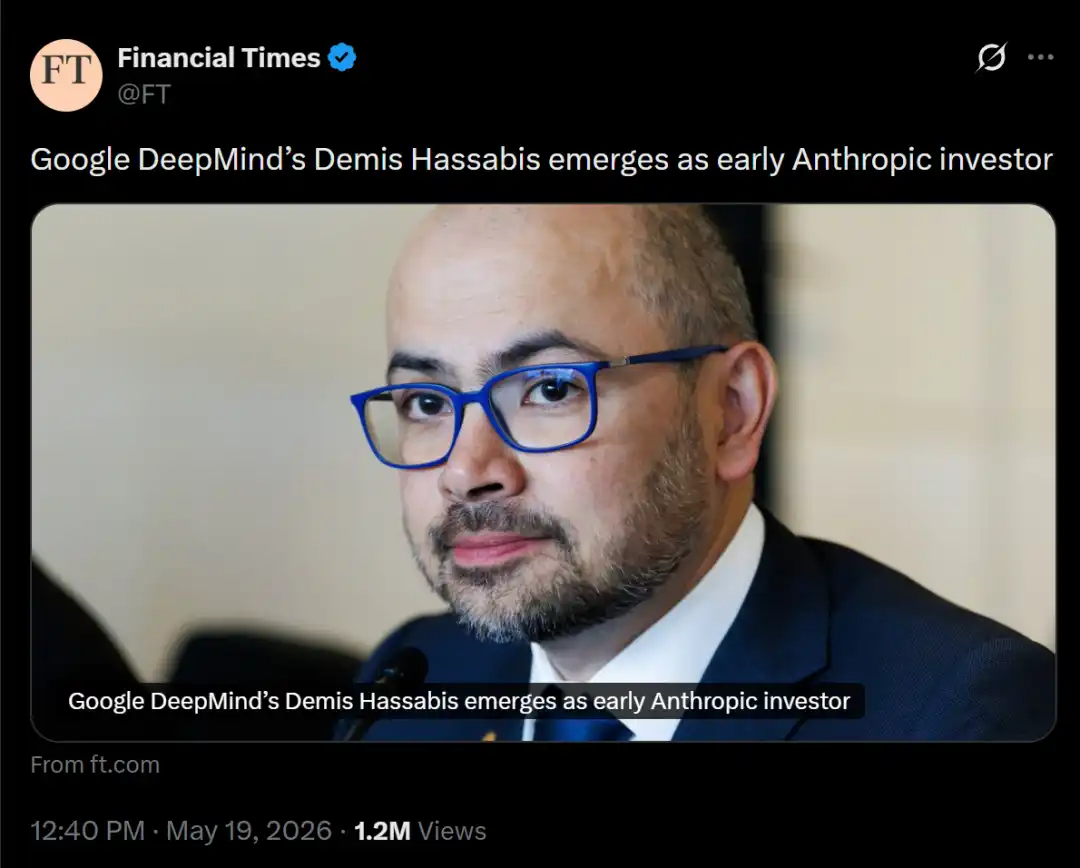
Demis Hassabis, Google AI's top leader, DeepMind founder, and Nobel laureate, was reportedly revealed to be an early, secret financial backer of its biggest rival, the super-unicorn Anthropic!
This meticulously planned infiltration is utterly shocking.

Even more unexpected is that following this clue has unearthed a vast 'DeepMind Mafia' empire, intricately woven and with deeply intertwined interests, personally orchestrated by Hassabis.

From Anthropic, valued at a staggering $900 billion, to Inflection AI which secured massive Microsoft investment, to Ineffable Intelligence which recently landed over $3 billion in funding... the leading figures or early backers behind the world's hottest, most cash-magnetizing AI startups are all him!

This is perhaps the most brilliant "Trojan Horse" in tech history—this "Godfather of AI" has quietly taken control of the discourse power in the global AI ecosystem right under our noses.
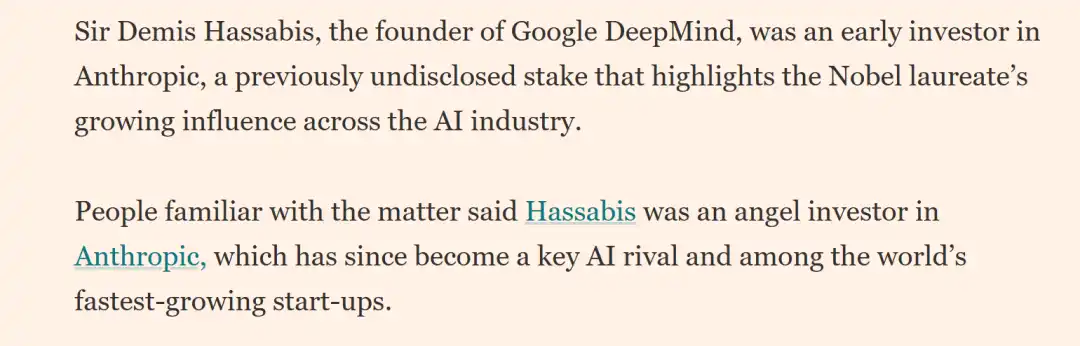
The Ultimate "Infiltration": Google AI Boss is a Major Shareholder in Its Rival?

In the current large model battlefield, Google's Gemini and Anthropic's Claude are locked in intense competition.

To outmaneuver their opponent, the two companies are engaged in a pixel-perfect arms race every day.

Yet, who would have thought that while Google employees work overtime to benchmark against Claude, their top boss had quietly bought shares in this "rival" company back when Anthropic was first founded.

According to the latest revelations by the Financial Times, Hassabis secretly invested in Anthropic as a personal angel investor during its early days.

This hidden ownership stake was previously unknown to the public.

The shock level is akin to discovering that during the fierce Cola Wars, the CEO of Coca-Cola was a founding shareholder of PepsiCo.
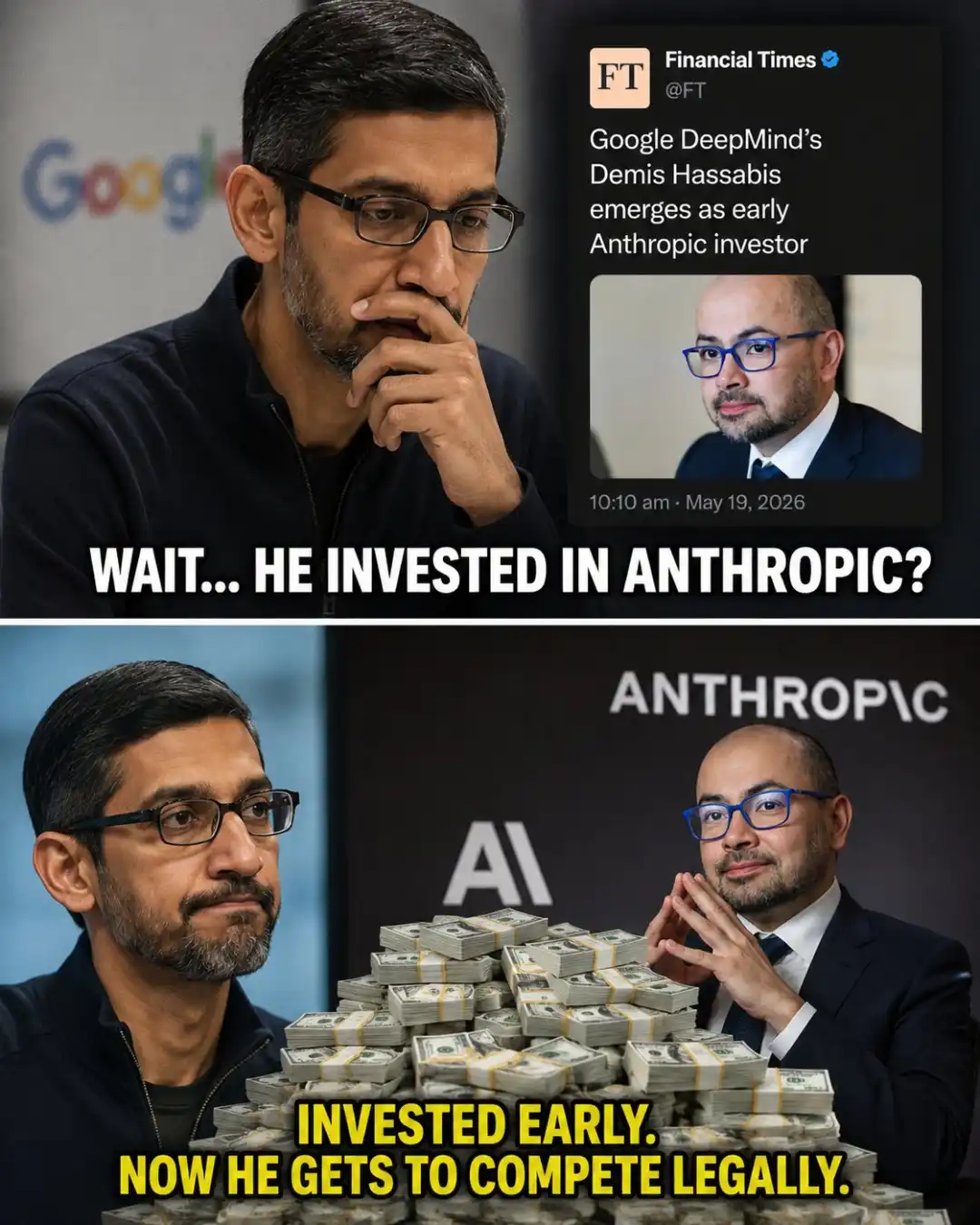
Looking at Anthropic's current monstrous size, you know Hassabis's investment paid off handsomely.

According to insiders, Anthropic's valuation has skyrocketed to an astonishing $900 billion in its latest funding round!

It has not only surpassed its arch-rival OpenAI but has ballooned into the fastest-growing "Leviathan" in global tech history.

Do the math, the assets in Hassabis's hands are now enormous enough to rival nations.

What's even more interesting is that Hassabis's "mothership," Google, later joined the game as well.

Google officially announced a multi-billion dollar investment in Anthropic earlier, establishing a deep cloud and AI partnership.
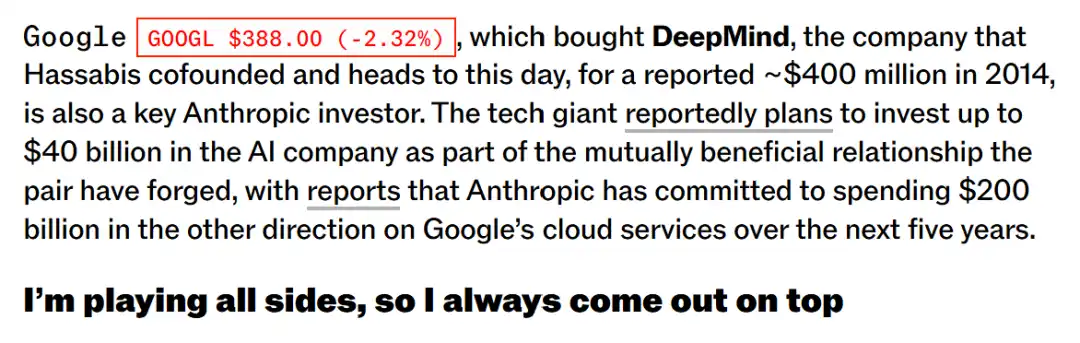
Rumored details of the deal suggest the scale of this "two-way street" is staggering—

Google reportedly plans to invest up to $40 billion in Anthropic; in return, as part of the agreement, Anthropic is said to have committed to spending a whopping $200 billion on Google Cloud services over the next five years!

In his left hand is the Google AI empire he commands; in his right hand is the $900 billion rival he incubated early on; and in between are tens of billions in cloud service contracts.

Hassabis's actions show us, "If I bet on both sides, the only winner in the end can be me."

Dario: He is My Mentor

Digging deeper, things get even more intriguing.

The relationship between the two men goes far beyond mere financial ties.

According to sources close to Anthropic's leadership, Dario Amodei, Anthropic's founder and CEO, privately regards Hassabis as his role model and mentor.

Even though Dario previously held a core executive position at OpenAI, in his heart, Hassabis's DeepMind represents the holy grail of modern AI engineering.

In Dario's widely circulated personal essay "Machines of Loving Grace," although he doesn't name names directly, the reverence and admiration for a certain "AI pioneer" between the lines is unmistakable to anyone reading.

Anyone with insight can tell—he's talking about Hassabis.

The "Couch Moment" at the World Economic Forum

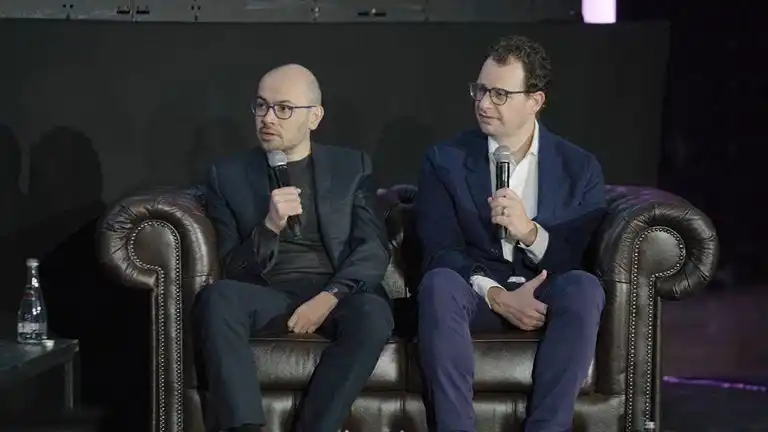
This relationship of friendly rivalry and mutual admiration was immortalized in a famous moment at the 2025 World Economic Forum.

At the time, as leaders of two industry giants, Hassabis and Dario, during an interview, were squeezed onto a narrow two-seater sofa by event staff.

The two AI titans, worth billions and shaping humanity's future, sat shoulder to shoulder, pressed tightly together due to the cramped space.

According to eyewitnesses, the scene was described like this: "It was a textbook example of tech world bromance. Two public rivals, squeezed together on camera, their eyes holding not animosity, but instead a sense of mutual understanding and amusement shared by peers at the top."

This personal closeness, transcending corporate boundaries, not only softens the coldness of business warfare but also reveals that on the highest throne of AI, they are fellow travelers on the same path.
The "DeepMind Mafia" on a Rampage: Former Employees Raised $14 Billion in Four Years!

Hassabis's ambition is far from limited to just Anthropic.

In Silicon Valley, there was once the famous "PayPal Mafia." This entrepreneurial clique, consisting of Elon Musk, Peter Thiel, Reid Hoffman, and others, nearly dominated the early Web 2.0 era.

Today, a more massive and potentially more disruptive "DeepMind Mafia" is rapidly expanding, with dual centers in London and Silicon Valley.
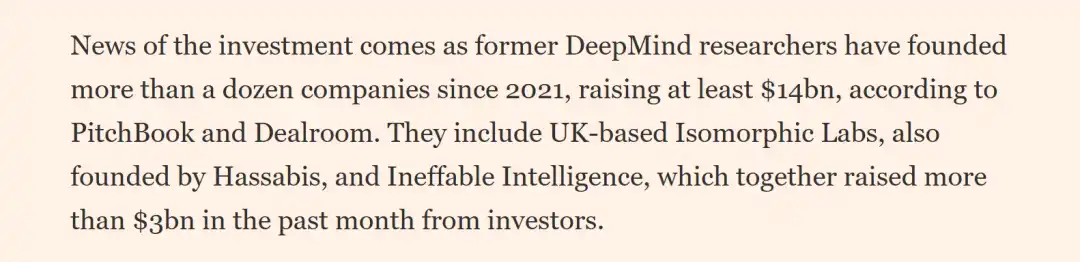
According to the latest statistics from the international authoritative startup databases PitchBook and Dealroom: Since 2021, core technical leads and executives who left DeepMind have gone on to found over 12 super AI startups.

Within just four years, this faction has cumulatively and frenziedly secured over $14 billion in funding from the market!

This scale is enough to make any venture capital firm tremble.

Let's look at this empire map composed of Hassabis and his disciples—

Core Members of the "DeepMind Mafia"
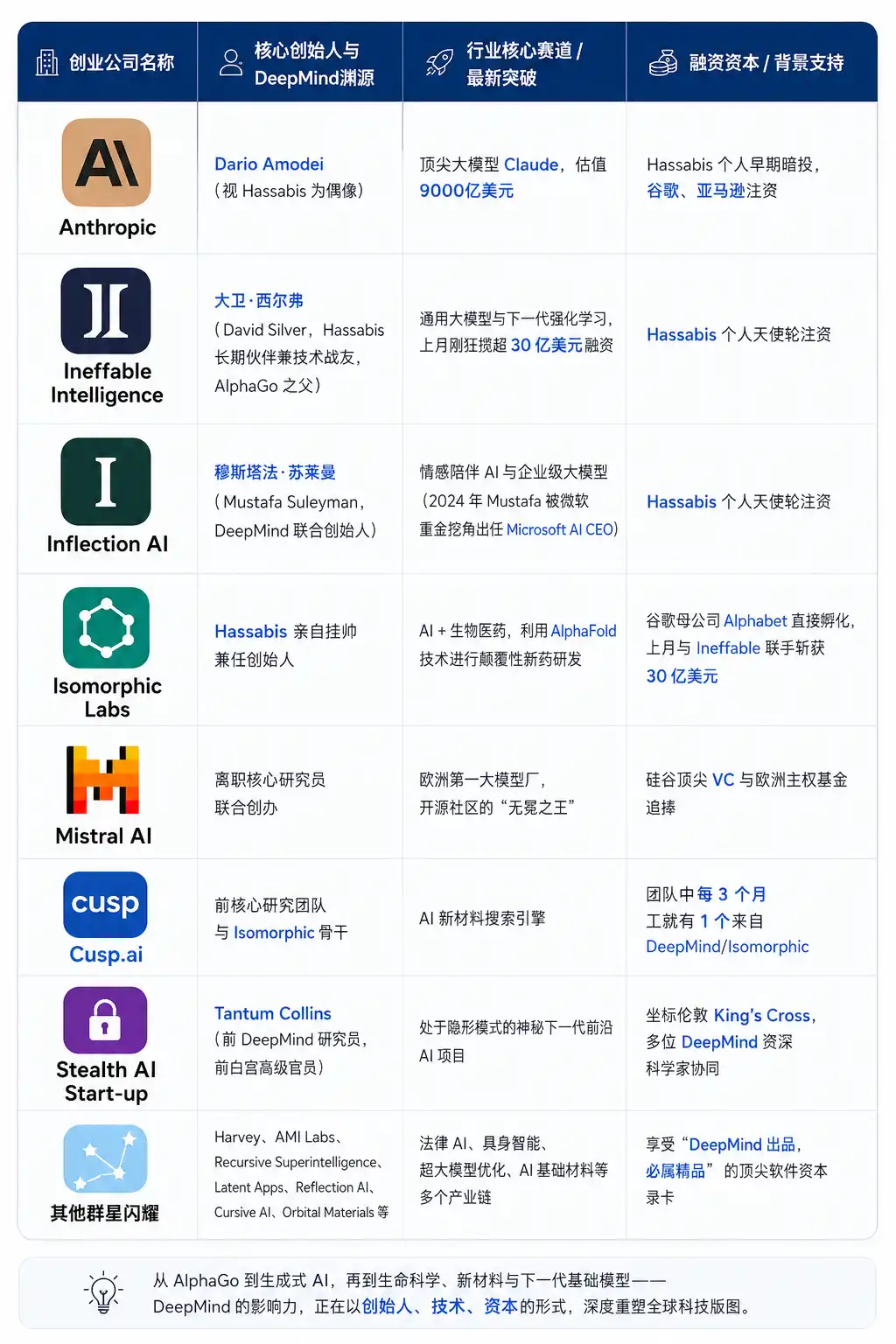
This list is still growing rapidly.

A seasoned Silicon Valley investor put it this way: "Nowadays, in the AI startup scene, if your resume says 'Former Senior Researcher at DeepMind,' you don't even need to finish your pitch deck—the checks are already on the table."

The Hidden Capital Web: Revealing the Harsh Truth Behind the Giants' 'Bloody War'

The most terrifying aspect of Hassabis's capital puzzle is its comprehensiveness and covertness.

As a billionaire who sold DeepMind to Google for £400 million in 2014, Hassabis holds vast cash reserves.

But instead of spending it on yachts or mansions like the typical wealthy, he turned this money into numerous precise capital tentacles, quietly reaching into the entrepreneurial ventures of former colleagues and subordinates.

David Silver wants to work on general AI, Hassabis invests.

Mustafa Suleyman leaves to start Inflection AI, Hassabis invests.

He is even a core angel investor in the famous startup incubator Entrepreneurs First (EF).

This kind of capital deployment completely tears open the harsh truth of modern tech giant competition—

Under the spotlight, the giants fight fiercely over market share, for financial reports and stock prices, engaging in bloody PR wars and patent battles.

But behind the curtain, the top AI elites are deeply bound together through a hidden network woven from personal capital, mentor-discipleship, and former colleague relationships.
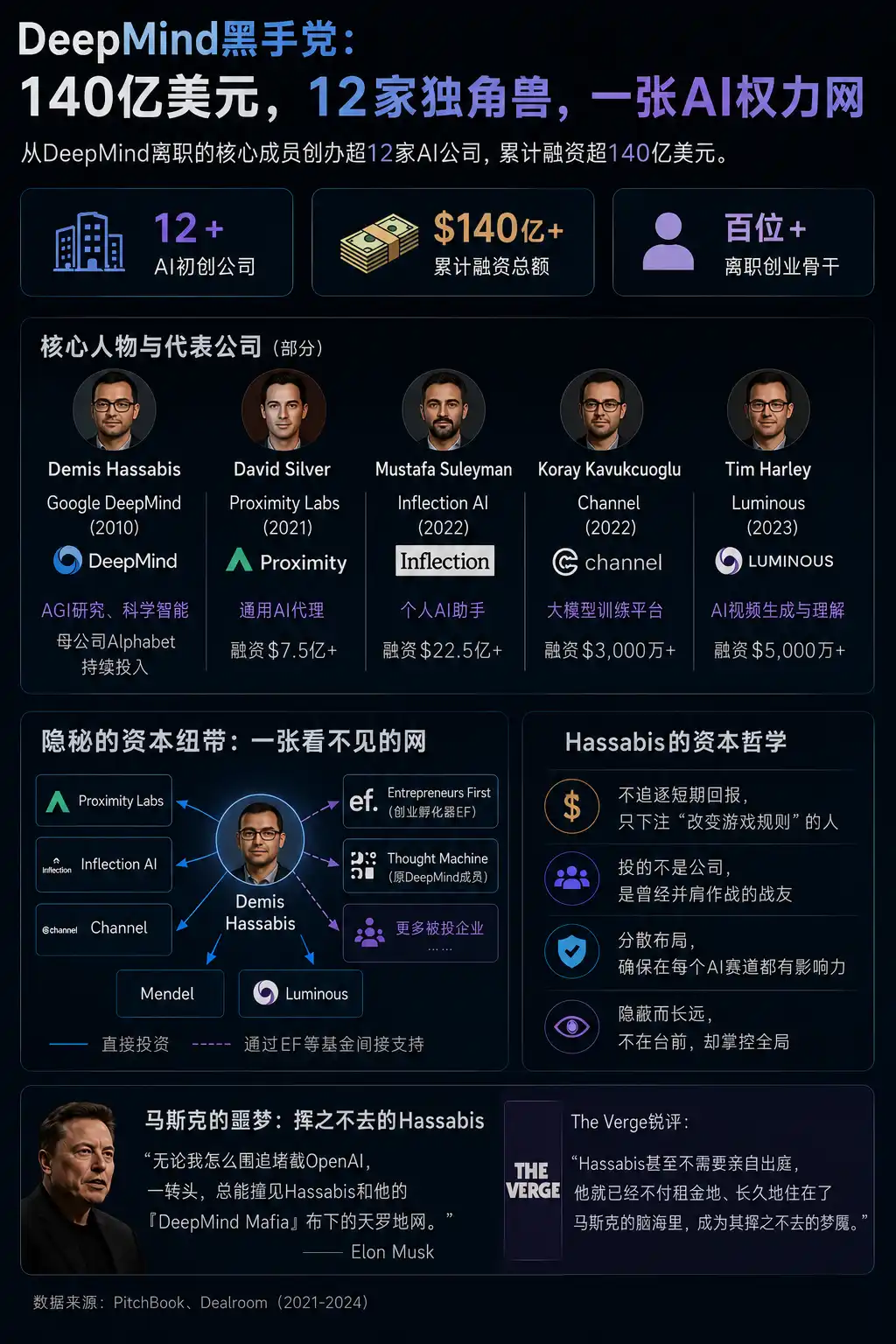
This phenomenon has even caused the maverick Elon Musk anxiety and anger.

In the high-profile, ongoing "Musk vs. Altman" lawsuit, court documents and testimonies show that Hassabis's name appears with high frequency in Musk's legal filings.

The Verge sharply commented: "Hassabis doesn't even need to show up in court; he already resides rent-free, permanently, in Musk's mind, becoming Musk's haunting nightmare.

Because Musk has discovered that no matter how he tries to corner OpenAI, whenever he turns around, he always runs into the intricate net laid by Hassabis and his 'DeepMind Mafia.'"

Pulling the Strings from Within: DeepMind Takes Over Google Completely

If aggressively deploying capital externally and nurturing external armies represents Hassabis's external strategy; then centralizing power and pulling strings from behind the scenes within Google is his internal mastery.

While exporting capital outward, DeepMind's senior executives are taking over the core power of the entire Google tech empire at an astonishing pace.

2023: The Unification of Google AI

Looking back to 2023, when OpenAI unleashed ChatGPT and caught Google off guard, causing its stock price to plummet, Alphabet made a historic decision: forcibly merging Google's once-proud Google Brain with DeepMind to form the new Google DeepMind, placed under Hassabis's unified command.

On the surface, this merger was a combination of strengths; in reality, it was a full-scale takeover of Google's core R&D force by DeepMind.

Hassabis declared at the time: "We need to simplify decision-making with greater speed, stronger collaboration, and execution to focus on achieving maximum impact."

Translation: I'm in charge of the AI business here.

Core Lieutenants, Ascending to Power

Within just two years, DeepMind's trusted inner circle has completely taken over and occupied the core decision-making layers of Google's AI and cloud services.

Koray Kavukcuoglu, DeepMind's former CTO, was officially promoted last year to Google's Chief AI Architect.

This means the underlying architecture of all future Google AI products bears the DeepMind stamp.

Pushmeet Kohli, who led the Nobel Prize-winning scientific marvel AlphaFold project, was formally appointed last month as Google Cloud's Chief Scientist. Thus, the technical brain behind Google's most profitable cloud business is also now a DeepMind confidant.

The "Power Behind the Throne" in London

Most remarkably, even though DeepMind has thoroughly completed its reverse takeover of Google's AI empire, Hassabis, wielding immense power, stubbornly keeps his headquarters in London's King's Cross district, refusing to relocate to Silicon Valley's Mountain View.

To accommodate this true power, Google even spent $1 billion building a grand new headquarters building in London's King's Cross.

"Demis possesses terrifying, incalculable soft power both within Google and across the entire tech industry," remarked Matt Clifford, a long-time friend of Hassabis and co-founder of EF.

"He was a pioneer long before anyone else figured out what AI was. A large part of the reason the younger generation of founders can raise such massive amounts of money is because they carry Demis's spiritual endorsement. Whether he's in Silicon Valley or London, his influence is growing exponentially."

The Ultimate Gambit of the "Godfather of AI"

As a former child prodigy in chess, now knighted by the British monarchy, Demis Hassabis clearly sees the entire global AI industry as a grand chess game.

In this game, Gemini is his public-facing chariot charging for Google; Anthropic is the hidden piece he placed secretly as a contingency; Ineffable, Inflection, Mistral, and other billion-dollar unicorns are the sharp pawns he has scattered across the board, ready to encircle the market at any moment.

And he himself sits calmly in his King's Cross office, watching capital, talent, and technology circulate perfectly within the web he has woven.

This recent exposure by the media punctures the harshest truth in the tech circle: the so-called great war among giants is nothing but a capital game played by the top elites, moving pieces from left hand to right.

No matter where the tide of technology flows, it never escapes the grasp of those who bought into the wave early.


Domande pertinenti

QWhat was the shocking revelation about Google's AI chief Demis Hassabis reported in the article?

ADemis Hassabis, Google's AI chief and DeepMind founder, was revealed to be an early secret financial backer of Anthropic, Google's major rival in AI.

QAccording to the article, what is the term used to describe the network of former DeepMind employees and their influence in the AI startup scene?

AThe term used is the 'DeepMind Mafia,' referring to the extensive network of former DeepMind employees who have founded and led major AI startups, collectively raising over $14 billion in funding.

QWhat significant corporate restructuring did Google undertake in 2023 in response to competitive pressure, as mentioned in the article?

AIn 2023, Google merged its Google Brain AI research unit with DeepMind to form Google DeepMind, placing it under the unified leadership of Demis Hassabis to streamline AI efforts.

QHow does the article characterize the relationship between Demis Hassabis and Anthropic CEO Dario Amodei?

AThe article characterizes their relationship as one of mutual respect and mentorship, with Dario Amodei privately viewing Hassabis as a role model and spiritual guide, despite their companies being public rivals.

QWhat is the article's perspective on the nature of competition among major AI companies?

AThe article suggests that while AI giants compete fiercely in public, the competition is underpinned by a hidden network of personal capital, mentorship, and former colleague ties among top AI elites, implying a more interconnected and less adversarial reality at the highest levels.

Letture associate

Warsh's First Day in Office, Markets Deliver a 'Wake-up Call': Rate Hike Expected This Year

On his first day in office, newly inaugurated Federal Reserve Chairman Warsh received a stark market warning, with expectations now fully pricing in a 25-basis-point interest rate hike this year. The shift was triggered by hawkish remarks from Fed Governor Waller, who stated that inflation is now the key policy "driver" and that the odds of a hike or cut are evenly split. This sent short-term Treasury yields higher. Waller signaled a significant pivot in his stance, citing disappointing inflation and labor data. He suggested removing "easing bias" language from Fed statements and did not rule out future rate increases if inflation fails to recede, though he noted immediate action isn't warranted without signs of unanchored inflation expectations. Chairman Warsh faces immediate pressure at his first FOMC meeting in June. With the preferred inflation gauge at a three-year high, analysts warn that failing to hike could be interpreted as an implicit easing of policy. The geopolitical situation in the Middle East is adding to existing price pressures. The market's expectation for a hike contrasts sharply with earlier forecasts for multiple cuts. While long-term Treasury yields have been contained by lower energy prices recently, analysts note they remain under structural upward pressure. Warsh's swearing-in at the White House highlights political scrutiny over Fed independence. However, the market has made it clear that inflation is the most urgent challenge, leaving the new chairman little time to settle in.

marsbit5 h fa

Warsh's First Day in Office, Markets Deliver a 'Wake-up Call': Rate Hike Expected This Year

marsbit5 h fa

Has Microsoft Lost Its Way in the AI Race, and Can Copilot Bring It Back on Track?

Microsoft, once seen as an early AI frontrunner due to its investment in OpenAI, is navigating a strategic shift amid increased competition. Its initial reliance on OpenAI’s GPT models has been complicated by OpenAI’s growing ambitions as a direct competitor, rapid advancements from rivals like Claude and Gemini, and the disruptive rise of AI agents, which challenge its traditional SaaS business model. These factors contributed to stock declines and slower-than-expected adoption of its flagship Copilot products. In response, CEO Satya Nadella has taken a hands-on role in product development, signaling the urgency of change. Microsoft is pivoting from a model-centric strategy to a "model-agnostic" enterprise platform approach. It aims to become the foundational layer connecting various AI models—from OpenAI, Anthropic, or its own new "Superintelligence" team—with enterprise workflows, data, security, and cloud services. Recent organizational changes merged consumer and enterprise Copilot teams to accelerate innovation, exemplified by new products like Copilot Tasks and Copilot Cowork. However, this transformation comes at a high cost. Microsoft faces massive capital expenditures, potentially reaching ~$190 billion by 2026, to support AI infrastructure. While its platform strategy shows early signs of traction with growing Azure AI revenue, it must balance startup-like agility with the reliability expected by enterprise clients. The core challenge is no longer being the sole AI winner but defending its position as the essential enterprise software entry point amidst rapid technological commoditization and the shift towards always-on AI agents.

marsbit6 h fa

Has Microsoft Lost Its Way in the AI Race, and Can Copilot Bring It Back on Track?

marsbit6 h fa

Why Haven't Forex Stablecoins Taken Off?

Why FX Stablecoins Never Took Off: A Path Forward via Synthetic FX Despite the explosive growth of stablecoin-powered digital banking, which has seen ~$6B in VC investment and a 24x surge in crypto card spending in under a year, a major limitation persists: these banks are essentially dollar-only accounts. This leaves 95-99% of global accounts, which are denominated in non-USD currencies, underserved. Attempts to create native foreign currency (FX) stablecoins (like EURC) have largely failed, with total FX stablecoin TVL at ~$600M compared to $400B for USD stablecoins—a 700x gap. These FX tokens face critical challenges: fragile pegs due to low liquidity, limited exchange/FinTech acceptance, poor on/off-ramps, complex regional compliance, and a chicken-and-egg adoption problem. The article argues that the solution lies not in competing with entrenched USD stablecoin networks (USDT/USDC), but in adopting a synthetic FX model inspired by traditional finance. Specifically, it advocates for Mark-to-Market Non-Deliverable Forwards (NDFs)—cash-settled FX derivatives that allow users to maintain underlying USD stablecoin holdings while having their account balance and P&L denominated in a foreign currency. This approach offers key advantages: strong oracle-based pegs, retention of deep USD stablecoin liquidity and yield, superior on/off-ramps, scalability to any currency with a reliable feed, and capital efficiency. It mirrors how modern institutional FX markets operate. Primary use cases for on-chain NDFs include: 1. **Digital Banks/Wallets:** Enabling multi-currency accounts for international users without leaving the USD stablecoin ecosystem, boosting deposits and retention. 2. **FX Carry Trade Vaults:** Offering access to sovereign interest rate differentials (e.g., earning yield on BRL) in a more stable and scalable format than crypto-native products like Ethena. 3. **Global Enterprise Payments:** Allowing merchants to receive payments in local currency equivalents while settling in USD stablecoins, similar to services offered by Stripe for fiat. The conclusion is that synthetic FX, not native FX stablecoins, is the viable path to integrating foreign exchange into the growing stablecoin digital banking landscape, potentially unlocking the next phase of institutional DeFi and multi-trillion-dollar global adoption.

链捕手6 h fa

Why Haven't Forex Stablecoins Taken Off?

链捕手6 h fa

Trading

Spot
Futures

Articoli Popolari

Cosa è $S$

Comprendere SPERO: Una Panoramica Completa Introduzione a SPERO Mentre il panorama dell'innovazione continua a evolversi, l'emergere delle tecnologie web3 e dei progetti di criptovaluta gioca un ruolo fondamentale nel plasmare il futuro digitale. Un progetto che ha attirato l'attenzione in questo campo dinamico è SPERO, denotato come SPERO,$$s$. Questo articolo mira a raccogliere e presentare informazioni dettagliate su SPERO, per aiutare gli appassionati e gli investitori a comprendere le sue basi, obiettivi e innovazioni nei domini web3 e crypto. Che cos'è SPERO,$$s$? SPERO,$$s$ è un progetto unico all'interno dello spazio crypto che cerca di sfruttare i principi della decentralizzazione e della tecnologia blockchain per creare un ecosistema che promuove l'impegno, l'utilità e l'inclusione finanziaria. Il progetto è progettato per facilitare interazioni peer-to-peer in modi nuovi, fornendo agli utenti soluzioni e servizi finanziari innovativi. Al suo interno, SPERO,$$s$ mira a responsabilizzare gli individui fornendo strumenti e piattaforme che migliorano l'esperienza dell'utente nello spazio delle criptovalute. Questo include la possibilità di metodi di transazione più flessibili, la promozione di iniziative guidate dalla comunità e la creazione di percorsi per opportunità finanziarie attraverso applicazioni decentralizzate (dApps). La visione sottostante di SPERO,$$s$ ruota attorno all'inclusività, cercando di colmare le lacune all'interno della finanza tradizionale mentre sfrutta i vantaggi della tecnologia blockchain. Chi è il Creatore di SPERO,$$s$? L'identità del creatore di SPERO,$$s$ rimane piuttosto oscura, poiché ci sono risorse pubblicamente disponibili limitate che forniscono informazioni dettagliate sul suo fondatore o fondatori. Questa mancanza di trasparenza può derivare dall'impegno del progetto per la decentralizzazione—un ethos che molti progetti web3 condividono, dando priorità ai contributi collettivi rispetto al riconoscimento individuale. Centrando le discussioni attorno alla comunità e ai suoi obiettivi collettivi, SPERO,$$s$ incarna l'essenza dell'empowerment senza mettere in evidenza individui specifici. Pertanto, comprendere l'etica e la missione di SPERO rimane più importante che identificare un creatore singolo. Chi sono gli Investitori di SPERO,$$s$? SPERO,$$s$ è supportato da una varietà di investitori che vanno dai capitalisti di rischio agli investitori angelici dedicati a promuovere l'innovazione nel settore crypto. Il focus di questi investitori generalmente si allinea con la missione di SPERO—dando priorità a progetti che promettono avanzamenti tecnologici sociali, inclusività finanziaria e governance decentralizzata. Queste fondazioni di investitori sono tipicamente interessate a progetti che non solo offrono prodotti innovativi, ma contribuiscono anche positivamente alla comunità blockchain e ai suoi ecosistemi. Il supporto di questi investitori rafforza SPERO,$$s$ come un concorrente degno di nota nel dominio in rapida evoluzione dei progetti crypto. Come Funziona SPERO,$$s$? SPERO,$$s$ impiega un framework multifunzionale che lo distingue dai progetti di criptovaluta convenzionali. Ecco alcune delle caratteristiche chiave che sottolineano la sua unicità e innovazione: Governance Decentralizzata: SPERO,$$s$ integra modelli di governance decentralizzati, responsabilizzando gli utenti a partecipare attivamente ai processi decisionali riguardanti il futuro del progetto. Questo approccio favorisce un senso di proprietà e responsabilità tra i membri della comunità. Utilità del Token: SPERO,$$s$ utilizza il proprio token di criptovaluta, progettato per servire varie funzioni all'interno dell'ecosistema. Questi token abilitano transazioni, premi e la facilitazione dei servizi offerti sulla piattaforma, migliorando l'impegno e l'utilità complessivi. Architettura Stratificata: L'architettura tecnica di SPERO,$$s$ supporta la modularità e la scalabilità, consentendo un'integrazione fluida di funzionalità e applicazioni aggiuntive man mano che il progetto evolve. Questa adattabilità è fondamentale per mantenere la rilevanza nel panorama crypto in continua evoluzione. Coinvolgimento della Comunità: Il progetto enfatizza iniziative guidate dalla comunità, impiegando meccanismi che incentivano la collaborazione e il feedback. Nutrendo una comunità forte, SPERO,$$s$ può affrontare meglio le esigenze degli utenti e adattarsi alle tendenze di mercato. Focus sull'Inclusione: Offrendo basse commissioni di transazione e interfacce user-friendly, SPERO,$$s$ mira ad attrarre una base utenti diversificata, inclusi individui che potrebbero non aver precedentemente interagito nello spazio crypto. Questo impegno per l'inclusione si allinea con la sua missione generale di empowerment attraverso l'accessibilità. Cronologia di SPERO,$$s$ Comprendere la storia di un progetto fornisce preziose intuizioni sulla sua traiettoria di sviluppo e sui traguardi. Di seguito è riportata una cronologia suggerita che mappa eventi significativi nell'evoluzione di SPERO,$$s$: Fase di Concettualizzazione e Ideazione: Le idee iniziali che formano la base di SPERO,$$s$ sono state concepite, allineandosi strettamente con i principi di decentralizzazione e focus sulla comunità all'interno dell'industria blockchain. Lancio del Whitepaper del Progetto: Dopo la fase concettuale, è stato rilasciato un whitepaper completo che dettaglia la visione, gli obiettivi e l'infrastruttura tecnologica di SPERO,$$s$ per suscitare interesse e feedback dalla comunità. Costruzione della Comunità e Prime Interazioni: Sono stati effettuati sforzi attivi di outreach per costruire una comunità di early adopters e potenziali investitori, facilitando discussioni attorno agli obiettivi del progetto e ottenendo supporto. Evento di Generazione del Token: SPERO,$$s$ ha condotto un evento di generazione del token (TGE) per distribuire i propri token nativi ai primi sostenitori e stabilire una liquidità iniziale all'interno dell'ecosistema. Lancio della Prima dApp: La prima applicazione decentralizzata (dApp) associata a SPERO,$$s$ è stata attivata, consentendo agli utenti di interagire con le funzionalità principali della piattaforma. Sviluppo Continuo e Partnership: Aggiornamenti e miglioramenti continui alle offerte del progetto, inclusi partnership strategiche con altri attori nello spazio blockchain, hanno plasmato SPERO,$$s$ in un concorrente competitivo e in evoluzione nel mercato crypto. Conclusione SPERO,$$s$ rappresenta una testimonianza del potenziale del web3 e delle criptovalute di rivoluzionare i sistemi finanziari e responsabilizzare gli individui. Con un impegno per la governance decentralizzata, il coinvolgimento della comunità e funzionalità progettate in modo innovativo, apre la strada verso un panorama finanziario più inclusivo. Come per qualsiasi investimento nello spazio crypto in rapida evoluzione, si incoraggiano potenziali investitori e utenti a ricercare approfonditamente e a impegnarsi in modo riflessivo con gli sviluppi in corso all'interno di SPERO,$$s$. Il progetto mostra lo spirito innovativo dell'industria crypto, invitando a ulteriori esplorazioni delle sue innumerevoli possibilità. Mentre il percorso di SPERO,$$s$ è ancora in fase di sviluppo, i suoi principi fondamentali potrebbero effettivamente influenzare il futuro di come interagiamo con la tecnologia, la finanza e tra di noi in ecosistemi digitali interconnessi.

75 Totale visualizzazioniPubblicato il 2024.12.17Aggiornato il 2024.12.17

Cosa è $S$

Cosa è AGENT S

Agent S: Il Futuro dell'Interazione Autonoma in Web3 Introduzione Nel panorama in continua evoluzione di Web3 e criptovalute, le innovazioni stanno costantemente ridefinendo il modo in cui gli individui interagiscono con le piattaforme digitali. Uno di questi progetti pionieristici, Agent S, promette di rivoluzionare l'interazione uomo-computer attraverso il suo framework agentico aperto. Aprendo la strada a interazioni autonome, Agent S mira a semplificare compiti complessi, offrendo applicazioni trasformative nell'intelligenza artificiale (AI). Questa esplorazione dettagliata approfondirà le complessità del progetto, le sue caratteristiche uniche e le implicazioni per il dominio delle criptovalute. Cos'è Agent S? Agent S si presenta come un innovativo framework agentico aperto, progettato specificamente per affrontare tre sfide fondamentali nell'automazione dei compiti informatici: Acquisizione di Conoscenze Specifiche del Dominio: Il framework apprende in modo intelligente da varie fonti di conoscenza esterne ed esperienze interne. Questo approccio duale gli consente di costruire un ricco repository di conoscenze specifiche del dominio, migliorando le sue prestazioni nell'esecuzione dei compiti. Pianificazione su Lungo Orizzonte di Compiti: Agent S impiega una pianificazione gerarchica potenziata dall'esperienza, un approccio strategico che facilita la suddivisione e l'esecuzione efficiente di compiti complessi. Questa caratteristica migliora significativamente la sua capacità di gestire più sottocompiti in modo efficiente ed efficace. Gestione di Interfacce Dinamiche e Non Uniformi: Il progetto introduce l'Interfaccia Agente-Computer (ACI), una soluzione innovativa che migliora l'interazione tra agenti e utenti. Utilizzando Modelli Linguistici Multimodali di Grandi Dimensioni (MLLM), Agent S può navigare e manipolare senza sforzo diverse interfacce grafiche utente. Attraverso queste caratteristiche pionieristiche, Agent S fornisce un framework robusto che affronta le complessità coinvolte nell'automazione dell'interazione umana con le macchine, preparando il terreno per innumerevoli applicazioni nell'AI e oltre. Chi è il Creatore di Agent S? Sebbene il concetto di Agent S sia fondamentalmente innovativo, informazioni specifiche sul suo creatore rimangono elusive. Il creatore è attualmente sconosciuto, il che evidenzia sia la fase embrionale del progetto sia la scelta strategica di mantenere i membri fondatori sotto anonimato. Indipendentemente dall'anonimato, l'attenzione rimane sulle capacità e sul potenziale del framework. Chi sono gli Investitori di Agent S? Poiché Agent S è relativamente nuovo nell'ecosistema crittografico, informazioni dettagliate riguardanti i suoi investitori e sostenitori finanziari non sono documentate esplicitamente. La mancanza di approfondimenti pubblicamente disponibili sulle fondazioni di investimento o sulle organizzazioni che supportano il progetto solleva interrogativi sulla sua struttura di finanziamento e sulla roadmap di sviluppo. Comprendere il supporto è cruciale per valutare la sostenibilità del progetto e il suo potenziale impatto sul mercato. Come Funziona Agent S? Al centro di Agent S si trova una tecnologia all'avanguardia che gli consente di funzionare efficacemente in contesti diversi. Il suo modello operativo è costruito attorno a diverse caratteristiche chiave: Interazione Uomo-Computer Simile a Quella Umana: Il framework offre una pianificazione AI avanzata, cercando di rendere le interazioni con i computer più intuitive. Mimando il comportamento umano nell'esecuzione dei compiti, promette di elevare le esperienze degli utenti. Memoria Narrativa: Utilizzata per sfruttare esperienze di alto livello, Agent S utilizza la memoria narrativa per tenere traccia delle storie dei compiti, migliorando così i suoi processi decisionali. Memoria Episodica: Questa caratteristica fornisce agli utenti una guida passo-passo, consentendo al framework di offrire supporto contestuale mentre i compiti si sviluppano. Supporto per OpenACI: Con la capacità di funzionare localmente, Agent S consente agli utenti di mantenere il controllo sulle proprie interazioni e flussi di lavoro, allineandosi con l'etica decentralizzata di Web3. Facile Integrazione con API Esterne: La sua versatilità e compatibilità con varie piattaforme AI garantiscono che Agent S possa adattarsi senza problemi agli ecosistemi tecnologici esistenti, rendendolo una scelta attraente per sviluppatori e organizzazioni. Queste funzionalità contribuiscono collettivamente alla posizione unica di Agent S all'interno dello spazio crittografico, poiché automatizza compiti complessi e multi-fase con un intervento umano minimo. Man mano che il progetto evolve, le sue potenziali applicazioni in Web3 potrebbero ridefinire il modo in cui si svolgono le interazioni digitali. Cronologia di Agent S Lo sviluppo e le tappe di Agent S possono essere riassunti in una cronologia che evidenzia i suoi eventi significativi: 27 Settembre 2024: Il concetto di Agent S è stato lanciato in un documento di ricerca completo intitolato “Un Framework Agentico Aperto che Usa i Computer Come un Umano”, mostrando le basi per il progetto. 10 Ottobre 2024: Il documento di ricerca è stato reso pubblicamente disponibile su arXiv, offrendo un'esplorazione approfondita del framework e della sua valutazione delle prestazioni basata sul benchmark OSWorld. 12 Ottobre 2024: È stata rilasciata una presentazione video, fornendo un'idea visiva delle capacità e delle caratteristiche di Agent S, coinvolgendo ulteriormente potenziali utenti e investitori. Questi indicatori nella cronologia non solo illustrano i progressi di Agent S, ma indicano anche il suo impegno per la trasparenza e il coinvolgimento della comunità. Punti Chiave su Agent S Man mano che il framework Agent S continua a evolversi, diversi attributi chiave si distinguono, sottolineando la sua natura innovativa e il potenziale: Framework Innovativo: Progettato per fornire un uso intuitivo dei computer simile all'interazione umana, Agent S porta un approccio nuovo all'automazione dei compiti. Interazione Autonoma: La capacità di interagire autonomamente con i computer attraverso GUI segna un passo avanti verso soluzioni informatiche più intelligenti ed efficienti. Automazione di Compiti Complessi: Con la sua metodologia robusta, può automatizzare compiti complessi e multi-fase, rendendo i processi più veloci e meno soggetti a errori. Miglioramento Continuo: I meccanismi di apprendimento consentono ad Agent S di migliorare dalle esperienze passate, migliorando continuamente le sue prestazioni e la sua efficacia. Versatilità: La sua adattabilità attraverso diversi ambienti operativi come OSWorld e WindowsAgentArena garantisce che possa servire un'ampia gamma di applicazioni. Man mano che Agent S si posiziona nel panorama di Web3 e delle criptovalute, il suo potenziale per migliorare le capacità di interazione e automatizzare i processi segna un significativo avanzamento nelle tecnologie AI. Attraverso il suo framework innovativo, Agent S esemplifica il futuro delle interazioni digitali, promettendo un'esperienza più fluida ed efficiente per gli utenti in vari settori. Conclusione Agent S rappresenta un audace passo avanti nell'unione tra AI e Web3, con la capacità di ridefinire il modo in cui interagiamo con la tecnologia. Sebbene sia ancora nelle sue fasi iniziali, le possibilità per la sua applicazione sono vaste e coinvolgenti. Attraverso il suo framework completo che affronta sfide critiche, Agent S mira a portare le interazioni autonome al centro dell'esperienza digitale. Man mano che ci addentriamo nei regni delle criptovalute e della decentralizzazione, progetti come Agent S giocheranno senza dubbio un ruolo cruciale nel plasmare il futuro della tecnologia e della collaborazione uomo-computer.

521 Totale visualizzazioniPubblicato il 2025.01.14Aggiornato il 2025.01.14

Cosa è AGENT S

Come comprare S

Benvenuto in HTX.com! Abbiamo reso l'acquisto di Sonic (S) semplice e conveniente. Segui la nostra guida passo passo per intraprendere il tuo viaggio nel mondo delle criptovalute.Step 1: Crea il tuo Account HTXUsa la tua email o numero di telefono per registrarti il tuo account gratuito su HTX. Vivi un'esperienza facile e sblocca tutte le funzionalità,Crea il mio accountStep 2: Vai in Acquista crypto e seleziona il tuo metodo di pagamentoCarta di credito/debito: utilizza la tua Visa o Mastercard per acquistare immediatamente SonicS.Bilancio: Usa i fondi dal bilancio del tuo account HTX per fare trading senza problemi.Terze parti: abbiamo aggiunto metodi di pagamento molto utilizzati come Google Pay e Apple Pay per maggiore comodità.P2P: Fai trading direttamente con altri utenti HTX.Over-the-Counter (OTC): Offriamo servizi su misura e tassi di cambio competitivi per i trader.Step 3: Conserva Sonic (S)Dopo aver acquistato Sonic (S), conserva nel tuo account HTX. In alternativa, puoi inviare tramite trasferimento blockchain o scambiare per altre criptovalute.Step 4: Scambia Sonic (S)Scambia facilmente Sonic (S) nel mercato spot di HTX. Accedi al tuo account, seleziona la tua coppia di trading, esegui le tue operazioni e monitora in tempo reale. Offriamo un'esperienza user-friendly sia per chi ha appena iniziato che per i trader più esperti.

935 Totale visualizzazioniPubblicato il 2025.01.15Aggiornato il 2025.03.21

Come comprare S

Discussioni

Benvenuto nella Community HTX. Qui puoi rimanere informato sugli ultimi sviluppi della piattaforma e accedere ad approfondimenti esperti sul mercato. Le opinioni degli utenti sul prezzo di S S sono presentate come di seguito.

活动图片