Recently, morale is low at Google, with the company seemingly on shaky ground.
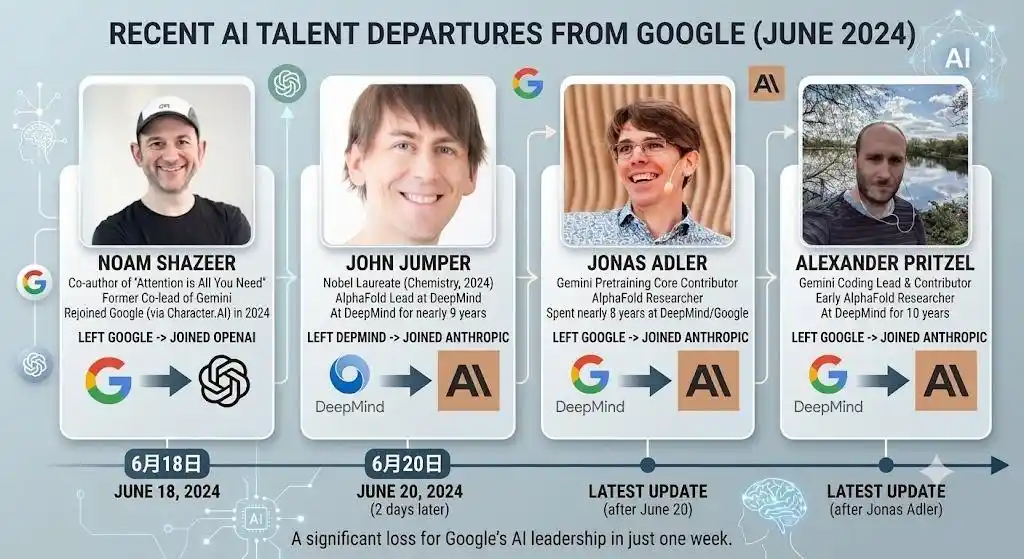
On June 18th, Noam Shazeer, one of the original eight authors of the 'Attention Is All You Need' paper, announced his departure from Google for OpenAI. In 2024, Google spent approximately $2.7 billion to bring him back, placing him in the role of co-lead for Gemini. In less than two years, he's gone again.
Two days later, John Jumper also left, heading to Anthropic. He is a 2024 Nobel Laureate in Chemistry, the lead developer of AlphaFold, and had been at DeepMind for nearly nine years.
Then came Jonas Adler and Alexander Pritzel, core contributors to Gemini's pre-training and programming directions, who also worked on AlphaFold. The latest news: these two are also preparing to join Anthropic.
If these were just ordinary resignations, Google could certainly withstand them.
The problem is, these four individuals each represent crucial nerve centers in the field of large models: architecture, science, programming, and pre-training.
The capital market's reaction was swift and direct, voting with its feet. On June 22nd, Alphabet's stock price fell 5% to 6% over two days, wiping hundreds of billions of dollars from its market capitalization.
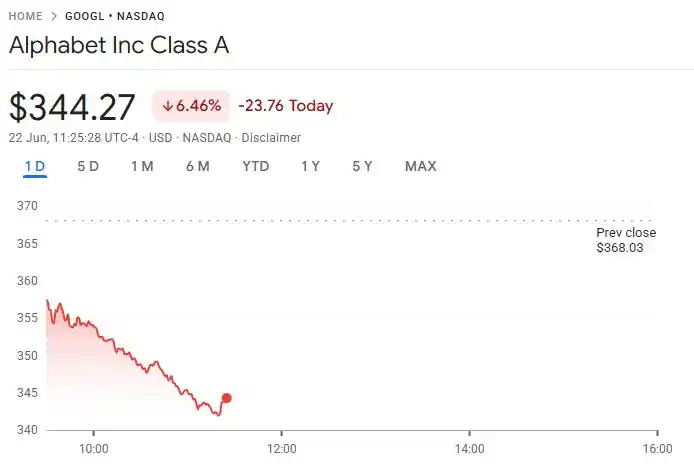
What investors fear isn't a specific product; it's something more fundamental: can Google still retain the people who built its most important creations?
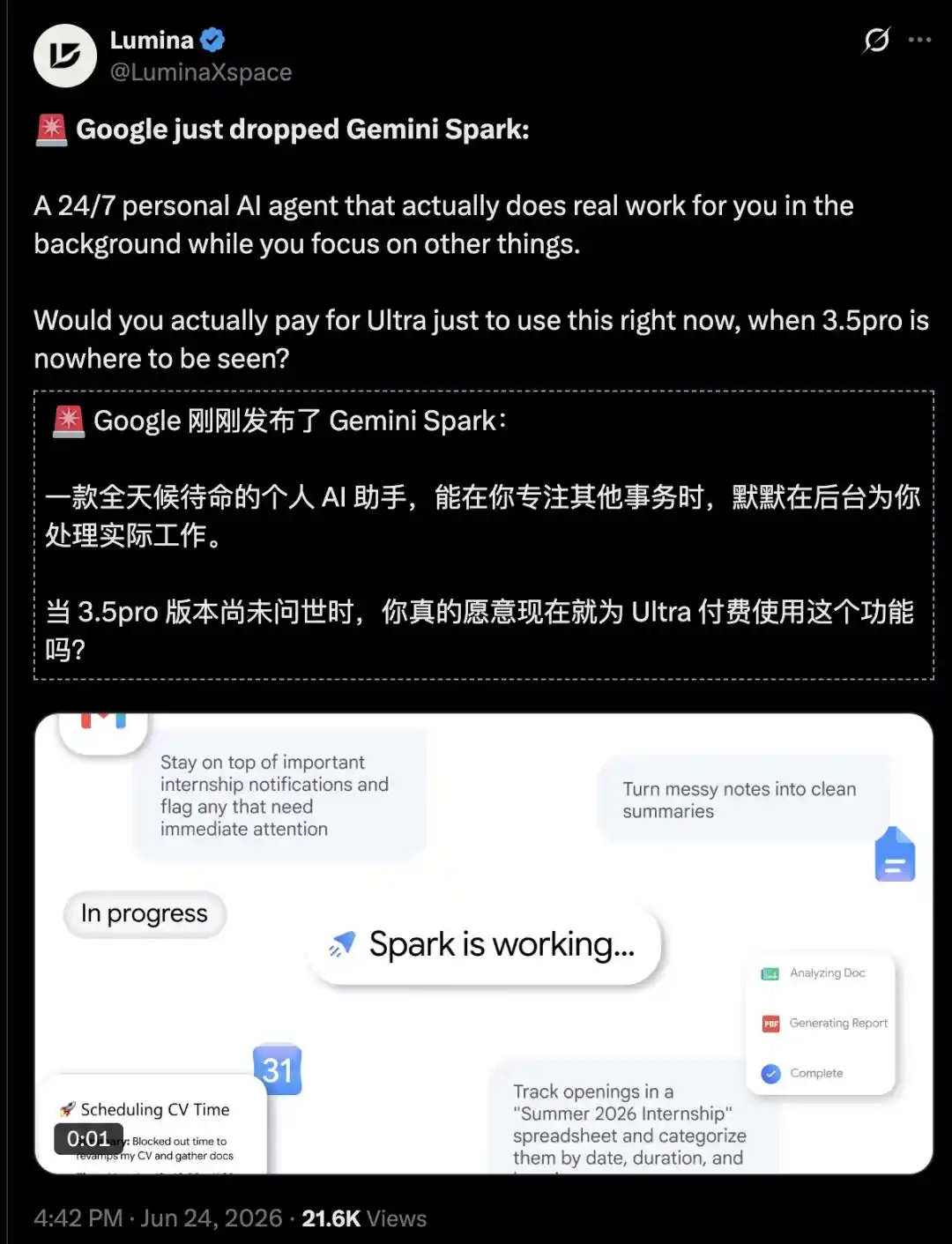
Making things more awkward, during the very same month this brain drain occurred, Google served up its long-brewed new card: Gemini Spark.
On one side, a brain drain; on the other, a massive push for breakthroughs.
The most authentic portrait of Google in 2026 is hidden within this schism.
Gemini 3.5 Pro Possibly Delayed. Is Google's Breakthrough Tied to Spark?
The talent exodus isn't the only issue; Google's product cadence looks even worse.
At I/O 2026, everyone was waiting for Gemini 3.5 Pro.
Google's CEO stood on stage and said, "Give us another month," reportedly eliciting a collective sigh from the audience.
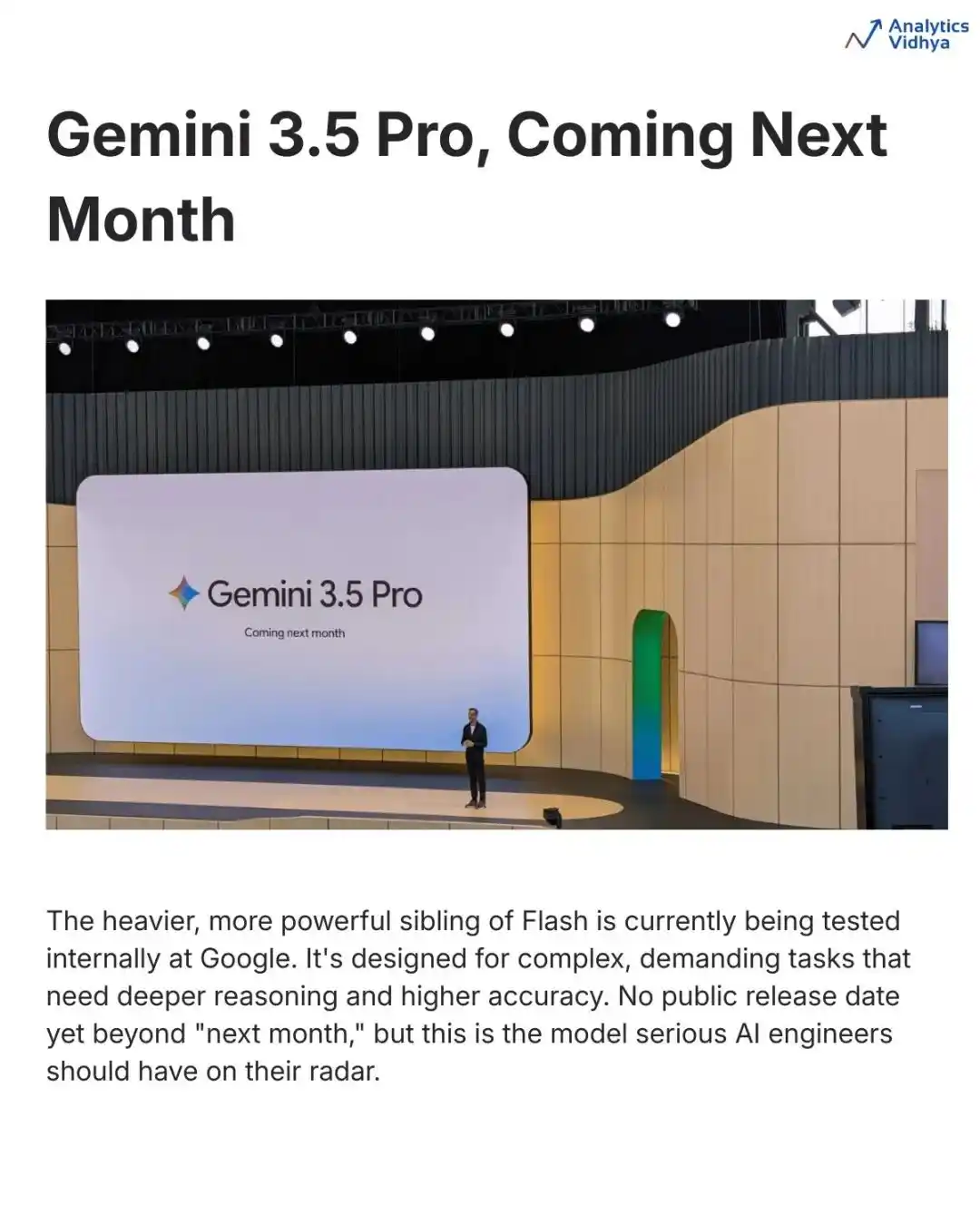
A month passed, and the latest news: Gemini 3.5 Pro has been pushed back from June to July.
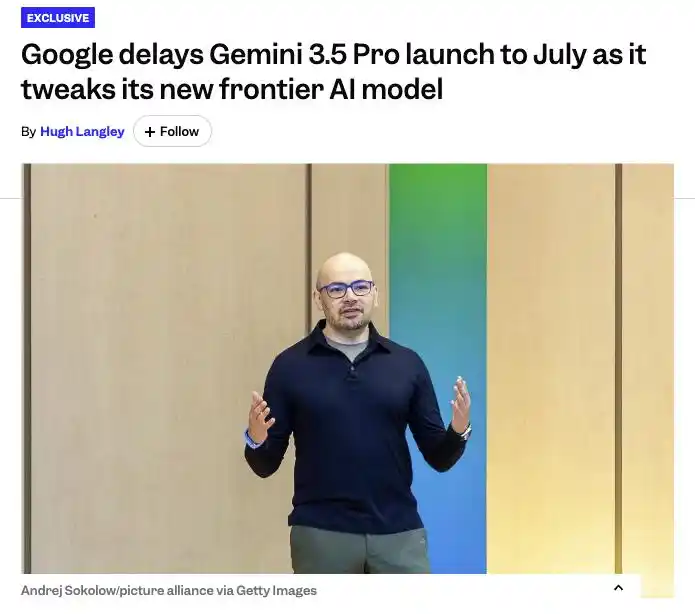
Two million token context, Deep Think reasoning—on paper, it's powerful. It just can't seem to reach your hands.
It was into this twilight that Google played its heaviest card of the year: Gemini Spark.
First, let's clarify how it differs from the Gemini app on your phone.
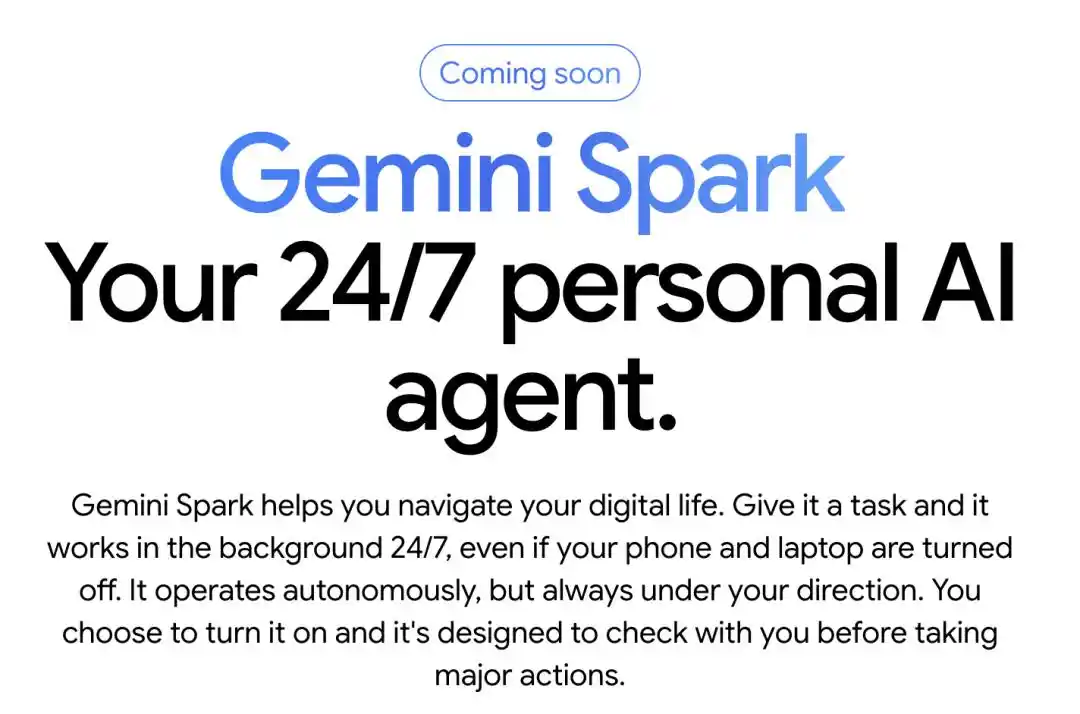
A regular chatbot: you ask, it answers. You close the app, it ceases to exist.
Spark is not like that. It runs on dedicated virtual machines in Google Cloud. You close your laptop, lock your phone, fall asleep—it remains awake in the cloud, continuing to work for you.
You don't need to keep your computer on for it to operate.
It connects most deeply to the Google tools you use every day: Gmail, Calendar, Docs, Sheets, Slides, Drive, plus Maps and YouTube.
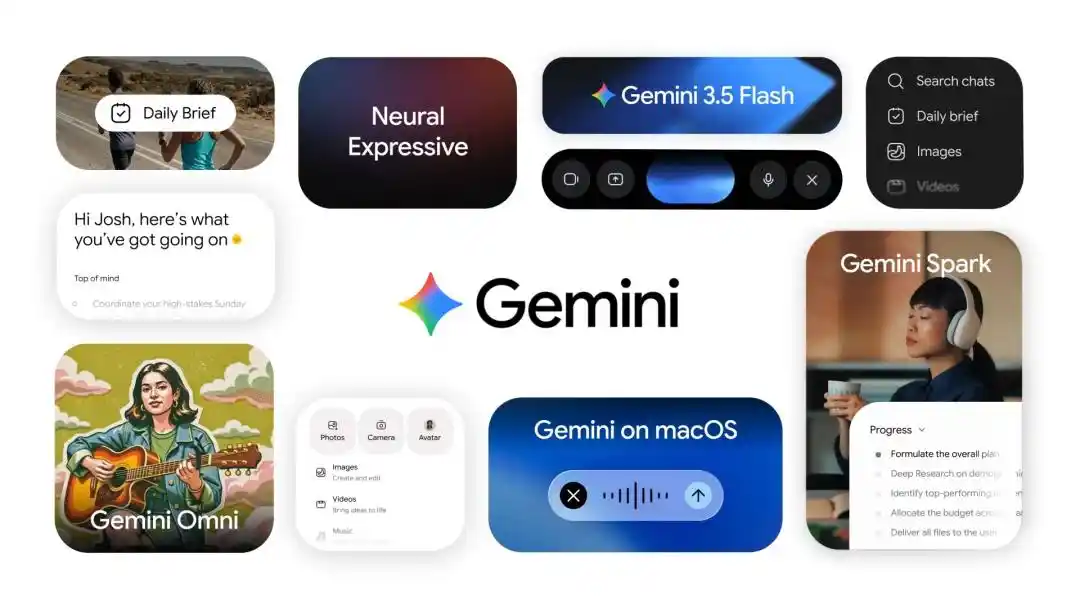
Words aren't enough; let's see what it can actually do.
You're a photographer. An inquiry email comes in. Spark automatically extracts the client's name and requested date, logs it into your "Client Tracker" spreadsheet, and creates a new Drive folder named after that client.
You have kids. Have it monitor your inbox for notifications from the school, extract key deadlines, and send you and your partner a daily summary.
Do you see the pattern?
These aren't one-off "help me write an email" prompts. You give it a goal, and it breaks it down into several steps, running across multiple apps to complete it.
Google equipped it with a framework called Antigravity, divided into Tasks, Skills, and Schedules. It can run on a schedule or wait for a specific trigger condition.
Tasks: You can set AI agents to work, connecting them to your Google Workspace ecosystem, including Gmail, Calendar, Docs, Sheets, and Slides.
Skills: By building skills, you can precisely define how Spark handles your frequently recurring tasks, customizing your experience and freeing you from repetitive prompting.
Schedules: By setting time-based or condition-based trigger rules, you can execute tasks exactly when you need them, automating your workload on your own terms.
It can also reach outward.
Through the MCP protocol, it connects to Canva, OpenTable, Instacart. Theoretically, you could have it book a restaurant or order groceries. For high-risk actions involving spending money or sending emails, it will pause and ask for your confirmation first.
Imagine an unpaid intern who doesn't drink coffee and is permanently online in the cloud. That's roughly the illusion Spark aims to create.
The cost? It's currently only available to Google AI Ultra users, the $100 per month tier.
Pro users get access to something else called Daily Brief, a morning briefing, not the Spark core.
Netizens are calling the pricing a joke.
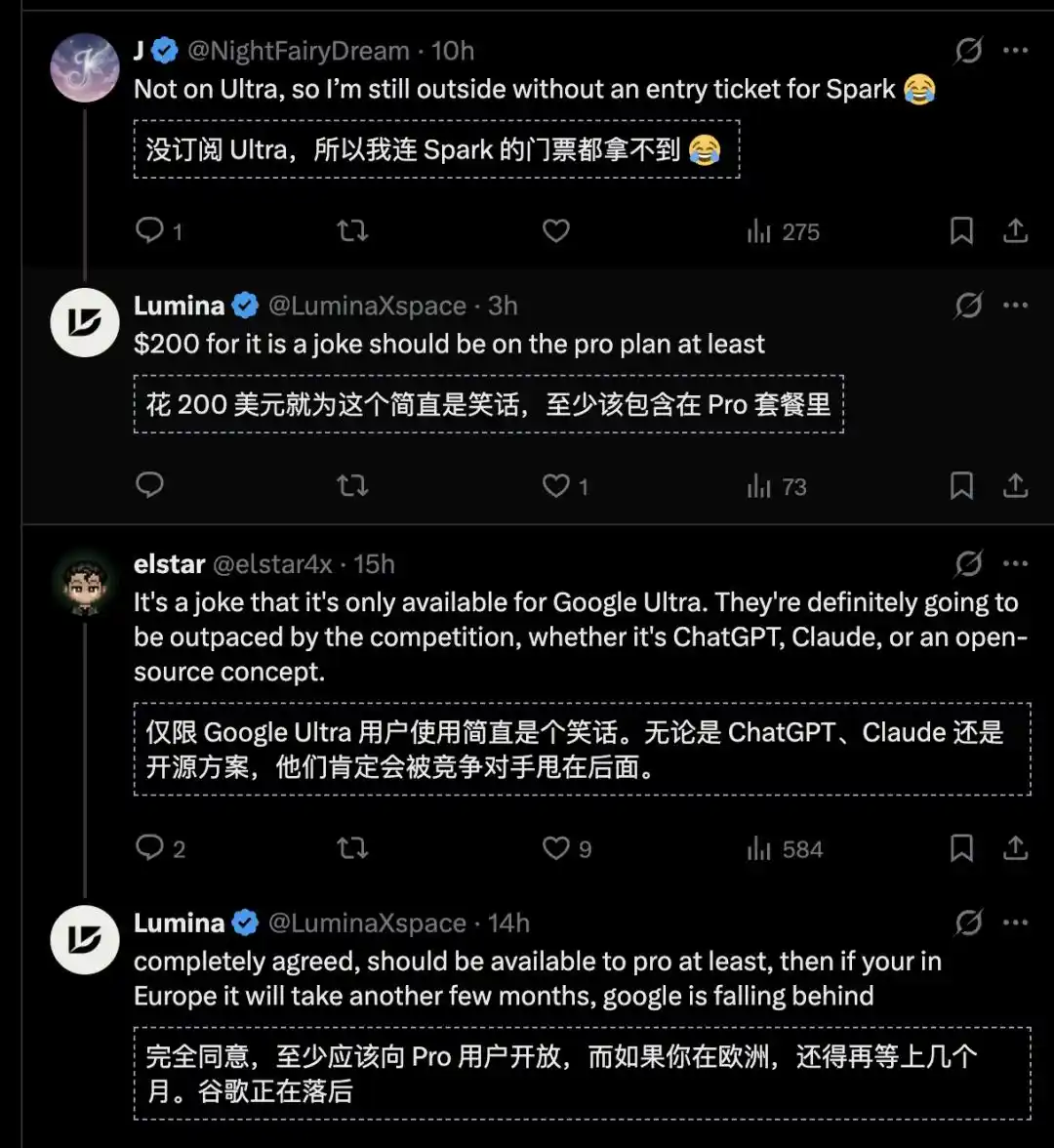
An invisible gate keeps the "digital employee" confined to the most expensive tier.
Google Started Early but Arrived Late to the Party
Placing Spark back into the broader Agent landscape makes its significance even more complex.
OpenAI has its own Agent product roadmap.
Anthropic, from Computer Use to Claude Code, is also delving deeper into "having AI do things for you."
Then there's a plethora of vertical Agent startups cutting into niches like legal, sales, recruitment, customer service, data analysis, and programming.
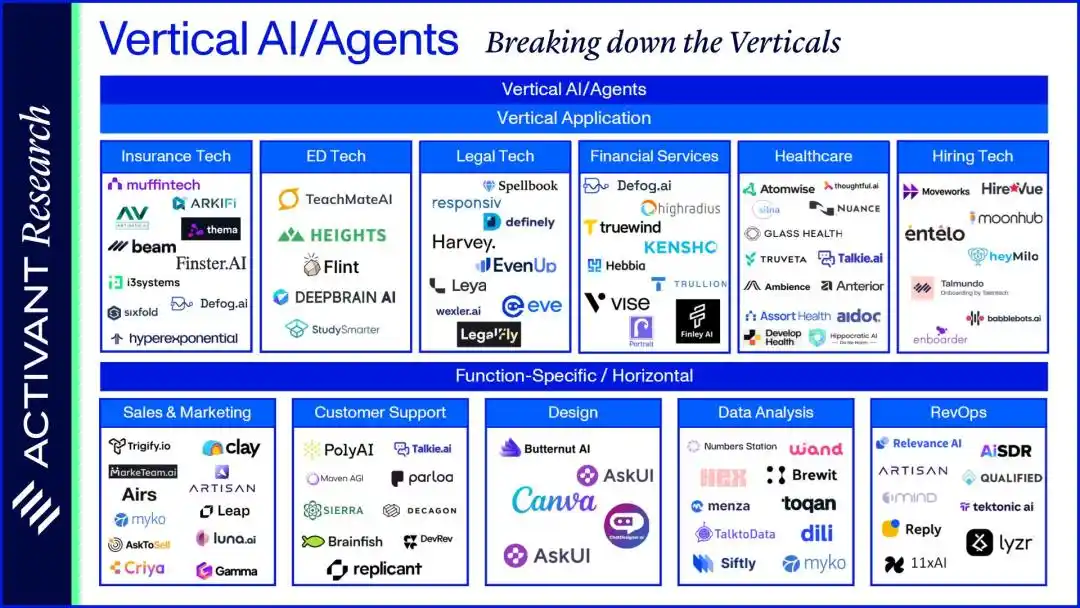
The industry has reached a high degree of consensus: AI is transitioning from being a tool to becoming labor.
Past AI was a co-pilot. You drive, it reminds you. Present AI is the driver. You state the destination, it plans the route.
And here lies Google's most awkward position: it should have won this race.
No company is better suited than Google to build a productivity Agent.
Gmail, Calendar, Docs, Sheets, Drive—these aren't isolated apps; they are the capillaries of modern work life.
A true digital employee, if it could natively access these systems, would possess a terrifying efficiency advantage.
The problem is, Google held the best cards but didn't play them first.
The reason isn't hard to understand. The bigger Google is, the more it fears mishaps.
What if the AI misreads an email? Deletes a file by mistake? Sends out content it shouldn't? Accesses user privacy, triggering a PR disaster?
These are risks for startups, but minefields for Google.
Thus, it was cautious, hesitant, scrutinizing, waiting.
And while Google hesitated, open-source projects like OpenClaw have been redefining "browser agents."
They operate like parasites, directly taking over web browser actions with impressive efficiency.
Google's setback is, at its core, a story of "giant's arrogance and fear."
The emergence of Spark marks the turning point where Google finally decided to loosen the reins, allowing AI to truly enter the background and "do the work."
This is Google's most painful paradox: it started early but arrived late to the party.
Can Google stem the bleeding with Spark? Unlikely.
But Spark at least points the way: AI must step out of the "dialog box" and enter the capillaries of productivity.
And for those investors who watched the market cap evaporate by $200 billion, the question they most want answered is: The creators have left. Can this remaining "work machine" truly support Google's next decade?
References:
https://x.com/LuminaXspace/status/2069702715999998139
https://www.datacamp.com/blog/gemini-spark
This article is from the WeChat public account "New Zhiyuan," author: ASI Apocalypse