Goldman Sachs Acquires NEOS for $2.25 Billion: Bitcoin Officially Enters the 'Income Era'

marsbitPubblicato 2026-08-13Pubblicato ultima volta 2026-08-13

Introduzione

Goldman Sachs acquired NEOS Investments for up to $2.25 billion, bringing a key product—the NEOS Bitcoin High Income ETF (BTCI)—into its portfolio. BTCI, with over $1.1 billion in assets, employs a covered call strategy on Bitcoin ETP holdings to generate high-yield monthly income, touting a 27% annualized yield. This yield stems from selling call options, capitalizing on Bitcoin's high volatility for premium income. However, the strategy carries significant risks: it caps upside potential during bull markets, has underperformed Bitcoin spot returns (with a -2% annualized return since late 2024), suffers from substantial net asset value erosion (near 50% peak-to-trough), and its distributions are largely classified as return of capital. The fund's true forward yield is closer to 7.8%, far below its advertised rate. The acquisition is part of Goldman's strategic push into the booming derivatives-based income ETF market, following its purchase of Innovator Capital. It targets investors, particularly retirees, seeking reliable monthly cash flow over high growth. This move signifies a rapid financialization of Bitcoin, transforming it from a tradable asset into an income-generating one within traditional finance. Yet, it raises questions about Bitcoin's core identity, as large-scale adoption of such strategies could permanently alter its market volatility and decentralized ethos.

Author: Xiaobing

Wall Street has finally found a way to tame Bitcoin—turning it into a goose that lays golden eggs.

On August 12, Goldman Sachs announced its acquisition of NEOS Investments for up to $2.25 billion in cash and equity. NEOS, a four-year-old firm managing $30 billion in assets, specializes in options strategy ETFs. The deal is expected to close in the first quarter of 2027, and NEOS co-founders Troy Cates and Garrett Paolella will join Goldman Sachs Asset Management as partners.

What Goldman Sachs gains from this transaction, aside from 19 option income ETFs, is a particular prize: BTCI, or NEOS Bitcoin High Income ETF. This “income fund” for Bitcoin boasts over $1.1 billion in assets under management and claims an annualized yield of 27%.

Where Does the 27% Annualized Return Come From?

First, let's dissect the mechanics behind this enticing number.

The operation of BTCI is not complicated: the fund holds spot Bitcoin ETPs (such as shares of the VanEck Bitcoin ETF) and sells covered call options against these holdings. The premiums paid by the option buyers become the source of the fund's monthly dividends.

For example. Assume Bitcoin's current price is $64,000. BTCI sells a call option expiring in one month with a strike price of $70,000 and receives a premium of $2,000. If Bitcoin doesn't rise above $70,000 by expiration, the option expires worthless, and the $2,000 is pure profit—this is the “income.” If Bitcoin rises to $80,000, the option is exercised, and BTCI must sell at $70,000; the extra $10,000 in profit goes to the option buyer. The $2,000 premium received cannot cover the lost $10,000 in potential gains.

This strategy is nothing new in the stock market. JPMorgan's JEPI, managing over $39 billion, uses the same logic to collect “rent” by selling options on the S&P 500. NEOS's own largest products, SPYI and QQQI, do the same on the S&P 500 and Nasdaq 100, respectively, collectively attracting over $10 billion.

However, applying this to Bitcoin naturally yields higher returns. The reason is simple: Bitcoin's implied volatility far exceeds that of stock indices. While the S&P 500 typically has annualized volatility of 15%-20%, Bitcoin's easily doubles or even triples that. Higher volatility means more expensive option premiums, allowing the fund to harvest more “rent.” This is the underlying logic behind BTCI's claimed 27% annualized yield. What it's selling is not Bitcoin's appreciation potential, but the violent price swings of Bitcoin itself.

A more straightforward analogy: Holding BTCI is like running an insurance company for Bitcoin. You collect premiums every month and are happy. But if Bitcoin suddenly surges, sorry, the policy is triggered, and the gains go to someone else.

The Price of 27%: Four Hidden Blades

But on the other side of the 27% high yield lie four hidden blades.

The First Blade: Capped Upside. Every call option contract is a pre-sale of future gains. If Bitcoin rises from $60,000 to $100,000, a spot holder profits 67%; a BTCI holder may only capture a small portion of the gain plus the option premium. In a bull market, this strategy is destined to significantly underperform spot holdings.

Data has already proven this. Since its launch in October 2024, BTCI's annualized average return is -2%. During the same period, Bitcoin experienced a full bull run from $70,000 to a historic high of $126,000, before retreating to around $64,000. BTCI sold off the juiciest profits of the bull market yet still bore the brunt of the decline in the bear market.

The Second Blade: Persistent Erosion of Net Asset Value. This is the most easily overlooked risk. BTCI's maximum drawdown reached 48.42%. As of the end of June 2026, its net asset value has fallen by nearly half from its peak. As the fund's NAV continuously shrinks, the same dividend amount corresponds to a “falsely inflated” yield. Over the past 12 months, the cumulative dividend per share was $12.37, corresponding to a share price of $29.53, superficially yielding over 40%. But this is like a person whose weight is constantly decreasing—you can't say they're healthy just because they're still eating every day.

A more crucial detail: BTCI's monthly dividend has decreased from $1.04 in January 2026 to a recent $0.65. Annualizing the latest dividend payment gives a forward-looking yield of about 7.8%, far below the publicly advertised 27%.

The Third Blade: The Illusion of Return of Capital. According to its 19a-1 notice, a large portion of BTCI's monthly dividend is classified as “Return of Capital.” This means most of the money the fund pays you is not actual “income” but rather a return of your own invested principal. Tax-wise, this lowers your cost basis, meaning you'll pay higher capital gains taxes when you eventually sell. It's moving money from your left hand to your right, with a management fee skimmed off in the middle.

The Fourth Blade: The 0.99% Management Fee. In an environment of persistent NAV decline, the erosion effect of this fee is amplified. If the fund's NAV falls 20% in a year, a 0.99% management fee means you pay nearly an extra percentage point in “ground rent” on top of your losses. For comparison, BlackRock's newly launched competitor BITA charges only 0.65%, and directly holding spot Bitcoin via IBIT costs just 0.25%.

Goldman Sachs' Empire Puzzle

To understand this acquisition, one must look beyond Bitcoin.

Over the past nine months, Goldman Sachs Asset Management has completed two ETF mergers totaling over $4.2 billion: In December 2025, it acquired Innovator Capital Management for $2 billion, gaining its 159 buffer/defined outcome ETFs and $31 billion in assets (the deal closed in April 2026); now, it's spending $2.25 billion to swallow NEOS's 19 option income ETFs and $30 billion in assets.

Putting these two acquisitions together, Goldman Sachs Asset Management's total ETF assets exceed $130 billion, propelling it to become the world's eighth-largest actively managed ETF issuer. More importantly, these acquisitions precisely cover the two core strategies of derivative income ETFs: Innovator focuses on downside protection (buffer), while NEOS focuses on income enhancement.

Behind this is an exploding market. By the end of 2025, total assets in U.S. derivative income funds had surpassed $140 billion, with the category seeing $40 billion in net inflows in the first seven months of 2026 alone. A VettaFi survey in August 2026 showed that 36% of financial advisors ranked “creating reliable income for clients” as their top priority, exceeding “long-term growth” (29%) and “managing volatility” (23%).

Goldman Sachs sees a structural trend: in an environment of high interest rates and increased market volatility, “receiving cash every month” is more attractive to retirement accounts and conservative investors than “possibly gaining 30% next year.” The buyer profile for such products is very clear: people aged 55 and above, living on retirement funds, with a physiological-level dependence on “money hitting the account every month.” They don't care if Bitcoin can reach $150,000; they care whether this month's pension supplement arrives on time.

Goldman Sachs CEO David Solomon referred to NEOS as a “highly complementary” acquisition in the announcement. Goldman's own Goldman Sachs Bitcoin Premium Income ETF is already in line at the SEC, with coverage designed between 40% and 100%. But launching a new fund from scratch involves a long cold-start period, high compliance costs, and time-consuming market education. Spending $2.25 billion to directly buy a mature team with a $1.1 billion Bitcoin income fund is simple arithmetic given the competitive pace of the ETF industry.

When Bitcoin Learns to Pay Dividends

Stepping back, what's happening carries a certain historical significance.

In January 2024, spot Bitcoin ETFs were approved, bringing Bitcoin through the first door of traditional finance as a “tradable asset.” Just two and a half years later, Wall Street is already transforming Bitcoin into an “income-generating asset.” This pace is at least a decade faster than the evolution from the GLD gold ETF to a derivatives ecosystem.

But there's a fundamental difference between Bitcoin and gold: Gold's volatility is around 15% annually, while Bitcoin's often exceeds 50%. This means Bitcoin, as the underlying asset for a covered call strategy, can naturally provide higher option premiums but also inherently carries greater NAV volatility and strategy failure risk.

High volatility is a double-edged sword. It makes the numbers on the income ETF's marketing materials look exceptionally good and makes the path dependency effect particularly deadly. If Bitcoin surges sharply before option expiration, the fund misses the gains and cannot recover; if it crashes, the premium income is far from enough to cover the principal loss. BTCI's nearly 50% drop from its peak provides a textbook case.

There's a structural question worth pondering: As Bitcoin's volatility is extracted on a large scale for commercialization, will the volatility itself decrease as a result?

Sellers in a covered call strategy are shorting volatility. As more capital flows into products like BTCI and BITA, the scale of sold call options continues to swell. The counterparties to these options (typically market makers) need to perform delta hedging, selling when Bitcoin rises and buying when it falls. This hedging behavior inherently acts to suppress volatility. If the AUM of this category continues to grow at its current speed, the microstructure of the Bitcoin market could be permanently altered.

For the Bitcoin community, this financial engineering transformation raises a deeper identity question. If more and more Bitcoin is locked in covered call strategies, priced and hedged by Wall Street market makers, is Bitcoin still the decentralized, “digital gold” meant to hedge against fiat debasement? Or is it becoming just another raw material for volatility on Wall Street, like natural gas or the VIX index, processed into various structured products and stuffed into pension fund portfolios?

Crypto di tendenza

Domande pertinenti

QWhat is the primary strategy of the NEOS Bitcoin High Income ETF (BTCI) that Goldman Sachs acquired, and how does it generate its advertised yield?

AThe primary strategy of BTCI is a covered call strategy. The fund holds spot Bitcoin ETPs (like VanEck's Bitcoin ETF) and sells call options on this underlying Bitcoin position. The premiums collected from selling these options are distributed as monthly dividends, which is the source of its advertised yield. It essentially generates income by 'renting out' its potential for large price gains in exchange for steady premium payments.

QWhat are two significant risks associated with BTCI's covered call strategy for Bitcoin, as highlighted in the article?

ATwo significant risks are: 1) **Capped Upside**: The fund sells away most of its potential for large price appreciation. In a strong bull market, the fund will significantly underperform direct Bitcoin holdings, as evidenced by its -2% annualized return during Bitcoin's run from $70k to $126k and back to ~$64k. 2) **Continuous NAV Erosion**: The fund's Net Asset Value has declined significantly (peak-to-trough drawdown of 48.42%). As the NAV falls, the same dividend amount translates to a misleadingly high yield percentage, and the actual forward-looking yield can be much lower than advertised (e.g., ~7.8% vs. 27% based on recent payouts).

QBeyond Bitcoin, what broader strategic goal is Goldman Sachs achieving with its acquisitions of Innovator Capital Management and NEOS Investments?

AGoldman Sachs is building a dominant position in the rapidly growing derivatives-based income ETF market. The acquisition of Innovator (offering buffer/protection ETFs) and NEOS (offering covered call/income ETFs) allows Goldman's asset management arm to cover the two core strategies in this space. The goal is to cater to the structural investor trend, especially among retirees, who prioritize reliable monthly income over long-term growth potential, thereby amassing over $130 billion in ETF assets.

QHow might the growth of covered call ETFs like BTCI potentially impact the underlying Bitcoin market's price behavior according to the article?

AThe article suggests the growth of covered call ETFs could permanently alter Bitcoin's market microstructure by dampening its volatility. Since these funds systematically sell call options, their counterparties (market makers) must conduct delta hedging—selling Bitcoin when its price rises and buying when it falls to manage their risk. This large-scale, automated hedging activity could act as a stabilizing force, potentially reducing Bitcoin's characteristic high volatility over time as the assets under management in these strategies grow.

QWhat philosophical or identity conflict for Bitcoin does the article raise as a result of its financial engineering into products like BTCI?

AThe article raises a conflict regarding Bitcoin's core identity. It questions whether Bitcoin, as it is packaged into structured income products managed by Wall Street firms, remains the decentralized 'digital gold' designed as a hedge against fiat currency debasement. Alternatively, it might be transforming into a mere raw material for volatility—similar to natural gas or the VIX index—that is processed into structured products to fill the portfolios of pension funds, potentially distancing it from its original anti-establishment ethos.

Letture associate

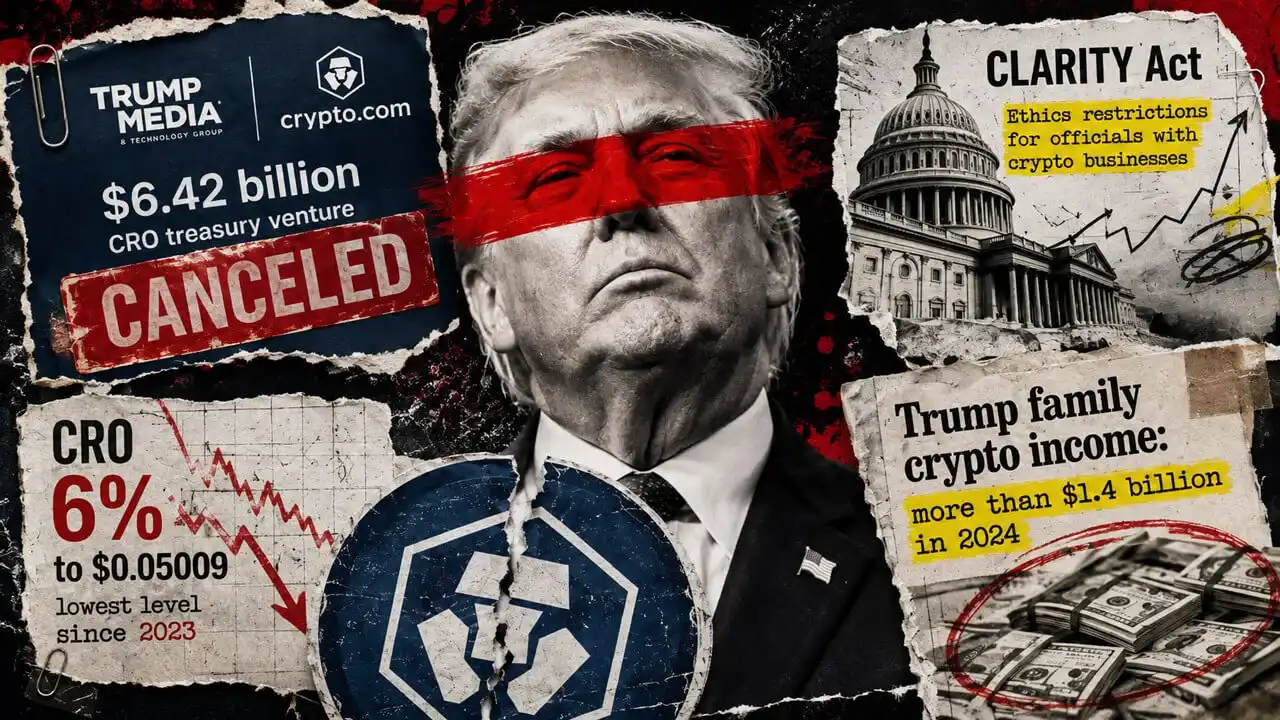
Crypto.com and Trump Media "Break Up": $6.42 Billion Vault Plan Fails, CRO Loses Its Largest Backstop Buyer

Crypto.com, Trump Media (DJT), and Yorkville Acquisition Corp. have officially terminated their planned $64.2 billion merger to create the "Trump Media Group CRO Strategy," a publicly-listed CRO treasury company. Announced in August 2025 during the peak of Digital Asset Treasury (DAT) hype, the deal was promoted as a massive vote of confidence, with Crypto.com's CEO Kris Marszalek once stating the entity would "forever" buy CRO. The termination, citing changing market conditions and business priorities, also ends related plans for ETF services and integrating a prediction market into Truth Social. Following the news, CRO's price fell below $0.05, hitting its lowest point since October 2023. The token is down approximately 95% from its 2021 all-time high. The collapse of this high-profile deal raises critical questions about the DAT model, suggesting it creates artificial, unsustainable demand rather than being driven by genuine token utility or adoption. This sentiment is reinforced by recent reports that Strategy, the largest Bitcoin treasury company, has been selling BTC, breaking its "never sell" narrative. For CRO holders, the failed merger adds to existing concerns, including recent reductions in Crypto.com card benefits and executive departures, forcing a broader reassessment of the exchange's fundamentals beyond a single abandoned transaction.

marsbit6 min fa

Crypto.com and Trump Media "Break Up": $6.42 Billion Vault Plan Fails, CRO Loses Its Largest Backstop Buyer

marsbit6 min fa

Hash Global Research Report: Bitcoin Hasn't Risen Yet, Why Are We Starting to Think the Bear Market Might Be Over?

Hash Global Research Report: Why We Think the Bear Market Might Be Ending Even Before Bitcoin Rises Over the past six months, AI has dominated market attention, causing a significant shakeout in crypto. Bitcoin has tested the $58-60K support three times since February, with volatility hitting multi-year lows. Despite stagnant prices, key underlying dynamics are shifting. The forces that drove the market down are weakening: macro tightening fears are easing as US inflation and jobs data cool, the perceived systemic risk from large holders like MicroStrategy selling is diminishing as they shore up finances, and institutional outflows have stopped. Simultaneously, on-chain data shows a rare concentration of over 240,000 BTC (approx. 12% of supply) accumulated in the $61-65K range, forming a new, consolidated base reminiscent of historical bottoms. Meanwhile, the AI trade is cooling, potentially redirecting capital towards undervalued crypto assets, as seen in July's relative outperformance. The current phase, where AI money hesitates and crypto veterans await a final dip, creates a "no-man's-land" investment opportunity—a potential entry point before a new consensus forms. While a definitive upturn isn't guaranteed, the confluence of weakening bearish pressures, improved on-chain structure, and a possible capital rotation suggests the window for positioning for the next cycle is opening.

marsbit16 min fa

Hash Global Research Report: Bitcoin Hasn't Risen Yet, Why Are We Starting to Think the Bear Market Might Be Over?

marsbit16 min fa

Explosion in Deep Sea Robots, the Hardest Series A Round Emerges

Deep-sea robotics startup Deepsea Zhiren has secured over 5 billion yuan in its Series A funding, a landmark deal backed by prominent investors including GGV Capital, Dachen Capital, Genesis Capital, Everbright Capital, China Life Insurance Investment, CETC Investment, and the energy tech fund managed by Cathay Capital with TotalEnergies as the cornerstone LP. Existing investors also participated significantly. The company, founded by industry veteran Ma Yiming, specializes in developing heavy-duty work-class ROVs for extreme deep-sea environments up to 6,000 meters, used in oil and gas, offshore wind, and subsea cable operations. Its product line includes models like "Taurus" (1,000m), "Phoenix 600" (3,000m), and "Singularity" (6,000m). A key achievement is securing multi-million dollar orders from UAE's telecom giant Etisalat, marking a breakthrough for Chinese-made deep-sea robotics in the international market. Deepsea Zhiren differentiates itself through full-stack in-house R&D—from pressure-resistant structures to control systems and AI—and a modular hardware approach. It has built a comprehensive internal standard system aligned with top global offshore specifications. The company is now advancing its "Deep Matrix" initiative, an unmanned, AI-powered, multi-robot cluster system designed for permanent seabed operations. This system aims to drastically reduce reliance on support vessels and human operators, potentially cutting costs in offshore oil field operations by billions over their lifecycle. The funding round signals strong market confidence in the deep-sea tech sector, recently highlighted in China's national policy. With the global subsea services market valued at around 1.5 trillion yuan and growing over 20% annually, Deepsea Zhiren aims to redefine deep-sea development through integrated hardware and embodied AI systems, positioning itself as a global pioneer in ocean robotics.

marsbit44 min fa

Explosion in Deep Sea Robots, the Hardest Series A Round Emerges

marsbit44 min fa

Trading

Spot

Articoli Popolari

Cosa è BITCOIN

Comprendere HarryPotterObamaSonic10Inu (ERC-20) e la sua posizione nel mondo delle criptovalute Negli ultimi anni, il mercato delle criptovalute ha assistito a un aumento della popolarità delle meme coin, catturando l'interesse non solo dei trader, ma anche di coloro che cercano coinvolgimento comunitario e valore di intrattenimento. Tra questi token unici c'è HarryPotterObamaSonic10Inu (ERC-20), un progetto intrigante che mescola riferimenti culturali nel tessuto delle criptovalute. Questo articolo esplora gli aspetti chiave di HarryPotterObamaSonic10Inu, analizzando i suoi meccanismi, l'etica guidata dalla comunità e il suo coinvolgimento con il panorama crittografico più ampio. Che cos'è HarryPotterObamaSonic10Inu (ERC-20)? Come suggerisce il suo nome, HarryPotterObamaSonic10Inu è una meme coin costruita sulla blockchain di Ethereum, classificata secondo lo standard ERC-20. A differenza delle criptovalute tradizionali che possono enfatizzare l'utilità pratica o il potenziale investimento, questo token prospera grazie al valore di intrattenimento e alla forza della sua comunità. Il progetto mira a creare un ambiente in cui gli utenti coinvolti possono riunirsi, condividere idee e partecipare ad attività ispirate a diversi fenomeni culturali. Una caratteristica notevole di HarryPotterObamaSonic10Inu è la zero tassa sulle transazioni. Questo elemento allettante tende a incoraggiare il trading e il coinvolgimento della comunità, privo di costi aggiuntivi che possono scoraggiare i trader di piccole dimensioni. L'offerta totale della moneta è fissata a un miliardo di token, un numero che segna la sua intenzione di mantenere una circolazione sostanziale all'interno della comunità. Creatore di HarryPotterObamaSonic10Inu (ERC-20) Le origini di HarryPotterObamaSonic10Inu sono avvolte in un certo mistero; i dettagli sul creatore rimangono sconosciuti. Lo sviluppo di questo token non presenta un team identificabile o un piano esplicito, cosa non rara nel settore delle meme coin. Invece, il progetto è emerso organicamente, con il suo progresso fortemente dipendente dall'entusiasmo e dalla partecipazione della sua comunità. Investitori di HarryPotterObamaSonic10Inu (ERC-20) Per quanto riguarda investimenti esterni e finanziamenti, HarryPotterObamaSonic10Inu rimane ambiguo. Il token non elenca alcuna fondazione di investimento conosciuta o un sostegno organizzativo significativo. Invece, la linfa vitale del progetto è la sua comunità di base, che informa la sua crescita e sostenibilità attraverso azioni collettive e coinvolgimento nello spazio crittografico. Come funziona HarryPotterObamaSonic10Inu (ERC-20)? In quanto meme coin, HarryPotterObamaSonic10Inu opera principalmente al di fuori delle strutture tradizionali che governano spesso il valore degli asset. Ci sono diversi aspetti distintivi che definiscono il funzionamento del progetto: Transazioni senza tasse: Senza costi fiscali sulle transazioni, gli utenti possono comprare e vendere liberamente il token senza preoccuparsi di costi nascosti. Coinvolgimento della comunità: Il progetto prospera sull'interazione della comunità, sfruttando le piattaforme social per creare entusiasmo e facilitare il coinvolgimento. Discussioni, condivisione di contenuti e coinvolgimento sono elementi cruciali che aiutano ad espandere la sua portata e a favorire la lealtà tra i sostenitori. Nessuna utilità pratica: Va notato che HarryPotterObamaSonic10Inu non offre un'utilità concreta all'interno dell'ecosistema finanziario. Piuttosto, è classificato come un token principalmente per attività di intrattenimento e comunitarie. Riferimento culturale: Il token incorpora astutamente elementi della cultura pop per attirare interesse, collegandosi a appassionati di meme e seguaci delle criptovalute. HarryPotterObamaSonic10Inu esemplifica come le meme coin operino in modo diverso rispetto ai progetti di criptovalute più tradizionali, entrando nel mercato come costrutti sociali innovativi piuttosto che come asset utilitari. Cronologia di HarryPotterObamaSonic10Inu (ERC-20) La storia di HarryPotterObamaSonic10Inu è segnata da diversi traguardi notevoli: Creazione: Il token è emerso da un meme virale, catturando l'immaginazione di molti appassionati di criptovalute. Le date di creazione specifiche non sono disponibili, sottolineando la sua crescita organica. Inserimento negli scambi: HarryPotterObamaSonic10Inu ha fatto il suo ingresso in vari scambi, consentendo un accesso e un trading più facili da parte della comunità. Iniziative di coinvolgimento della comunità: Attività in corso volte a migliorare l'interazione della comunità, comprese gare, campagne sui social media e generazione di contenuti da parte di fan e sostenitori. Piani di espansione futura: La tabella di marcia del progetto include il lancio di una collezione NFT, merchandising e un sito di eCommerce relativo ai suoi temi culturali, coinvolgendo ulteriormente la comunità e cercando di aggiungere più dimensioni al suo ecosistema. Punti chiave su HarryPotterObamaSonic10Inu (ERC-20) Natura guidata dalla comunità: Il progetto dà priorità al contributo collettivo e alla creatività, garantendo che il coinvolgimento degli utenti sia al centro del suo sviluppo. Classificazione come meme coin: Rappresenta l'epitome delle criptovalute basate sull'intrattenimento, distinguendosi dai veicoli d'investimento tradizionali. Nessuna affiliazione diretta con Bitcoin: Nonostante la somiglianza nel nome del ticker, HarryPotterObamaSonic10Inu è distintivo e non ha alcuna relazione con Bitcoin o altre criptovalute consolidate. Focus sulla collaborazione: HarryPotterObamaSonic10Inu è progettato per creare uno spazio per la collaborazione e la condivisione di storie tra i suoi detentori, fornendo un canale per la creatività e il legame comunitario. Prospettive future: L'ambizione di espandersi oltre il suo presupposto iniziale verso NFT e merchandising delinea un percorso per il progetto per potenzialmente entrare in strade più mainstream all'interno della cultura digitale. Poiché le meme coin continuano a catturare l'immaginazione della comunità crittografica, HarryPotterObamaSonic10Inu (ERC-20) si distingue per i suoi legami culturali e il suo approccio centrato sulla comunità. Anche se potrebbe non adattarsi al modello tipico di un token orientato all'utilità, la sua essenza risiede nella gioia e nella camaraderia coltivate tra i suoi sostenitori, evidenziando la natura in evoluzione delle criptovalute in un'epoca sempre più digitale. Con la continuazione dello sviluppo del progetto, sarà importante osservare come le dinamiche della comunità influenzano la sua traiettoria nel panorama in continuo cambiamento della tecnologia blockchain.

2.3k Totale visualizzazioniPubblicato il 2024.04.01Aggiornato il 2024.12.03

Cosa è BITCOIN

Come comprare BTC

Benvenuto in HTX.com! Abbiamo reso l'acquisto di Bitcoin (BTC) semplice e conveniente. Segui la nostra guida passo passo per intraprendere il tuo viaggio nel mondo delle criptovalute.Step 1: Crea il tuo Account HTXUsa la tua email o numero di telefono per registrarti il tuo account gratuito su HTX. Vivi un'esperienza facile e sblocca tutte le funzionalità,Crea il mio accountStep 2: Vai in Acquista crypto e seleziona il tuo metodo di pagamentoCarta di credito/debito: utilizza la tua Visa o Mastercard per acquistare immediatamente BitcoinBTC.Bilancio: Usa i fondi dal bilancio del tuo account HTX per fare trading senza problemi.Terze parti: abbiamo aggiunto metodi di pagamento molto utilizzati come Google Pay e Apple Pay per maggiore comodità.P2P: Fai trading direttamente con altri utenti HTX.Over-the-Counter (OTC): Offriamo servizi su misura e tassi di cambio competitivi per i trader.Step 3: Conserva Bitcoin (BTC)Dopo aver acquistato Bitcoin (BTC), conserva nel tuo account HTX. In alternativa, puoi inviare tramite trasferimento blockchain o scambiare per altre criptovalute.Step 4: Scambia Bitcoin (BTC)Scambia facilmente Bitcoin (BTC) nel mercato spot di HTX. Accedi al tuo account, seleziona la tua coppia di trading, esegui le tue operazioni e monitora in tempo reale. Offriamo un'esperienza user-friendly sia per chi ha appena iniziato che per i trader più esperti.

4.7k Totale visualizzazioniPubblicato il 2024.12.12Aggiornato il 2026.06.02

Come comprare BTC

Cosa è $BITCOIN

ORO DIGITALE ($BITCOIN): Un'Analisi Completa Introduzione all'ORO DIGITALE ($BITCOIN) L'ORO DIGITALE ($BITCOIN) è un progetto basato su blockchain che opera sulla rete Solana, con l'obiettivo di combinare le caratteristiche dei metalli preziosi tradizionali con l'innovazione delle tecnologie decentralizzate. Sebbene condivida un nome con Bitcoin, spesso definito “oro digitale” a causa della sua percezione come riserva di valore, l'ORO DIGITALE è un token separato progettato per creare un ecosistema unico all'interno del panorama Web3. Il suo obiettivo è posizionarsi come un asset digitale alternativo valido, anche se i dettagli riguardanti le sue applicazioni e funzionalità sono ancora in fase di sviluppo. Cos'è l'ORO DIGITALE ($BITCOIN)? L'ORO DIGITALE ($BITCOIN) è un token di criptovaluta esplicitamente progettato per l'uso sulla blockchain di Solana. A differenza di Bitcoin, che fornisce un ruolo di stoccaggio di valore ampiamente riconosciuto, questo token sembra concentrarsi su applicazioni e caratteristiche più ampie. Aspetti notevoli includono: Infrastruttura Blockchain: Il token è costruito sulla blockchain di Solana, nota per la sua capacità di gestire transazioni ad alta velocità e a basso costo. Dinamiche di Offerta: L'ORO DIGITALE ha un'offerta massima fissata a 100 quadrilioni di token (100P $BITCOIN), sebbene i dettagli riguardanti la sua offerta circolante siano attualmente non divulgati. Utilità: Sebbene le funzionalità precise non siano esplicitamente delineate, ci sono indicazioni che il token potrebbe essere utilizzato per varie applicazioni, potenzialmente coinvolgendo applicazioni decentralizzate (dApp) o strategie di tokenizzazione degli asset. Chi è il Creatore dell'ORO DIGITALE ($BITCOIN)? Attualmente, l'identità dei creatori e del team di sviluppo dietro l'ORO DIGITALE ($BITCOIN) rimane sconosciuta. Questa situazione è tipica tra molti progetti innovativi nel settore blockchain, in particolare quelli allineati con la finanza decentralizzata e i fenomeni delle meme coin. Sebbene tale anonimato possa favorire una cultura guidata dalla comunità, intensifica le preoccupazioni riguardo alla governance e alla responsabilità. Chi sono gli Investitori dell'ORO DIGITALE ($BITCOIN)? Le informazioni disponibili indicano che l'ORO DIGITALE ($BITCOIN) non ha alcun sostenitore istituzionale noto o investimenti di venture capital prominenti. Il progetto sembra operare su un modello peer-to-peer incentrato sul supporto e sull'adozione della comunità piuttosto che su percorsi di finanziamento tradizionali. La sua attività e liquidità si trovano principalmente su exchange decentralizzati (DEX), come PumpSwap, piuttosto che su piattaforme di trading centralizzate consolidate, evidenziando ulteriormente il suo approccio di base. Come Funziona l'ORO DIGITALE ($BITCOIN) Le meccaniche operative dell'ORO DIGITALE ($BITCOIN) possono essere elaborate in base al suo design blockchain e alle caratteristiche della rete: Meccanismo di Consenso: Sfruttando il proof-of-history (PoH) unico di Solana combinato con un modello di proof-of-stake (PoS), il progetto garantisce una validazione efficiente delle transazioni contribuendo all'alta performance della rete. Tokenomics: Sebbene meccanismi deflazionistici specifici non siano stati dettagliati ampiamente, l'ampia offerta massima di token implica che potrebbe soddisfare microtransazioni o casi d'uso di nicchia che devono ancora essere definiti. Interoperabilità: Esiste il potenziale per l'integrazione con l'ecosistema più ampio di Solana, inclusi vari piattaforme di finanza decentralizzata (DeFi). Tuttavia, i dettagli riguardanti integrazioni specifiche rimangono non specificati. Cronologia degli Eventi Chiave Ecco una cronologia che evidenzia traguardi significativi riguardanti l'ORO DIGITALE ($BITCOIN): 2023: Il dispiegamento iniziale del token avviene sulla blockchain di Solana, contrassegnato dal suo indirizzo di contratto. 2024: L'ORO DIGITALE guadagna visibilità poiché diventa disponibile per il trading su exchange decentralizzati come PumpSwap, consentendo agli utenti di scambiarlo contro SOL. 2025: Il progetto assiste a un'attività di trading sporadica e a un potenziale interesse per impegni guidati dalla comunità, sebbene non siano state documentate partnership significative o avanzamenti tecnici fino ad ora. Analisi Critica Punti di Forza Scalabilità: L'infrastruttura sottostante di Solana supporta alti volumi di transazioni, il che potrebbe migliorare l'utilità di $BITCOIN in vari scenari di transazione. Accessibilità: Il potenziale basso prezzo di trading per token potrebbe attrarre investitori al dettaglio, facilitando una partecipazione più ampia grazie a opportunità di proprietà frazionata. Rischi Mancanza di Trasparenza: L'assenza di sostenitori, sviluppatori o di un processo di audit pubblicamente noti potrebbe generare scetticismo riguardo alla sostenibilità e all'affidabilità del progetto. Volatilità del Mercato: L'attività di trading è fortemente dipendente dal comportamento speculativo, il che può comportare una significativa volatilità dei prezzi e incertezze per gli investitori. Conclusione L'ORO DIGITALE ($BITCOIN) emerge come un progetto intrigante ma ambiguo all'interno dell'evolvente ecosistema di Solana. Sebbene tenti di sfruttare la narrativa dell'“oro digitale”, la sua partenza dal ruolo consolidato di Bitcoin come riserva di valore sottolinea la necessità di una chiara differenziazione della sua utilità e struttura di governance. L'accettazione e l'adozione future dipenderanno probabilmente dall'affrontare l'attuale opacità e dalla definizione più esplicita delle sue strategie operative ed economiche. Nota: Questo rapporto comprende informazioni sintetizzate disponibili a ottobre 2023, e potrebbero essersi verificati sviluppi oltre il periodo di ricerca.

475 Totale visualizzazioniPubblicato il 2025.05.13Aggiornato il 2025.05.13

Cosa è $BITCOIN

Discussioni

Benvenuto nella Community HTX. Qui puoi rimanere informato sugli ultimi sviluppi della piattaforma e accedere ad approfondimenti esperti sul mercato. Le opinioni degli utenti sul prezzo di BTC BTC sono presentate come di seguito.

活动图片