To understand why Bitcoin has reacted tepidly to interest rate cuts, it's helpful to start with gold. Gold is a globally priced asset. While retail investors typically trade in grams, its international pricing is denominated in troy ounces and tons. It is this global pricing structure that makes the influence of macroeconomic factors so significant.
Bitcoin shares this characteristic. Furthermore, its price is globally uniform, meaning any serious analysis must begin with the U.S. macroeconomic situation.
The puzzle is evident. The U.S. has entered a new cycle of interest rate cuts, yet Bitcoin's price lingers around $80,000, while the price of gold continues to climb. Conventional theory suggests that low interest rates should benefit risk assets like stocks and cryptocurrencies. However, so-called defensive assets are rallying against the trend.
This contradiction can be explained by two structural factors.
The "Middle Layer Blockage" Problem
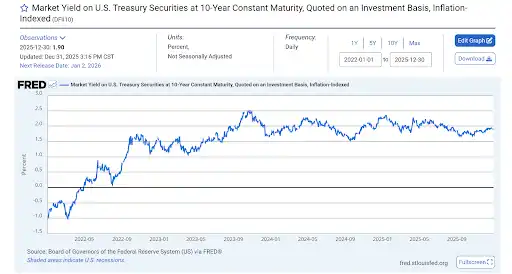
The market's focus is not on nominal interest rates, but on real interest rates. Inflation remains stubbornly high. As long as inflation persists, even if policy rates are cut, real rates struggle to break significantly lower from their elevated levels.
From the perspective of the real economy, rate cuts have not translated into easier financial conditions. Banks have not substantively loosened lending standards. Businesses remain reluctant to borrow. In other words, the intermediate link between policy and capital allocation remains blocked.
Meanwhile, the U.S. Treasury continues to issue a massive volume of new debt. In the second half of 2025, the pace of bond issuance for refinancing existing debt outpaced the liquidity released by rate cuts. The result seems counterintuitive but is crucial: overall liquidity did not expand; it actually contracted.
There simply isn't enough "available money" to push Bitcoin's price higher at the moment.
This is a Defensive Rate-Cut Cycle, Not a Growth Cycle.
This rate-cutting cycle is fundamentally different from previous ones that fueled bull markets. The Fed is cutting rates not because the economy is strong, but because unemployment is rising, corporate default rates are increasing, and the government's debt servicing costs are becoming unsustainable.
This is a defensive rate cut, driven primarily by recession fears and stagflation risks.
In this environment, capital behaves differently. Institutional investors prioritize survival over yield. Their first reaction is not to chase volatility but to reduce risk exposure and build cash buffers.
Despite its long lifecycle, Bitcoin remains one of the world's most liquid high-risk assets. When market stress increases, it is treated as a source of liquidity—a financial ATM. Risk-off flows start in crypto, not stop there.
This mirrors the logic during price expansions. Money flows into crypto last during price run-ups; it flows out of crypto first when uncertainty rises.
In contrast, as investors await a significant drop in real rates, gold is being used as a hedge against dollar devaluation.
The Deeper Issue: America's Debt Trilemma
U.S. interest payments now exceed defense spending, ranking as the federal government's third-largest expenditure after Social Security and Medicare.
Washington effectively has only three choices left.
First, roll over the debt indefinitely by issuing new bonds to pay off old ones. Given the total federal debt exceeds $38 trillion, this only exacerbates the problem.
Second, suppress long-term yields by shifting issuance towards short-term bills, lowering the average funding cost, but not addressing the fundamental imbalance.
Third, and most significantly, allow an implicit default through currency devaluation. When debt cannot be repaid in real terms, repay it with devalued dollars.
This is the structural reason behind gold's surge towards $4,500. The world is hedging against the late-stage credibility crisis of the U.S. dollar.
Rate cuts alone are insufficient. Many on Wall Street now openly state that to avoid collapse, the financial system needs continuous monetary expansion and managed inflation. This creates a vicious cycle: either print money leading to currency devaluation, or refuse to print triggering defaults.
History suggests the choice is inevitable. The Fed is unlikely to tolerate systemic collapse. The reintroduction of Quantitative Easing (QE) and Yield Curve Control (YCC) now seems more a question of timing than probability.
2026 Strategic Outlook: From Liquid Darkness to Flood
Once this framework is understood, the current divergence between gold and crypto makes perfect sense. Both assets hedge against it, but timing is crucial.
Gold is anticipating the future trend of monetary expansion; Bitcoin is waiting for confirmation.
In my view, the path forward unfolds in two phases.
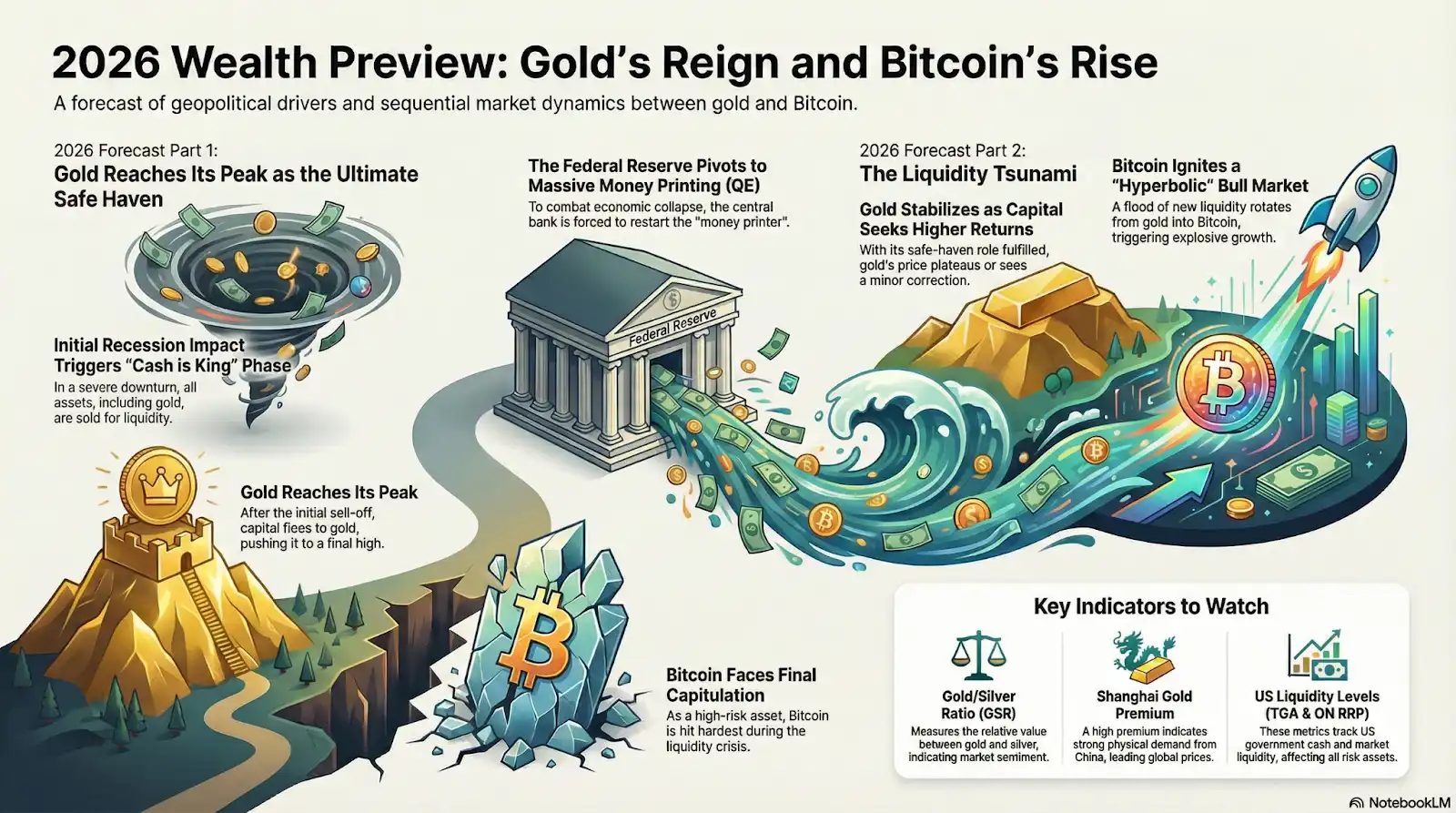
Act I: Recession Shock and the "Gold Peak"
When recession indicators are fully triggered—for example, U.S. unemployment rising above 5%—gold prices are likely to hold high or spike further. It will then be seen as the ultimate safe haven.
Bitcoin, however, could face a final leg down. In the initial phase of a recession, all assets are sold to raise cash. Margin calls and forced liquidations dominate market behavior.
History is clear on this. In 2008, gold fell nearly 30% before rebounding. In March 2020, gold dropped 12% in two weeks, while Bitcoin was halved.
Liquidity crises wash over all assets. The difference lies in which asset recovers first. Gold typically stabilizes and rebounds quicker; Bitcoin takes more time to rebuild market confidence.
Act II: Fed Capitulation and Bitcoin's Liquidity Explosion
Eventually, rate cuts will prove inadequate to handle the economic stress. Economic strain will force the Fed to expand its balance sheet again.
This is the moment the liquidity floodgates truly open.
Gold prices may consolidate or trade sideways. Capital will aggressively rotate into high-beta assets. Bitcoin, as the purest expression of excess liquidity, will absorb these flows.
In such scenarios, price moves are rarely gradual. Once momentum builds, Bitcoin's price can change violently within months.
A Note on Silver and the Gold-Silver Ratio
Silver's rally in 2025 was driven by two factors: its historical link to gold and its industrial demand. AI infrastructure, solar power, and electric vehicles are all heavily reliant on silver.
In 2025, inventories at major exchanges, including the Shanghai Futures Exchange and the London Bullion Market Association, fell to critical levels. In a bull market, silver typically outperforms gold, but in a bear market, it carries higher downside risk.
The gold-silver ratio remains a key metric.
Above 80, silver is historically cheap. Below 60, silver is expensive relative to gold. Below 50, speculative excess tends to dominate.
With the ratio currently around 59, the signal suggests a rotation towards gold, not aggressive accumulation of silver.
The Long View: Different Leaders, Same Destination
Setting aside the specific timing of 2026, the long-term conclusion remains unchanged. Both gold and Bitcoin are in an upward trend against fiat currencies.
The only variable is leadership. This year belongs to gold; the next phase belongs to Bitcoin.
As long as global debt expands and monetary authorities rely on currency debasement to relieve pressure, scarce assets will outperform. In the long run, fiat currency is the only consistently losing asset.
What matters now is patience, data, and discipline. The transition from gold dominance to Bitcoin dominance will not be announced—it will manifest through liquidity indicators, policy shifts, and capital rotation.
I will continue watching for these signals.