Gold Returns to $4800, Where Is This Year's Peak?

Odaily星球日报Pubblicato 2026-04-09Pubblicato ultima volta 2026-04-09

Introduzione

Gold has rebounded above $4,800 per ounce amid easing U.S.-Iran tensions after six weeks of conflict. This article explores gold's potential peak in 2026, citing predictions from platforms like Polymarket, where some traders bet on prices exceeding $6,000 by year-end. Key drivers include sustained central bank purchases (notably China’s 17-month buying streak), institutional demand from entities like Tether (now a top-30 global gold holder), and retail investment, particularly in Asia. While short-term volatility persists, analysts from UBS and Goldman Sachs project gold could reach $5,200-$5,400 by mid-year and $5,900-$6,300 longer-term, supported by geopolitical uncertainty, dollar weakening, and gold’s role as a hedge in a shifting global monetary system. The outlook remains bullish despite periodic corrections.

Original | Odaily Planet Daily (@OdailyChina)

Author | Wenser (@wenser 2010)
After enduring nearly six weeks of sudden shocks from the U.S.-Iran conflict, gold has returned above $4800 for the first time in nearly a month, following news related to a U.S.-Iran ceasefire agreement.

From the gold token XAUm mentioned as early as October 2024, to the accurate prediction of gold spot prices rising above $3900 when it was at $3500 in September last year, and later to the gold token XAUT mentioned when gold rose to around $4500 in January this year, I myself began a journey of fixed investment while following gold.

On the other hand, at the macro level, against the backdrop of intensifying geopolitical conflicts, central banks around the world continue to increase their gold holdings, with the Chinese central bank making large purchases for 17 consecutive months; major investment institutions and banks are also very confident about the gold price rally.

In view of this, this article from Odaily Planet Daily will explore a question from the perspectives of recent industry dynamics and changes in the political and economic situation: What is the upper limit for gold this year?
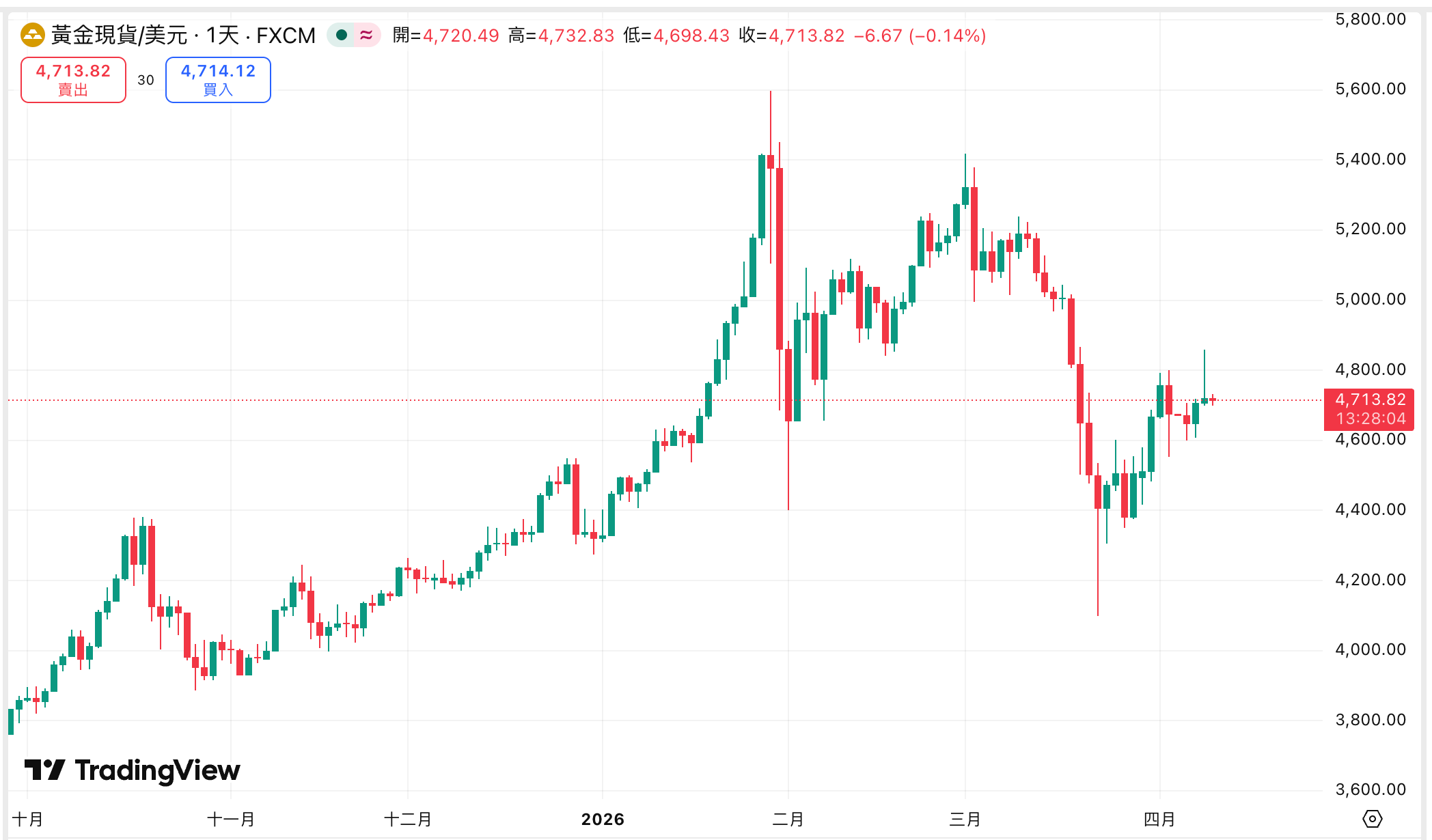
Gold price trend in the past six months

Views on gold price fluctuations in the prediction market: Price may be below $4200 before June, annual peak may exceed $6000

Since the emergence of prediction markets, thanks to factors such as real-money betting and "collective intelligence," they have become an important barometer for predicting asset prices. Currently, the annual price range for gold on Polymarket is around $3800-$6000.

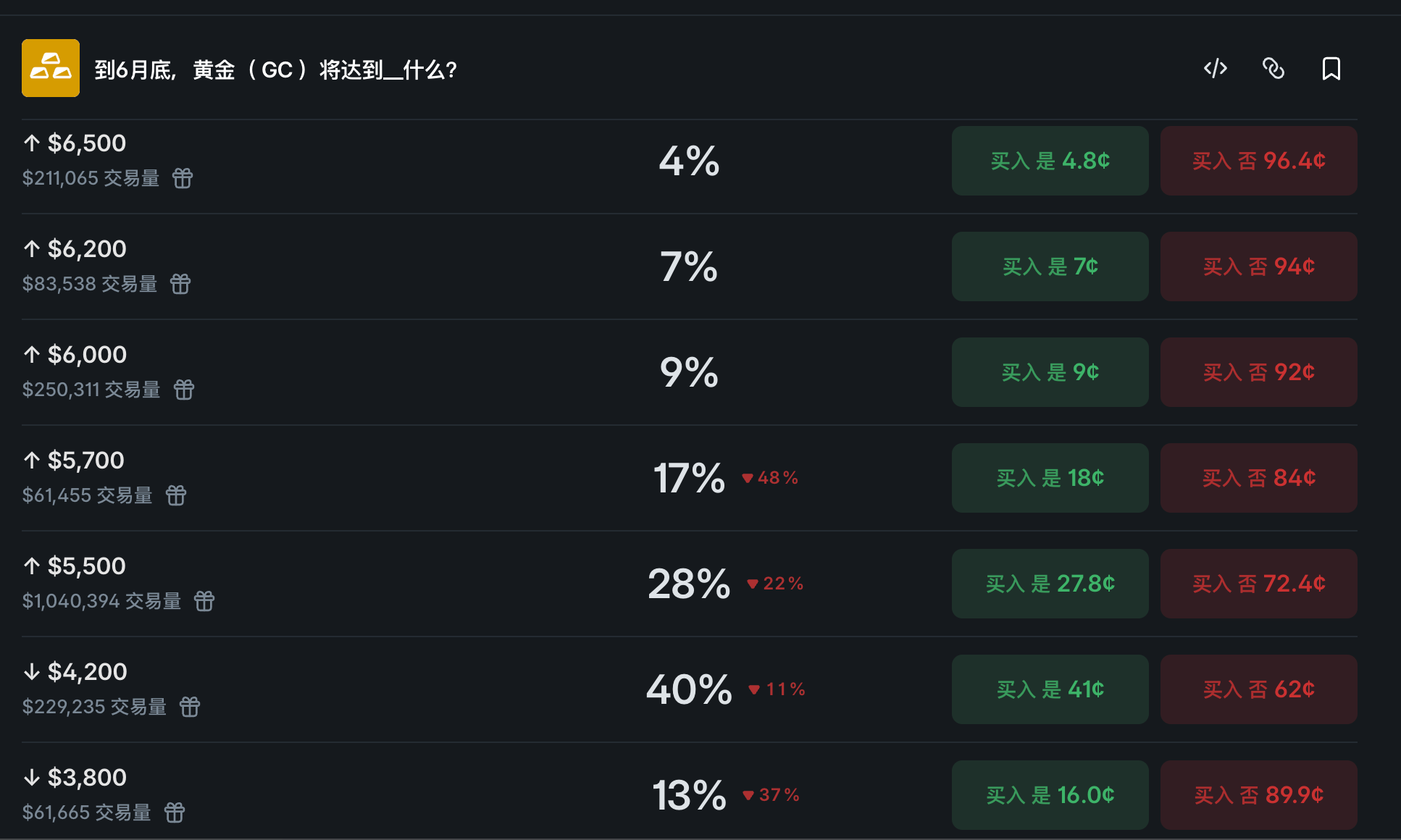
On Polymarket, the betting volume for the mid-year gold price prediction currently exceeds $3.5 million, of which:

The probability of being below $4200 is the highest, at 40%;

The probability of being above $5500 is next, at 28%;

Followed by above $5700 (probability temporarily reported at 17%) and below $3800 (probability temporarily reported at 13%).
The betting volume for the annual gold price prediction on Polymarket is currently only nearly $200,000, of which:

The probability of being above $6000 is the highest, at 46%;

The probability of being above $7000 is next, at 25%;

The probability of being above $8000 is next, at 16%.
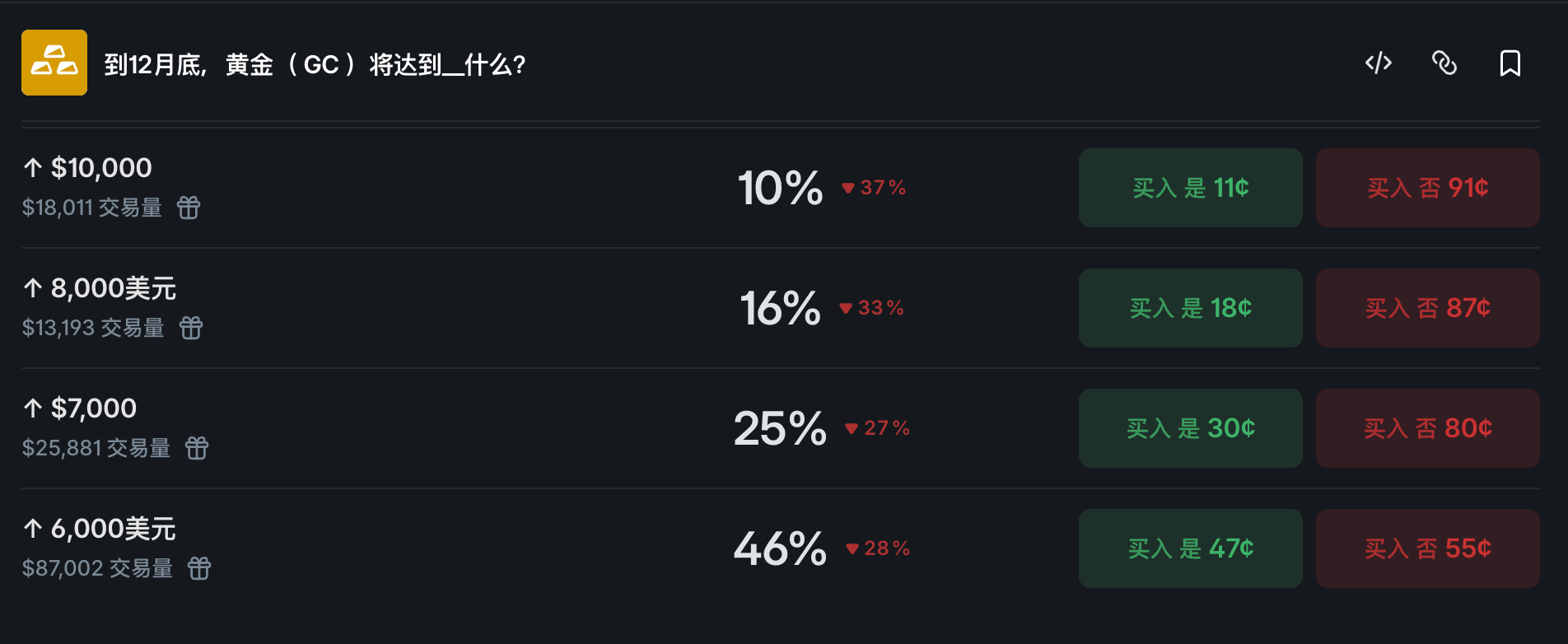
In other words, although the trading volume is relatively small, prediction market users still place the annual price above $6000, a difference of nearly 20%.

It is worth noting that the rules for gold price-related events on Polymarket use the official settlement price of the CME gold (GC) futures contract active month. Intraday trading, highest price, lowest price, bid, ask, or indicative prices are not counted.

Macro buying: Central banks continue to increase holdings, Turkish central bank exchanges gold for money

As the world's largest asset class by market value, the largest buyer of gold is naturally the central banks that control the fiat currency minting rights.

In early April, the World Gold Council released its February central bank gold buying monthly report. It pointed out that central banks net bought 19 tons of gold in February 2026, although still below the monthly average of 26 tons reported in 2025, it rebounded compared to the net purchase of 5 tons in January 2026. In addition, the report showed that some central banks maintained a continuous net buying record, with a cumulative gold purchase of 44 tons from November 2024 to February 2026, and the Czech Republic reported its 36th consecutive month of net buying. China increased its gold holdings for the 16th consecutive month (February data).

Goldman Sachs' research report at the end of March pointed out that supported by continued gold purchases by central banks and the expectation that the Federal Reserve will cut interest rates twice this year, the medium-term prospects for gold remain solid, and the gold price is expected to climb to $5400/ounce by the end of the year. UBS, at the end of March, expected the target price of gold to be $5900/ounce by early 2027.

On the 7th of this month, the Chinese central bank announced that China's gold reserves at the end of March were 74.38 million ounces (approximately 2313.48 tons), an increase of 160,000 ounces (approximately 4.98 tons) from the previous month. The figure at the end of February was 74.22 million ounces (approximately 2308.5 tons), marking the 17th consecutive month of increasing gold holdings.

On the other hand, traditional gold reserve powers have remained almost unchanged—such as the United States (approximately 8100 tons), Germany (approximately 3300 tons), Italy (approximately 2400 tons), and France (approximately 2400 tons).

As for the pressure on the fiat currency system in the Middle East due to the U.S.-Iran conflict, "the Turkish central bank sold over 120 tons of gold in the past 3 weeks, worth $20 billion." Many people only know one side of the story. In fact, most of this gold did not flow into the market but belonged to gold-currency swap futures. Simply put, the Turkish central bank only mortgaged its gold reserves to obtain U.S. dollar foreign exchange to stabilize the exchange rate of its domestic currency, the lira.

Structurally, the proportion of gold reserves to total reserves in emerging market central banks is still at a low level of just over 10%, and China is even in the single digits. This means that the room for central banks to increase holdings is far from saturated, and the strategic need for "de-dollarization" will provide rigid buying support for gold for many years to come.

Crypto buying: Stablecoin giant Tether's gold reserve scale ranks among the top 30 globally

In February, Wall Street investment bank Jefferies released a report stating that stablecoin issuer Tether continues to increase its gold holdings. As of January 31, its gold reserve scale has increased to about 148 tons, worth about $23 billion at current prices. Its holdings have exceeded those of many sovereign nations, ranking among the top 30 gold holders globally.

The report showed that Tether increased its gold holdings by about 26 tons in the fourth quarter of 2025 and continued to increase by about 6 tons in January this year. Its quarterly gold purchase scale was second only to a few central banks such as Poland and Brazil. Its current gold reserve scale has exceeded that of countries such as Australia, the UAE, Qatar, South Korea, and Greece.

The institution pointed out that the above gold is mainly used to support the dollar stablecoin USDT and the gold-pegged token XAUT (current FDV market value exceeds $3.3 billion). Since Tether is not a listed company, its disclosed data may only be the minimum level, and the actual gold holdings may be higher than the published value. Tether CEO Paolo Ardoino previously stated that the company plans to allocate about 10%–15% of its investment portfolio to physical gold.

Retail buying: High-level套牢 determines holding stability

In 2026, retail participation in gold investment has significantly increased, especially Asian funds becoming the new main force in the gold market.

In January, Asian gold ETFs saw a single-month inflow of up to $10 billion.

In addition, Chinese investors purchased 432 tons of gold bars and coins throughout 2025, a record high. The scene of queues at domestic gold stores to purchase accumulated gold, and the frequent sold-out status of accumulated gold on bank apps, reflect ordinary investors' strong recognition of gold's value preservation function.

However, the flip side of retail buying is the intensified two-way volatility of gold prices. In January, the news of Kevin Warsh being nominated as Fed chairman caused the gold price to plummet by more than 9% in a single day, the largest single-day drop in nearly 40 years; in March, the gold price once fell below $4200/ounce, and a large number of retail investors were套牢 at high levels. Combined with the action of the Chinese central bank buying heavily, it formed a sharp contrast of "retail panic selling, sovereign funds buying at lows."

As a result, a large amount of retail buying套牢 at high levels反而 means that the amount of gold sold within the year will not be too large.

Note: 套牢 (tào láo) is a Chinese term meaning to be trapped in a position (e.g., bought at a high price and now the price is lower, unable to sell without a loss). The translation uses "套牢" (tao lao) transliterated and explained as "trapped in a position" or simply "trapped" in context.

Institutional views: Gold will still hit new highs, price may be around $5200 by the end of June

At the institutional level, UBS, which has always paid much attention to the precious metals market, has frequently expressed views this year.

On January 21, UBS precious metals strategist Joni Teves said that diversification needs are the core driving force behind this round of gold price increases. Institutional investors, retail investors, and central banks are all increasing their gold holdings to cope with macro uncertainties. It is expected that the gold price will still have upward momentum in the first half of the year. If market concerns about the Fed's independence continue to heat up, the gold price is expected to hit the $5000/ounce mark in the first half of the year. Silver will benefit from the带动 of rising gold prices and its own narrowing supply-demand gap, and may challenge $100/ounce this year.

Subsequently, gold and silver both surged, with the former once rising to nearly $5600/ounce, and the latter once rising to $120/ounce.

On February 24, UBS Group said it expects the gold price to reach $6200 per ounce in the coming months because the key factors driving its strong rally over the past year remain.

Subsequently, on February 28, the U.S.-Iran conflict officially broke out, with Israel and the United States jointly attacking Iran, and regional hot war began.

On March 5, UBS Group analysts stated in a report that data since 1900 shows that for financial markets, economic risks have proven to be more significant than geopolitical risks. They said that in most cases, investors perform best if they can "see through" the noise of geopolitics.

At the end of March, UBS expected the target price of gold to be $5900/ounce by early 2027.

On April 2, UBS strategist Joni Teves预计, despite recent gold price fluctuations, the gold price will hit a new high this year, and views the recent回调 as a buying opportunity. UBS expects the average gold price in 2026 to be $5000 per ounce, and $4800 and $4250 in 2027 and 2028 respectively.

On April 7, UBS lowered its gold price expectation for the end of June to $5,200/ounce, due to cooling investor demand amid increased market volatility.

In addition, in early February, JPMorgan publicly firmly看好 gold, believing that the year-end target is up to $6300, with a remaining 34% increase.

Understanding the nature of gold: Safe-haven asset and core of the de-dollarized monetary system

Finally, let's briefly discuss the nature of gold investment.

In 1971, the United States亲手 dismantled the Bretton Woods system it had built. Subsequently, the gold price soared from $35/ounce to nearly $5000/ounce today, a cumulative increase of over 94 times in 55 years. Taking 4-5 years as an investment cycle, it has累计穿越 at least 10 bull and bear cycles.

After the outbreak of the Russia-Ukraine conflict in 2022, the economic process of "de-dollarization" suddenly accelerated, and global central banks thus started a new round of gold reserve competition, which step by step created the "super行情" of gold in the past 3 years.

Entering 2026, as the US Trump was挑拨 by Israel's Netanyahu to send troops to the Middle East (Odaily Planet Daily Note: It is rumored that Netanyahu personally lobbied before the US-Israel joint attack on Iran), although affected by AI, technology, local industrial回流 and other news and policies, the US political and economic situation will not collapse instantly, but the monetary credit system of the US dollar has already shown initial signs of decline.

In January this year,知名投行 Morgan Stanley said that the role of the US dollar in the global system is being continuously and gradually weakened, but since credible alternative currencies are still limited, in an increasingly multipolar world, gold has become the biggest challenger to the US dollar. According to Morgan Stanley's research, the international influence of the US dollar has declined on several indicators, including its share in central banks' foreign exchange reserves下滑, and its use in corporate and emerging market sovereign issuance减少. Nevertheless, the US dollar still accounts for the largest share of global reserves, indicating that there is currently no challenger of substantive significance. However, once gold is taken into account, the situation changes. The proportion of gold in central banks' held assets has risen from about 14% to 25%—28%, and this upward trend "shows no signs of slowing down." Risk premiums and hedging behavior will continue to put pressure on the US dollar while supporting gold demand.

Although in the chaos caused by the U.S.-Iran conflict in Dubai, gold's "safe-haven asset属性" was questioned due to its inconvenience to carry,但从 the current international situation, it is still the only hard currency recognized by the international community besides the US dollar.

As for Iran's guarding of the Strait of Hormuz and charging passage fees in RMB, BTC and other cryptocurrencies, it further exposed the reality of the declining credibility of the US dollar in the global economic system.

Therefore, although Bloomberg Intelligence senior market analyst Mike McGlone warned in his April metal market outlook report that gold and silver may have peaked, and the "once-in-a-generation" high may have passed. But given Trump's current首鼠两端、sometimes winning, sometimes winning political attitude, gold is still at a relative low for the year.

Based on the above multi-dimensional analysis, the trend of gold in 2026 can be summarized as a three-stage structure of "surging to the top in the first quarter, a shallow回调 in the second quarter, and bottoming out and rising in the third and fourth quarters". The core logic is still upward, but volatility will be significantly higher than in previous years.

At the current price level of $4800/ounce, gold may be in a修复性反弹 stage, and $4900 is the key resistance interval in the near term. The progress of the U.S.-Iran ceasefire talks, US CPI data, and Fed policy signals will be the most critical short-term price catalysts. If the ceasefire agreement continues and oil prices continue to fall, and rate cut expectations further heat up, the gold price is expected to challenge the $5200 mark by the end of the second quarter.

In the second half of the year, as US inflationary pressures ease with falling oil prices, the Fed's rate cut window reopens, and a weaker US dollar will provide more room for gold to rise. In addition, the unpredictable situation of the midterm elections will also provide certain political momentum for the rise of assets such as gold and BTC.

In terms of price上限, comprehensive institutional predictions and market trends, the reasonable upper limit prediction interval for the gold price in 2026 is $5400~$6000/ounce, and under optimistic conditions, it may rise to $6200-$6400/ounce.

In a nutshell, the United States is like the powerful but declining Qin Dynasty in the past, "When Qin loses its deer, all heroes chase it." At this time, among the大类 assets under heaven, if we talk about稳妥保障、保值增值, who else is there besides gold?

Recommended Reading

What's more worth paying attention to behind the gold回调: The loosening of the old system

Is Iran's talk of paying Strait passage fees with Bitcoin just hot air?

Domande pertinenti

QAccording to the article, what is the current price of gold and what key resistance level is it approaching in the near term?

AThe current price of gold is $4800 per ounce, and it is approaching a key near-term resistance level of $4900.

QWhat are the two main drivers for gold's medium-term prospects as mentioned by Goldman Sachs in their late-March research report?

AGoldman Sachs cited continued gold purchases by central banks and the expectation that the Federal Reserve will cut interest rates twice this year as the main drivers for gold's medium-term prospects.

QWhich stablecoin issuer has a significant gold reserve that ranks among the top 30 globally, and what is the estimated size of its holdings?

AThe stablecoin issuer is Tether, and its estimated gold reserve is about 148 tons, valued at approximately $23 billion, placing it among the top 30 global holders.

QWhat overall price structure does the article predict for gold in 2026, and what is the core logic behind this prediction?

AThe article predicts a three-phase structure for gold in 2026: a peak in Q1, a shallow correction in Q2, and a bottoming-out and recovery in Q3 and Q4. The core logic is that the overall trend is still upward, but volatility will be significantly higher than in previous years.

QWhat does the article identify as the 'only hard currency' recognized by the international community besides the US dollar?

AThe article identifies gold as the only hard currency recognized by the international community besides the US dollar.

Letture associate

Agents Take Over Traffic Distribution Power: What Are Tencent, ByteDance, and Alibaba Competing For?

In the race to dominate the AI era's entry point, China's tech giants—Tencent, ByteDance, and Alibaba—are aggressively deploying AI Agents to control the future of traffic distribution. Alibaba is pursuing a dual-track "closed loop + openness" strategy. Its Qianwen app is evolving into a super-Agent integrated across its ecosystem (Taobao, Alipay, etc.) to handle complex tasks like travel planning. Concurrently, it is opening its platform to external brands (Luckin Coffee, KFC) and has launched a B2B Agent platform, "Wukong," targeting enterprise automation. Its other flagship, Quark, aims to be an "AI super search box" for information and tasks. ByteDance is executing an omnipresent "sprawl strategy." Its Doubao app boasts over 300 million monthly active users and is evolving into a default AI entry point for daily life, with plans for paid versions and e-commerce integration. Its core weapon is the Kouzi platform, a visual "AI assembly factory" for developers to build custom Agents. ByteDance is also pushing hardware integration, collaborating on AI phones and developing smart glasses to embed Doubao everywhere. Tencent is playing its long-held "ultimate card" by quietly embedding an AI Agent directly into WeChat. This Agent, accessible via a swipe, can understand user commands and automatically execute tasks by calling upon WeChat's millions of mini-programs (e.g., finding and ordering coffee). This leverages WeChat's unparalleled 1.4-billion-user ecosystem to position the app as an AI-powered "service operating system," a move that could dramatically reshape the competitive landscape. The core battleground is shifting from competing for "user screen time" to competing to be the "default execution layer" for user intent. The business model is evolving from an "attention economy" to an "intent economy," where the Agent that can most efficiently fulfill a user's need gains control over service access and token flow. This represents a fundamental change in how users connect with digital services, making the fight for the Agent入口 (entry point) a pivotal moment for redefining industry leadership in the AI age.

marsbit13 min fa

Agents Take Over Traffic Distribution Power: What Are Tencent, ByteDance, and Alibaba Competing For?

marsbit13 min fa

From Banning Doubao to Embracing Honor: Why Did WeChat Suddenly 'Change Its Face'?

The article explores the sudden shift in WeChat's strategy towards AI assistants from mobile phone manufacturers, transitioning from strict opposition to active collaboration. For over a year, WeChat fiercely resisted attempts by phone AI assistants (like ByteDance's Doubao in late 2025) to control its features via GUI automation ("simulated clicking"), citing security and data control concerns. This stance created a significant barrier for system-level AI integration. Now, Tencent has initiated A2A (Agent-to-Agent) partnerships with major phone brands like Honor, Xiaomi, OPPO, and vivo. This model allows a phone's system AI (e.g., Honor's YOYO) to parse a user's voice command and send a structured request directly to WeChat's own internal AI agent via secure APIs. WeChat then executes the action (e.g., sending a message) and returns the result. The article attributes Tencent's "change of face" to strategic pressure. While leading in social app usage, Tencent trails rivals like ByteDance and Alibaba in standalone AI app popularity. WeChat, with its vast mini-program ecosystem, is Tencent's key asset for an AI comeback. The upcoming WeChat AI agent aims to handle tasks like booking and payments within the app. However, phone system assistants remain the primary AI entry point for most users. The A2A collaboration allows Tencent to extend WeChat's AI reach to this crucial system layer while maintaining control over its core functions and data. For phone manufacturers, embracing A2A is a pragmatic move. The GUI route proved unviable due to WeChat's blocks. A2A offers a compliant path to integrate a vital service, enhancing their AI assistants' usefulness. It allows them to focus on developing their own AI ecosystems for other services while cooperating on WeChat access. The collaboration is framed as a mutual, strategic necessity: Tencent gains a distribution channel, and manufacturers gain a key functionality. The partnership relies on a "dual authorization" mechanism for security, requiring both user and app consent for each action. While questions about long-term data privacy practices remain, experts note A2A is more secure and compliant than GUI automation. Ultimately, this cooperation is seen as a tentative, calculated truce. Tencent's long-term goal is to make WeChat an AI-powered "service OS." Phone manufacturers aim to make their system AI the central user interface. Their paths may converge or clash in the future, but for now, the A2A deal represents the opening chapter in the battle for the AI-era user入口, driven by necessity and strategic calculus on both sides.

marsbit1 h fa

From Banning Doubao to Embracing Honor: Why Did WeChat Suddenly 'Change Its Face'?

marsbit1 h fa

On-Chain Figures on the Eve of Kickoff: 1.6 Billion Traded Before the World Cup Even Begins

"On-Chain Numbers on the Eve of the World Cup: $1.6 Billion Traded Before Kick-off" Analysis of on-chain markets before the 2026 FIFA World Cup reveals significant crypto integration into football. The most striking figure is the approximately **$1.6 billion** in total trading volume on the single "World Cup Winner" contract on the Polymarket prediction market platform, accumulated before a single match was played. This represents explosive growth for a sector whose annual volume surged from ~$16B in 2024 to ~$64B in 2025. The ecosystem is maturing beyond speculation. Key developments include: 1) **Infrastructure upgrades** like Polymarket's migration to native, regulated USDC stablecoin for settlements; 2) **Reliable data oracles**, such as Chainlink, being used to resolve real-world match outcomes on-chain; and 3) **Official recognition**, with FIFA appointing its first-ever "Prediction Markets" partner. Over 100 contracts now cover everything from the outright winner to individual match results and even non-sporting risks like venue relocation. This evolution marks a fundamental shift. While crypto firms are absent from FIFA's top-tier sponsor list, the technology has deeply penetrated the tournament's financial and predictive infrastructure through regulated stablecoin settlements, decentralized oracles, and new official partnership categories. The regulatory landscape remains complex and varies by jurisdiction, but on-chain markets for the World Cup are already a multi-billion-dollar reality.

marsbit2 h fa

On-Chain Figures on the Eve of Kickoff: 1.6 Billion Traded Before the World Cup Even Begins

marsbit2 h fa

Trading

Spot
Futures

Articoli Popolari

Cosa è $S$

Comprendere SPERO: Una Panoramica Completa Introduzione a SPERO Mentre il panorama dell'innovazione continua a evolversi, l'emergere delle tecnologie web3 e dei progetti di criptovaluta gioca un ruolo fondamentale nel plasmare il futuro digitale. Un progetto che ha attirato l'attenzione in questo campo dinamico è SPERO, denotato come SPERO,$$s$. Questo articolo mira a raccogliere e presentare informazioni dettagliate su SPERO, per aiutare gli appassionati e gli investitori a comprendere le sue basi, obiettivi e innovazioni nei domini web3 e crypto. Che cos'è SPERO,$$s$? SPERO,$$s$ è un progetto unico all'interno dello spazio crypto che cerca di sfruttare i principi della decentralizzazione e della tecnologia blockchain per creare un ecosistema che promuove l'impegno, l'utilità e l'inclusione finanziaria. Il progetto è progettato per facilitare interazioni peer-to-peer in modi nuovi, fornendo agli utenti soluzioni e servizi finanziari innovativi. Al suo interno, SPERO,$$s$ mira a responsabilizzare gli individui fornendo strumenti e piattaforme che migliorano l'esperienza dell'utente nello spazio delle criptovalute. Questo include la possibilità di metodi di transazione più flessibili, la promozione di iniziative guidate dalla comunità e la creazione di percorsi per opportunità finanziarie attraverso applicazioni decentralizzate (dApps). La visione sottostante di SPERO,$$s$ ruota attorno all'inclusività, cercando di colmare le lacune all'interno della finanza tradizionale mentre sfrutta i vantaggi della tecnologia blockchain. Chi è il Creatore di SPERO,$$s$? L'identità del creatore di SPERO,$$s$ rimane piuttosto oscura, poiché ci sono risorse pubblicamente disponibili limitate che forniscono informazioni dettagliate sul suo fondatore o fondatori. Questa mancanza di trasparenza può derivare dall'impegno del progetto per la decentralizzazione—un ethos che molti progetti web3 condividono, dando priorità ai contributi collettivi rispetto al riconoscimento individuale. Centrando le discussioni attorno alla comunità e ai suoi obiettivi collettivi, SPERO,$$s$ incarna l'essenza dell'empowerment senza mettere in evidenza individui specifici. Pertanto, comprendere l'etica e la missione di SPERO rimane più importante che identificare un creatore singolo. Chi sono gli Investitori di SPERO,$$s$? SPERO,$$s$ è supportato da una varietà di investitori che vanno dai capitalisti di rischio agli investitori angelici dedicati a promuovere l'innovazione nel settore crypto. Il focus di questi investitori generalmente si allinea con la missione di SPERO—dando priorità a progetti che promettono avanzamenti tecnologici sociali, inclusività finanziaria e governance decentralizzata. Queste fondazioni di investitori sono tipicamente interessate a progetti che non solo offrono prodotti innovativi, ma contribuiscono anche positivamente alla comunità blockchain e ai suoi ecosistemi. Il supporto di questi investitori rafforza SPERO,$$s$ come un concorrente degno di nota nel dominio in rapida evoluzione dei progetti crypto. Come Funziona SPERO,$$s$? SPERO,$$s$ impiega un framework multifunzionale che lo distingue dai progetti di criptovaluta convenzionali. Ecco alcune delle caratteristiche chiave che sottolineano la sua unicità e innovazione: Governance Decentralizzata: SPERO,$$s$ integra modelli di governance decentralizzati, responsabilizzando gli utenti a partecipare attivamente ai processi decisionali riguardanti il futuro del progetto. Questo approccio favorisce un senso di proprietà e responsabilità tra i membri della comunità. Utilità del Token: SPERO,$$s$ utilizza il proprio token di criptovaluta, progettato per servire varie funzioni all'interno dell'ecosistema. Questi token abilitano transazioni, premi e la facilitazione dei servizi offerti sulla piattaforma, migliorando l'impegno e l'utilità complessivi. Architettura Stratificata: L'architettura tecnica di SPERO,$$s$ supporta la modularità e la scalabilità, consentendo un'integrazione fluida di funzionalità e applicazioni aggiuntive man mano che il progetto evolve. Questa adattabilità è fondamentale per mantenere la rilevanza nel panorama crypto in continua evoluzione. Coinvolgimento della Comunità: Il progetto enfatizza iniziative guidate dalla comunità, impiegando meccanismi che incentivano la collaborazione e il feedback. Nutrendo una comunità forte, SPERO,$$s$ può affrontare meglio le esigenze degli utenti e adattarsi alle tendenze di mercato. Focus sull'Inclusione: Offrendo basse commissioni di transazione e interfacce user-friendly, SPERO,$$s$ mira ad attrarre una base utenti diversificata, inclusi individui che potrebbero non aver precedentemente interagito nello spazio crypto. Questo impegno per l'inclusione si allinea con la sua missione generale di empowerment attraverso l'accessibilità. Cronologia di SPERO,$$s$ Comprendere la storia di un progetto fornisce preziose intuizioni sulla sua traiettoria di sviluppo e sui traguardi. Di seguito è riportata una cronologia suggerita che mappa eventi significativi nell'evoluzione di SPERO,$$s$: Fase di Concettualizzazione e Ideazione: Le idee iniziali che formano la base di SPERO,$$s$ sono state concepite, allineandosi strettamente con i principi di decentralizzazione e focus sulla comunità all'interno dell'industria blockchain. Lancio del Whitepaper del Progetto: Dopo la fase concettuale, è stato rilasciato un whitepaper completo che dettaglia la visione, gli obiettivi e l'infrastruttura tecnologica di SPERO,$$s$ per suscitare interesse e feedback dalla comunità. Costruzione della Comunità e Prime Interazioni: Sono stati effettuati sforzi attivi di outreach per costruire una comunità di early adopters e potenziali investitori, facilitando discussioni attorno agli obiettivi del progetto e ottenendo supporto. Evento di Generazione del Token: SPERO,$$s$ ha condotto un evento di generazione del token (TGE) per distribuire i propri token nativi ai primi sostenitori e stabilire una liquidità iniziale all'interno dell'ecosistema. Lancio della Prima dApp: La prima applicazione decentralizzata (dApp) associata a SPERO,$$s$ è stata attivata, consentendo agli utenti di interagire con le funzionalità principali della piattaforma. Sviluppo Continuo e Partnership: Aggiornamenti e miglioramenti continui alle offerte del progetto, inclusi partnership strategiche con altri attori nello spazio blockchain, hanno plasmato SPERO,$$s$ in un concorrente competitivo e in evoluzione nel mercato crypto. Conclusione SPERO,$$s$ rappresenta una testimonianza del potenziale del web3 e delle criptovalute di rivoluzionare i sistemi finanziari e responsabilizzare gli individui. Con un impegno per la governance decentralizzata, il coinvolgimento della comunità e funzionalità progettate in modo innovativo, apre la strada verso un panorama finanziario più inclusivo. Come per qualsiasi investimento nello spazio crypto in rapida evoluzione, si incoraggiano potenziali investitori e utenti a ricercare approfonditamente e a impegnarsi in modo riflessivo con gli sviluppi in corso all'interno di SPERO,$$s$. Il progetto mostra lo spirito innovativo dell'industria crypto, invitando a ulteriori esplorazioni delle sue innumerevoli possibilità. Mentre il percorso di SPERO,$$s$ è ancora in fase di sviluppo, i suoi principi fondamentali potrebbero effettivamente influenzare il futuro di come interagiamo con la tecnologia, la finanza e tra di noi in ecosistemi digitali interconnessi.

75 Totale visualizzazioniPubblicato il 2024.12.17Aggiornato il 2024.12.17

Cosa è $S$

Cosa è AGENT S

Agent S: Il Futuro dell'Interazione Autonoma in Web3 Introduzione Nel panorama in continua evoluzione di Web3 e criptovalute, le innovazioni stanno costantemente ridefinendo il modo in cui gli individui interagiscono con le piattaforme digitali. Uno di questi progetti pionieristici, Agent S, promette di rivoluzionare l'interazione uomo-computer attraverso il suo framework agentico aperto. Aprendo la strada a interazioni autonome, Agent S mira a semplificare compiti complessi, offrendo applicazioni trasformative nell'intelligenza artificiale (AI). Questa esplorazione dettagliata approfondirà le complessità del progetto, le sue caratteristiche uniche e le implicazioni per il dominio delle criptovalute. Cos'è Agent S? Agent S si presenta come un innovativo framework agentico aperto, progettato specificamente per affrontare tre sfide fondamentali nell'automazione dei compiti informatici: Acquisizione di Conoscenze Specifiche del Dominio: Il framework apprende in modo intelligente da varie fonti di conoscenza esterne ed esperienze interne. Questo approccio duale gli consente di costruire un ricco repository di conoscenze specifiche del dominio, migliorando le sue prestazioni nell'esecuzione dei compiti. Pianificazione su Lungo Orizzonte di Compiti: Agent S impiega una pianificazione gerarchica potenziata dall'esperienza, un approccio strategico che facilita la suddivisione e l'esecuzione efficiente di compiti complessi. Questa caratteristica migliora significativamente la sua capacità di gestire più sottocompiti in modo efficiente ed efficace. Gestione di Interfacce Dinamiche e Non Uniformi: Il progetto introduce l'Interfaccia Agente-Computer (ACI), una soluzione innovativa che migliora l'interazione tra agenti e utenti. Utilizzando Modelli Linguistici Multimodali di Grandi Dimensioni (MLLM), Agent S può navigare e manipolare senza sforzo diverse interfacce grafiche utente. Attraverso queste caratteristiche pionieristiche, Agent S fornisce un framework robusto che affronta le complessità coinvolte nell'automazione dell'interazione umana con le macchine, preparando il terreno per innumerevoli applicazioni nell'AI e oltre. Chi è il Creatore di Agent S? Sebbene il concetto di Agent S sia fondamentalmente innovativo, informazioni specifiche sul suo creatore rimangono elusive. Il creatore è attualmente sconosciuto, il che evidenzia sia la fase embrionale del progetto sia la scelta strategica di mantenere i membri fondatori sotto anonimato. Indipendentemente dall'anonimato, l'attenzione rimane sulle capacità e sul potenziale del framework. Chi sono gli Investitori di Agent S? Poiché Agent S è relativamente nuovo nell'ecosistema crittografico, informazioni dettagliate riguardanti i suoi investitori e sostenitori finanziari non sono documentate esplicitamente. La mancanza di approfondimenti pubblicamente disponibili sulle fondazioni di investimento o sulle organizzazioni che supportano il progetto solleva interrogativi sulla sua struttura di finanziamento e sulla roadmap di sviluppo. Comprendere il supporto è cruciale per valutare la sostenibilità del progetto e il suo potenziale impatto sul mercato. Come Funziona Agent S? Al centro di Agent S si trova una tecnologia all'avanguardia che gli consente di funzionare efficacemente in contesti diversi. Il suo modello operativo è costruito attorno a diverse caratteristiche chiave: Interazione Uomo-Computer Simile a Quella Umana: Il framework offre una pianificazione AI avanzata, cercando di rendere le interazioni con i computer più intuitive. Mimando il comportamento umano nell'esecuzione dei compiti, promette di elevare le esperienze degli utenti. Memoria Narrativa: Utilizzata per sfruttare esperienze di alto livello, Agent S utilizza la memoria narrativa per tenere traccia delle storie dei compiti, migliorando così i suoi processi decisionali. Memoria Episodica: Questa caratteristica fornisce agli utenti una guida passo-passo, consentendo al framework di offrire supporto contestuale mentre i compiti si sviluppano. Supporto per OpenACI: Con la capacità di funzionare localmente, Agent S consente agli utenti di mantenere il controllo sulle proprie interazioni e flussi di lavoro, allineandosi con l'etica decentralizzata di Web3. Facile Integrazione con API Esterne: La sua versatilità e compatibilità con varie piattaforme AI garantiscono che Agent S possa adattarsi senza problemi agli ecosistemi tecnologici esistenti, rendendolo una scelta attraente per sviluppatori e organizzazioni. Queste funzionalità contribuiscono collettivamente alla posizione unica di Agent S all'interno dello spazio crittografico, poiché automatizza compiti complessi e multi-fase con un intervento umano minimo. Man mano che il progetto evolve, le sue potenziali applicazioni in Web3 potrebbero ridefinire il modo in cui si svolgono le interazioni digitali. Cronologia di Agent S Lo sviluppo e le tappe di Agent S possono essere riassunti in una cronologia che evidenzia i suoi eventi significativi: 27 Settembre 2024: Il concetto di Agent S è stato lanciato in un documento di ricerca completo intitolato “Un Framework Agentico Aperto che Usa i Computer Come un Umano”, mostrando le basi per il progetto. 10 Ottobre 2024: Il documento di ricerca è stato reso pubblicamente disponibile su arXiv, offrendo un'esplorazione approfondita del framework e della sua valutazione delle prestazioni basata sul benchmark OSWorld. 12 Ottobre 2024: È stata rilasciata una presentazione video, fornendo un'idea visiva delle capacità e delle caratteristiche di Agent S, coinvolgendo ulteriormente potenziali utenti e investitori. Questi indicatori nella cronologia non solo illustrano i progressi di Agent S, ma indicano anche il suo impegno per la trasparenza e il coinvolgimento della comunità. Punti Chiave su Agent S Man mano che il framework Agent S continua a evolversi, diversi attributi chiave si distinguono, sottolineando la sua natura innovativa e il potenziale: Framework Innovativo: Progettato per fornire un uso intuitivo dei computer simile all'interazione umana, Agent S porta un approccio nuovo all'automazione dei compiti. Interazione Autonoma: La capacità di interagire autonomamente con i computer attraverso GUI segna un passo avanti verso soluzioni informatiche più intelligenti ed efficienti. Automazione di Compiti Complessi: Con la sua metodologia robusta, può automatizzare compiti complessi e multi-fase, rendendo i processi più veloci e meno soggetti a errori. Miglioramento Continuo: I meccanismi di apprendimento consentono ad Agent S di migliorare dalle esperienze passate, migliorando continuamente le sue prestazioni e la sua efficacia. Versatilità: La sua adattabilità attraverso diversi ambienti operativi come OSWorld e WindowsAgentArena garantisce che possa servire un'ampia gamma di applicazioni. Man mano che Agent S si posiziona nel panorama di Web3 e delle criptovalute, il suo potenziale per migliorare le capacità di interazione e automatizzare i processi segna un significativo avanzamento nelle tecnologie AI. Attraverso il suo framework innovativo, Agent S esemplifica il futuro delle interazioni digitali, promettendo un'esperienza più fluida ed efficiente per gli utenti in vari settori. Conclusione Agent S rappresenta un audace passo avanti nell'unione tra AI e Web3, con la capacità di ridefinire il modo in cui interagiamo con la tecnologia. Sebbene sia ancora nelle sue fasi iniziali, le possibilità per la sua applicazione sono vaste e coinvolgenti. Attraverso il suo framework completo che affronta sfide critiche, Agent S mira a portare le interazioni autonome al centro dell'esperienza digitale. Man mano che ci addentriamo nei regni delle criptovalute e della decentralizzazione, progetti come Agent S giocheranno senza dubbio un ruolo cruciale nel plasmare il futuro della tecnologia e della collaborazione uomo-computer.

533 Totale visualizzazioniPubblicato il 2025.01.14Aggiornato il 2025.01.14

Cosa è AGENT S

Come comprare S

Benvenuto in HTX.com! Abbiamo reso l'acquisto di Sonic (S) semplice e conveniente. Segui la nostra guida passo passo per intraprendere il tuo viaggio nel mondo delle criptovalute.Step 1: Crea il tuo Account HTXUsa la tua email o numero di telefono per registrarti il tuo account gratuito su HTX. Vivi un'esperienza facile e sblocca tutte le funzionalità,Crea il mio accountStep 2: Vai in Acquista crypto e seleziona il tuo metodo di pagamentoCarta di credito/debito: utilizza la tua Visa o Mastercard per acquistare immediatamente SonicS.Bilancio: Usa i fondi dal bilancio del tuo account HTX per fare trading senza problemi.Terze parti: abbiamo aggiunto metodi di pagamento molto utilizzati come Google Pay e Apple Pay per maggiore comodità.P2P: Fai trading direttamente con altri utenti HTX.Over-the-Counter (OTC): Offriamo servizi su misura e tassi di cambio competitivi per i trader.Step 3: Conserva Sonic (S)Dopo aver acquistato Sonic (S), conserva nel tuo account HTX. In alternativa, puoi inviare tramite trasferimento blockchain o scambiare per altre criptovalute.Step 4: Scambia Sonic (S)Scambia facilmente Sonic (S) nel mercato spot di HTX. Accedi al tuo account, seleziona la tua coppia di trading, esegui le tue operazioni e monitora in tempo reale. Offriamo un'esperienza user-friendly sia per chi ha appena iniziato che per i trader più esperti.

1.1k Totale visualizzazioniPubblicato il 2025.01.15Aggiornato il 2026.06.02

Come comprare S

Discussioni

Benvenuto nella Community HTX. Qui puoi rimanere informato sugli ultimi sviluppi della piattaforma e accedere ad approfondimenti esperti sul mercato. Le opinioni degli utenti sul prezzo di S S sono presentate come di seguito.

活动图片














