Global SaaS Crisis, AaaS Becomes Mainstream, Claude is Undermining SME Software

marsbitPubblicato 2026-05-15Pubblicato ultima volta 2026-05-15

Introduzione

Claude's new "Claude for Small Business" product integrates directly with tools like QuickBooks, PayPal, and Google Workspace to automate core business workflows. Aimed at small businesses, it handles tasks such as payroll, month-end closing, invoicing, and marketing campaigns through simple conversational commands. The service, included with a Claude subscription, offers pre-built automations for 15 high-frequency scenarios and operates with user-approval steps for security. This move represents a shift from traditional SaaS toward AI Agent-as-a-Service (AaaS), targeting the underserved small business market with a low-cost, intuitive alternative to complex, multi-software stacks. The release follows Anthropic's strategy of industry-specific AI integration, signaling potential disruption for single-function SaaS companies as AI becomes the primary operational interface.

Following the release of 11 plugins by Claude in early January, which triggered the "SaaSpocalypse," Claude has now introduced actual workflows with the new release of Claude for Small Business.

The interface of this new product reads: "Out of the weeds, into the work." Roughly translated to Chinese, it means: Stop getting bogged down in trivial matters and get back to the real work.

This time, Claude isn't just playing with concepts. It can directly integrate with tools businesses use daily, including QuickBooks, PayPal, HubSpot, Canva, DocuSign, Google Workspace, and Microsoft 365, among others.

Once connected, Claude can automatically handle routine business tasks such as payroll calculation and distribution, month-end financial closing, sales and marketing execution, and invoice follow-ups—without switching software or manual reconciliation.

Scrolling down on the official website, it directly showcases several dialogue examples.

how to do payroll, how to run month-end close, how to automatically generate Monday briefings.

You input a command like: "Close out March for me. Reconcile my QuickBooks transactions against PayPal settlements, flag anything that doesn't match, and write the P&L narrative"

It will reconcile 147 transactions, flag 5 exceptions one by one, and write the profit and loss narrative, ready to be forwarded directly to the accountant.
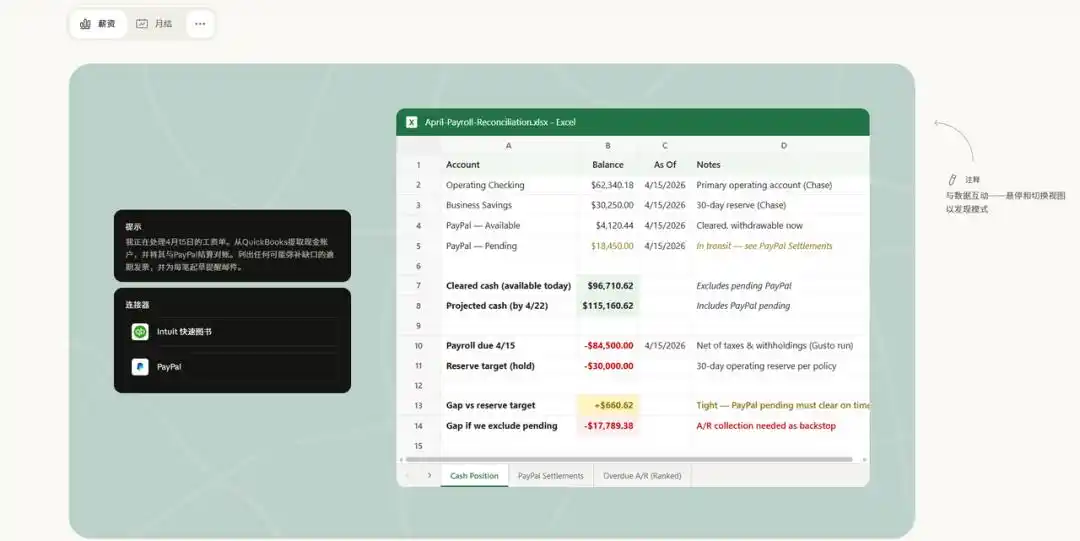
Product Details Worth Highlighting

The most crucial point is that processing 147 transactions with a single command is remarkably smooth.

You simply need to switch to the Cowork tab in the Claude desktop app, turn on the Claude for Small Business plugin, and it's ready to use—no extra fees, just a Claude subscription.

Regarding security, Claude adheres to the permissions you set in each tool. What an employee cannot see in Gmail, they also cannot see through Claude.

Operationally, there's no need to worry about Claude making random operations that ultimately reduce efficiency. You can see which tool Claude is about to access before execution, and each step requires approval by default.

In terms of feature selection, this is a bundled package combining Cowork + 11 plugins + small business pre-built workflows + deep integration with business software. Claude has curated 15 workflows: Payroll, Invoice Follow-up, Month-end Close, Marketing, Contracts, Onboarding, etc., all high-frequency, practical scenarios that genuinely meet business needs.
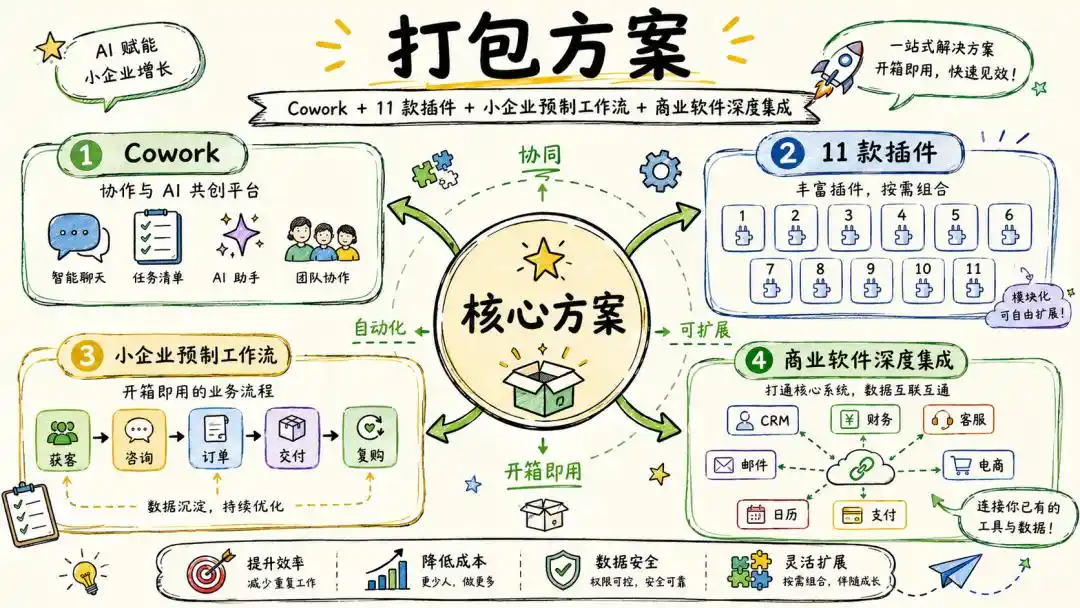
Specific Functions and Scenarios

Seven functions, covering basically all the daily software usage scenarios for a small business owner.

QuickBooks Financial Core: Payroll planning, month-end closing, cash flow analysis, account reconciliation, generating profit & loss statements and cash flow statements, preparing materials for tax season.

PayPal: Settlement, invoicing, refunds, payment follow-up. Works with QuickBooks for cash reconciliation and fund forecasting.

HubSpot Sales and Marketing: Lead triage, customer dynamic analysis, marketing campaign attribution, sales trend analysis.

Canva: Posters, social media graphics, copy with supporting visual content, supports team collaboration, editing, and publishing.

DocuSign: Send contracts, track signing status, automatically archive signed documents.

Google Workspace and Microsoft 365 Office Collaboration: File storage, email processing, scheduling, document generation. Export reports, prepare document packages, team collaboration.

Common Commands

After enabling the Small Business plugin in Claude Cowork, you can use the following common commands to run automated workflows directly in tools like QuickBooks, HubSpot, PayPal, Canva, DocuSign, Stripe, etc.:

/plan-payroll Forecast cash flow + chase overdue invoices

/close-month Reconcile accounts + write P&L narrative

/run-campaign Build Canva assets + prepare HubSpot send

/monday-brief: Cash, pipeline, top three todos displayed on one screen

/chase-invoices: Batch invoice follow-up and chasing

/cash-flow-forecast: Cash flow forecasting and analysis

/business-pulse: Overall business health overview

/contract-review: Contract review and suggestions

/lead-triage: Lead classification and prioritization

/employee-onboarding: New employee onboarding process

Why Has This Market Been Untouched?

The needs of small businesses are completely different from those of large companies. Large companies are willing to pay hundreds of thousands annually for a software feature, with dedicated personnel to study how to use, deploy, and train on it.

A small business owner often combines the roles of finance, HR, and operations. The annual software budget might only be a few thousand dollars. With the same R&D investment, selling to one large client versus a hundred small ones yields similar revenue but much higher service costs. This led SaaS companies in the past to prefer large clients and avoid small businesses.

Thus, even though US small businesses contribute 44% of GDP and employ nearly half of the private workforce—a massive volume—they still haven't been seriously targeted by AI companies.

Claude's design logic aims to solve this problem—you don't need to learn AI, just tell it what to do. It shifts from users adapting to tools, to tools adapting to users' ways of working.

This addresses non-standard scenarios that were difficult for past SaaS to handle. Claude for Small Business, leveraging AI combined with traditional software, effortlessly solves complex business problems.

Moreover, it's priced at a monthly fee of $20–200 (including Claude membership), far below traditional SaaS per-user subscription fees.

Viewing the Product Within Anthropic's Strategy

In the enterprise market, Anthropic is emerging like a beast, increasingly close to disrupting the SaaS market.

On January 30, 2026, Claude Cowork released 11 plugins, directly replacing core SaaS functions in legal, finance, CRM, marketing, etc., causing instant market panic: Within 48 hours, the global software sector lost $285 billion; nearly $1 trillion evaporated within a week.
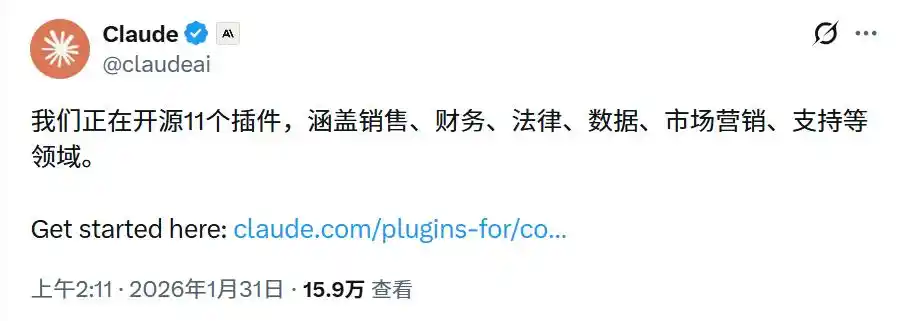
Instead of getting caught in endless rounds of parameter escalation on general models, they are slicing the market by industry.
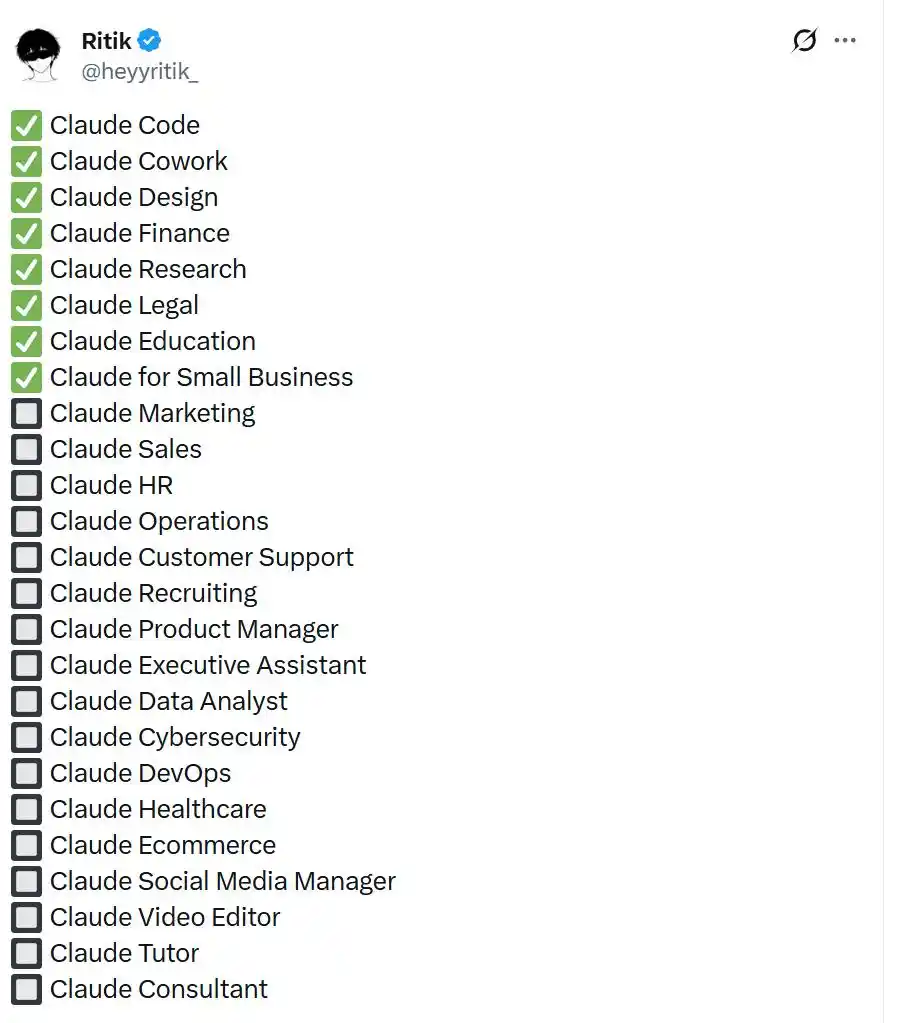
This is the aforementioned "SaaSpocalypse." This time, despite connecting traditional software, the trend of pre-built AI workflows making AaaS (Agent as a Service) mainstream is becoming increasingly evident.

From finance, legal, to the small business edition, Claude is being integrated into the existing tools and workflows of those industries. Enterprises are no longer just procuring SaaS but are procuring AI digital employees, which is also becoming an apparent phenomenon.

It can be seen that competition in general models has reached a plateau. Parameters, context windows, benchmark scores—the gap between each generation is narrowing. But penetration into industry-specific scenarios has just begun. The toolchains used in law, compliance processes in finance, and the daily operations of small businesses are completely different.

Expanding the ecosystem into different fields and permeating various industries might be one aspect of gaining a competitive edge.

An Interesting Side Note

Anthropic's CEO, Dario Amodei, previously stated that single-function SaaS companies might be consumed by AI.

Among the tools Claude has integrated this time, several are companies he mentioned. On one hand, he says they are at risk, and on the other hand, he integrates them. A relationship of both cooperation and competition is emerging between AI products and traditional SaaS.

You use my API, I become your entry point; you integrate my service, I gradually consume your interface. If Claude truly becomes the operational entry point for small businesses, will the business models of those integrated SaaS companies also change?

Software giant Salesforce has already made changes, recently announcing plans to open its API and launch "headless products"—simply put, removing the interface and exposing the underlying database for external calls.

After Claude released the 11 plugins last time, Salesforce's market value dropped by up to 26% year-to-date. Since the AI trend is unstoppable, Salesforce is adapting to it.

But who can say for sure that after software ate the world, AI won't eventually eat all SaaS?

What we see now is that because of AI, spring has come for SME owners, but the sky is falling for enterprise service software bosses.

This article is from the WeChat public account "Jingxuan AI," author: Jingxuan AI

Domande pertinenti

QWhat is Claude for Small Business and what core problem does it aim to solve?

AClaude for Small Business is a new product from Anthropic that integrates AI directly into small businesses' daily workflows by connecting to tools like QuickBooks, PayPal, and HubSpot. It aims to solve the problem of small business owners being overloaded with administrative tasks across multiple software platforms. Instead of requiring them to learn and manually operate different SaaS applications, it allows them to give natural language instructions to automate routine operations such as payroll, invoicing, month-end closing, and marketing execution, letting them focus on core business work.

QHow does Claude for Small Business handle security and user control when performing automated tasks?

AClaude for Small Business adheres to the permissions set within each connected tool (e.g., Google Workspace). If an employee cannot see something in Gmail directly, they also cannot access it through Claude. Furthermore, before executing any action, Claude shows the user which specific tool it will interact with. By default, every step requires user approval, preventing unauthorized or unintended operations and maintaining user control.

QWhat key feature of Claude for Small Business challenges the traditional SaaS business model for small enterprises?

AIts key challenging feature is bundling AI-powered automation for 15 predefined, high-frequency business workflows (like payroll, chasing invoices, and month-end close) with deep integrations into popular business software. It offers this at a subscription cost ($20–$200/month including Claude membership) that is significantly lower than the per-seat fees of traditional SaaS suites. This makes sophisticated automation accessible and affordable for small businesses, a market traditionally underserved by SaaS vendors due to high service costs relative to revenue.

QAccording to the article, what broader industry trend does the launch of Claude for Small Business represent?

AIt represents the trend of AaaS (Agent as a Service) becoming mainstream, where businesses shift from purchasing multiple standalone SaaS applications to purchasing AI 'digital employees' or agents. These AI agents understand specific industry contexts, integrate into existing toolchains and workflows, and execute complex tasks based on natural language commands. The article suggests this trend, exemplified by Anthropic's industry-specific approaches, is moving beyond competition on generic AI model metrics and towards deep penetration into vertical business scenarios.

QHow are some traditional SaaS companies, like Salesforce, responding to the competitive threat posed by AI agents like Claude?

ASome traditional SaaS companies are adapting by opening their platforms for deeper AI integration. For example, Salesforce announced plans to open its APIs and offer a 'headless product,' which essentially removes its own user interface and exposes its core database and functionality for direct external access and integration by AI agents and other platforms. This is a strategic move to remain relevant and essential in an ecosystem where AI might become the primary user interface, transforming but not necessarily completely eliminating the role of backend SaaS services.

Letture associate

Jensen Huang: Vera Rubin Full Mass Production, AI Agent a Key Focus, Challenging Intel to Target the Next-Generation AI PC Gateway

NVIDIA CEO Jensen Huang delivered the keynote speech at GTC Taipei 2026, announcing several major product launches and strategic directions. The company's Vera Rubin architecture is now in full-scale production, with OpenAI, Anthropic, and SpaceX among the first customers. NVIDIA highlighted AI Agent as a key future focus, introducing the Vera CPU designed for AI agents and the Vera BlueField-4 STX for secure, chip-level AI storage processing. A significant move involves challenging Intel in the PC market. NVIDIA, in collaboration with MediaTek, is developing the RTX SPARK PC chip (manufactured by TSMC) for Windows systems, set to launch this fall for laptops and desktops. This signals NVIDIA's push into the next-generation AI PC arena, aiming to provide a vertically integrated core computing platform for the entire Windows ecosystem, similar to Apple's approach. Other announcements include the new Nemotron 3 Ultra AI model and the NVIDIA DSX platform, described as a complete "playbook" for building AI factories, allowing performance simulation and validation before physical deployment. In automotive, the DRIVE Hyperion platform was positioned as a global robotaxi platform, with major Chinese automakers like BYD, Geely, Zeekr, Xiaomi, and Pony.ai already adopting or developing autonomous driving solutions based on it. The Alpamayo 2 super open inference model for robotaxis was also introduced. For robotics, NVIDIA unveiled the Isaac GR00T humanoid robot reference platform for academic research and a large open-source agent tools and skills suite for Physical AI. The company plans to collaborate with global humanoid robot manufacturers, including China's Unitree, whose H2 Plus robot served as the reference hardware for the GR00T platform demonstration.

marsbit21 min fa

Jensen Huang: Vera Rubin Full Mass Production, AI Agent a Key Focus, Challenging Intel to Target the Next-Generation AI PC Gateway

marsbit21 min fa

Running MoE on Mobile Phones? Meta Proposes MobileMoE, Speeding Up iPhone 16 Pro by 3.8x

Meta's MobileMoE, a mobile-optimized Mixture-of-Experts (MoE) language model architecture, enables efficient on-device large language model (LLM) inference for the first time on commercial smartphones. Designed for decoder-only Transformers, it replaces dense feed-forward layers with MoE layers. Key design choices include 8 experts with granularity g=8, top-4 routing, and a shared expert. The model undergoes a four-stage training process: pre-training, intermediate training, supervised fine-tuning, and quantization-aware training. Results show MobileMoE models, with similar memory footprint, achieve equal or higher average accuracy across 14 foundational benchmarks while using only 1/2 to 1/4 of the FLOPs compared to dense baselines. After INT4 quantization, they remain competitive. Notably, on an iPhone 16 Pro, MobileMoE-S demonstrates significant speedups: up to 3.8x faster in the prompt phase and 2.2-3.4x faster in per-token generation compared to a dense counterpart, with lower peak memory usage. While MobileMoE establishes a new Pareto frontier for on-device LLMs in accuracy-compute trade-offs, particularly excelling in code and math tasks, it currently lags behind models like Qwen3.5 2B in advanced instruction following and knowledge reasoning. Future work includes improving post-training techniques, exploring NPU deployment, and managing the runtime memory sensitivity of MoE models to varying inputs.

marsbit26 min fa

Running MoE on Mobile Phones? Meta Proposes MobileMoE, Speeding Up iPhone 16 Pro by 3.8x

marsbit26 min fa

Bitcoin's Weak Rebound Fails to Mask Adjustment Trend, HYPE's Top Signal Warns of Short-Term Risks | Invited Analysis

**Title:** Bitcoin's Weak Rebound Fails to Mask Downtrend; HYPE Top Signal Alerts of Short-Term Risks | Exclusive Analysis **Abstract:** This weekly market analysis examines the current technical structures of Bitcoin and HYPE, outlining key trading strategies. Bitcoin's daily chart shows it has broken below the median line of its primary ascending channel, indicating structural weakness. It is currently experiencing a weak rebound within a short-term descending channel, targeting resistance at $75,000-$76,000. Failure to break above this zone could lead to a resumption of the downtrend, testing support at $69,500-$70,500. Trading strategies include positioning for a rebound rejection (Plan A) or a breakdown below key support (Plan B) with controlled short positions. For HYPE, the 4-hour chart reveals a potential seven-wave advance from the May 14 low, now showing signs of exhaustion. A bearish divergence (momentum weakening) has been observed, coupled with a top signal from the proprietary "Spread Trading Model" at potential endpoint 47. The key this week is to monitor if a confirmed top forms here, especially upon a breach of the $62.5-$64.57 support area. If broken, a larger corrective move towards $54-$56.30 is anticipated. The short-term strategy for HYPE focuses on cautious long entries only upon confirmed stabilization within the support zone. The report also details a successful short BTC trade from the previous week, yielding a ~5.07% profit, executed based on model signals and price action. Strict risk management rules, including dynamic stop-loss adjustments, are emphasized.

marsbit42 min fa

Bitcoin's Weak Rebound Fails to Mask Adjustment Trend, HYPE's Top Signal Warns of Short-Term Risks | Invited Analysis

marsbit42 min fa

Trading

Spot
Futures
活动图片





