Global debt markets show dollar dominance moves in cycles, US Fed says

cointelegraphPubblicato 2025-12-18Pubblicato ultima volta 2025-12-18

Introduzione

A new Federal Reserve discussion paper reveals that the U.S. dollar’s dominance in global debt markets has moved in cycles over the past 60 years, with no clear long-term trend toward either dollarization or de-dollarization. The study identifies three distinct "dollarization waves" since the 1960s, showing currency usage shifts are cyclical rather than structural. As of 2024, emerging markets still rely heavily on dollar-denominated debt, which makes up about 80% of their international bonds. Meanwhile, the rise of dollar-pegged stablecoins like USDT and USDC—which together represent 85% of the $309.6 billion stablecoin market—has reinforced dollar dominance. These stablecoins are backed significantly by U.S. Treasury holdings, making their issuers major holders of U.S. government debt. The report concludes that despite vulnerabilities, the dollar’s global role remains unchallenged due to a lack of alternatives. Efforts to internationalize other currencies, including the Chinese renminbi, have seen limited success. European policymakers have expressed concern over the growing influence of dollar-backed stablecoins.

A new Federal Reserve discussion paper finds that the US dollar’s role in global bond markets has risen and fallen in cycles over the past six decades, with no clear long-term trend toward either greater dollar dominance or de-dollarization.

Using the Bank for International Settlements’ (BIS) international debt securities database, the authors identify three distinct “dollarization waves” since the 1960s, showing that shifts in currency use have followed cyclical patterns rather than a steady structural change in global financing.

“We find no monotonic dollarization or de-dollarization trend; instead, the dollar’s share exhibits a wavelike pattern,” the paper says.

The most recent wave emerged after the 2008 global financial crisis, when the dollar regained market share in international bond issuance, climbing back toward levels seen before the surge in euro-denominated bond issuance in the early 2000s, according to the report.
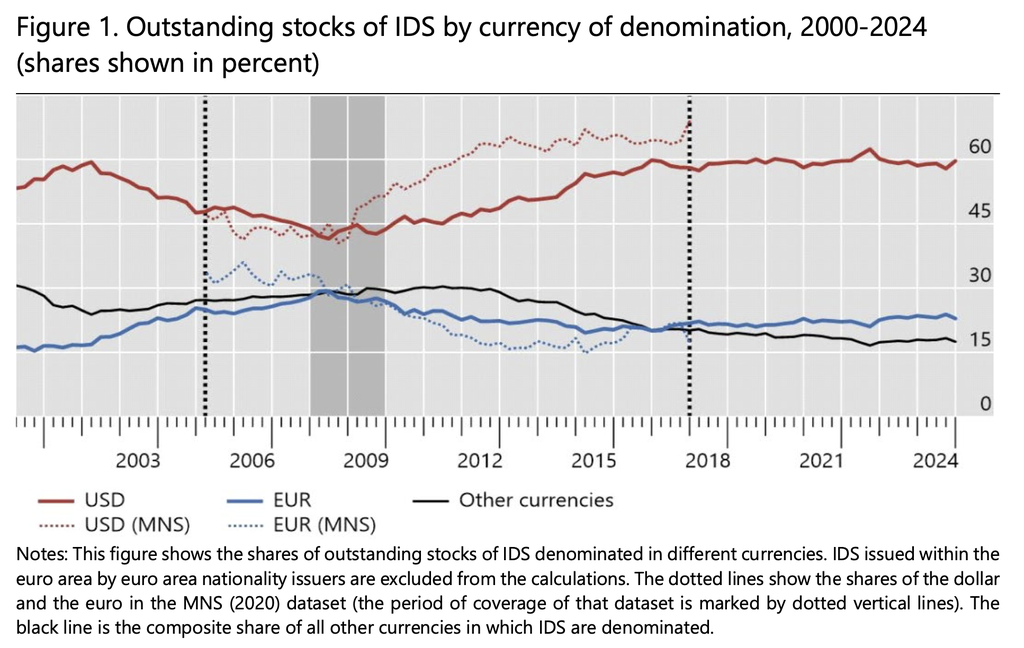
Share of international debt issued by currency, 2000–2024. Source: Federalreserve.gov

The study also found that, as of 2024, emerging market issuers still rely predominantly on dollar-denominated debt, which accounts for about 80% of their outstanding international bonds, while efforts by China begun in 2010 to internationalize its currency, the renminbi, have produced only modest gains.

“While the dollar’s eminence rests on vulnerable foundations, the absence of viable alternatives has left the dollar’s primacy unchallenged,” the report said.

Related: Intuit to use Circle’s stablecoin for financial platforms

Stablecoins back US Treasurys

The global stablecoin market has expanded sharply over the past year, growing to roughly $309.6 billion from $205.5 billion in December 2024, according to DefiLlama data.

Most of that growth has been concentrated in US dollar-pegged tokens, with Tether’s USDt (USDT) and Circle’s USDC (USDC) together accounting for about 85% of total stablecoin supply, or roughly $264 billion of the market at the time of writing.
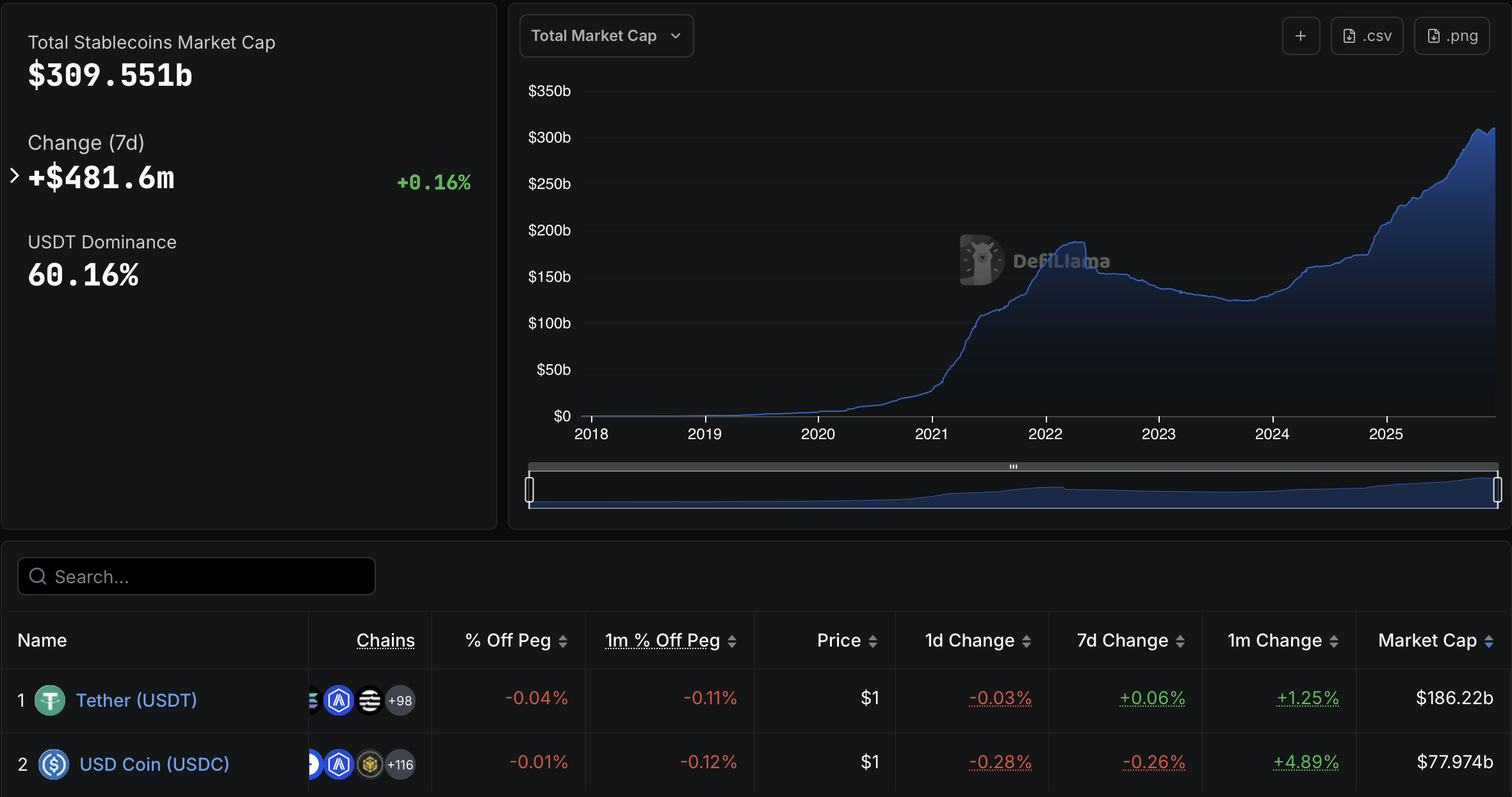
Stablecoin market cap. Source: DefiLlama

As dollar-pegged stablecoins have expanded, issuers have become significant holders of short-term US government debt.

In its second-quarter 2025 reserve report, Tether said its exposure to US Treasurys exceeded $127 billion, including $105.5 billion held directly and $21.3 billion held indirectly. According to the company, that level of Treasury holdings places Tether among the largest holders of US government debt.

Circle’s latest transparency report, dated Dec. 15, shows USDC is also backed largely by US government debt instruments, including $49.7 billion in overnight reverse Treasury repos and $18.5 billion in short-term Treasurys.
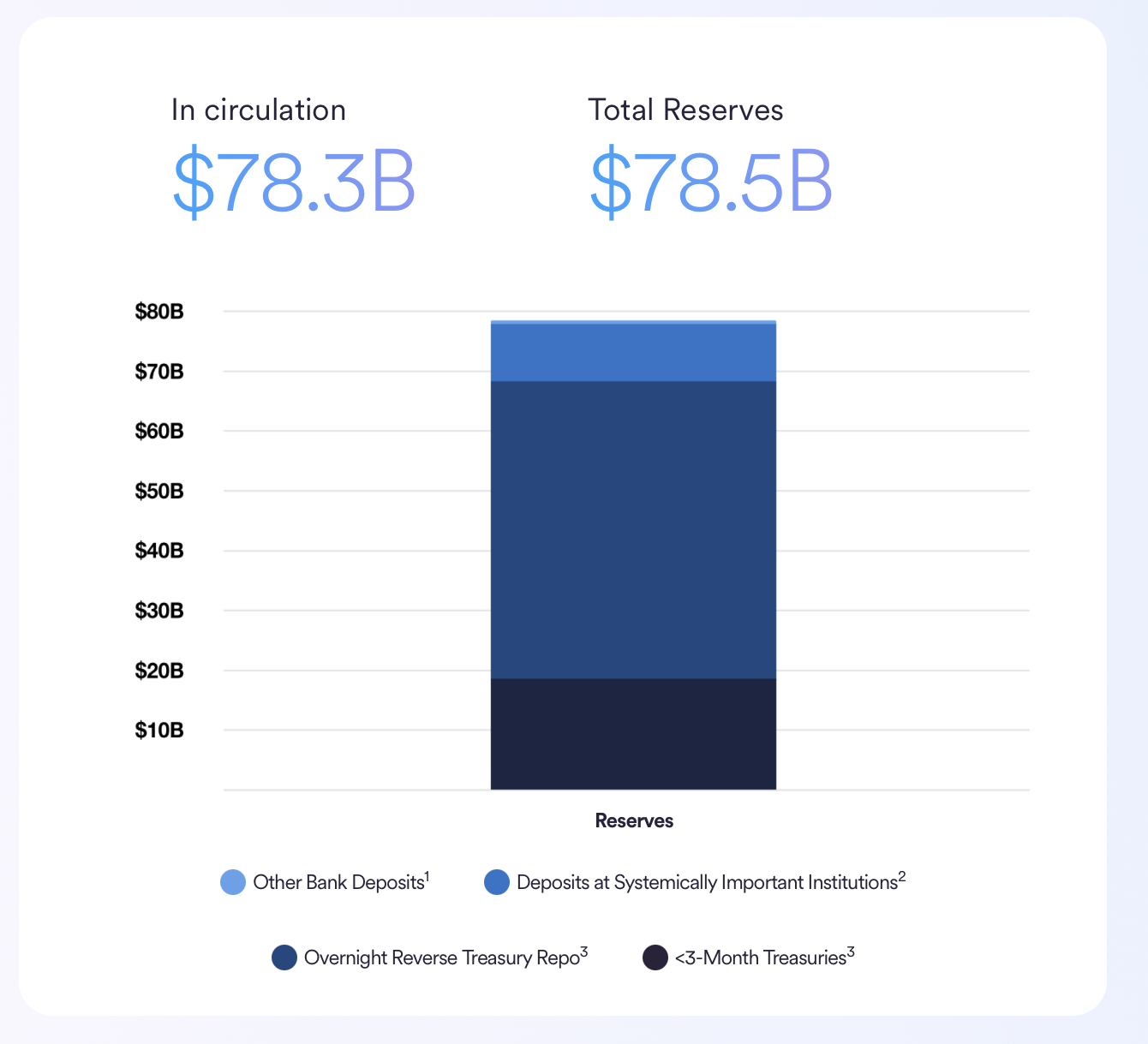
Circle’s reserves composition. Dec. 15, 2025. Source: Circle

A July report from digital asset bank Sygnum said the US government sees dollar-pegged stablecoins as a means to reinforce the dollar’s role as a global reserve currency and is backing their growth through legislation.

Other countries have taken notice. In April, Italy’s Economy and Finance Minister Giancarlo Giorgetti warned that US policies supporting dollar-backed stablecoins pose a greater long-term risk to Europe’s financial system than trade tariffs, citing their potential to erode the euro’s role in cross-border payments.

In December, a group of 10 European banks said they plan to launch a euro-pegged stablecoin in the second half of 2026.

Magazine: Meet the onchain crypto detectives fighting crime better than the cops

Domande pertinenti

QWhat is the main finding of the Federal Reserve discussion paper regarding the US dollar's role in global debt markets?

AThe paper finds that the US dollar's role in global bond markets has risen and fallen in cyclical waves over the past six decades, with no clear long-term trend toward either greater dollar dominance or de-dollarization.

QAccording to the report, what percentage of emerging market issuers' outstanding international bonds are denominated in US dollars as of 2024?

AAs of 2024, dollar-denominated debt accounts for about 80% of emerging market issuers' outstanding international bonds.

QWhich two stablecoins dominate the stablecoin market, and what is their combined market share?

ATether's USDt (USDT) and Circle's USDC (USDC) together account for about 85% of the total stablecoin supply.

QHow significant is Tether's holding of US Treasurys, according to its Q2 2025 reserve report?

ATether's exposure to US Treasurys exceeded $127 billion, a level that places it among the largest holders of US government debt.

QWhat concern did Italy's Economy and Finance Minister raise regarding US policies on dollar-backed stablecoins?

AHe warned that US policies supporting dollar-backed stablecoins pose a greater long-term risk to Europe's financial system than trade tariffs, citing their potential to erode the euro's role in cross-border payments.

Letture associate

Understanding Hash in One Article: The "Browser Miner" on Ethereum

Hash is an Ethereum-based ERC-20 token described as a "browser-minable post-quantum token." Its key features include enabling browser-based GPU mining without specialized hardware, a fixed supply cap of 21 million tokens, immutable and permissionless smart contracts with no team allocation or pre-mining, and an emphasis on post-quantum security using Keccak256 hashing. The mining mechanism is a simplified on-chain proof-of-work where miners solve unique challenges tied to their wallet address. Key design elements prevent answer theft, with epochs resetting every 100 blocks (~20 minutes) and a per-block minting limit. Emission follows a Bitcoin-like halving schedule every 100,000 mints, starting at 100 tokens per mint. Projections suggest all tokens could be mined within approximately 294 days if a target rate of one mint per minute is sustained. Hash emphasizes "post-quantum" security by leveraging hash-based primitives like Keccak256, which are considered more resistant to quantum attacks compared to elliptic-curve cryptography. While not a fully post-quantum asset, it aligns with Ethereum's broader post-quantum research narrative. The project completed its Genesis sale at $0.03 and began trading on Uniswap, with its price reaching around $0.19. The initial circulating supply is small, with 5% sold in Genesis and 5% allocated to liquidity. The majority (47.6% of total supply) is allocated to early-stage mining, leading to a front-loaded emission schedule. This structure, combined with low initial liquidity, makes Hash a high-volatility, high-risk project dependent on sustained miner participation and market demand to absorb new supply.

marsbit2 min fa

Understanding Hash in One Article: The "Browser Miner" on Ethereum

marsbit2 min fa

OpenAI's Largest Internal Wealth Creation: 600 People Cash Out a Total of $6.6 Billion, 75 Take Home the Maximum $30 Million Each

A Wall Street Journal report reveals OpenAI's unprecedented pre-IPO wealth creation. In a single employee stock sale last October, over 600 current and former employees sold shares, collectively cashing out approximately $6.6 billion. Due to high investor demand, the company tripled the individual sale cap to $30 million, with about 75 employees selling the maximum amount. This event represents the largest such transaction in tech industry history for a private company. OpenAI's valuation was $500 billion for this tender offer. Employees with over two years of tenure were eligible, allowing many post-ChatGPT hires their first liquidity event. The company's stock has reportedly grown over 100-fold in seven years. Following a restructuring, employees collectively hold about 26% of OpenAI. The scale of executive wealth is also staggering. In court testimony related to Elon Musk's lawsuit, President and co-founder Greg Brockman confirmed his OpenAI stake is worth around $30 billion. Analysis indicates about 165 current and former employees hold a combined ~$164.9 billion in equity, averaging nearly $1 billion per person in paper wealth. OpenAI's per-employee stock-based compensation is estimated to be 34 times the average of major tech firms before their IPOs. OpenAI continues its rapid ascent, closing a $122 billion funding round at an $852 billion valuation in March. With monthly revenue hitting $2 billion, over 900 million weekly ChatGPT users, and plans for a potential trillion-dollar IPO in late 2026, this wealth-creation engine shows no signs of stopping.

链捕手24 min fa

OpenAI's Largest Internal Wealth Creation: 600 People Cash Out a Total of $6.6 Billion, 75 Take Home the Maximum $30 Million Each

链捕手24 min fa

Understanding CPO (Co-Packaged Optics) in One Article: Why Nvidia Is Willing to Spend $3.2 Billion on a Fiber?

NVIDIA and Corning announced a multi-year strategic partnership on May 6, 2026, with NVIDIA committing up to $3.2 billion to support Corning's U.S. expansion. This investment will triple Corning's manufacturing plants and significantly boost its optical fiber and communications production capacity. The core driver behind this massive investment is the fundamental shift from copper to optical interconnect technology within AI data centers. As GPU clusters scale, copper wires face critical limitations: severe signal attenuation over distance, high energy consumption for signal integrity, and excessive heat generation. Optical fiber, transmitting light instead of electrical signals, solves these issues with minimal loss, near-light speed, and lower power needs. The article outlines a three-stage evolution of data center interconnect: 1. **Traditional Copper Interconnects:** The mainstream solution of the 2010s, now being phased out due to scaling bottlenecks. 2. **Pluggable Optical Modules:** The current mainstream, where modules convert electrical signals to light externally. This process still introduces energy loss and latency. 3. **CPO (Co-Packaged Optics):** The next-generation technology where the optical engine is integrated directly with the GPU chip package. This drastically reduces the electrical signal travel distance to mere millimeters, slashing power consumption and latency while boosting data density. NVIDIA CEO Jensen Huang has identified CPO as an essential core technology for AI infrastructure. NVIDIA's investment signifies a strategic shift from being a buyer to actively controlling its supply chain for critical components. With demand for specialized optical fiber far outstripping supply—evidenced by soaring prices—securing long-term manufacturing capacity has become a competitive necessity. While Corning's expansion may pressure some suppliers, a projected global fiber supply gap of 5-15% over the next few years creates a significant opportunity window, particularly for Chinese manufacturers competitive in optical preforms, chips, and modules. Ultimately, NVIDIA's move is not about chasing a trend but an engineering imperative. The transition to light-based interconnects like CPO is driven by the physical limits of copper, marking a definitive step in the ongoing AI computing revolution.

marsbit49 min fa

Understanding CPO (Co-Packaged Optics) in One Article: Why Nvidia Is Willing to Spend $3.2 Billion on a Fiber?

marsbit49 min fa

Trading

Spot
Futures

Articoli Popolari

Come comprare US

Benvenuto in HTX.com! Abbiamo reso l'acquisto di Talus Network (US) semplice e conveniente. Segui la nostra guida passo passo per intraprendere il tuo viaggio nel mondo delle criptovalute.Step 1: Crea il tuo Account HTXUsa la tua email o numero di telefono per registrarti il tuo account gratuito su HTX. Vivi un'esperienza facile e sblocca tutte le funzionalità,Crea il mio accountStep 2: Vai in Acquista crypto e seleziona il tuo metodo di pagamentoCarta di credito/debito: utilizza la tua Visa o Mastercard per acquistare immediatamente Talus NetworkUS.Bilancio: Usa i fondi dal bilancio del tuo account HTX per fare trading senza problemi.Terze parti: abbiamo aggiunto metodi di pagamento molto utilizzati come Google Pay e Apple Pay per maggiore comodità.P2P: Fai trading direttamente con altri utenti HTX.Over-the-Counter (OTC): Offriamo servizi su misura e tassi di cambio competitivi per i trader.Step 3: Conserva Talus Network (US)Dopo aver acquistato Talus Network (US), conserva nel tuo account HTX. In alternativa, puoi inviare tramite trasferimento blockchain o scambiare per altre criptovalute.Step 4: Scambia Talus Network (US)Scambia facilmente Talus Network (US) nel mercato spot di HTX. Accedi al tuo account, seleziona la tua coppia di trading, esegui le tue operazioni e monitora in tempo reale. Offriamo un'esperienza user-friendly sia per chi ha appena iniziato che per i trader più esperti.

378 Totale visualizzazioniPubblicato il 2025.12.11Aggiornato il 2025.12.11

Come comprare US

Discussioni

Benvenuto nella Community HTX. Qui puoi rimanere informato sugli ultimi sviluppi della piattaforma e accedere ad approfondimenti esperti sul mercato. Le opinioni degli utenti sul prezzo di US US sono presentate come di seguito.

活动图片













