Global Crypto Reporting Expands As 48 Countries Prep For CARF 2027

bitcoinistPubblicato 2026-01-02Pubblicato ultima volta 2026-01-02

Introduzione

A coordinated effort among 48 jurisdictions to implement the Crypto-Asset Reporting Framework (CARF) has begun, with standardized crypto transaction and user data collection starting January 1, 2026. The first automatic cross-border exchanges between tax authorities are expected in 2027. Service providers, including exchanges, brokers, and crypto ATMs, must collect account details, transaction histories, and users’ tax residency information. This framework aims to enhance tax transparency and enforcement of existing rules, not create new taxes. While larger platforms are adapting systems, smaller ones face operational burdens, and privacy concerns have been raised regarding data storage and access. An additional 27 jurisdictions plan to begin collection in 2027, with exchanges following in 2028. For users, this means more detailed onboarding processes and clearer record-keeping requirements from providers.

A coordinated effort to gather crypto tax records has begun in a group of jurisdictions preparing to take part in the Crypto-Asset Reporting Framework (CARF).

According to official monitoring from the Organization for Economic Co-operation and Development (OECD), 48 jurisdictions committed to start collecting standardized crypto transaction and user data from January 1, 2026, with the first automatic cross-border exchanges expected to take place in 2027.

Countries Begin Collecting Data

Based on reports, service providers such as major exchanges, some broker platforms, crypto ATMs and certain custody services will be obliged to record account details, transaction histories and users’ tax residency information for reporting to domestic tax authorities.

That information will be formatted so it can be shared automatically with partner tax offices once the exchange phase starts. The OECD monitoring update lays out the kinds of fields that must be gathered and stored for future reporting.
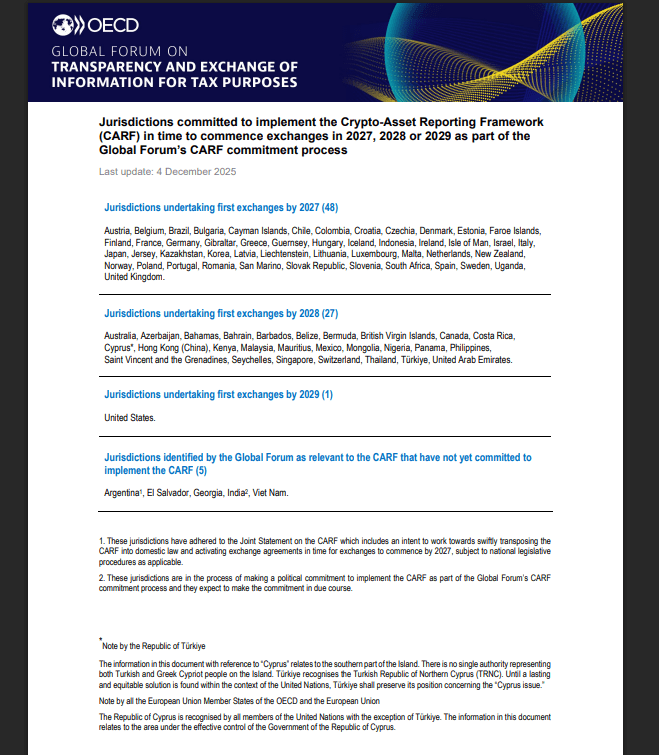
Source: OECD

What Exchanges Must Report

According to news outlets tracking the rollout, exchanges are already adjusting onboarding forms and internal compliance systems to verify customers’ tax residency and capture wallet-level activity.

Some jurisdictions, led by the United Kingdom, have moved faster to require platforms to keep detailed purchase and sale records for users in scope. Tax authorities will then receive yearly reports covering balances, transfers and gains for listed accounts.

Operational Strain And Privacy Questions

The new rules create practical burdens. Smaller platforms will need to upgrade systems or hire compliance staff to track the new data points.

Based on reports, privacy advocates and parts of the crypto industry are warning that the depth of data collection could raise concerns about how long sensitive transaction records are held and who can access them.

Some legal teams are already studying how domestic data-privacy laws interact with automatic information exchange.

Total crypto market cap currently at $2.99 trillion. Chart: TradingView

Middle Nations Join The Second Wave

A further group of jurisdictions has said it will begin domestic collection later. Reports note that an additional 27 jurisdictions have timelines that target January 1, 2027 for starting to collect, with exchanges of information to follow in 2028 for that batch.

At least one analysis of national updates also indicates that a handful of countries are planning to stagger implementation because of local legislative calendars.

How This Will Play Out For Users

For ordinary crypto users, the immediate change will be more questions during account setup and clearer record-keeping demands from providers.

Based on official guidance, CARF itself does not create new taxes; rather, it gives tax offices the data they need to enforce existing rules. For some investors, that means past reporting gaps will be easier for authorities to spot.

Reports have disclosed that implementation will vary by country. Some tax administrations are ready to receive standardized files in 2027, while others are still finishing domestic law changes.

Observers say the rollout marks a major step toward treating crypto transactions like other financial accounts when it comes to cross-border tax transparency.

Featured image from Unsplash, chart from TradingView

Domande pertinenti

QWhat is the Crypto-Asset Reporting Framework (CARF) and when will the first automatic cross-border exchanges begin?

AThe Crypto-Asset Reporting Framework (CARF) is a coordinated effort to gather standardized crypto tax records. According to the OECD, the first automatic cross-border exchanges of this data are expected to take place in 2027.

QHow many jurisdictions have committed to start collecting standardized crypto transaction data from January 1, 2026?

A48 jurisdictions have committed to start collecting standardized crypto transaction and user data from January 1, 2026.

QWhat specific information will crypto service providers be obliged to record and report under CARF?

AService providers such as exchanges, broker platforms, crypto ATMs, and custody services will be obliged to record account details, transaction histories, and users' tax residency information for reporting to domestic tax authorities.

QWhat are two major concerns or challenges raised by the implementation of CARF?

ATwo major concerns are the practical burden and operational strain on smaller platforms, which will need to upgrade systems or hire compliance staff, and the privacy concerns regarding how long sensitive transaction records are held and who can access them.

QHow will the CARF implementation affect ordinary crypto users according to the article?

AFor ordinary crypto users, the immediate change will be more questions during account setup and clearer record-keeping demands from their service providers. CARF does not create new taxes but gives tax offices the data to enforce existing rules, making it easier for authorities to spot past reporting gaps.

Letture associate

Why Bitcoin Holds Above $64,000 After Fed's Hard Pause

**Bitcoin Stabilizes Near $64,000 Following Hawkish Fed Pause** The cryptocurrency market, led by Bitcoin, remained stable around $64,000 despite a volatile reaction to the latest U.S. Federal Reserve meeting. The Fed paused interest rates but signaled a hawkish stance, with three committee members voting for an increase—the highest dissent since 2016. This limits risk appetite but hasn't triggered panic selling. Key market highlights include Bitcoin ETFs seeing a net inflow of $32.1 million, breaking a streak of outflows, while Ethereum ETFs experienced outflows of $18.65 million. Liquidations affected about 90,000 traders. Technically, Bitcoin finds support around $63,000-$63,500, with major resistance near $66,000. While its price is about 49% below its all-time high, institutional demand via ETFs and the absence of mass capitulation support a potential recovery scenario in the second half of the year. Major altcoins showed mixed movements, with Solana attracting capital while Ethereum faced selling pressure despite strong on-chain metrics like a growing staking queue. Regulatory news took a pause as the U.S. Senate delayed the CLARITY Act vote until at least autumn. For the final trading day of July, U.S. inflation and consumer spending data will be crucial. Bitcoin's key levels to watch are $63,000 support and $66,000 resistance. Sustained ETF inflows and Bitcoin holding above $63,000 are seen as positive signs for a potential market recovery later in the year.

cryptonews.ru32 min fa

Why Bitcoin Holds Above $64,000 After Fed's Hard Pause

cryptonews.ru32 min fa

Participants in XRP Fraud Scheme That Stole $9 Million from 71 Investors Arrested

South Korean police have arrested three individuals accused of operating a fraudulent investment platform that stole approximately 3.4 million XRP (worth about $9 million) from 71 investors between October 16 and 23. The suspects promoted the site Fxrpntwork.com through blogs, online articles, and YouTube videos, promising guaranteed principal and monthly returns of 1.5% to 1.8%. Investors were instructed to transfer XRP from Korean exchanges to overseas platforms and then to wallets controlled by the group before the site was shut down. The scammers copied the branding of legitimate projects Flare Network and FXRP to appear credible. Authorities warn that such impersonation frauds, which use familiar branding and urgent promises of guaranteed profits, are a common red flag. Legitimate companies do not solicit cryptocurrency transfers through unsolicited promotions. Seoul police have issued an Interpol Red Notice for a fourth suspect abroad and are investigating others involved in creating and promoting the fraudulent website. While investigators froze 17.3 billion won in assets, approximately 10 billion won was moved during the probe, with wallet analysis revealing transfers totaling 27.3 billion won, suggesting there may be additional unidentified victims and accomplices. The case underscores the organized, cross-border nature of crypto investment fraud.

cryptonews.ru35 min fa

Participants in XRP Fraud Scheme That Stole $9 Million from 71 Investors Arrested

cryptonews.ru35 min fa

Trading

Spot
活动图片





