Global Asset Rotation: Why Does Liquidity Drive the Cryptocurrency Cycle? (Part 1)

marsbitPubblicato 2025-12-26Pubblicato ultima volta 2025-12-26

Introduzione

This article introduces a new series on global asset allocation and rotation, arguing that liquidity—not new narratives—is the primary driver of cryptocurrency market cycles. While narratives like RWA or X-402 can attract attention, they are triggers, not fundamental drivers. The real force is capital flow: ample liquidity amplifies even weak narratives, while liquidity contraction undermains the most compelling ones. The framework begins by mapping global assets not by traditional labels (stocks, bonds, commodities) but by their roles and dependencies within economic and liquidity cycles. Cryptocurrency is reclassified not as a traditional risk asset (like equities, which have cash flows and valuation models) but as a non-cash-flow alternative asset. Its price action is driven primarily by capital inflows and outflows, making it highly sensitive to liquidity and risk appetite. Five key macro indicators are identified as core drivers: interest rates (especially real rates), inflation metrics (CPI, PCE), economic growth indicators (PMI, GDP), systemic liquidity (central bank balance sheets, money supply), and risk appetite (volatility indices, credit spreads). A causal chain is proposed: inflation influences interest rates, which affect liquidity, which then drives risk preference and ultimately asset prices. The U.S. remains the anchor for global capital flows, and understanding its monetary policy cycle is crucial. During loose monetary conditions, risk assets like crypto...

This article marks the beginning of a new series of research on global asset allocation and rotation. After delving deeply into this topic, we discovered one of the most unexpected yet crucial facts: what ultimately determines a cryptocurrency bull market is not the emergence of new narratives.

Whether it's RWA, X402, or any other concept, these themes are often triggers, not the true driving forces. They can attract attention but do not, in themselves, provide energy. The real power comes from capital. When liquidity is abundant, even weak arguments can be amplified into market consensus. And when liquidity dries up, the most powerful arguments struggle to maintain their momentum.

This first part focuses on building the foundation: how to construct a global asset allocation and rotation framework that places cryptocurrency in the proper macro context. The latter part of the framework will be explained in subsequent articles.

Step 1: Step Outside Crypto, Map Global Assets

The first step is to deliberately step outside the cryptocurrency market and construct a panoramic view of global assets. Traditional classifications—stocks, bonds, commodities—are useful but insufficient for understanding capital rotation across different cycles.

Instead, we can classify assets based on the roles they play during different phases of the economic and liquidity cycles. What matters is not whether an asset is labeled "equity" or "commodity," but rather what it depends on and what it is vulnerable to. Some assets benefit from falling real rates, some from inflation uncertainty, and others from outright risk aversion.

Building an "asset spectrum map" does not require deep expertise in every market. What it truly requires is an intuitive understanding of the interdependencies of each asset: which conditions support it and which conditions weaken it. This mental map will become the reference system for all subsequent decisions.

Within this framework, cryptocurrency deserves special treatment.
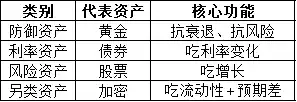
Why Crypto is an Alternative Asset, Not a Traditional Risk Asset?

Cryptocurrencies are often grouped with stocks (especially U.S. tech stocks) because their price movements are highly correlated. Superficially, this classification seems reasonable. Cryptocurrencies exhibit extreme volatility, high beta, and significant drawdowns—all characteristics similar to risk assets.

However, correlation itself does not define economic essence.

From a capital structure perspective, stocks have cash flows. Companies generate earnings, distribute dividends, and can be valued using discounted cash flow models or valuation multiples. Even when prices deviate from fundamentals, the anchoring logic is still based on cash flows.

Crypto assets operate on a fundamentally different logic. They do not generate dividends, nor do they have intrinsic cash flow that can be discounted. Therefore, traditional valuation frameworks simply do not apply.

Instead, cryptocurrencies behave like a purely liquidity-sensitive asset. Their price movements are primarily driven by capital inflows and outflows, rather than changes in fundamental productivity. Narratives help explain *why* capital flows, but they do not determine *that* it flows. Capital flows regardless.

Thus, cryptocurrency is best understood as a non-cash-flow alternative asset, positioned at the extreme end of the risk appetite spectrum. It performs best when liquidity is abundant and risk appetite is high; it underperforms when capital prioritizes safety and yield.

Liquidity is the Core Driver of Crypto Performance

Once you view cryptocurrency as a liquidity asset rather than a valuation asset, its behavior across cycles becomes easier to explain.

In equity research, price targets often stem from a structured process: forecasting future revenue, applying valuation multiples, and discounting the result to present value. This works because the asset itself generates measurable economic output.

Cryptocurrency lacks this anchoring effect. Its upside depends on whether new capital is willing to enter the market and accept higher prices. And this capital almost always comes from outside the crypto ecosystem—from stocks, credit, or cash sitting idle due to low yields.

Therefore, understanding the source and timing of liquidity is more important than tracking individual protocols or events. When capital begins seeking higher volatility and convexity, cryptocurrency becomes one of the most attractive destinations. And when capital prioritizes capital preservation, crypto is often the first asset to be sold.

In short, liquidity is the decisive factor; everything else is secondary.

Step 2: Focus on Macro Drivers First, Asset Details Second

The second pillar of this framework is macro analysis. It is more efficient to first identify the variables influencing price movements rather than starting with the study of specific assets. All assets are integrated together.

At the highest level, five macro indicators play a central role:

  • Interest rates, especially the distinction between nominal and real rates.

  • Inflation indicators, such as the Consumer Price Index (CPI) and Personal Consumption Expenditures (PCE).

  • Economic growth indicators, such as Purchasing Managers' Index (PMI) and Gross Domestic Product (GDP) trends.

  • Systemic liquidity, often reflected in central bank balance sheets and money supply measures.

  • Risk appetite, typically measured by volatility indices and credit spreads.

Many crypto participants closely watch Federal Reserve meetings but often focus solely on the rate decision. However, institutional capital places greater importance on real rates (nominal rates adjusted for inflation) because real rates determine the true opportunity cost of holding a non-yielding asset.

Inflation data is widely discussed in crypto circles, but liquidity and risk appetite receive little attention. This is a blind spot. Monetary supply dynamics and volatility regimes often explain overall market behavior before narratives even emerge.

A useful mental model is a simple chain of transmission:

  1. Inflationary pressures influence interest rates.
  2. Interest rates influence liquidity conditions.
  3. Liquidity conditions influence risk appetite.
  4. Risk appetite drives asset prices.

Understanding where the economy is positioned in this chain provides deeper insight than analyzing assets in isolation.

Step 3: Build a Cycle-Based Mental Model

The economic cycle is a familiar concept, but it remains crucial. At a macro level, economic cycles tend to alternate between expansion and contraction, easing and tightening.

Simply put, the pattern often looks like this:

Periods of monetary easing favor risk assets, including cryptocurrencies and small-cap stocks.

Periods of monetary tightening favor defensive assets like cash, government bonds, and gold.

This framework is not meant to be applied mechanically. Each asset's reaction will vary based on timing, expectations, and positioning. Nonetheless, a cycle-based reference helps avoid emotional decision-making during shifts in the market landscape.

An important nuance is that the global economic cycle is not synchronized. The world does not operate as a single economy.

As growth momentum slows, the U.S. might be transitioning from late-cycle high rates towards easing. Japan might be cautiously ending decades of ultra-loose monetary policy. China continues its structural adjustments in a low-inflation environment, while parts of Europe still grapple with economic stagnation.

Despite this divergence, the United States remains the anchor for global capital flows. Dollar liquidity and U.S. interest rates still exert the strongest influence on global capital movements. Therefore, any global asset rotation framework should start with the U.S. and expand outward.

Conclusion: Framework Before Forecast

This first half of the framework emphasizes structure over prediction. The goal is not to forecast short-term price movements but to understand the factors that make certain assets competitive at specific points in time.

By redefining crypto as a liquidity-driven alternative asset, focusing on macro drivers before narratives, and basing decisions on cycle awareness, investors can avoid many common analytical pitfalls.

The next article will build upon this, delving into the sequence of capital flows, real-world indicators, and how to identify when liquidity is shifting towards high-risk assets.

Some of the above viewpoints are referenced from @Web3___Ace

Original article link

Crypto di tendenza

Domande pertinenti

QWhat is the primary driver of cryptocurrency bull markets according to the article?

ALiquidity, not new narratives, is the primary driver of cryptocurrency bull markets. Capital flows are the true source of energy, while narratives are merely triggers that can amplify market consensus when liquidity is abundant.

QHow does the article suggest classifying assets for a global asset allocation framework?

AThe article suggests classifying assets based on the roles they play in different phases of the economic and liquidity cycle, focusing on what conditions support or weaken them, rather than traditional labels like 'equities' or 'commodities'.

QWhy is cryptocurrency considered an alternative asset rather than a traditional risk asset in the framework?

ACryptocurrency is considered a non-cash-flow alternative asset because it lacks intrinsic cash flows (like dividends) and cannot be valued using traditional discounted cash flow models. Its price is primarily driven by capital inflows and outflows, making it a pure liquidity-sensitive asset at the extreme end of the risk preference spectrum.

QWhat are the five core macro indicators that the article identifies as crucial for understanding price movements?

AThe five core macro indicators are: 1) Interest rates, particularly the distinction between nominal and real rates; 2) Inflation indicators like CPI and PCE; 3) Economic growth indicators like PMI and GDP trends; 4) Systemic liquidity, reflected in central bank balance sheets and money supply; 5) Risk appetite, measured by volatility indices and credit spreads.

QWhat is the simple transmission chain model described in the article for understanding how macro factors drive asset prices?

AThe simple transmission chain model is: 1) Inflationary pressures influence interest rates; 2) Interest rates influence liquidity conditions; 3) Liquidity conditions influence risk appetite; 4) Risk appetite drives asset prices.

Letture associate

Ripple MiCA Authorization Opens A Wider European Payments Lane

Ripple has obtained full MiCA (Markets in Crypto-Assets) authorization in Europe. This regulatory approval provides a clearer path for Ripple's corporate payment entity to offer crypto-enabled payment services across the European Union and European Economic Area. It is important to note that this authorization specifically applies to Ripple's business operations under MiCA, not a blanket endorsement of XRP trading itself. The authorization is significant for Ripple's strategy, as the unified MiCA framework simplifies scaling across Europe for compliant firms. This regulatory clarity can facilitate partnerships with banks, payment providers, and institutional clients by addressing compliance concerns. While the development supports the broader XRP narrative by reducing regulatory uncertainty for Ripple's core payments business, it does not directly translate to regulatory approval for XRP as an investment product. The true impact on XRP will depend on whether this regulatory milestone leads to increased adoption, new client partnerships, and greater payment volume in European corridors. The approval reflects a broader trend where crypto firms are seeking regulatory footing in Europe due to MiCA's comprehensive rulebook, contrasting with the uncertain regulatory landscape in the United States. Ultimately, the license is a permission to operate; its success hinges on Ripple's ability to convert this regulatory advantage into tangible business growth and adoption.

bitcoinist8 min fa

Ripple MiCA Authorization Opens A Wider European Payments Lane

bitcoinist8 min fa

Trading

Spot

Articoli Popolari

Come comprare O

Benvenuto in HTX.com! Abbiamo reso l'acquisto di O1 exchange (O) semplice e conveniente. Segui la nostra guida passo passo per intraprendere il tuo viaggio nel mondo delle criptovalute.Step 1: Crea il tuo Account HTXUsa la tua email o numero di telefono per registrarti il tuo account gratuito su HTX. Vivi un'esperienza facile e sblocca tutte le funzionalità,Crea il mio accountStep 2: Vai in Acquista crypto e seleziona il tuo metodo di pagamentoCarta di credito/debito: utilizza la tua Visa o Mastercard per acquistare immediatamente O1 exchangeO.Bilancio: Usa i fondi dal bilancio del tuo account HTX per fare trading senza problemi.Terze parti: abbiamo aggiunto metodi di pagamento molto utilizzati come Google Pay e Apple Pay per maggiore comodità.P2P: Fai trading direttamente con altri utenti HTX.Over-the-Counter (OTC): Offriamo servizi su misura e tassi di cambio competitivi per i trader.Step 3: Conserva O1 exchange (O)Dopo aver acquistato O1 exchange (O), conserva nel tuo account HTX. In alternativa, puoi inviare tramite trasferimento blockchain o scambiare per altre criptovalute.Step 4: Scambia O1 exchange (O)Scambia facilmente O1 exchange (O) nel mercato spot di HTX. Accedi al tuo account, seleziona la tua coppia di trading, esegui le tue operazioni e monitora in tempo reale. Offriamo un'esperienza user-friendly sia per chi ha appena iniziato che per i trader più esperti.

151 Totale visualizzazioniPubblicato il 2026.06.19Aggiornato il 2026.06.29

Come comprare O

Come comprare PROS

Benvenuto in HTX.com! Abbiamo reso l'acquisto di Pharos (PROS) semplice e conveniente. Segui la nostra guida passo passo per intraprendere il tuo viaggio nel mondo delle criptovalute.Step 1: Crea il tuo Account HTXUsa la tua email o numero di telefono per registrarti il tuo account gratuito su HTX. Vivi un'esperienza facile e sblocca tutte le funzionalità,Crea il mio accountStep 2: Vai in Acquista crypto e seleziona il tuo metodo di pagamentoCarta di credito/debito: utilizza la tua Visa o Mastercard per acquistare immediatamente PharosPROS.Bilancio: Usa i fondi dal bilancio del tuo account HTX per fare trading senza problemi.Terze parti: abbiamo aggiunto metodi di pagamento molto utilizzati come Google Pay e Apple Pay per maggiore comodità.P2P: Fai trading direttamente con altri utenti HTX.Over-the-Counter (OTC): Offriamo servizi su misura e tassi di cambio competitivi per i trader.Step 3: Conserva Pharos (PROS)Dopo aver acquistato Pharos (PROS), conserva nel tuo account HTX. In alternativa, puoi inviare tramite trasferimento blockchain o scambiare per altre criptovalute.Step 4: Scambia Pharos (PROS)Scambia facilmente Pharos (PROS) nel mercato spot di HTX. Accedi al tuo account, seleziona la tua coppia di trading, esegui le tue operazioni e monitora in tempo reale. Offriamo un'esperienza user-friendly sia per chi ha appena iniziato che per i trader più esperti.

145 Totale visualizzazioniPubblicato il 2026.06.22Aggiornato il 2026.06.29

Come comprare PROS

Cosa è VERONA

I. Introduzione al Progetto VERONA è una blockchain costruita per tutti, ovunque attraverso l'astrazione della catena. Utilizzando il suo livello di astrazione generalizzato, VERONA si distingue integrando funzionalità blockchain complesse, come conti, firme e interoperabilità, direttamente a livello di protocollo. Questo approccio consente di interagire con le applicazioni blockchain senza la necessità di comprendere le tecnologie sottostanti.1) Informazioni di Base Nome:VERONA(VERONA)III. Link Correlati Link al sito ufficiale:https://xion.burnt.com/ Whitepaper:https://xion.burnt.com/whitepaper.pdf Esploratori:https://explorer.burnt.com/ Social Media: https://x.com/burnt_xion Nota: L'introduzione al progetto proviene dai materiali pubblicati o forniti dal team ufficiale del progetto, che è solo a scopo di riferimento e non costituisce consulenza per investimenti. HTX non si assume responsabilità per eventuali perdite dirette o indirette risultanti.

163 Totale visualizzazioniPubblicato il 2026.06.22Aggiornato il 2026.06.22

Cosa è VERONA

Discussioni

Benvenuto nella Community HTX. Qui puoi rimanere informato sugli ultimi sviluppi della piattaforma e accedere ad approfondimenti esperti sul mercato. Le opinioni degli utenti sul prezzo di A A sono presentate come di seguito.

活动图片