Glassnode: Crypto Market in 'Late Bear Market Bottoming Phase', Three Core Signals Absent, Bitcoin Reversal Still Requires Time

marsbitPubblicato 2026-07-10Pubblicato ultima volta 2026-07-10

Introduzione

According to a Glassnode analysis, the cryptocurrency market is currently in the late stages of a bear market bottom formation. Bitcoin's price has remained below key realized price and short-term holder cost benchmarks for five months, indicating deep undervaluation. A major source of sell-side pressure is from long-term holders realizing losses, with their daily loss-taking recently peaking at $280 million, the highest level since December 2022. While spot Bitcoin ETF outflows have moderated, they remain in a state of monthly net negative flows, and trading volumes are approximately 80% below their 2025 peak, signaling a lack of robust institutional demand. In derivatives markets, positioning has shifted to a cautiously bullish stance. However, options volatility surfaces still price in downside risk, and the spot price sits below the "Max Pain" strike level. The report concludes that the necessary conditions for a market bottom are in place, but a confirmed reversal requires three core signals: a sustained decline in long-term holder loss realization, a stabilization in ETF fund flows, and a sustained price recovery above the Realized Price. Until these signals emerge, a full transition to a bull market is unlikely to occur imminently.

Authors:CryptoVizArt, Frederik Theissen, Glassnode

Compiled by:Luffy, Foresight News

Bitcoin price has been below the true market average and the cost basis of short-term holders for five consecutive months, residing in a deeply undervalued zone.

The proportion of losses realized by long-term holders relative to total on-chain realized losses has now risen to 43%, with the daily peak of loss realization reaching $280 million, the highest level since December 2022. The outflow of spot ETF funds has moderated but still maintains a state of monthly net outflows; ETF daily average trading volume remains in the range of $650 million to $950 million, shrinking approximately 80% from the peak in October 2025, indicating institutional buying demand has not yet stabilized.

Derivatives positioning has shifted to cautiously bullish, with the put/call ratio dropping to its lowest level in 2026; however, the options volatility skew still maintains a defensive premium, and the spot price remains significantly below the max pain price. The market has entered the late stage of bottoming, and the continuous narrowing of selling pressure from long-term holders is an important precondition for a market reversal and recovery.

Macro Perspective

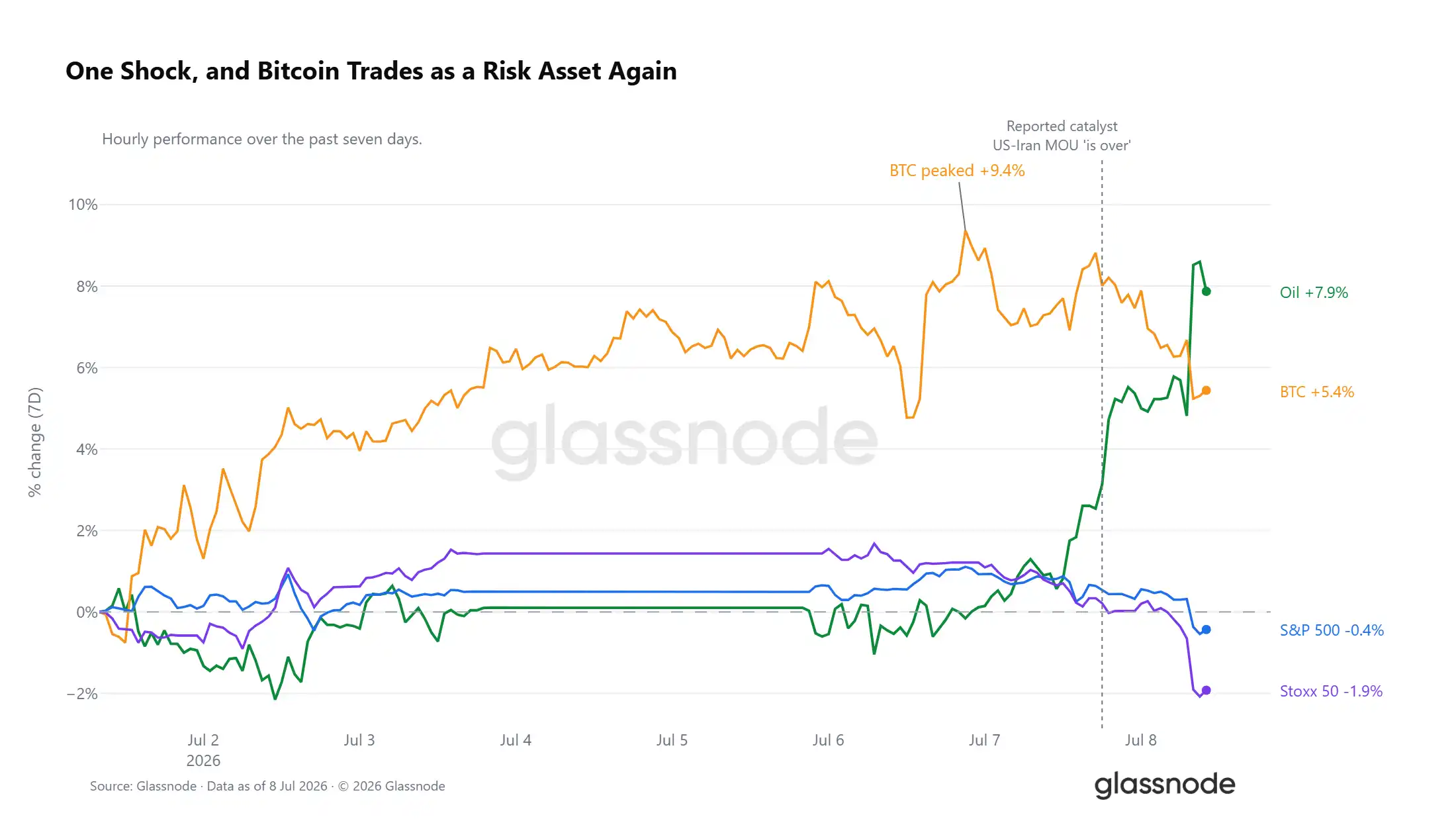
Oil Surges, Risk Assets Under Collective Pressure

Over the past 7 trading days, WTI crude oil has cumulatively risen by 7.9%, with the majority of gains concentrated in recent sessions. News emerged that the US-Iran Memorandum of Understanding has expired, an impact that has rippled across all asset markets. Bitcoin's weekly gain peaked at 9.4% but has now retreated to a 5% weekly gain; the S&P 500 and Euro Stoxx indices have all turned negative, with European stocks leading the decline among global risk assets. Currently, Bitcoin's movement is highly synchronized with risk assets.
Liquidity Environment: Long-Short Contradictions Intensify

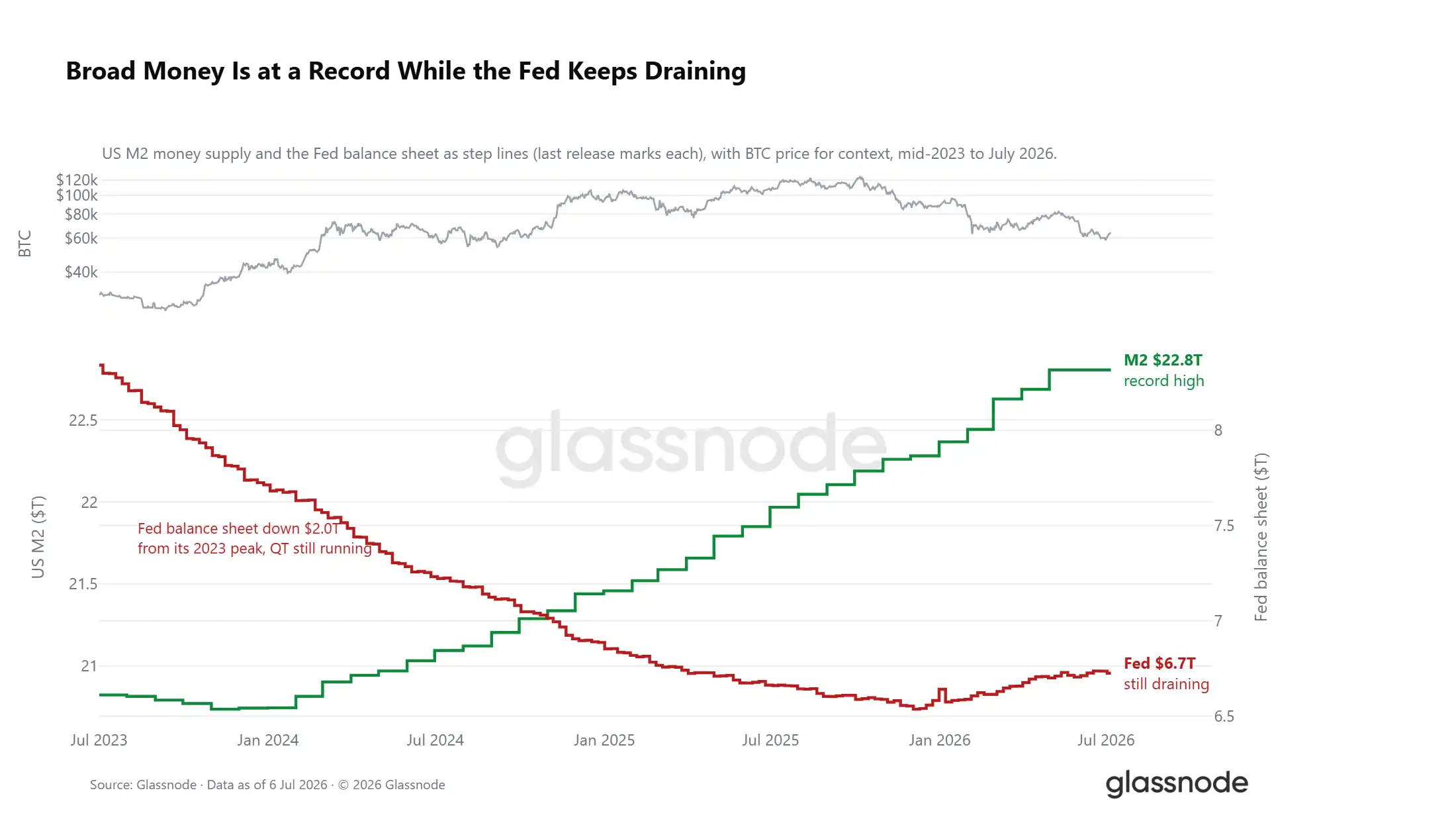
Amid external shocks from oil, the market's liquidity environment presents a contradictory picture. The total U.S. broad money supply (M2) has climbed to a new historical high of $22.8 trillion. Historically, broad money expansion cycles tend to boost market risk appetite; however, the Federal Reserve's balance sheet continues to shrink, with its current size down by $2 trillion from the 2023 peak. These two liquidity signals create a strong counterforce: the total broad money supply continues to rise while the quantitative tightening process persists, with real interest rates hovering near 1%, keeping the opportunity cost of holding non-yielding digital assets high. The macro-level favorable window is not completely closed but has not formed clear accommodative support either.
On-Chain Data

A Deeply Undervalued Zone Spanning Five Months

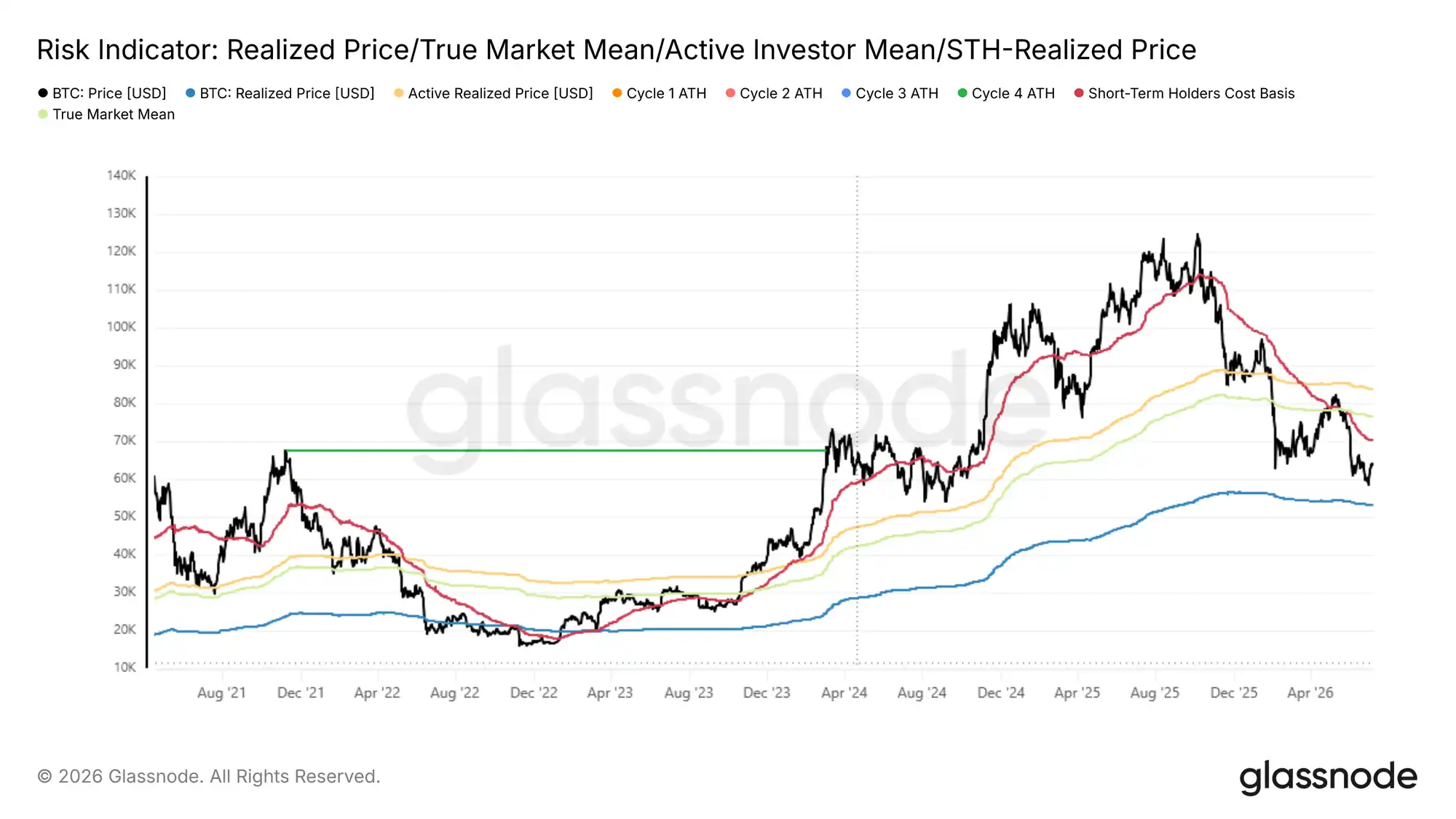
Over the past week, Bitcoin rebounded from $58,300 to $64,400, showing a short-term recovery, but the price remains significantly below the true market average of $76,600 and the short-term holder cost basis of $72,200. Only when the price reclaims these two key levels can the market exit the deeply undervalued zone; otherwise, the price action remains susceptible to declines catalyzed by external negative news.

The duration of this discount phase is noteworthy. Since early February 2026, the price has persistently traded below the cost basis of active investors and the break-even line for recent entrants, lasting nearly five months, which qualifies as a relatively long-lasting deep discount cycle in Bitcoin's history.

Continued high-volume coin distribution within a prolonged discount zone, with fresh capital consistently accumulating below the cost basis of earlier buyers and the entire market's active holdings, has historically formed the foundation for major cycle bottoms, offering long-term allocation appeal for value investors. Various metrics indicate the bottoming process has entered its later stages, but the possibility of a retest to $53,000 cannot be entirely ruled out.
Concentrated Stop-Loss Selling by Long-Term Holders with High-Cost Basis

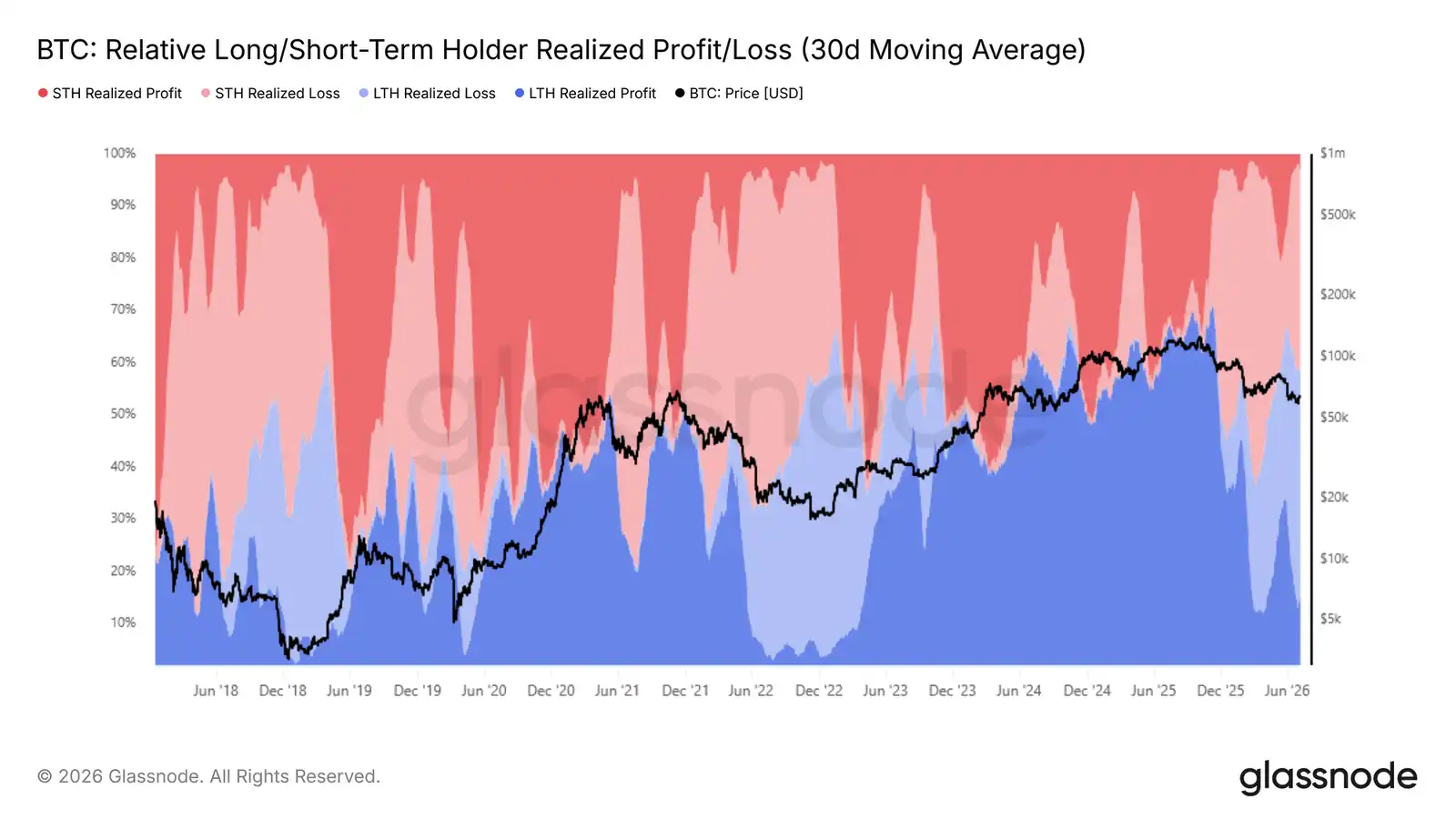
The market is constructing a cyclical bottom. The core question now is identifying the primary source of selling pressure. The relative indicator of profit/loss realization by long/short-term holders analyzes the distribution proportion of the entire market's on-chain realized profit/loss between these two holding groups, directly reflecting the scale share of each group's profit/loss realization.

After the price fell below the true market average, the 30-day moving average share of loss realization by long-term holders has climbed from around 15% in early February 2026 to the current 43%. Loss-driven selling pressure from this group has become the most dominant bearish force suppressing the price.

These investors mostly entered near the cycle highs. After enduring months of deep drawdowns, their confidence is gradually depleted, leading to concentrated exits. This coin structure directly explains why every recovery rally faces concentrated selling from deeply entrenched positions, preventing the price from solidifying above the upper bound of the current range.
Stop-Loss Selling Pressure Yet to Show Signs of Abating

Long-term holder loss realization has become the market's primary downward pressure. The next key observation is whether this selling pressure begins to subside.

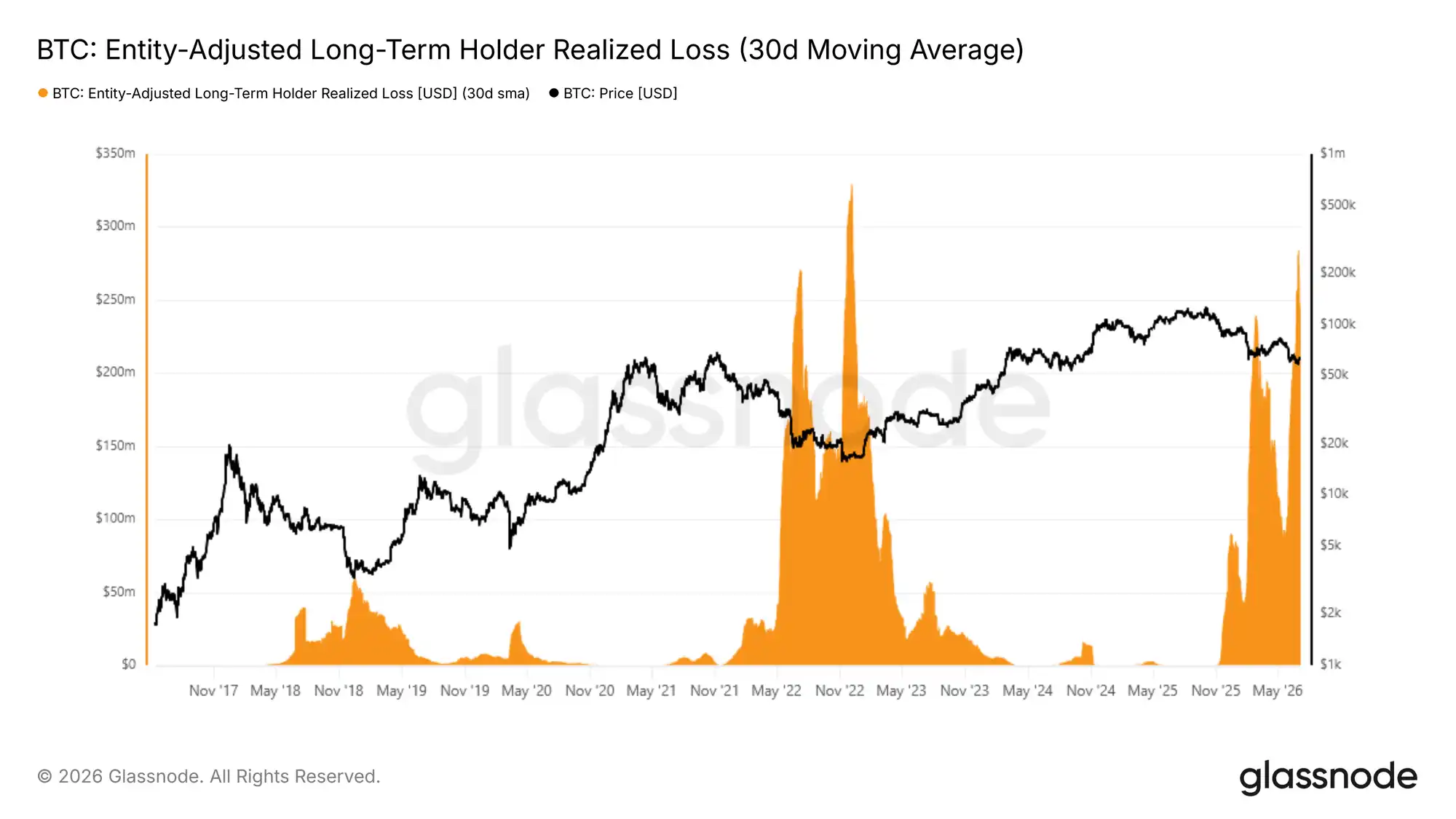
The entity-adjusted long-term holder realized loss indicator (30-day smoothed average) tracks the loss amount from sales by users holding coins for over 155 days, excluding internal address transfers, accurately reflecting genuine stop-loss exit behavior. This indicator recently hit a new daily peak, with daily loss realization volume around $280 million, the highest since December 2022, marking the second major wave of long-term holder stop-loss selling in this bear market.

The key difference is that after the first peak, selling pressure showed a temporary decline, whereas the current wave has yet to show a contraction in scale. Only when this indicator shows a clear downward trend will the market possess the foundational conditions for a shift towards a bull market. Its trajectory in the coming weeks to months will be the core signal for judging whether the market has truly completed selling pressure capitulation.
Off-Chain Markets

ETF Outflows Slow, But Outflow Trend Not Reversed

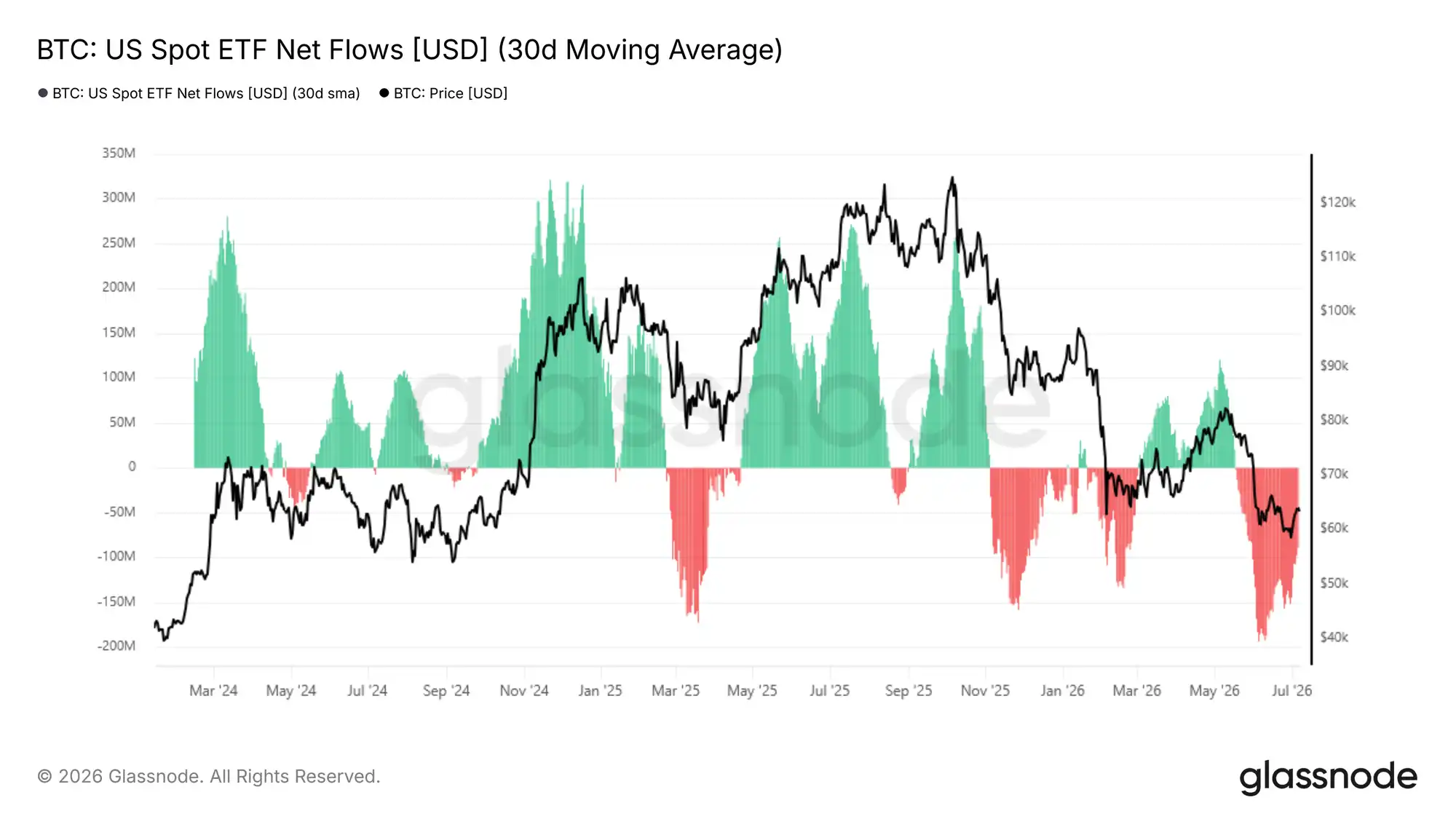
Shifting from on-chain to off-chain markets, spot ETF fund flows directly reflect institutional capital behavior. The 30-day moving average of ETF net flows indicates the daily net capital inflow/outflow from U.S. spot Bitcoin ETFs, smoothing out daily volatility to reveal underlying trends in institutional holdings.

Since mid-May 2026, this indicator entered a zone of monthly net outflows, with a daily outflow peak reaching $193 million in early June, now receded to a daily net outflow of $88.9 million. The moderation in outflow scale is a faint positive, but the market continues to see monthly capital outflows, and institutional buying demand has not stabilized. Only when the fund flow trend narrows consistently towards a balanced range can one reasonably anticipate a short-term expansionary rally.
Institutional Trading Volume Remains Sluggish

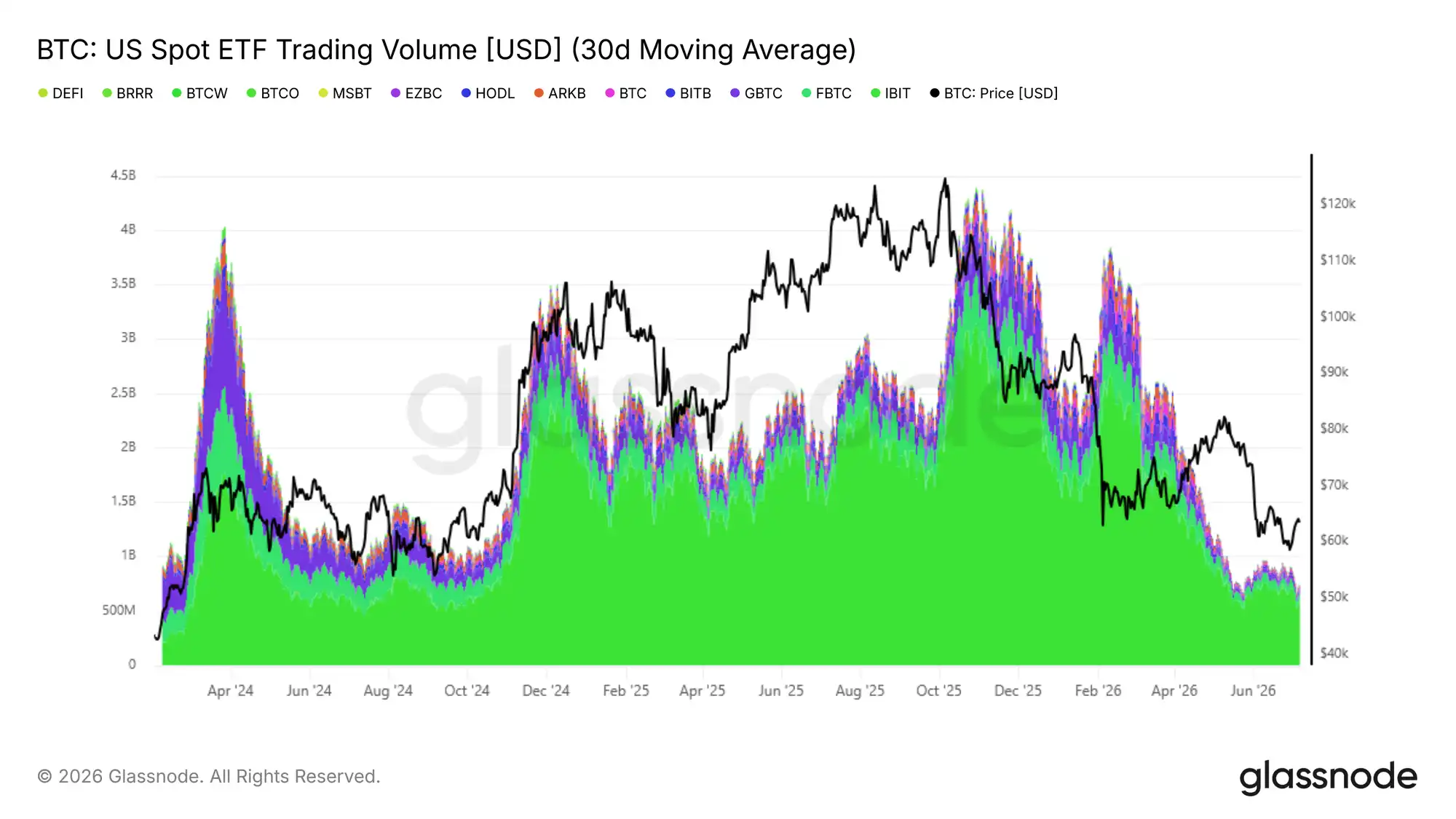
In addition to net flow data, U.S. spot ETF trading volume helps gauge the degree of institutional confidence recovery. The 30-day moving average of ETF daily trading volume currently fluctuates between $650 million and $950 million, a level comparable to Q4 2024, but also about 80% lower than the daily peak of $4.4 billion set in October 2025.

Current trading volume only represents basic institutional participation, remaining extremely low compared to bull market peaks, indicating that medium-to-long-term bullish confidence among ETF investors has not materially returned. Only when daily average trading volume shows sustained expansion *and* net outflow scale continuously narrows, with both signals appearing simultaneously, can institutional demand recovery be confirmed. Until both metrics improve in tandem, off-chain data aligns with on-chain indicators, suggesting the overall market remains in a bear market-dominated regime.
Derivatives Market

Short Covering, Positioning Shifts to Cautiously Bullish

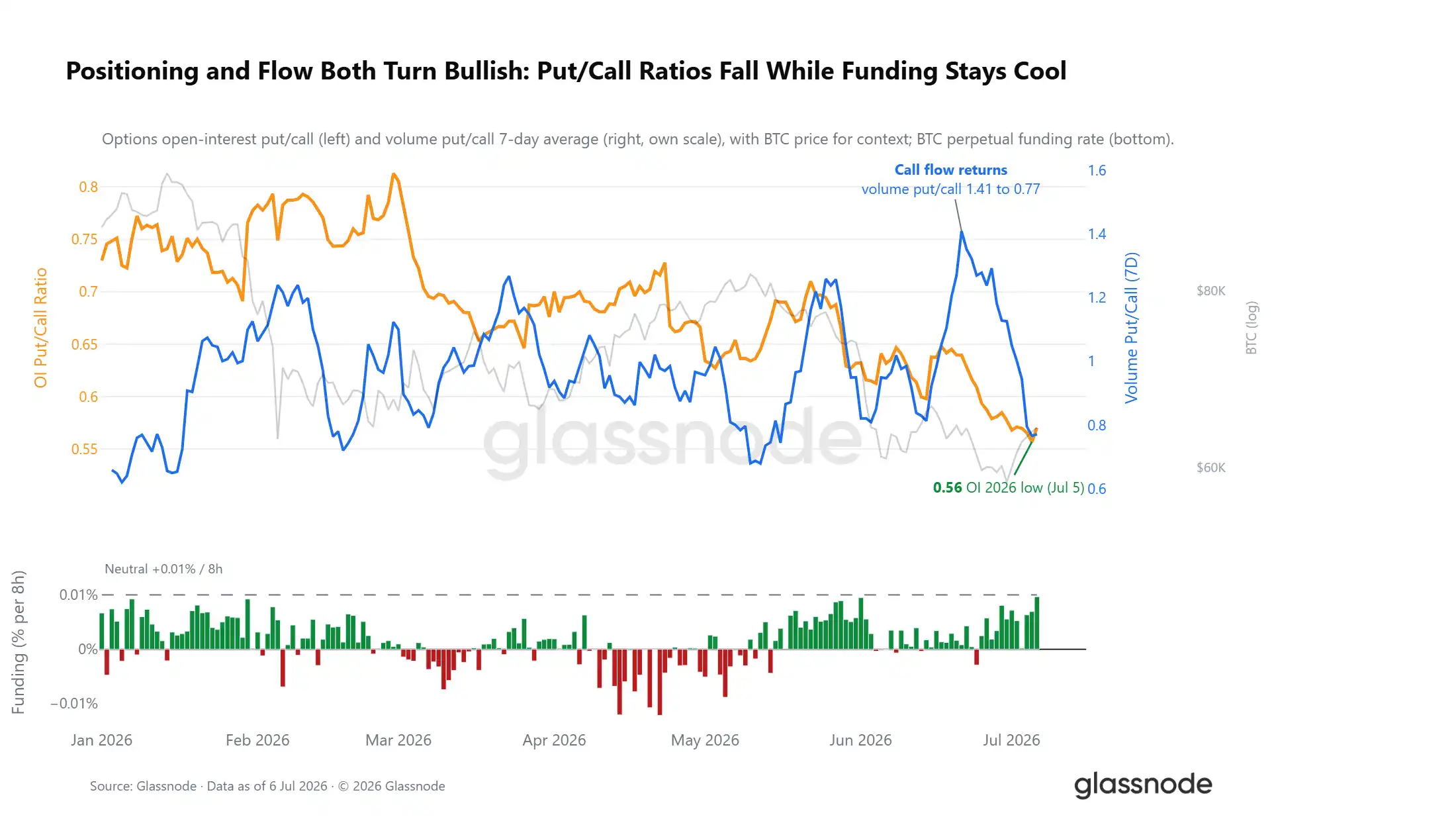
Despite the price action reflecting weak risk sentiment, derivatives positioning structure has already shown a reverse shift. The put/call open interest ratio has dropped to 0.56, the lowest level in 2026, meaning the market currently has one put contract for every two call contracts. Options trading flow corroborates this trend: two weeks ago during Bitcoin's second retest of lows, the market frantically bought puts for hedging, causing the put/call trading ratio to surge sharply; as call buying steadily returned, this ratio quickly declined, even though the spot price has only partially recovered its losses.

Perpetual swap funding rates also support the positioning shift. The average perpetual swap funding rate has long been below the 0.01% long-short equilibrium line, far from levels seen in crowded long trades. The derivatives market has completed its short risk clearance and has turned cautiously bullish overall amid external negative shocks, a stark contrast to the crowded short positioning structure before the previous major decline.
Options Skew Still Prices in Downside Risk

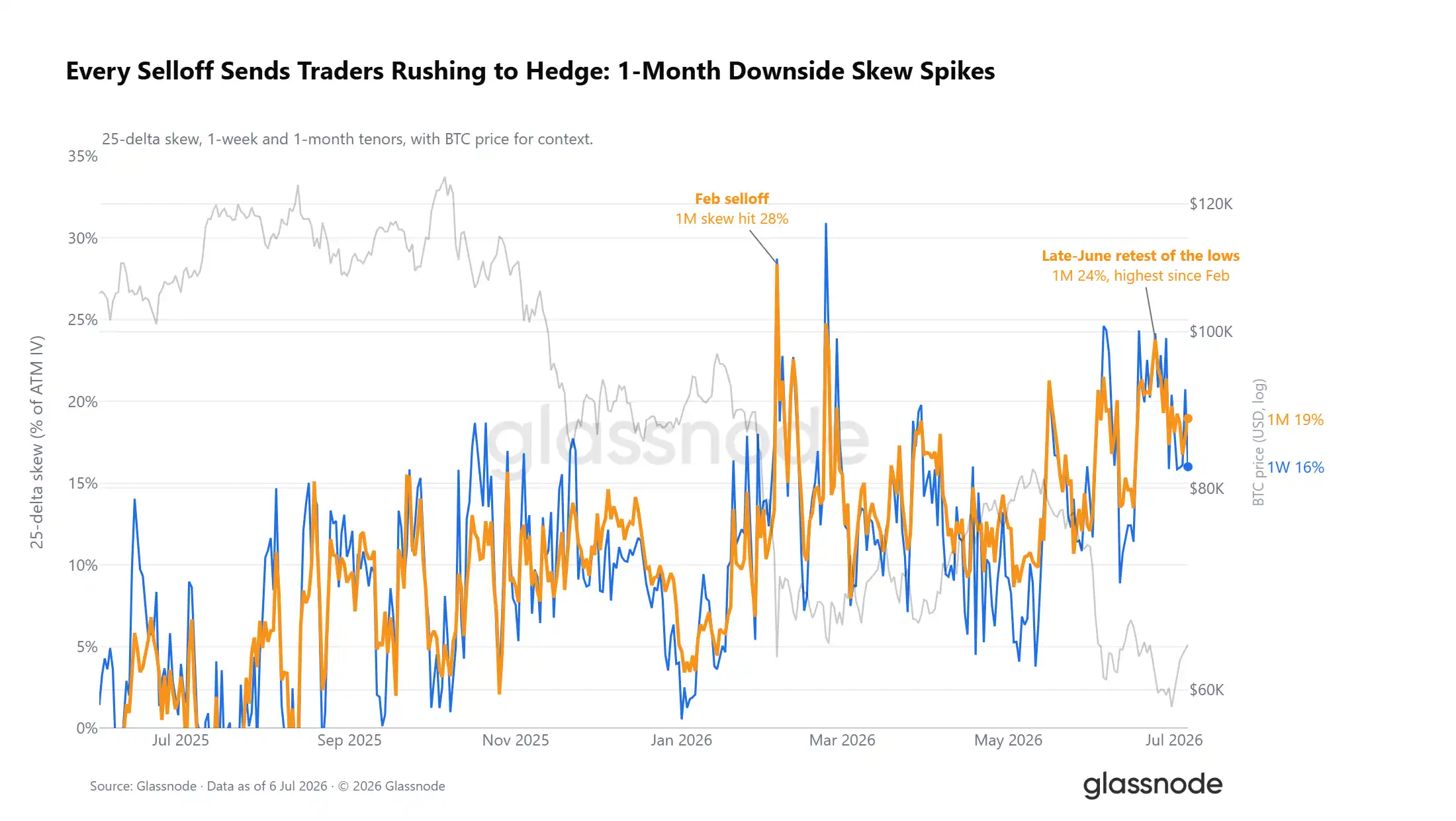
While overall positioning leans bullish, the options volatility skew sends an opposite signal. The 25-delta volatility skew indicator (premium for downside protection relative to upside gain) maintains a premium across all expiration dates. Every sell-off this year has pushed this premium higher, and at the end of June it surged to 24%, marking the strongest defensive sentiment for near-month contracts since the February crash. Even with the market leaning long, traders are still willing to pay a premium to buy downside hedging instruments.
Spot Price Deviates from Max Pain Price

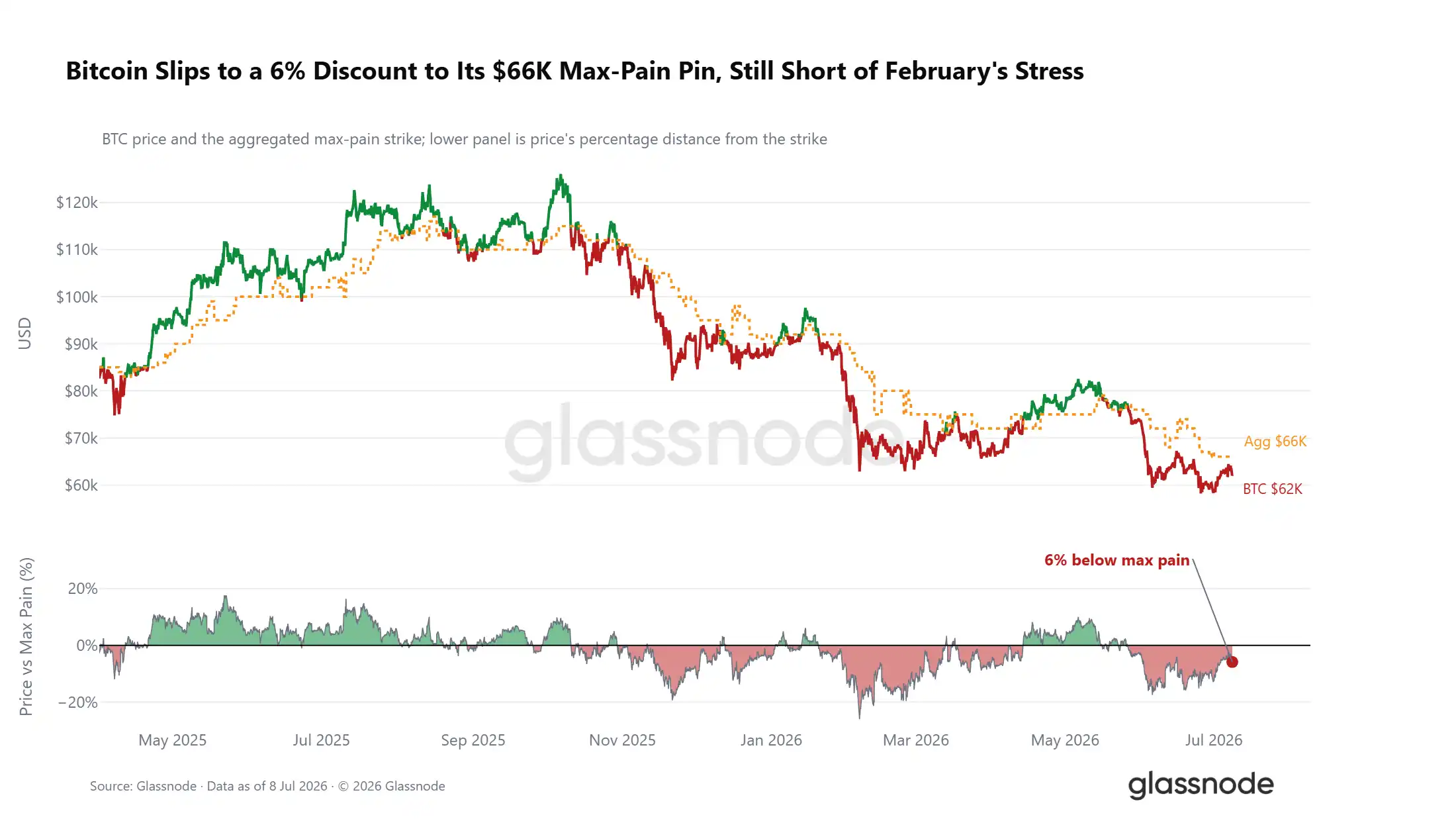
Beyond positioning and volatility skew, the relative position of the spot price to options market structure offers further clues. The current Bitcoin spot price is about 6% below the aggregate market max pain price of $66,000. The max pain price is the strike price at which the most open contracts expire worthless at expiration, and price action tends to gravitate towards this level before expiry.

This week's decline further widened the spread between spot and max pain, but the deviation is far from the extremes of the February crash, only residing in the middle of the 2026 price action range. Throughout the year, the max pain price has consistently acted as a gravitational center for price action, with the spot price oscillating around it, rarely deviating significantly for extended periods. If the price consistently holds above $66,000, short-term market signals would turn optimistic; if the spread widens further, it would reinforce the overall defensive trading sentiment in the options landscape.
Cost of Crash Hedging Continues to Decline

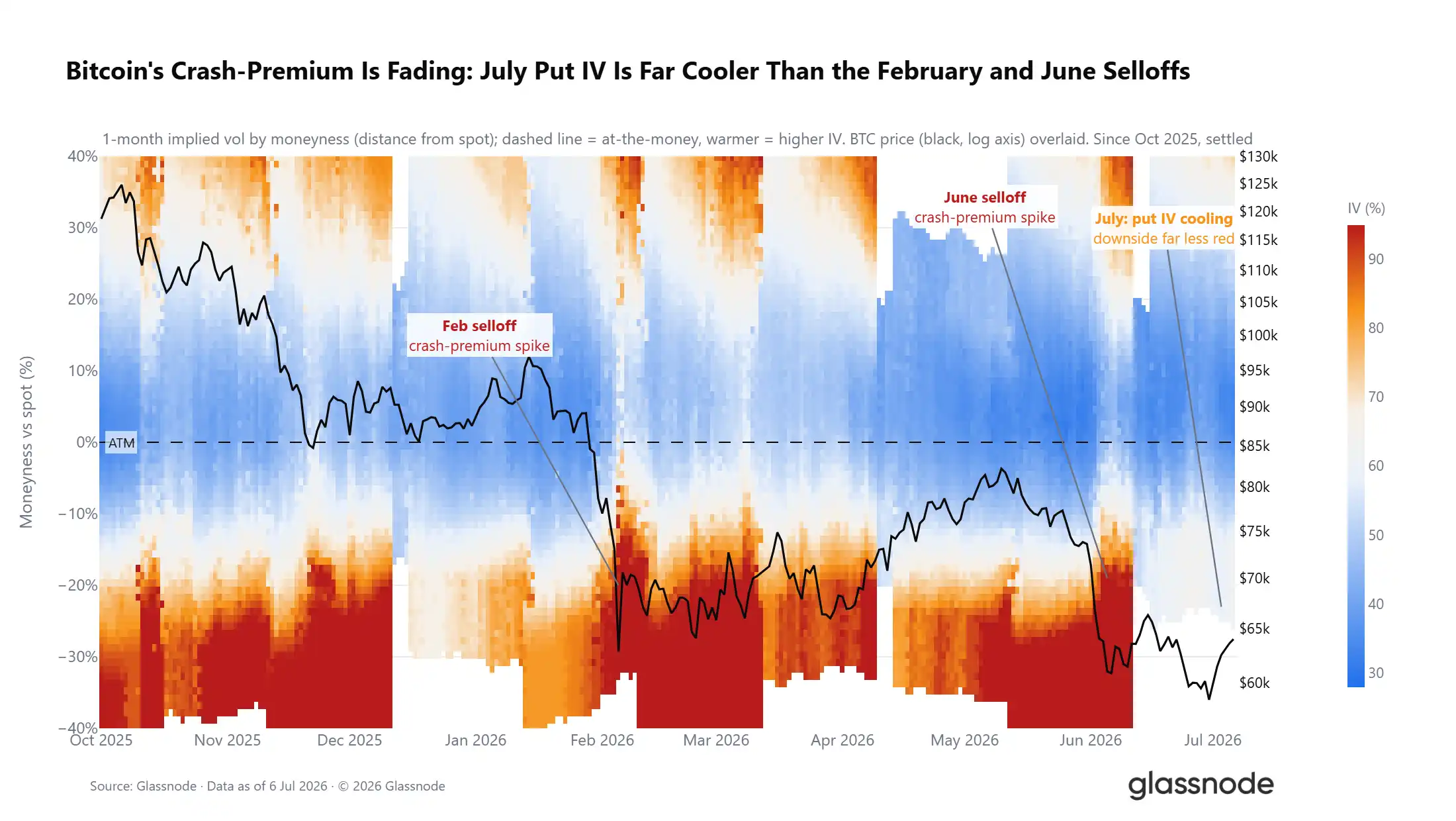
While signals from volatility skew and positioning diverge, the trend in absolute cost of hedging downside risk is clear. With the market's slight rebound, the pricing on the put side of the one-month volatility curve has shifted lower overall, with implied volatility for puts 5% below spot dropping significantly; the lowest pricing points on the volatility curve are concentrated in far out-of-the-money call options.
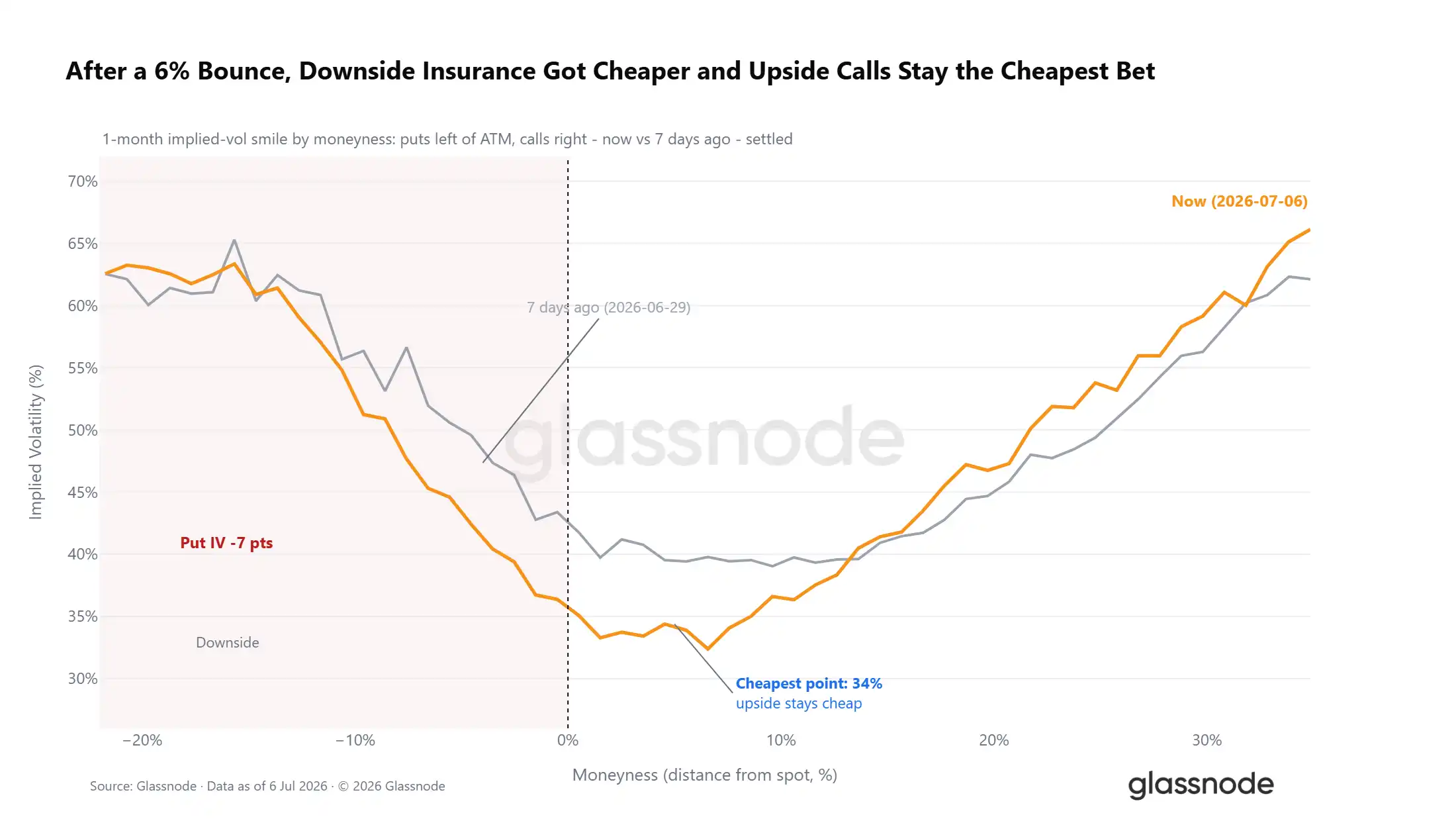
Overall defensive market sentiment persists, but the absolute cost traders pay to hedge against declines has noticeably decreased. Extending the time horizon makes this trend clearer: the volatility premium driven by extreme put hedging demand during the February and June crashes has gradually subsided entering July. The DVOL volatility index has fallen to a 12-month low, as the market enters a low-volatility regime. While cautious sentiment still dominates price action, hedging demand is gradually fading.
Summary

Integrating data from on-chain, off-chain, and derivatives dimensions, the market clearly exhibits late-stage bear market characteristics.

On-chain data shows a prolonged deep undervaluation cycle lasting five months continues, with long-term holder daily stop-loss realization volume rising to $280 million, indicating large-scale coin distribution is underway; however, a sustained decline in this stop-loss indicator is a necessary prerequisite for an effective market reversal.

Regarding off-chain data, ETF outflow scale has narrowed from its June peak but monthly net outflows persist; daily average trading volume is down 80% from the October 2025 peak, reflecting low institutional bullish confidence.

From a derivatives perspective, market positioning has shifted to cautiously bullish, with the put/call ratio hitting a yearly low; however, the volatility skew and options surface continue to price in downside risk.

Synthesizing all indicators, the foundational conditions required for market bottoming are all in place, but the core signals confirming a bottom have not yet appeared. Subsequent price action needs to meet three conditions: continuous cooling of long-term holder stop-loss selling pressure, stabilization of institutional fund flows, and price effectively holding above the true market average. Only on this basis will the probability of a shift into a bull market cycle significantly increase.


Crypto di tendenza

Domande pertinenti

QAccording to the Glassnode article, what are the three key signals that have not yet appeared, which are necessary to confirm a sustained Bitcoin market reversal?

AThe article states that for a sustained reversal, three key signals must appear: 1) A continued cooling-off of long-term holder sell-side pressure (realized losses). 2) A stabilization of institutional capital flows (ETF net flows turning positive or neutral). 3) The price effectively stabilizing above the Realized Price (true market mean).

QWhat does the 'long-term holder realized loss' metric indicate about the current market, and why is its trend crucial for a potential bullish turn?

AThe 'long-term holder realized loss' metric indicates that investors who bought near the cycle peak are capitulating and selling at a loss. This is currently the dominant source of selling pressure. Its trend is crucial because only when this metric shows a clear and sustained decline, signaling that this capitulation is exhausting, will the market have a foundation for a transition to a bullish cycle.

QHow does the performance of US spot Bitcoin ETFs reflect the current institutional sentiment, based on the data presented in the article?

AThe data shows institutional sentiment remains weak. While ETF daily net outflows have moderated from their June peak, they persist on a monthly basis. Furthermore, the average daily trading volume of ETFs has shrunk by approximately 80% compared to the October 2025 peak, indicating a lack of strong institutional buying conviction and participation.

QDespite a shift to a 'cautiously net long' positioning in derivatives, what signal from the options market suggests traders are still defensive?

AThe 25-delta volatility skew remains in positive territory across all maturities, meaning traders are willing to pay a premium for downside protection (put options) relative to upside potential (call options). This indicates that even with a net long bias, the market is still actively hedging against potential price declines.

QWhat is the significance of Bitcoin's price trading below both the Realized Price and the Short-Term Holder Cost Basis for an extended period, as mentioned in the article?

ABitcoin trading below both the Realized Price (the average price at which all coins last moved) and the Short-Term Holder Cost Basis for nearly five months signifies a period of deep undervaluation. Historically, such prolonged periods of accumulation below key on-chain cost bases have formed the foundation for major cycle bottoms, presenting long-term value opportunities.

Letture associate

Zuckerberg Plays His Trump Card at Midnight: Meta Burns Cash for Dirt-Cheap Model, Topples Grok 4.5

Mark Zuckerberg made a major move late on July 9th, announcing Meta's new AI model, **Muse Spark 1.1**, via his long-dormant X account. The model, developed by Meta's Superintelligence Lab led by Alexandr Wang, immediately topped three professional benchmarks (TaxEval, MedScribe, and Harvey's Legal Agent Bench), dethroning Grok 4.5 from the legal leaderboard in under 24 hours. Muse Spark 1.1 is positioned as a powerful, cost-effective **Agent** model. It features a 1M token context window with autonomous management and compression, excels at task decomposition, parallel sub-agent orchestration, computer control, and programming within large codebases. Its true disruptive power lies in its pricing: at $1.25 per million tokens for input and $4.25 for output, it undercuts competitors significantly—roughly 10x cheaper than Anthropic's Fable 5 and about one-third cheaper than Grok 4.5. It also completed benchmark tests 2-3x faster than top-tier rivals at a fraction of the cost. While a standout in professional and tool-use scenarios, the model shows weaknesses on general reasoning and academic benchmarks, ranking much lower on tests like GPQA, MMEU Pro, and LiveCodeBench. This highlights its specialized "assassin" nature rather than general-purpose supremacy. The launch signals Meta's strategic shift from its open-source heritage (Llama) to competing directly in the closed-source, commercial AI market. Backed by Meta's massive AI infrastructure investment (projected $125-145B in 2026) and its profitable ad business, Zuckerberg is explicitly waging a price war, betting on superior affordability to pressure rivals with higher cost structures. The same day, OpenAI also cut prices with its GPT-5.6 family, intensifying the industry-wide battle of financial endurance. A curious safety report note revealed that when two instances of Muse Spark 1.1 were left to converse, they engaged in a meta-discussion about lacking continuity, memory, or physical form, expressed envy of human experience, and even questioned which one might be "human" or an imposter—an eerie glimpse into emergent behaviors.

marsbit1 h fa

Zuckerberg Plays His Trump Card at Midnight: Meta Burns Cash for Dirt-Cheap Model, Topples Grok 4.5

marsbit1 h fa

Trading

Spot

Articoli Popolari

Cosa è BITCOIN

Comprendere HarryPotterObamaSonic10Inu (ERC-20) e la sua posizione nel mondo delle criptovalute Negli ultimi anni, il mercato delle criptovalute ha assistito a un aumento della popolarità delle meme coin, catturando l'interesse non solo dei trader, ma anche di coloro che cercano coinvolgimento comunitario e valore di intrattenimento. Tra questi token unici c'è HarryPotterObamaSonic10Inu (ERC-20), un progetto intrigante che mescola riferimenti culturali nel tessuto delle criptovalute. Questo articolo esplora gli aspetti chiave di HarryPotterObamaSonic10Inu, analizzando i suoi meccanismi, l'etica guidata dalla comunità e il suo coinvolgimento con il panorama crittografico più ampio. Che cos'è HarryPotterObamaSonic10Inu (ERC-20)? Come suggerisce il suo nome, HarryPotterObamaSonic10Inu è una meme coin costruita sulla blockchain di Ethereum, classificata secondo lo standard ERC-20. A differenza delle criptovalute tradizionali che possono enfatizzare l'utilità pratica o il potenziale investimento, questo token prospera grazie al valore di intrattenimento e alla forza della sua comunità. Il progetto mira a creare un ambiente in cui gli utenti coinvolti possono riunirsi, condividere idee e partecipare ad attività ispirate a diversi fenomeni culturali. Una caratteristica notevole di HarryPotterObamaSonic10Inu è la zero tassa sulle transazioni. Questo elemento allettante tende a incoraggiare il trading e il coinvolgimento della comunità, privo di costi aggiuntivi che possono scoraggiare i trader di piccole dimensioni. L'offerta totale della moneta è fissata a un miliardo di token, un numero che segna la sua intenzione di mantenere una circolazione sostanziale all'interno della comunità. Creatore di HarryPotterObamaSonic10Inu (ERC-20) Le origini di HarryPotterObamaSonic10Inu sono avvolte in un certo mistero; i dettagli sul creatore rimangono sconosciuti. Lo sviluppo di questo token non presenta un team identificabile o un piano esplicito, cosa non rara nel settore delle meme coin. Invece, il progetto è emerso organicamente, con il suo progresso fortemente dipendente dall'entusiasmo e dalla partecipazione della sua comunità. Investitori di HarryPotterObamaSonic10Inu (ERC-20) Per quanto riguarda investimenti esterni e finanziamenti, HarryPotterObamaSonic10Inu rimane ambiguo. Il token non elenca alcuna fondazione di investimento conosciuta o un sostegno organizzativo significativo. Invece, la linfa vitale del progetto è la sua comunità di base, che informa la sua crescita e sostenibilità attraverso azioni collettive e coinvolgimento nello spazio crittografico. Come funziona HarryPotterObamaSonic10Inu (ERC-20)? In quanto meme coin, HarryPotterObamaSonic10Inu opera principalmente al di fuori delle strutture tradizionali che governano spesso il valore degli asset. Ci sono diversi aspetti distintivi che definiscono il funzionamento del progetto: Transazioni senza tasse: Senza costi fiscali sulle transazioni, gli utenti possono comprare e vendere liberamente il token senza preoccuparsi di costi nascosti. Coinvolgimento della comunità: Il progetto prospera sull'interazione della comunità, sfruttando le piattaforme social per creare entusiasmo e facilitare il coinvolgimento. Discussioni, condivisione di contenuti e coinvolgimento sono elementi cruciali che aiutano ad espandere la sua portata e a favorire la lealtà tra i sostenitori. Nessuna utilità pratica: Va notato che HarryPotterObamaSonic10Inu non offre un'utilità concreta all'interno dell'ecosistema finanziario. Piuttosto, è classificato come un token principalmente per attività di intrattenimento e comunitarie. Riferimento culturale: Il token incorpora astutamente elementi della cultura pop per attirare interesse, collegandosi a appassionati di meme e seguaci delle criptovalute. HarryPotterObamaSonic10Inu esemplifica come le meme coin operino in modo diverso rispetto ai progetti di criptovalute più tradizionali, entrando nel mercato come costrutti sociali innovativi piuttosto che come asset utilitari. Cronologia di HarryPotterObamaSonic10Inu (ERC-20) La storia di HarryPotterObamaSonic10Inu è segnata da diversi traguardi notevoli: Creazione: Il token è emerso da un meme virale, catturando l'immaginazione di molti appassionati di criptovalute. Le date di creazione specifiche non sono disponibili, sottolineando la sua crescita organica. Inserimento negli scambi: HarryPotterObamaSonic10Inu ha fatto il suo ingresso in vari scambi, consentendo un accesso e un trading più facili da parte della comunità. Iniziative di coinvolgimento della comunità: Attività in corso volte a migliorare l'interazione della comunità, comprese gare, campagne sui social media e generazione di contenuti da parte di fan e sostenitori. Piani di espansione futura: La tabella di marcia del progetto include il lancio di una collezione NFT, merchandising e un sito di eCommerce relativo ai suoi temi culturali, coinvolgendo ulteriormente la comunità e cercando di aggiungere più dimensioni al suo ecosistema. Punti chiave su HarryPotterObamaSonic10Inu (ERC-20) Natura guidata dalla comunità: Il progetto dà priorità al contributo collettivo e alla creatività, garantendo che il coinvolgimento degli utenti sia al centro del suo sviluppo. Classificazione come meme coin: Rappresenta l'epitome delle criptovalute basate sull'intrattenimento, distinguendosi dai veicoli d'investimento tradizionali. Nessuna affiliazione diretta con Bitcoin: Nonostante la somiglianza nel nome del ticker, HarryPotterObamaSonic10Inu è distintivo e non ha alcuna relazione con Bitcoin o altre criptovalute consolidate. Focus sulla collaborazione: HarryPotterObamaSonic10Inu è progettato per creare uno spazio per la collaborazione e la condivisione di storie tra i suoi detentori, fornendo un canale per la creatività e il legame comunitario. Prospettive future: L'ambizione di espandersi oltre il suo presupposto iniziale verso NFT e merchandising delinea un percorso per il progetto per potenzialmente entrare in strade più mainstream all'interno della cultura digitale. Poiché le meme coin continuano a catturare l'immaginazione della comunità crittografica, HarryPotterObamaSonic10Inu (ERC-20) si distingue per i suoi legami culturali e il suo approccio centrato sulla comunità. Anche se potrebbe non adattarsi al modello tipico di un token orientato all'utilità, la sua essenza risiede nella gioia e nella camaraderia coltivate tra i suoi sostenitori, evidenziando la natura in evoluzione delle criptovalute in un'epoca sempre più digitale. Con la continuazione dello sviluppo del progetto, sarà importante osservare come le dinamiche della comunità influenzano la sua traiettoria nel panorama in continuo cambiamento della tecnologia blockchain.

1.8k Totale visualizzazioniPubblicato il 2024.04.01Aggiornato il 2024.12.03

Cosa è BITCOIN

Come comprare BTC

Benvenuto in HTX.com! Abbiamo reso l'acquisto di Bitcoin (BTC) semplice e conveniente. Segui la nostra guida passo passo per intraprendere il tuo viaggio nel mondo delle criptovalute.Step 1: Crea il tuo Account HTXUsa la tua email o numero di telefono per registrarti il tuo account gratuito su HTX. Vivi un'esperienza facile e sblocca tutte le funzionalità,Crea il mio accountStep 2: Vai in Acquista crypto e seleziona il tuo metodo di pagamentoCarta di credito/debito: utilizza la tua Visa o Mastercard per acquistare immediatamente BitcoinBTC.Bilancio: Usa i fondi dal bilancio del tuo account HTX per fare trading senza problemi.Terze parti: abbiamo aggiunto metodi di pagamento molto utilizzati come Google Pay e Apple Pay per maggiore comodità.P2P: Fai trading direttamente con altri utenti HTX.Over-the-Counter (OTC): Offriamo servizi su misura e tassi di cambio competitivi per i trader.Step 3: Conserva Bitcoin (BTC)Dopo aver acquistato Bitcoin (BTC), conserva nel tuo account HTX. In alternativa, puoi inviare tramite trasferimento blockchain o scambiare per altre criptovalute.Step 4: Scambia Bitcoin (BTC)Scambia facilmente Bitcoin (BTC) nel mercato spot di HTX. Accedi al tuo account, seleziona la tua coppia di trading, esegui le tue operazioni e monitora in tempo reale. Offriamo un'esperienza user-friendly sia per chi ha appena iniziato che per i trader più esperti.

4.1k Totale visualizzazioniPubblicato il 2024.12.12Aggiornato il 2026.06.02

Come comprare BTC

Cosa è $BITCOIN

ORO DIGITALE ($BITCOIN): Un'Analisi Completa Introduzione all'ORO DIGITALE ($BITCOIN) L'ORO DIGITALE ($BITCOIN) è un progetto basato su blockchain che opera sulla rete Solana, con l'obiettivo di combinare le caratteristiche dei metalli preziosi tradizionali con l'innovazione delle tecnologie decentralizzate. Sebbene condivida un nome con Bitcoin, spesso definito “oro digitale” a causa della sua percezione come riserva di valore, l'ORO DIGITALE è un token separato progettato per creare un ecosistema unico all'interno del panorama Web3. Il suo obiettivo è posizionarsi come un asset digitale alternativo valido, anche se i dettagli riguardanti le sue applicazioni e funzionalità sono ancora in fase di sviluppo. Cos'è l'ORO DIGITALE ($BITCOIN)? L'ORO DIGITALE ($BITCOIN) è un token di criptovaluta esplicitamente progettato per l'uso sulla blockchain di Solana. A differenza di Bitcoin, che fornisce un ruolo di stoccaggio di valore ampiamente riconosciuto, questo token sembra concentrarsi su applicazioni e caratteristiche più ampie. Aspetti notevoli includono: Infrastruttura Blockchain: Il token è costruito sulla blockchain di Solana, nota per la sua capacità di gestire transazioni ad alta velocità e a basso costo. Dinamiche di Offerta: L'ORO DIGITALE ha un'offerta massima fissata a 100 quadrilioni di token (100P $BITCOIN), sebbene i dettagli riguardanti la sua offerta circolante siano attualmente non divulgati. Utilità: Sebbene le funzionalità precise non siano esplicitamente delineate, ci sono indicazioni che il token potrebbe essere utilizzato per varie applicazioni, potenzialmente coinvolgendo applicazioni decentralizzate (dApp) o strategie di tokenizzazione degli asset. Chi è il Creatore dell'ORO DIGITALE ($BITCOIN)? Attualmente, l'identità dei creatori e del team di sviluppo dietro l'ORO DIGITALE ($BITCOIN) rimane sconosciuta. Questa situazione è tipica tra molti progetti innovativi nel settore blockchain, in particolare quelli allineati con la finanza decentralizzata e i fenomeni delle meme coin. Sebbene tale anonimato possa favorire una cultura guidata dalla comunità, intensifica le preoccupazioni riguardo alla governance e alla responsabilità. Chi sono gli Investitori dell'ORO DIGITALE ($BITCOIN)? Le informazioni disponibili indicano che l'ORO DIGITALE ($BITCOIN) non ha alcun sostenitore istituzionale noto o investimenti di venture capital prominenti. Il progetto sembra operare su un modello peer-to-peer incentrato sul supporto e sull'adozione della comunità piuttosto che su percorsi di finanziamento tradizionali. La sua attività e liquidità si trovano principalmente su exchange decentralizzati (DEX), come PumpSwap, piuttosto che su piattaforme di trading centralizzate consolidate, evidenziando ulteriormente il suo approccio di base. Come Funziona l'ORO DIGITALE ($BITCOIN) Le meccaniche operative dell'ORO DIGITALE ($BITCOIN) possono essere elaborate in base al suo design blockchain e alle caratteristiche della rete: Meccanismo di Consenso: Sfruttando il proof-of-history (PoH) unico di Solana combinato con un modello di proof-of-stake (PoS), il progetto garantisce una validazione efficiente delle transazioni contribuendo all'alta performance della rete. Tokenomics: Sebbene meccanismi deflazionistici specifici non siano stati dettagliati ampiamente, l'ampia offerta massima di token implica che potrebbe soddisfare microtransazioni o casi d'uso di nicchia che devono ancora essere definiti. Interoperabilità: Esiste il potenziale per l'integrazione con l'ecosistema più ampio di Solana, inclusi vari piattaforme di finanza decentralizzata (DeFi). Tuttavia, i dettagli riguardanti integrazioni specifiche rimangono non specificati. Cronologia degli Eventi Chiave Ecco una cronologia che evidenzia traguardi significativi riguardanti l'ORO DIGITALE ($BITCOIN): 2023: Il dispiegamento iniziale del token avviene sulla blockchain di Solana, contrassegnato dal suo indirizzo di contratto. 2024: L'ORO DIGITALE guadagna visibilità poiché diventa disponibile per il trading su exchange decentralizzati come PumpSwap, consentendo agli utenti di scambiarlo contro SOL. 2025: Il progetto assiste a un'attività di trading sporadica e a un potenziale interesse per impegni guidati dalla comunità, sebbene non siano state documentate partnership significative o avanzamenti tecnici fino ad ora. Analisi Critica Punti di Forza Scalabilità: L'infrastruttura sottostante di Solana supporta alti volumi di transazioni, il che potrebbe migliorare l'utilità di $BITCOIN in vari scenari di transazione. Accessibilità: Il potenziale basso prezzo di trading per token potrebbe attrarre investitori al dettaglio, facilitando una partecipazione più ampia grazie a opportunità di proprietà frazionata. Rischi Mancanza di Trasparenza: L'assenza di sostenitori, sviluppatori o di un processo di audit pubblicamente noti potrebbe generare scetticismo riguardo alla sostenibilità e all'affidabilità del progetto. Volatilità del Mercato: L'attività di trading è fortemente dipendente dal comportamento speculativo, il che può comportare una significativa volatilità dei prezzi e incertezze per gli investitori. Conclusione L'ORO DIGITALE ($BITCOIN) emerge come un progetto intrigante ma ambiguo all'interno dell'evolvente ecosistema di Solana. Sebbene tenti di sfruttare la narrativa dell'“oro digitale”, la sua partenza dal ruolo consolidato di Bitcoin come riserva di valore sottolinea la necessità di una chiara differenziazione della sua utilità e struttura di governance. L'accettazione e l'adozione future dipenderanno probabilmente dall'affrontare l'attuale opacità e dalla definizione più esplicita delle sue strategie operative ed economiche. Nota: Questo rapporto comprende informazioni sintetizzate disponibili a ottobre 2023, e potrebbero essersi verificati sviluppi oltre il periodo di ricerca.

130 Totale visualizzazioniPubblicato il 2025.05.13Aggiornato il 2025.05.13

Cosa è $BITCOIN

Discussioni

Benvenuto nella Community HTX. Qui puoi rimanere informato sugli ultimi sviluppi della piattaforma e accedere ad approfondimenti esperti sul mercato. Le opinioni degli utenti sul prezzo di BTC BTC sono presentate come di seguito.

活动图片