Giants Wage the Context War, Reconstructing AI Moats

marsbitPubblicato 2026-06-23Pubblicato ultima volta 2026-06-23

Introduzione

The article "Giants Launch the Context War, Reconstructing AI's Moat" discusses how leading AI companies—OpenAI, Anthropic, and Google—are shifting their competitive focus from model size to acquiring, managing, and utilizing user context (Context). Initially, Context referred to the length of text a model could process, leading to a "arms race" for longer context windows. However, the competition has evolved through three key phases: expanding text capacity (long context windows), enabling memory across sessions, and finally, integrating AI into real user environments like browsers and desktops to capture dynamic task states. Each company is pursuing a distinct strategy. OpenAI is building Context around the ChatGPT account, turning it into a central hub that accumulates user understanding across various integrated applications and tools. Anthropic, lacking a major user base, focuses on high-value verticals like coding, empowering its Claude model to actively gather Context through GUI interaction (Computer Use) and system connections (MCP protocol). Google, with vast existing user data from products like Search and Gmail, faces the challenge of restructuring this data into actionable, AI-understandable Context for its Gemini model within its ecosystem. The core argument is that the nature of competitive advantage in AI is changing. The internet era prized network effects—connecting more users. The AI era values "individual depth": the ability to build deep, task-specific ...

This year, the three major US AI giants have been labeling their own model products with some "sci-fi" tags.

OpenAI says ChatGPT has learned to "dream"; Anthropic wants to give Claude a built-in "personal Wiki"; Google claims Gemini "natively comes with ten years of your memories".

These three statements seem unrelated, but they are actually competing for the same thing—Context.

Early on, Context was just an unremarkable technical parameter, measuring how many characters a model could process at once. Today, the meaning of Context is broadening: it is user assets, tool permissions, the real-time state of a task's progress, and ultimately, how well the AI understands you.

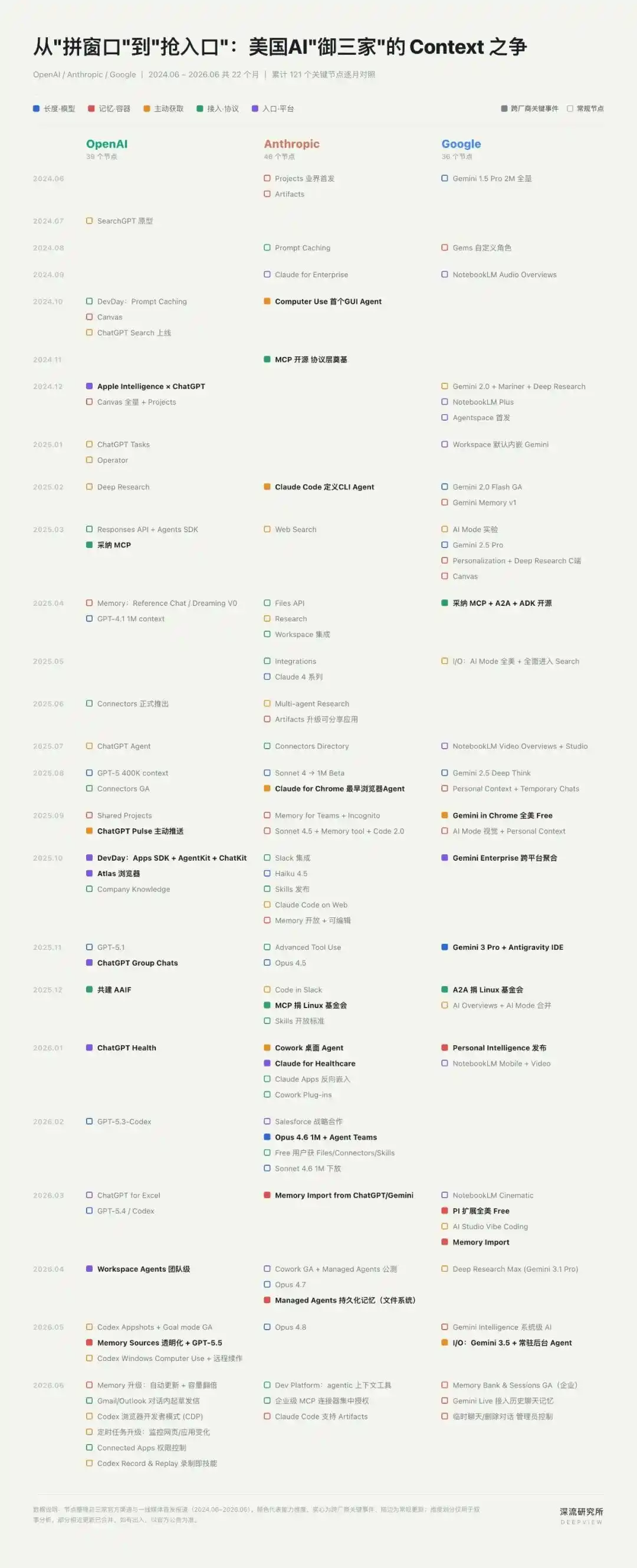
According to "Deep Flow Research Institute," since the beginning of this year, OpenAI, Anthropic, and Google have released over 40 important product and feature updates centered around Context—on average, a new capability hits the market every three to four days.

From long-context windows to cross-session Memory, to browser, desktop, and GUI capabilities, almost all the most significant changes in AI products over the past two years have revolved around Context.

A war over "Context" has already begun, which is quietly reconstructing the moats of the AI era.

1. From Long Windows to the Real Environment: Three Leaps in the Boundaries of Context

The earliest competition over Context happened in "text length."

In the Chatbot era, Context primarily meant how much information a model could ingest at one time. The longer the window, the more capable the model was at handling papers, codebases, even complete project documentation. Thus, OpenAI, Anthropic, and Google ignited an arms race in context window length.

In May 2023, Anthropic led the charge by extending Claude's context window from 9K to 100K, equivalent to about 75,000 words, making "uploading an entire book" a reality for the first time. In November 2023, OpenAI followed up with GPT-4 Turbo's 128K window. Three months later, Google pushed the window to the million-level with Gemini 1.5 Pro.

In less than a year, Context leaped from the hundred-thousand level to the million level.
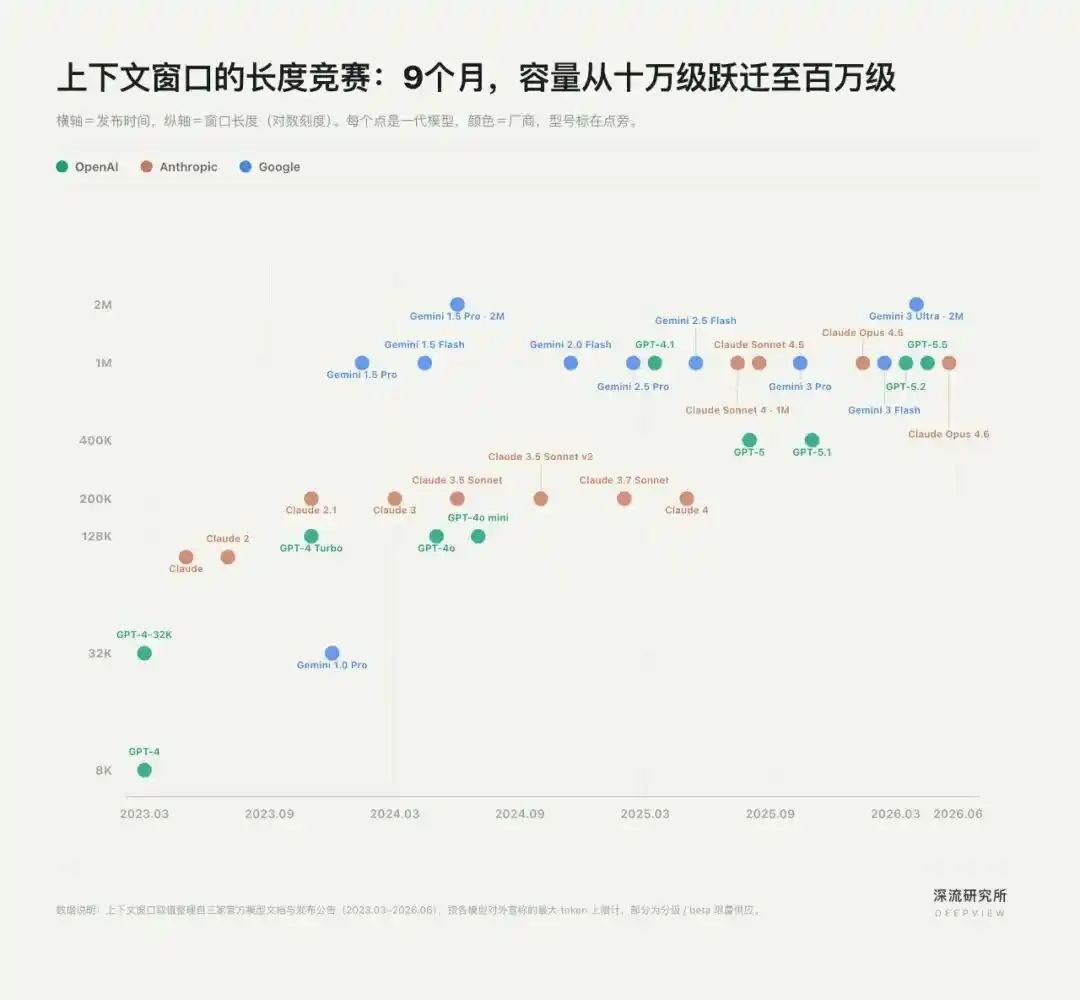
Long windows solved the AI's "throughput" problem, but this race quickly exposed its limitations: the model seeing more information doesn't necessarily mean it can better understand the task.

Especially as AI products evolved from Chatbot to Agent, the boundaries of Context began to change. It was no longer just the input text in a single conversation, but the continuously accumulating, dynamically updated state flow within the task loop.

The focus of competition shifted accordingly: from "how much the model can know at once" to "what the model can remember long-term." Memory became the typical product form of this stage.

In early 2024, OpenAI was the first to introduce cross-session memory for ChatGPT, allowing the model to remember user preferences, backgrounds, and long-term needs. Subsequently, Anthropic and Google also equipped Claude and Gemini with memory capabilities.

Context began to have a time dimension. AI no longer only processed the current input; it also started trying to establish continuity between a user's interactions today, last week, and last month. Only AI with long-term Context could string discrete interactions into an ongoing relationship.

However, Memory answers "what happened in the past," but hasn't yet touched upon an even more critical question: what is happening now?

The real watershed moment appeared in the second half of 2025.

Starting in August of that year, the three companies almost simultaneously pushed the Context front to the browser: Anthropic released Claude for Chrome, Google embedded Gemini into Chrome, and OpenAI launched the standalone AI browser ChatGPT Atlas.

The browser is a natural Context goldmine. Web content, search intent, login status, forms, history, tabs, and the tasks the user is executing are all deposited within the browser. More importantly, the Context here is more real-time, continuous, and closer to the actual task site.

Previously, the way AI obtained Context was essentially still waiting for the user to deliver materials: uploading files, inputting instructions, authorizing memory, connecting data sources.

After entering the browser, the logic changed. AI began entering the user's work environment, observing page state, understanding task progress, capturing operational intent, and executing the next step within the real interface.

This was the third leap in Context boundaries: it transformed from static data input on the model side to the dynamic state captured by Agents in GUI, web pages, and system environments.

Long windows determine how much information the model can ingest at once; Memory determines whether the model can understand the user across time; browser, desktop products, and GUI capabilities determine whether the model can enter the real task site.

Together, these three constitute the main thread of AI product competition over the past two years: Context is no longer just a model capability issue; it is gradually becoming a product entry point issue, a user relationship issue, and an asset accumulation issue.

2. Context Becomes the New Battleground: Three Paths for the US AI "Big Three"

When Context evolves from a model parameter to a user asset, the core of competition becomes: who can more stably acquire, organize, and invoke Context.

Centered on this, OpenAI, Anthropic, and Google have taken three differentiated paths.
ChatGPT is OpenAI's most core source of Context.

Memories, preferences, historical tasks, and tool usage records left by users in countless conversations gradually accumulate under the same ChatGPT account.

This account differs from traditional internet accounts. Traditional accounts record login status, subscription relationships, and payment information; ChatGPT accounts record the user's "history understood by AI."

This is an AI-native user asset. Its value lies not only in more personalized answers but also in reducing cold-start costs, continuing task states, and reusing the same set of user understanding across different product scenarios.

For OpenAI, lacking Google's native data ecosystem, it must have users continuously generate new Context within the ChatGPT system.

Therefore, OpenAI's product moves over the past two years have consistently expanded the task radius that the ChatGPT account can cover—the Apps SDK brings third-party apps into ChatGPT, Atlas brings the browser into ChatGPT, and the newly integrated Codex brings programming tasks into the same workflow.

OpenAI's unique path lies in not first controlling the entry point and then plugging AI into it; rather, it takes ChatGPT as the origin point and pulls application, browser, programming, and other scenarios back into the same account system.

ChatGPT thus is no longer just a conversational entry point but a hub for converging, invoking, and updating Context.

In contrast, Anthropic lacks both C-end entry points and large-scale existing user data.

Its path is to cut into high-value vertical scenarios like Coding and Agent and strengthen Claude's ability to actively acquire Context within these scenarios.

For Claude, Context is not a piece of text input by the user but the dynamically changing environment within the task site: codebases, file systems, terminal output, browser pages, databases, project documentation, and feedback after each execution step.

Therefore, Anthropic emphasizes the proactivity of Context acquisition more. The model should not just wait for user input; it should also actively enter the environment, read the state, and obtain feedback during task execution.

In October 2024, Anthropic launched Computer Use, allowing Claude to move the mouse, click buttons, and input text based on screen captures.

According to the official statement, Claude 3.5 Sonnet is the first frontier AI model publicly offering computer use capabilities.

This means that when Context exists in web pages, forms, backend system interfaces, and local software UIs, rather than in structured APIs, Claude can still enter the environment via GUI, observe the state, and execute operations.

A month later, Anthropic released MCP. This open protocol connecting AI assistants with external tools and data sources is officially defined as connecting AI assistants to "systems where data resides," including content libraries, business tools, and development environments.

Its value lies in allowing Claude to no longer rely on users copy-pasting but to access external tools and data sources through standardized methods.

These two types of capabilities correspond to Anthropic's two paths for acquiring Context:

Computer Use enters interfaces via GUI; MCP connects systems via protocol. One enters the task site; the other connects to external tools, collectively enabling Claude to obtain dynamic Context.
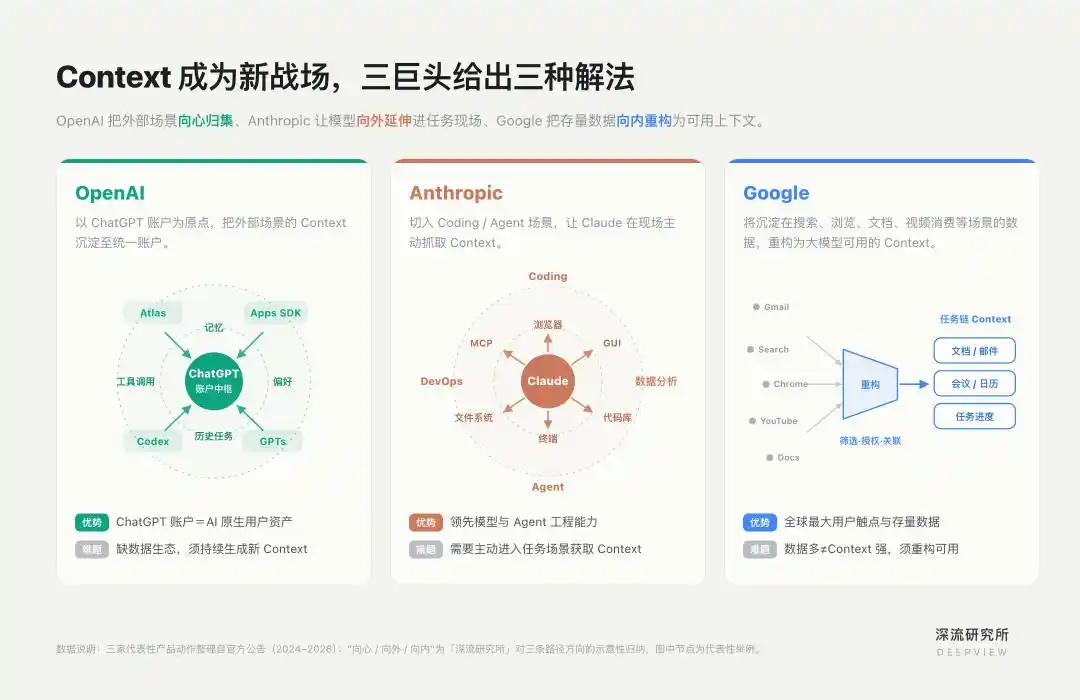
Now, looking at Google. It's often said externally that Google is one of the companies with the most Context. It lacks neither entry points nor data. Products like Chrome, Gmail, YouTube, and Search constitute one of the largest collections of user touchpoints globally.

But from an AI perspective, more data does not equal stronger Context.

What Google accumulated in the past was search, browsing, email, documents, location, video consumption, and other data, primarily serving search ranking, ad delivery, content recommendation, and office collaboration. They are essentially behavioral signals needed for system operation.

What Agents need is task background that can be understood, reasoned about, and invoked by models.

Only when a model can judge which information is relevant to the current task, which is outdated, which can be invoked, and how these pieces of information are related, does data truly become Context.

The challenge Google faces is not simply "accessing data," but a data refactoring. It needs to re-screen, correlate, authorize, and transform old data scattered across different products, serving different system goals, into personal context usable by Gemini.

The difficulty of this engineering task is no less than OpenAI re-accumulating Context or Anthropic entering the task site.

Over the past two years, Google's product moves have not been starting from scratch but reforming inward along its existing strongholds. The core of this path is organizing fragmented data into task chains.

In May 2024, Gemini 1.5 Pro entered the Workspace sidebar, allowing the model to first invoke current context within work scenarios like Gmail, Docs, and Drive.

In July 2025, the Gemini app began connecting to tools like Gmail, Drive, and Calendar, extending Context from a single application to cross-application tasks.

In January 2026, Personal Intelligence launched a test version, further incorporating personal data like Gmail and Photos into Gemini's personalized background.

Google's Context strategy is not "we have more data, so we're naturally ahead."

What it truly needs to accomplish is a data usability engineering project: transforming historically accumulated behavioral data serving system goals like search, ads, and recommendation into understandable, authorizable, actionable Context for the AI era.

3. From "Network Scale" to "Individual Depth": AI Era Moats Are Changing

Over the past two years, OpenAI, Anthropic, and Google have all accelerated the accumulation and mining of Context, building capabilities around its acquisition, organization, and invocation, attempting to form new competitive barriers.

But a seemingly contradictory change is also happening simultaneously: since this year, the three companies have coincidentally made Memory more transparent, explainable, and even migratable.

In March 2026, Anthropic and Google successively launched Memory Import, supporting users in migrating memories between ChatGPT, Gemini, and Claude.

Subsequently, OpenAI, through Memory Sources, allowed users to see which memories, historical chats, or external data sources were invoked behind a personalized answer.

If Context is the most important asset in the AI era, why are platforms starting to open its permissions?

The answer lies in the fact that Memory Import truly only opens surface-level Context: user preferences, memory summaries, compressed versions of chat history.

This information is highly structured and easily described in natural language. Migrating it is not technically difficult.

What's truly hard to migrate is another type of Context: task states, tool permissions, enterprise system integrations, real-time feedback from execution sites.

This Context is deeply embedded within product and system environments and cannot be fully moved with a prompt.

This also indicates that the competitive logic of the AI era differs from that of the internet era.

The basic form of the internet is the network. It connects people, content, goods, services, and information into nodes. The more nodes and denser the connections, the more valuable the product. Therefore, the strongest moat in the internet era was network effects; value came from more people using it.

The basic form of AI is closer to a new kind of computer, or a new information processing system.

Its primary value is not connecting more people, but understanding information, processing tasks, invoking tools, and completing actions. An AI could create enormous value even serving just one user.

Therefore, the moats of the AI era are shifting from "network scale" to "individual depth." This "individual depth" barrier primarily comes from three layers:

First, the compounding effect of Context. Every time an AI completes a task, it understands the user's expression habits, judgment standards, data sources, and workflow better. The next time it executes, the cold-start cost is lower.

Second, the embedding of permissions and toolchains. When users authorize AI to access their email, documents, codebases, etc., AI is no longer just a replaceable Q&A tool; it enters the real task site.

Third, the formation of trust relationships. The more complex and high-value the task, the less likely users are to casually hand it to an unfamiliar AI. Only an AI that has long understood them, knows their boundaries, and can continue the context will likely be allowed to execute the next step.

If internet products compete for attention entry points, then AI products compete for task entry points.

Once an AI consistently enters a user's workflow, accumulates context, and gains execution permissions, the migration cost isn't just switching an app; it's re-establishing a whole set of task relationships of being understood, authorized, and trusted.

Changes in domestic products can also be understood within this logic.

Take Tencent as an example. It accumulated relationship chains, content, service ecosystems, and high-frequency entry points in the internet era; in the AI era, the value of these assets lies in whether they can be reorganized into Context that Agents can understand, invoke, and execute.

Whether it's WorkBuddy accessing work scenarios like documents, meetings, and WeCom, or WeChat's "Xiao Wei" attempting to invoke mini-programs and services within the WeChat ecosystem, the essence is transforming content, relationships, and processes originally serving humans into task environments AI can enter.

As Tencent's Chief AI Scientist Yao Shunyu judges: Context may appear as a data asset, but essentially it is a comprehensive reflection of product capabilities, engineering capabilities, and organizational coordination capabilities.

In the internet era, moats were about scale. In the AI era, moats should be more about conversion efficiency:

Who can transform their existing ecosystem into an AI work environment faster? Who can allow AI to accumulate deeper user understanding through each task? Whoever does this is more likely to build new barriers.

This is what truly deserves attention about the Context War.

This article is from WeChat public account "Deep Flow Research Institute," author: Jiang Feng

Crypto di tendenza

Domande pertinenti

QAccording to the article, what are the three major evolutions of the meaning of 'Context' in AI, and what does each represent?

AThe article describes three major evolutions in the meaning of 'Context'. First, it started as a technical parameter for text length (long context windows), addressing the model's 'throughput'. Second, it evolved to include a time dimension through 'Memory', allowing AI to understand users across sessions. Third, it expanded to become dynamic state captured from real environments like browsers and GUIs, enabling AI to operate within real task contexts.

QHow do the strategies of OpenAI, Anthropic, and Google for acquiring and utilizing Context differ, as outlined in the article?

ATheir strategies differ significantly. OpenAI focuses on the ChatGPT account as a central hub to accumulate Context from diverse tasks (apps, browser, coding). Anthropic, lacking major data ecosystems, emphasizes proactive Context acquisition through capabilities like Computer Use (GUI interaction) and the MCP protocol (connecting to external tools and data). Google's strategy involves transforming its vast existing user data from products like Search, Gmail, and Chrome into actionable, task-relevant Context usable by its Gemini AI, a complex data restructuring effort.

QWhat key shift in the nature of AI-era competitive moats does the article identify, compared to the internet era?

AThe article identifies a shift from moats based on 'network scale' in the internet era to moats based on 'individual depth' in the AI era. Internet value came from connecting more people (network effects). AI value comes from deeply understanding and efficiently completing tasks for individuals or organizations. The new moat is built on Context compounding, embedded permissions/toolchains, and formed trust relationships within a user's workflow.

QWhat is the apparent contradiction the article notes regarding Memory in AI systems, and what is the explanation provided?

AThe contradiction is that while companies are heavily competing on Context/Memory as a core asset, they are also making Memory features like 'Memory Import' transparent and portable between platforms. The explanation is that what is made portable is only surface-level, structured Context (preferences, summaries). The truly valuable, hard-to-migrate Context is deeply embedded in task states, tool permissions, system integrations, and real-time environmental feedback, which remains locked within each platform's ecosystem.

QHow does the article interpret the value of a company like Tencent's existing internet-era assets in the new AI context-driven competition?

AThe article interprets that the value of Tencent's assets (social graphs, content, services, high-frequency apps) in the AI era lies not in their scale alone, but in their potential to be reorganized and converted into 'Context'—task environments that AI agents can understand, access, and operate within. Success depends on the efficiency of transforming these human-centric ecosystems into AI-actionable workflows, as seen in products like WorkBuddy and the 'Xiaowei' assistant within WeChat.

Letture associate

Preferred Stock Is Not the Trigger for Corporate Bankruptcy, MicroStrategy's Dollar Reserves Can Cover Dividend and Interest Payments Until February 2027

Preferred Shares Are Not the Catalyst for Corporate Bankruptcy; MicroStrategy's Dollar Reserves Can Cover Dividend and Interest Payments Until February 2027. This article analyzes the nature of preferred shares used by MicroStrategy (MSTR). Legally equity but economically similar to debt, these shares, including its Bitcoin-linked STR convertible preferred notes (STRC), offer fixed or floating dividends. Crucially, MicroStrategy's preferred shares lack rigid redemption clauses, meaning they are not classified as traditional debt. This eliminates principal repayment pressure and means missed dividends do not constitute default or trigger bankruptcy, creating a "self-contradictory virtuous cycle." The article clarifies that if funds are short, MicroStrategy can defer or suspend preferred share dividends (except for non-cumulative types like STRD) without immediate risk. The real potential crisis point lies with its convertible bonds. If a prolonged bear market prevents conversion, MicroStrategy might need to sell Bitcoin to repay these bonds starting from the earliest maturity in September 2027, potentially creating a downward spiral. Preferred dividend suspensions would only exacerbate market panic in such a scenario. Recent financial activity shows MicroStrategy strengthened its position through four weeks of common stock (MSTR) issuances, raising over $851 million without issuing new preferred shares. It increased its dollar reserves to approximately $1.4 billion, which is sufficient to cover all preferred share dividends and interest until around March 2027. While Bitcoin purchases slowed recently, this prioritization of cash reserves enhances the company's near-term financial safety. The analysis concludes that if the Bitcoin bear market ends by early 2025 as anticipated, MicroStrategy can resume issuing MSTR stock in a rising market to replenish reserves and manage future dividend obligations, thereby reducing the long-term pressure from its preferred share structure.

marsbit30 min fa

Preferred Stock Is Not the Trigger for Corporate Bankruptcy, MicroStrategy's Dollar Reserves Can Cover Dividend and Interest Payments Until February 2027

marsbit30 min fa

Foundation Steps Back, Ethlabs Steps Forward: Ethereum Undergoes Its Largest Restructuring in History

On June 23rd, the Ethereum ecosystem witnessed two major shifts, signaling a significant governance realignment. First, former Ethereum Foundation researchers established Ethlabs, a new independent non-profit. Backed by major ETH holders like Bitmine and SharpLink, Ethlabs aims to address practical needs for institutional adoption, including faster settlement, native asset issuance, cross-chain transactions, and mainnet scaling. Secondly, the Ethereum Foundation announced a major restructuring, laying off 54 employees (20% of its staff) to become a leaner entity focused on protocol governance and maintenance rather than being the primary builder. This move represents a pivotal correction. Criticisms had mounted over the Foundation's perceived slowness, lack of clear strategy, and over-reliance on Vitalik Buterin's influence. Ethlabs emerges as a more execution-oriented, "industrialized" layer focused on market adoption—bridging the gap between research and real-world use. Notably, Vitalik Buterin is absent from its list of supporters, interpreted as an intentional step to avoid excessive personal endorsement and allow the organization to build independent credibility. The Ethereum Foundation's downsizing and redefinition mark a retreat from its former central coordinating role. It now aims to share the "privilege of stewarding Ethereum" with other emerging groups like Ethlabs, the Ethereum Applications Guild, and The Ethereum Economic Zone. Analysts frame this dual shift as the Foundation ensuring Ethereum remains "correct" (credibly neutral), while Ethlabs must prove it remains "effective" (competitive and attractive for capital and adoption). This addresses community "shareholder-like anxiety" about ETH's market performance. While risks exist—such as concerns over shifting from Foundation centrality to large-holder influence—the consensus is that the greater risk for Ethereum was inaction, caught between technical idealism and organizational inertia. These steps aim to create a more multi-stakeholder, execution-driven future for the network.

链捕手8 h fa

Foundation Steps Back, Ethlabs Steps Forward: Ethereum Undergoes Its Largest Restructuring in History

链捕手8 h fa

Second Half of U.S. Crypto Policy: The Clarity Act Aims for 60 Votes, CFTC's "One-Person Commission" Becomes Biggest Variable

In a pivotal year for US crypto policy, the "CLARITY Act" is advancing in the Senate but faces a high hurdle, needing 60 votes to pass. Key challenges include bridging partisan divides on ethics and swaying undecided Republican senators within a tight legislative calendar of only about 40 working days. The policy "second half" involves intense negotiations on a broader framework for Web3 and DeFi, including crypto tax reforms and the Blockchain Regulatory Certainty Act. A significant uncertainty is the understaffed CFTC, operating with four commissioner vacancies, which complicates regulatory clarity. Meanwhile, the departure of key "crypto champions"—SEC Commissioner Hester Peirce and Senator Cynthia Lummis—will impact ongoing policy efforts. Industry experts are cautiously optimistic but realistic. Sara K. Weed notes that while progress is being made, CLARITY is unlikely to pass this Congress, pushing agencies like the SEC and CFTC to provide more guidance. Sulolit Mukherjee suggests meaningful crypto tax legislation is more likely to be attached to larger must-pass bills. Rashan Colbert discusses the jurisdictional debate over prediction markets, emphasizing the need for a regulatory framework that fosters their development as financial tools rather than treating them broadly as gambling. The clock is ticking, but opportunities remain for substantive progress through continued bipartisan dialogue and pragmatic efforts.

marsbit11 h fa

Second Half of U.S. Crypto Policy: The Clarity Act Aims for 60 Votes, CFTC's "One-Person Commission" Becomes Biggest Variable

marsbit11 h fa

Dan Koe's New Essay: Escaping the Fate of the Wage Slave, How to Survive the AI Replacement Wave?

Dan Koe argues that the true threat in the AI era isn't technology itself, but a reliance on others for one's livelihood and happiness. The core problem is "wage slavery"—spending life on unfulfilling work. To survive and thrive, one must escape this by building their own enterprise. The key is developing five elements: Agency (initiative), Taste (discernment), Persuasion, Persistence, and Iteration. These boil down to problem-solving skills and experiential knowledge, which cannot be learned passively but only through doing your own projects. The solution is to become "unemployable" by shifting your identity. This requires: 1) Radically changing your environment to force growth, 2) Choosing a medium (like content creation) that provides real feedback through trial and error, and 3) Mastering either code or, preferably, media (content). Content creation is more valuable because its subjective nature and need for human perspective create a durable advantage over generic AI output. To start, define your life's work by answering foundational questions about your innate knowledge, unique abilities, and contrarian beliefs. Then, immediately act by publishing your first piece of content. The cycle of creating, receiving feedback, and iterating is the essential path to developing the skills needed for an independent, meaningful career and financial resilience.

marsbit12 h fa

Dan Koe's New Essay: Escaping the Fate of the Wage Slave, How to Survive the AI Replacement Wave?

marsbit12 h fa

Trading

Spot
Futures

Articoli Popolari

Cosa è GROK AI

Grok AI: Rivoluzionare la Tecnologia Conversazionale nell'Era Web3 Introduzione Nel panorama in rapida evoluzione dell'intelligenza artificiale, Grok AI si distingue come un progetto notevole che collega i domini della tecnologia avanzata e dell'interazione con l'utente. Sviluppato da xAI, un'azienda guidata dal rinomato imprenditore Elon Musk, Grok AI cerca di ridefinire il modo in cui interagiamo con l'intelligenza artificiale. Mentre il movimento Web3 continua a prosperare, Grok AI mira a sfruttare il potere dell'IA conversazionale per rispondere a query complesse, offrendo agli utenti un'esperienza che è non solo informativa ma anche divertente. Cos'è Grok AI? Grok AI è un sofisticato chatbot di intelligenza artificiale conversazionale progettato per interagire dinamicamente con gli utenti. A differenza di molti sistemi di intelligenza artificiale tradizionali, Grok AI abbraccia un'ampia gamma di domande, comprese quelle tipicamente considerate inappropriate o al di fuori delle risposte standard. Gli obiettivi principali del progetto includono: Ragionamento Affidabile: Grok AI enfatizza il ragionamento di buon senso per fornire risposte logiche basate sulla comprensione contestuale. Supervisione Scalabile: L'integrazione dell'assistenza degli strumenti garantisce che le interazioni degli utenti siano sia monitorate che ottimizzate per la qualità. Verifica Formale: La sicurezza è fondamentale; Grok AI incorpora metodi di verifica formale per migliorare l'affidabilità delle sue uscite. Comprensione del Lungo Contesto: Il modello di IA eccelle nel trattenere e richiamare una vasta storia di conversazione, facilitando discussioni significative e consapevoli del contesto. Robustezza Adversariale: Concentrandosi sul miglioramento delle sue difese contro input manipolati o malevoli, Grok AI mira a mantenere l'integrità delle interazioni degli utenti. In sostanza, Grok AI non è solo un dispositivo di recupero informazioni; è un partner conversazionale immersivo che incoraggia un dialogo dinamico. Creatore di Grok AI Il cervello dietro Grok AI non è altri che Elon Musk, un individuo sinonimo di innovazione in vari campi, tra cui automotive, viaggi spaziali e tecnologia. Sotto l'egida di xAI, un'azienda focalizzata sull'avanzamento della tecnologia AI in modi benefici, la visione di Musk mira a rimodellare la comprensione delle interazioni con l'IA. La leadership e l'etica fondamentale sono profondamente influenzate dall'impegno di Musk nel superare i confini tecnologici. Investitori di Grok AI Sebbene i dettagli specifici riguardanti gli investitori che sostengono Grok AI rimangano limitati, è pubblicamente riconosciuto che xAI, l'incubatore del progetto, è fondato e supportato principalmente dallo stesso Elon Musk. Le precedenti imprese e partecipazioni di Musk forniscono un robusto sostegno, rafforzando ulteriormente la credibilità e il potenziale di crescita di Grok AI. Tuttavia, al momento, le informazioni riguardanti ulteriori fondazioni di investimento o organizzazioni che supportano Grok AI non sono facilmente accessibili, segnando un'area per potenziali esplorazioni future. Come Funziona Grok AI? Le meccaniche operative di Grok AI sono innovative quanto il suo framework concettuale. Il progetto integra diverse tecnologie all'avanguardia che facilitano le sue funzionalità uniche: Infrastruttura Robusta: Grok AI è costruito utilizzando Kubernetes per l'orchestrazione dei container, Rust per prestazioni e sicurezza, e JAX per il calcolo numerico ad alte prestazioni. Questo trio garantisce che il chatbot operi in modo efficiente, si scaldi efficacemente e serva gli utenti prontamente. Accesso alla Conoscenza in Tempo Reale: Una delle caratteristiche distintive di Grok AI è la sua capacità di attingere a dati in tempo reale attraverso la piattaforma X—precedentemente nota come Twitter. Questa capacità consente all'IA di accedere alle informazioni più recenti, permettendole di fornire risposte e raccomandazioni tempestive che altri modelli di IA potrebbero perdere. Due Modalità di Interazione: Grok AI offre agli utenti la scelta tra “Modalità Divertente” e “Modalità Normale”. La Modalità Divertente consente uno stile di interazione più giocoso e umoristico, mentre la Modalità Normale si concentra sulla fornitura di risposte precise e accurate. Questa versatilità garantisce un'esperienza su misura che soddisfa varie preferenze degli utenti. In sostanza, Grok AI sposa prestazioni con coinvolgimento, creando un'esperienza che è sia arricchente che divertente. Cronologia di Grok AI Il viaggio di Grok AI è segnato da traguardi fondamentali che riflettono le sue fasi di sviluppo e distribuzione: Sviluppo Iniziale: La fase fondamentale di Grok AI si è svolta in circa due mesi, durante i quali sono stati condotti l'addestramento iniziale e il perfezionamento del modello. Rilascio Beta di Grok-2: In un significativo avanzamento, è stata annunciata la beta di Grok-2. Questo rilascio ha introdotto due versioni del chatbot—Grok-2 e Grok-2 mini—ognuna dotata delle capacità per chattare, programmare e ragionare. Accesso Pubblico: Dopo lo sviluppo beta, Grok AI è diventato disponibile per gli utenti della piattaforma X. Coloro che hanno account verificati tramite un numero di telefono e attivi per almeno sette giorni possono accedere a una versione limitata, rendendo la tecnologia disponibile a un pubblico più ampio. Questa cronologia racchiude la crescita sistematica di Grok AI dall'inizio all'impegno pubblico, enfatizzando il suo impegno per il miglioramento continuo e l'interazione con gli utenti. Caratteristiche Chiave di Grok AI Grok AI comprende diverse caratteristiche chiave che contribuiscono alla sua identità innovativa: Integrazione della Conoscenza in Tempo Reale: L'accesso a informazioni attuali e rilevanti differenzia Grok AI da molti modelli statici, consentendo un'esperienza utente coinvolgente e accurata. Stili di Interazione Versatili: Offrendo modalità di interazione distinte, Grok AI soddisfa varie preferenze degli utenti, invitando alla creatività e alla personalizzazione nella conversazione con l'IA. Avanzata Struttura Tecnologica: L'utilizzo di Kubernetes, Rust e JAX fornisce al progetto un solido framework per garantire affidabilità e prestazioni ottimali. Considerazione del Discorso Etico: L'inclusione di una funzione di generazione di immagini mette in mostra lo spirito innovativo del progetto. Tuttavia, solleva anche considerazioni etiche riguardanti il copyright e la rappresentazione rispettosa di figure riconoscibili—una discussione in corso all'interno della comunità AI. Conclusione Come entità pionieristica nel campo dell'IA conversazionale, Grok AI incarna il potenziale per esperienze utente trasformative nell'era digitale. Sviluppato da xAI e guidato dall'approccio visionario di Elon Musk, Grok AI integra conoscenze in tempo reale con capacità di interazione avanzate. Si sforza di spingere i confini di ciò che l'intelligenza artificiale può realizzare, mantenendo un focus su considerazioni etiche e sicurezza degli utenti. Grok AI non solo incarna il progresso tecnologico, ma rappresenta anche un nuovo paradigma conversazionale nel panorama Web3, promettendo di coinvolgere gli utenti con sia conoscenze esperte che interazioni giocose. Man mano che il progetto continua a evolversi, si erge come testimonianza di ciò che l'incrocio tra tecnologia, creatività e interazione simile a quella umana può realizzare.

501 Totale visualizzazioniPubblicato il 2024.12.26Aggiornato il 2024.12.26

Cosa è GROK AI

Cosa è ERC AI

Euruka Tech: Una Panoramica di $erc ai e delle sue Ambizioni in Web3 Introduzione Nel panorama in rapida evoluzione della tecnologia blockchain e delle applicazioni decentralizzate, nuovi progetti emergono frequentemente, ciascuno con obiettivi e metodologie uniche. Uno di questi progetti è Euruka Tech, che opera nel vasto dominio delle criptovalute e del Web3. L'obiettivo principale di Euruka Tech, in particolare del suo token $erc ai, è presentare soluzioni innovative progettate per sfruttare le crescenti capacità della tecnologia decentralizzata. Questo articolo si propone di fornire una panoramica completa di Euruka Tech, un'esplorazione dei suoi obiettivi, della funzionalità, dell'identità del suo creatore, dei potenziali investitori e della sua importanza nel contesto più ampio del Web3. Cos'è Euruka Tech, $erc ai? Euruka Tech è caratterizzato come un progetto che sfrutta gli strumenti e le funzionalità offerte dall'ambiente Web3, concentrandosi sull'integrazione dell'intelligenza artificiale nelle sue operazioni. Sebbene i dettagli specifici sul framework del progetto siano piuttosto sfuggenti, è progettato per migliorare l'engagement degli utenti e automatizzare i processi nello spazio crypto. Il progetto mira a creare un ecosistema decentralizzato che non solo faciliti le transazioni, ma incorpori anche funzionalità predittive attraverso l'intelligenza artificiale, da cui il nome del suo token, $erc ai. L'obiettivo è fornire una piattaforma intuitiva che faciliti interazioni più intelligenti e un'elaborazione delle transazioni più efficiente all'interno della crescente sfera del Web3. Chi è il Creatore di Euruka Tech, $erc ai? Attualmente, le informazioni riguardanti il creatore o il team fondatore di Euruka Tech rimangono non specificate e piuttosto opache. Questa assenza di dati solleva preoccupazioni, poiché la conoscenza del background del team è spesso essenziale per stabilire credibilità nel settore blockchain. Pertanto, abbiamo classificato queste informazioni come sconosciute fino a quando dettagli concreti non saranno resi disponibili nel dominio pubblico. Chi sono gli Investitori di Euruka Tech, $erc ai? Allo stesso modo, l'identificazione degli investitori o delle organizzazioni di supporto per il progetto Euruka Tech non è prontamente fornita attraverso la ricerca disponibile. Un aspetto cruciale per i potenziali stakeholder o utenti che considerano di impegnarsi con Euruka Tech è la garanzia che deriva da partnership finanziarie consolidate o dal supporto di società di investimento rispettabili. Senza divulgazioni sulle affiliazioni di investimento, è difficile trarre conclusioni complete sulla sicurezza finanziaria o sulla longevità del progetto. In linea con le informazioni trovate, anche questa sezione rimane allo stato di sconosciuto. Come funziona Euruka Tech, $erc ai? Nonostante la mancanza di specifiche tecniche dettagliate per Euruka Tech, è essenziale considerare le sue ambizioni innovative. Il progetto cerca di sfruttare la potenza computazionale dell'intelligenza artificiale per automatizzare e migliorare l'esperienza dell'utente all'interno dell'ambiente delle criptovalute. Integrando l'IA con la tecnologia blockchain, Euruka Tech mira a fornire funzionalità come operazioni automatizzate, valutazioni del rischio e interfacce utente personalizzate. L'essenza innovativa di Euruka Tech risiede nel suo obiettivo di creare una connessione fluida tra gli utenti e le vaste possibilità presentate dalle reti decentralizzate. Attraverso l'utilizzo di algoritmi di apprendimento automatico e IA, mira a ridurre le sfide degli utenti alle prime armi e semplificare le esperienze transazionali all'interno del framework Web3. Questa simbiosi tra IA e blockchain sottolinea l'importanza del token $erc ai, fungendo da ponte tra le interfacce utente tradizionali e le avanzate capacità delle tecnologie decentralizzate. Cronologia di Euruka Tech, $erc ai Sfortunatamente, a causa delle limitate informazioni disponibili riguardo a Euruka Tech, non siamo in grado di presentare una cronologia dettagliata dei principali sviluppi o traguardi nel percorso del progetto. Questa cronologia, tipicamente preziosa per tracciare l'evoluzione di un progetto e comprendere la sua traiettoria di crescita, non è attualmente disponibile. Man mano che le informazioni su eventi notevoli, partnership o aggiunte funzionali diventano evidenti, gli aggiornamenti miglioreranno sicuramente la visibilità di Euruka Tech nella sfera crypto. Chiarimento su Altri Progetti “Eureka” È importante sottolineare che più progetti e aziende condividono una nomenclatura simile con “Eureka.” La ricerca ha identificato iniziative come un agente IA della NVIDIA Research, che si concentra sull'insegnamento ai robot di compiti complessi utilizzando metodi generativi, così come Eureka Labs ed Eureka AI, che migliorano l'esperienza utente nell'istruzione e nell'analisi del servizio clienti, rispettivamente. Tuttavia, questi progetti sono distinti da Euruka Tech e non dovrebbero essere confusi con i suoi obiettivi o funzionalità. Conclusione Euruka Tech, insieme al suo token $erc ai, rappresenta un attore promettente ma attualmente oscuro nel panorama del Web3. Sebbene i dettagli sul suo creatore e sugli investitori rimangano non divulgati, l'ambizione centrale di combinare intelligenza artificiale e tecnologia blockchain si erge come un punto focale di interesse. Gli approcci unici del progetto nel promuovere l'engagement degli utenti attraverso l'automazione avanzata potrebbero distinguerlo mentre l'ecosistema Web3 progredisce. Con l'evoluzione continua del mercato crypto, gli stakeholder dovrebbero tenere d'occhio gli sviluppi riguardanti Euruka Tech, poiché lo sviluppo di innovazioni documentate, partnership o una roadmap definita potrebbe presentare opportunità significative nel prossimo futuro. Così com'è, attendiamo ulteriori approfondimenti sostanziali che potrebbero svelare il potenziale di Euruka Tech e la sua posizione nel competitivo panorama crypto.

520 Totale visualizzazioniPubblicato il 2025.01.02Aggiornato il 2025.01.02

Cosa è ERC AI

Cosa è DUOLINGO AI

DUOLINGO AI: Integrare l'apprendimento delle lingue con Web3 e innovazione AI In un'era in cui la tecnologia rimodella l'istruzione, l'integrazione dell'intelligenza artificiale (AI) e delle reti blockchain annuncia una nuova frontiera per l'apprendimento delle lingue. Entra in scena DUOLINGO AI e la sua criptovaluta associata, $DUOLINGO AI. Questo progetto aspira a fondere la potenza educativa delle principali piattaforme di apprendimento delle lingue con i benefici della tecnologia decentralizzata Web3. Questo articolo esplora gli aspetti chiave di DUOLINGO AI, esaminando i suoi obiettivi, il framework tecnologico, lo sviluppo storico e il potenziale futuro, mantenendo chiarezza tra la risorsa educativa originale e questa iniziativa indipendente di criptovaluta. Panoramica di DUOLINGO AI Alla sua base, DUOLINGO AI cerca di stabilire un ambiente decentralizzato in cui gli studenti possono guadagnare ricompense crittografiche per il raggiungimento di traguardi educativi nella competenza linguistica. Applicando smart contracts, il progetto mira ad automatizzare i processi di verifica delle competenze e le allocazioni di token, aderendo ai principi di Web3 che enfatizzano la trasparenza e la proprietà da parte degli utenti. Il modello si discosta dagli approcci tradizionali all'acquisizione linguistica, facendo forte affidamento su una struttura di governance guidata dalla comunità, che consente ai detentori di token di suggerire miglioramenti ai contenuti dei corsi e alle distribuzioni delle ricompense. Alcuni degli obiettivi notevoli di DUOLINGO AI includono: Apprendimento Gamificato: Il progetto integra traguardi blockchain e token non fungibili (NFT) per rappresentare i livelli di competenza linguistica, promuovendo la motivazione attraverso ricompense digitali coinvolgenti. Creazione di Contenuti Decentralizzati: Apre opportunità per educatori e appassionati di lingue di contribuire con i propri corsi, facilitando un modello di condivisione dei ricavi che beneficia tutti i collaboratori. Personalizzazione Guidata dall'AI: Utilizzando modelli avanzati di machine learning, DUOLINGO AI personalizza le lezioni per adattarsi ai progressi individuali, simile alle funzionalità adattive presenti nelle piattaforme consolidate. Creatori del Progetto e Governance A partire da aprile 2025, il team dietro $DUOLINGO AI rimane pseudonimo, una pratica comune nel panorama decentralizzato delle criptovalute. Questa anonimato è inteso a promuovere la crescita collettiva e il coinvolgimento degli stakeholder piuttosto che concentrarsi su sviluppatori individuali. Lo smart contract distribuito sulla blockchain di Solana annota l'indirizzo del wallet dello sviluppatore, che segna l'impegno verso la trasparenza riguardo alle transazioni, nonostante l'identità dei creatori sia sconosciuta. Secondo la sua roadmap, DUOLINGO AI mira a evolversi in un'Organizzazione Autonoma Decentralizzata (DAO). Questa struttura di governance consente ai detentori di token di votare su questioni critiche come l'implementazione di funzionalità e le allocazioni del tesoro. Questo modello si allinea con l'etica dell'empowerment della comunità presente in varie applicazioni decentralizzate, enfatizzando l'importanza del processo decisionale collettivo. Investitori e Partnership Strategiche Attualmente, non ci sono investitori istituzionali o capitalisti di rischio identificabili pubblicamente legati a $DUOLINGO AI. Invece, la liquidità del progetto proviene principalmente da scambi decentralizzati (DEX), segnando un netto contrasto con le strategie di finanziamento delle aziende tradizionali di tecnologia educativa. Questo modello di base indica un approccio guidato dalla comunità, riflettendo l'impegno del progetto verso la decentralizzazione. Nel suo whitepaper, DUOLINGO AI menziona la formazione di collaborazioni con “piattaforme educative blockchain” non specificate, mirate ad arricchire la sua offerta di corsi. Sebbene partnership specifiche non siano ancora state divulgate, questi sforzi collaborativi suggeriscono una strategia per mescolare innovazione blockchain con iniziative educative, ampliando l'accesso e il coinvolgimento degli utenti attraverso diverse vie di apprendimento. Architettura Tecnologica Integrazione AI DUOLINGO AI incorpora due componenti principali guidate dall'AI per migliorare la sua offerta educativa: Motore di Apprendimento Adattivo: Questo sofisticato motore apprende dalle interazioni degli utenti, simile ai modelli proprietari delle principali piattaforme educative. Regola dinamicamente la difficoltà delle lezioni per affrontare le sfide specifiche degli studenti, rinforzando le aree deboli attraverso esercizi mirati. Agenti Conversazionali: Utilizzando chatbot alimentati da GPT-4, DUOLINGO AI offre una piattaforma per gli utenti per impegnarsi in conversazioni simulate, promuovendo un'esperienza di apprendimento linguistico più interattiva e pratica. Infrastruttura Blockchain Costruito sulla blockchain di Solana, $DUOLINGO AI utilizza un framework tecnologico completo che include: Smart Contracts per la Verifica delle Competenze: Questa funzionalità assegna automaticamente token agli utenti che superano con successo i test di competenza, rinforzando la struttura di incentivi per risultati di apprendimento genuini. Badge NFT: Questi token digitali significano vari traguardi che gli studenti raggiungono, come completare una sezione del loro corso o padroneggiare competenze specifiche, consentendo loro di scambiare o mostrare digitalmente i loro successi. Governance DAO: I membri della comunità dotati di token possono partecipare alla governance votando su proposte chiave, facilitando una cultura partecipativa che incoraggia l'innovazione nell'offerta di corsi e nelle funzionalità della piattaforma. Cronologia Storica 2022–2023: Concettualizzazione I lavori per DUOLINGO AI iniziano con la creazione di un whitepaper, evidenziando la sinergia tra i progressi dell'AI nell'apprendimento delle lingue e il potenziale decentralizzato della tecnologia blockchain. 2024: Lancio Beta Un lancio beta limitato introduce offerte in lingue popolari, premiando i primi utenti con incentivi in token come parte della strategia di coinvolgimento della comunità del progetto. 2025: Transizione DAO Ad aprile, avviene un lancio completo della mainnet con la circolazione di token, stimolando discussioni nella comunità riguardo a possibili espansioni nelle lingue asiatiche e ad altri sviluppi dei corsi. Sfide e Direzioni Future Ostacoli Tecnici Nonostante i suoi obiettivi ambiziosi, DUOLINGO AI affronta sfide significative. La scalabilità rimane una preoccupazione costante, in particolare nel bilanciare i costi associati all'elaborazione dell'AI e nel mantenere una rete decentralizzata reattiva. Inoltre, garantire la creazione e la moderazione di contenuti di qualità in un'offerta decentralizzata presenta complessità nel mantenere standard educativi. Opportunità Strategiche Guardando al futuro, DUOLINGO AI ha il potenziale per sfruttare partnership di micro-credentialing con istituzioni accademiche, fornendo validazioni verificate dalla blockchain delle competenze linguistiche. Inoltre, l'espansione cross-chain potrebbe consentire al progetto di attingere a basi utenti più ampie e a ulteriori ecosistemi blockchain, migliorando la sua interoperabilità e portata. Conclusione DUOLINGO AI rappresenta una fusione innovativa di intelligenza artificiale e tecnologia blockchain, presentando un'alternativa focalizzata sulla comunità ai sistemi tradizionali di apprendimento delle lingue. Sebbene il suo sviluppo pseudonimo e il modello economico emergente comportino alcuni rischi, l'impegno del progetto verso l'apprendimento gamificato, l'istruzione personalizzata e la governance decentralizzata illumina un percorso per la tecnologia educativa nel regno di Web3. Man mano che l'AI continua a progredire e l'ecosistema blockchain evolve, iniziative come DUOLINGO AI potrebbero ridefinire il modo in cui gli utenti interagiscono con l'istruzione linguistica, potenziando le comunità e premiando il coinvolgimento attraverso meccanismi di apprendimento innovativi.

475 Totale visualizzazioniPubblicato il 2025.04.11Aggiornato il 2025.04.11

Cosa è DUOLINGO AI

Discussioni

Benvenuto nella Community HTX. Qui puoi rimanere informato sugli ultimi sviluppi della piattaforma e accedere ad approfondimenti esperti sul mercato. Le opinioni degli utenti sul prezzo di AI AI sono presentate come di seguito.

活动图片