Ghana Crypto Sandbox: SEC Kicks Off 12‑Month Regulated Trading Pilot

bitcoinistPubblicato 2026-03-11Pubblicato ultima volta 2026-03-11

Introduzione

Ghana's Securities and Exchange Commission (SEC) has launched a 12-month regulatory sandbox for Virtual Asset Service Providers (VASPs), marking the country's first operational step to formalize crypto trading. The pilot allows 11 approved firms—including exchanges, custodians, and tokenization projects—to operate under close regulatory supervision. Over the 12-month period, the SEC will monitor participant performance, investor behavior, and compliance with anti-money laundering standards. Firms deemed "market ready" after six months may transition to full licenses, while others can continue testing. The initiative aims to balance innovation with investor protection and market integrity, using real-world data to shape future crypto regulations in Ghana.

Ghana is launching a 12-month virtual-asset sandbox, the country’s first operational step to formalize crypto trading and related services.

A Regulatory Crypto Sandbox

On March 10, the Securities and Exchange Commission of Ghana (SEC) announced that it has finalized its regulatory sandbox framework for Virtual Asset Service Providers (VASPs), Bloomberg reports. The framework will allow 11 approved firms to pilot their products and services in a controlled environment under the direct oversight of the Commission, the announcement states. This new sandbox sits under Ghana’s recently enacted Virtual Asset Service Providers Act, 2025 (Act 1154), which sets the legal basis for licensing and monitoring crypto‐asset businesses in the country.

How The Sandbox Will Work

The official announcement details that the sandbox will run for 12 months, during which a limited group of approved Virtual Asset Service Providers (VASPs) can offer real products and services to users under close regulatory supervision. After the first 6 months, firms that are considered “market ready” and fully compliant may start transitioning toward full activity‐based licenses or registrations, while others can continue testing for the remainder of the period.

What It Means For Regulators

From the regulator’s perspective, the sandbox is a way to encourage innovation without sacrificing core objectives such as investor protection, market integrity, and AML/CFT standards. As stated in the announcement:

This sandbox period aims to support responsible innovation while strengthening investor protection, market integrity, and compliance with anti-money laundering and counter-terrorism financing standards.

Instead of relying only on theoretical impact assessments or industry lobbying, regulators can use the sandbox to gather real‐world data on investor behavior, platform resilience, and market abuse risks. The pilot will also allow the SEC to validate and refine detailed guidelines for each licensing category defined under the Virtual Asset Service Providers Act, 2025 (Act 1154), before opening the regime to the wider market. The announcements claims that “lessons from the pilot will inform future policy and licensing frameworks for virtual assets services”.

By limiting participation to a small, vetted group, the SEC can respond quickly to issues (e.g., security incidents, mis‐selling, liquidity problems) and adjust rules or technical requirements before granting full licenses.

What It Means For Participants

The SEC press released details the 11 firms that have been admitted in the pilot. The list includes tokenization projects, custodial services and exchanges, such as WhiteBit, a centralized exchange with spot trading, custody and fiat/crypto gateways.

The 11 participants must operate within predefined risk, disclosure, and compliance parameters, giving the regulator a controlled environment to observe how their trading, custody, and tokenization models behave in practice. The successful sandbox participants will effectively become the reference models for what a “good” licensed VASP should look like.

The 12‐month sandbox is a probation period: if they perform well, they move to full licensing; if they fall short, they risk being shut out of a regulated Ghanaian market once the framework is fully rolled out.

Ghana In The African Crypto Context

Multiple African countries are rolling out new crypto laws and sandbox regimes, with Ghana now joining peers like Zambia that are already testing crypto regulation technology to supervise services before they enter the market, signaling a broader African shift toward sandbox‐style oversight. Ghana, one of Africa’s biggest gold producers, is seeing a rapid virtual‐asset uptake, with local estimates suggesting millions of adults already trade crypto. Bitcoinist has also covered how Ghana’s central bank has been working on draft crypto rules to move the sector into a formal regulatory framework.

If the sandbox delivers clean data and limited incidents, Ghana could fast‐track a fully regulated environment for exchanges and tokenization platforms.
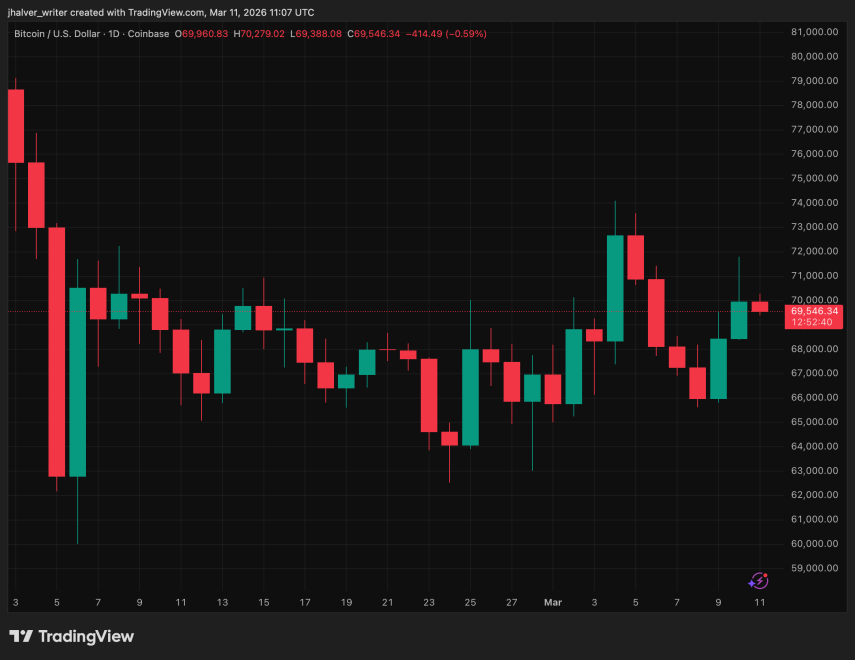
BTC’s price trends to the downside on the daily chart. Source: BTCUSD on Tradingview

Cover image from Perplexity, BTCUSD chart from Tradingview

Domande pertinenti

QWhat is the main purpose of Ghana's 12-month virtual-asset sandbox?

AThe main purpose is to formalize crypto trading and related services by allowing approved Virtual Asset Service Providers (VASPs) to pilot their products in a controlled environment under regulatory oversight, while ensuring investor protection, market integrity, and compliance with AML/CFT standards.

QHow many firms have been approved to participate in Ghana's crypto sandbox pilot?

A11 firms have been approved to participate in the crypto sandbox pilot.

QWhat happens to firms that are considered 'market ready' after the first 6 months of the sandbox?

AFirms considered 'market ready' and fully compliant after the first 6 months may start transitioning toward full activity-based licenses or registrations.

QWhich African country is mentioned as already testing crypto regulation technology similar to Ghana's approach?

AZambia is mentioned as a peer country that is already testing crypto regulation technology to supervise services before they enter the market.

QWhat legislation provides the legal basis for Ghana's Virtual Asset Service Providers sandbox?

AThe Virtual Asset Service Providers Act, 2025 (Act 1154) provides the legal basis for licensing and monitoring crypto-asset businesses and the regulatory sandbox in Ghana.

Letture associate

UNI Doubles in Two Months Against the Trend: A 5-Year-Overdue Value Realization

Amidst a generally stagnant crypto market in June and July, UNI, the governance token of Uniswap, saw a significant surge, nearly doubling in price from around $2.3 to $4.6. This rally represents a delayed but significant value reassessment, triggered by the practical implementation of its long-debated "fee switch" mechanism. The key turning point was the on-chain execution of the UNIfication proposal in December 2025. It activated a protocol fee on select pools, directed Unichain sequencer revenue (net of costs) to a communal treasury, executed a one-time burn of 100 million UNI, and established a system where all protocol revenue flows into a "TokenJar" contract. This treasury has a single exit: purchasing and permanently burning UNI via a "Firepit" contract. Initially, the market reacted tepidly as the generated revenue and corresponding burn rate were modest. The narrative shifted dramatically in July 2025 with two major developments. First, the launch of Robinhood Chain, tailored for tokenized stocks, rapidly became a primary source of volume and fees for Uniswap, at one point contributing nearly half of its weekly fees. Second, governance votes successfully expanded the fee mechanism to v4 pools and initiated a temperature check for fees on Robinhood Chain. The activation of v4 fees caused the protocol's daily revenue earmarked for UNI burns to nearly triple. The core of UNI's recent price action is the transition from a pure governance token to a cash-flow asset with a permanent, protocol-funded buyer. Its effectiveness is amplified by UNI's mature and widely distributed supply, with no major impending unlocks to dilute the impact of the buybacks. The sustainability of this rally now hinges on whether the transaction volume, particularly on Robinhood Chain, persists after its initial gas subsidies expire, determining if this is a genuine value realization or a subsidy-fueled spike.

marsbit1 h fa

UNI Doubles in Two Months Against the Trend: A 5-Year-Overdue Value Realization

marsbit1 h fa

Breaking: Google Earth Urgently Pulls Back Nano Banana 2 Image Generation Feature!

Google Earth's newly launched "Create image" feature, powered by the Nano Banana 2 AI image generation model, was abruptly withdrawn shortly after its release due to being "played" by users. The feature allowed users to generate and overlay AI-created visuals directly onto real-world satellite and 3D maps in Google Earth. The tool enabled creative applications like historical recreations (e.g., visualizing ancient Pompeii), generating informational graphics for landmarks, and envisioning architectural projects or futuristic cityscapes on real terrain. It operated under "geospatial grounding," meaning the AI respected the underlying geography, topography, and perspective of the chosen map view. The model also integrated with Gemini to retrieve relevant factual information. However, upon release, users quickly tested its limits. A prominent example involved reimagining Philadelphia's historic Independence Hall as a post-apocalyptic ruin overrun by "happy" zombies, evil clowns, and giant alien mechs. This highlighted both the feature's playful potential and its risks regarding the generation of inappropriate or misleading content on realistic maps, leading to its swift temporary removal. Google stated it would re-release the feature after implementing "enhanced guardrails." Analysts note this move strategically leverages Google's vast proprietary geospatial data, positioning its AI not just for artistic generation but for spatially accurate world visualization—a unique advantage in the competitive AI image generation landscape.

marsbit2 h fa

Breaking: Google Earth Urgently Pulls Back Nano Banana 2 Image Generation Feature!

marsbit2 h fa

Altman Admits: Overestimated AI Snatching Jobs! Huang Renxun: The Unemployment Narrative Is Completely Backwards

Sam Altman has revised his earlier predictions about AI rapidly replacing jobs, admitting he overestimated the speed at which AI would eliminate entry-level white-collar roles. Speaking on the "Invest Like the Best" podcast, he stated that people do not truly want an AI CEO, as accountability and human connection remain critical. He found that individuals prefer interacting with people who can be held responsible for decisions. Similarly, NVIDIA's Jensen Huang argued that the narrative of AI destroying jobs is misguided. He distinguishes between tasks and jobs, noting that while AI can automate specific tasks, entire jobs—encompassing communication, judgment, coordination, and accountability—are not eliminated. He cited examples like radiologists and software engineers, where demand for these roles has increased as AI handles repetitive tasks, allowing for business expansion and the creation of more positions. Data from a University of Maryland and LinkUp study supports this, showing that U.S. job postings for new graduates have actually risen, countering the fear of vanishing entry-level roles. However, a significant shift is occurring: the traditional entry-level tasks that help newcomers gain experience are being automated, making initial career access more challenging. The key insight is that as AI takes over standardized tasks, the enduring value of human work shifts toward areas of responsibility, trust-building, and final decision-making—aspects that AI cannot replicate. The real "moat" for professionals lies in these irreplaceable human elements.

marsbit3 h fa

Altman Admits: Overestimated AI Snatching Jobs! Huang Renxun: The Unemployment Narrative Is Completely Backwards

marsbit3 h fa

Trading

Spot
活动图片