Georgia Teams Up With Tether To Launch National Stablecoin

bitcoinistPubblicato 2026-05-26Pubblicato ultima volta 2026-05-26

Introduzione

The government of Georgia has partnered with Tether, the issuer of USDT, to launch GEL₮, a national stablecoin pegged to the Georgian Lari. This initiative aims to integrate the national currency directly onto digital asset infrastructure under a new regulatory framework, designed to align with regulations like the U.S. GENIUS Act. Georgia's prime minister and Tether's CEO highlighted the move as a step toward a more transparent and digitally empowered financial system, building on the country's existing digital asset payment infrastructure. While specific launch details for GEL₮ are pending, the announcement coincides with a period of strong regulatory momentum and growth for stablecoins, whose combined market cap is near an all-time high of approximately $322.7 billion.

The government of Georgia has announced a partnership with USDT issuer Tether to launch GEL₮, an official stablecoin for the country.

Tether To Launch Stablecoin Based On The Georgian Lari

As announced on its website, Tether has partnered up with the government of Georgia for a stablecoin. A “stablecoin” is a type of cryptocurrency that has its price tied to a fiat currency. Currently, tokens of this type based on a range of currencies are available in the market, but the most dominant ones are those based on the US Dollar.

Tether is the issuer of one such USD-pegged stablecoin called USDT. In fact, based on the market cap, the firm’s asset ranks the largest among fiat-tied cryptocurrencies and third overall in the sector as a whole.

Now, the company is looking to release a new stablecoin in collaboration with the Georgian government. This token, known as GEL₮, will be based on the Georgian Lari, the official currency of the country. “This marks one of the first joint efforts to place a national currency directly onto digital asset rails under a purpose-built stablecoin regulatory framework,” noted the announcement.

The move is one among many being made by governments around the world when it comes to stablecoin regulation. A major win for the sector has been the GENIUS Act enacted in the United States last year. According to Tether’s press release, Georgia’s framework has been designed to achieve compatibility with the GENIUS Act and other US regulation.

Irakli Kobakhidze, prime minister of Georgia, said:

Together with visionary partners like Tether, Georgia is laying the foundations for a more connected, transparent, and digitally empowered financial world

Georgia already has an advanced system in place for digital asset payments, with regulated intermediaries allowing conversion of cryptocurrencies into local currency for real-world settlements.

Paolo Ardoino, Tether CEO, noted:

Georgia has moved early to create serious regulatory architecture for digital assets and stablecoins, and that clarity creates the foundation for real innovation and adoption.

Further details related to GEL₮ like its release date and rollout structure are still unknown, with the press release noting that they will be announced at a later date.

The positive regulatory momentum related to stablecoins around the world recently has meant that the sector has held up relatively well during the past few months even as the wider digital asset market has struggled. As data from DefiLlama shows, the combined market cap of the stablecoins has been enjoying an uptrend.
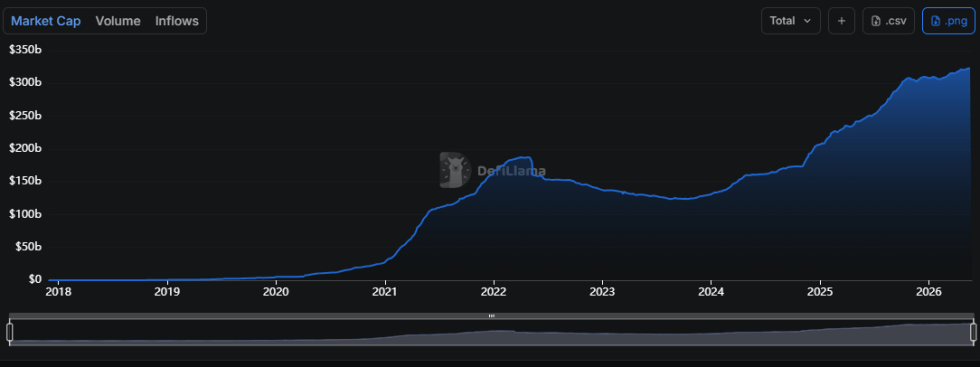
The trend in the market cap of the stablecoins over the years | Source: DefiLlama

Currently, the market cap of these assets is sitting at $322.7 billion, which is around an all-time high (ATH).

Bitcoin Price

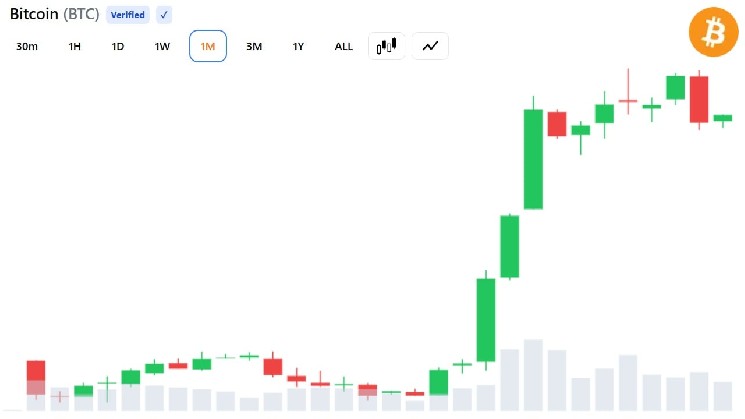
At the time of writing, Bitcoin is trading around $77,400, up 0.7% over the past week.

Looks like the price of the coin has rebounded from its dip | Source: BTCUSDT on TradingView

Domande pertinenti

QWhat is the name of the new stablecoin that Tether is launching in partnership with Georgia, and which fiat currency is it pegged to?

AThe new stablecoin is called GEL₮, and it is pegged to the Georgian Lari, the official currency of Georgia.

QAccording to the article, how does the press release describe Georgia's new stablecoin framework in relation to US regulation?

AThe press release notes that Georgia's stablecoin regulatory framework has been designed to achieve compatibility with the GENIUS Act and other US regulations.

QWhat did Paolo Ardoino, Tether CEO, cite as a key reason for Georgia being a suitable partner for this stablecoin initiative?

APaolo Ardoino stated that Georgia has moved early to create a serious regulatory architecture for digital assets and stablecoins, and that clarity creates the foundation for real innovation and adoption.

QWhat is the current total market capitalization of stablecoins according to the data from DefiLlama mentioned in the article?

AAccording to the article, the combined market cap of stablecoins is currently sitting at $322.7 billion, which is around an all-time high.

QWhat was the approximate price and weekly performance of Bitcoin at the time the article was written?

AAt the time of writing, Bitcoin was trading around $77,400, up 0.7% over the past week.

Letture associate

How to Regulate Single-Stock Leveraged ETFs? On Thursday, the Entire Market Is Watching This Korean Government Meeting

The highest-level economic coordination body in South Korea, the "F4" comprising the Ministry of Economy and Finance, the Financial Services Commission, the Bank of Korea, and the Financial Supervisory Service, will hold an emergency meeting on Thursday to discuss regulatory measures for single-stock leveraged ETFs. These products, launched just six weeks ago, have been widely blamed for exacerbating market volatility. The KOSPI's 8% plunge on Monday triggered the year's seventh trading halt, intensifying scrutiny. Regulators have expressed rare public regret over approving the products. FSS Governor Lee Bok-hyun stated he "regretted not doing everything possible to prevent" their introduction and acknowledged structural problems, citing massive retail investments and legal complications from a rushed rollout. Possible countermeasures under discussion include raising margin requirements, imposing daily price limits, and adjusting leverage caps. However, officials admit these may be temporary fixes. Data confirms the amplified volatility. Since the ETFs' launch, days with KOSPI moves exceeding 3% have nearly doubled. Trading halts have reached record levels, surpassing the 2008 financial crisis peak. The products allow 2x leveraged bets on giants like Samsung Electronics and SK Hynix. Their daily rebalancing to match returns is seen as mechanically fueling market swings. The outcome of Thursday's F4 meeting is highly anticipated, with expectations leaning towards stricter controls on leverage, investor access, or other structural constraints to curb the products' market impact.

marsbit9 min fa

How to Regulate Single-Stock Leveraged ETFs? On Thursday, the Entire Market Is Watching This Korean Government Meeting

marsbit9 min fa

AI Overhauled Terence Tao's 30-Year-Old Website, Uncovering Two Bugs Hidden for Over Two Decades in the Process

AI Revamps Terence Tao's 30-Year-Old Website, Unearthing Two 20-Year-Old Bugs in His Code Terence Tao, a renowned mathematician, has enlisted an AI agent to overhaul his personal academic website, which was built in 1997 with a static HTML, manually-maintained "Web 1.0" architecture. In just one day, the agent migrated 560 papers and preprints, 374 travel logs, 68 courses, 19 books, and 29 old math applets to a new system on GitHub Pages. The new site is structured around YAML files as the "single source of truth," with static HTML pages automatically generated from this data—a fundamental shift from maintaining individual documents to managing a centralized database. During the migration, the AI uncovered inconsistencies, outdated entries, and broken links that had accumulated over nearly three decades of manual updates. It also successfully ported a set of small educational Java 1.0 applets to JavaScript. Notably, while reviewing this translation, Tao found only one new bug introduced by the AI. Conversely, the AI identified two subtle bugs in his original Java code that he was previously unaware of. Tao emphasizes the project highlights AI's potential for automating tedious "digital housekeeping"—routine tasks like data migration and website maintenance that are costly and error-prone when done manually. He also revived a 27-year-old stalled project: a special relativity visualizer or "Minkowskian Inkscape." With AI assistance, a working alpha version was built in two hours. While AI still requires human oversight for critical work, Tao argues that for such structured, non-core tasks, "AI + human review" can result in lower error rates and drastically lower correction costs compared to purely manual maintenance over decades.

marsbit9 min fa

AI Overhauled Terence Tao's 30-Year-Old Website, Uncovering Two Bugs Hidden for Over Two Decades in the Process

marsbit9 min fa

ZORA Plunges 95%, Coinbase Finally Admits Creator Coins Failed

On July 13th, Coinbase CEO Brian Armstrong publicly declared the failure of Base network's year-long "content coins" strategy. Initially launched in 2025 via the Zora platform and integrated into Coinbase's wallet as a core feature, the model aimed to turn every social media post into a tradeable token. Each post or creator account would generate 1 billion ERC-20 tokens, with creators receiving an initial allocation. The concept briefly propelled Base to become the largest L2 by new token issuance. However, the model proved unsustainable. These tokens, explicitly not granting ownership or revenue shares, primarily functioned as speculative assets dependent on new buyers. While activity surged in mid-2025—with millions of tokens minted and billions in trading volume—it failed to build lasting user engagement or value. High-profile token launches, including one by Base's official account, experienced extreme volatility, often crashing shortly after spikes. The supporting infrastructure token, ZORA, plummeted approximately 95% from its August 2025 peak, losing nearly $520 million in market capitalization. Armstrong acknowledged the misstep, stating "it didn't work" and that Base had shifted focus earlier in the year toward its core competencies of trading and stablecoin payments. This pivot follows internal criticism that the content coin experiment consumed excessive resources, harmed other Base projects, and ultimately resulted in significant financial losses for participating users.

Foresight News26 min fa

ZORA Plunges 95%, Coinbase Finally Admits Creator Coins Failed

Foresight News26 min fa

Trading

Spot
活动图片