From ZEC's Surge to Vitalik's Support: Will the Privacy Narrative Resurface?

marsbitPubblicato 2026-05-27Pubblicato ultima volta 2026-05-27

Introduzione

From ZEC's surge to Vitalik's endorsement, is privacy making a comeback? The recent rally in ZEC has refocused attention on the crypto privacy sector. This resurgence stems from a growing market realization: while blockchain transparency builds trust, full exposure of user balances, trading strategies, and risk positions can become a vulnerability, especially for large traders and institutions on platforms like Hyperliquid. The privacy landscape has evolved beyond classic anonymity coins like ZEC, XMR, and DASH. It now encompasses privacy infrastructure projects such as Railgun (bringing privacy to DeFi) and Aztec (a privacy-focused L2), as well as newer entrants like Genius Terminal, SilentSwap, and 0xBow that emphasize transaction privacy while attempting to balance compliance. Industry trends confirm privacy is becoming integrated, not a niche feature. Perp DEX Aster has introduced a "Shield Mode," and Vitalik has discussed the need for native privacy at the Ethereum protocol level, including proposals like EIP-8182 for standardized private transfers. In conclusion, this revival is more than a simple sector rotation. It reflects a critical reassessment of transparency's limits. As on-chain finance matures, the challenge is finding a sustainable balance between necessary transparency for trust and essential privacy for protecting assets and strategies, making privacy a potential cornerstone of next-generation infrastructure.

Author: Changan I Biteye Content Team

A strong rally in ZEC has brought the long-dormant privacy sector back to the center of market attention.

Beyond the price increase, more importantly, it has reignited market discussion about the privacy narrative: In today's world of increasingly transparent on-chain data and easily traceable transactions, is privacy still a niche demand?

In the past, privacy was often understood as the anonymity needs of a few users. But as more funds, transactions, and strategies move on-chain, privacy is becoming a more realistic problem: If all behaviors are visible, will on-chain finance truly be safer?

Starting from ZEC's current price action, let's examine what the market is actually discussing behind the renewed focus on the privacy sector.

I. Full On-Chain Transparency: From Cornerstone of Trust to a Targeted Weakness

The open-book risk brought by on-chain transparency first appeared in lending liquidation scenarios.

As early as the last cycle, when institutions or large holders engaged in on-chain lending, their collateral, debt size, health factor, and liquidation prices were almost all publicly visible. By monitoring these addresses, one could clearly see their risk positions.

When a large holder's liquidation price is visible to everyone, other traders might trade around that liquidation line. The price could be pushed into the liquidation range, triggering a margin call, followed by a quick rebound.

Such cases made many realize for the first time that completely public on-chain data also means being targetable.

This issue has become even more pronounced in the current cycle.

With the popularity of on-chain derivatives platforms like Hyperliquid, more whales are opening positions on-chain. Large positions, trade direction, margin changes, and liquidation prices could all be monitored by the market.

  • For ordinary users, transparency might just mean information disclosure.

  • But for large-scale traders, transparency sometimes means exposing their trading intentions and risk positions to all counterparties.

Therefore, the renewed focus on the privacy sector is not just due to the rise of certain tokens, nor is it merely a rotation among legacy privacy coins.

The deeper issue is: Can a fully transparent on-chain environment continue to support larger-scale, more professional on-chain financial activities?

Users need transparency to build trust, but they also need privacy to protect assets, strategies, and trading security.

II. Overview of the Three Core Segments in the Privacy Sector

Judging from this cycle's market action, the privacy sector is no longer just about legacy anonymous coins. It can be roughly divided into three categories: one includes legacy privacy assets like ZEC and XMR; another includes privacy infrastructure represented by Railgun and Aztec; and a third includes projects like Genius, SilentSwap, and 0xBow, which emphasize transaction privacy and compliance.
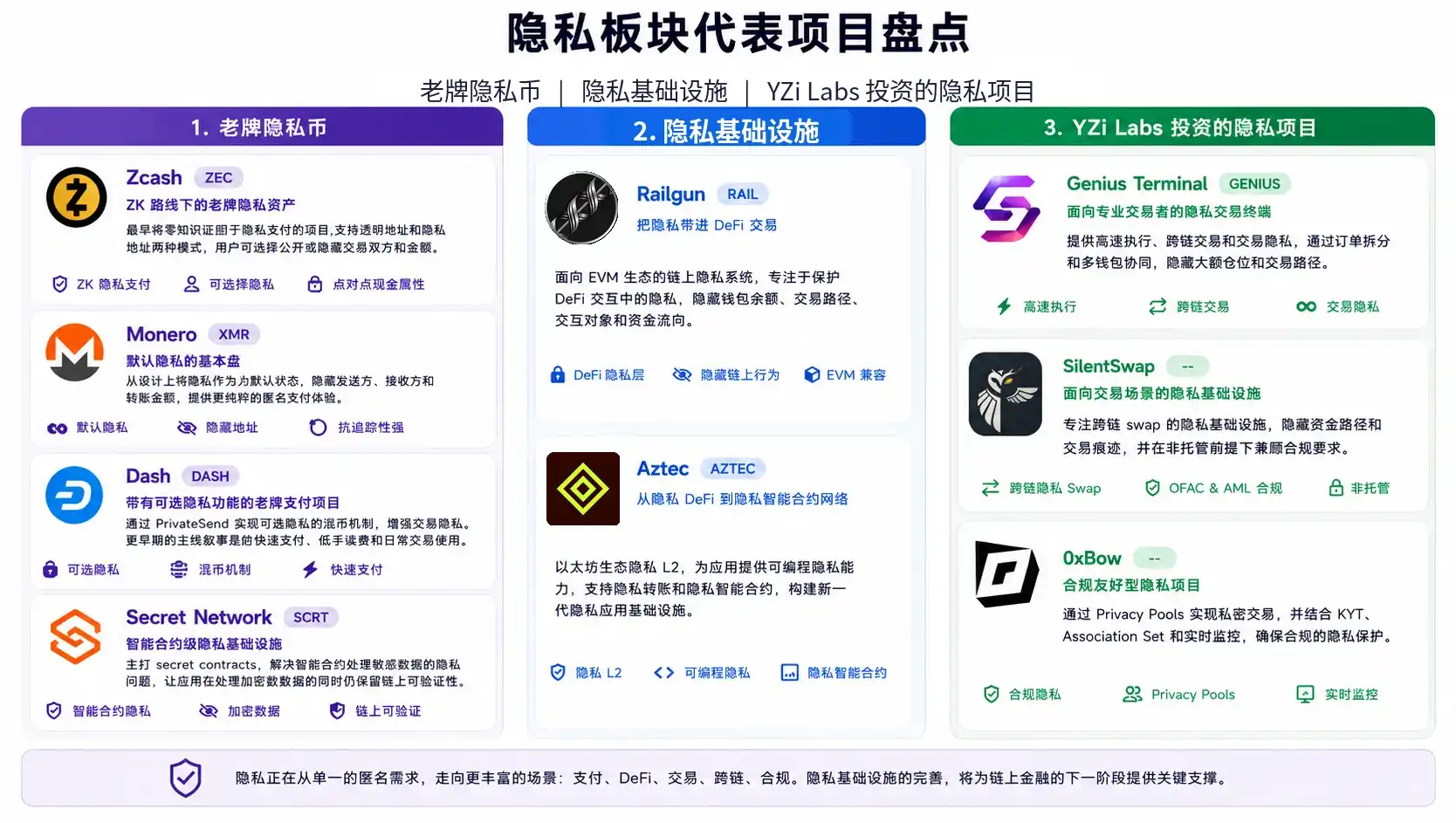
1. Legacy Privacy Coins: Asset and Payment Properties

Zcash (ZEC): Legacy Privacy Asset on the ZK Path

X: @zcash | XHunt Ranking: 13364

Zcash is a representative legacy privacy coin and one of the earliest crypto projects to use zero-knowledge proofs for private payments. Unlike regular public chains where all transactions are publicly viewable, Zcash supports both transparent and shielded (private) addresses.

Users can make public transfers like they would with Bitcoin, or they can hide the sender, receiver, and amount through shielded transactions.

Zcash's official definition is "encrypted electronic cash," emphasizing its properties for private peer-to-peer payments.

💰 Token Performance:

Naval Ravikant once stated on X: If Bitcoin is insurance against fiat currency risk, then Zcash is insurance against Bitcoin's transparency risk.

In terms of price performance, ZEC has been one of the most prominent primary assets in this cycle's privacy sector, rising from around $200 in March to $620.

Monero (XMR): The Default Privacy Baseline

X:@monero|XHunt Ranking: 4812

Monero is another highly representative project among legacy privacy coins, with its core positioning being default-private payments.

Unlike Zcash's optional privacy, Monero is designed with privacy as the default state from the ground up; transactions hide the sender, receiver, and amount.

Default privacy makes it more purist in the direction of anonymous payments, but it also subjects it to long-term higher regulatory pressure and exchange liquidity pressure.

💰 Token Performance:

However, judging from this cycle's market action, XMR's price performance hasn't been particularly outstanding. Although the broader market environment itself isn't strong, compared to ZEC, XMR clearly lacks elasticity.

Dash (DASH): Legacy Payment Project with Optional Privacy Features

X:@Dashpay|XHunt Ranking: 11376

Dash is an early entrant into the market, a legacy crypto project focused on payments. Dash's privacy features are optional, primarily implemented through PrivateSend.

The core idea of PrivateSend is to enhance transaction privacy through a coin mixing mechanism, allowing users to hide fund sources and transaction paths when needed. However, in terms of positioning, Dash is not a pure privacy coin; its earlier main narratives were actually fast payments, low fees, and everyday transactional use.

💰 Token Performance:

From this cycle's action, DASH has seen periodic rebounds, but its overall performance is not as prominent as ZEC's. Its current price is around 43 USDT. While it still carries the labels of a legacy payment project and optional privacy, the market's pricing of it seems more driven by sector rotation rather than a re-pricing of a primary privacy asset.

Secret Network (SCRT): Smart Contract-Level Privacy Infrastructure

X:@SecretNetwork|XHunt Ranking: 3677

Secret Network is an early public chain project focused on smart contract-level privacy, with its core feature being secret contracts. Unlike traditional privacy coins that focus on transfer privacy, it aims to solve data privacy problems at the application layer: Can smart contracts process sensitive data during execution without exposing everything on the public chain?

Secret Network's advantage lies in bringing privacy capabilities to the application layer. For applications like DeFi, NFTs, gaming, identity, and data markets, many scenarios are not suitable for completely public user data. The significance of secret contracts is enabling applications to process encrypted data while retaining on-chain verifiability.

💰 Token Performance:

In terms of price performance, SCRT hasn't clearly benefited from this round of privacy narrative resurgence. Its current price is around $0.08, still in a long-term low range.

2. New-Generation Privacy Infrastructure: Empowering the Application Layer

Railgun (RAIL): Bringing Privacy into DeFi Trading

X:@RAILGUN_Project|XHunt Ranking: 4099

Railgun is an on-chain privacy system for the EVM ecosystem, primarily serving DeFi scenarios. It doesn't aim to create a new privacy payment asset; rather, it hopes to bring privacy features into DeFi trading.

On public chains, users' wallet balances, transaction paths, counterparties, and fund flows can all be traced.

  • For ordinary users, this means asset exposure.

  • For traders, it means strategies could be copied or even targeted.

This is the problem Railgun aims to solve: allowing users to hide their on-chain behavior while participating in DeFi.

It's worth noting that Vitalik recently discussed the underlying problems faced by privacy protocols when talking about the Ethereum Foundation's future direction. He believes that protocols like smart contract wallets and Railgun still need intermediaries to submit transactions to the chain, which itself is a vulnerability.

💰 Token Performance:

RAIL has also clearly benefited from the recent warming of the privacy sector. The RAIL token's market cap has risen from 60M in April to 240M currently.

Compared to high-market-cap primary assets like ZEC, RAIL resembles more of a high-beta play within the privacy sector—easier to rally quickly when the narrative heats up, but with more pronounced liquidity and volatility.

Aztec (AZTEC): From Private DeFi to Private Smart Contract Network

X:@aztecnetwork|XHunt Ranking: 760

Aztec is a privacy L2 in the Ethereum ecosystem, positioned to provide programmable privacy for applications.

It's not a new project. Aztec initially launched zk.money and Aztec Connect, providing Ethereum users with private transfers and private DeFi entry points. However, in 2023, the team chose to shut down Aztec Connect and shift focus to a new private smart contract network.

In late 2025, AZTEC held a public token sale using a Continuous Clearing Auction mechanism, with the public sale price around $0.047.

💰 Token Performance:

From its secondary market performance, AZTEC's overall performance since listing hasn't been particularly strong. Its current price is around $0.025, still below the public sale cost. However, with the resurgence of the privacy sector, AZTEC has also seen a noticeable rebound recently.

3. YZi Labs' Investment Portfolio: Focusing on the Balance Between Transaction Privacy and Compliance

Genius Terminal (GENIUS): Privacy Trading Terminal for Professional Traders

X:@GeniusTerminal|XHunt Ranking: 7845

Genius Terminal is an on-chain trading terminal for professional DeFi users, emphasizing high-speed execution, cross-chain trading, and transaction privacy.

Genius can help users hide large positions and trading paths through order splitting and multi-wallet coordination. Users can complete cross-chain trades within one terminal without frequently switching wallets, bridges, and DEXs.

In January 2026, YZi Labs announced an investment in Genius, calling it a "private high-velocity on-chain trading terminal."

YZi Labs mentioned that Genius's goal is to provide an experience close to that of centralized exchanges in terms of speed, liquidity, and privacy, without sacrificing user ownership and decentralization.

💰 Token Performance:

In terms of secondary market performance, GENIUS has shown obvious short-term elasticity recently. Its current price is around $0.73.

SilentSwap: Privacy Infrastructure for Trading Scenarios

X:@SilentSwap|XHunt Ranking: 78144

SilentSwap is a privacy infrastructure for cross-chain trading scenarios, focusing on private cross-chain swaps. It aims to allow users to hide their fund paths and transaction traces when performing cross-chain swaps, transfers, and bridging assets.

On public chains, cross-chain transactions often expose a lot of information: which chain a user came from, what assets were swapped, the final destination of funds, and whether different addresses are associated. SilentSwap aims to solve this type of privacy leakage in cross-chain transactions.

Another feature of SilentSwap is that it doesn't just emphasize privacy; it also puts compliance among its product selling points. Its website explicitly lists "OFAC & AML Compliant" and states that it holds two legal opinions in the US. This sets it apart from traditional privacy projects that "only emphasize anonymity": it attempts to find a balance between non-custodial, cross-chain privacy, and compliance.

0xBow: Compliance-Friendly Privacy Project

X:@0xbowio|XHunt Ranking: 9376

0xBow is an infrastructure project for on-chain privacy and compliance scenarios, with its core direction being compliant onchain privacy.

Unlike traditional privacy projects emphasizing "untraceability," 0xBow is more concerned with: Can users prove their funds are not mixed with illicit activities while protecting their transaction privacy?

Its core product is Privacy Pools. Privacy Pools support peer-to-peer private transactions while avoiding users' funds mixing with illegal funds. 0xBow monitors deposits entering Privacy Pools and filters them through a Know Your Transaction mechanism. Only funds meeting the criteria enter the Association Set.

Behind this lies 0xBow's Association Set Provider (ASP). ASPs continuously monitor transactions within Privacy Pools, identify suspicious patterns, and support Proof of Association, real-time transaction monitoring, programmable compliance, and modular deployment.

In other words, 0xBow isn't simply creating an anonymous pool; it attempts to make private transactions operate within a compliance framework.

III. Industry Consensus: Privacy is No Longer an "Isolated Narrative"

Aster: Perp DEXs Also Begin Introducing Transaction Privacy

Aster itself is a Perp DEX, but its Shield Mode has already integrated privacy into the derivatives trading experience.

This indicates that privacy needs no longer exist only in transfer scenarios. For on-chain traders, what is truly sensitive is often trade direction, position size, transaction paths, and fund intentions.

Especially in Perp DEXs, if large trades and position changes are exposed in a public environment, they are prone to being copied, targeted, or even front-run.

Therefore, Aster's Shield Mode is essentially not a traditional privacy coin feature; it embeds transaction privacy into the Perp DEX product itself. It reflects a more specific trend: If on-chain derivatives want to continue attracting more professional trading demand, they may need to address not just liquidity and fees but also the issue of exposed trading intent.

Vitalik: Ethereum Also Needs Native Privacy

It's not just the application layer that is starting to value privacy; the Ethereum core roadmap is also beginning to revisit this issue.

Recently, Vitalik also mentioned Ethereum's lack of native privacy capabilities and proposed a set of short-term privacy improvement directions, including Account Abstraction, FOCIL, keyed nonces, and access-layer privacy work like Kohaku. These correspond to censorship resistance, transaction unlinkability, and privacy protection in wallets and chain-reading processes, respectively.

This shows that privacy is no longer just an add-on feature for external applications; it is also being discussed within wallet designs, transaction structures, access layers, and protocol design.

EIP-8182: Ethereum Also Discusses Native Private Transfers

EIP-8182 proposes introducing a standardized private transfer system for Ethereum. Through a shared shielded pool, system contracts, and ZK verification precompiles, it aims to give ETH and ERC-20 transfers native privacy capabilities.

Simply put, it asks: Can private transfers no longer rely on fragmented third-party applications but instead become shared infrastructure at the Ethereum protocol layer?

In the past, privacy on Ethereum was often fragmented. Different protocols had different privacy pools, different entry points, and different anonymity sets, resulting in a non-uniform user experience and diluted privacy effects.

EIP-8182 attempts to push this issue toward the protocol layer: If ETH and ERC-20s can share a common private transfer infrastructure, wallets, applications, and users can all more easily access privacy capabilities.

This also illustrates that privacy is no longer just the narrative of a few specific privacy projects. Whether it's Aster embedding privacy into its Perp DEX or EIP-8182 pushing private transfers toward the Ethereum protocol layer, they essentially point to the same thing:

The more mature the on-chain world becomes, the less privacy resembles a niche feature and the more it resembles part of the next stage of infrastructure.

IV. Conclusion: Finding the Balance Between Transparency and Protection

The privacy sector's return to the market spotlight this cycle appears, on the surface, to be a sector rotation play. However, if we only interpret it as "privacy coins are hot again," we might underestimate the significance of this change. What has truly changed is that the market is beginning to re-examine the boundaries of on-chain transparency.

In the past, the crypto industry often equated transparency with trust, believing that as long as all information is public, the system is more trustworthy. But transparency does not mean all financial behavior should be exposed without reservation. Users' asset balances, transaction paths, position changes, liquidation prices, and strategic intentions are essentially sensitive information. When this information is completely public, transparency can transform from a trust mechanism into a new source of risk.

Therefore, privacy is not the opposite of transparency; it is answering a more practical question: For on-chain finance to continue expanding, what information should be public, and what information should be protected? What will truly matter in the future may not be who can achieve the most complete anonymity, but who can find the balance between transparency, privacy, compliance, and usability.

When on-chain finance was still in the small-scale experimental stage, complete transparency might have sufficed. But if it is to carry larger funds, more complex trades, and more professional participants, privacy ceases to be merely a niche demand and becomes part of the infrastructure for the next stage.

Domande pertinenti

QWhat is the main reason behind the renewed interest in the privacy sector, beyond the rise in ZEC's price?

AThe deeper reason is market concern over whether a fully transparent on-chain environment can continue to support larger-scale, more professional on-chain financial activities. Users need transparency for trust but also need privacy to protect assets, strategies, and trading safety from risks like front-running and targeted attacks.

QAccording to the article, how is the modern privacy sector categorized?

AThe modern privacy sector is categorized into three main groups: 1) Legacy privacy assets like ZEC and XMR, focusing on private payments. 2) Next-generation privacy infrastructure like Railgun and Aztec, focusing on application-layer privacy (e.g., for DeFi). 3) Projects focusing on a balance between transaction privacy and compliance, like Genius, SilentSwap, and 0xBow, which are associated with YZi Labs' investments.

QWhat is the key difference between Zcash (ZEC) and Monero (XMR) regarding privacy?

AZcash offers optional privacy, allowing users to choose between transparent (public) addresses and shielded (private) addresses for transactions. Monero, in contrast, has privacy as its default state, where all transactions automatically hide the sender, receiver, and transaction amount by design.

QWhat point did Vitalik Buterin make about the current state of privacy protocols on Ethereum?

AVitalik pointed out that current privacy protocols, like those using smart contract wallets or Railgun, still have a vulnerability: they require an intermediary to submit transactions to the chain. He also discussed Ethereum's need for native privacy improvements, mentioning directions like Account Abstraction, FOCIL, and keyed nonces to address censorship resistance and transaction unlinkability.

QWhat is the core idea behind EIP-8182 for Ethereum?

AEIP-8182 proposes introducing a standardized private transfer system at the protocol level for Ethereum. It aims to enable native privacy for ETH and ERC-20 transfers by creating shared infrastructure like a shielded pool, system contracts, and ZK verification precompiles, moving away from fragmented, application-specific privacy solutions.

Letture associate

Agentized OS: It's Not About AI, It's About the Foundation

The Agentic OS: Beyond AI, It's About the Foundational Stack In 2026, major operating systems like Android, iOS, HarmonyOS, and Windows are entering the "Agentic" era, integrating proactive AI assistants deeply into the system layer. However, the real competition lies not in the flashy AI features showcased at events, but in the three-layer foundational stack that enables them: the system-level AI Runtime, proprietary/controllable chips, and the on-device/cloud model matrix. The AI Runtime acts as the central scheduler, managing model inference, resource allocation, and exposing capabilities to apps. Controllable chips (e.g., Apple Silicon, Google Tensor, Huawei Kirin) are crucial for deep hardware-software co-optimization, determining the efficiency and experience limits of on-device Agents. The on-device/cloud model matrix provides the "intelligence," with proprietary, chip-optimized small models (like Gemini Nano, Apple's ~3B model) handling daily tasks locally for low latency, privacy, and reliability, while cloud models tackle complex requests. Deep synergy between these three layers enables key Agent differentiators: ultra-low latency and power efficiency, genuine "on-device first" privacy, access to system-level personal context across apps, and reliable performance as a system service even offline. OS vendors with strong integration across this stack (like Apple, Google, and Huawei) build a deeper moat. Beyond this core stack, long-term competitiveness depends on variables like structured App integration (e.g., App Intents/AppFunctions) for reliable multi-step workflows, and robust privacy frameworks that build user trust. This shift towards Agentic OS extends beyond phones and PCs to IoT, cars, and XR glasses via existing multi-device ecosystems. The race is won not in a keynote, but through generations of meticulously co-developed chips, models, and system software.

marsbit55 min fa

Agentized OS: It's Not About AI, It's About the Foundation

marsbit55 min fa

Why Sam Altman's 'Water and Electricity Theory' Sparks Copyright Controversy

OpenAI CEO Sam Altman's recent statement that "intelligence will become a utility like electricity or water" has sparked significant controversy, primarily around copyright issues and the nature of AI development. While positioning AI as a utility serves as a compelling narrative for infrastructure investors, critics argue the analogy is flawed in three key areas. First, there's a fundamental "property gap." Traditional utilities like water and power create new, physical infrastructure from scratch. In contrast, major AI models are trained by reorganizing vast amounts of existing human-created content—books, articles, code, etc.—often scraped from the web without explicit permission or compensation to creators. This "free acquisition, paid resale" model is seen by many as ethically problematic. Second, there's a "pricing gap." True public utilities are typically regulated to ensure universal service with non-discriminatory, cost-plus pricing. AI's token-based pricing, however, involves significant price discrimination (e.g., output tokens costing much more than input tokens) and is designed for revenue maximization, not equitable access. Third, a "governance gap" exists. Utilities operate under public oversight, while AI pricing and development are currently controlled by a few private companies. Furthermore, the industry's own shift toward buying licensed training data (e.g., deals with Reddit or news publishers) undermines its previous legal reliance on "fair use" for freely scraped data. In conclusion, while AI is indeed becoming a foundational technology, calling it a public utility remains contentious. The title requires not just scale and a pay-per-use model, but also credible solutions for data provenance, equitable pricing, and public governance.

marsbit1 h fa

Why Sam Altman's 'Water and Electricity Theory' Sparks Copyright Controversy

marsbit1 h fa

Trading

Spot
Futures

Articoli Popolari

Cosa è $S$

Comprendere SPERO: Una Panoramica Completa Introduzione a SPERO Mentre il panorama dell'innovazione continua a evolversi, l'emergere delle tecnologie web3 e dei progetti di criptovaluta gioca un ruolo fondamentale nel plasmare il futuro digitale. Un progetto che ha attirato l'attenzione in questo campo dinamico è SPERO, denotato come SPERO,$$s$. Questo articolo mira a raccogliere e presentare informazioni dettagliate su SPERO, per aiutare gli appassionati e gli investitori a comprendere le sue basi, obiettivi e innovazioni nei domini web3 e crypto. Che cos'è SPERO,$$s$? SPERO,$$s$ è un progetto unico all'interno dello spazio crypto che cerca di sfruttare i principi della decentralizzazione e della tecnologia blockchain per creare un ecosistema che promuove l'impegno, l'utilità e l'inclusione finanziaria. Il progetto è progettato per facilitare interazioni peer-to-peer in modi nuovi, fornendo agli utenti soluzioni e servizi finanziari innovativi. Al suo interno, SPERO,$$s$ mira a responsabilizzare gli individui fornendo strumenti e piattaforme che migliorano l'esperienza dell'utente nello spazio delle criptovalute. Questo include la possibilità di metodi di transazione più flessibili, la promozione di iniziative guidate dalla comunità e la creazione di percorsi per opportunità finanziarie attraverso applicazioni decentralizzate (dApps). La visione sottostante di SPERO,$$s$ ruota attorno all'inclusività, cercando di colmare le lacune all'interno della finanza tradizionale mentre sfrutta i vantaggi della tecnologia blockchain. Chi è il Creatore di SPERO,$$s$? L'identità del creatore di SPERO,$$s$ rimane piuttosto oscura, poiché ci sono risorse pubblicamente disponibili limitate che forniscono informazioni dettagliate sul suo fondatore o fondatori. Questa mancanza di trasparenza può derivare dall'impegno del progetto per la decentralizzazione—un ethos che molti progetti web3 condividono, dando priorità ai contributi collettivi rispetto al riconoscimento individuale. Centrando le discussioni attorno alla comunità e ai suoi obiettivi collettivi, SPERO,$$s$ incarna l'essenza dell'empowerment senza mettere in evidenza individui specifici. Pertanto, comprendere l'etica e la missione di SPERO rimane più importante che identificare un creatore singolo. Chi sono gli Investitori di SPERO,$$s$? SPERO,$$s$ è supportato da una varietà di investitori che vanno dai capitalisti di rischio agli investitori angelici dedicati a promuovere l'innovazione nel settore crypto. Il focus di questi investitori generalmente si allinea con la missione di SPERO—dando priorità a progetti che promettono avanzamenti tecnologici sociali, inclusività finanziaria e governance decentralizzata. Queste fondazioni di investitori sono tipicamente interessate a progetti che non solo offrono prodotti innovativi, ma contribuiscono anche positivamente alla comunità blockchain e ai suoi ecosistemi. Il supporto di questi investitori rafforza SPERO,$$s$ come un concorrente degno di nota nel dominio in rapida evoluzione dei progetti crypto. Come Funziona SPERO,$$s$? SPERO,$$s$ impiega un framework multifunzionale che lo distingue dai progetti di criptovaluta convenzionali. Ecco alcune delle caratteristiche chiave che sottolineano la sua unicità e innovazione: Governance Decentralizzata: SPERO,$$s$ integra modelli di governance decentralizzati, responsabilizzando gli utenti a partecipare attivamente ai processi decisionali riguardanti il futuro del progetto. Questo approccio favorisce un senso di proprietà e responsabilità tra i membri della comunità. Utilità del Token: SPERO,$$s$ utilizza il proprio token di criptovaluta, progettato per servire varie funzioni all'interno dell'ecosistema. Questi token abilitano transazioni, premi e la facilitazione dei servizi offerti sulla piattaforma, migliorando l'impegno e l'utilità complessivi. Architettura Stratificata: L'architettura tecnica di SPERO,$$s$ supporta la modularità e la scalabilità, consentendo un'integrazione fluida di funzionalità e applicazioni aggiuntive man mano che il progetto evolve. Questa adattabilità è fondamentale per mantenere la rilevanza nel panorama crypto in continua evoluzione. Coinvolgimento della Comunità: Il progetto enfatizza iniziative guidate dalla comunità, impiegando meccanismi che incentivano la collaborazione e il feedback. Nutrendo una comunità forte, SPERO,$$s$ può affrontare meglio le esigenze degli utenti e adattarsi alle tendenze di mercato. Focus sull'Inclusione: Offrendo basse commissioni di transazione e interfacce user-friendly, SPERO,$$s$ mira ad attrarre una base utenti diversificata, inclusi individui che potrebbero non aver precedentemente interagito nello spazio crypto. Questo impegno per l'inclusione si allinea con la sua missione generale di empowerment attraverso l'accessibilità. Cronologia di SPERO,$$s$ Comprendere la storia di un progetto fornisce preziose intuizioni sulla sua traiettoria di sviluppo e sui traguardi. Di seguito è riportata una cronologia suggerita che mappa eventi significativi nell'evoluzione di SPERO,$$s$: Fase di Concettualizzazione e Ideazione: Le idee iniziali che formano la base di SPERO,$$s$ sono state concepite, allineandosi strettamente con i principi di decentralizzazione e focus sulla comunità all'interno dell'industria blockchain. Lancio del Whitepaper del Progetto: Dopo la fase concettuale, è stato rilasciato un whitepaper completo che dettaglia la visione, gli obiettivi e l'infrastruttura tecnologica di SPERO,$$s$ per suscitare interesse e feedback dalla comunità. Costruzione della Comunità e Prime Interazioni: Sono stati effettuati sforzi attivi di outreach per costruire una comunità di early adopters e potenziali investitori, facilitando discussioni attorno agli obiettivi del progetto e ottenendo supporto. Evento di Generazione del Token: SPERO,$$s$ ha condotto un evento di generazione del token (TGE) per distribuire i propri token nativi ai primi sostenitori e stabilire una liquidità iniziale all'interno dell'ecosistema. Lancio della Prima dApp: La prima applicazione decentralizzata (dApp) associata a SPERO,$$s$ è stata attivata, consentendo agli utenti di interagire con le funzionalità principali della piattaforma. Sviluppo Continuo e Partnership: Aggiornamenti e miglioramenti continui alle offerte del progetto, inclusi partnership strategiche con altri attori nello spazio blockchain, hanno plasmato SPERO,$$s$ in un concorrente competitivo e in evoluzione nel mercato crypto. Conclusione SPERO,$$s$ rappresenta una testimonianza del potenziale del web3 e delle criptovalute di rivoluzionare i sistemi finanziari e responsabilizzare gli individui. Con un impegno per la governance decentralizzata, il coinvolgimento della comunità e funzionalità progettate in modo innovativo, apre la strada verso un panorama finanziario più inclusivo. Come per qualsiasi investimento nello spazio crypto in rapida evoluzione, si incoraggiano potenziali investitori e utenti a ricercare approfonditamente e a impegnarsi in modo riflessivo con gli sviluppi in corso all'interno di SPERO,$$s$. Il progetto mostra lo spirito innovativo dell'industria crypto, invitando a ulteriori esplorazioni delle sue innumerevoli possibilità. Mentre il percorso di SPERO,$$s$ è ancora in fase di sviluppo, i suoi principi fondamentali potrebbero effettivamente influenzare il futuro di come interagiamo con la tecnologia, la finanza e tra di noi in ecosistemi digitali interconnessi.

75 Totale visualizzazioniPubblicato il 2024.12.17Aggiornato il 2024.12.17

Cosa è $S$

Cosa è AGENT S

Agent S: Il Futuro dell'Interazione Autonoma in Web3 Introduzione Nel panorama in continua evoluzione di Web3 e criptovalute, le innovazioni stanno costantemente ridefinendo il modo in cui gli individui interagiscono con le piattaforme digitali. Uno di questi progetti pionieristici, Agent S, promette di rivoluzionare l'interazione uomo-computer attraverso il suo framework agentico aperto. Aprendo la strada a interazioni autonome, Agent S mira a semplificare compiti complessi, offrendo applicazioni trasformative nell'intelligenza artificiale (AI). Questa esplorazione dettagliata approfondirà le complessità del progetto, le sue caratteristiche uniche e le implicazioni per il dominio delle criptovalute. Cos'è Agent S? Agent S si presenta come un innovativo framework agentico aperto, progettato specificamente per affrontare tre sfide fondamentali nell'automazione dei compiti informatici: Acquisizione di Conoscenze Specifiche del Dominio: Il framework apprende in modo intelligente da varie fonti di conoscenza esterne ed esperienze interne. Questo approccio duale gli consente di costruire un ricco repository di conoscenze specifiche del dominio, migliorando le sue prestazioni nell'esecuzione dei compiti. Pianificazione su Lungo Orizzonte di Compiti: Agent S impiega una pianificazione gerarchica potenziata dall'esperienza, un approccio strategico che facilita la suddivisione e l'esecuzione efficiente di compiti complessi. Questa caratteristica migliora significativamente la sua capacità di gestire più sottocompiti in modo efficiente ed efficace. Gestione di Interfacce Dinamiche e Non Uniformi: Il progetto introduce l'Interfaccia Agente-Computer (ACI), una soluzione innovativa che migliora l'interazione tra agenti e utenti. Utilizzando Modelli Linguistici Multimodali di Grandi Dimensioni (MLLM), Agent S può navigare e manipolare senza sforzo diverse interfacce grafiche utente. Attraverso queste caratteristiche pionieristiche, Agent S fornisce un framework robusto che affronta le complessità coinvolte nell'automazione dell'interazione umana con le macchine, preparando il terreno per innumerevoli applicazioni nell'AI e oltre. Chi è il Creatore di Agent S? Sebbene il concetto di Agent S sia fondamentalmente innovativo, informazioni specifiche sul suo creatore rimangono elusive. Il creatore è attualmente sconosciuto, il che evidenzia sia la fase embrionale del progetto sia la scelta strategica di mantenere i membri fondatori sotto anonimato. Indipendentemente dall'anonimato, l'attenzione rimane sulle capacità e sul potenziale del framework. Chi sono gli Investitori di Agent S? Poiché Agent S è relativamente nuovo nell'ecosistema crittografico, informazioni dettagliate riguardanti i suoi investitori e sostenitori finanziari non sono documentate esplicitamente. La mancanza di approfondimenti pubblicamente disponibili sulle fondazioni di investimento o sulle organizzazioni che supportano il progetto solleva interrogativi sulla sua struttura di finanziamento e sulla roadmap di sviluppo. Comprendere il supporto è cruciale per valutare la sostenibilità del progetto e il suo potenziale impatto sul mercato. Come Funziona Agent S? Al centro di Agent S si trova una tecnologia all'avanguardia che gli consente di funzionare efficacemente in contesti diversi. Il suo modello operativo è costruito attorno a diverse caratteristiche chiave: Interazione Uomo-Computer Simile a Quella Umana: Il framework offre una pianificazione AI avanzata, cercando di rendere le interazioni con i computer più intuitive. Mimando il comportamento umano nell'esecuzione dei compiti, promette di elevare le esperienze degli utenti. Memoria Narrativa: Utilizzata per sfruttare esperienze di alto livello, Agent S utilizza la memoria narrativa per tenere traccia delle storie dei compiti, migliorando così i suoi processi decisionali. Memoria Episodica: Questa caratteristica fornisce agli utenti una guida passo-passo, consentendo al framework di offrire supporto contestuale mentre i compiti si sviluppano. Supporto per OpenACI: Con la capacità di funzionare localmente, Agent S consente agli utenti di mantenere il controllo sulle proprie interazioni e flussi di lavoro, allineandosi con l'etica decentralizzata di Web3. Facile Integrazione con API Esterne: La sua versatilità e compatibilità con varie piattaforme AI garantiscono che Agent S possa adattarsi senza problemi agli ecosistemi tecnologici esistenti, rendendolo una scelta attraente per sviluppatori e organizzazioni. Queste funzionalità contribuiscono collettivamente alla posizione unica di Agent S all'interno dello spazio crittografico, poiché automatizza compiti complessi e multi-fase con un intervento umano minimo. Man mano che il progetto evolve, le sue potenziali applicazioni in Web3 potrebbero ridefinire il modo in cui si svolgono le interazioni digitali. Cronologia di Agent S Lo sviluppo e le tappe di Agent S possono essere riassunti in una cronologia che evidenzia i suoi eventi significativi: 27 Settembre 2024: Il concetto di Agent S è stato lanciato in un documento di ricerca completo intitolato “Un Framework Agentico Aperto che Usa i Computer Come un Umano”, mostrando le basi per il progetto. 10 Ottobre 2024: Il documento di ricerca è stato reso pubblicamente disponibile su arXiv, offrendo un'esplorazione approfondita del framework e della sua valutazione delle prestazioni basata sul benchmark OSWorld. 12 Ottobre 2024: È stata rilasciata una presentazione video, fornendo un'idea visiva delle capacità e delle caratteristiche di Agent S, coinvolgendo ulteriormente potenziali utenti e investitori. Questi indicatori nella cronologia non solo illustrano i progressi di Agent S, ma indicano anche il suo impegno per la trasparenza e il coinvolgimento della comunità. Punti Chiave su Agent S Man mano che il framework Agent S continua a evolversi, diversi attributi chiave si distinguono, sottolineando la sua natura innovativa e il potenziale: Framework Innovativo: Progettato per fornire un uso intuitivo dei computer simile all'interazione umana, Agent S porta un approccio nuovo all'automazione dei compiti. Interazione Autonoma: La capacità di interagire autonomamente con i computer attraverso GUI segna un passo avanti verso soluzioni informatiche più intelligenti ed efficienti. Automazione di Compiti Complessi: Con la sua metodologia robusta, può automatizzare compiti complessi e multi-fase, rendendo i processi più veloci e meno soggetti a errori. Miglioramento Continuo: I meccanismi di apprendimento consentono ad Agent S di migliorare dalle esperienze passate, migliorando continuamente le sue prestazioni e la sua efficacia. Versatilità: La sua adattabilità attraverso diversi ambienti operativi come OSWorld e WindowsAgentArena garantisce che possa servire un'ampia gamma di applicazioni. Man mano che Agent S si posiziona nel panorama di Web3 e delle criptovalute, il suo potenziale per migliorare le capacità di interazione e automatizzare i processi segna un significativo avanzamento nelle tecnologie AI. Attraverso il suo framework innovativo, Agent S esemplifica il futuro delle interazioni digitali, promettendo un'esperienza più fluida ed efficiente per gli utenti in vari settori. Conclusione Agent S rappresenta un audace passo avanti nell'unione tra AI e Web3, con la capacità di ridefinire il modo in cui interagiamo con la tecnologia. Sebbene sia ancora nelle sue fasi iniziali, le possibilità per la sua applicazione sono vaste e coinvolgenti. Attraverso il suo framework completo che affronta sfide critiche, Agent S mira a portare le interazioni autonome al centro dell'esperienza digitale. Man mano che ci addentriamo nei regni delle criptovalute e della decentralizzazione, progetti come Agent S giocheranno senza dubbio un ruolo cruciale nel plasmare il futuro della tecnologia e della collaborazione uomo-computer.

526 Totale visualizzazioniPubblicato il 2025.01.14Aggiornato il 2025.01.14

Cosa è AGENT S

Come comprare S

Benvenuto in HTX.com! Abbiamo reso l'acquisto di Sonic (S) semplice e conveniente. Segui la nostra guida passo passo per intraprendere il tuo viaggio nel mondo delle criptovalute.Step 1: Crea il tuo Account HTXUsa la tua email o numero di telefono per registrarti il tuo account gratuito su HTX. Vivi un'esperienza facile e sblocca tutte le funzionalità,Crea il mio accountStep 2: Vai in Acquista crypto e seleziona il tuo metodo di pagamentoCarta di credito/debito: utilizza la tua Visa o Mastercard per acquistare immediatamente SonicS.Bilancio: Usa i fondi dal bilancio del tuo account HTX per fare trading senza problemi.Terze parti: abbiamo aggiunto metodi di pagamento molto utilizzati come Google Pay e Apple Pay per maggiore comodità.P2P: Fai trading direttamente con altri utenti HTX.Over-the-Counter (OTC): Offriamo servizi su misura e tassi di cambio competitivi per i trader.Step 3: Conserva Sonic (S)Dopo aver acquistato Sonic (S), conserva nel tuo account HTX. In alternativa, puoi inviare tramite trasferimento blockchain o scambiare per altre criptovalute.Step 4: Scambia Sonic (S)Scambia facilmente Sonic (S) nel mercato spot di HTX. Accedi al tuo account, seleziona la tua coppia di trading, esegui le tue operazioni e monitora in tempo reale. Offriamo un'esperienza user-friendly sia per chi ha appena iniziato che per i trader più esperti.

937 Totale visualizzazioniPubblicato il 2025.01.15Aggiornato il 2025.03.21

Come comprare S

Discussioni

Benvenuto nella Community HTX. Qui puoi rimanere informato sugli ultimi sviluppi della piattaforma e accedere ad approfondimenti esperti sul mercato. Le opinioni degli utenti sul prezzo di S S sono presentate come di seguito.

活动图片