From Spring Festival Gala Robots to the Computing Power Energy War: Why Does China Hold the 'Trump Card' in the AI Era?

marsbitPubblicato 2026-02-22Pubblicato ultima volta 2026-02-22

Introduzione

China's 2026 Spring Festival Gala showcased a breakthrough in embodied AI, featuring robots from companies like Magic Atom, Unitree, and Galaxy General performing complex tasks such as dancing, martial arts, and comedy. This demonstrated China's advanced progress in robotics and AI physical integration. Meanwhile, the U.S. faces an escalating energy crisis, with electricity prices rising 36% by early 2026. Training AI models like GPT-4 consumes power equivalent to 100,000 households annually, and U.S. data centers are projected to use 600,000 GWh by 2028. Aging infrastructure, fragmented grids, and lengthy approval processes for new transmission lines exacerbate the problem. In contrast, China has built a strategic advantage through decades of infrastructure investment. It operates 45 ultra-high-voltage (UHV) power transmission projects, spanning 40,000 kilometers, efficiently delivering clean energy from the west to eastern data centers. Renewable energy accounts for over 60% of China’s power capacity, with 40% of electricity coming from green sources. China also dominates transformer production, holding 60% of global capacity. While the U.S. excels in AI algorithms, China’s robust energy infrastructure—UHV grids, renewable energy, and manufacturing capacity—provides a foundational edge in the AI era, turning energy into a critical competitive asset.

In the Spring Festival of 2026, while the world was still marveling at OpenAI's latest model parameters, China used a Spring Festival Gala to showcase another facet of AI to the world—the physical implementation of embodied intelligence.

Looking at the program list of the 2026 CCTV Spring Festival Gala, we witnessed an unprecedented "AI military parade." This was no longer the simple mechanical dance displays of a few years ago but a concentrated explosion of China's robotics industry featuring "multiple enterprises, multiple models, and full-scene applications."
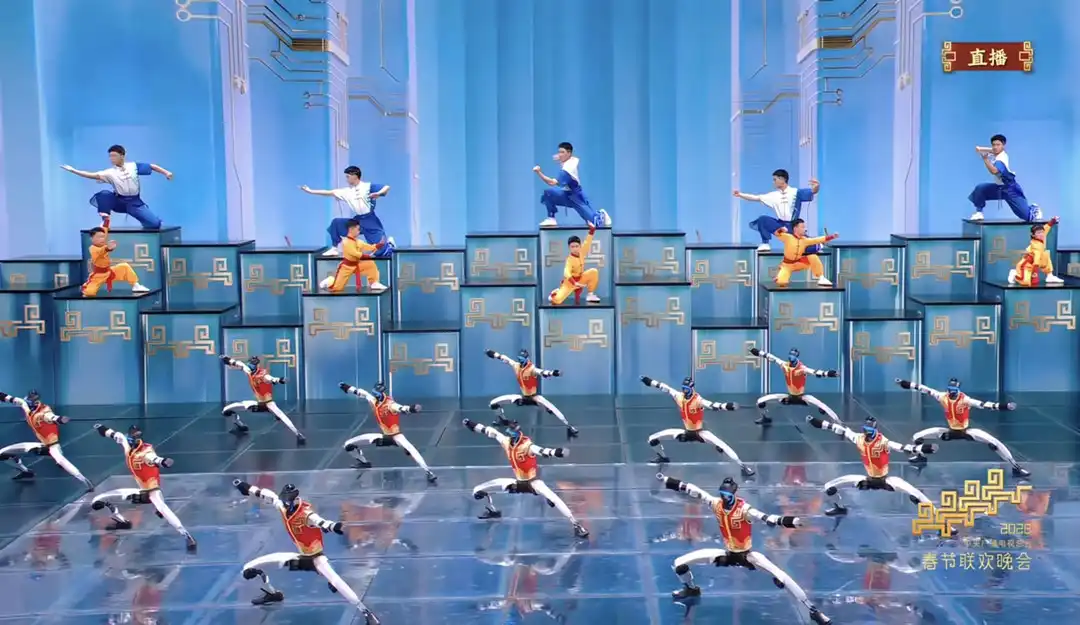
  • Magic Atom's full-stack cluster made robots the best "atmosphere group," accompanying Chen Xiaochun and Yi Yangqianxi in "Intelligent Manufacturing Future" with coordination so seamless it was hard to distinguish from humans.
  • Unitree's G1 and H2 robots demonstrated astonishing motion control capabilities in "Wǔ BOT"—without real-time remote control, relying entirely on edge-side computing power for autonomous balance. When the H2, draped in a red robe, performed a sword dance, it proved that the motion cerebellum of Chinese robots had matured.
  • Songyan Power, in the skit "Grandma's Favorite," assigned robots the comedic role of delivering and responding to punchlines, completing the transition from "prop" to "actor."
  • Galaxy General's Galbot G1 performed "walnut rolling" in a microfilm—a seemingly simple action that showcased the pinnacle of dexterous hand and tactile feedback technology.

The Gala sent a clear signal: China's AI is not just confined to servers; it has grown limbs and entered reality.

However, just as we were cheering for the robots, Wall Street was plunged into silent panic. They discovered that the "lifeblood" powering these systems—electricity—was running dry. Shifting our gaze from the Gala stage to Silicon Valley's data centers, we encounter the elephant in the room—power.

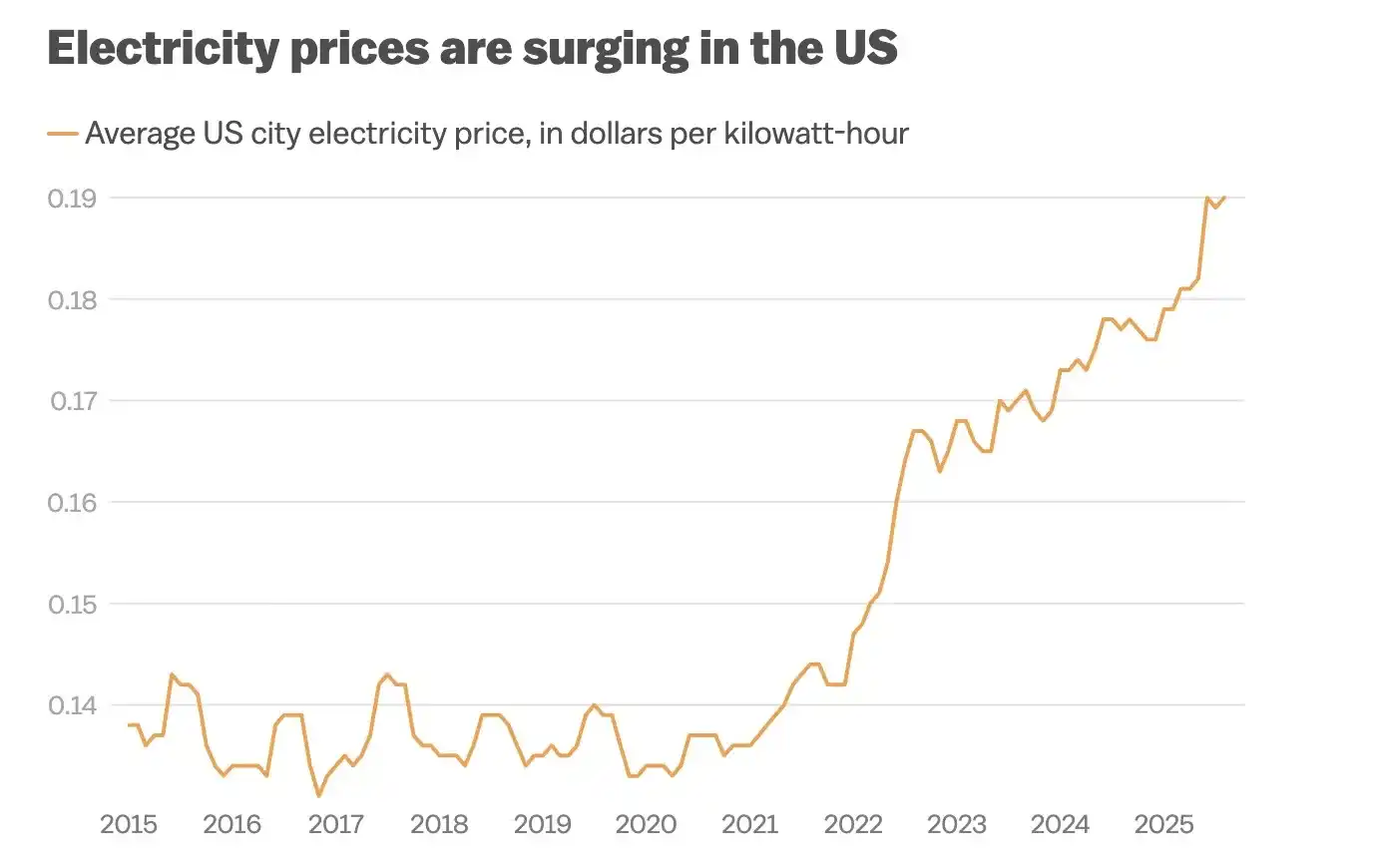
By early 2026, U.S. residential electricity prices had surged by 36%, reaching $0.18 per kWh. But this was just the surface; the core crisis lay in the collapse of the supply side. Training a GPT-4-level model consumes as much electricity as 100,000 households use in a year. By 2028, the annual electricity consumption of U.S. data centers is projected to skyrocket to 600,000 GWh.
The U.S. power grid is facing a dual crisis of "heart disease" and "vascular blockage." Five percent of its electricity relies on aging fossil fuels and nuclear power, and these units are facing a retirement wave. The U.S. grid is fragmented into three major islands—East, West, and Texas—with poor interconnectivity. Approving an interstate transmission line can take up to 15 years, preventing wind power from the Midwest from reaching East Coast data centers.

As Sam Altman said, "Energy is currency." In Silicon Valley today, CEOs are no longer troubled by chip quotas but by—where can they find enough electricity to run these chips?

If computing power is the engine of AI, then electricity is its fuel. In this energy game, China, with a decade of超前布局 (forward-looking planning), has built a strategic moat that the U.S. cannot easily replicate. If computing power is the engine of AI, then electricity is its fuel. In this energy game, China, with a decade of超前布局 (forward-looking planning), has built a strategic moat that the U.S. cannot easily replicate.

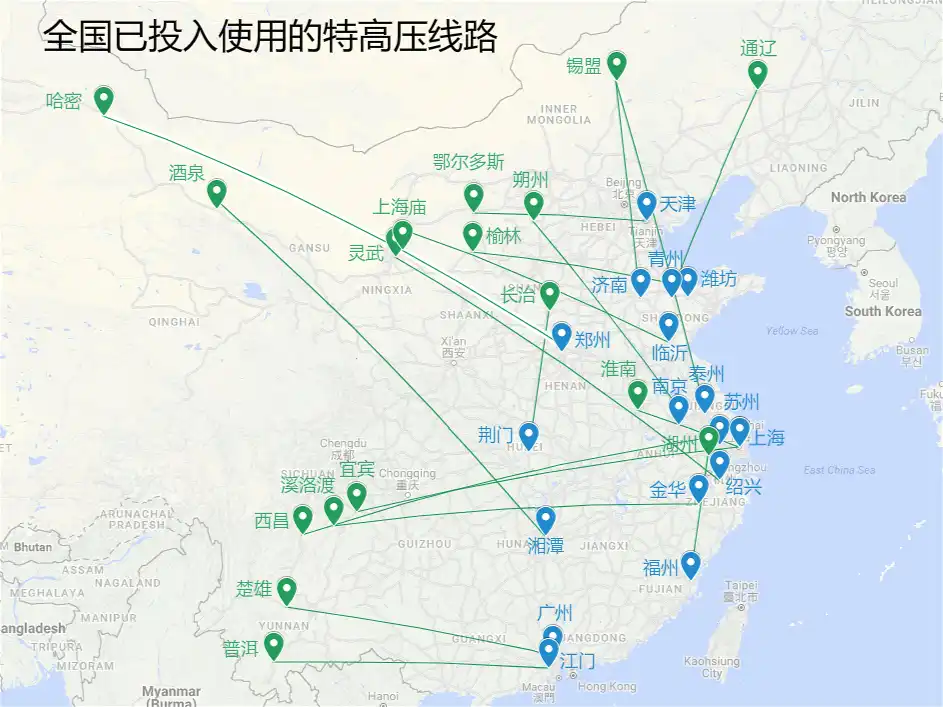
By 2025, China had completed 45 ultra-high voltage (UHV) projects, with the total length of UHV DC transmission lines exceeding 40,000 kilometers. These "electricity superhighways" can transmit abundant clean energy from the west to data centers in the east at millisecond speeds, or directly support the "East Data West Computing" hubs. China possesses 35 of the world's 37 largest high-voltage direct current cable systems—an infrastructure gap that is an insurmountable chasm for the U.S. in the short term.
The high energy consumption of AI inherently demands clean energy. In 2025, the proportion of renewable energy installed capacity in China historically surpassed 60%, with new wind and solar installations exceeding 430 million kilowatts. Of the total electricity consumption, nearly 4 out of every 10 kWh came from green power. While the U.S. is still grappling with nuclear power plant delays, China has achieved grid parity for photovoltaics and wind power, providing a cheap and green energy solution for high-consumption AI data centers.

China is the global manufacturing center for transformers, accounting for over 60% of global production. The biggest pain point for U.S. grid upgrades is transformer shortages, with delivery times now stretching to 3-4 years. Whether through transshipment via Mexico or direct procurement, the maintenance of the U.S. grid is highly dependent on Chinese manufacturing. While U.S. data centers face shutdowns due to transformer shortages, China's power equipment companies are operating at full capacity, supporting the rapid expansion of domestic computing infrastructure.

The 2026 Spring Festival Gala was not just a carnival of robots but also a profile of China's industrial strength.

When we watch Unitree's robotic dogs tumble and Galaxy General's robots perform tasks on screen, we must not forget: behind every agile movement, there is not only advanced algorithms but also a stable current transmitted thousands of kilometers through UHV lines, supported by a robust power grid.

In the second half of this AI revolution, the marginal cost of computing power growth will no longer depend on the nanometer size of chips but on the cost of acquiring joules. The U.S. possesses top-tier algorithm design, but China has the most powerful energy conversion and delivery system.

For investors, the logic is clear: in this gold rush, if NVIDIA is selling shovels, then China's infrastructure builders (UHV, power equipment, green energy) control the water source.


Crypto di tendenza

Domande pertinenti

QWhat was the significance of the 2026 CCTV Spring Festival Gala in showcasing China's AI capabilities?

AThe 2026 CCTV Spring Festival Gala served as a significant demonstration of China's advancements in embodied AI and physical robotics. It featured a multi-enterprise, multi-model, and all-scenario display of China's robot industry, moving beyond simple mechanical dances to show highly coordinated performances, advanced motion control, and robots taking on complex roles like comedy and delicate manipulation, signaling that China's AI has tangible, real-world applications.

QWhat is the core energy crisis facing the United States in relation to AI development as described in the article?

AThe core energy crisis facing the U.S. is a severe shortage of electricity to power its AI data centers. The U.S. grid is struggling with an aging infrastructure reliant on fossil fuels and nuclear power, which is facing a retirement wave. Additionally, the grid is fragmented into three major isolated networks, and bureaucratic delays in approving new transmission lines (taking up to 15 years) prevent the efficient transfer of renewable energy from the Midwest to data centers on the coasts. This has caused electricity prices to soar and threatens the operational capacity of AI systems.

QHow has China built a strategic advantage in the AI energy game according to the article?

AChina has built a strategic advantage through a decade of超前布局 (forward-looking planning) in its energy infrastructure. It has constructed 45 ultra-high voltage (UHV) power transmission projects, creating a 'power highway' over 40,000 kilometers long that efficiently transmits clean energy from the west to data centers in the east. China also dominates global transformer manufacturing (over 60% capacity) and has achieved a historic milestone with renewable energy accounting for over 60% of its installed capacity, providing a cheap and green power solution for its AI data centers.

QWhat does the article suggest is the new limiting factor for AI's computational growth?

AThe article suggests that the new limiting factor for AI's computational growth is no longer the nanometer size of chips, but the cost of acquiring energy (the cost per joule). The marginal cost of increasing computing power is becoming dependent on the availability and cost of the electrical energy required to run the powerful hardware.

QWhat analogy does the article use to describe the role of Chinese infrastructure companies in the AI 'gold rush'?

AThe article uses the analogy of a gold rush. It states that if NVIDIA is selling shovels (the hardware/tools for AI), then Chinese infrastructure builders—those involved in ultra-high voltage power transmission, power equipment, and green energy—control the water source. This means they provide the essential, foundational resource (energy) that is required for the entire AI industry to function and grow.

Letture associate

UNI Doubles in Two Months Against the Trend: A 5-Year-Overdue Value Realization

Amidst a generally stagnant crypto market in June and July, UNI, the governance token of Uniswap, saw a significant surge, nearly doubling in price from around $2.3 to $4.6. This rally represents a delayed but significant value reassessment, triggered by the practical implementation of its long-debated "fee switch" mechanism. The key turning point was the on-chain execution of the UNIfication proposal in December 2025. It activated a protocol fee on select pools, directed Unichain sequencer revenue (net of costs) to a communal treasury, executed a one-time burn of 100 million UNI, and established a system where all protocol revenue flows into a "TokenJar" contract. This treasury has a single exit: purchasing and permanently burning UNI via a "Firepit" contract. Initially, the market reacted tepidly as the generated revenue and corresponding burn rate were modest. The narrative shifted dramatically in July 2025 with two major developments. First, the launch of Robinhood Chain, tailored for tokenized stocks, rapidly became a primary source of volume and fees for Uniswap, at one point contributing nearly half of its weekly fees. Second, governance votes successfully expanded the fee mechanism to v4 pools and initiated a temperature check for fees on Robinhood Chain. The activation of v4 fees caused the protocol's daily revenue earmarked for UNI burns to nearly triple. The core of UNI's recent price action is the transition from a pure governance token to a cash-flow asset with a permanent, protocol-funded buyer. Its effectiveness is amplified by UNI's mature and widely distributed supply, with no major impending unlocks to dilute the impact of the buybacks. The sustainability of this rally now hinges on whether the transaction volume, particularly on Robinhood Chain, persists after its initial gas subsidies expire, determining if this is a genuine value realization or a subsidy-fueled spike.

marsbit1 h fa

UNI Doubles in Two Months Against the Trend: A 5-Year-Overdue Value Realization

marsbit1 h fa

Breaking: Google Earth Urgently Pulls Back Nano Banana 2 Image Generation Feature!

Google Earth's newly launched "Create image" feature, powered by the Nano Banana 2 AI image generation model, was abruptly withdrawn shortly after its release due to being "played" by users. The feature allowed users to generate and overlay AI-created visuals directly onto real-world satellite and 3D maps in Google Earth. The tool enabled creative applications like historical recreations (e.g., visualizing ancient Pompeii), generating informational graphics for landmarks, and envisioning architectural projects or futuristic cityscapes on real terrain. It operated under "geospatial grounding," meaning the AI respected the underlying geography, topography, and perspective of the chosen map view. The model also integrated with Gemini to retrieve relevant factual information. However, upon release, users quickly tested its limits. A prominent example involved reimagining Philadelphia's historic Independence Hall as a post-apocalyptic ruin overrun by "happy" zombies, evil clowns, and giant alien mechs. This highlighted both the feature's playful potential and its risks regarding the generation of inappropriate or misleading content on realistic maps, leading to its swift temporary removal. Google stated it would re-release the feature after implementing "enhanced guardrails." Analysts note this move strategically leverages Google's vast proprietary geospatial data, positioning its AI not just for artistic generation but for spatially accurate world visualization—a unique advantage in the competitive AI image generation landscape.

marsbit2 h fa

Breaking: Google Earth Urgently Pulls Back Nano Banana 2 Image Generation Feature!

marsbit2 h fa

Altman Admits: Overestimated AI Snatching Jobs! Huang Renxun: The Unemployment Narrative Is Completely Backwards

Sam Altman has revised his earlier predictions about AI rapidly replacing jobs, admitting he overestimated the speed at which AI would eliminate entry-level white-collar roles. Speaking on the "Invest Like the Best" podcast, he stated that people do not truly want an AI CEO, as accountability and human connection remain critical. He found that individuals prefer interacting with people who can be held responsible for decisions. Similarly, NVIDIA's Jensen Huang argued that the narrative of AI destroying jobs is misguided. He distinguishes between tasks and jobs, noting that while AI can automate specific tasks, entire jobs—encompassing communication, judgment, coordination, and accountability—are not eliminated. He cited examples like radiologists and software engineers, where demand for these roles has increased as AI handles repetitive tasks, allowing for business expansion and the creation of more positions. Data from a University of Maryland and LinkUp study supports this, showing that U.S. job postings for new graduates have actually risen, countering the fear of vanishing entry-level roles. However, a significant shift is occurring: the traditional entry-level tasks that help newcomers gain experience are being automated, making initial career access more challenging. The key insight is that as AI takes over standardized tasks, the enduring value of human work shifts toward areas of responsibility, trust-building, and final decision-making—aspects that AI cannot replicate. The real "moat" for professionals lies in these irreplaceable human elements.

marsbit2 h fa

Altman Admits: Overestimated AI Snatching Jobs! Huang Renxun: The Unemployment Narrative Is Completely Backwards

marsbit2 h fa

Trading

Spot

Articoli Popolari

Come comprare GALA

Benvenuto in HTX.com! Abbiamo reso l'acquisto di GALA (GALA) semplice e conveniente. Segui la nostra guida passo passo per intraprendere il tuo viaggio nel mondo delle criptovalute.Step 1: Crea il tuo Account HTXUsa la tua email o numero di telefono per registrarti il tuo account gratuito su HTX. Vivi un'esperienza facile e sblocca tutte le funzionalità,Crea il mio accountStep 2: Vai in Acquista crypto e seleziona il tuo metodo di pagamentoCarta di credito/debito: utilizza la tua Visa o Mastercard per acquistare immediatamente GALAGALA.Bilancio: Usa i fondi dal bilancio del tuo account HTX per fare trading senza problemi.Terze parti: abbiamo aggiunto metodi di pagamento molto utilizzati come Google Pay e Apple Pay per maggiore comodità.P2P: Fai trading direttamente con altri utenti HTX.Over-the-Counter (OTC): Offriamo servizi su misura e tassi di cambio competitivi per i trader.Step 3: Conserva GALA (GALA)Dopo aver acquistato GALA (GALA), conserva nel tuo account HTX. In alternativa, puoi inviare tramite trasferimento blockchain o scambiare per altre criptovalute.Step 4: Scambia GALA (GALA)Scambia facilmente GALA (GALA) nel mercato spot di HTX. Accedi al tuo account, seleziona la tua coppia di trading, esegui le tue operazioni e monitora in tempo reale. Offriamo un'esperienza user-friendly sia per chi ha appena iniziato che per i trader più esperti.

409 Totale visualizzazioniPubblicato il 2024.12.11Aggiornato il 2026.06.02

Come comprare GALA

Discussioni

Benvenuto nella Community HTX. Qui puoi rimanere informato sugli ultimi sviluppi della piattaforma e accedere ad approfondimenti esperti sul mercato. Le opinioni degli utenti sul prezzo di GALA GALA sono presentate come di seguito.

活动图片