From Spring Festival Gala Robots to the Computing Power Energy War: Why Does China Hold the 'Trump Card' in the AI Era?

marsbitPubblicato 2026-02-22Pubblicato ultima volta 2026-02-22

Introduzione

China's 2026 Spring Festival Gala showcased a breakthrough in embodied AI, featuring robots from companies like Magic Atom, Unitree, and Galaxy General performing complex tasks such as dancing, martial arts, and comedy. This demonstrated China's advanced progress in robotics and AI physical integration. Meanwhile, the U.S. faces an escalating energy crisis, with electricity prices rising 36% by early 2026. Training AI models like GPT-4 consumes power equivalent to 100,000 households annually, and U.S. data centers are projected to use 600,000 GWh by 2028. Aging infrastructure, fragmented grids, and lengthy approval processes for new transmission lines exacerbate the problem. In contrast, China has built a strategic advantage through decades of infrastructure investment. It operates 45 ultra-high-voltage (UHV) power transmission projects, spanning 40,000 kilometers, efficiently delivering clean energy from the west to eastern data centers. Renewable energy accounts for over 60% of China’s power capacity, with 40% of electricity coming from green sources. China also dominates transformer production, holding 60% of global capacity. While the U.S. excels in AI algorithms, China’s robust energy infrastructure—UHV grids, renewable energy, and manufacturing capacity—provides a foundational edge in the AI era, turning energy into a critical competitive asset.

In the Spring Festival of 2026, while the world was still marveling at OpenAI's latest model parameters, China used a Spring Festival Gala to showcase another facet of AI to the world—the physical implementation of embodied intelligence.

Looking at the program list of the 2026 CCTV Spring Festival Gala, we witnessed an unprecedented "AI military parade." This was no longer the simple mechanical dance displays of a few years ago but a concentrated explosion of China's robotics industry featuring "multiple enterprises, multiple models, and full-scene applications."
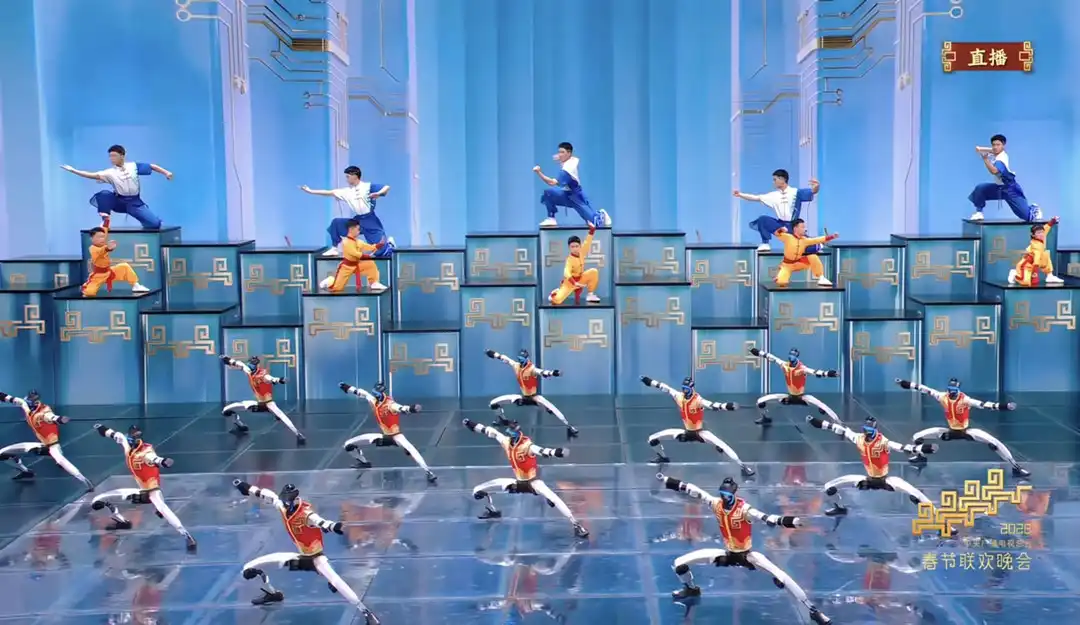
  • Magic Atom's full-stack cluster made robots the best "atmosphere group," accompanying Chen Xiaochun and Yi Yangqianxi in "Intelligent Manufacturing Future" with coordination so seamless it was hard to distinguish from humans.
  • Unitree's G1 and H2 robots demonstrated astonishing motion control capabilities in "Wǔ BOT"—without real-time remote control, relying entirely on edge-side computing power for autonomous balance. When the H2, draped in a red robe, performed a sword dance, it proved that the motion cerebellum of Chinese robots had matured.
  • Songyan Power, in the skit "Grandma's Favorite," assigned robots the comedic role of delivering and responding to punchlines, completing the transition from "prop" to "actor."
  • Galaxy General's Galbot G1 performed "walnut rolling" in a microfilm—a seemingly simple action that showcased the pinnacle of dexterous hand and tactile feedback technology.

The Gala sent a clear signal: China's AI is not just confined to servers; it has grown limbs and entered reality.

However, just as we were cheering for the robots, Wall Street was plunged into silent panic. They discovered that the "lifeblood" powering these systems—electricity—was running dry. Shifting our gaze from the Gala stage to Silicon Valley's data centers, we encounter the elephant in the room—power.

By early 2026, U.S. residential electricity prices had surged by 36%, reaching $0.18 per kWh. But this was just the surface; the core crisis lay in the collapse of the supply side. Training a GPT-4-level model consumes as much electricity as 100,000 households use in a year. By 2028, the annual electricity consumption of U.S. data centers is projected to skyrocket to 600,000 GWh.
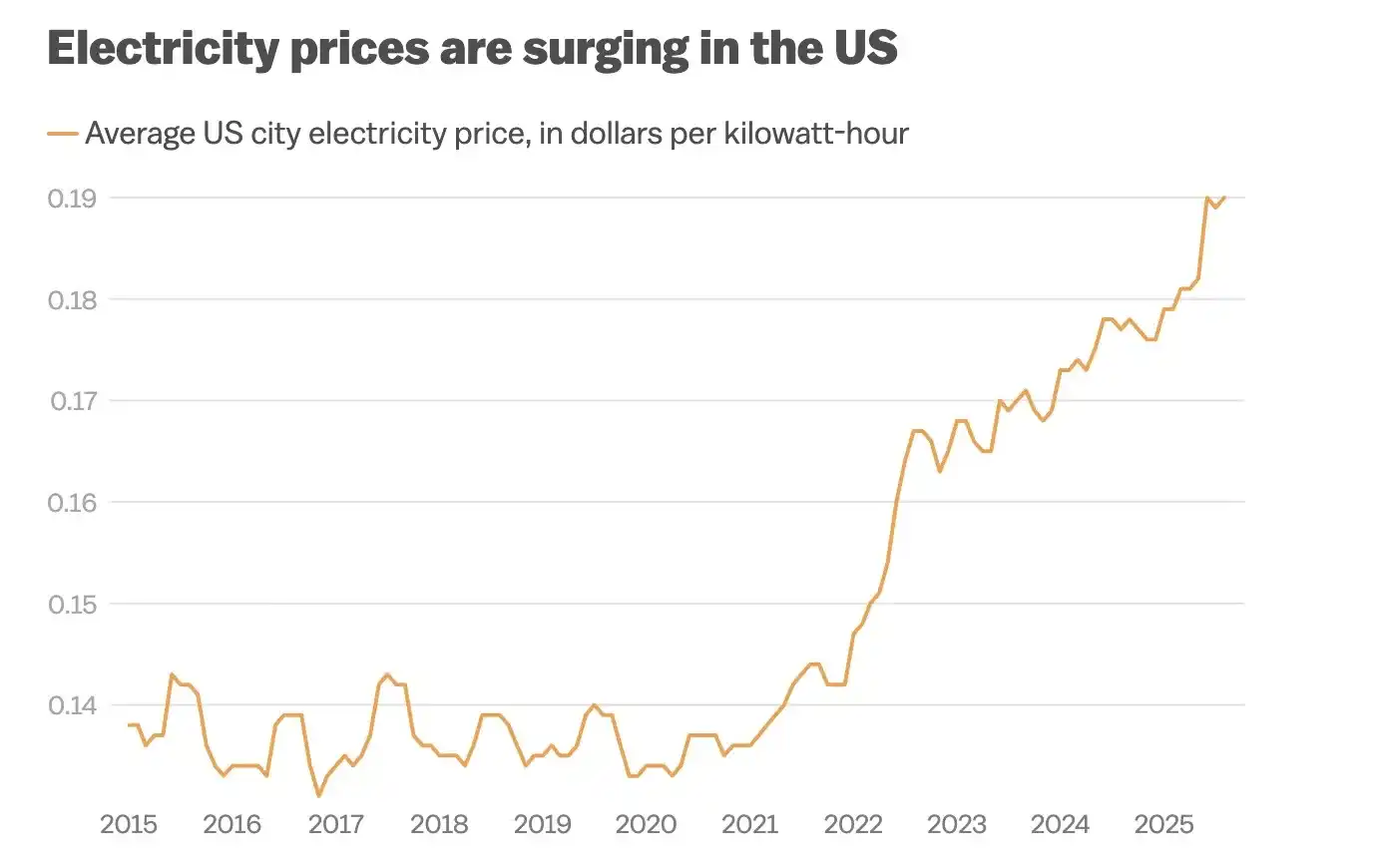
The U.S. power grid is facing a dual crisis of "heart disease" and "vascular blockage." Five percent of its electricity relies on aging fossil fuels and nuclear power, and these units are facing a retirement wave. The U.S. grid is fragmented into three major islands—East, West, and Texas—with poor interconnectivity. Approving an interstate transmission line can take up to 15 years, preventing wind power from the Midwest from reaching East Coast data centers.

As Sam Altman said, "Energy is currency." In Silicon Valley today, CEOs are no longer troubled by chip quotas but by—where can they find enough electricity to run these chips?

If computing power is the engine of AI, then electricity is its fuel. In this energy game, China, with a decade of超前布局 (forward-looking planning), has built a strategic moat that the U.S. cannot easily replicate. If computing power is the engine of AI, then electricity is its fuel. In this energy game, China, with a decade of超前布局 (forward-looking planning), has built a strategic moat that the U.S. cannot easily replicate.

By 2025, China had completed 45 ultra-high voltage (UHV) projects, with the total length of UHV DC transmission lines exceeding 40,000 kilometers. These "electricity superhighways" can transmit abundant clean energy from the west to data centers in the east at millisecond speeds, or directly support the "East Data West Computing" hubs. China possesses 35 of the world's 37 largest high-voltage direct current cable systems—an infrastructure gap that is an insurmountable chasm for the U.S. in the short term.
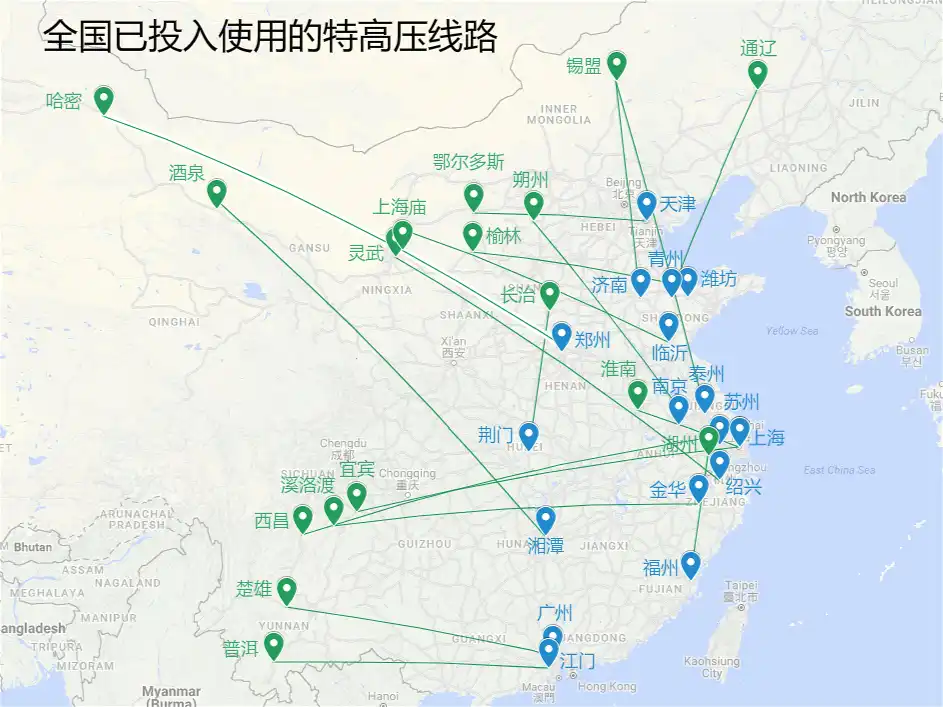
The high energy consumption of AI inherently demands clean energy. In 2025, the proportion of renewable energy installed capacity in China historically surpassed 60%, with new wind and solar installations exceeding 430 million kilowatts. Of the total electricity consumption, nearly 4 out of every 10 kWh came from green power. While the U.S. is still grappling with nuclear power plant delays, China has achieved grid parity for photovoltaics and wind power, providing a cheap and green energy solution for high-consumption AI data centers.

China is the global manufacturing center for transformers, accounting for over 60% of global production. The biggest pain point for U.S. grid upgrades is transformer shortages, with delivery times now stretching to 3-4 years. Whether through transshipment via Mexico or direct procurement, the maintenance of the U.S. grid is highly dependent on Chinese manufacturing. While U.S. data centers face shutdowns due to transformer shortages, China's power equipment companies are operating at full capacity, supporting the rapid expansion of domestic computing infrastructure.

The 2026 Spring Festival Gala was not just a carnival of robots but also a profile of China's industrial strength.

When we watch Unitree's robotic dogs tumble and Galaxy General's robots perform tasks on screen, we must not forget: behind every agile movement, there is not only advanced algorithms but also a stable current transmitted thousands of kilometers through UHV lines, supported by a robust power grid.

In the second half of this AI revolution, the marginal cost of computing power growth will no longer depend on the nanometer size of chips but on the cost of acquiring joules. The U.S. possesses top-tier algorithm design, but China has the most powerful energy conversion and delivery system.

For investors, the logic is clear: in this gold rush, if NVIDIA is selling shovels, then China's infrastructure builders (UHV, power equipment, green energy) control the water source.


Crypto di tendenza

Domande pertinenti

QWhat was the significance of the 2026 CCTV Spring Festival Gala in showcasing China's AI capabilities?

AThe 2026 CCTV Spring Festival Gala served as a significant demonstration of China's advancements in embodied AI and physical robotics. It featured a multi-enterprise, multi-model, and all-scenario display of China's robot industry, moving beyond simple mechanical dances to show highly coordinated performances, advanced motion control, and robots taking on complex roles like comedy and delicate manipulation, signaling that China's AI has tangible, real-world applications.

QWhat is the core energy crisis facing the United States in relation to AI development as described in the article?

AThe core energy crisis facing the U.S. is a severe shortage of electricity to power its AI data centers. The U.S. grid is struggling with an aging infrastructure reliant on fossil fuels and nuclear power, which is facing a retirement wave. Additionally, the grid is fragmented into three major isolated networks, and bureaucratic delays in approving new transmission lines (taking up to 15 years) prevent the efficient transfer of renewable energy from the Midwest to data centers on the coasts. This has caused electricity prices to soar and threatens the operational capacity of AI systems.

QHow has China built a strategic advantage in the AI energy game according to the article?

AChina has built a strategic advantage through a decade of超前布局 (forward-looking planning) in its energy infrastructure. It has constructed 45 ultra-high voltage (UHV) power transmission projects, creating a 'power highway' over 40,000 kilometers long that efficiently transmits clean energy from the west to data centers in the east. China also dominates global transformer manufacturing (over 60% capacity) and has achieved a historic milestone with renewable energy accounting for over 60% of its installed capacity, providing a cheap and green power solution for its AI data centers.

QWhat does the article suggest is the new limiting factor for AI's computational growth?

AThe article suggests that the new limiting factor for AI's computational growth is no longer the nanometer size of chips, but the cost of acquiring energy (the cost per joule). The marginal cost of increasing computing power is becoming dependent on the availability and cost of the electrical energy required to run the powerful hardware.

QWhat analogy does the article use to describe the role of Chinese infrastructure companies in the AI 'gold rush'?

AThe article uses the analogy of a gold rush. It states that if NVIDIA is selling shovels (the hardware/tools for AI), then Chinese infrastructure builders—those involved in ultra-high voltage power transmission, power equipment, and green energy—control the water source. This means they provide the essential, foundational resource (energy) that is required for the entire AI industry to function and grow.

Letture associate

Welcome to the New Crypto World: Only This Time, The Place Where You Lose Money Is Called the Stock Market

Welcome to the New Crypto World: Only This Time, the Place to Lose Money is Called the Stock Market. The article depicts a future (2026) where global stock markets, particularly tech stocks, are exhibiting behaviors and risks reminiscent of the cryptocurrency world. The narrative centers on a sharp crash in South Korea's KOSPI index and leading stocks like SK Hynix, highlighting widespread retail losses, leverage-induced liquidations, and extreme volatility. It argues that a significant shift in market dynamics is underway: pricing is increasingly driven by narratives (like the AI boom) over fundamental valuation, amplified by high leverage and the rapid, emotion-fueled consensus formed on social media. Former crypto traders, seeking new opportunities, brought their high-risk strategies—chasing narratives, using leverage—into equity markets, focusing on sectors like AI and semiconductors. Ironically, data suggests some major tech stocks have recently shown greater volatility and faster crashes than Bitcoin, which is becoming relatively more stable and "stock-like" through institutional adoption. The piece details how leveraged ETFs in Korea, particularly those tied to single stocks, created a vicious cycle of forced selling that exacerbated the market plunge. It concludes that while stocks retain underlying fundamentals, the *trading* of them has undergone a "de-rationalization": markets now prioritize themes, social media sentiment, and leveraged bets over traditional analysis. In a paradoxical twist, Bitcoin is striving to become more like a traditional asset, while a segment of the stock market is becoming more like crypto—a cycle of grand stories, crowded trades, easy leverage, and the pervasive, often misplaced, belief that one can exit before everyone else. The final, poignant wish from a Korean retail investor—to go back to life before trading and get their money back—underscores that markets offer no refunds.

marsbit12 min fa

Welcome to the New Crypto World: Only This Time, The Place Where You Lose Money Is Called the Stock Market

marsbit12 min fa

Feishu Has Become Doubao

This may be the most important day in the ten-year history of Feishu. On July 30, ByteDance announced a major restructuring via internal email. Feishu, an independent operation for a decade, will no longer function separately and will lose its independent sales and marketing teams. Its product team is being integrated into Doubao AI, and its Go-to-Market strategy merges into the Volcano Engine's To B system. This move signals a strategic pivot, not a failure of Feishu. The era where Feishu sought to be an all-encompassing super-app for productivity is ending. AI has become the dominant logic. Industry trends show a shift from building platform "entrances" to embedding AI directly into workflows, as seen with Microsoft Copilot and Google's Gemini. Data reveals the driver: over 90% of Feishu's new clients in Q2 2026 purchased its AI products. Enterprises are now buying integrated AI solutions, not standalone software. By integrating Feishu's deep enterprise workflow scenarios, Doubao evolves from a consumer-facing chatbot into a powerful enterprise productivity engine. This gives Doubao a critical asset: real-world business application. Concurrently, ByteDance established the "Creative Services Platform," unifying its previously fragmented sales fronts (Feishu, Doubao, Volcano Engine) into a single customer-facing entity. This represents ByteDance's first genuine shift to thinking like a true To B company, organizing around client needs rather than internal product silos. The restructuring underscores that AI is no longer just a business line but foundational infrastructure. Doubao is becoming the new organizational core, mirroring TikTok's past ascendancy. This demonstrates a profound shift: AI is beginning to reshape corporate structures, determining resource allocation and strategic priorities. ByteDance is likely just the first of many companies to undergo such an AI-driven reorganization.

marsbit22 min fa

Feishu Has Become Doubao

marsbit22 min fa

The Second Half of the RWA Issuance Race: Amidst the Utilization Dilemma, Trillions Worth of On-Chain Assets Awaken

RWA (Real-World Asset) tokenization has surged to a record $32 billion in on-chain value. However, a structural challenge has emerged: approximately 87% of these tokenized assets are inactive, not participating in DeFi lending or trading activities. This "utilization gap" highlights a key question: what happens after assets are brought on-chain? Data shows a stark contrast among major platforms. While Securitize leads in scale ($4.9B), it has a DeFi utilization rate of only 0.7%. Similarly, Ondo Finance ($3.5B) sees about 2.7% utilization. In contrast, Maple Finance, with a smaller $2.3B in assets, achieves a 62% utilization rate by embedding its assets directly into lending activities from the outset. Three primary factors contribute to low utilization: 1) **Asset Nature**: Tokenized treasuries are often held for yield, not traded. 2) **Regulatory Barriers**: Securities laws and KYC requirements restrict free movement into permissionless DeFi pools. 3) **Infrastructure Gaps**: A lack of deep secondary markets, real-time pricing, and mature clearing mechanisms hinders liquidity. The RWA narrative is now shifting from a "race to issue" to a "battle for application." While native lending protocols like Maple have inherent advantages, distribution channels are becoming critical. The success of products like SyrupUSDG on platforms like Robinhood Crypto demonstrates that access to existing user bases can accelerate adoption far more effectively than protocol-led efforts alone. The $32 billion milestone validates the feasibility of tokenization, but low utilization underscores that bringing assets on-chain is just the first step. The true test for the sector is enabling these assets to circulate, be utilized, and create new economic value within the DeFi ecosystem.

marsbit22 min fa

The Second Half of the RWA Issuance Race: Amidst the Utilization Dilemma, Trillions Worth of On-Chain Assets Awaken

marsbit22 min fa

Trading

Spot

Articoli Popolari

Come comprare GALA

Benvenuto in HTX.com! Abbiamo reso l'acquisto di GALA (GALA) semplice e conveniente. Segui la nostra guida passo passo per intraprendere il tuo viaggio nel mondo delle criptovalute.Step 1: Crea il tuo Account HTXUsa la tua email o numero di telefono per registrarti il tuo account gratuito su HTX. Vivi un'esperienza facile e sblocca tutte le funzionalità,Crea il mio accountStep 2: Vai in Acquista crypto e seleziona il tuo metodo di pagamentoCarta di credito/debito: utilizza la tua Visa o Mastercard per acquistare immediatamente GALAGALA.Bilancio: Usa i fondi dal bilancio del tuo account HTX per fare trading senza problemi.Terze parti: abbiamo aggiunto metodi di pagamento molto utilizzati come Google Pay e Apple Pay per maggiore comodità.P2P: Fai trading direttamente con altri utenti HTX.Over-the-Counter (OTC): Offriamo servizi su misura e tassi di cambio competitivi per i trader.Step 3: Conserva GALA (GALA)Dopo aver acquistato GALA (GALA), conserva nel tuo account HTX. In alternativa, puoi inviare tramite trasferimento blockchain o scambiare per altre criptovalute.Step 4: Scambia GALA (GALA)Scambia facilmente GALA (GALA) nel mercato spot di HTX. Accedi al tuo account, seleziona la tua coppia di trading, esegui le tue operazioni e monitora in tempo reale. Offriamo un'esperienza user-friendly sia per chi ha appena iniziato che per i trader più esperti.

408 Totale visualizzazioniPubblicato il 2024.12.11Aggiornato il 2026.06.02

Come comprare GALA

Discussioni

Benvenuto nella Community HTX. Qui puoi rimanere informato sugli ultimi sviluppi della piattaforma e accedere ad approfondimenti esperti sul mercato. Le opinioni degli utenti sul prezzo di GALA GALA sono presentate come di seguito.

活动图片