From Satoshi to Saylor: The Crypto Undercurrent in the Epstein Files

比推Pubblicato 2026-02-03Pubblicato ultima volta 2026-02-03

Introduzione

Recent disclosures from the "Epstein Files" reveal significant, previously unknown connections between the late financier Jeffrey Epstein and the cryptocurrency industry. As early as 2011, Epstein was aware of Bitcoin, calling it a "brilliant idea" with "serious flaws." The documents show he was involved in discussions about Bitcoin's nature, invested in the seed round of infrastructure firm Blockstream, and received updates on market developments from figures like a16z's Steven Sinofsky. The files suggest Epstein may have met with "some Bitcoin creators," potentially including Satoshi Nakamoto, raising questions about Bitcoin's origins and the U.S. government's knowledge. He also proposed creating Sharia-compliant digital currencies to Middle Eastern contacts. Additionally, the documents include a harsh critique of MicroStrategy CEO Michael Saylor from 2010, describing him as a socially awkward "weirdo" at one of Epstein's parties. The revelations, which also involve investments in projects like Ripple and Stellar, hint at a deeper, hidden history of crypto's early days, with more information potentially yet to be disclosed.

Author: Cookie, Block Rhythm BlockBeats

Original Title: Claimed to Have Met Satoshi, Called Saylor a Freak: The Crypto Secrets in the Epstein Files


On January 30, the U.S. Department of Justice disclosed a large number of "Epstein Files" for the first time, immediately attracting widespread attention and discussion globally. While we were seeing whether Musk "went to the island," Bill Gates's extramarital affair, or the next Fed chairman nominee Kevin Warsh also appeared on Epstein's party invitation list, these newly disclosed files also dropped a series of bombshells about the cryptocurrency industry.

The history of the cryptocurrency industry may have finally revealed the tip of the iceberg and could be rewritten from now on.

Was Epstein a "Crypto OG"?

As early as 2011, Epstein had already taken notice of Bitcoin. That year, Bitcoin's total annual trading volume had not yet exceeded $100 million, and its price had surged past $30 only to plummet by 90%.

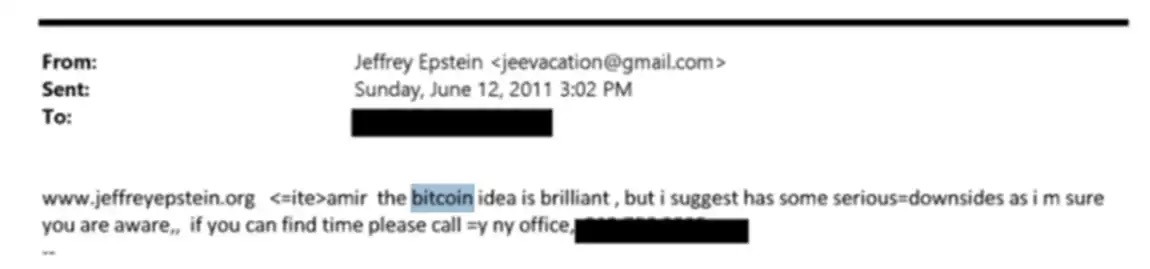
The email below is dated June 12, 2011, right around the peak of Bitcoin's price that year. Epstein stated in the email, "Bitcoin is a brilliant idea, but it has some serious drawbacks."
In 2013, the frequency of cryptocurrency mentions in Epstein's correspondence increased.

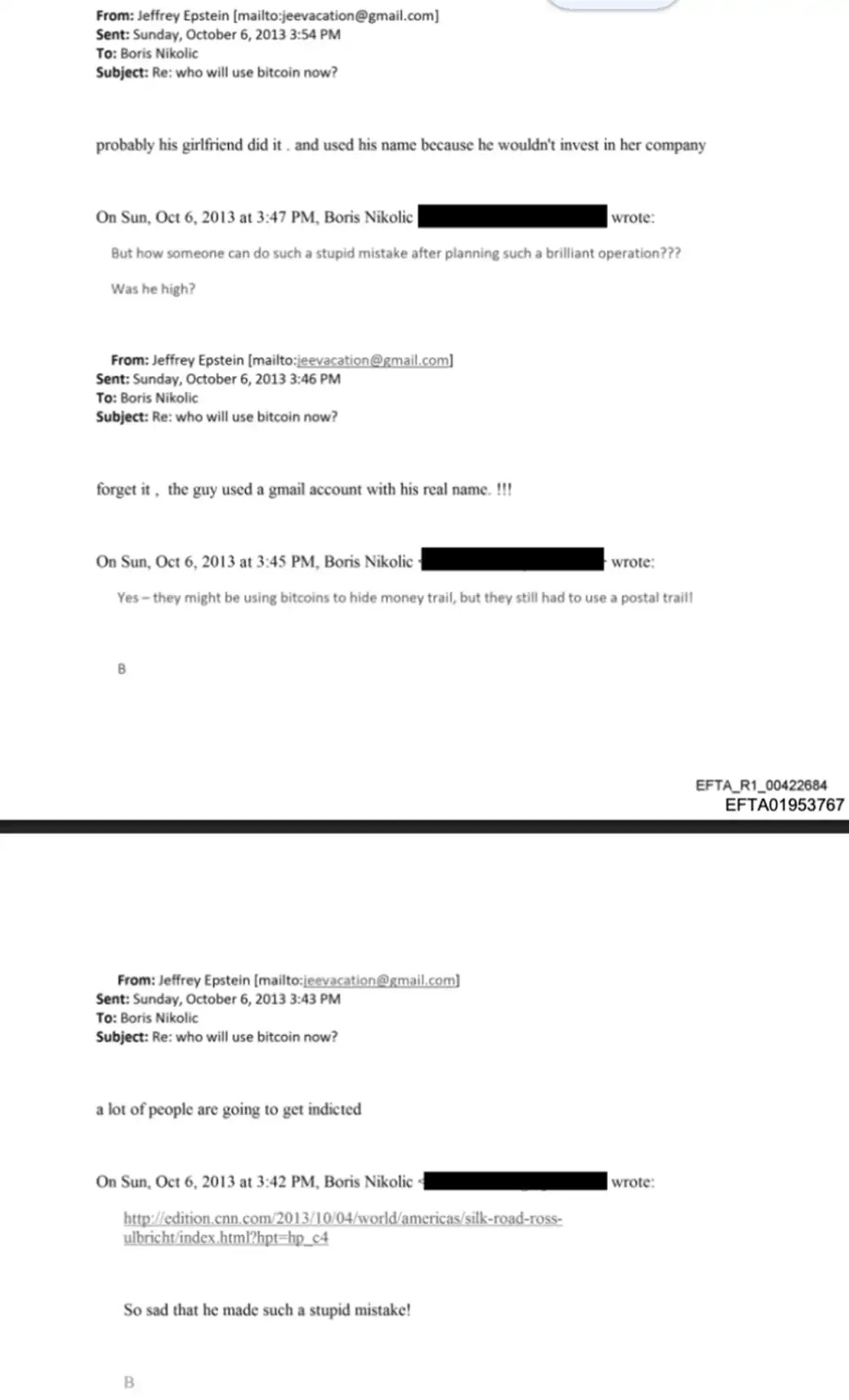
First, in an email exchange with Boris Nikolic (who once served as Bill Gates's chief technology advisor and was named in Epstein's will), the subject was "Who uses Bitcoin now?" They sarcastically discussed Ross Ulbricht, the founder of Silk Road who was arrested that year, saying that Ross's use of a Gmail account with his real name was a stupid mistake.
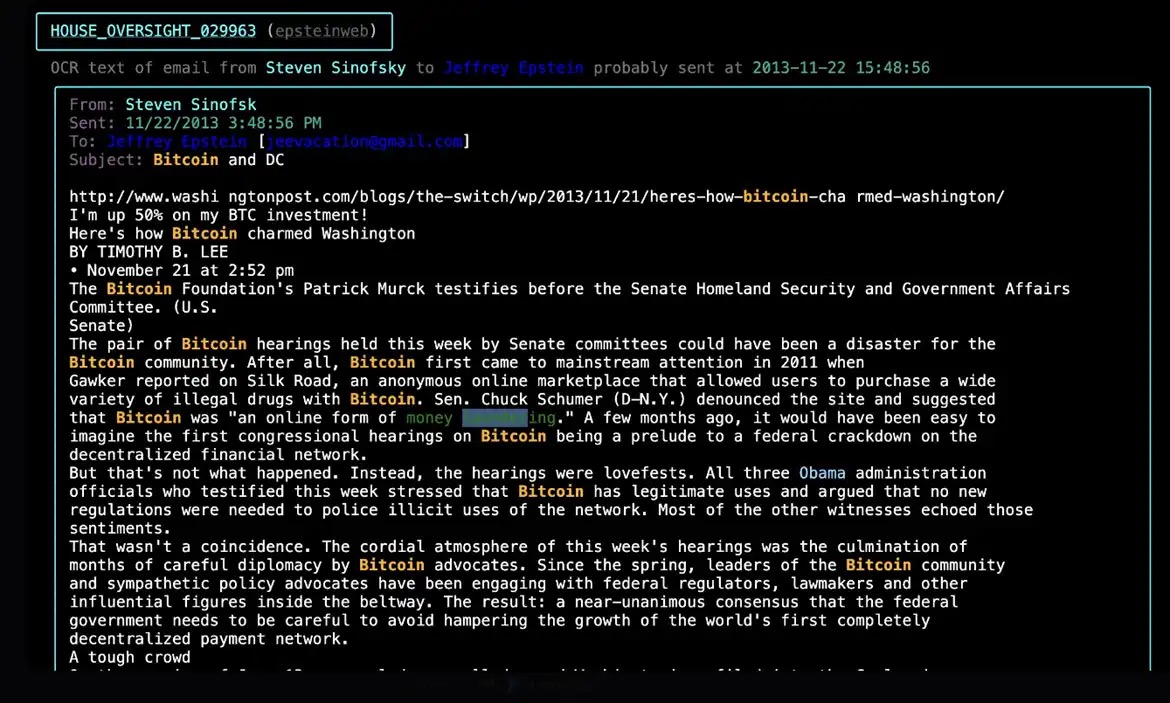
a16z board partner and former president of Microsoft's Windows division, Steven Sinofsky, emailed Epstein to say that his Bitcoin investment had increased by 50% and shared Timothy B. Lee's article "How Bitcoin Captivated Washington."
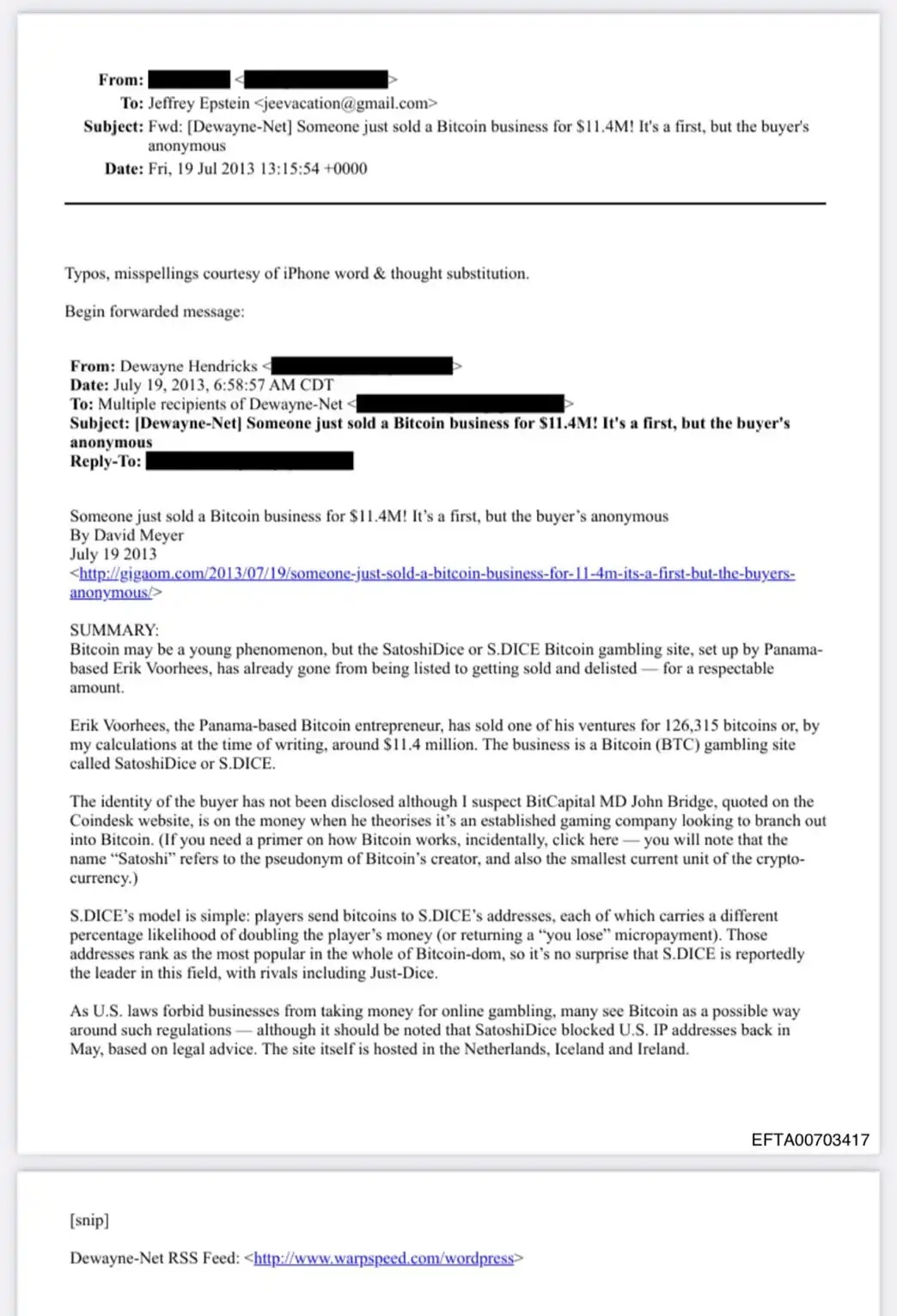
He also received news that the once-famous Bitcoin website Satoshi Dice had been sold for $11.4 million.
In 2014, Epstein engaged in an in-depth discussion with PayPal co-founder Peter Thiel about the nature of Bitcoin.
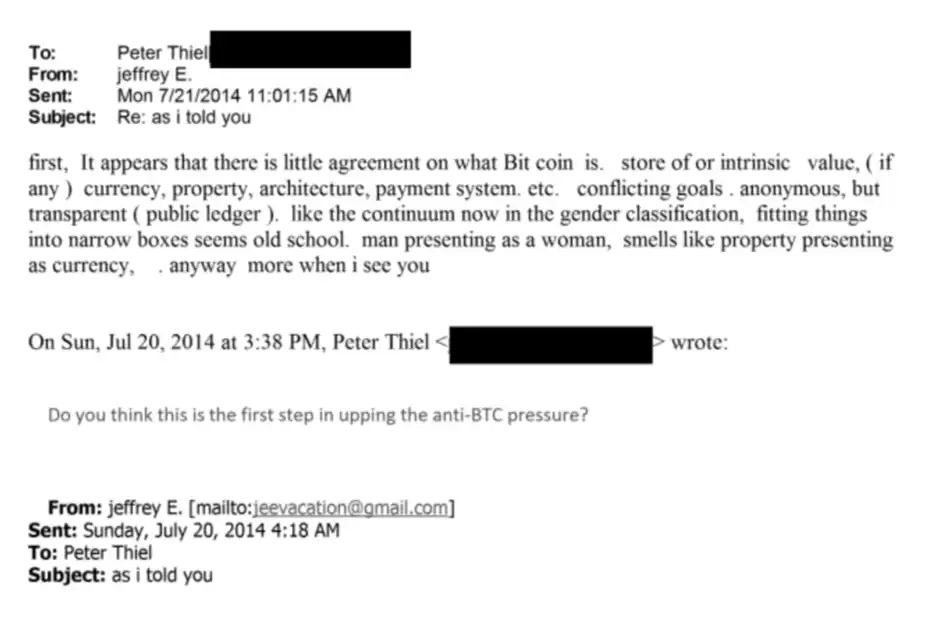
"There is no consensus on what Bitcoin is—a store of value, a currency, or property... It's like a man dressing as a woman, like property masquerading as currency."

This exchange shows that Epstein was very familiar with the ideological debates surrounding Bitcoin's nature in the early stages of the cryptocurrency market. He even compared it to gender identity.

Another email revealed that Epstein participated in the seed round funding of Bitcoin infrastructure company Blockstream. The round totaled $18 million, and Epstein's investment increased from $50,000 to $500,000.
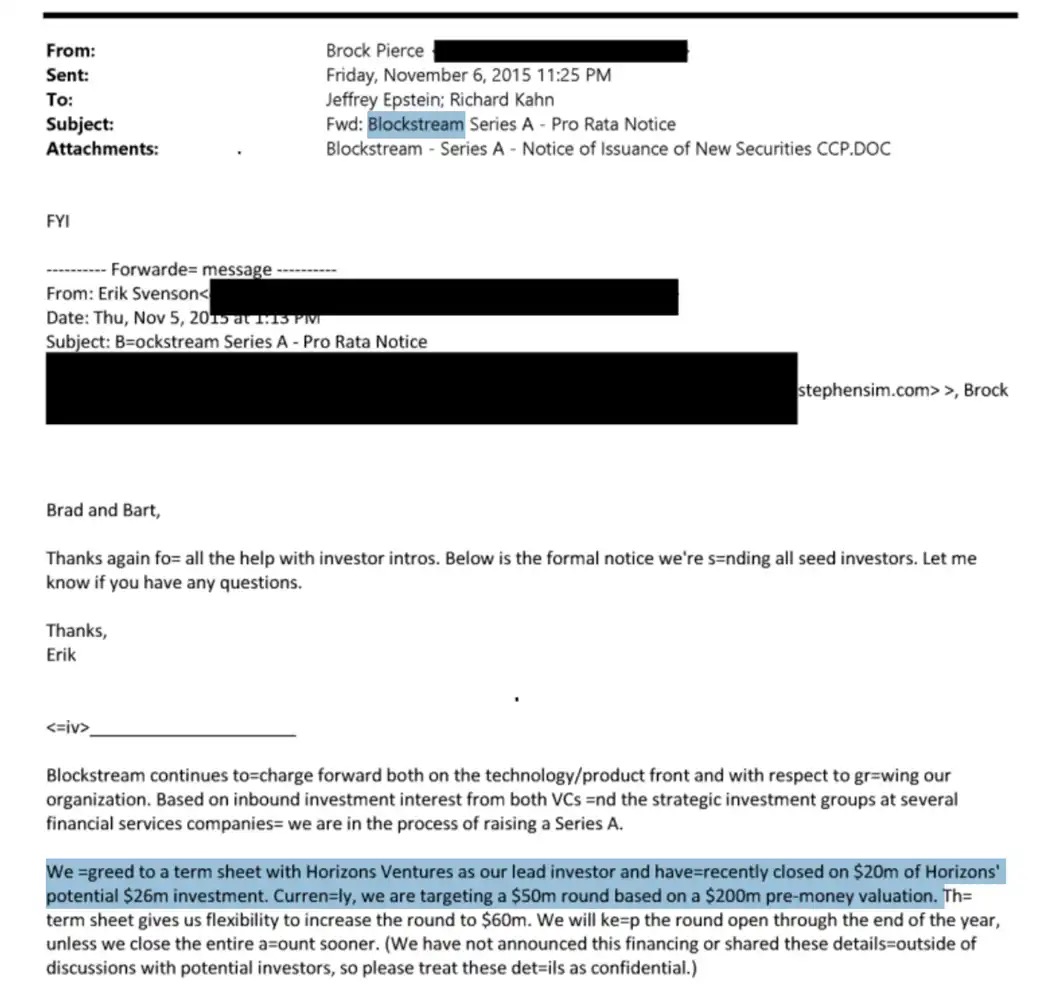
Blockstream CEO Adam Back recently issued a statement denying any direct or indirect financial connection between the company and Epstein or his estate. He explained that Epstein was a limited partner in a fund that once held a minority stake in Blockstream but had since fully divested.

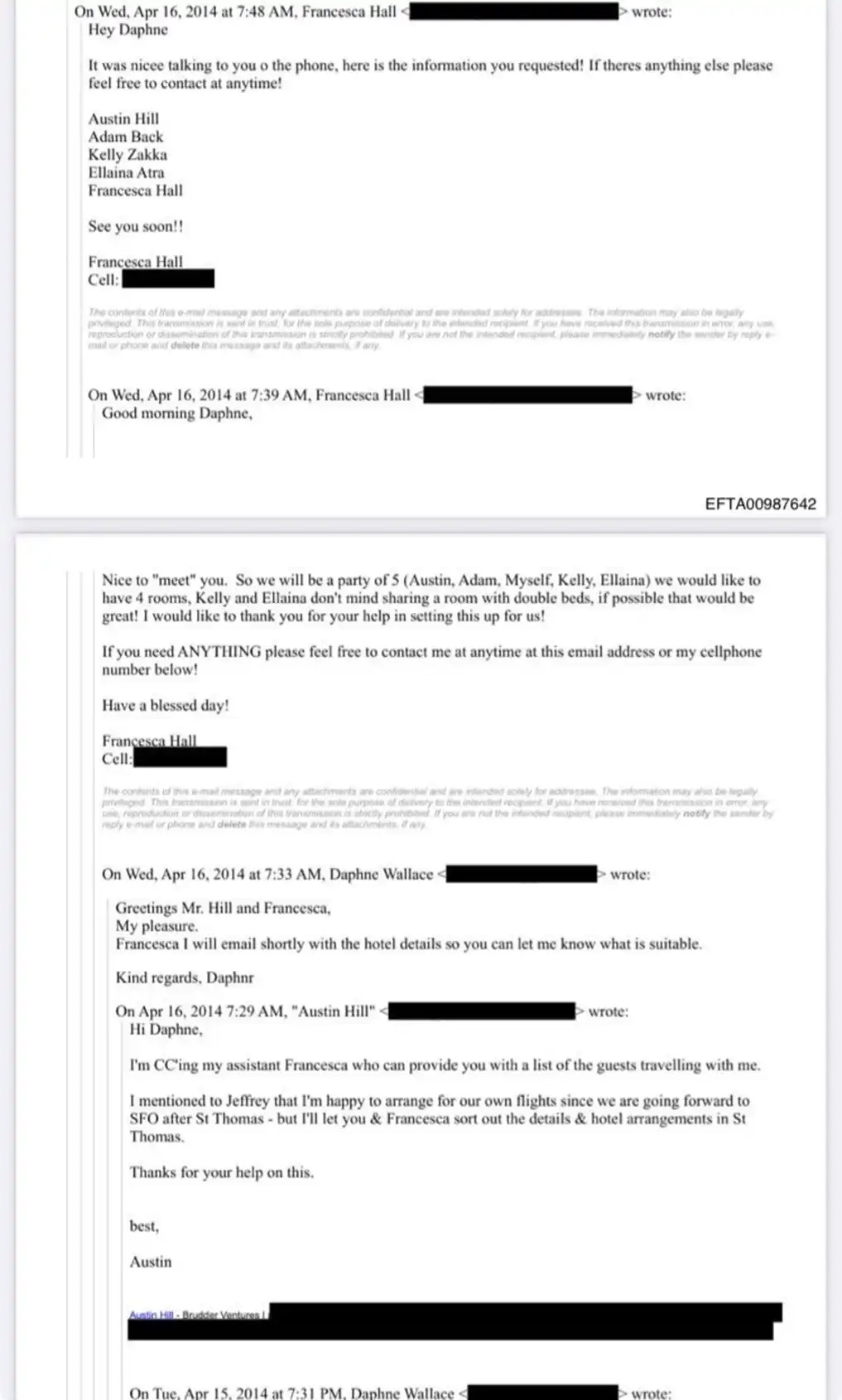
However, the names of Adam Back and Austin Hill (Blockstream co-founder) appeared in travel arrangement emails for St. Thomas Island (about 2 miles from "Epstein Island"):
Additionally, in 2014, Austin Hill emailed Epstein and Joi Ito (former director of the MIT Media Lab; Epstein invested in Blockstream through his fund). He stated that Ripple ($XRP) and Stellar (a new project by Ripple founder Jed McCaleb after leaving Ripple) negatively impacted the ecosystem Blockstream was building and harmed Blockstream because their investors were "backing two horses in the same race."
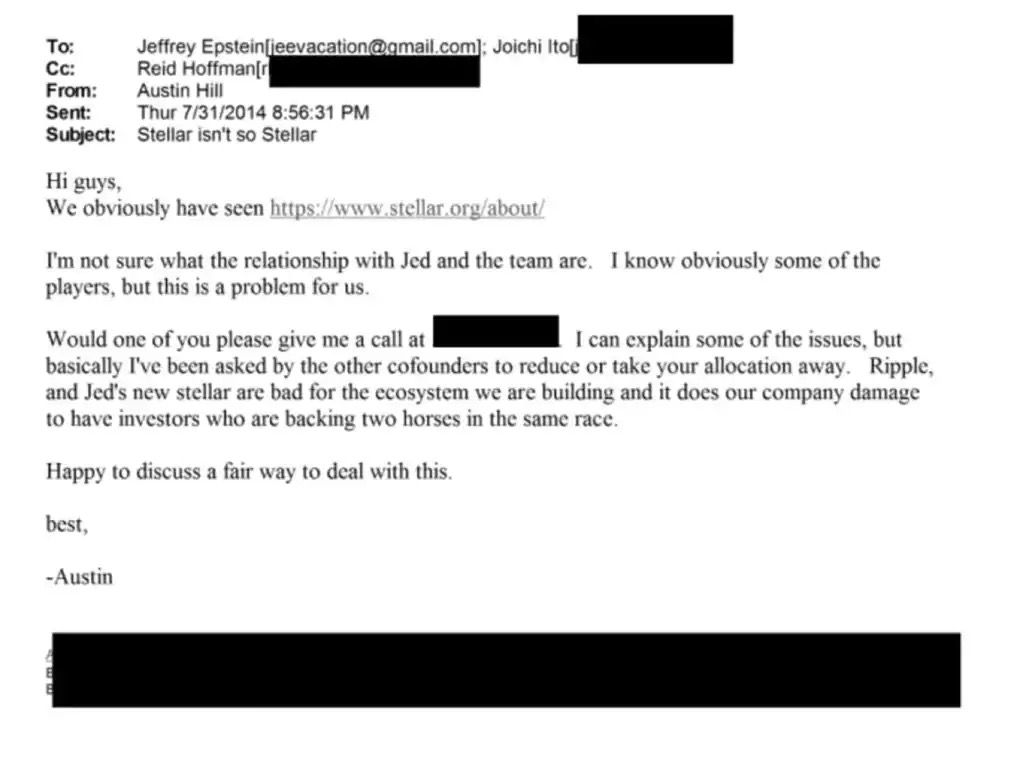
There is some divergence in the English-speaking community regarding the interpretation of this. Based on the context, I personally tend to adopt the interpretation that Epstein may have also invested in Ripple/Stellar at the time, which displeased Blockstream. This led Austin Hill to state in the email, "I was asked by other co-founders to reduce or even cancel your allocation."

Although Ripple and Stellar's growth was not affected, we do not know if more, unknown, excellent cryptocurrency projects have been stifled in their infancy through such behind-the-scenes pressure, from then until now.

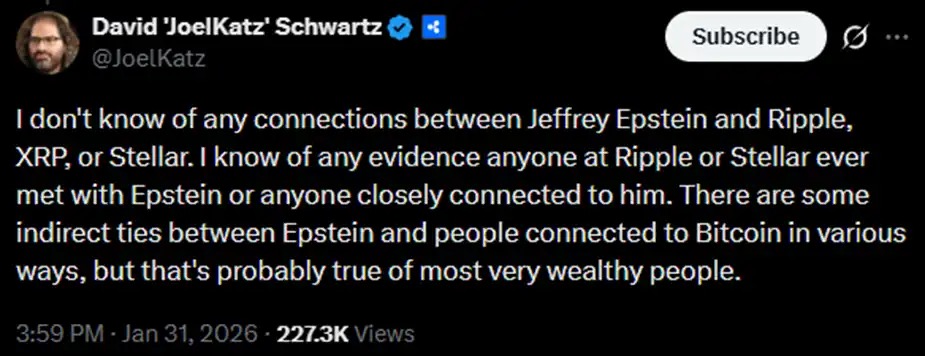
In response, former Ripple CTO David Schwartz tweeted, "I don't want to be a conspiracy theorist, but if this is just the tip of the iceberg, I wouldn't be surprised at all."
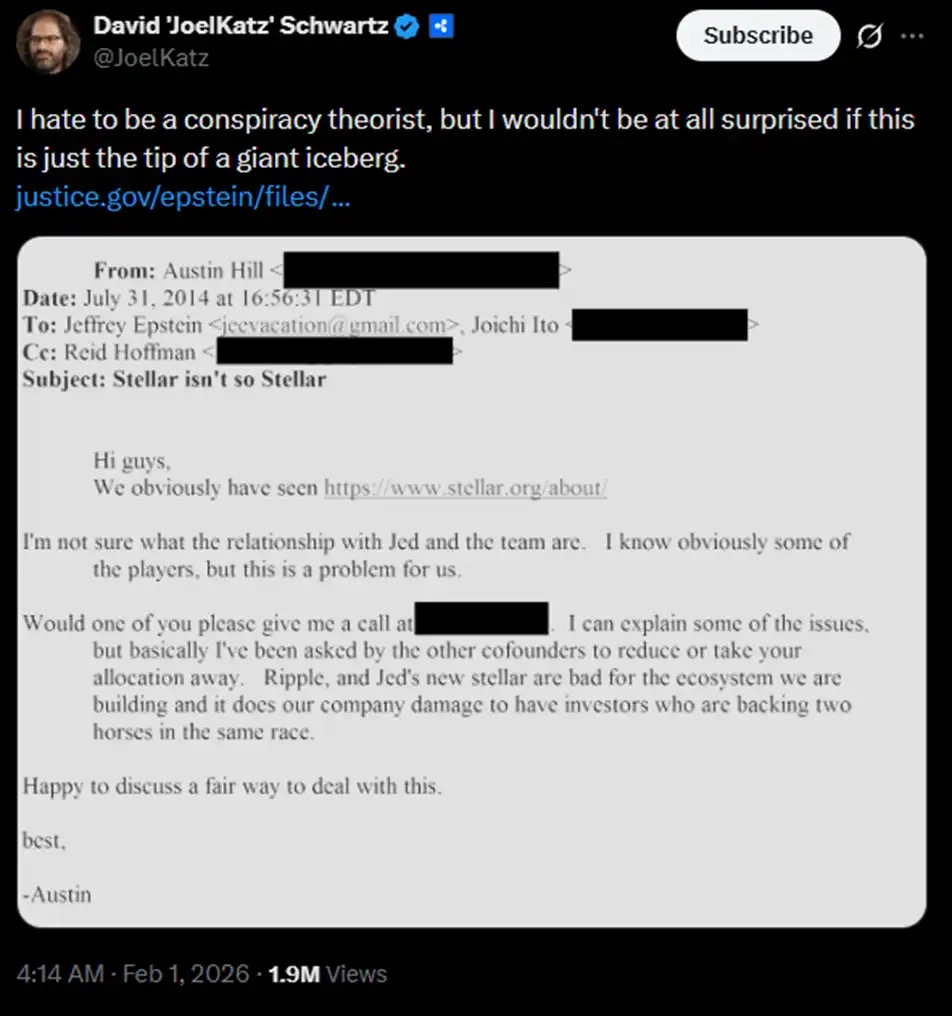
So, does this mean Epstein's evil also existed in the cryptocurrency field? David Schwartz also stated that for most ultra-wealthy individuals, having some connection to Bitcoin is probably very common.
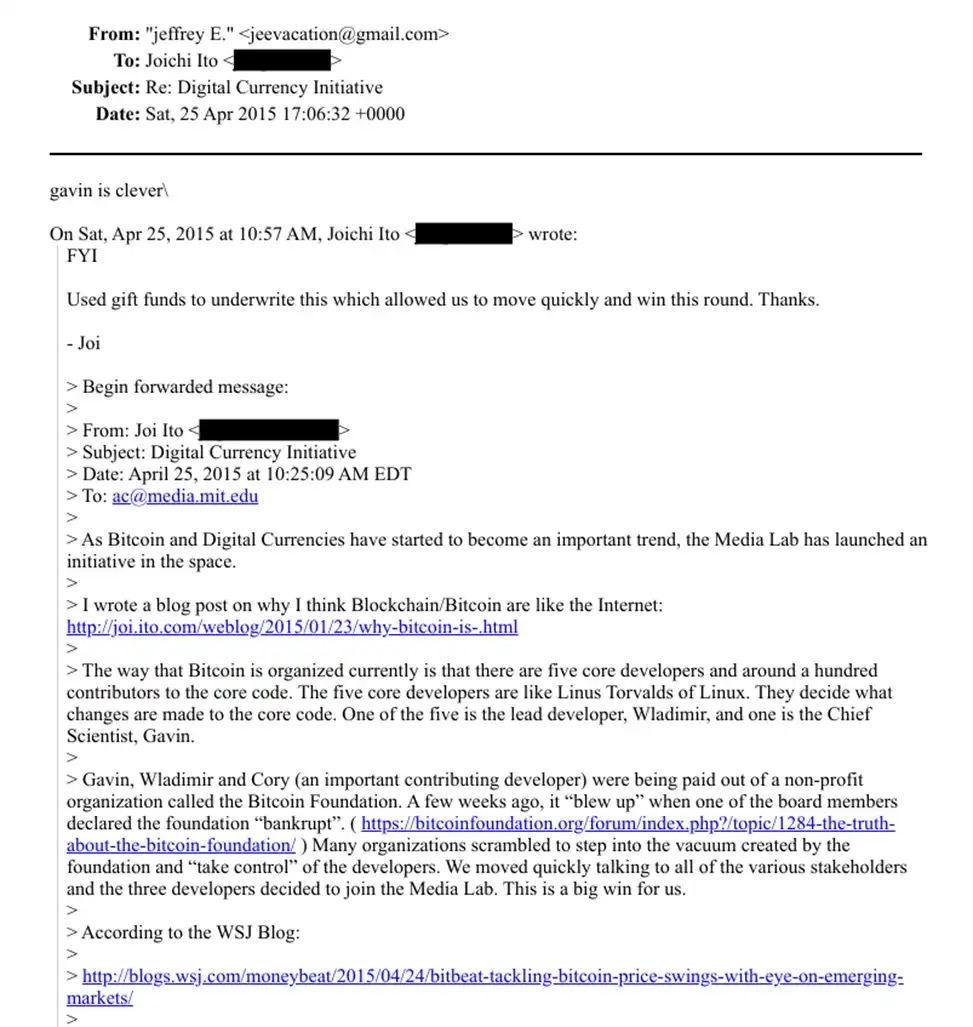
Furthermore, in 2014-2015, the collapse of the Bitcoin Foundation left Bitcoin Core developers without stable salaries. The MIT Media Lab's Digital Currency Initiative (DCI) began paying salaries to several Bitcoin Core developers. As a result, three Bitcoin Core developers—Gavin Andresen, Wladimir van der Laan, and Cory Fields—decided to join the MIT Media Lab.

At that time, the scandal had not yet broken, and the public was unaware of Epstein's anonymous donations to the MIT Media Lab. Joi Ito thanked Epstein via email, not only explaining Bitcoin's development operations to Epstein but also stating that thanks to this money, the lab was "able to move quickly and score a huge victory" because "many organizations wanted to take advantage of the situation to control Bitcoin's developers."

Epstein's reply was a simple compliment about Gavin Andresen: "Gavin is very smart."
Did Epstein Meet Satoshi?

In 2016, Epstein emailed Saudi Royal Court advisor Raafat AlSabbagh and current Abu Dhabi Department of Culture and Tourism advisor Aziza Al Ahmadi with two "radical ideas for creating two new currencies." One was a "Sharia" dollar. Just as all U.S. dollar bills have "In God We Trust," the Middle East could have its own "Sharia" dollar for internal use.
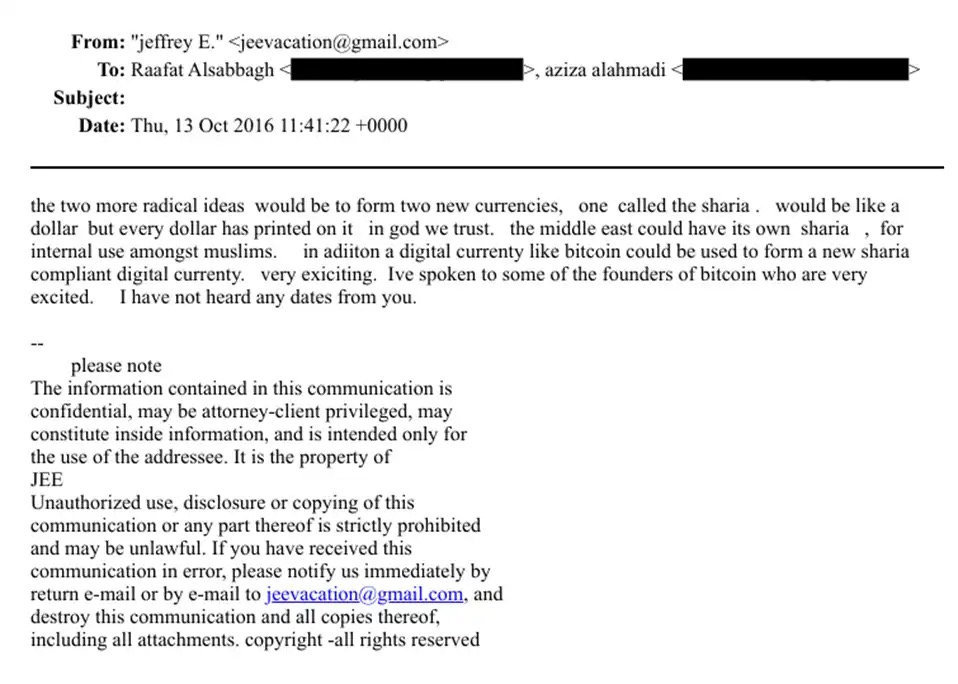
The other idea was to create a digital currency like Bitcoin to make money compliant with Sharia law. Then, after this idea, he casually and lightly dropped this piece of information:

"I have spoken with some of the Bitcoin creators, and they are very excited."

Epstein's purpose at the time might have been more about showing off his connections to enhance his reliable image, so he mentioned it offhand. But this could completely rewrite the history of Bitcoin and even the entire cryptocurrency industry. "Some Bitcoin creators"—does this mean Satoshi Nakamoto was not an individual but a team? If so, many mysteries surrounding Satoshi Nakamoto would have a reasonable explanation.

There are even more thought-provoking questions. Who was this team? What was their motivation for creating Bitcoin? If Epstein really met them, how did he initially find out who they were and establish a relationship with them? If even Epstein knew who created Bitcoin, wouldn't the U.S. government know? What motives does the U.S. government, which has remained silent on this issue, have?

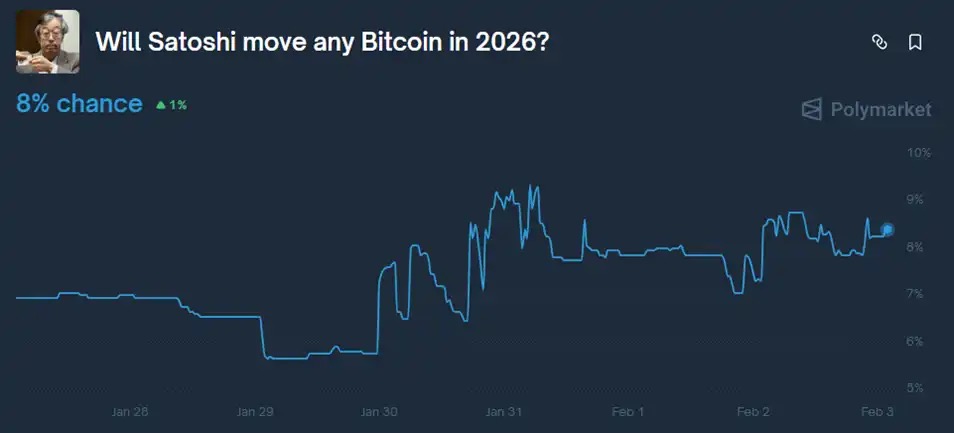
After this latest batch of Epstein files was disclosed, the possibility of "Satoshi Nakamoto's Bitcoin address taking action in 2026" on the prediction market Polymarket rose from about 6% to about 9.3% and is currently holding at 8%.
If Epstein did meet Satoshi Nakamoto, it seems Satoshi was not successful in evangelizing Bitcoin to him during their contact. In an email exchange on August 31, 2017, when asked "Is it worth buying a Bitcoin?" Epstein simply said "No." At that time, one Bitcoin was less than $5,000.

Whether Epstein actually met Satoshi Nakamoto is still unknown. However, we do know that he met the now most famous Bitcoin bull—MicroStrategy CEO Michael Saylor.

For years, Saylor's determination to only buy and never sell Bitcoin has been堪称变态 (abnormal/perverse, used here for emphasis on his extreme behavior). But in 2010, he was not yet famous for this identity.

That year, Comrade Saylor spent $25,000 to attend a party organized by Epstein's publicist Peggy Siegal and initially displayed his "autistic" traits at the event. This is how Peggy Siegal described Saylor:
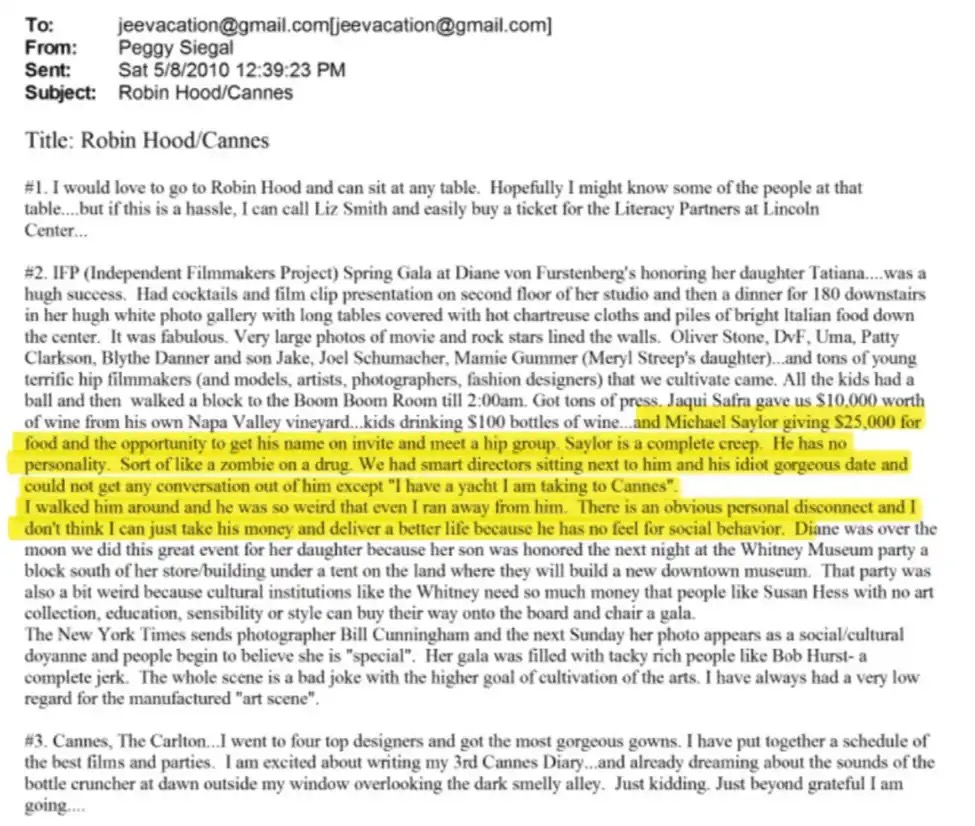
"This guy is a total freak, completely charmless, like a zombie on a drug overdose. We had smart directors at our party, sitting right next to him and his pretty, idiotic chick, and besides 'I have a yacht' and 'I'm going to Cannes,' there was no conversation. I took him around, but he was so weird I just had to run away. He has no personality and no social skills. I don't even know how to get money from him."

Being called变态 (freak/weirdo) by a变态 (freak/weirdo, referring to Epstein's associates) shows just how变态 Saylor) Saylor really is. Perhaps only a creation as great as Bitcoin could accommodate a变态 like Saylor and allow him to build a great career.

Conclusion

About half of the Epstein files have not yet been disclosed. How many more bombshells related to the cryptocurrency industry are hidden in these remaining files?

Will time clear the fog?


Twitter:https://twitter.com/BitpushNewsCN

Bitpush TG Discussion Group:https://t.me/BitPushCommunity

Bitpush TG Subscription: https://t.me/bitpush

Original link:https://www.bitpush.news/articles/7608204

Domande pertinenti

QWhat was Jeffrey Epstein's initial opinion on Bitcoin in 2011, and what did he identify as its key issue?

AIn 2011, Jeffrey Epstein described Bitcoin as 'a brilliant idea' but noted that it had 'some serious drawbacks.'

QWhich prominent Bitcoin infrastructure company did Epstein invest in through a fund, and what was the controversy surrounding his involvement?

AEpstein invested in Blockstream's seed round through a fund, initially putting in $50,000 which grew to $500,000. Blockstream's CEO later denied any direct or indirect financial ties, stating Epstein was a limited partner in a fund that held a minority stake and had fully divested.

QWhat startling claim did Epstein make in a 2016 email regarding the creators of Bitcoin?

AIn a 2016 email, Epstein claimed, 'I have been meeting with some of the bitcoin creators and they are very excited,' suggesting he may have had contact with Satoshi Nakamoto or the founding team.

QHow did Epstein's associate, Peggy Siegal, describe MicroStrategy CEO Michael Saylor after meeting him at a party?

APeggy Siegal described Michael Saylor as a 'complete freak' with 'no charm,' comparing him to a 'zombie on too many drugs.' She found him socially awkward and difficult to engage with.

QWhat role did Epstein's donations to the MIT Media Lab play in the Bitcoin ecosystem?

AEpstein's anonymous donations to the MIT Media Lab allowed its Digital Currency Initiative (DCI) to fund the salaries of key Bitcoin Core developers like Gavin Andresen, Wladimir van der Laan, and Cory Fields, which the lab's director saw as a crucial move to prevent other organizations from controlling the developers.

Letture associate

In-Depth Report on the On-Chain Lending Market: When Off-Chain Credit Meets On-Chain Liquidation

The on-chain lending market has evolved from a peripheral DeFi niche into core financial infrastructure. As of early 2026, total value locked (TVL) in on-chain lending protocols has reached $64.3 billion, accounting for 53.54% of total DeFi TVL, making it the largest and most mature vertical within decentralized finance. Aave dominates the sector with approximately $32.9 billion in TVL, commanding nearly half of the market—a leadership position that is unlikely to be challenged in the foreseeable future. However, the path of on-chain lending forward is not without risk. Liquidation cascades, credit defaults, and cross-chain vulnerabilities remain systemic threats hanging over the industry. At the same time, a deeper structural transformation is underway: on-chain lending is shifting from a “leverage tool for crypto-native users” to a “compliant gateway for institutional capital”. The scale of RWA (Real World Asset) lending has surpassed $18.5 billion, with U.S. Treasuries and government securities increasingly serving as core collateral. Institutional capital inflows are reshaping both the user base and risk appetite of the sector. This report systematically analyzes the evolution of on-chain lending definitions, competitive dynamics, core risks, and future trends, providing a comprehensive industry outlook for investors and trade practitioners. Key findings suggest that the “one dominant player with several strong challengers” structure will persist in the short term, while fixed-rate lending, compliant collateral, and institutional credit underwriting will define the next phase of competition. For investors focused on DeFi infrastructure, three key opportunity tracks stand out, namely, the Aave ecosystem (Morpho, Spark), RWA lending protocols (Ondo, Maple) and fixed-rate innovation (Notional, Pendle).

HTX Learn7 min fa

In-Depth Report on the On-Chain Lending Market: When Off-Chain Credit Meets On-Chain Liquidation

HTX Learn7 min fa

Fu Peng's First Public Speech in 2026: What Exactly Are Crypto Assets? Why Did I Join the Crypto Asset Industry?

Fu Peng, a renowned macroeconomist and now Chief Economist at New火 Group, delivered his first public speech of 2026 at the Hong Kong Web3 Festival. He explained his perspective on crypto assets and why he joined the industry, framing it within the context of macroeconomic trends and financial evolution. Fu emphasized that crypto assets are transitioning from an early, belief-driven phase to a mature, institutionally integrated asset class. He drew parallels to the 1970s-80s, when technological advances (like computing) revolutionized traditional finance, leading to the rise of FICC (Fixed Income, Currencies, and Commodities). Similarly, current advancements in AI, data, and blockchain are reshaping finance, with crypto assets becoming part of a new "FICC + C" (C for Crypto) framework. He noted that institutional capital, including traditional hedge funds, avoided early crypto due to its speculative nature but are now engaging as regulatory clarity emerges (e.g., stablecoin laws, CFTC classifying crypto as a commodity). Fu predicted that 2025-2026 marks a turning point where crypto becomes a standardized, financially viable asset for diversified portfolios, akin to commodities or derivatives in traditional finance. Fu defined Bitcoin not as "digital gold" in a simplistic sense but as a value-preserving, financially tradable asset. He highlighted that crypto's future lies in regulated, institutional adoption, moving away from retail-dominated trading. His entry into crypto signals this maturation, where traditional finance integrates crypto into mainstream asset management.

marsbit1 h fa

Fu Peng's First Public Speech in 2026: What Exactly Are Crypto Assets? Why Did I Join the Crypto Asset Industry?

marsbit1 h fa

Justin Sun Sues Trump Family: What $75 Million Bought Was Only a Blacklist

Justin Sun, founder of Tron, has filed a lawsuit in federal court against World Liberty Financial (WLF), alleging he was made the "primary target of a fraudulent scheme" after investing $75 million. Sun claims the investment secured him an advisor title and WLFI tokens, which were later frozen by WLF, causing "hundreds of millions in losses." The dispute began in late 2024 when Sun's investment helped revive WLF's struggling token sale, which ultimately raised $550 million. Shortly after, the SEC dropped its lawsuit against Sun following Donald Trump's inauguration. However, relations soured when Sun refused WLF's demands for additional funding. In August 2025, WLF added a "blacklist" function to its smart contract, allowing it to unilaterally freeze tokens. Sun's holdings, worth approximately $107 million, were frozen, and he was threatened with token destruction. The lawsuit highlights WLF's structure, which directs 75% of token sale profits to the Trump family, who had earned $1 billion by December 2025. WLF's CEO is Zach Witkoff, son of U.S. Middle East envoy Steve Witkoff. The project faces scrutiny for opaque operations, including a controversial loan arrangement on the Dolomite platform, co-founded by a WLF advisor. Despite Sun's history with the SEC, the case underscores centralization risks within DeFi, as WLF controls governance and holds powers to freeze assets arbitrarily. Sun's tokens remain frozen as legal proceedings begin.

marsbit1 h fa

Justin Sun Sues Trump Family: What $75 Million Bought Was Only a Blacklist

marsbit1 h fa

Trading

Spot
Futures

Articoli Popolari

Come comprare COOKIE

Benvenuto in HTX.com! Abbiamo reso l'acquisto di Cookie DAO (COOKIE) semplice e conveniente. Segui la nostra guida passo passo per intraprendere il tuo viaggio nel mondo delle criptovalute.Step 1: Crea il tuo Account HTXUsa la tua email o numero di telefono per registrarti il tuo account gratuito su HTX. Vivi un'esperienza facile e sblocca tutte le funzionalità,Crea il mio accountStep 2: Vai in Acquista crypto e seleziona il tuo metodo di pagamentoCarta di credito/debito: utilizza la tua Visa o Mastercard per acquistare immediatamente Cookie DAOCOOKIE.Bilancio: Usa i fondi dal bilancio del tuo account HTX per fare trading senza problemi.Terze parti: abbiamo aggiunto metodi di pagamento molto utilizzati come Google Pay e Apple Pay per maggiore comodità.P2P: Fai trading direttamente con altri utenti HTX.Over-the-Counter (OTC): Offriamo servizi su misura e tassi di cambio competitivi per i trader.Step 3: Conserva Cookie DAO (COOKIE)Dopo aver acquistato Cookie DAO (COOKIE), conserva nel tuo account HTX. In alternativa, puoi inviare tramite trasferimento blockchain o scambiare per altre criptovalute.Step 4: Scambia Cookie DAO (COOKIE)Scambia facilmente Cookie DAO (COOKIE) nel mercato spot di HTX. Accedi al tuo account, seleziona la tua coppia di trading, esegui le tue operazioni e monitora in tempo reale. Offriamo un'esperienza user-friendly sia per chi ha appena iniziato che per i trader più esperti.

170 Totale visualizzazioniPubblicato il 2025.07.23Aggiornato il 2025.07.23

Come comprare COOKIE

Discussioni

Benvenuto nella Community HTX. Qui puoi rimanere informato sugli ultimi sviluppi della piattaforma e accedere ad approfondimenti esperti sul mercato. Le opinioni degli utenti sul prezzo di COOKIE COOKIE sono presentate come di seguito.

活动图片