From Safe Haven to Risk Basket: Why Gold, Silver, and BTC Are Becoming Increasingly Similar?

marsbitPubblicato 2026-02-06Pubblicato ultima volta 2026-02-06

Introduzione

In January 2026, gold, silver, and Bitcoin experienced a synchronized sharp decline, challenging traditional asset classifications. The pricing of precious metals has shifted from physical demand to financialized markets, driven by the same macro factors—dollar liquidity, real interest rates, and risk appetite—that influence Bitcoin. Institutional investors and algorithmic trading systems now dominate marginal price movements, treating all three as "non-sovereign scarce assets" within the same risk basket. Silver, with its leverage and industrial role, acted as a volatility amplifier, while Bitcoin's decentralized narrative weakened due to institutionalization. Physical markets for gold and silver showed resilience with central bank buying and industrial demand, creating a two-tier structure: long-term support from physical buyers and short-term volatility from leveraged paper markets. The crypto ecosystem, including altcoins and DeFi, faces pressure as Bitcoin's value proposition aligns more with macro liquidity tools than decentralized ideals.

Author: Nikka / WolfDAO (X: @10xWolfdao)

In January 2026, gold, silver, and BTC plummeted simultaneously, breaking the classification of traditional safe-haven and speculative assets. The pricing power of precious metals has long shifted to financialized markets, driven by the same macro factors as BTC—such as dollar liquidity and real interest rates—and are bought and sold together by the same institutional funds. Silver, with its high leverage, acts as a volatility amplifier, and all three trigger leveraged liquidations at liquidity turning points. The paper market and physical market for precious metals are diverging, while BTC's decentralization narrative is being diluted by institutionalization, putting pressure on the crypto ecosystem.

Anomalous Synchronization

On January 30, 2026, gold plunged over 12% from its all-time high of $5,600 per ounce, marking its largest single-day drop in nearly 40 years. Silver fell even more sharply, dropping 27% in one day and another 6.7% the next day. Bitcoin fell below $75,000, touching the $70,000 range over the weekend, and as of this week, it has dropped below the $60,000 mark, with market panic intensifying.

In traditional understanding, this should not happen. Gold and silver are safe-haven assets—low volatility, risk-resistant, and wealth during crises. Bitcoin is a speculative asset—high volatility, high risk, and both loved and hated. They should fluctuate at different times, in different ways, and for different reasons.

But the real market is proving in the most direct way: this classification system has failed. At least in terms of pricing logic, precious metals and Bitcoin are being treated as the same type of asset.

The issue is not that gold and silver have "become unsafe" but that the forces determining their prices have fundamentally changed.

The Overlooked Shift

Let’s start with a key fact: The prices of gold and silver are no longer primarily determined by "safe-haven demand."
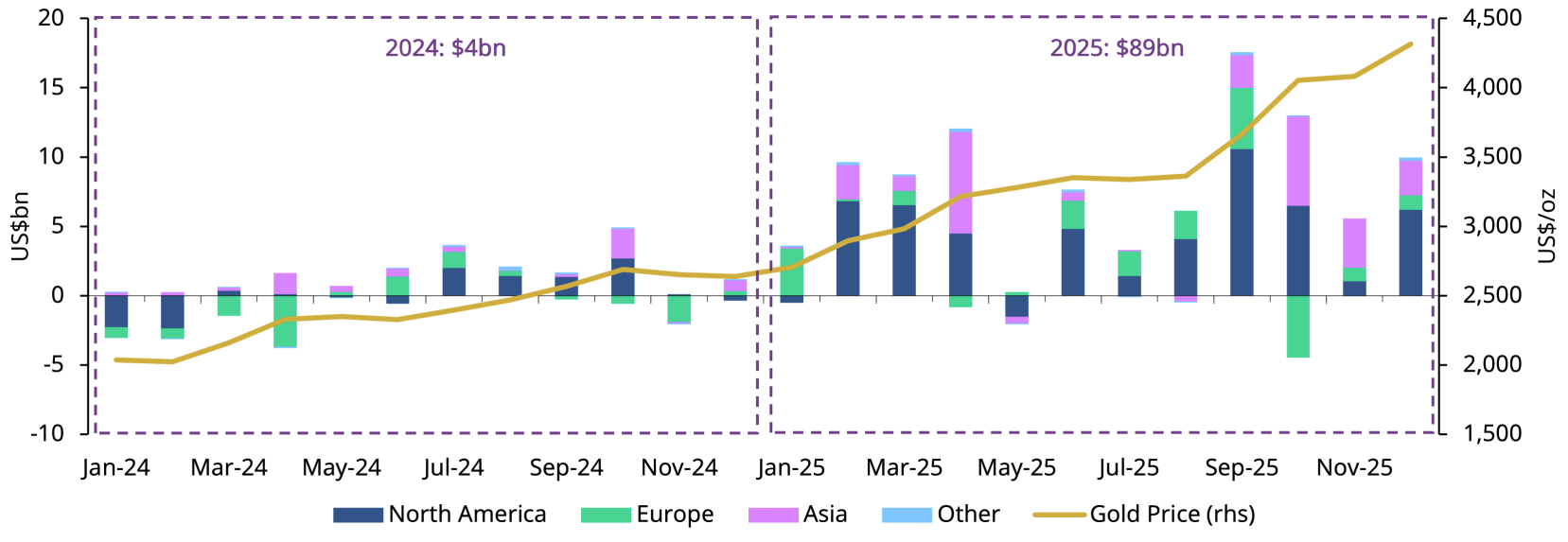
source: gold.org

In 2025, global gold ETF inflows hit a record $89 billion, doubling the assets under management to $559 billion. The proportion of gold in global financial assets has risen from its low in 2010 to 2.8% in the third quarter of 2025.

This 2.8% marks a profound structural shift: the pricing power of precious metals has shifted from physical demand to financialized markets.

Today, the marginal price fluctuations of gold and silver are driven by the same global macro funds: hedge funds, CTA strategies, systematic trend funds, and cross-market institutional accounts. These funds don’t care about "whether gold is a safe haven"; they only care about three variables:

  • Dollar liquidity
  • Real interest rates
  • The pace of risk appetite changes

JP Morgan research shows that changes in U.S. Treasury yields can explain about 70% of gold’s quarterly price fluctuations. This means gold pricing has become highly macro-driven and systematic. When you see gold price movements, they are no longer driven by India’s wedding season or Chinese retail investors’ buying enthusiasm but by Wall Street’s quantitative models and algorithmic trading systems.

The Same Button

This explains why gold, silver, and Bitcoin have recently fluctuated sharply at the same time.

They are all exposed to the same macro factor: violent swings in global liquidity expectations.

When the market bets on rate cuts, a weaker dollar, or diluted purchasing power, these three assets are bought simultaneously—not because they are "safe havens" but because, in quantitative models, they are all "non-sovereign scarce assets."

When inflation proves sticky, rate expectations rebound, the dollar strengthens, or risk models trigger deleveraging, they are sold off simultaneously—not because they are "high risk" but because they are in the same risk basket.

Price fluctuations are not due to "changes in asset attributes" but because the participants and trading methods driving pricing have become homogenized.

January 30 is the best proof. Trump nominated Kevin Warsh as Fed chair, which the market interpreted as a hawkish signal. The dollar rebounded, and immediately:

  • Gold fell from $5,600 to below $4,900
  • Silver plummeted from $120 to $75
  • Bitcoin slid from $88,000 to $81,000

Three assets, same moment, same direction, same violence. This is not a coincidence but direct evidence that they are priced by the same trading system.

Silver: The Amplifier Effect

Silver’s performance is particularly representative.

Compared to gold, silver has dual attributes as both a precious metal and an industrial metal, with higher leverage and more fragile liquidity. By the end of 2025, silver’s 30-day realized volatility surged above 50%, while Bitcoin’s compressed to the 40% range—a significant reversal.

Silver’s rapid rally and sharp decline were essentially due to concentrated inflows and outflows of macro long positions, not any structural change in fundamentals over the short term. In January 2026, the Chicago Mercantile Exchange raised silver futures margin requirements from historical lows to 15–16.5%, ending the era of low-cost "paper silver" speculation.

When prices fell, highly leveraged speculators couldn’t meet the new margin requirements and were forced to liquidate. This triggered cascading liquidations—prices fell further, and more positions were forcibly closed. This "margin trap" is identical to the 1980 move to crush the Hunt Brothers’ silver accumulation by raising margins.

This price action is almost identical to Bitcoin’s behavior near liquidity turning points.

The Truth of the Paradox

This also explains a seemingly contradictory phenomenon: safe-haven assets plummet when "risk arrives."

The reason is not that they have lost their safe-haven attributes but that when systemic risk rises to a certain level, the market prioritizes "cash" and "liquidity" over "long-term preservation logic."

When volatility spikes, liquidity often evaporates. Market makers narrow quote sizes, spreads widen, and price gaps appear. In such an environment, all highly financialized, quickly liquidatable assets with leveraged exposure are sold off simultaneously—whether they are called gold, silver, or Bitcoin.

As Saxo Bank’s Ole Hansen said: "Volatility reinforces itself." When prices fluctuate violently, market structure takes over everything. In this cycle, the "intrinsic attributes" of assets play almost no role.

A Tale of Two Markets

But this is not the whole truth.

While the paper market crashed, the physical market showed opposite signals. After silver’s plunge, physical silver premiums in Shanghai and Dubai soared to $20 above the Western spot price. Major silver miner Fresnillo has cut its 2026 production guidance to 42–46.5 million ounces. Industrial demand (solar, electric vehicles, semiconductors) remains strong.

This split reveals a key contradiction:

  • Paper market: Highly financialized, extremely volatile, driven by macro funds
  • Physical market: Supply-constrained, demand-supported, relatively stable

The same split exists in the gold market. In 2026, central banks are still expected to buy 750–950 tons of gold, marking the third consecutive year of purchases exceeding 1,000 tons. These "traditional" buyers—mainly emerging market central banks—buy gold for dedollarization, reserve diversification, and long-term value storage. They don’t engage in short-term trading, don’t use leverage, and aren’t forced to liquidate by margin calls.

This creates a two-tier structure:

  • Long-term floor: Central banks provide sustained buying, setting a price bottom
  • Short-term volatility: Institutional investors and algorithms dominate marginal pricing, creating extreme fluctuations

Narrative Collapse

A deeper issue: The narrative system long relied upon by the crypto market is collapsing.

The "decentralized safe haven" narrative is being diluted by institutionalization. When Bitcoin falls sharply over weekends with thin liquidity, it is largely due to leveraged trading and futures market liquidations—products of centralized finance. The fundamentalists who hold private keys and adhere to "not your keys, not your coins" have long been marginalized in pricing power.

This change affects not just Bitcoin but the entire crypto ecosystem.

Altcoins face greater pressure: If even Bitcoin has lost its unique value proposition and is grouped into the "macro liquidity trading tool" basket, where will altcoins with weaker narratives and more fragile fundamentals go? When institutions allocate crypto assets, will they choose the already "tamed" BTC or risk investing in Ethereum, Solana, or other public chains?

Ethereum fell 4% to $2,660 during the same period, underperforming Bitcoin. This hints at a brutal possibility: in macro risk models, funds will flow集中 to "the gold of the crypto market" (BTC) and abandon assets seen as "the silver or copper of the crypto market."

DeFi’s paradox: Decentralized finance was once seen as the most revolutionary innovation in crypto, promising lending, trading, and other services without relying on traditional financial intermediaries. But if the underlying assets (BTC, ETH) are entirely priced by traditional financial markets, how much "decentralization" do DeFi protocols really have left?

You can trade using decentralized protocols, but if price discovery happens on Wall Street trading desks, Chicago futures markets, and quantitative model servers, this decentralization is only superficial.


Domande pertinenti

QWhy did gold, silver, and Bitcoin experience a synchronized sharp decline in January 2026, breaking traditional asset classifications?

AThey experienced a synchronized sharp decline because their pricing is now driven by the same macro factors—such as dollar liquidity, real interest rates, and risk appetite—and are traded by the same institutional funds using similar quantitative models and algorithmic systems, rather than their traditional roles as safe-haven or speculative assets.

QWhat key structural shift in the precious metals market has led to gold and silver being priced like financial assets rather than physical commodities?

AThe key structural shift is the financialization of the precious metals market, where pricing power has moved from physical demand to financial markets. Global gold ETF inflows reached a record $89 billion in 2025, and institutional investors like hedge funds and CTAs now drive marginal price movements based on macro factors, not physical supply and demand.

QHow does silver act as a 'volatility amplifier' compared to gold and Bitcoin in the current market structure?

ASilver acts as a volatility amplifier due to its high leverage, lower liquidity, and dual role as both a precious and industrial metal. Its leverage makes it more susceptible to margin calls and cascading liquidations during market stress, as seen when CME raised margin requirements in January 2026, triggering sharp price swings.

QWhat contradiction exists between the 'paper market' and the 'physical market' for assets like gold and silver?

AThe paper market is highly financialized, driven by macro funds and algorithms, leading to extreme volatility and leverage-induced price swings. In contrast, the physical market is supported by steady demand from banks and industrial users, with central banks buying gold for long-term reserve diversification, creating a stable price floor despite paper market turbulence.

QHow has the institutionalization of Bitcoin diluted its 'decentralized haven' narrative and impacted the broader ecosystem?

AInstitutionalization has diluted Bitcoin's decentralized narrative because its price is now heavily influenced by traditional financial mechanisms like futures markets, leverage trading, and macro liquidity factors. This shift marginalizes core 'not your keys, not your coins' holders and pressures the broader crypto ecosystem, as altcoins and DeFi protocols lose their unique value propositions when underlying asset pricing is dominated by Wall Street.

Letture associate

Anthropic Starts Poaching Scientists? $27K Weekly Onsite Stipend to Fix Claude's Expert-Level Errors

Anthropic has launched a new STEM Fellow program, offering $3,800 per week for a three-month, in-person residency in San Francisco. The role targets experts from science, technology, engineering, and mathematics (STEM) fields—machine learning experience is helpful but not required. Instead, Anthropic values scientific judgment and a willingness to learn quickly. Fellows will work with Claude models and internal tools under the guidance of an Anthropic researcher. Example projects include a materials scientist identifying errors in Claude’s reasoning or a climate scientist integrating atmospheric modeling software with Claude. The goal is to have experts "tell Claude where it's wrong" and improve its scientific capabilities. This initiative is part of Anthropic’s broader strategy to strengthen its scientific ecosystem, following earlier programs like the AI Safety Fellows and AI for Science programs. The company acknowledges that current AI models, while powerful, still produce high-confidence errors and lack end-to-end research autonomy. The program aims to embed domain expertise directly into model development, turning scientists into "high-level reviewers" for AI. Anthropic CEO Dario Amodei has previously emphasized AI’s potential to accelerate scientific breakthroughs, particularly in biology and healthcare. The company believes that the next phase of AI competition will depend not on scaling parameters, but on integrating human expertise to refine model accuracy and reliability.

marsbit28 min fa

Anthropic Starts Poaching Scientists? $27K Weekly Onsite Stipend to Fix Claude's Expert-Level Errors

marsbit28 min fa

On the Eve of X Money's Launch, Musk Dismantles the Referee First

"X Money Launches After Dismantling Regulator: Musk's 9-Day Power Play" In February 2025, a team from the "Department of Government Efficiency" (DOGE), led by Elon Musk, entered the Consumer Financial Protection Bureau (CFPB) headquarters. Shortly after, the CFPB was effectively dismantled—its funding frozen, activities suspended, and nearly 90% of staff laid off. This move came just nine days after X announced a partnership with Visa and as X Money prepared to launch. The article contrasts this with the decade-long regulatory battles faced by companies like Coinbase and PayPal. Coinbase spent over $75 million in political contributions and endured a major SEC lawsuit to operate legally. PayPal complied with strict state and federal rules for its stablecoin PYUSD, including 100% reserve requirements and monthly audits. However, Musk’s approach was different. After the CFPB introduced a rule placing large digital payment apps under federal oversight, Musk tweeted "Delete CFPB." Within months, the rule was revoked by Congress. Meanwhile, DOGE operatives gained "god-tier" access to CFPB databases, potentially obtaining sensitive competitive information from rivals like Apple, Google, and PayPal. The article also highlights a "suspicious exemption clause" in the GENIUS Act, which allows private companies like X to issue stablecoins with fewer restrictions. Senator Elizabeth Warren questioned whether Musk, who was a senior presidential advisor during the Act’s drafting, influenced this clause. X Money offers a 6% APY on deposits, despite FDIC warnings that stablecoin users are not insured. As X Money launches to 600 million monthly users, the article questions the fairness of a system where Musk can bypass regulations that others spent years and millions to comply with. The dismantling of the CFPB and the alleged regulatory advantages raise concerns about the future of equitable rule-making in the U.S. financial system.

marsbit37 min fa

On the Eve of X Money's Launch, Musk Dismantles the Referee First

marsbit37 min fa

Trading

Spot
Futures

Articoli Popolari

Cosa è BITCOIN

Comprendere HarryPotterObamaSonic10Inu (ERC-20) e la sua posizione nel mondo delle criptovalute Negli ultimi anni, il mercato delle criptovalute ha assistito a un aumento della popolarità delle meme coin, catturando l'interesse non solo dei trader, ma anche di coloro che cercano coinvolgimento comunitario e valore di intrattenimento. Tra questi token unici c'è HarryPotterObamaSonic10Inu (ERC-20), un progetto intrigante che mescola riferimenti culturali nel tessuto delle criptovalute. Questo articolo esplora gli aspetti chiave di HarryPotterObamaSonic10Inu, analizzando i suoi meccanismi, l'etica guidata dalla comunità e il suo coinvolgimento con il panorama crittografico più ampio. Che cos'è HarryPotterObamaSonic10Inu (ERC-20)? Come suggerisce il suo nome, HarryPotterObamaSonic10Inu è una meme coin costruita sulla blockchain di Ethereum, classificata secondo lo standard ERC-20. A differenza delle criptovalute tradizionali che possono enfatizzare l'utilità pratica o il potenziale investimento, questo token prospera grazie al valore di intrattenimento e alla forza della sua comunità. Il progetto mira a creare un ambiente in cui gli utenti coinvolti possono riunirsi, condividere idee e partecipare ad attività ispirate a diversi fenomeni culturali. Una caratteristica notevole di HarryPotterObamaSonic10Inu è la zero tassa sulle transazioni. Questo elemento allettante tende a incoraggiare il trading e il coinvolgimento della comunità, privo di costi aggiuntivi che possono scoraggiare i trader di piccole dimensioni. L'offerta totale della moneta è fissata a un miliardo di token, un numero che segna la sua intenzione di mantenere una circolazione sostanziale all'interno della comunità. Creatore di HarryPotterObamaSonic10Inu (ERC-20) Le origini di HarryPotterObamaSonic10Inu sono avvolte in un certo mistero; i dettagli sul creatore rimangono sconosciuti. Lo sviluppo di questo token non presenta un team identificabile o un piano esplicito, cosa non rara nel settore delle meme coin. Invece, il progetto è emerso organicamente, con il suo progresso fortemente dipendente dall'entusiasmo e dalla partecipazione della sua comunità. Investitori di HarryPotterObamaSonic10Inu (ERC-20) Per quanto riguarda investimenti esterni e finanziamenti, HarryPotterObamaSonic10Inu rimane ambiguo. Il token non elenca alcuna fondazione di investimento conosciuta o un sostegno organizzativo significativo. Invece, la linfa vitale del progetto è la sua comunità di base, che informa la sua crescita e sostenibilità attraverso azioni collettive e coinvolgimento nello spazio crittografico. Come funziona HarryPotterObamaSonic10Inu (ERC-20)? In quanto meme coin, HarryPotterObamaSonic10Inu opera principalmente al di fuori delle strutture tradizionali che governano spesso il valore degli asset. Ci sono diversi aspetti distintivi che definiscono il funzionamento del progetto: Transazioni senza tasse: Senza costi fiscali sulle transazioni, gli utenti possono comprare e vendere liberamente il token senza preoccuparsi di costi nascosti. Coinvolgimento della comunità: Il progetto prospera sull'interazione della comunità, sfruttando le piattaforme social per creare entusiasmo e facilitare il coinvolgimento. Discussioni, condivisione di contenuti e coinvolgimento sono elementi cruciali che aiutano ad espandere la sua portata e a favorire la lealtà tra i sostenitori. Nessuna utilità pratica: Va notato che HarryPotterObamaSonic10Inu non offre un'utilità concreta all'interno dell'ecosistema finanziario. Piuttosto, è classificato come un token principalmente per attività di intrattenimento e comunitarie. Riferimento culturale: Il token incorpora astutamente elementi della cultura pop per attirare interesse, collegandosi a appassionati di meme e seguaci delle criptovalute. HarryPotterObamaSonic10Inu esemplifica come le meme coin operino in modo diverso rispetto ai progetti di criptovalute più tradizionali, entrando nel mercato come costrutti sociali innovativi piuttosto che come asset utilitari. Cronologia di HarryPotterObamaSonic10Inu (ERC-20) La storia di HarryPotterObamaSonic10Inu è segnata da diversi traguardi notevoli: Creazione: Il token è emerso da un meme virale, catturando l'immaginazione di molti appassionati di criptovalute. Le date di creazione specifiche non sono disponibili, sottolineando la sua crescita organica. Inserimento negli scambi: HarryPotterObamaSonic10Inu ha fatto il suo ingresso in vari scambi, consentendo un accesso e un trading più facili da parte della comunità. Iniziative di coinvolgimento della comunità: Attività in corso volte a migliorare l'interazione della comunità, comprese gare, campagne sui social media e generazione di contenuti da parte di fan e sostenitori. Piani di espansione futura: La tabella di marcia del progetto include il lancio di una collezione NFT, merchandising e un sito di eCommerce relativo ai suoi temi culturali, coinvolgendo ulteriormente la comunità e cercando di aggiungere più dimensioni al suo ecosistema. Punti chiave su HarryPotterObamaSonic10Inu (ERC-20) Natura guidata dalla comunità: Il progetto dà priorità al contributo collettivo e alla creatività, garantendo che il coinvolgimento degli utenti sia al centro del suo sviluppo. Classificazione come meme coin: Rappresenta l'epitome delle criptovalute basate sull'intrattenimento, distinguendosi dai veicoli d'investimento tradizionali. Nessuna affiliazione diretta con Bitcoin: Nonostante la somiglianza nel nome del ticker, HarryPotterObamaSonic10Inu è distintivo e non ha alcuna relazione con Bitcoin o altre criptovalute consolidate. Focus sulla collaborazione: HarryPotterObamaSonic10Inu è progettato per creare uno spazio per la collaborazione e la condivisione di storie tra i suoi detentori, fornendo un canale per la creatività e il legame comunitario. Prospettive future: L'ambizione di espandersi oltre il suo presupposto iniziale verso NFT e merchandising delinea un percorso per il progetto per potenzialmente entrare in strade più mainstream all'interno della cultura digitale. Poiché le meme coin continuano a catturare l'immaginazione della comunità crittografica, HarryPotterObamaSonic10Inu (ERC-20) si distingue per i suoi legami culturali e il suo approccio centrato sulla comunità. Anche se potrebbe non adattarsi al modello tipico di un token orientato all'utilità, la sua essenza risiede nella gioia e nella camaraderia coltivate tra i suoi sostenitori, evidenziando la natura in evoluzione delle criptovalute in un'epoca sempre più digitale. Con la continuazione dello sviluppo del progetto, sarà importante osservare come le dinamiche della comunità influenzano la sua traiettoria nel panorama in continuo cambiamento della tecnologia blockchain.

1.1k Totale visualizzazioniPubblicato il 2024.04.01Aggiornato il 2024.12.03

Cosa è BITCOIN

Come comprare BTC

Benvenuto in HTX.com! Abbiamo reso l'acquisto di Bitcoin (BTC) semplice e conveniente. Segui la nostra guida passo passo per intraprendere il tuo viaggio nel mondo delle criptovalute.Step 1: Crea il tuo Account HTXUsa la tua email o numero di telefono per registrarti il tuo account gratuito su HTX. Vivi un'esperienza facile e sblocca tutte le funzionalità,Crea il mio accountStep 2: Vai in Acquista crypto e seleziona il tuo metodo di pagamentoCarta di credito/debito: utilizza la tua Visa o Mastercard per acquistare immediatamente BitcoinBTC.Bilancio: Usa i fondi dal bilancio del tuo account HTX per fare trading senza problemi.Terze parti: abbiamo aggiunto metodi di pagamento molto utilizzati come Google Pay e Apple Pay per maggiore comodità.P2P: Fai trading direttamente con altri utenti HTX.Over-the-Counter (OTC): Offriamo servizi su misura e tassi di cambio competitivi per i trader.Step 3: Conserva Bitcoin (BTC)Dopo aver acquistato Bitcoin (BTC), conserva nel tuo account HTX. In alternativa, puoi inviare tramite trasferimento blockchain o scambiare per altre criptovalute.Step 4: Scambia Bitcoin (BTC)Scambia facilmente Bitcoin (BTC) nel mercato spot di HTX. Accedi al tuo account, seleziona la tua coppia di trading, esegui le tue operazioni e monitora in tempo reale. Offriamo un'esperienza user-friendly sia per chi ha appena iniziato che per i trader più esperti.

3.6k Totale visualizzazioniPubblicato il 2024.12.12Aggiornato il 2025.03.21

Come comprare BTC

Cosa è $BITCOIN

ORO DIGITALE ($BITCOIN): Un'Analisi Completa Introduzione all'ORO DIGITALE ($BITCOIN) L'ORO DIGITALE ($BITCOIN) è un progetto basato su blockchain che opera sulla rete Solana, con l'obiettivo di combinare le caratteristiche dei metalli preziosi tradizionali con l'innovazione delle tecnologie decentralizzate. Sebbene condivida un nome con Bitcoin, spesso definito “oro digitale” a causa della sua percezione come riserva di valore, l'ORO DIGITALE è un token separato progettato per creare un ecosistema unico all'interno del panorama Web3. Il suo obiettivo è posizionarsi come un asset digitale alternativo valido, anche se i dettagli riguardanti le sue applicazioni e funzionalità sono ancora in fase di sviluppo. Cos'è l'ORO DIGITALE ($BITCOIN)? L'ORO DIGITALE ($BITCOIN) è un token di criptovaluta esplicitamente progettato per l'uso sulla blockchain di Solana. A differenza di Bitcoin, che fornisce un ruolo di stoccaggio di valore ampiamente riconosciuto, questo token sembra concentrarsi su applicazioni e caratteristiche più ampie. Aspetti notevoli includono: Infrastruttura Blockchain: Il token è costruito sulla blockchain di Solana, nota per la sua capacità di gestire transazioni ad alta velocità e a basso costo. Dinamiche di Offerta: L'ORO DIGITALE ha un'offerta massima fissata a 100 quadrilioni di token (100P $BITCOIN), sebbene i dettagli riguardanti la sua offerta circolante siano attualmente non divulgati. Utilità: Sebbene le funzionalità precise non siano esplicitamente delineate, ci sono indicazioni che il token potrebbe essere utilizzato per varie applicazioni, potenzialmente coinvolgendo applicazioni decentralizzate (dApp) o strategie di tokenizzazione degli asset. Chi è il Creatore dell'ORO DIGITALE ($BITCOIN)? Attualmente, l'identità dei creatori e del team di sviluppo dietro l'ORO DIGITALE ($BITCOIN) rimane sconosciuta. Questa situazione è tipica tra molti progetti innovativi nel settore blockchain, in particolare quelli allineati con la finanza decentralizzata e i fenomeni delle meme coin. Sebbene tale anonimato possa favorire una cultura guidata dalla comunità, intensifica le preoccupazioni riguardo alla governance e alla responsabilità. Chi sono gli Investitori dell'ORO DIGITALE ($BITCOIN)? Le informazioni disponibili indicano che l'ORO DIGITALE ($BITCOIN) non ha alcun sostenitore istituzionale noto o investimenti di venture capital prominenti. Il progetto sembra operare su un modello peer-to-peer incentrato sul supporto e sull'adozione della comunità piuttosto che su percorsi di finanziamento tradizionali. La sua attività e liquidità si trovano principalmente su exchange decentralizzati (DEX), come PumpSwap, piuttosto che su piattaforme di trading centralizzate consolidate, evidenziando ulteriormente il suo approccio di base. Come Funziona l'ORO DIGITALE ($BITCOIN) Le meccaniche operative dell'ORO DIGITALE ($BITCOIN) possono essere elaborate in base al suo design blockchain e alle caratteristiche della rete: Meccanismo di Consenso: Sfruttando il proof-of-history (PoH) unico di Solana combinato con un modello di proof-of-stake (PoS), il progetto garantisce una validazione efficiente delle transazioni contribuendo all'alta performance della rete. Tokenomics: Sebbene meccanismi deflazionistici specifici non siano stati dettagliati ampiamente, l'ampia offerta massima di token implica che potrebbe soddisfare microtransazioni o casi d'uso di nicchia che devono ancora essere definiti. Interoperabilità: Esiste il potenziale per l'integrazione con l'ecosistema più ampio di Solana, inclusi vari piattaforme di finanza decentralizzata (DeFi). Tuttavia, i dettagli riguardanti integrazioni specifiche rimangono non specificati. Cronologia degli Eventi Chiave Ecco una cronologia che evidenzia traguardi significativi riguardanti l'ORO DIGITALE ($BITCOIN): 2023: Il dispiegamento iniziale del token avviene sulla blockchain di Solana, contrassegnato dal suo indirizzo di contratto. 2024: L'ORO DIGITALE guadagna visibilità poiché diventa disponibile per il trading su exchange decentralizzati come PumpSwap, consentendo agli utenti di scambiarlo contro SOL. 2025: Il progetto assiste a un'attività di trading sporadica e a un potenziale interesse per impegni guidati dalla comunità, sebbene non siano state documentate partnership significative o avanzamenti tecnici fino ad ora. Analisi Critica Punti di Forza Scalabilità: L'infrastruttura sottostante di Solana supporta alti volumi di transazioni, il che potrebbe migliorare l'utilità di $BITCOIN in vari scenari di transazione. Accessibilità: Il potenziale basso prezzo di trading per token potrebbe attrarre investitori al dettaglio, facilitando una partecipazione più ampia grazie a opportunità di proprietà frazionata. Rischi Mancanza di Trasparenza: L'assenza di sostenitori, sviluppatori o di un processo di audit pubblicamente noti potrebbe generare scetticismo riguardo alla sostenibilità e all'affidabilità del progetto. Volatilità del Mercato: L'attività di trading è fortemente dipendente dal comportamento speculativo, il che può comportare una significativa volatilità dei prezzi e incertezze per gli investitori. Conclusione L'ORO DIGITALE ($BITCOIN) emerge come un progetto intrigante ma ambiguo all'interno dell'evolvente ecosistema di Solana. Sebbene tenti di sfruttare la narrativa dell'“oro digitale”, la sua partenza dal ruolo consolidato di Bitcoin come riserva di valore sottolinea la necessità di una chiara differenziazione della sua utilità e struttura di governance. L'accettazione e l'adozione future dipenderanno probabilmente dall'affrontare l'attuale opacità e dalla definizione più esplicita delle sue strategie operative ed economiche. Nota: Questo rapporto comprende informazioni sintetizzate disponibili a ottobre 2023, e potrebbero essersi verificati sviluppi oltre il periodo di ricerca.

99 Totale visualizzazioniPubblicato il 2025.05.13Aggiornato il 2025.05.13

Cosa è $BITCOIN

Discussioni

Benvenuto nella Community HTX. Qui puoi rimanere informato sugli ultimi sviluppi della piattaforma e accedere ad approfondimenti esperti sul mercato. Le opinioni degli utenti sul prezzo di BTC BTC sono presentate come di seguito.

活动图片