From 'Safe Harbor' to 'Compliant Innovation': An Analysis of the Impact of the SEC's Innovation Exemption Policy

marsbitPubblicato 2025-12-15Pubblicato ultima volta 2025-12-15

Introduzione

From "Safe Harbor" to "Compliant Innovation": An Analysis of the SEC's Innovation Exemption Policy The U.S. SEC, under Chairman Paul Atkins, introduced the "Innovation Exemption" policy in July 2025, marking a historic shift from an "enforcement-as-regulation" approach to a proactive framework. This temporary exemption, set to take effect in January 2026, provides a 12–24 month grace period for crypto projects (exchanges, DeFi protocols, stablecoin issuers, DAOs) to operate with simplified disclosures instead of full SEC registration, reducing initial compliance burdens. The exemption is principle-based, requiring basic investor protections like periodic reporting, risk disclosures, investment limits, and adherence to technical standards such as ERC-3643 for identity verification. It operates alongside congressional efforts like the CLARITY Act (clarifying SEC/CFTC jurisdiction) and the enacted GENIUS Act (regulating stablecoins under banking rules). Reactions are polarized: startups and institutions welcome the lower entry costs and regulatory clarity, which attract capital and foster innovation. However, the DeFi community warns that mandatory KYC/AML and transfer restrictions risk "traditionalizing" decentralized protocols. Traditional financial institutions oppose it, fearing regulatory arbitrage. Globally, this flexible U.S. model contrasts with the EU’s pre-authorization MiCA regime, forcing companies into dual compliance strategies. The exemption positions the U.S....

Author: @BlazingKevin_, the Researcher at Movemaker

Introduction: A Historic Regulatory Turning Point

The cryptocurrency industry witnessed a historic turning point in the U.S. regulatory environment in 2025. After a prolonged period of "regulation by enforcement" that created significant legal uncertainty, the new SEC Chairman Paul Atkins launched the "Crypto Project" initiative in July 2025, aiming to modernize securities regulation and support the administration's vision of positioning the U.S. as the "global capital center for crypto."

A core initiative of this new regulatory paradigm is the introduction of the Innovation Exemption policy. Designed as a time-limited regulatory relief, this exemption aims to allow nascent crypto technologies and products to enter the market quickly while mitigating initial compliance burdens, pending the SEC's finalization of permanent rules for digital assets. Atkins has confirmed that the exemption rule is expected to take effect officially in January 2026. The release of this policy signal marks a shift by U.S. regulators from reactive responses to proactive construction, seeking a more resilient balance between investor protection and industry innovation.

This article will provide an in-depth analysis of the core mechanisms of the SEC's Innovation Exemption, its strategic positioning within the overall U.S. crypto regulatory framework, assess the controversies and opportunities it has sparked in the market, and place it in a global context, particularly comparing it with the EU's MiCA regulation, to offer strategic advice for industry participants.

1. Core Mechanisms and Objectives of the Innovation Exemption

The core of the SEC's Innovation Exemption lies in providing a temporary "safe harbor" channel, allowing digital asset companies to operate without immediately bearing the full registration and disclosure burdens of traditional securities laws.

1.1 Scope and Duration of the Exemption

The Innovation Exemption has a broad scope of application; any entity developing or operating a business related to crypto assets can apply, including trading platforms, DeFi protocols, stablecoin issuers, and even DAOs.

  • Timeframe Design: The exemption period is typically set for 12 to 24 months, intended to provide project teams with a sufficient "incubation period" to encourage their networks to achieve "maturity" or "sufficient decentralization."
  • Simplified Registration: During the exemption period, projects only need to submit simplified information disclosures without completing complex and time-consuming S-1 registration documents. This mechanism is similar to the "on-ramp" design in the pending Congressional CLARITY Act, which would allow startups to raise up to $75 million annually from the public without fully complying with SEC registration requirements, provided they meet disclosure obligations.

1.2 Principles-Based Compliance Conditions

Atkins emphasized that this exemption will be principles-based rather than relying on rigid rules. Companies utilizing the exemption must still meet basic compliance standards and investor protection measures, such as:

  • Periodic Reporting and Review: Possibly requiring the submission of quarterly operational reports and undergoing periodic reviews by the SEC.
  • Investor Protection: For projects targeting retail investors, risk warnings and investment limits must be established.
  • Technical Standards: Conditions may include requiring projects to use whitelists or certified participant pools, or even adhere to standards-based restrictions like ERC-3643.

1.3 Token Classification and the "Decentralization" Test

The operation of the Innovation Exemption relies on the SEC's emerging token classification system, designed to determine which digital assets constitute securities based on the principles of the Howey Test.
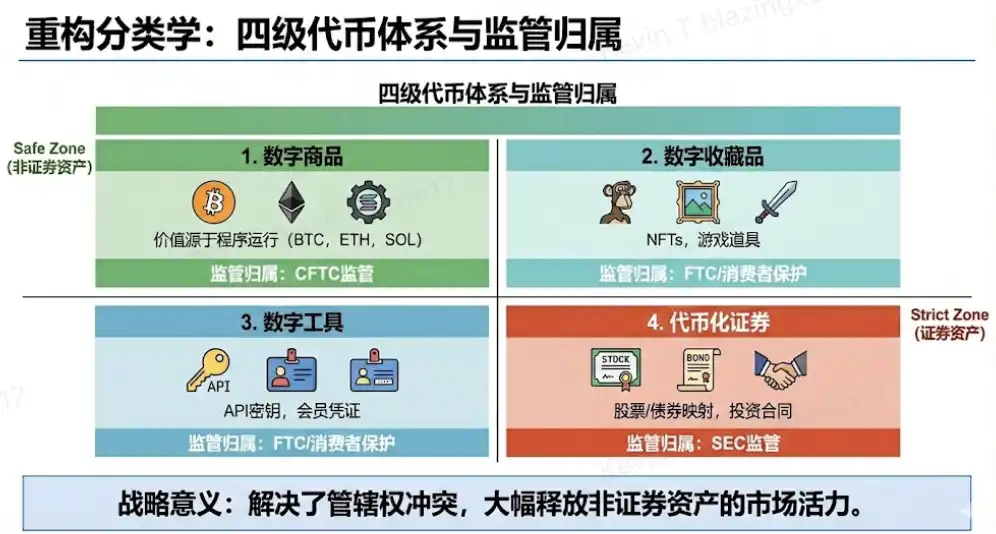
  • Classification System: The SEC categorizes digital assets into four main types: Commodity/Network Tokens (e.g., BTC), Utility Tokens, Collectibles (NFTs), and Tokenized Securities.
  • Exit Path: If the first three types of assets meet the conditions for "sufficient decentralization" or "functional completeness," they can exit the securities regulatory framework. Once the investment contract is deemed "terminated," even if a token was issued as a security initially, its subsequent trading is not automatically considered a "securities transaction." This model of control transfer provides a clear regulatory exit path for projects.
  • Significance of the Exemption: Under this framework, the SEC has been directed to clarify when digital assets constitute securities, emphasizing that most crypto assets are not securities, and even if they are, regulation should encourage, not hinder, their development.

2. Strategic Context of the Innovation Exemption: Synergy with Congressional Legislation

The SEC's Innovation Exemption is not an isolated administrative action; it forms part of the new U.S. crypto regulatory system alongside the two major legislative pillars advancing in Congress: the CLARITY Act and the GENIUS Act.

2.1 Clarifying Jurisdiction: Complementing the CLARITY Act

The CLARITY Act aims to resolve the long-standing jurisdictional conflict between the SEC and the Commodity Futures Trading Commission (CFTC).

  • Core Division: The CLARITY Act places primary issuance/fundraising activities under the SEC's jurisdiction, while explicitly granting regulatory authority over spot trading of digital commodities to the CFTC.
  • Mature Blockchain Test: The CLARITY Act introduces a "mature blockchain" test to determine when a project has achieved sufficient decentralization to qualify for lighter regulatory treatment (i.e., being treated as a digital commodity). This test includes criteria such as dispersed token ownership, governance participation, and functional independence from any single controlling group.
  • Exemption Coordination: The Innovation Exemption provides a temporary transitional period for those startup projects in an "intending to mature" state. It allows these projects to conduct limited fundraising and product testing through simplified disclosures while working towards full decentralization. This means the administrative exemption and the legislative draft's boundary划分 (demarcation) are highly synergistic: the exemption is a temporary administrative "pilot" permit, while the CLARITY Act provides a permanent legislative "graduation" standard.

2.2 Isolating the Stablecoin Framework: The Enactment of the GENIUS Act

The GENIUS Act was signed into law in July 2025, becoming the first comprehensive federal digital asset legislation in the U.S.

  • Status of Stablecoins: The GENIUS Act explicitly excludes payment stablecoins from the definitions of "security" or "commodity" under federal securities and commodity exchange laws, placing them under the supervision of banking regulators (like the OCC).
  • Issuance Requirements: The Act requires approved stablecoin issuers to maintain reserves in high-liquidity assets (only including U.S. dollars, Treasury bills, etc.) at a 1:1 ratio and prohibits paying interest or yields.
  • Regulatory Impact: Since the GENIUS Act has already clarified the regulatory framework and issuer qualifications for payment stablecoins, the SEC's Innovation Exemption will primarily focus on more innovative areas beyond stablecoins, such as DeFi protocols and novel network tokens, avoiding duplicate or conflicting regulations in the stablecoin space.

2.3 Inter-Agency Cooperation and Market Supervision

The SEC and CFTC announced they would enhance regulatory coordination through joint statements and joint roundtable discussions to address cross-agency jurisdictional uncertainties.

  • Spot Trading: A joint statement clarified that exchanges registered with both the SEC and CFTC are permitted to facilitate trading of certain spot crypto asset products, reflecting the regulators' willingness to encourage market participants' freedom to choose trading venues.
  • Exemption Coordination: One of the topics for discussion in the joint roundtables is the "Innovation Exemption" and DeFi regulation. This coordination is crucial for reducing compliance gaps for market participants.

3. The Risk of DeFi's "Traditionalization"

The introduction of the SEC's Innovation Exemption has sparked strong polarized reactions within the crypto industry.

3.1 Opportunities for Innovators and Compliant Actors
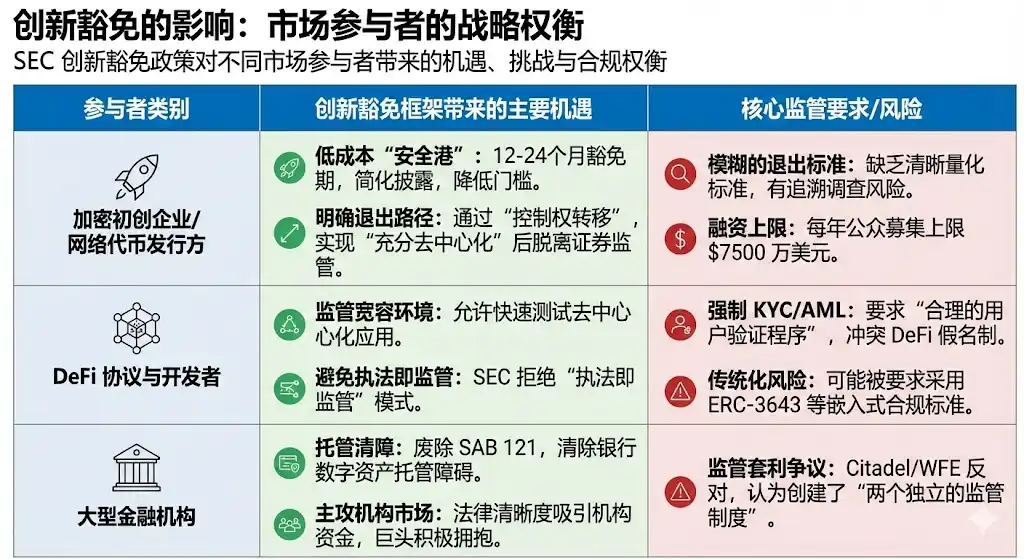
For startups and existing platforms seeking to operate compliantly within the U.S., the Innovation Exemption offers tangible benefits:

  • Reduced Entry Costs: Previously, a crypto project aiming for compliant operation in the U.S. could incur millions of dollars in legal fees and take over a year. The Innovation Exemption significantly lowers the compliance threshold and time cost for startup teams through simplified disclosure procedures and a clear transitional framework.
  • Attracting Venture Capital: Clear regulatory pathways will make projects that previously chose to "leave" or base themselves overseas due to regulatory ambiguity reconsider the U.S. market. Policy certainty helps attract institutional investors and venture capital, who value the ability to invest within a clear framework.
  • Promoting Product Innovation: The exemption period allows a range of new crypto concepts to be tested under the new framework, especially emerging DeFi and Web3 ecosystems. For instance, companies like ConsenSys can thrive in an environment of regulatory tolerance, enabling rapid testing of decentralized applications.
  • Beneficial for Large Institutions: Traditional financial giants (e.g., JPMorgan, Morgan Stanley) are actively embracing digital assets. The SEC's rescission of SAB 121 (an accounting standard that forced custodians to record clients' crypto assets as on-balance-sheet liabilities) removed a major obstacle for banks and trust companies to provide digital asset custody services at scale. Coupled with the administrative flexibility offered by the Innovation Exemption, these institutions can enter the crypto space with lower regulatory capital costs and a more defined legal path.

3.2 DeFi Community Concerns and "Traditionalization" Risks

The core controversy of the exemption policy lies in its impact on the ideals of decentralization:

  • Mandatory User Verification (KYC/AML): The new rules require all projects utilizing the exemption to implement "reasonable user verification procedures," meaning DeFi protocols need to implement KYC/AML procedures.
  • Protocol Splitting and Control: To comply, DeFi protocols might need to split liquidity pools into "permissioned pools" and "public pools," and be required to adopt compliant token standards like ERC-3643. ERC-3643 aims to embed identity verification and transfer restrictions into smart contracts. If every transaction requires a whitelist check and tokens can be frozen by a centralized entity, questions arise about whether DeFi remains truly DeFi. Industry leaders like the founder of Uniswap argue that regulating software developers as financial intermediaries will harm U.S. competitiveness and stifle innovation.

3.3 Opposition from Traditional Financial Institutions

The traditional financial industry has also expressed opposition to the "Innovation Exemption," fearing it creates "regulatory arbitrage."

  • Same Asset, Different Rules: The World Federation of Exchanges (WFE) and companies like Citadel Securities have written to the SEC urging it to abandon the "Innovation Exemption" plan, arguing that providing broad exemptions for tokenized securities creates two separate regulatory regimes for the same asset.
  • Insisting on Traditional Protections: The Securities Industry and Financial Markets Association (SIFMA) emphasized that tokenized securities must adhere to the same fundamental investor protection rules as traditional financial assets. They argue that relaxing regulations increases market risk and fraud.

4. Global Regulatory Comparison: Strategic Divergence Between U.S. and EU Models
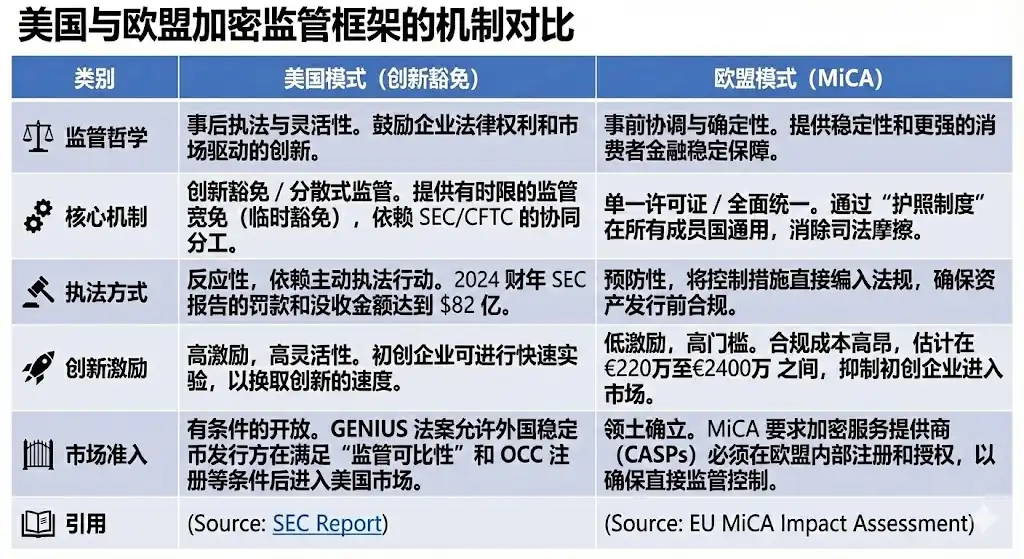
The SEC's Innovation Exemption and the more flexible U.S. model form one pole of global digital asset regulation, contrasting sharply with the ex-ante coordinated and unified model represented by the EU's MiCA (Markets in Crypto-Assets Regulation), with significant philosophical and operational differences between the two.

The "control transfer" philosophy of the U.S. Innovation Exemption and CLARITY Act stands in stark contrast to MiCA's "ex-ante authorization" model. The U.S. model tolerates initial uncertainty and higher risk exposure in exchange for speed and flexibility in innovation, which is most attractive to small and medium-sized fintech companies and startups. MiCA, conversely, provides large, established financial institutions (like JPMorgan) with a stable, predictable market across the EU through structural safeguards and uniform rules.

This regulatory divergence forces global companies to adopt a "market-by-market" dual compliance strategy to cope with the different classifications and operational requirements for the same product (e.g., a USD-pegged stablecoin) in the two major jurisdictions.

5. Market Outlook and Conclusion

The formal implementation of the SEC's Innovation Exemption policy is a critical step towards the maturation of the U.S. crypto regulatory system. It not only provides an administrative "safe harbor" but also profoundly influences the geographical flow of global digital asset innovation in the coming years, marking 2026 as the inaugural year of "compliant innovation." Armed with the unprecedented legal certainty granted by the Innovation Exemption and the CLARITY Act, the U.S. crypto industry will attract substantial institutional capital, accelerating the transformation of crypto assets from the fringes of traditional finance into a "structured asset class."

For industry participants eager to seize this policy红利 (dividend), the strategic focus must be clear: Startups should view the exemption period (12-24 months) as a window for low-cost, rapid entry into the U.S. market, but must treat "sufficient decentralization" as the ultimate operational goal. This means teams must design clear decentralization roadmaps based on "control," rather than relying on vague "ongoing efforts" standards. Projects failing to achieve verifiable decentralization on time will face high retrospective compliance risks. Furthermore, given the ongoing controversy surrounding the requirement for DeFi protocols to implement KYC/AML under the exemption policy, projects that cannot achieve full technical decentralization and are unwilling to adopt standards like ERC-3643 may need to consider exiting the U.S. retail market after the exemption period.

Despite breakthroughs at the administrative and legislative levels in the U.S., the challenge of global regulatory fragmentation remains severe. The divergence between the flexible U.S. model and the EU's strict, ex-ante MiCA model will continue to lead companies to engage in "regulatory arbitrage" globally. To create a level playing field and ensure consumer protection is not dependent on geography, the future development of the industry urgently requires international coordination. In the long term, a plausible prediction is that by 2030, major jurisdictions might converge towards adopting a common baseline framework, including unified AML/KYC standards and stablecoin reserve requirements, which would foster interoperability and institutional adoption worldwide.

The SEC's Innovation Exemption policy is a milestone in the U.S. regulatory system's shift from "vague suppression" to "clear regulation." It attempts to use administrative flexibility to compensate for legislative lag, providing a transitional path for digital assets to move towards compliance while maintaining vitality. For the crypto industry, the opening of this door for exploration means the era of wild growth has ended, and "compliant innovation" will become the core competency for navigating cycles. The next phase of crypto will no longer be built solely on code but will rely more heavily on clear asset classification and regulatory frameworks. The key to corporate success lies in the ability to steadfastly move towards verifiable decentralization and robust compliance baselines while enjoying the speed advantages brought by the exemption, thereby transforming regulatory complexity into a competitive advantage in the global market.


Domande pertinenti

QWhat is the core purpose of the SEC's Innovation Exemption policy as introduced in 2025?

AThe core purpose of the SEC's Innovation Exemption is to provide a time-limited regulatory reprieve, allowing nascent crypto technologies and products to enter the market quickly with reduced initial compliance burdens, while the SEC finalizes permanent rules for digital assets. It aims to foster innovation and find a more flexible balance between investor protection and industry growth.

QHow does the Innovation Exemption policy interact with the proposed CLARITY Act?

AThe Innovation Exemption acts as a temporary administrative 'on-ramp' or transition period for startups, allowing them to operate with simplified disclosures while they work towards achieving 'sufficient decentralization.' The CLARITY Act, in contrast, provides the permanent legislative 'graduation' criteria, such as the 'mature blockchain' test, to determine when a project can be regulated as a digital commodity under the CFTC rather than a security under the SEC. The two frameworks are highly synergistic.

QWhat are the key concerns raised by the DeFi community regarding the Innovation Exemption?

AThe DeFi community's primary concern is the 'traditionalization' risk, where the exemption's requirement for 'reasonable user verification procedures' (KYC/AML) forces DeFi protocols to implement identity checks. This could necessitate splitting liquidity pools into 'permissioned' and 'public' pools and adopting standards like ERC-3643, which embed transfer restrictions and freezing capabilities, fundamentally undermining the core principles of decentralization and permissionless access.

QHow does the US regulatory approach, exemplified by the Innovation Exemption, differ from the EU's MiCA regulation?

AThe US approach, with its Innovation Exemption and 'control transfer' model, emphasizes regulatory flexibility, speed, and tolerating initial uncertainty to foster innovation, which is attractive to startups. The EU's MiCA represents a 'pre-harmonization' model with strict, ex-ante authorization requirements and unified rules, providing predictability and stability that appeals to large, established financial institutions. This creates a strategic divergence leading to a 'market-by-market' compliance strategy for global firms.

QWhat is a critical strategic consideration for a startup planning to utilize the Innovation Exemption?

AA critical strategic consideration is to treat the exemption period (12-24 months) as a window for low-cost market entry but to have a clear decentralization roadmap with 'control transfer' as the ultimate operational goal. Failure to achieve verifiable decentralization by the end of the exemption period could result in high retrospective compliance risks. Projects unwilling to implement required KYC/AML may need to exit the US retail market post-exemption.

Letture associate

Trading

Spot
Futures

Articoli Popolari

Cosa è $S$

Comprendere SPERO: Una Panoramica Completa Introduzione a SPERO Mentre il panorama dell'innovazione continua a evolversi, l'emergere delle tecnologie web3 e dei progetti di criptovaluta gioca un ruolo fondamentale nel plasmare il futuro digitale. Un progetto che ha attirato l'attenzione in questo campo dinamico è SPERO, denotato come SPERO,$$s$. Questo articolo mira a raccogliere e presentare informazioni dettagliate su SPERO, per aiutare gli appassionati e gli investitori a comprendere le sue basi, obiettivi e innovazioni nei domini web3 e crypto. Che cos'è SPERO,$$s$? SPERO,$$s$ è un progetto unico all'interno dello spazio crypto che cerca di sfruttare i principi della decentralizzazione e della tecnologia blockchain per creare un ecosistema che promuove l'impegno, l'utilità e l'inclusione finanziaria. Il progetto è progettato per facilitare interazioni peer-to-peer in modi nuovi, fornendo agli utenti soluzioni e servizi finanziari innovativi. Al suo interno, SPERO,$$s$ mira a responsabilizzare gli individui fornendo strumenti e piattaforme che migliorano l'esperienza dell'utente nello spazio delle criptovalute. Questo include la possibilità di metodi di transazione più flessibili, la promozione di iniziative guidate dalla comunità e la creazione di percorsi per opportunità finanziarie attraverso applicazioni decentralizzate (dApps). La visione sottostante di SPERO,$$s$ ruota attorno all'inclusività, cercando di colmare le lacune all'interno della finanza tradizionale mentre sfrutta i vantaggi della tecnologia blockchain. Chi è il Creatore di SPERO,$$s$? L'identità del creatore di SPERO,$$s$ rimane piuttosto oscura, poiché ci sono risorse pubblicamente disponibili limitate che forniscono informazioni dettagliate sul suo fondatore o fondatori. Questa mancanza di trasparenza può derivare dall'impegno del progetto per la decentralizzazione—un ethos che molti progetti web3 condividono, dando priorità ai contributi collettivi rispetto al riconoscimento individuale. Centrando le discussioni attorno alla comunità e ai suoi obiettivi collettivi, SPERO,$$s$ incarna l'essenza dell'empowerment senza mettere in evidenza individui specifici. Pertanto, comprendere l'etica e la missione di SPERO rimane più importante che identificare un creatore singolo. Chi sono gli Investitori di SPERO,$$s$? SPERO,$$s$ è supportato da una varietà di investitori che vanno dai capitalisti di rischio agli investitori angelici dedicati a promuovere l'innovazione nel settore crypto. Il focus di questi investitori generalmente si allinea con la missione di SPERO—dando priorità a progetti che promettono avanzamenti tecnologici sociali, inclusività finanziaria e governance decentralizzata. Queste fondazioni di investitori sono tipicamente interessate a progetti che non solo offrono prodotti innovativi, ma contribuiscono anche positivamente alla comunità blockchain e ai suoi ecosistemi. Il supporto di questi investitori rafforza SPERO,$$s$ come un concorrente degno di nota nel dominio in rapida evoluzione dei progetti crypto. Come Funziona SPERO,$$s$? SPERO,$$s$ impiega un framework multifunzionale che lo distingue dai progetti di criptovaluta convenzionali. Ecco alcune delle caratteristiche chiave che sottolineano la sua unicità e innovazione: Governance Decentralizzata: SPERO,$$s$ integra modelli di governance decentralizzati, responsabilizzando gli utenti a partecipare attivamente ai processi decisionali riguardanti il futuro del progetto. Questo approccio favorisce un senso di proprietà e responsabilità tra i membri della comunità. Utilità del Token: SPERO,$$s$ utilizza il proprio token di criptovaluta, progettato per servire varie funzioni all'interno dell'ecosistema. Questi token abilitano transazioni, premi e la facilitazione dei servizi offerti sulla piattaforma, migliorando l'impegno e l'utilità complessivi. Architettura Stratificata: L'architettura tecnica di SPERO,$$s$ supporta la modularità e la scalabilità, consentendo un'integrazione fluida di funzionalità e applicazioni aggiuntive man mano che il progetto evolve. Questa adattabilità è fondamentale per mantenere la rilevanza nel panorama crypto in continua evoluzione. Coinvolgimento della Comunità: Il progetto enfatizza iniziative guidate dalla comunità, impiegando meccanismi che incentivano la collaborazione e il feedback. Nutrendo una comunità forte, SPERO,$$s$ può affrontare meglio le esigenze degli utenti e adattarsi alle tendenze di mercato. Focus sull'Inclusione: Offrendo basse commissioni di transazione e interfacce user-friendly, SPERO,$$s$ mira ad attrarre una base utenti diversificata, inclusi individui che potrebbero non aver precedentemente interagito nello spazio crypto. Questo impegno per l'inclusione si allinea con la sua missione generale di empowerment attraverso l'accessibilità. Cronologia di SPERO,$$s$ Comprendere la storia di un progetto fornisce preziose intuizioni sulla sua traiettoria di sviluppo e sui traguardi. Di seguito è riportata una cronologia suggerita che mappa eventi significativi nell'evoluzione di SPERO,$$s$: Fase di Concettualizzazione e Ideazione: Le idee iniziali che formano la base di SPERO,$$s$ sono state concepite, allineandosi strettamente con i principi di decentralizzazione e focus sulla comunità all'interno dell'industria blockchain. Lancio del Whitepaper del Progetto: Dopo la fase concettuale, è stato rilasciato un whitepaper completo che dettaglia la visione, gli obiettivi e l'infrastruttura tecnologica di SPERO,$$s$ per suscitare interesse e feedback dalla comunità. Costruzione della Comunità e Prime Interazioni: Sono stati effettuati sforzi attivi di outreach per costruire una comunità di early adopters e potenziali investitori, facilitando discussioni attorno agli obiettivi del progetto e ottenendo supporto. Evento di Generazione del Token: SPERO,$$s$ ha condotto un evento di generazione del token (TGE) per distribuire i propri token nativi ai primi sostenitori e stabilire una liquidità iniziale all'interno dell'ecosistema. Lancio della Prima dApp: La prima applicazione decentralizzata (dApp) associata a SPERO,$$s$ è stata attivata, consentendo agli utenti di interagire con le funzionalità principali della piattaforma. Sviluppo Continuo e Partnership: Aggiornamenti e miglioramenti continui alle offerte del progetto, inclusi partnership strategiche con altri attori nello spazio blockchain, hanno plasmato SPERO,$$s$ in un concorrente competitivo e in evoluzione nel mercato crypto. Conclusione SPERO,$$s$ rappresenta una testimonianza del potenziale del web3 e delle criptovalute di rivoluzionare i sistemi finanziari e responsabilizzare gli individui. Con un impegno per la governance decentralizzata, il coinvolgimento della comunità e funzionalità progettate in modo innovativo, apre la strada verso un panorama finanziario più inclusivo. Come per qualsiasi investimento nello spazio crypto in rapida evoluzione, si incoraggiano potenziali investitori e utenti a ricercare approfonditamente e a impegnarsi in modo riflessivo con gli sviluppi in corso all'interno di SPERO,$$s$. Il progetto mostra lo spirito innovativo dell'industria crypto, invitando a ulteriori esplorazioni delle sue innumerevoli possibilità. Mentre il percorso di SPERO,$$s$ è ancora in fase di sviluppo, i suoi principi fondamentali potrebbero effettivamente influenzare il futuro di come interagiamo con la tecnologia, la finanza e tra di noi in ecosistemi digitali interconnessi.

75 Totale visualizzazioniPubblicato il 2024.12.17Aggiornato il 2024.12.17

Cosa è $S$

Cosa è AGENT S

Agent S: Il Futuro dell'Interazione Autonoma in Web3 Introduzione Nel panorama in continua evoluzione di Web3 e criptovalute, le innovazioni stanno costantemente ridefinendo il modo in cui gli individui interagiscono con le piattaforme digitali. Uno di questi progetti pionieristici, Agent S, promette di rivoluzionare l'interazione uomo-computer attraverso il suo framework agentico aperto. Aprendo la strada a interazioni autonome, Agent S mira a semplificare compiti complessi, offrendo applicazioni trasformative nell'intelligenza artificiale (AI). Questa esplorazione dettagliata approfondirà le complessità del progetto, le sue caratteristiche uniche e le implicazioni per il dominio delle criptovalute. Cos'è Agent S? Agent S si presenta come un innovativo framework agentico aperto, progettato specificamente per affrontare tre sfide fondamentali nell'automazione dei compiti informatici: Acquisizione di Conoscenze Specifiche del Dominio: Il framework apprende in modo intelligente da varie fonti di conoscenza esterne ed esperienze interne. Questo approccio duale gli consente di costruire un ricco repository di conoscenze specifiche del dominio, migliorando le sue prestazioni nell'esecuzione dei compiti. Pianificazione su Lungo Orizzonte di Compiti: Agent S impiega una pianificazione gerarchica potenziata dall'esperienza, un approccio strategico che facilita la suddivisione e l'esecuzione efficiente di compiti complessi. Questa caratteristica migliora significativamente la sua capacità di gestire più sottocompiti in modo efficiente ed efficace. Gestione di Interfacce Dinamiche e Non Uniformi: Il progetto introduce l'Interfaccia Agente-Computer (ACI), una soluzione innovativa che migliora l'interazione tra agenti e utenti. Utilizzando Modelli Linguistici Multimodali di Grandi Dimensioni (MLLM), Agent S può navigare e manipolare senza sforzo diverse interfacce grafiche utente. Attraverso queste caratteristiche pionieristiche, Agent S fornisce un framework robusto che affronta le complessità coinvolte nell'automazione dell'interazione umana con le macchine, preparando il terreno per innumerevoli applicazioni nell'AI e oltre. Chi è il Creatore di Agent S? Sebbene il concetto di Agent S sia fondamentalmente innovativo, informazioni specifiche sul suo creatore rimangono elusive. Il creatore è attualmente sconosciuto, il che evidenzia sia la fase embrionale del progetto sia la scelta strategica di mantenere i membri fondatori sotto anonimato. Indipendentemente dall'anonimato, l'attenzione rimane sulle capacità e sul potenziale del framework. Chi sono gli Investitori di Agent S? Poiché Agent S è relativamente nuovo nell'ecosistema crittografico, informazioni dettagliate riguardanti i suoi investitori e sostenitori finanziari non sono documentate esplicitamente. La mancanza di approfondimenti pubblicamente disponibili sulle fondazioni di investimento o sulle organizzazioni che supportano il progetto solleva interrogativi sulla sua struttura di finanziamento e sulla roadmap di sviluppo. Comprendere il supporto è cruciale per valutare la sostenibilità del progetto e il suo potenziale impatto sul mercato. Come Funziona Agent S? Al centro di Agent S si trova una tecnologia all'avanguardia che gli consente di funzionare efficacemente in contesti diversi. Il suo modello operativo è costruito attorno a diverse caratteristiche chiave: Interazione Uomo-Computer Simile a Quella Umana: Il framework offre una pianificazione AI avanzata, cercando di rendere le interazioni con i computer più intuitive. Mimando il comportamento umano nell'esecuzione dei compiti, promette di elevare le esperienze degli utenti. Memoria Narrativa: Utilizzata per sfruttare esperienze di alto livello, Agent S utilizza la memoria narrativa per tenere traccia delle storie dei compiti, migliorando così i suoi processi decisionali. Memoria Episodica: Questa caratteristica fornisce agli utenti una guida passo-passo, consentendo al framework di offrire supporto contestuale mentre i compiti si sviluppano. Supporto per OpenACI: Con la capacità di funzionare localmente, Agent S consente agli utenti di mantenere il controllo sulle proprie interazioni e flussi di lavoro, allineandosi con l'etica decentralizzata di Web3. Facile Integrazione con API Esterne: La sua versatilità e compatibilità con varie piattaforme AI garantiscono che Agent S possa adattarsi senza problemi agli ecosistemi tecnologici esistenti, rendendolo una scelta attraente per sviluppatori e organizzazioni. Queste funzionalità contribuiscono collettivamente alla posizione unica di Agent S all'interno dello spazio crittografico, poiché automatizza compiti complessi e multi-fase con un intervento umano minimo. Man mano che il progetto evolve, le sue potenziali applicazioni in Web3 potrebbero ridefinire il modo in cui si svolgono le interazioni digitali. Cronologia di Agent S Lo sviluppo e le tappe di Agent S possono essere riassunti in una cronologia che evidenzia i suoi eventi significativi: 27 Settembre 2024: Il concetto di Agent S è stato lanciato in un documento di ricerca completo intitolato “Un Framework Agentico Aperto che Usa i Computer Come un Umano”, mostrando le basi per il progetto. 10 Ottobre 2024: Il documento di ricerca è stato reso pubblicamente disponibile su arXiv, offrendo un'esplorazione approfondita del framework e della sua valutazione delle prestazioni basata sul benchmark OSWorld. 12 Ottobre 2024: È stata rilasciata una presentazione video, fornendo un'idea visiva delle capacità e delle caratteristiche di Agent S, coinvolgendo ulteriormente potenziali utenti e investitori. Questi indicatori nella cronologia non solo illustrano i progressi di Agent S, ma indicano anche il suo impegno per la trasparenza e il coinvolgimento della comunità. Punti Chiave su Agent S Man mano che il framework Agent S continua a evolversi, diversi attributi chiave si distinguono, sottolineando la sua natura innovativa e il potenziale: Framework Innovativo: Progettato per fornire un uso intuitivo dei computer simile all'interazione umana, Agent S porta un approccio nuovo all'automazione dei compiti. Interazione Autonoma: La capacità di interagire autonomamente con i computer attraverso GUI segna un passo avanti verso soluzioni informatiche più intelligenti ed efficienti. Automazione di Compiti Complessi: Con la sua metodologia robusta, può automatizzare compiti complessi e multi-fase, rendendo i processi più veloci e meno soggetti a errori. Miglioramento Continuo: I meccanismi di apprendimento consentono ad Agent S di migliorare dalle esperienze passate, migliorando continuamente le sue prestazioni e la sua efficacia. Versatilità: La sua adattabilità attraverso diversi ambienti operativi come OSWorld e WindowsAgentArena garantisce che possa servire un'ampia gamma di applicazioni. Man mano che Agent S si posiziona nel panorama di Web3 e delle criptovalute, il suo potenziale per migliorare le capacità di interazione e automatizzare i processi segna un significativo avanzamento nelle tecnologie AI. Attraverso il suo framework innovativo, Agent S esemplifica il futuro delle interazioni digitali, promettendo un'esperienza più fluida ed efficiente per gli utenti in vari settori. Conclusione Agent S rappresenta un audace passo avanti nell'unione tra AI e Web3, con la capacità di ridefinire il modo in cui interagiamo con la tecnologia. Sebbene sia ancora nelle sue fasi iniziali, le possibilità per la sua applicazione sono vaste e coinvolgenti. Attraverso il suo framework completo che affronta sfide critiche, Agent S mira a portare le interazioni autonome al centro dell'esperienza digitale. Man mano che ci addentriamo nei regni delle criptovalute e della decentralizzazione, progetti come Agent S giocheranno senza dubbio un ruolo cruciale nel plasmare il futuro della tecnologia e della collaborazione uomo-computer.

421 Totale visualizzazioniPubblicato il 2025.01.14Aggiornato il 2025.01.14

Cosa è AGENT S

Come comprare S

Benvenuto in HTX.com! Abbiamo reso l'acquisto di Sonic (S) semplice e conveniente. Segui la nostra guida passo passo per intraprendere il tuo viaggio nel mondo delle criptovalute.Step 1: Crea il tuo Account HTXUsa la tua email o numero di telefono per registrarti il tuo account gratuito su HTX. Vivi un'esperienza facile e sblocca tutte le funzionalità,Crea il mio accountStep 2: Vai in Acquista crypto e seleziona il tuo metodo di pagamentoCarta di credito/debito: utilizza la tua Visa o Mastercard per acquistare immediatamente SonicS.Bilancio: Usa i fondi dal bilancio del tuo account HTX per fare trading senza problemi.Terze parti: abbiamo aggiunto metodi di pagamento molto utilizzati come Google Pay e Apple Pay per maggiore comodità.P2P: Fai trading direttamente con altri utenti HTX.Over-the-Counter (OTC): Offriamo servizi su misura e tassi di cambio competitivi per i trader.Step 3: Conserva Sonic (S)Dopo aver acquistato Sonic (S), conserva nel tuo account HTX. In alternativa, puoi inviare tramite trasferimento blockchain o scambiare per altre criptovalute.Step 4: Scambia Sonic (S)Scambia facilmente Sonic (S) nel mercato spot di HTX. Accedi al tuo account, seleziona la tua coppia di trading, esegui le tue operazioni e monitora in tempo reale. Offriamo un'esperienza user-friendly sia per chi ha appena iniziato che per i trader più esperti.

835 Totale visualizzazioniPubblicato il 2025.01.15Aggiornato il 2025.03.21

Come comprare S

Discussioni

Benvenuto nella Community HTX. Qui puoi rimanere informato sugli ultimi sviluppi della piattaforma e accedere ad approfondimenti esperti sul mercato. Le opinioni degli utenti sul prezzo di S S sono presentate come di seguito.

活动图片