From Precious Metals to U.S. Stocks: Crypto Platforms Are Reshaping Global Asset Pricing Power

marsbitPubblicato 2026-03-17Pubblicato ultima volta 2026-03-17

Introduzione

Amidst geopolitical tensions and attacks on Middle Eastern facilities, cryptocurrency platforms are rapidly gaining influence in global asset pricing, particularly for commodities like oil. While traditional markets were closed over a weekend, platforms such as MEXC saw surging activity in WTI oil perpetual futures, with prices to spike ahead of formal market reopenings. These crypto-based perpetual contracts—leveraged, speculative, and operating 24/7—allow instant reactions to breaking news, attracting a new generation of traders unwilling to wait for conventional exchanges. The trend extends beyond oil. Tokenized stocks and perpetual contracts for assets like gold, silver, and U.S. equities (e.g., AMD) are increasingly available on crypto exchanges, appealing to investors seeking real-time responsiveness. This shift highlights a broader movement toward digitized, continuous trading, challenging traditional market hours and structures. However, this high-leverage, always-on model carries significant risks, including extreme volatility and forced liquidations. Despite these challenges, the integration of crypto mechanisms into traditional finance appears inevitable, positioning crypto platforms at the forefront of a new, borderless financial paradigm.

When geopolitical black swans take flight on weekends, traditional financial market investors often find themselves helpless. Recently, attacks on facilities in the UAE and other regions have intensified oil price volatility. Since the U.S. and Israel launched airstrikes against Iran, numerous traders have flocked to crypto platforms to trade oil perpetual contracts. While traditional energy investors were counting down the hours last weekend, waiting for the futures market to reopen on Sunday, overseas cryptocurrency traders had already begun betting on oil price trends.
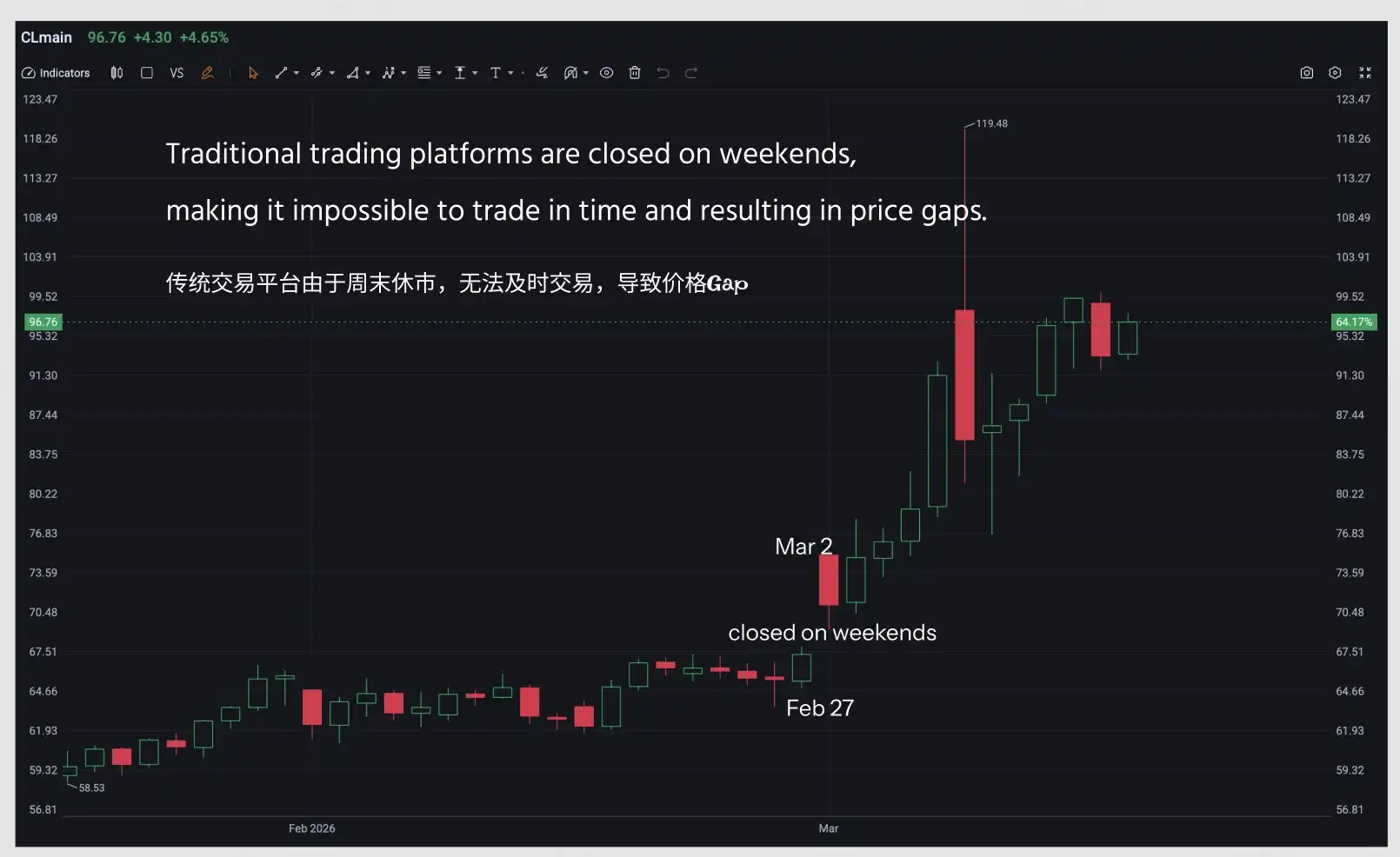
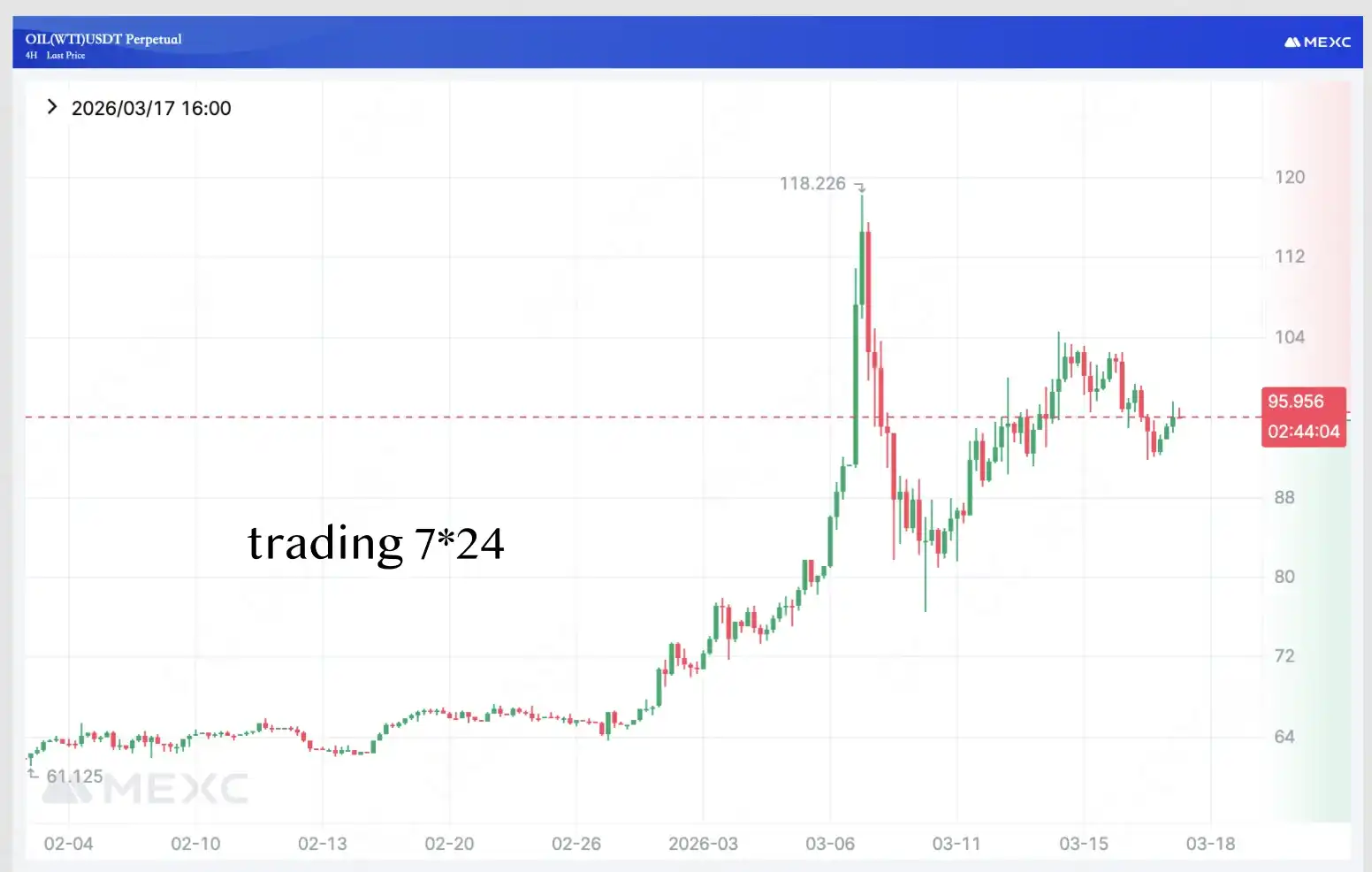
Last Saturday evening, about 20 hours before the opening of mainstream derivatives markets, the price of WTI crude oil perpetual futures on the MEXC platform surged to approximately $96 per barrel, higher than the regular crude oil futures closing price of $90.90 on Friday afternoon. In this market movement triggered by sudden conflict, crypto platforms were the first to complete the repricing of assets. Their seamless operating mechanisms made the fixed closing hours of traditional exchanges appear incredibly outdated.
The Wall Street Journal: Accelerating Integration of Traditional and Digital Finance

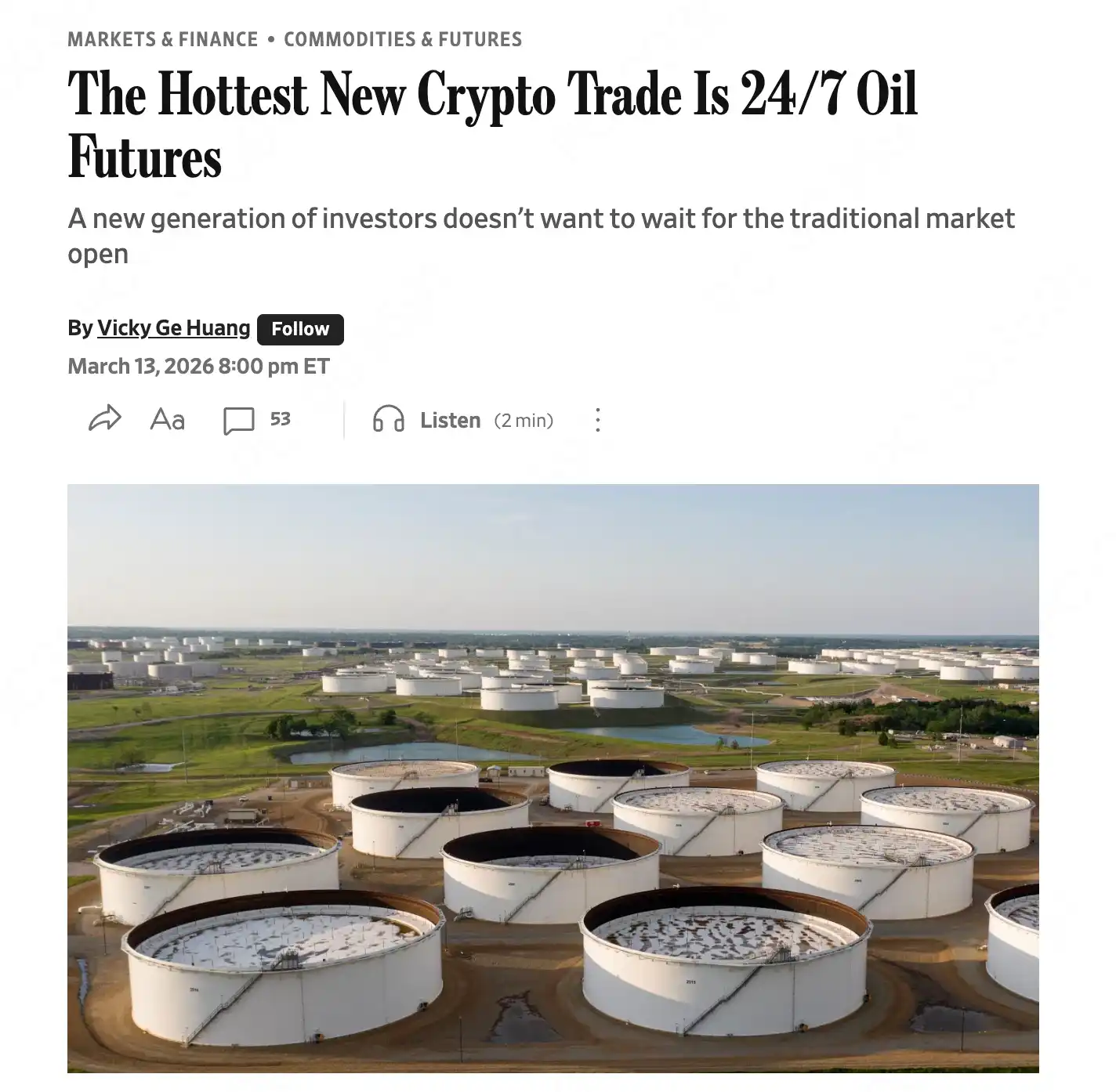
This disruptive market phenomenon quickly caught the attention of The Wall Street Journal. The report pointed out that a new generation of investors is no longer willing to wait for traditional markets to open. Crypto platforms now offer perpetual futures that track commodities, a highly speculative derivative.
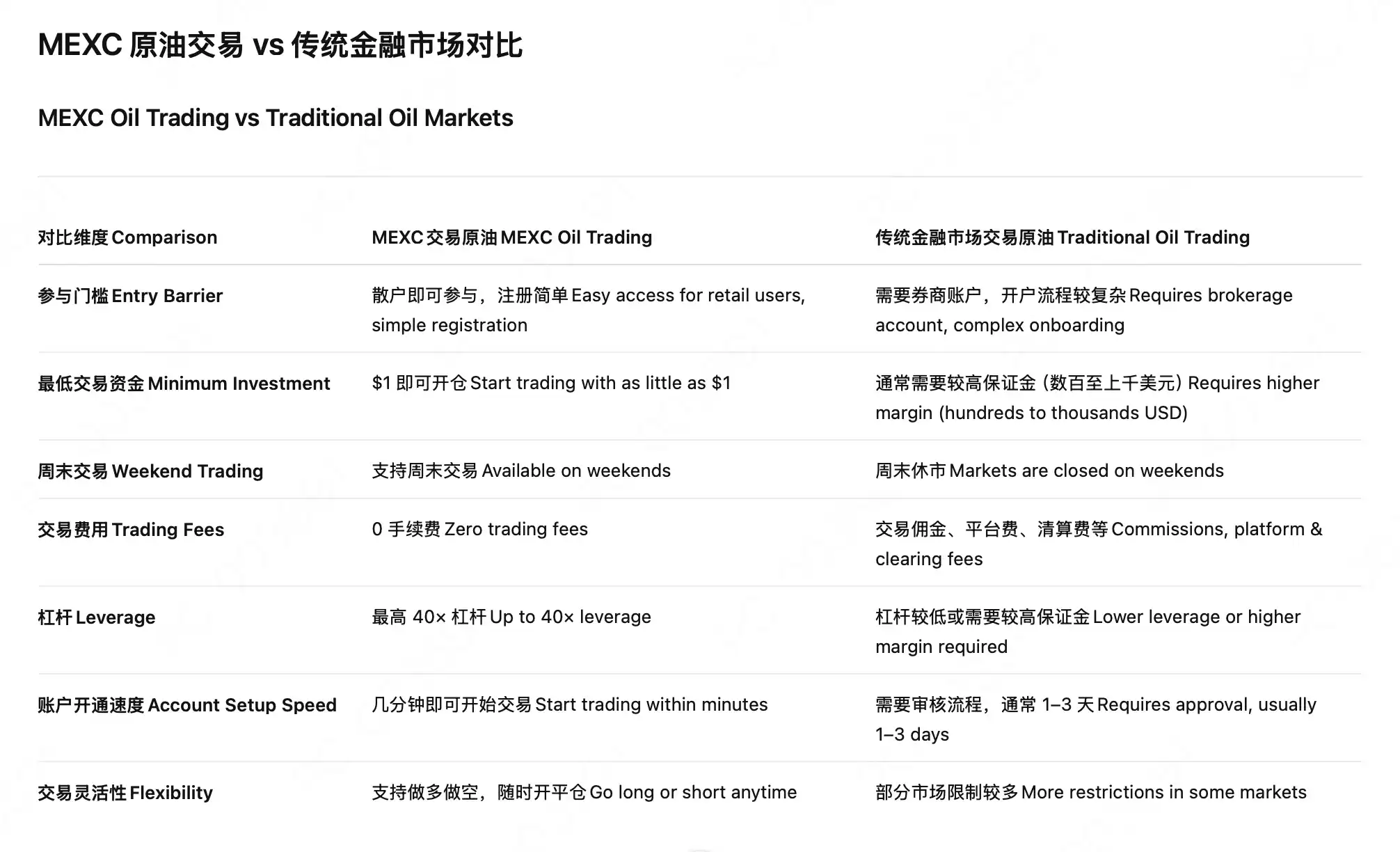
Perpetual contracts never expire and have no strike price (the point at which the contract becomes effective). They also allow traders to use extremely high leverage, which can amplify profits but also lead to the loss of the entire investment. As industry professionals have stated: "You don't need to wait until Monday for the market to open before everyone starts acting." This is changing the traditional model, enabling real participants to take action when weekend events occur.

Market data vividly reflects this vote of confidence with capital. In just a few days, the cumulative trading volume of oil futures surged from $339 million on February 28th to approximately $7.3 billion on Thursday.

Crossing Asset Boundaries: The 24/7 Wave from Crude Oil to U.S. Stocks

Time arbitrage in the oil market is just the beginning. Round-the-clock trading is already commonplace for cryptocurrency investors. For modern traders, the trading mechanisms provided by crypto platforms are demonstrating significant appeal for U.S. stocks and other commodities.

Wall Street is racing to utilize the digital ledger technology underpinning Bitcoin and other cryptocurrencies to tokenize stocks and other traditional assets. Similar to digital assets and prediction markets, so-called tokenized stocks are increasingly attracting the younger generation of investors who wish to trade 24/7 and react in real-time to geopolitical events and breaking company news. For example, investors can now trade contracts for popular U.S. stocks like AMD on crypto platforms at any time.
In addition to oil, crypto platforms have recently launched perpetual contracts for gold and silver, and the prices of these precious metals have also experienced abnormal volatility. Both metals saw their prices soar to historic highs, only to plummet subsequently.

As liquidity and trading habits migrate, an irreversible trend is emerging: Crypto platforms, with their advantages of seamless 24/7 trading, high capital efficiency, and disregard for geographical and time limitations, are continuously eating into the market share of traditional trading platforms. While traditional financial institutions remain constrained by rigid operating hours, the crypto ecosystem is gradually accommodating the trading needs of a massive volume of global assets, becoming the core hub for a new generation of pricing power.

A New Paradigm of Coexisting Opportunities and Challenges

Objectively speaking, this trading model combining high leverage and 24/7 operation is a double-edged sword. The author believes that cryptocurrency traders have short attention spans, so they desire quick returns and also crave volatility. On Sunday, the author observed that oil had reached unsustainable levels and began shorting—a judgment confirmed correct: On Monday, after President Trump stated that the war with Iran was "pretty much over," crude oil futures prices fell back below $100 per barrel.

This volatility can backfire once problems arise.

For many traders, the ability to trade these assets with leverage 24/7 is highly attractive, especially on weekends when traditional markets are closed. That said, trading highly volatile assets with leverage carries genuine market risks, and the author has also noted large-scale liquidations during sudden price swings.

Despite the challenges, the recent debut of oil futures contracts on multiple crypto platforms foreshadows a future of integration between traditional and digital finance—a time when all forms of assets can be traded at any time. In this historical process, crypto exchanges are at the forefront of this transformation. For traders eager to always maintain market initiative, a trading ecosystem that never sleeps is undoubtedly the most attractive battleground for the future.


Domande pertinenti

QWhat key advantage do cryptocurrency platforms offer over traditional financial markets for trading commodities like oil, according to the article?

ACryptocurrency platforms offer 24/7 trading, allowing investors to react to geopolitical events and market-moving news in real-time, even when traditional markets are closed, thus enabling faster asset repricing.

QWhat specific financial instrument on crypto platforms is highlighted as being used to speculate on oil prices during the recent Middle East conflict?

AOil perpetual futures contracts are the instrument used, which never expire, have no strike price, and allow for the use of high leverage.

QBesides oil, what other traditional assets are mentioned as being available for trading on crypto platforms?

AThe article mentions that crypto platforms also offer perpetual contracts for gold, silver, and tokenized stocks of companies like AMD.

QWhat is one of the major risks associated with the high-leverage, 24/7 trading model described in the article?

AA major risk is the potential for massive liquidations (forced closing of positions) during periods of sudden price volatility, which can lead to traders losing their entire investment.

QWhat broader trend does the article suggest is an irreversible shift in global finance?

AThe article suggests an irreversible trend of crypto platforms, with their 24/7 operation and high capital efficiency, reshaping global asset pricing power and eroding the market share of traditional trading platforms.

Letture associate

Within Strategy's Framework, STRC's Dividend Yield Remains at 12% as Share Price Stays Below Par Value

Michael Saylor, Executive Chairman of Strategy (MSTR), confirmed that the dividend rate for its STRC perpetual preferred shares will remain at 12.00% through August 2026. The rate has increased from 9% at its July 2025 launch to the current high via a "ratchet" mechanism, which permanently raises the rate by 0.5% whenever the share price falls below $95. This mechanism is intended to push the price back toward its $100 par value and support Strategy's "at-the-market" (ATM) program for issuing new shares to fund Bitcoin purchases. However, the mechanism has not worked as intended. STRC shares closed at $89.46 on July 31, remaining about 10-11% below par value despite the record-high dividend. Competition from rival Strive's higher-yielding SATA securities has pressured demand. The persistent discount has forced Strategy to suspend new STRC issuances via its ATM program, limiting this funding channel for Bitcoin acquisitions. STRC's struggles reflect Bitcoin's own volatility, as the preferred shares historically move in tandem. Analysts have warned the ratchet structure carries long-term, one-way risk. A law firm is investigating Strategy's ability to maintain dividend payments if Bitcoin's price stays low. Retail investors own roughly 83% of outstanding STRC shares, a group seen as prone to panic selling during downturns. In response, Strategy has established financial reserves, including a liquidity cushion covering about 26 months of dividend/interest obligations, and a $2 billion share buyback program alongside a Bitcoin monetization framework, though the company emphasized it is not obligated to sell any Bitcoin.

cryptonews.ru39 min fa

Within Strategy's Framework, STRC's Dividend Yield Remains at 12% as Share Price Stays Below Par Value

cryptonews.ru39 min fa

Analyst: Bitcoin's Price Will Drop to $60k in August, Then Rebound to $70k

Financial analyst Andrey Poroshin has provided a new forecast for Bitcoin's price dynamics in August. Poroshin, an analyst at the Bitbanker exchange, expects the cryptocurrency market to experience a downturn this month, with prices retesting the $60,000 level due to a lack of supportive macroeconomic catalysts. He noted that the recent US Federal Reserve decision to hold interest rates did not significantly impact the market, while inflation remains above the 2% target. Poroshin stated that Bitcoin is ending July under pressure from moderate volatility and a lack of new macroeconomic stimuli, leading to continued market caution. According to his base scenario, Bitcoin will drop to a range of $60,000 to $62,000 before recovering to $70,000. He pointed out that even $70,000 remains below the cost of mining in the US, which has prompted some miners to shift towards AI data center operations. Poroshin cited the winding down of BitMEX's operations as a potential catalyst for a price rebound, suggesting the exit of weaker players often coincides with market reversals and reduced short-term selling pressure. He believes Bitcoin is currently less susceptible to geopolitical shocks, such as the Iran-US conflict, and does not expect significant market changes in August related to the pending CLARITY Act. Looking ahead, Poroshin forecasts that September will bring more active price fluctuations driven by potential Fed rate decisions and possible discussions or approval of the CLARITY Act.

cryptonews.ru39 min fa

Analyst: Bitcoin's Price Will Drop to $60k in August, Then Rebound to $70k

cryptonews.ru39 min fa

Trading

Spot
活动图片




