From Pizza to Unit of Account: A Prehistory of Bitcoin Price Discovery

marsbitPubblicato 2026-05-19Pubblicato ultima volta 2026-05-19

Introduzione

From Pizza to Unit of Account: The Prehistory of Bitcoin Price Discovery This article traces Bitcoin's earliest price discovery mechanisms, focusing on its functional evolution as a unit of account rather than its price trajectory. The analysis centers on a nine-month period from October 2009 to July 2010, identifying three distinct, sequential layers of price formation. The narrative begins with the cost-of-production anchor established by NewLibertyStandard in October 2009, which calculated a unilateral USD/BTC exchange rate based on the electricity cost of mining. This constituted a posted rate, not a market-discovered price. The second layer emerged with peer-to-peer (P2P) discovery mechanisms starting in March 2010. This included Dustin Dollar's Bitcoin Market platform, which introduced a basic public order book, and forum-based实物 trades. The pivotal event in this phase was Laszlo Hanyecz's purchase of two pizzas for 10,000 BTC on May 22, 2010. Critically, the offer was made exclusively in BTC ("10,000 bitcoins for a couple of pizzas"), marking the first documented instance where Bitcoin functionally acted as a unit of account to price another good in a real transaction, 21 days before Hanyecz later provided a USD anchor (~$25). The third layer commenced in July 2010 with Jed McCaleb's launch of the Mt.Gox exchange. Its continuous order book, with last price, highs, lows, and volume, provided the first standardized, externally referenceable format for BTC/USD prices....

Prologue

On May 22, 2010, Laszlo Hanyecz exchanged 10,000 BTC for two pizzas. This day was later dubbed Bitcoin Pizza Day, commemorated annually by the crypto community in a specific way—multiplying the value of 10,000 BTC from that day by the current fiat price to produce a starkly contrasting figure, captioned "the most expensive pizza in history."

This article does not calculate that compound interest.

This article discusses something else: on May 22, 2010, Bitcoin (BTC) was, for the first time, used as a unit to price another commodity in a real transaction. This is the verifiable moment when BTC first functionally played the "unit of account" role among the three functions of money (medium of exchange / unit of account / store of value). This moment sits at the midpoint of a longer timeline of mechanisms—from cost-of-production anchoring (NewLibertyStandard), to P2P matching and discovery (Bitcoin Market), to centralized matching with continuous quotes (Mt.Gox). What Bitbase Research aims to reconstruct is this nine-month prehistory and its comparable forms with the evolutionary paths of price discovery mechanisms for various asset classes throughout history.

Chapter One · What is a "Price"—The Birth of a Unit of Account

1.1 The Three Functions of Money and the Conceptual Boundary of "Price"

The functions of money are standardly defined in financial economics textbooks. Frederic Mishkin, in Chapter 3 of the 13th edition of "The Economics of Money, Banking, and Financial Markets," divides monetary functions into three items [1]: medium of exchange, unit of account, store of value. John Hicks's judgment in the opening of "Critical Essays in Monetary Theory" (Oxford, 1967) is more concise—"money is what money does"; money is defined by its functions, not its physical form [2].

This distinction has specific methodological significance for this article. Something "having an exchange rate" is not the same as "having a price." An exchange rate can be unilaterally published—a third-party observer calculates the conversion ratio between two assets and then announces it; it does not require market participants to conclude transactions based on it, nor does it require others to reference this ratio to price their goods. Price is different. Price is the product of market matching; it requires at least two parties to agree on a conversion ratio for a specific transaction at a specific moment, and this ratio can be recognized, referenced, and reused by third parties.

By this distinction, before May 22, 2010, BTC was in a specific semantic state: it had an exchange rate, but it did not have a market price in the market sense.

1.2 The Functional Performance of "Unit of Account"

Among the three functions of money, medium of exchange and unit of account are often intuitively conflated, but they are not equivalent. The former describes "using this thing as an intermediary in a transaction"—as long as both parties are willing, anything can perform this function. The latter describes "using this thing as the unit for pricing other things." A commodity being used as a payment instrument in a transaction does not necessarily mean it simultaneously functions to price that commodity.

On May 18, 2010, Laszlo Hanyecz wrote in the initiating post of Bitcointalk topic=137: "I'll pay 10,000 bitcoins for a couple of pizzas," and explicitly allowed the other party to order Papa John's pizzas on his behalf [3]. No US Dollar (USD) amount appears in the entire initiating post—he did not say "pizzas worth how many dollars"; he said "10,000 bitcoins for two pizzas." When the completion of this transaction was reported at 19:17:26 UTC on May 22 [4], something happened at the functional level: two pizzas were priced in units of "10,000 BTC."

This is the verifiable moment when BTC was first functionally performed as a unit of account. "Functionally performing this role" and "fully satisfying this function in monetary definition" are two different things. The latter requires this unit to be consistently used as a pricing identifier across groups of traders, a condition only partially met after Mt.Gox's continuous quoting. May 22 is the first time this function appeared in an actual transaction.

Notably, the figure "about $25" does not appear in the initiating post of May 18. Hanyecz gave this fiat anchor for the first time in a subsequent reply in the same thread on June 12, 2010, at 20:14:44 UTC [5]. BTC first assumed the function of pricing pizzas in a transaction; the semantic act of "reverse identification between BTC and USD" occurred 21 days later. This temporal sequence has methodological significance: BTC's functional performance as a unit of account occurred before the bidirectional identification between BTC and USD was completed.

Chapter Two · Mechanism Timeline

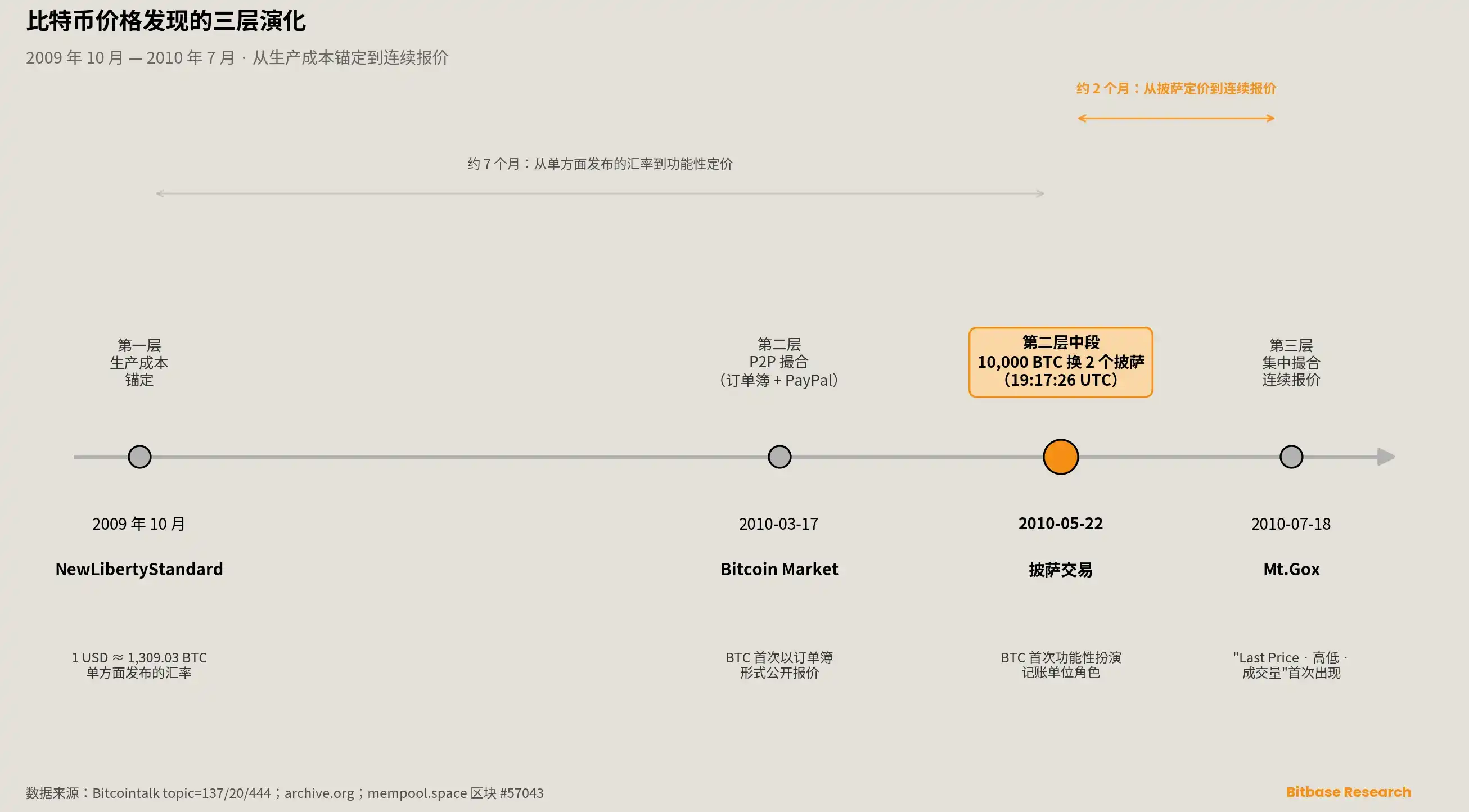
This chapter reconstructs the three-tier mechanism evolution from October 2009 to July 2010 in chronological order. Each section provides firsthand timestamps, firsthand post IDs, and a description of the mechanism itself.
2.1 Tier One · Cost-of-Production Anchoring (From October 2009)

NewLibertyStandard (hereafter NLS) published a BTC-to-USD exchange rate formula on its webpage newlibertystandard.wetpaint.com in October 2009. The website is now offline. As of May 14, 2026, the earliest recorded archive.org snapshot is from December 29, 2009, 13:26:10 UTC [6]. The formula on the snapshot reads:

During 2009 my exchange rate was calculated by dividing $1.00 by the average amount of electricity required to run a computer with high CPU for a year, 1,331.5 kWh, multiplied by the average residential cost of electricity in the United States for the previous year, $0.1136, divided by 12 months divided by the number of bitcoins generated by my computer over the past 30 days.

The methodology of this formula is to anchor BTC's value to the "marginal production cost of running a miner"—electricity cost divided by BTC output per unit time. It is essentially an extension of the classical labor-energy theory of value to digital assets: BTC had no market; it was priced by the electric meter. This is a "unilaterally published exchange rate," not a market-matched price.

The first exchange rate figure publicized by NLS, 1 USD ≈ 1,309.03 BTC, has been widely reused in secondary narratives, but there is no original post by NLS himself on the Bitcointalk forum citing this number [7]. This study adopts the archived snapshot data and honestly notes: as of May 14, 2026, this specific number is only available from the first-hand source of the archive snapshot.

Separate from NLS, the earliest recorded BTC-to-USD transaction was conducted by Martti Malmi, an early Bitcoin core contributor—on October 12, 2009, Malmi transferred 5,050 BTC to NLS, received $5.02 via PayPal, and confirmed it in a tweet on January 15, 2014 [8].

2.2 Tier Two · P2P Matching and Discovery (From March 2010)

The second tier mechanism was initiated by dwdollar (real identity Dustin Dollar). On January 15, 2010, at 09:42:18 UTC, dwdollar initiated a motion in Bitcointalk topic=20 msg=100 [9]: "I'm in the process of building an exchange. ... It will be a real market where people will be able to buy and sell Bitcoins with each other."

The platform Bitcoin Market began service on March 17, 2010. dwdollar's update post that day read: "Looks like we had our first real trade around noon!"—this was the first BTC-to-USD transaction matched via a quasi-public order book.

The matching mechanism of Bitcoin Market needs to be stated factually: it was not the complete form of order book matching. dwdollar self-described in msg=265 on February 6, 2010, at 22:37:44 UTC: "ONLY the limit orders work. Market orders will come later." [10]—the platform only supported limit orders, market orders were not implemented; settlement relied on PayPal intermediation, not pure on-chain settlement. Nevertheless, Bitcoin Market was the first platform to publicly display BTC quotes in an order book form; this form itself has mechanistic significance.

Parallel to Bitcoin Market during the same period was P2P physical matching on Bitcointalk. Hanyecz's pizza event is a representative case of this form. The two paths coexisted in parallel from March to July 2010—the dwdollar path proved BTC could be matched with USD to produce quotes, the Hanyecz path proved BTC could be matched with physical goods to produce quotes.

2.3 Midpoint · The Pizza Transaction (May 22, 2010)

Hanyecz's pizza transaction sits at the midpoint of the second tier in the mechanism timeline. Reconstructed in UTC chronological order:

  • 2010-05-18 00:35:20 UTC: Hanyecz issued the invitation in Bitcointalk topic=137 msg=1141 [3]. Hanyecz was located in Jacksonville, Florida, USA (EDT, UTC−4), corresponding to the local time of 2010-05-17 20:35. This timezone conversion explains why some secondary narratives date the initiation to May 17.

  • 2010-05-22 18:16:31 UTC: txid a1075db55d416d3ca199f55b6084e2115b9345e16c5cf302fc80e9d5fbf5d48d was included in block #57043 [11].

  • 2010-05-22 19:17:26 UTC: Hanyecz reported completion in msg=1195—"I just want to report that I successfully traded 10,000 bitcoins for pizza. Thanks jercos!" [4]

The 61-minute difference between the on-chain block time and the Bitcointalk confirmation post time is consistent with the narrative of "posting confirmation after pizza delivery." This time difference also independently confirms that the Bitcointalk forum displays timestamps in UTC, not Eastern Time.

The real identity and location of the counterparty jercos are often misstated in secondary narratives. jercos is Jeremy Sturdivant, who stated in a written interview with Bitcoin Who's Who on January 30, 2016: "I have yet to travel outside of the US, and am living on the west coast, near Santa Cruz, California." [12] According to Sturdivant's own account, he is an American, living near Santa Cruz, California, was 19 years old on May 22, 2010, and had never left the United States. The widely circulated description of a "19-year-old British person" is inconsistent with firsthand records.

Hanyecz withdrew the open invitation on June 4, 2010, at 17:51:05 UTC [13], stating "I can't afford that many more." Eight days later, on June 12, he reopened the invitation in msg=1526 and gave the USD anchor for the first time: two pizzas costing about $25, maybe $30 with a tip [5].

2.4 Tier Three · Centralized Matching with Continuous Quotes (From July 2010)

On July 18, 2010, at 01:57:19 UTC, username mtgox posted an announcement in Bitcointalk topic=444 msg=3866: "Hi Everyone, I just put up a new bitcoin exchange." [14] The operator behind this account was Jed McCaleb—founder of eDonkey, the original holder of the mtgox.com domain (an acronym for Magic: The Gathering Online eXchange). The Wayback Machine's earliest recorded capture of mtgox.com is August 17, 2007 [15], about 17 months before the BTC genesis block; this domain was repurposed as a BTC exchange in July 2010.

McCaleb described the platform's quoting architecture in msg=3873 (2010-07-18 02:15:09 UTC) of the same thread [14]: "Last Price ... High ... Low ... Volume ... Current Lowest Buy Price; Current Highest Sell Price ... All trades are between users."—"Last Price," "24-hour high/low," "volume," "best bid/ask"; this set of terms appeared for the first time in the Bitcoin context, marking that BTC now had a standard format for continuous quoting. The mechanistic difference was structural: matching between users rather than intermediary settlement, automatic continuous operation of the order book, 24/7 availability.

From this moment, BTC gained external referentiality in the unit of account dimension—others could say "my thing is worth X BTC," and X BTC had an uninterrupted USD identifier. Mt.Gox was announced to be transferred by McCaleb to MagicalTux (later Mark Karpelès) on March 6, 2011 [16]; its subsequent fate is another independent timeline not expanded here.

Chapter Three · Structural Similarity—The Same Curve Across Three Hundred Years

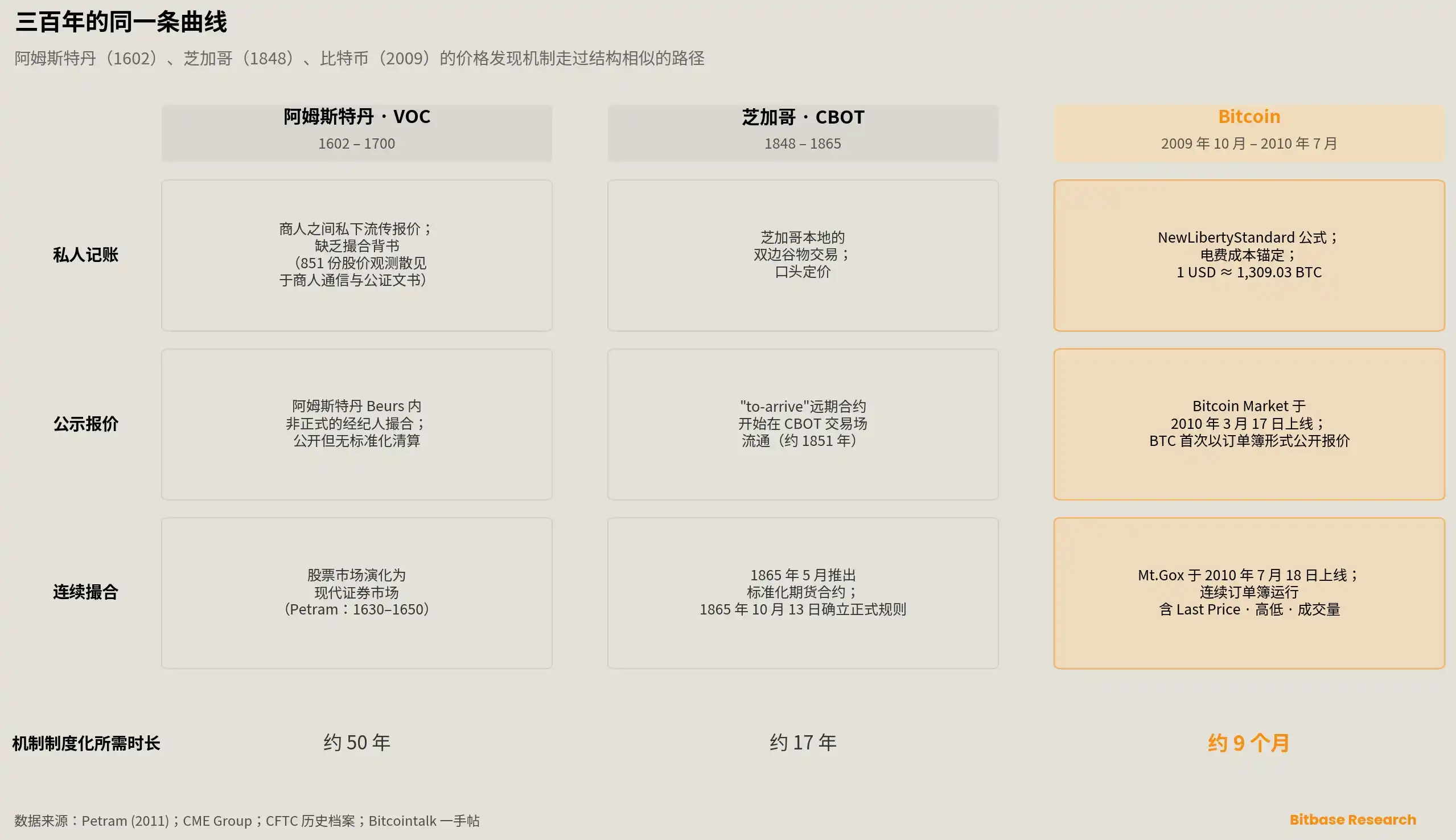
The proposition of this chapter is: The three-tier mechanism evolution completed by BTC between October 2009 and July 2010—cost-of-production anchoring → P2P matching and discovery → centralized matching with continuous quotes—has comparable structural forms with the evolutionary paths of various asset classes throughout history. This chapter presents two cases for structural comparison and does not construct a quantifiable cross-asset comparison model.

3.1 Amsterdam · The 17th-Century VOC Secondary Market

The Dutch East India Company (VOC) was established in 1602, issuing shares to 1,143 subscribers; share transfers required in-person registration by the company bookkeeper at the East India House [17]. This is generally regarded as the earliest identifiable scenario of an equity secondary market [17].

The maturation of its price discovery mechanism occurred about half a century later. Lodewijk Petram, in his 2011 PhD dissertation "The world's first stock exchange" at the University of Amsterdam, states: the stock market "evolved into a modern securities market" between 1630 and 1650, and "a continuous price discovery process took shape in that period" [17]. Petram's judgment is based on 851 sets of 17th-century stock price observation data. These data were not from official exchange records—neither the VOC nor the exchange systematically recorded prices; data were scattered in merchant correspondence, notarial deeds, and occasional newspapers. The very "dataset" of 17th-century VOC share prices grew from private bookkeeping and oral exchange rates.

The structural similarity with BTC's early path is specific. The NLS formula is to BTC what privately circulated VOC quotes among 17th-century merchants were: unilaterally published, private bookkeeping, lacking matching endorsement. Bitcoin Market is to BTC what informal broker matching within the Amsterdam Beurs was: public but lacking standardized clearing. Mt.Gox is to BTC the starting point of continuous quoting institutionalization—not the end point.

3.2 Chicago · 19th-Century CBOT Standardized Futures Contracts

The second comparison comes from 19th-century American grain trading. The Chicago Board of Trade (CBOT) was founded in 1848, initially as a spot market for commodities [18]. Around 1851, "to-arrive" forward contracts began circulating at CBOT—traders promised to deliver grain at a future date at a specified price [18].

The key institutionalization date for the price discovery mechanism is 1865. CME Group historical archives and the official history of the U.S. Commodity Futures Trading Commission (CFTC) both record [18][19]: CBOT introduced standardized futures contracts in May 1865 and established formal trading rules on October 13, 1865. There is academic controversy over this—one view holds that mature futures trading did not appear until around 1874 [18]. This study adopts 1865 as the starting point and acknowledges this periodization dispute.

The structural similarity between the CBOT path and the BTC path lies in this: the evolution from dispersed bilateral forward contracts to standardized, tradable futures contracts with margin and delivery rules follows the same curve of price discovery mechanism institutionalization. Chicago took 17 years, Bitcoin took 9 months. The difference in time scale does not dissolve the structural similarity. Price discovery in all markets does not start from an exchange; it grows from specific bilateral transactions, oral exchange rates, and private bookkeeping.
3.3 The Explanatory Power and Boundaries of Structural Similarity

Placing BTC's early path within the three-hundred-year sequence of Amsterdam–Chicago–Bitcoin yields a judgment at the mechanism level, not a quantitative model. Three assets, three institutional environments, three technological conditions, yet the price discovery mechanisms all follow the same coarse-grained path: private bookkeeping → publicized quotes → continuous matching. In other words, crypto derivatives infrastructure was not invented out of thin air; it lies on a financial institution evolution line spanning centuries.

This structural similarity argument is not a causal argument. It does not claim "BTC inevitably followed the same path as VOC and grain futures," nor does it claim "all future digital assets will follow the same curve." It claims that: when an observer faces a new asset class, the "prehistory of price discovery mechanisms" is a more enduring subject of study than "asset price trends."

Chapter Four · Acknowledging Limitations and Leaving Gaps

This piece does not expand on contemporary price discovery mechanism comparisons. ETF fund flows, CME open interest, Perpetual Futures funding rates, on-chain market-making—these are the current forms of this 16-year path, but the space and methodology required to expand on them are left for subsequent research.

There are three reverse signals for this article's core argument. First, if academic or on-chain archaeology research reveals an earlier effective entity publishing exchange rates before NewLibertyStandard, the positioning of the "first externally publicized exchange rate" needs revision. Second, if the timestamps of the three core Bitcointalk threads—topic=20, topic=137, topic=444—are proven false at the archival layer, the event anchors need resetting. Third, if the "semantic transition of unit of account" framework is replaced by a more precise monetary function evolution theory, the core argument requires revision.

This article acknowledges the following boundaries. First, "BTC's first functional performance as a unit of account" is an interpretive proposition, not the full establishment of the function in monetary definition. Second, labeling Bitcoin Market as "P2P matching and discovery" is a simplification. Third, the structural similarity argument with Amsterdam and Chicago serves only as a mechanism-level comparison and does not construct a quantifiable cross-asset comparison model. This article does not predict BTC price movements and makes no statements regarding BTC's investment attributes as a single asset.


Domande pertinenti

QWhat was the key significance of the Bitcoin Pizza Day transaction on May 22, 2010, according to the article?

AThe transaction marked the first documented instance where Bitcoin (BTC) functionally acted as a unit of account, pricing the two pizzas at 10,000 BTC, distinct from its use merely as a medium of exchange.

QDescribe the three-layer evolution of Bitcoin's price discovery mechanism in its first nine months as outlined in the article.

AThe evolution comprised: 1) Cost-of-production anchoring (NewLibertyStandard, October 2009), 2) P2P matching discovery (Bitcoin Market platform and Bitcointalk bartering, starting March 2010), and 3) Centralized continuous matching and quoting (Mt.Gox, starting July 2010).

QHow does the article distinguish between 'having an exchange rate' and 'having a price' in the context of early Bitcoin?

A'Having an exchange rate' refers to a unilaterally published conversion ratio that doesn't require market consensus or real transactions. 'Having a price' refers to a ratio resulting from market matching where at least two parties agree on a specific transaction, making the ratio identifiable and reusable by third parties.

QWhat structural similarity does the article draw between Bitcoin's early price discovery and the 17th-century Amsterdam VOC stock market?

ABoth followed a similar path: starting with private valuations or unilaterally published rates (NLS formula/merchant quotes), moving to informal public matching (Bitcoin Market/Beurs brokerages), and eventually evolving towards a formalized system of continuous, standardized quoting (Mt.Gox/VOC's mature price discovery process in the 1630s-1650s).

QAccording to the article, what are the potential signals that would require a revision of its core arguments?

AThe core arguments would need revision if: 1) An entity earlier than NewLibertyStandard publishing a valid exchange rate is discovered. 2) The timestamps in the core Bitcointalk threads (topics 20, 137, 444) are proven false. 3. A more precise theoretical framework for the evolution of monetary functions replaces the 'semantic leap as a unit of account' framework.

Letture associate

Anthropic Major Release: "The Founder's Playbook" - All 4 Stages of Entrepreneurship, Completely Reimagined with AI

**Anthropic Releases "The Founder's Playbook," Reimagining the Four Stages of Startups with AI** The logic of entrepreneurship is being fundamentally reshaped by AI. Anthropic's new handbook, "The Founder's Playbook: Building an AI-Native Startup," defines the AI-native startup as a new species: not a traditional company with AI tools, but a venture driven by AI from day one. The founder's role is transforming from a hands-on builder to a conductor or architect, orchestrating AI agents for execution while focusing on high-level judgment and strategy. Anthropic outlines a product matrix of Claude tools for different tasks: Claude Chat for interactive research, Claude Code for generating production-ready code, and Claude Cowork for automating knowledge-intensive workflows. The handbook structures the startup lifecycle into four stages, detailing core goals, pitfalls, and AI applications for each: 1. **Idea Stage**: Focuses on validating a real problem. The core challenge is avoiding confirmation bias. AI practices include using Claude as a "structured devil's advocate" to challenge assumptions and for automated market/competitor research. 2. **MVP Stage**: Aims to gather early signals of Product-Market Fit (PMF). Key risks are technical debt and scope creep due to rapid AI-assisted development. Recommended AI uses include maintaining project memory documents (e.g., CLAUDE.md), using Claude Code for structured coding, and automating user feedback analysis. 3. **Launch Stage**: Centers on establishing scalable growth, operations, and compliance. Challenges include accelerating technical debt and founders becoming bottlenecks. AI should be used to build an "operating system" for launch—automating routine tasks (scheduling, reporting, content) and code audits—freeing founders for critical decisions. 4. **Scale Stage**: Focuses on achieving sustainable business operations. The main challenge is delegating operational control. AI should be leveraged for differentiated marketing, operational optimization, and building competitive moats through data network effects. The handbook concludes that in the AI era, "Can we build it?" is no longer the primary constraint. The advantage shifts back to foundational strengths: **insight, judgment, and a deep understanding of a specific problem and audience.**

marsbit7 h fa

Anthropic Major Release: "The Founder's Playbook" - All 4 Stages of Entrepreneurship, Completely Reimagined with AI

marsbit7 h fa

Trading

Spot
Futures

Articoli Popolari

Cosa è BITCOIN

Comprendere HarryPotterObamaSonic10Inu (ERC-20) e la sua posizione nel mondo delle criptovalute Negli ultimi anni, il mercato delle criptovalute ha assistito a un aumento della popolarità delle meme coin, catturando l'interesse non solo dei trader, ma anche di coloro che cercano coinvolgimento comunitario e valore di intrattenimento. Tra questi token unici c'è HarryPotterObamaSonic10Inu (ERC-20), un progetto intrigante che mescola riferimenti culturali nel tessuto delle criptovalute. Questo articolo esplora gli aspetti chiave di HarryPotterObamaSonic10Inu, analizzando i suoi meccanismi, l'etica guidata dalla comunità e il suo coinvolgimento con il panorama crittografico più ampio. Che cos'è HarryPotterObamaSonic10Inu (ERC-20)? Come suggerisce il suo nome, HarryPotterObamaSonic10Inu è una meme coin costruita sulla blockchain di Ethereum, classificata secondo lo standard ERC-20. A differenza delle criptovalute tradizionali che possono enfatizzare l'utilità pratica o il potenziale investimento, questo token prospera grazie al valore di intrattenimento e alla forza della sua comunità. Il progetto mira a creare un ambiente in cui gli utenti coinvolti possono riunirsi, condividere idee e partecipare ad attività ispirate a diversi fenomeni culturali. Una caratteristica notevole di HarryPotterObamaSonic10Inu è la zero tassa sulle transazioni. Questo elemento allettante tende a incoraggiare il trading e il coinvolgimento della comunità, privo di costi aggiuntivi che possono scoraggiare i trader di piccole dimensioni. L'offerta totale della moneta è fissata a un miliardo di token, un numero che segna la sua intenzione di mantenere una circolazione sostanziale all'interno della comunità. Creatore di HarryPotterObamaSonic10Inu (ERC-20) Le origini di HarryPotterObamaSonic10Inu sono avvolte in un certo mistero; i dettagli sul creatore rimangono sconosciuti. Lo sviluppo di questo token non presenta un team identificabile o un piano esplicito, cosa non rara nel settore delle meme coin. Invece, il progetto è emerso organicamente, con il suo progresso fortemente dipendente dall'entusiasmo e dalla partecipazione della sua comunità. Investitori di HarryPotterObamaSonic10Inu (ERC-20) Per quanto riguarda investimenti esterni e finanziamenti, HarryPotterObamaSonic10Inu rimane ambiguo. Il token non elenca alcuna fondazione di investimento conosciuta o un sostegno organizzativo significativo. Invece, la linfa vitale del progetto è la sua comunità di base, che informa la sua crescita e sostenibilità attraverso azioni collettive e coinvolgimento nello spazio crittografico. Come funziona HarryPotterObamaSonic10Inu (ERC-20)? In quanto meme coin, HarryPotterObamaSonic10Inu opera principalmente al di fuori delle strutture tradizionali che governano spesso il valore degli asset. Ci sono diversi aspetti distintivi che definiscono il funzionamento del progetto: Transazioni senza tasse: Senza costi fiscali sulle transazioni, gli utenti possono comprare e vendere liberamente il token senza preoccuparsi di costi nascosti. Coinvolgimento della comunità: Il progetto prospera sull'interazione della comunità, sfruttando le piattaforme social per creare entusiasmo e facilitare il coinvolgimento. Discussioni, condivisione di contenuti e coinvolgimento sono elementi cruciali che aiutano ad espandere la sua portata e a favorire la lealtà tra i sostenitori. Nessuna utilità pratica: Va notato che HarryPotterObamaSonic10Inu non offre un'utilità concreta all'interno dell'ecosistema finanziario. Piuttosto, è classificato come un token principalmente per attività di intrattenimento e comunitarie. Riferimento culturale: Il token incorpora astutamente elementi della cultura pop per attirare interesse, collegandosi a appassionati di meme e seguaci delle criptovalute. HarryPotterObamaSonic10Inu esemplifica come le meme coin operino in modo diverso rispetto ai progetti di criptovalute più tradizionali, entrando nel mercato come costrutti sociali innovativi piuttosto che come asset utilitari. Cronologia di HarryPotterObamaSonic10Inu (ERC-20) La storia di HarryPotterObamaSonic10Inu è segnata da diversi traguardi notevoli: Creazione: Il token è emerso da un meme virale, catturando l'immaginazione di molti appassionati di criptovalute. Le date di creazione specifiche non sono disponibili, sottolineando la sua crescita organica. Inserimento negli scambi: HarryPotterObamaSonic10Inu ha fatto il suo ingresso in vari scambi, consentendo un accesso e un trading più facili da parte della comunità. Iniziative di coinvolgimento della comunità: Attività in corso volte a migliorare l'interazione della comunità, comprese gare, campagne sui social media e generazione di contenuti da parte di fan e sostenitori. Piani di espansione futura: La tabella di marcia del progetto include il lancio di una collezione NFT, merchandising e un sito di eCommerce relativo ai suoi temi culturali, coinvolgendo ulteriormente la comunità e cercando di aggiungere più dimensioni al suo ecosistema. Punti chiave su HarryPotterObamaSonic10Inu (ERC-20) Natura guidata dalla comunità: Il progetto dà priorità al contributo collettivo e alla creatività, garantendo che il coinvolgimento degli utenti sia al centro del suo sviluppo. Classificazione come meme coin: Rappresenta l'epitome delle criptovalute basate sull'intrattenimento, distinguendosi dai veicoli d'investimento tradizionali. Nessuna affiliazione diretta con Bitcoin: Nonostante la somiglianza nel nome del ticker, HarryPotterObamaSonic10Inu è distintivo e non ha alcuna relazione con Bitcoin o altre criptovalute consolidate. Focus sulla collaborazione: HarryPotterObamaSonic10Inu è progettato per creare uno spazio per la collaborazione e la condivisione di storie tra i suoi detentori, fornendo un canale per la creatività e il legame comunitario. Prospettive future: L'ambizione di espandersi oltre il suo presupposto iniziale verso NFT e merchandising delinea un percorso per il progetto per potenzialmente entrare in strade più mainstream all'interno della cultura digitale. Poiché le meme coin continuano a catturare l'immaginazione della comunità crittografica, HarryPotterObamaSonic10Inu (ERC-20) si distingue per i suoi legami culturali e il suo approccio centrato sulla comunità. Anche se potrebbe non adattarsi al modello tipico di un token orientato all'utilità, la sua essenza risiede nella gioia e nella camaraderia coltivate tra i suoi sostenitori, evidenziando la natura in evoluzione delle criptovalute in un'epoca sempre più digitale. Con la continuazione dello sviluppo del progetto, sarà importante osservare come le dinamiche della comunità influenzano la sua traiettoria nel panorama in continuo cambiamento della tecnologia blockchain.

1.5k Totale visualizzazioniPubblicato il 2024.04.01Aggiornato il 2024.12.03

Cosa è BITCOIN

Come comprare BTC

Benvenuto in HTX.com! Abbiamo reso l'acquisto di Bitcoin (BTC) semplice e conveniente. Segui la nostra guida passo passo per intraprendere il tuo viaggio nel mondo delle criptovalute.Step 1: Crea il tuo Account HTXUsa la tua email o numero di telefono per registrarti il tuo account gratuito su HTX. Vivi un'esperienza facile e sblocca tutte le funzionalità,Crea il mio accountStep 2: Vai in Acquista crypto e seleziona il tuo metodo di pagamentoCarta di credito/debito: utilizza la tua Visa o Mastercard per acquistare immediatamente BitcoinBTC.Bilancio: Usa i fondi dal bilancio del tuo account HTX per fare trading senza problemi.Terze parti: abbiamo aggiunto metodi di pagamento molto utilizzati come Google Pay e Apple Pay per maggiore comodità.P2P: Fai trading direttamente con altri utenti HTX.Over-the-Counter (OTC): Offriamo servizi su misura e tassi di cambio competitivi per i trader.Step 3: Conserva Bitcoin (BTC)Dopo aver acquistato Bitcoin (BTC), conserva nel tuo account HTX. In alternativa, puoi inviare tramite trasferimento blockchain o scambiare per altre criptovalute.Step 4: Scambia Bitcoin (BTC)Scambia facilmente Bitcoin (BTC) nel mercato spot di HTX. Accedi al tuo account, seleziona la tua coppia di trading, esegui le tue operazioni e monitora in tempo reale. Offriamo un'esperienza user-friendly sia per chi ha appena iniziato che per i trader più esperti.

3.8k Totale visualizzazioniPubblicato il 2024.12.12Aggiornato il 2025.03.21

Come comprare BTC

Cosa è $BITCOIN

ORO DIGITALE ($BITCOIN): Un'Analisi Completa Introduzione all'ORO DIGITALE ($BITCOIN) L'ORO DIGITALE ($BITCOIN) è un progetto basato su blockchain che opera sulla rete Solana, con l'obiettivo di combinare le caratteristiche dei metalli preziosi tradizionali con l'innovazione delle tecnologie decentralizzate. Sebbene condivida un nome con Bitcoin, spesso definito “oro digitale” a causa della sua percezione come riserva di valore, l'ORO DIGITALE è un token separato progettato per creare un ecosistema unico all'interno del panorama Web3. Il suo obiettivo è posizionarsi come un asset digitale alternativo valido, anche se i dettagli riguardanti le sue applicazioni e funzionalità sono ancora in fase di sviluppo. Cos'è l'ORO DIGITALE ($BITCOIN)? L'ORO DIGITALE ($BITCOIN) è un token di criptovaluta esplicitamente progettato per l'uso sulla blockchain di Solana. A differenza di Bitcoin, che fornisce un ruolo di stoccaggio di valore ampiamente riconosciuto, questo token sembra concentrarsi su applicazioni e caratteristiche più ampie. Aspetti notevoli includono: Infrastruttura Blockchain: Il token è costruito sulla blockchain di Solana, nota per la sua capacità di gestire transazioni ad alta velocità e a basso costo. Dinamiche di Offerta: L'ORO DIGITALE ha un'offerta massima fissata a 100 quadrilioni di token (100P $BITCOIN), sebbene i dettagli riguardanti la sua offerta circolante siano attualmente non divulgati. Utilità: Sebbene le funzionalità precise non siano esplicitamente delineate, ci sono indicazioni che il token potrebbe essere utilizzato per varie applicazioni, potenzialmente coinvolgendo applicazioni decentralizzate (dApp) o strategie di tokenizzazione degli asset. Chi è il Creatore dell'ORO DIGITALE ($BITCOIN)? Attualmente, l'identità dei creatori e del team di sviluppo dietro l'ORO DIGITALE ($BITCOIN) rimane sconosciuta. Questa situazione è tipica tra molti progetti innovativi nel settore blockchain, in particolare quelli allineati con la finanza decentralizzata e i fenomeni delle meme coin. Sebbene tale anonimato possa favorire una cultura guidata dalla comunità, intensifica le preoccupazioni riguardo alla governance e alla responsabilità. Chi sono gli Investitori dell'ORO DIGITALE ($BITCOIN)? Le informazioni disponibili indicano che l'ORO DIGITALE ($BITCOIN) non ha alcun sostenitore istituzionale noto o investimenti di venture capital prominenti. Il progetto sembra operare su un modello peer-to-peer incentrato sul supporto e sull'adozione della comunità piuttosto che su percorsi di finanziamento tradizionali. La sua attività e liquidità si trovano principalmente su exchange decentralizzati (DEX), come PumpSwap, piuttosto che su piattaforme di trading centralizzate consolidate, evidenziando ulteriormente il suo approccio di base. Come Funziona l'ORO DIGITALE ($BITCOIN) Le meccaniche operative dell'ORO DIGITALE ($BITCOIN) possono essere elaborate in base al suo design blockchain e alle caratteristiche della rete: Meccanismo di Consenso: Sfruttando il proof-of-history (PoH) unico di Solana combinato con un modello di proof-of-stake (PoS), il progetto garantisce una validazione efficiente delle transazioni contribuendo all'alta performance della rete. Tokenomics: Sebbene meccanismi deflazionistici specifici non siano stati dettagliati ampiamente, l'ampia offerta massima di token implica che potrebbe soddisfare microtransazioni o casi d'uso di nicchia che devono ancora essere definiti. Interoperabilità: Esiste il potenziale per l'integrazione con l'ecosistema più ampio di Solana, inclusi vari piattaforme di finanza decentralizzata (DeFi). Tuttavia, i dettagli riguardanti integrazioni specifiche rimangono non specificati. Cronologia degli Eventi Chiave Ecco una cronologia che evidenzia traguardi significativi riguardanti l'ORO DIGITALE ($BITCOIN): 2023: Il dispiegamento iniziale del token avviene sulla blockchain di Solana, contrassegnato dal suo indirizzo di contratto. 2024: L'ORO DIGITALE guadagna visibilità poiché diventa disponibile per il trading su exchange decentralizzati come PumpSwap, consentendo agli utenti di scambiarlo contro SOL. 2025: Il progetto assiste a un'attività di trading sporadica e a un potenziale interesse per impegni guidati dalla comunità, sebbene non siano state documentate partnership significative o avanzamenti tecnici fino ad ora. Analisi Critica Punti di Forza Scalabilità: L'infrastruttura sottostante di Solana supporta alti volumi di transazioni, il che potrebbe migliorare l'utilità di $BITCOIN in vari scenari di transazione. Accessibilità: Il potenziale basso prezzo di trading per token potrebbe attrarre investitori al dettaglio, facilitando una partecipazione più ampia grazie a opportunità di proprietà frazionata. Rischi Mancanza di Trasparenza: L'assenza di sostenitori, sviluppatori o di un processo di audit pubblicamente noti potrebbe generare scetticismo riguardo alla sostenibilità e all'affidabilità del progetto. Volatilità del Mercato: L'attività di trading è fortemente dipendente dal comportamento speculativo, il che può comportare una significativa volatilità dei prezzi e incertezze per gli investitori. Conclusione L'ORO DIGITALE ($BITCOIN) emerge come un progetto intrigante ma ambiguo all'interno dell'evolvente ecosistema di Solana. Sebbene tenti di sfruttare la narrativa dell'“oro digitale”, la sua partenza dal ruolo consolidato di Bitcoin come riserva di valore sottolinea la necessità di una chiara differenziazione della sua utilità e struttura di governance. L'accettazione e l'adozione future dipenderanno probabilmente dall'affrontare l'attuale opacità e dalla definizione più esplicita delle sue strategie operative ed economiche. Nota: Questo rapporto comprende informazioni sintetizzate disponibili a ottobre 2023, e potrebbero essersi verificati sviluppi oltre il periodo di ricerca.

99 Totale visualizzazioniPubblicato il 2025.05.13Aggiornato il 2025.05.13

Cosa è $BITCOIN

Discussioni

Benvenuto nella Community HTX. Qui puoi rimanere informato sugli ultimi sviluppi della piattaforma e accedere ad approfondimenti esperti sul mercato. Le opinioni degli utenti sul prezzo di BTC BTC sono presentate come di seguito.

活动图片